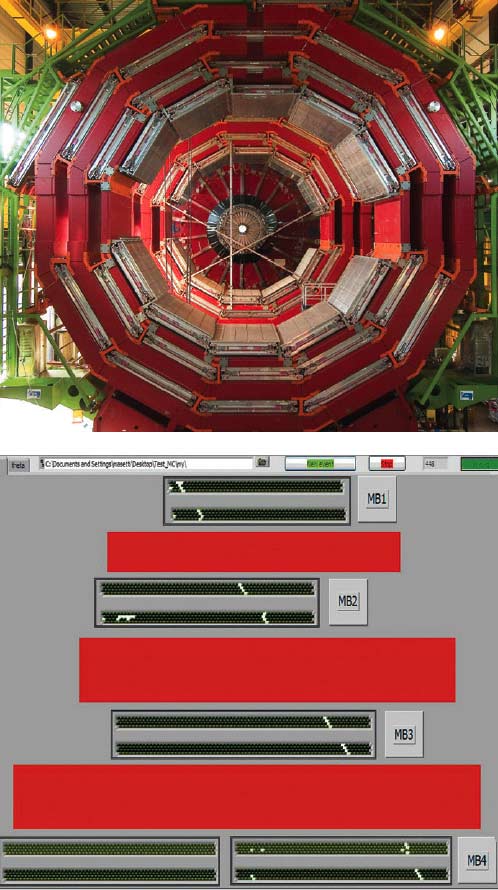
The CMS collaboration has for the first time operated a whole sector of drift-tube chambers (DTCs) and detected cosmic muons. This is the first stage in commissioning the CMS Muon Barrel detector prior to installation below ground later in 2006.
Since the summer of 2004, the team building the DTCs – from Aachen, Bologna, Madrid (CIEMAT), Padova and Torino – has been engaged in the delicate and complex operation of installing the chambers in the CMS experiment’s iron yoke. The chambers have 12 layers of drift tubes, arranged in three groups of four, two measuring the R-φ coordinate and one measuring the z-coordinate. Each layer has up to 60 tubes. Unlike conventional drift-tube systems, consecutive layers are staggered by half a tube-width, enabling the DTCs to generate trigger signals for CMS, using a “mean timer” method.
Chambers constructed in the collaborating institutes are first assembled on the main site at CERN together with their on-chamber cables, pipes and mini-crates. These “dressed” chambers require very few external components to become operational, and so undergo thorough pre-installation tests before being transported to the CMS site at Cessy. There they are inserted into the CMS iron yoke in the surface building. The chambers are then ready for final commissioning tests, which include long data-taking runs that exploit the chamber’s self-triggering capability with cosmic muons. By February two of the five wheels in the CMS barrel yoke had been instrumented, and 82 DTCs commissioned.
This first sector test marked the beginning of a long series of tests that will culminate this spring with the CMS Cosmic Challenge. At this point the five barrel wheels and the two endcaps will be pushed together in the surface building and the superconducting solenoid operated for the first time. Segments of all sub-detectors will be present and cosmic muons will be detected and measured. The lowering of the CMS sections into the underground cavern is due to begin in the summer.
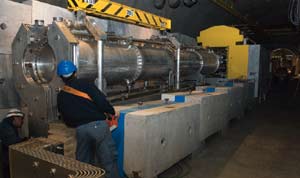
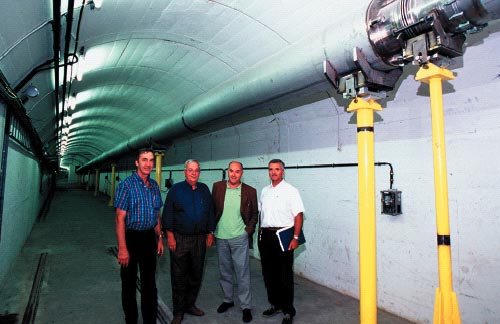
The magnetic system that focuses the beam of particles arising from the graphite target of the CERN Neutrinos to Gran Sasso project (CNGS) has been installed in its final position in the tunnel. This represents the final milestone of the project prior to testing all systems in preparation for the first commissioning with beam, at the end of May.
The CNGS secondary beam magnetic system consists of two elements: the horn and the reflector, both acting as focusing lenses for the positively-charged pions and kaons produced by proton interactions in the target. Most of these pions and kaons will decay in a 1 km-long vacuum pipe. At the end of this, a barrier, comprising 3 m of graphite and 15 m of iron, will absorb the remaining hadrons, leaving behind a beam of muons and neutrinos. Muons are quickly absorbed downstream in the rock, leaving only muon-neutrinos to traverse the Earth’s crust towards the Gran Sasso laboratory 732 km away in Italy.
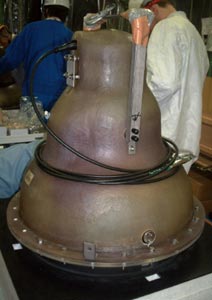
Both the horn and the reflector came originally from LAL/IN2P3 before major modification at CERN. They are 7 m long and weigh more than a tonne each. They work with high pulsed currents, 150 kA for the horn and 180 kA for the reflector. These currents flow for a few milliseconds at the instant when the proton-beam pulse hits the target.
The heat that the current produces and the energy deposited by stray particles require a complex water cooling system. To avoid modifications in the mechanical properties of the aluminium alloy that makes up the whole system, the temperature must not exceed 80 °C. Cooling power is extracted from the chilled-water network by means of a heat exchanger. Demineralized water is sprayed onto the inner conductor, then collected at the bottom of the horn and the reflector, and finally pumped back to the system in a closed circuit.
The neutrino beam will be remotely monitored from the newly built central control room at CERN’s Prévessin site. The completion of the CNGS project, that is the hand- over to the teams in charge of regular operation of the beam, is planned for mid July.
The Institute of High Energy Physics (IHEP) in Beijing is looking forward to a new era as construction of the upgraded Beijing Electron-Positron Collider (BEPC) moves into its final stage.
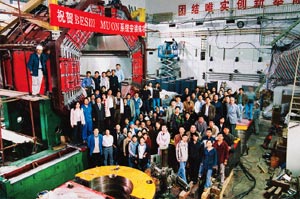
The BEPC II linac is now in place and installation of the storage ring has started. At the same time, the muon identifier and the superconducting magnet have been installed in the third incarnation of the Beijing Spectrometer (BES III). This was therefore an important time for the BES III collaboration meeting held in January, during which new members from GSI and the universities of Giessen and Bochum were accepted, and a new organizational structure of the collaboration was formally adopted.
BEPC II is a two-ring e+e– collider running in the tau-charm energy region (Ecm = 2.0-4.2 GeV), which, with a design luminosity of 1 × 1033 cm-2s-1 at the beam energy of 1.89 GeV, is an improvement of a factor of 100 over its successful predecessor, BEPC. The upgrade will use the existing tunnel, some major infrastructure items, and some of the old magnets. The 202 m long linac of the new machine can accelerate electrons and positrons up to 1.89 GeV with a positron injection rate of 50 mA/min. Its installation was completed in the summer of 2005 and it has reached most of the design specifications.
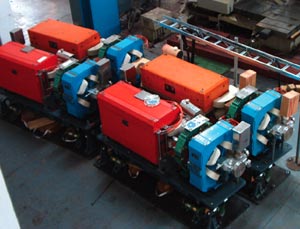
The collider consists of two 237.5 m long storage rings, one for electrons and one for positrons. They collide at the interaction point with a horizontal crossing angle of 11 mrad and a bunch spacing of 8 ns. Each ring holds 93 bunches with a beam current of 910 mA. The machine will also provide a high flux of synchrotron radiation at a beam energy of 2.5 GeV. The manufacture of major equipment such as magnets, superconducting RF cavities (with the co-operation of the Japanese high-energy physics laboratory, KEK, and the company MELCO) and quadrupole magnets (with the co-operation of the Brookhaven National Laboratory), as well as the cryogenics system, have been completed, and their installation is under way. The pre-alignment of magnets has made good progress. Figure 2 shows the mock-up of the installation of four pre-alignment units in the tunnel. Actual installation in the tunnel will begin soon and beam collisions are expected in the spring of 2007.
The BES III detector consists of a helium-based, small-celled drift chamber, time-of-flight (TOF) counters for particle identification, a calorimeter of thallium-doped caesium iodide CsI(Tl) crystals, a super-conducting solenoidal magnet with a field of 1 T, and a muon identifier that uses the magnet yoke interleaved with resistive plate counters (RPCs). Figure 3 shows a perspective view of the detector.
The wiring of the drift chamber has been completed, and the assembly of the chamber has started. Beam tests of prototypes have been performed at KEK and IHEP with electronics prototypes, and both tests show that all design specifications have been satisfied and that the single wire resolution is 110 μm. CsI(Tl) crystals are being produced by Saint-Gobain Crystals, by the Shanghai Institute of Ceramics, and by Hamamatsu (Beijing). More than two-thirds of the crystals have been delivered, with satisfactory light yield, uniformity and radiation hardness. A beam test shows that the electronics noise from the preamplifier, main amplifier, charge digitizer and 18 m of cable was less than 1000 electrons equivalent per crystal, corresponding to about 220 keV of energy.
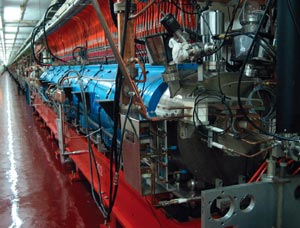
The scintillator and phototubes for the TOF system will be delivered before summer. All the RPCs for the muon identifier, made of bakelite but without the linseed oil surface treatment, have been manufactured, tested, and installed (figure 4). The average dark current and noise level for all chambers installed after one week’s training is 1.6 μA/m2 and 0.095 Hz/cm2, respectively, for a high voltage corresponding to an average efficiency of 95%.
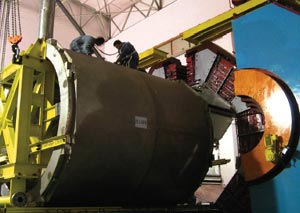
The BES III superconducting magnet is the first of its kind built in China. The vacuum cylinder and the supporting cylinder are made in China, in collaboration with the Wang NMR company of California. The wiring of the superconducting cable and the epoxy curing, the assembly and testing were all done at IHEP, with advice from experts all over the world. The superconducting magnet coil has now been successfully installed into the detector (figure 5) and will be cooled soon.
The latest BES III collaboration meeting was held on 10-12 January at IHEP. More than a hundred collaborators attended the meeting, coming from 21 institutions in 5 countries, namely China, Germany, Japan, Russia and the US. The meeting reviewed the current status of the BES III construction and discussed technical details. The collaboration accepted new groups as members, including teams from GSI, the University of Bochum and the University of Giessen, all from Germany. This meeting was also historic as the governance rules of the collaboration were approved and used for the first time. Under these rules, the Institutional Board was established and Hongfang Chen from the University of Science and Technology of China was elected as the chair, with Weiguo Li from IHEP chosen as deputy chair. Yifang Wang from IHEP was elected as spokesperson, and Yuanning Gao from Tshinghua University and Frederick Harris from the University of Hawaii were elected as co-spokespersons. The next collaboration meeting is scheduled to be held at IHEP on 8-9 June, immediately after the Charm 2006 workshop on 5-7 June, also at IHEP.
The International Conference on Accelerator and Large Experimental Physics Control Systems (ICALEPCS) is the prime conference in the field of controls for experimental-physics facilities, namely particle accelerators and detectors, optical and radio telescopes, thermo-nuclear fusion installations, lasers, nuclear reactors, gravitational antennas, and so on. The initiative to create this series of biennial conferences was taken at the end of 1985. An initial group of six laboratories – CERN, the Grand Accelerateur National d’Ions Lourds, the Hahn-Meitner Institut, Kern Forschung Anlage, Los Alamos National Laboratory and the Paul Scherrer Institut – were called upon to create an interdivisional group on Experimental Physics Control Systems within the European Physical Society (EPS) with the purpose, among others, of supporting these conferences. As a next step, CERN offered to organize the first ICALEPCS in 1987, in Villars-sur-Ollon.
The ICALEPCS circulate around the globe with meetings in Europe, America and Asia, co-organized by the EPS-EPCS, under the auspices of the Institute of Electrical and Electronics Engineers through its Nuclear and Plasma Science Society, the Association of Asia Pacific Physics Societies, the American Physical Society, the International Federation of Automatic Control, and the International Federation for Information Processing through its Technical Committee on Computer Applications in Technology.
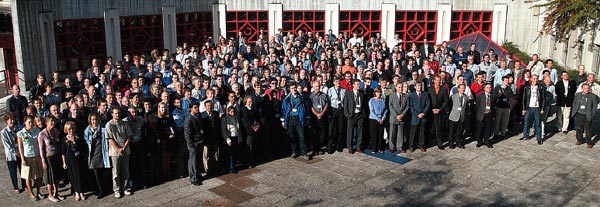
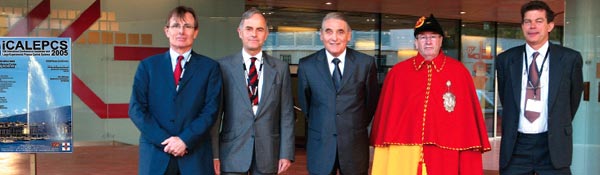
ICALEPCS 2005, the 10th meeting in the series, fell auspiciously during the World Year of Physics, being held from 10-15 October 2005 at the Geneva International Conference Centre (CICG). It was hosted by CERN together with the Centre de Recherches en Physique des Plasmas (CRPP) of the École Polytechnique Fédérale de Lausanne (EPFL), and chaired jointly by CERN’s Bertrand Frammery and Jonathan Lister from CRPP-EPFL. Attendance reached 442, with delegates from 160 laboratories, universities and industries in 27 countries in Europe, America, Asia, and Oceania-Australia.
In the opening session, Axel Daneels of CERN, who is chairman of the International Scientific Advisory Committee and who has steered the ICALEPCS since their inception, introduced ICALEPCS 2005, and invited Carlo Lamprecht, Minister of Economy and Councillor of the State of Geneva to express his welcome and his support to the conference. Co-chair Lister welcomed the participants in his turn and was followed by Jos Engelen, CERN’s chief scientific officer, who presented the challenges raised by the CERN’s Large Hadron Collider (LHC) project – both the accelerator and the detectors.
Down to business
The first main sessions consisted of status reports on several major new and planned experimental-physics facilities around the world, with an emphasis on controls. Particle accelerators were represented by the LHC, the Japan Proton Accelerator Research Complex and CERN’s Low Energy Ion Ring. Synchrotron light sources covered the ELETTRA laboratory in Trieste, the SOLEIL synchrotron at Saint Aubin and the ALBA synchrotron near Barcelona. The fusion community described the controls of the National Ignition Facility (NIF) at Lawrence Livermore National Laboratory, the Angara-5 facility at the Troitsk Institute for Innovation and Fusion Research and the data challenges of the international project ITER. The presentations on telescopes discussed the controls of the Atacama Large Millimetre Array radio telescope in the Andes and the proposed Low Frequency Array in the Netherlands. CERN presented control systems for the CMS and ALICE detectors for the LHC. There were also presentations on the 8 GeV X-ray free-electron laser at the Japanese synchrotron radiation facility, SPring-8, and on VIRGO, the 3 km French-Italian gravitational-wave detection facility.
Special sessions
The session on process tuning, automation and synchronization heard how automation systems are crucial for reliable, coherent, safe and flexible operation of complex facilities such as NIF, VIRGO and the LHC detectors. The operation of tokamaks, such as the Joint European Torus in the UK and the Korea Superconducting Tokomak Advanced Research project, relies on real-time measurements and accurate synchronization systems. Low-level RF control systems were presented for the superconducting RF quadrupoles for the new positive-ion injector, Piave, at the INFN Laboratori Nazionali di Legnaro and for the LINAC-3 cavities at CERN. Synchrotron light sources, such as the Indus-2 storage ring at the Centre for Advanced Technology in Indore and Bessy II in Berlin, rely on orbit control and active feedback loops to position their optical components.
The session on security and other major challenges considered interlock systems combined with alarm-handling systems that monitor facilities operating in harsh environments in terms of radiation, temperature and so on. Security of computing networks for controls is an issue of concern for example at SPring-8 and CERN. The design of control systems for security and dependability was discussed in the context of the Dependable Distributed Systems (DeDiSys) research project supported by the European Union. Dependability covers availability, reliability, maintainability, safety and security.
Experimental-physics facilities are becoming more sophisticated and hence more demanding in matters of controls. However, control systems with many appropriate features are huge projects in themselves, which conflict with the reduction in resources that prevails in the research community. Laboratories are thus being driven into collaboration on the joint development of systems based on commercial hardware and software components – the topic of the session on development approaches. Collaboration frameworks are being developed to assure a streamlined and standard approach when integrating commercial components into a coherent system and to ease debugging, testing, deployment and maintenance. Collaborative projects include the Joint Controls Project for the LHC detector controls; the TANGO project for synchrotron radiation facilities, developed jointly by ALBA, ELETTRA, SOLEIL and the European Synchrotron Radiation Facility (ESRF) in Grenoble; and the ALMA Common Software project for distributed control.
The session on the evolution of hardware technology looked at how control-system architectures are evolving towards a higher granularity, thanks to the availability of small-size boards with an Ethernet port. This approach reduces the cost and improves the overall reliability. More specifically, while standard peripheral component interconnect (PCI) is still being supported for less demanding applications, PCI Express is becoming the only standard for connecting devices with high bandwidth requirements. In the domain of networking, 1 Gbit/s Ethernet is a consolidated standard, but a bandwidth up to 100 Gbit/s can already be found in projects such as ALMA. Networks with a low bandwidth are used as field buses. Programmable logic devices are the building blocks of digital controllers and are replacing complex boards based on digital-signal processors. Their importance is growing as they allow the integration of standard functions with custom application logic.
Middleware frameworks such as NIF’s large-scale CORBA framework were one of the topics of the session on the evolution of software technology. These have matured, and attention is shifting from mere deployment towards easier development. Application developers can be now shielded from particular middleware products and testing and integration of components can be facilitated through software simulation. Access to remote distributed resources is increasingly based on Web and Grid technologies. HyperDAQ, an application to provide access to distributed DAQ systems, employs web and peer-to-peer technology. The Virtual Instrument Grid Service, a part of the GRIDCC project, will use Grid computing to control distributed instrumentation.
The session on operational issues considered machine operations, which are tightly coupled to data management, alarm handling and remote collaboration. Operational information is managed through relational databases, as for example the configuration database for the LHCb experiment, while the commercial Geographical Information Systems are being applied to accelerator configuration management. Intelligence is added to alarm-handlers to reduce the incidence of unimportant alarms. Common frameworks, such as CERN’s Directory Services, tend to be introduced to integrate diverse systems operationally.
Experimental-physics facilities involve large investments and evolve during their lifetime – the subject of the session on dealing with evolution. Control systems must thus cope with this evolution while protecting the investment, so their architectures must be modular, data-driven and based on commercial products and standards. Examples are the JAPC Code (Java API for Parameter Control) developed to ease the programming of the LHC application software. Evolution often also implies proliferation of computers. Facing this phenomenon and to limit hardware failure and maintenance, SPring-8 has applied virtualization technology by which many computers are accommodated into a reduced number of virtual machines, each with independent resources (CPU, discs etc) as if they were stand-alone. Three virtualization approaches were discussed at the meeting: emulation of hardware or specific guest operating systems; multiplexing of physical resources by software; and application shielding to isolate applications from each other. By contrast, medical accelerators are designed for minimal upgrades and limited improvement during a lifetime, for safety and regulatory reasons.
Additional activities
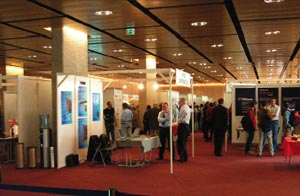
The scientific programme was complemented by a three-day exhibition involving 17 companies and 10 technical seminars in which companies presented their views on the evolution of their technology as well as their strategy, and which were particularly well attended. In the week preceding ICALEPCS 2005, 150 controls specialists had also attended four workshops: Experimental Physics and Industrial Control System (organized by Matthias Clausen of DESY), ALMA Common Software (organized by Gianluca Chiozzi of ESO), TANGO (organized by Andy Götz of ESRF) and a Joint ECLIPSE Workshop (organized by Clausen and Götz). These workshops were held in France at Archamps, the Haute-Savoie’s business park near Geneva, and fully supported by the Conseil Général de la Haute-Savoie. In addition, Markus Völter from Völter-Ingenieurbüro für Softwaretechnologie, Germany, gave a tutorial on Model-driven Development of Distributed Systems at the CICG.
The conference also included a social programme featuring a welcome reception sponsored by Hewlett-Packard; wine-tasting parties, sponsored by the Canton wine producers; an organ and brass concert in the St Pierre Cathedral in Geneva’s old town, sponsored by the Republic and Canton of Geneva; a cruise with a banquet on lake Geneva; and at the closing session, an ICALEPCS tenth anniversary cake. Technical visits, attended by more than 120 participants, were organized to two of CERN’s LHC experiments (CMS and LHCb), and to the CRPP-EPFL Tokomak.
ITER should be bold and as restrictive as possible on standards and equipment.
The registration fee for the 26 participants from industrially emerging nations was waived and 17 of them received an additional grant through one of the following organizations: the EPS, namely the East West Fund and the Young Physicists Fund; the Abdus Salam International Centre for Theoretical Physics; the programme for Scientific Co-operation between Eastern Europe and Switzerland 2005-2008 of the Swiss National Science Foundation and the Swiss Agency for Development and Co-operation; and the International Association for the Promotion of Co-operation with Scientists from the New Independent States of the Former Soviet Union.
At the ends of the special sessions about 80 people took part in a round-table discussion on the in-kind procurement of large systems for collaborative experiments. The future ITER project was taken as an example, although the proposed International Linear Collider will have similar considerations to make. The discussion aroused much interest but generated little conflict. The general agreement was that ITER should be bold and as restrictive as possible on standards and equipment, even though there was no evidence suggesting this has been possible in the past.
ICALEPCS 2005 closed with an invited talk on the test system for the Airbus 380 and with an invitation to ICALEPCS 2007 in Knoxville, to be jointly hosted by Oak Ridge National Laboratory and Jefferson Lab.
• ICALEPCS 2005 was sponsored by the Swiss Federal Government, through the CICG, the Republic and State of Geneva, the Département de la Haute Savoie in France and its Archamps site, as well as by several industrial companies: Agilent Technologies, Hewlett-Packard and Siemens. DELL, an ICALEPCS 2005 partner, supplied the entire informatics infrastructure. SWISS, the Swiss airline and the ICLEPCS 2005 official carrier, offered a free return flight to an Indian delegate.
CERN’s director-general, Robert Aymar praised the immense progress made towards the Large Hadron Collider (LHC) project when he addressed the 135th session of the CERN Council on 16 December 2005. “In one year, we have made great progress,” he said. “The challenge is not over, of course, but we have great confidence of maintaining the schedule for start-up in 2007.”
The LHC is the leading project for the world’s particle-physics community. Experiments performed there will investigate perplexing questions including why fundamental particles have the masses they have, and focus on understanding the missing mass and dark energy of the universe; visible matter seems to make up just 5% of what must exist. Physicists will also explore the reason for nature’s inclination for matter over antimatter, and probe matter as it existed immediately after the Big Bang.
Aymar’s congratulations come after a challenging year with delays imposed by repairing defects in the LHC’s cryogenic-fluid distribution system. These delays are now largely recovered. The cryogenic system is now well advanced and installation of the LHC’s magnets is progressing rapidly. Almost 1000 of the 1232 dipole magnets have been delivered to CERN and more than 200 magnets are already installed in the LHC’s underground tunnel. An average of 20 magnets a week are currently being installed, but this needs to increase to 25 a week in 2006 to reach the 2007 start-up deadline. A review of this schedule is planned for Spring 2006.
Aymar also informed delegates that CERN’s new visitor and networking centre, the Globe of Science and Innovation, opened its doors to the public in September 2005. The Globe is scheduled to host a permanent exhibition about scientific works at CERN, coinciding with the LHC start-up in 2007.
Operation of the Super-Kamiokande (SK) II detector in Japan was terminated last October after three years of running to begin a full restoration of the detector. Precise studies on neutrinos will resume next June.
The SK detector consists of a cylindrical tank containing 50,000 tonnes of pure water viewed by about 11,000 photomultipliers (PMTs) of 50 cm diameter. The water tank is 40 m in height and 40 m in diameter, and located 1000 m underground. Neutrinos interact with the water and give rise to Cherenkov light, which provides information about the neutrino energy, direction and type or flavour. In 1998, the collaboration announced that neutrinos change flavour – oscillate – which is possible only if the particles have mass. The evidence came from observing neutrinos created by cosmic-ray interactions in the atmosphere. This was followed in 2001 by evidence for the oscillations of solar neutrinos in the combined data from SK and the Sudbury Neutrino Observatory. More recently, the KEK-to-Kamioka (K2K) experiment, using a man-made neutrino beam from KEK to the SK detector has confirmed the oscillations observed in the atmospheric neutrinos.
Several thousands of PMTs in the detector were destroyed in November 2001, when the shock wave from the implosion of one PMT at the bottom of the tank triggered a chain reaction of implosions in more than half the PMTs (see CERN Courier January/February 2002 p6). In 2002, the detector was partially reconstructed using about 5000 PMTs encased in plastic covers to avoid a similar accident. This partial reconstruction was done quickly in only a year in order to continue the K2K experiment. After three years of operation as SK-II, with half the original density of PMTs, the long awaited full reconstruction of the detector has now begun. Next June, the detector’s third phase, SK-III, will start to take data again.
The discovery of neutrino oscillations has opened up a new window of research with a variety of subjects for SK to tackle. An experiment using an intense neutrino beam from Tokai – Tokai-to-Kamioka (T2K) – is expected to start in 2009. The beam will be produced by a 50 GeV proton synchrotron being constructed at the Japan Proton Accelerator Research Complex in Tokai (see CERN Courier November 2004 p41). SK-III will be the far detector at a distance of 295 km from the beam-production point. The T2K experiment will determine neutrino oscillation parameters precisely and search for effects of the neutrino mixing angle, θ13, which is so far unobserved.
A longer exposure to atmospheric neutrinos will be important in searching for a resonant matter effect in the Earth and may help to resolve the octant ambiguity in the mixing angle θ23. At the lower energies of solar neutrinos, an up-turn in the spectrum is expected as direct evidence for large-mixing-angle solutions and will provide precise oscillation parameters. The higher statistics from several years of exposure should allow this measurement.
SK could also detect several thousand neutrino interactions from a galactic supernova. Such a large number of events would reveal details of the supernova explosion mechanism, as well as information on the properties of neutrinos. The positive identification of electron-antineutrinos in SK could also be possible in future. Neutrons emitted in antineutrino interactions could be detected through the 2.2 MeV gamma-rays emitted by neutron capture on protons and through interactions with gadolinium dissolved in the pure water.
Lastly, the detection of nucleon decay as predicted by grand unified theories has always been one of the primary topics for SK. Sensitivity to the decay mode p →e+ + p0 will soon reach the level corresponding to a lifetime of 1034 years. Decay modes favoured by supersymmetry, which include K mesons in the final state, will become interesting with a longer exposure in SK-III, and the collaboration hopes to observe the first indication of nucleon decay in the near future.
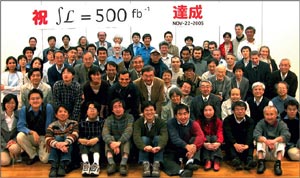
By mid-afternoon on 22 November, the Belle experiment at KEK had accumulated an integrated luminosity of 500 fb-1 of electron-positron collision data. This integrated luminosity marks a landmark in the progress of the KEKB accelerator and the Belle experiment, which began operation in 1999. It is equivalent to achieving 5 × 1041 crossings of electrons and positrons a square centimetre. More than 500 million pairs of B and Bbar mesons have been generated in the collisions.
The original challenge for KEKB was to achieve 100 fb-1 in 3 years. The total of 500 fb-1 in 6.5 years surpasses this goal. The group now aims to achieve even higher records with various upgrades to the machine.
Representatives from European research and industry have established the European Industry Forum for Accelerators with Superconducting RF Technology, EIFast. More than 30 companies and institutes from nine countries sent a total of 64 participants to a meeting to found the forum at DESY on 27 October. They agreed on the forum’s statutes and elected the members of the coordination board.
The proposal to create the forum resulted from the considerable industrial interest triggered by several large accelerator projects based on superconducting RF (SCRF) technology, in particular the approved X-ray free-electron laser, XFEL, and the planned International Linear Collider. Both projects use SCRF technology, which has been substantially advanced during the past decade by the TESLA Technology Collaboration. In addition, the TESLA test facility at DESY, built with involvement from European companies, has added to the solid base of expertise in SCRF accelerators in European industry.
Against this background, it was concluded that a forum would further strengthen the excellent position of European science and industry in SCRF technology. Moreover, similar bodies have been established in both the US and Japan.
Members of European research centres and industrial companies decided to found EIFast at a meeting at DESY in April 2005. Its scope includes all systems and components needed for an SCRF accelerator, including supplies and services. Acting as a common voice for European research and industry, the forum will now try to promote the realization of SCRF projects in a coherent way.
The forum aims to bring research institutes either working in the field of SCRF technology or interested in becoming involved together with industrial companies interested in supplying products to projects based on the technology. The main tasks of the forum include generating support for projects at the political level in Europe, ensuring a flow of up-to-date information about projects between institutes and companies, promoting involvement of industry in projects at an early stage, and supporting the members in gaining access to information channels and decision makers otherwise difficult to obtain.
In its 2005 run, DESY’s HERA collider achieved the largest integrated luminosity it has ever produced in one year. Colliding 27.5 GeV electrons with 920 GeV protons, HERA delivered a total of 213 pb-1 to the experiments H1 and ZEUS in 318 days of running. Compared with the positron-proton luminosity production of 2004, the integrated luminosity and the average luminosity were increased by factors of 2.2 and 1.5, respectively. The peak luminosity reached 5.1 ×1031 cm-2s-1 – the design luminosity for the upgraded HERA collider.
This success is particularly remarkable since, compared with running with positrons, additional complications were expected for electron-proton collisions, due to increased synchrotron radiation in the interaction regions and degradations in the lifetime of the electron beam. The synchrotron radiation problems were successfully avoided by improved beam control. Problems with the electron-beam lifetime proved rare and were not relevant for production of luminosity. Nevertheless the electron-beam current reached only 90% of the positron currents in 2004.
The proton intensity improved slightly in 2005 due to improved beam transfer from the injector, while the specific luminosity (luminosity/current) increased considerably beyond the design value owing to the additional focusing of the electron beam by the beam-beam force. The large beam-beam forces made longitudinal electron-spin polarization more difficult: the average peak polarization decreased from 50% in 2004 to 45% in 2005. All in all, however, the operating efficiency improved noticeably compared with the previous running.
Operation at HERA is scheduled to resume at the end of January 2006. Various improvements that have been added during the shutdown – such as refurbished normal conducting magnet coils, enhanced RF interlocks, active damper and feedback systems – will further improve the availability, peak luminosity and background conditions for the run during 2006.
The energies attained at CERN and other particle physics laboratories are useful not only for probing nature’s deepest layers, they also enable the study of matter in the relatively low range up to a few million electron-volts. This range is typical of supernovae and X-ray bursters, and is also relevant for most nuclear-structure phenomena. Experimentalists at CERN have exploited these lower energies for many years, and the present status of their achievements and the prospects for further studies were the subject of the recent Nuclear Physics and Astrophysics at CERN (NuPAC) meeting held on 10-12 October 2005.
These activities are concentrated at CERN around the Isotope Separator On-Line (ISOLDE) and Neutrino Time-of-Flight (n_TOF) facilities. Both come under the ISOLDE and Neutron Time-of-Flight Experiments Committee (INTC), which has been asked by the CERN management to review the scientific case for the two facilities. NuPAC is one step in this review process.
In many ways, nuclear-structure physics is experiencing a renaissance. Some of the “basic truths” about nuclear structure, believed to be universal only 20 years ago, are now known to be approximations that hold for stable and close-to-stable nuclei, but that cannot be used further away from stability. For example, we are used to thinking in terms of nuclear shells based on unassailable “magic” numbers. However, it is possible to move far enough away from the stable nuclei for the balance between the number of neutrons and protons in a nucleus to be so disturbed that the magic numbers can and do change. Reaching the regions where this happens and performing detailed studies of how and why the changes occur are important tasks for nuclear physicists. So far “erosions” of the magic numbers N = 8, 20 and 28 are known, and it seems that they are at least partly replaced by N = 6 and 16, although our present understanding is not complete.
Another change when we move far away from stable nuclei is that continuum states need to be taken into account much more directly because binding energies become low (turning to zero at the neutron and proton driplines, where nuclei are so saturated with an excess of neutrons or protons that they “drip” the relevant nucleon). Experiments can now cross the proton dripline for many elements; and even the neutron dripline, which is further away from stability than the proton one, has been reached and partially crossed for the light elements up to about neon. The structure and dynamics of loosely bound nuclei show new phenomena, such as the spatially extended halo and the “pygmy” resonances at low-excitation energies. This is a challenging area for both experimentalists and theoreticians.
Two of the sessions at NuPAC were dedicated to the evolution of nuclear structure towards and at the driplines. Several theoretical talks outlined how far recent developments have taken us in descriptions of nuclear structure and reaction theory for loosely bound systems, of the evolution of shell structure and nuclear shape as the proton and neutron numbers change, and of the very complex problem the fission process presents. The experimental talks gave examples of the widely different techniques that are used today and planned for the near future.
Measuring the nucleus
Using the low-energy ISOLDE beams, properties such as mass, radius and magnetic moment can be measured relatively directly and in a model-independent way for “long-lived” states (that is, with half-lives longer than a few milliseconds). Decay experiments also make use of these beams and provide information about many aspects of nuclear structure. For the past four years it has also been possible to perform reaction experiments through post-acceleration in the Radioactive Beam EXperiment (REX-ISOLDE) accelerator. Most of these experiments have used the Miniball gamma-ray detector array.
Speakers at the meeting stressed the importance of the planned energy upgrade of REX-ISOLDE to at least 5.5 MeV per nucleon. This will enable reaction experiments to be performed with all of the 800 and more nuclei that ISOLDE can now produce. Participants also strongly supported the continuation of the beam development programme that is ISOLDE’s hallmark. On the “wish list” are beams of even more kinds of nuclei, as well as improved quality (intensity, isotopic purity, phase space extent) for existing beams.
A reliable knowledge of nuclear structure is one of the basic requirements for properly understanding how energy is produced in stars, and thereby how stars evolve. The session dedicated to these questions presented various aspects of the problems as seen by astronomers, theoreticians and nuclear experimentalists. Half of the heavy elements produced are made in what is known as the s-process, the slow neutron capture that takes place in massive stars in later stages of their evolution. Experimental data are still needed as input for a complete understanding, in particular of the weak s-process component (nuclei below mass number 90). One of the main lines of the future n_TOF physics programme is to measure these neutron-capture processes with sufficient resolution. Explosive astrophysical events – such as supernovae, novae and X-ray bursters – quickly drive nuclei far from the region of stability, and data collected at ISOLDE can benefit in several ways the theoretical modelling of these events.
Further uses
Experiments in nuclear physics dominated the early stages of the investigation into weak interactions. Particle physics has taken the place of nuclear physics for many decades, but nuclei still provide important information through precision experiments that restrict the low-energy limit of the phenomena seen more directly at higher energy. A short session at NuPAC gave two examples of this: on the one hand nuclear measurements are needed to improve further the unitarity test of the Cabibbo-Kobayashi-Maskawa quark-mixing matrix; and on the other hand precision measurements of beta-decays in ion and/or atom traps are sensitive to new interactions. These experiments typically run for up to a decade to obtain the required low level of systematic uncertainties.
A session was devoted to presentations of applications of nuclear physics. Basic data on neutron-capture cross-sections on many nuclei are indispensable to enable further developments of nuclear technologies – for example, the accelerator-driven systems for transmutation or the thorium cycle with its potential for a significant reduction of the amount of radiotoxic waste. As several speakers outlined, it is an important part of the present and future n_TOF programme to provide these data. The application of radioactive nuclei in solid-state physics and life science has been an important facet of the ISOLDE programme for many years, and some of the highlights were presented. A possible future use of radioactive ions as probes of nanostructures was outlined; this again requires isotopically pure beams of high beam-optical quality. Also discussed was the use of radioisotopes in nuclear medicine, where progress in biomedicine combined with the introduction of new high-purity radioisotopes opens new possibilities for diagnosis and therapy.
The proposed upgrades will further boost the scientific reach of the facilities and serve a community of more than 500 users.
The last session was devoted to the proposed upgrades of the ISOLDE and n_TOF facilities, and of the proton injectors on which they depend. The ISOLDE community is proposing an upgrade project, HIE (High Intensity and Energy)-ISOLDE, that includes increasing the REX energy to 5.5 MeV/u in 2009, with the goal of reaching 10 MeV/u in 2011. Furthermore, the beam quality will be improved with the help of, for example, new ion sources, an upgraded laser ion source with a trap close to the target, low-energy beam coolers and charge breeders. The target and ion source development programme would be boosted to keep the leading edge in this key field.
The n_TOF community is proposing to restart the facility (after refurbishing the target) and to use a different moderator to increase the proton flux at low energy. It is envisaged that at a later date the n_TOF facility will have a new, shorter TOF tube with a target area that is fully equipped to handle radioactive sources. In principle, such an arrangement could enable sources collected at ISOLDE to be used at n_TOF.
The faster cycling of the Proton Synchrotron (PS) Booster could in the short term provide ISOLDE with more protons. CERN’s Accelerator Beams Department is developing a scheme that will permit the Booster to cycle at 900 ms without any additional risk for the aging PS magnets. Further in the future, Linac 4 will make even more protons available for both ISOLDE and n_TOF, and will serve as the first step towards a multimegawatt proton source at CERN, the Superconducting Proton Linac (SPL). The long-term goal of the ISOLDE community is to realise the European Isotope Separation On-Line Radioactive Ion Beam Facility (EURISOL) – a high-intensity radioactive beam facility that will enable nuclear physicists to probe even further into the unknown. The SPL would be a suitable driver for EURISOL.
The opportunities at the present nuclear-physics and astrophysics facilities at CERN are clearly not yet exhausted. The proposed upgrades will further boost the scientific reach of the facilities and serve a community of more than 500 users. It will be interesting to follow the development of this programme over the coming years.
To provide the best experiences, we use technologies like cookies to store and/or access device information. Consenting to these technologies will allow us to process data such as browsing behavior or unique IDs on this site. Not consenting or withdrawing consent, may adversely affect certain features and functions.
Functional
Always active
The technical storage or access is strictly necessary for the legitimate purpose of enabling the use of a specific service explicitly requested by the subscriber or user, or for the sole purpose of carrying out the transmission of a communication over an electronic communications network.
Preferences
The technical storage or access is necessary for the legitimate purpose of storing preferences that are not requested by the subscriber or user.
Statistics
The technical storage or access that is used exclusively for statistical purposes.The technical storage or access that is used exclusively for anonymous statistical purposes. Without a subpoena, voluntary compliance on the part of your Internet Service Provider, or additional records from a third party, information stored or retrieved for this purpose alone cannot usually be used to identify you.
Marketing
The technical storage or access is required to create user profiles to send advertising, or to track the user on a website or across several websites for similar marketing purposes.