The free-electron laser (FEL) at Jefferson Lab has produced its first beams at ultraviolet wavelengths. On 31 August, its first day of generating ultraviolet light, the FEL produced more than 50 W of laser light at a wavelength of 372 nm. It was then tuned from 363–438 nm, through many ultraviolet wavelengths and into the visible range.
Jefferson Lab’s FEL, which is based on a superconducting energy-recovery linac, is well known as the most powerful tunable laser in the infrared and also as a powerful source of terahertz light. Its high-power beams of infrared laser light, deliver more than 10 kW in continuous wave operation. Now, a four-year effort has succeeded in extending the spectrum to the shorter wavelengths of the ultraviolet region.
By producing 372 nm at 50 watts in August, the Jefferson Lab team has also demonstrated that it can produce milliwatts of laser light at 124 nm, the third harmonic of the light at 372 nm. So far, the FEL, has produced UV laser light only in the vault, which contains the accelerator and the mirrors that produce the primary wavelength of laser light. Before experiments at the shorter wavelength can begin, the team will need to install a different mirror to extract the 124 nm light and characterize it. In the meantime, the FEL operators plan to test the machine’s capabilities in the ultraviolet region. They expect the FEL to be capable of delivering more than a kilowatt of laser light at 372 nm. This should be ideal for studying many novel materials.
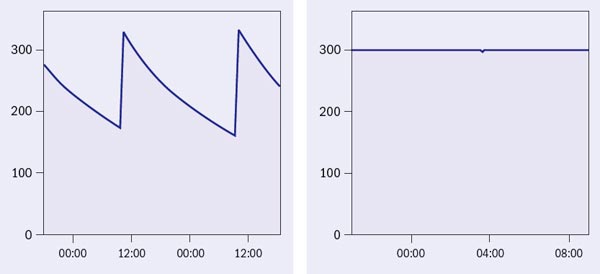
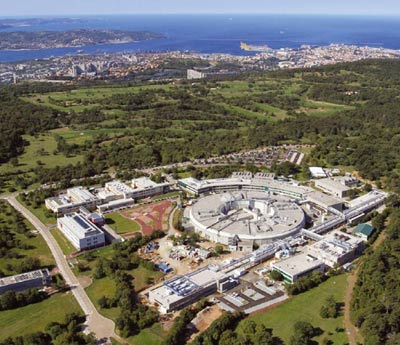
Elettra, the 2/2.4 GeV third generation Italian light source, has successfully joined the synchrotron facilities that operate fully in top-up mode. Located on the outskirts of Trieste, Elettra has operated for users since 1994, but during the past few years a large upgrade programme has taken place. This has included the construction and start-up operation of a full-energy injector. The new injector chain and the other machine and beam-line upgrades, together with the demands for intensity and thermal stability, naturally led to the change to top-up mode, in which frequent beam injections maintain a constant beam current in the storage ring during user operations. This is in contrast with the decay mode, where the stored beam is allowed to decay to some level before refilling occurs.
Elettra was not originally designed for this type of operation (and indeed even operated for many years without a full-energy injector). However, in May, only a year after establishing the stable operations of the new injector, the storage ring began to work successfully with top-up at the two user energies of 2 GeV and 2.4 GeV. Elettra has thus become another example showing how a third-generation synchrotron that previously operated in decay mode can advance to full top-up operation, in this case at multiple energies.
With top-up operation the photon intensity produced at Elettra is stable and the integrated intensity is 60% higher over a time period equal to the beam lifetime. Thus while keeping the optical components of the beam lines in thermal equilibrium, the integrated number of photons is also higher, so providing an additional gain in beam time for the experiments. At the same time the intensity-dependent electronics also remain stable, allowing submicron accuracy in the position of the electron beam and hence a higher stability of the photon beam.
Elettra’s upgrade to top-up started in 2009 and included the addition of various diagnostic and radiation-safety instruments, modification of the control and interlock software, fine tuning of the timing of the kicker and septa, as well as a revised operation strategy. A great deal of effort in collaboration with the radiation-protection team resulted in a high-level application with a “top-up controller” handling and controlling all aspects of the procedure. Careful radiation measurements at each beam line under various conditions of the injected beam, together with the high injection efficiencies achieved at both energies, meant that no additional shielding was required for the beam lines. Radiation levels in all beam lines remain below 1 μSv/h for efficiencies higher than 90%.
The project for the full-energy injector started in 2005 and finished by providing beam in March 2008 on time and within budget. The new injection chain consists of a 100 MeV linear accelerator and a 2.5 GeV booster that sends the beam into the storage ring at a rate of up to 3 Hz. The storage ring beam current at 2 GeV is set by the users to 300 mA and top-up occurs every 6 minutes by injecting 1 mA in 4 s, thus keeping the current level constant to 3‰. At 2.4 GeV the stored beam current is set to 140 mA and top-up occurs every 20 minutes, injecting 1 mA in 4 s to maintain the current level constant to 7‰.
The users have chosen fixed current-interval top-up (1 mA) instead of a fixed time interval. The injection system is perfectly tuned and for the majority of the beam lines does not produce interference with data-acquisition processes. A gating signal is also provided, but up to now only a few, very sensitive beam lines see some interference and therefore are gated.
The change to top-up mode required no transition period and once it began all went exceptionally smoothly, thanks to the very good preparation and the high level of expertise of the personnel involved. Although at the beginning, the operation in top-up was programmed for 20% of users’ beam time, it became immediately clear that the users strongly preferred this mode and so Elettra has operated in top-up for 100% of the beam time dedicated to users right from the start in May.
Three weeks of intense machine development on the LHC came to a satisfying conclusion on the night of 21 September with the final validation of the machine-protection systems for operation with “bunch trains”. Less than three weeks later, the machine was running with 248 bunches per beam, giving a peak luminosity of 8.8×1031 cm–2 s–1, close to this year’s target of 1032 cm–2 s–1.
Until the beginning of September, the LHC ran with bunches spaced by 1–2 μs, injected one bunch at a time from the Super Proton Synchrotron, the final stage in the injection chain. The change to injecting bunch trains – groups of bunches – not only reduces the time required to fill the machine but also allows for further increases in luminosity. It is therefore another important step on the route to full operation of the LHC. Eventually, the collider will run with 2808 bunches per beam, with 25 ns between bunches in a train. The target for 2010 was for a bunch spacing of 150 ns (equivalent to about 45 m) in the trains.
Running with bunch trains requires the careful setting-up of crossing angles between the beams at the interaction points in order to avoid unwanted collisions on either side of the experiments. Tests showed that the minimum angle needed to avoid parasitic collisions with the 150 ns trains is 100 μrad. They also revealed that there is more dynamic machine aperture at the interaction region than predicted at the nominal crossing angle, at injection, of 170 μrad. For the subsequent physics runs the crossing angle was reduced to 100 μrad during the ramp of the beam energy and the “squeeze”.
Using crossing angles has the consequence that all the protection devices had to be set up to match the new trajectories round the machine, a process that alone took the best part of a week, but all was ready for the first physics fill with the new conditions on 22 September. For this, the operations team injected three trains of eight bunches to give 24 bunches per beam. The fill of 13.5 hours provided around 170 nb–1 of integrated luminosity. A day later, the number of bunches was increased to 56 per beam.
This initial work on bunch trains was with approximately the same total beam intensity as in August, but the first fill brought a bonus. Bunches of nominal intensity were injected into the LHC with a smaller-than-usual transverse size. While this might give a higher initial luminosity, it was expected to cause lifetime problems when the beams were brought into collision. However, the beam lifetime remained surprisingly high (around 25 hours) and the luminosity was significantly higher than expected.
The first step to higher intensity took place on 25 September, with an increase to 104 bunches per beam. The total intensity was now more than 1013 protons per beam and a single fill for physics could deliver more than 1 pb–1. At 3.5 TeV the LHC had reached a stored energy per beam of 6 MJ, the highest for any collider and exceeding the record set at the Intersecting Storage Rings at CERN many years ago.
The next increase, to 152 bunches per beam, was made on 30 September by injecting 16 bunches at a time in two 8-bunch trains. This was followed on the night of 4–5 October with the first physics fill with 200 bunches, which provided 2 pb–1 in 12 hours. Then, on 7–8 October, the fill with 248 bunches was achieved, with bunch trains injected three at a time.
The strategy for increasing the intensity is driven by the machine protection, as the stored beam energy increases with each step. The aim is to provide three successful fills for physics to deliver more than 20 hours of colliding beams before progressing to the next step. Running with protons is scheduled to stop towards the end of October, by which time the LHC should be running with 344 bunches per beam. There will then be a period to set up for the first runs with heavy ions, before a short shutdown at the end of the year.
Recent work by the operations team at the LHC has focused on pushing the machine’s performance towards higher luminosity and into new territory in terms of stored beam power.
Moving to 25 bunches per beam with almost nominal bunch intensities at the beginning of August implied operation with a stored energy in each beam of more than 1 MJ. This corresponds to the current record for stored beam energy in existing hadron accelerators and marks an energy regime where a sudden loss of beam or operational errors can result in serious damage to equipment: an energy of 1 MJ is sufficient to melt 2 kg of copper. Extreme care and a thorough optimization of all operational procedures are therefore required in making this important transition in the machine’s performance. The work during August has included optimizing the operational procedures and the machine protection systems, with the aim of gaining experience with the reliability and reproducibility of the operation of the machine at such a high stored beam energy.
Early August also saw record results for the LHC performance in terms of delivered luminosity. For the first time the peak luminosity surpassed 4 × 1030 cm–2s–1 and the total integrated luminosity delivered to the experiments passed the milestone of 1 inverse picobarn (1 pb–1 or 1000 nb–1) over the weekend of 7–8 August. Another step towards higher luminosity occurred on 19 August, when the number of bunches in each beam was increased from 25 to 49. By the end of August the total integrated luminosity passed the threshold of 3 pb–1, about half being delivered in just one week of running with the higher number of bunches.
In parallel, the operations team has been conducting several tests for improving the LHC performance still further. The ramp speed of the magnets (the rate at which the electrical current can be changed in the LHC main dipoles) has been increased from 2 A/s to 10 A/s for the pre-cycle (without beam) of the magnet system. The ramp speed of 10 A/s has also been successfully tested for acceleration with beam, but the final implementation must wait until the LHC starts operation with bunch “trains”, in which the bunches of protons are grouped closely together, in contrast to the present operation with widely separated bunches. The faster ramp speed reduces significantly the minimum required time between two physics fills and therefore increases the overall machine performance in terms of integrated luminosity,
Operating the machine with bunch trains will open the door for increasing the total number of bunches in successive steps, so improving the LHC’s luminosity over the coming months by another factor of 10 to 100. For this the operations team is working with bunch trains with 150 ns spacing between bunches (the current minimum spacing is 1000 ns). This involves making the necessary changes throughout the injector chain, as well as in the LHC itself. In the LHC, bunch trains imply working with a defined crossing angle between the beams throughout the machine cycle, in order to avoid unwanted parasitic collisions. This means that the whole process of injection, ramp and squeeze has to be re-commissioned.
The task also includes re-commissioning all of the protection systems, both at injection and elsewhere in the cycle. This is particularly important now that the energy stored in each beam is about 3 MJ and is set to increase further in the coming weeks. Alongside these operations, the LHC teams will bring the higher-speed energy ramp (10A/s) into operation, which will reduce the time needed to fill the machine. The initial aim of this re-commissioning phase is to bring a few high-intensity bunches in trains into collision for physics and later move from 50 up to 96 bunches injected in each direction. Once again, this should result in a significant increase in the luminosity delivered to the experiments.
On 2 September, user operation resumed at the FLASH free-electron laser (FEL) at DESY in Hamburg after a major upgrade that boosted its energy to 1.2 GeV and its wavelength to 4.45 nm. The third user run will last a year and comprise more than 350 twelve-hour shifts. It is already overbooked by a factor of three.
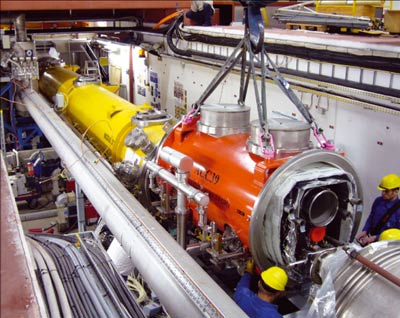
FLASH, the world’s first soft X-ray FEL, has been available to photon-science users for experiments since 2005. Last winter, the facility underwent an extensive five-month upgrade. The photo-injector was replaced with a new electron source that generates considerably less dark current and features a low transverse emittance. A further superconducting accelerator module – a prototype for the European XFEL hard X-ray laser – was added to the six that are already installed, increasing the beam energy from 1 to 1.2 GeV. This enabled the FLASH team to set a new record for the facility, pushing the wavelength from 6.5 nm to 4.45 nm in June.
Another key element is a new module with four superconducting cavities operating at 3.9 GHz rather than the 1.3 GHz customary at FLASH. This third-harmonic RF system – built at Fermilab in collaboration with DESY – flattens the energy distribution of the electrons in the bunch, leading to a linearization of the longitudinal phase space. The system is now routinely in operation, allowing a considerable increase in the energy of a single photon pulse to a couple of hundred microjoules and more flexibility in adjusting the duration of the photon pulse. This also constitutes an important test for the European XFEL, which is to be equipped with similar modules.
In addition, the FLASH team installed a seeding experiment (sFLASH) in which light amplification will be triggered using an optical laser – as opposed to the current self-amplified spontaneous emission (SASE) process in which amplification is started by the stochastic radiation that the electron bunches emit along the undulator. The optical laser provides the seed radiation with a wavelength of 38 nm by generating higher harmonics of the optical wavelength in a gas cell. The seeding will make it possible to reduce significantly the intensity fluctuations between individual pulses and enhance further the laser properties of the radiation. The radiation produced this way will be made available at a separate beamline, without interfering with the rest of the FLASH operations.
FLASH thus continues to offer new and unique experimental possibilities. The shortest wavelengths may even allow for first experiments on carbon in organic molecules, while magneto-dynamics experiments, with the third-harmonic wavelength, will benefit from the substantially increased intensities.
DESY’s new X-ray source, PETRA III, has begun operating for the international scientific community, with the first external users welcomed at the third-generation synchrotron source. The first user period, which will last until Christmas, is already overbooked, indicating the user community’s enormous interest in the new facility.
In this period, 32 scientific workgroups will carry out experiments at the first three measuring stations at PETRA III. They were selected from a total of 54 applications for beam time, through an international peer-review process. The experiments cover a variety of science, from high-temperature superconductivity and magnetism to the mapping of biological nanostructures. In parallel with the start of research activities, the remaining measuring stations in the PETRA III experimental hall are being equipped and put into operation. Light will reach 14 beam lines by the end of the year. PETRA III, with a circumference of 2.3 km, is the third reincarnation of the PETRA storage ring, which began life as a leading electron–positron collider in the 1980s. In the newly erected 300-m long experimental hall, it will ultimately be possible to carry out up to 16 experiments simultaneously at 30 measuring stations.
Equipment destined for a new project at JINR, Dubna, has been shipped from CERN. A tracking detector manufactured by the NA48 collaboration at CERN will be used in the Multipurpose Detector (MPD) in the Nuclotron-based Ion Collider Facility (NICA), which is aimed at studying maximally high baryonic densities.
The shipment marks the beginning of a renewed partnership between the two international physics centres within the context of a new co-operation agreement, which was signed in January. The previous co-operation agreement, which had been in force since 1992, defined the participation of JINR’s scientists and specialists in the research programme carried out at CERN. The new agreement introduces more symmetry into the relationship, with mutual participation in the research programmes of both laboratories. In particular, it foresees the help of experts from CERN in the realization of JINR’s research programme.
JINR has contributed for almost two decades to the construction of the accelerator and detectors for the LHC project, which is now successfully completed, with data-taking and data analysis underway. In the meantime JINR has developed its own exciting research programme. This programme will renew JINR’s experimental base, and CERN will help with its expertise in accelerator and detector technology.
The NICA/MPD project was initiated by former director of JINR, Alexei Sissakian, who sadly passed away on 1 May. The studies of hot and dense baryonic matter at the facility, together with the search for the quark-hadron mixed phase, could make Dubna one of the most attractive centres in this domain, together with GSI and Brookhaven.
The equipment transported to Dubna in July consists of a tracking detector, which includes four drift chambers with a diameter of 2.6 m – optimal for use as end-cap tracking systems in the MPD as well as for the future Spin Physics Detector. It was shipped together with data read-out electronics.
The ring imaging Cherenkov (RICH) technique is used extensively in nuclear, high-energy and astroparticle physics experiments to identify charged particles via the measurement of their Cherenkov emission angles, over momenta ranging from a few hundred MeV/c to several hundred GeV/c. The technological feats of the single-photon RICH detection technique – manifested in the most extreme case via the 3D imaging of single photoelectrons that have been created by Cherenkov photons and then been allowed to drift a metre or so through gas at atmospheric pressure – remain unmatched in any other detection technology.
In 1993, Eugenio Nappi of INFN Bari and Tom Ypsilantis of Collège de France launched a series of international workshops as a forum for reviewing new developments and perspectives in this powerful technique. RICH2010, the latest in the series, took place on 3–7 May in the French Mediterranean port of Cassis. A broad programme of invited and contributed talks, as well as poster presentations, attracted 115 participants from 25 countries, reflecting the expanding application of Cherenkov imaging in accelerator-based particle and nuclear physics, astroparticle physics and neutrino astronomy. In addition to 10 invited talks, the programme included 42 contributed talks, which were selected from some 80 submissions to allow time for extensive discussions; the other 34 contributions were presented in poster sessions.
From the LHC to Lake Baikal
The workshop began appropriately with a comprehensive review of the fundamentals of Cherenkov-light imaging and recent developments by Jurgen Engelfried of the University of San Luis Potosi. The opening session on operating RICH detectors in nuclear- and particle-physics experiments then provided an opportunity to see the first calibration measurements with real LHC data from the ALICE and LHCb experiments.
The High Momentum Particle Identification Detector (HMPID) in ALICE employs a perfluoro-n-hexane (C6F14) liquid radiator with photon imaging via a reflective caesium iodide (CsI) photocathode operating in a multiwire proportional chamber (MWPC) filled with methane (CH4) at atmospheric pressure. The detector has already demonstrated the expected π/K separation up to 3 GeV/c and proton identification up to 5 GeV/c; a future upgrade should extend the momentum range beyond this. LHCb has two RICH systems: RICH1, operating with aerogel and perfluoro-n-butane (C4F10) radiators; and RICH2, with a carbon tetrafluoride (CF4) radiator, to provide a combined particle-identification range over 2–100 GeV/c. The data already taken clearly demonstrate the identification of hyperons and strange mesons.
Also at CERN, the COMPASS experiment has a RICH detector that has been operating since 2002 in beam rates as high as 108 Hz with a C4F10 gas radiator for hadron identification over 3–60 GeV/c. The detector was subsequently upgraded with multianode photomultiplier tubes (MAPMTs) replacing the four central CsI MWPCs with pad read-out. This should allow an improvement from the present operation at 40 MHz to deadtimeless operation at 100 MHz in the central region. The NA62 experiment will use a RICH detector with a 17 m neon radiator and a focal plane of 2000 PMTs. Designed for electron–muon separation between 15 and 35 GeV/c, it should begin data-taking in 2012.
At Brookhaven, the hadron-blind RICH in the PHENIX experiment has demonstrated extremely high efficiency for photon detection in windowless operation, with CF4 serving as radiator and for photoelectron detection in a gas-electron multiplier (GEM) device with a CsI photocathode. Ionization from passing hadrons is trapped on electrodes in the GEM, allowing for clean electron identification in gold–gold collisions at the Relativistic Heavy Ion Collider.
Following the success of the BaBar experiment at SLAC, techniques for the detection of internally reflected Cherenkov (DIRC) light produced in quartz bars continue to evolve. The barrel focusing-DIRC for the proposed Super-B facility would be more compact than its BaBar ancestor. It would also have quartz blocks instead of water in the focusing zone and MAPMTs with sub-200 ps time resolution or multianode microchannel plate PMTs to replace conventional tubes and provide time-of-propagation (TOP) measurements that could resolve the colour of individual Cherenkov photons. The more compact forward region would use an aerogel radiator.
SuperKEKB, the upgraded B facility planned at KEK, will operate at beam luminosities of more than 80 times the current value of 1034 cm–2s–1. The Belle II experiment will employ a challenging TOP detector that relies on new multichannel hybrid devices based on avalanche photodiodes (APDs) that are under development at Hamamatsu Photonics. The PANDA experiment at the Facility for Antiproton and Ion Research (FAIR), Darmstadt, will include a barrel DIRC that follows similar principles to barrel designs for Super-B and Belle II, while for the forward directions a DIRC detector with innovative disc geometry is under study.
The expansion in the use of imaging Cherenkov detectors in astroparticle physics, witnessed in earlier RICH workshops, continues to accelerate. Imaging air Cherenkov telescope (IACT) arrays use the Earth’s atmosphere as radiator. The High Energy Stereoscopic System (HESS) array in Namibia has discovered numerous high-energy gamma-ray sources and a legacy survey of the galactic plane is almost complete. Sensitivity will be further increased in HESS-II with a fifth and larger (600 m2) dish added at the centre of the array. The future Cherenkov Telescope Array (CTA), with around 80 dishes of three diameters, is expected to be approved in 2013. The CTA will greatly increase sensitivity to astrophysical gamma-ray sources through the exploitation of ongoing advances in mirror coatings, photon-camera technology and control systems for telescope positioning. Some of these advances are already becoming apparent in the innovative photon cameras of the MAGIC-II IACT and in the First Avalanche-photodiode Camera Test (FACT) project for a novel camera using Geiger-mode APDs (G-APDs), both on La Palma.
The ANTARES neutrino telescope, by contrast, looks downwards, using seawater as the radiator and the Earth to filter out up-going charged cosmic rays. At a depth of 2500 m in the Mediterranean Sea, the telescope was completed in 2008 and results based on an analysis of around 1000 detected neutrinos were presented. The constructional and operational experience gained in ANTARES represents a major step towards the KM3NeT multi-cubic-kilometre neutrino telescope for the deep Mediterranean, which is being pursued by a consortium that includes members of the ANTARES, NEMO and NESTOR neutrino-detector projects.
The Lake Baikal neutrino telescope has been running while increasing in size since 1993. With the deployment of additional optical detectors it will soon reach a target mass of a gigatonne of water. Nearby, the complementary 1 km2 TUNKA-133 extensive air-shower array is coming into operation. This will be sensitive to primary cosmic rays in the energy range of 1015–1018 eV.
Glimpses of the future
The first permanent RICH installation outside the Earth’s atmosphere will soon be achieved with the launch of the Alpha Magnetic Spectrometer (AMS-02) in the final NASA space shuttle mission (STS-134) to the International Space Station in February 2011. The RICH subdetector consists of sodium fluoride and aerogel radiators, with a conical mirror and MAPMT photon detection. Tests at CERN last year using cosmic rays and a test beam confirmed the expected performance of the RICH subdetector.
Rapid, ongoing developments in solid-state, vacuum-based and gaseous photon detectors were reviewed in invited talks by Samo Korpar of Maribor, Toru Iijima of Nagoya and Silvia Dalla Torre of INFN Trieste, respectively. Leszek Ropelewski of CERN completed the picture with a fascinating evening seminar on developments in micropattern gas detectors (MPGDs) within the RD51 collaboration.
Solid-state, single-photon detectors continue to mature. Progress on the design of G-APDs has led to commercialized silicon photomultipliers, offering single-photon sensitivity with high detection efficiency, high gain for bias voltages less than 100 V, excellent (tens of picoseconds) timing resolution and operation in high magnetic fields. Current disadvantages include a high (temperature-sensitive) dark count rate, which increases with radiation exposure. Nonetheless, G-APDs have already demonstrated their adaptability in various detectors. They are combined with light-collecting Winston cones in successful prototype IACT cameras in MAGIC and FACT. More than 60,000 G-APD modules are currently installed in the near detector of the Tokai-to-Kamioka long-baseline neutrino experiment; G-APDs have also been successfully tested with an aerogel radiator in studies for the RICH detector for Belle II.
Vacuum-based photon detectors continue to diverge from classical PMT forms to include: new multianode types; versions with photoelectron gain achieved in the pores of a microchannel plate (MCP), affording the time resolution required for future DIRC devices; and hybrid devices that combine a pixellated silicon pin-diode sensor or APD with a photocathode and photoelectron acceleration potential of several kilovolts. LHCb’s RICH detectors represent the first implementation of such semiconductor hybrid devices in an operating experiment, while 144-channel hybrid APDs are foreseen as the baseline for Belle II. Quantum efficiencies continue to rise from typical values of 23% for bialkali (BA) photocathodes operating in the visible range to routinely produced “super” and “ultra” BAs, which approach 35% and 45% respectively. Such improvements are important for future water-based neutrino detectors, including MEMPHYS, because they allow for a bigger detector spacing and target volume.
While gaseous photon detectors – today with solid reflecting photocathodes rather than photosensitive vapours – remain the only approach to affordable large surfaces, great efforts have been made to inhibit the positive-ion feedback that limits photocathode lifetime and reduces operating speed. MPGDs based on stacked, perforated electrostatic layers in the GEM configuration have been implemented in several tracking detectors, including the hadron-blind RICH detector in PHENIX. Gaseous photon detectors for visible wavelengths so far remain elusive but many applications await, if they can be made cheaply enough.
Making the most of RICH detectors requires exceptional performance in many challenging technical areas, as highlighted in the invited talk by Clara Matteuzzi of INFN Milano. These include the purity of the solid, liquid or gas media – which the Cherenkov radiator transparency depends upon – as well as the transparency of radiator windows and reflectivity of focusing mirrors, which often operate at ultraviolet wavelengths. Groups in Novosibirsk and Japan have attained new levels of performance from aerogel radiators, in particular in terms of improved transparency and the production of tiles with customized refractive index.
In the tradition of the previous workshops, a session was also devoted to talks on pattern recognition and data analysis, where sophisticated methods and algorithms were presented. Last, in the conference summary, Blair Ratcliff of SLAC selected highlights from the many contributions at RICH2010 and revealed a picture of high “V2” (variety and vitality) in Cherenkov-light imaging.
The first half of the conference suffered appalling and uncharacteristic weather, but nevertheless the participants enjoyed a social programme that included a (rescheduled) boat visit to the Calanques of Cassis and a banquet in the barrel hall of the Domaine Bunan vineyard, near Bandol. The accompanying concert featured keyboard improvisations by Jacques Diennet of Ubris Studio, Marseille, accompanied by passing cosmic rays, made audible in the “Cosmophone”, which was introduced by its inventor, Claude Vallée of the Centre de Physique des Particules de Marseille. The concert continued with contemporary pieces played on vintage Provençial instruments by Jean-Marc Montera (lute and guitar) and the Meditrio ensemble. Fortunately, the weather smiled on the final days of the conference and on the closing ceremony, where the RICH2010 conference flag was presented to Takayuki Sumiyoshi of Tokyo Metropolitan University, in anticipation of RICH2013, which will take place in Japan.
• RICH2010 was sponsored by French and European private companies and institutions including CERN, IN2P3, Commissariat à l’énergie Atomique, Université de la Méditerranée Aix-Marseille II, Conseil General des Bouches du Rhône, Conseil General de la Région Provence – Alpes – Cote d’Azur and the town of Cassis.
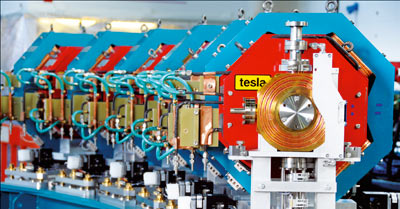
On Tuesday 22 June at 10.37 p.m. an electron beam passed for the first time through four sectors of EMMA, the prototype that has been built at the UK’s Daresbury Laboratory to test the concept of the nonscaling fixed-field alternating gradient accelerator (FFAG). As the beam passed more than half way round the accelerator’s circumference it marked a world “first” and demonstrated the underlying soundness of the most technically demanding aspects of the design.
FFAGs have a ring of magnets to focus the beam strongly, as in an alternating-gradient synchrotron, but the fixed magnetic field means that the beam spirals outwards as it is accelerated, as in a cyclotron. The result is more compact than a cyclotron, however, and although the concept is some 50 years old such machines are now being considered world-wide for a variety of applications. EMMA, the Electron Model for Many Applications, is a 20 MeV accelerator, which will test for the first time the concept of the nonscaling FFAG, in which the betatron tunes (the frequency of the transverse oscillations) are allowed to vary during the acceleration process. Nonscaling FFAGs are attractive because they tend to have much smaller transverse apertures than scaling FFAGs (where the beam optics remain constant during acceleration), which were first demonstrated at KEK in 2000.
EMMA has been built at the Daresbury Laboratory of the Science and Technology Facilities Council, under the auspices of the project for the COnstruction of a Nonscaling FFAG for Oncology, Research and Medicine (CONFORM). The electron beam injected into EMMA is generated by another novel accelerator system at Daresbury, the Accelerators and Lasers in Combined Experiments (ALICE). ALICE is the first accelerator in Europe to operate using energy recovery, where the energy used to create its high-energy beam is captured and reused after each circuit of the accelerator for further acceleration of fresh particles.
The next steps for EMMA, which are now underway, are to complete commissioning of the full ring, followed by the world’s first demonstration of the new acceleration technique.
Beam commissioning at the LHC continues to result in increasing luminosity for the experiments. The end of the first week of August saw data-taking pass another milestone, with integrated luminosity reaching 1 pb–1 – that is, a thousandfold increase since the end of June.
A major factor has been the implementation of multibunch injection from the Super Proton Synchrotron (SPS). This involves sending several bunches to the LHC in one SPS cycle, thus reducing the time needed to fill the collider. In tests on 27 July, using this scheme for the first time, the operators sent four bunches at a time into the LHC to give a total of 25 bunches (including one pilot bunch) in each direction.
Then, from around midnight on 30 July, the machine ran with stable beams of 25 bunches, providing 16 colliding pairs per experiment and delivering a peak instantaneous luminosity of around 2.6 × 1030 cm–2s–1. This corresponds to a total stored beam energy of 1.2 MJ. Further long fills with 25 bunches per beam followed in the first week of August, with peak luminosities of up to
3 × 1030 cm–2s–1 providing up to 120 nb–1 integrated luminosity per fill. By Friday 6 August, with the milestone of 1 pb–1 on the horizon, there was a small and well deserved celebration in the CERN Control Room, for the operations and commissioning teams whose hard work makes this progress possible.
To provide the best experiences, we use technologies like cookies to store and/or access device information. Consenting to these technologies will allow us to process data such as browsing behavior or unique IDs on this site. Not consenting or withdrawing consent, may adversely affect certain features and functions.
Functional
Always active
The technical storage or access is strictly necessary for the legitimate purpose of enabling the use of a specific service explicitly requested by the subscriber or user, or for the sole purpose of carrying out the transmission of a communication over an electronic communications network.
Preferences
The technical storage or access is necessary for the legitimate purpose of storing preferences that are not requested by the subscriber or user.
Statistics
The technical storage or access that is used exclusively for statistical purposes.The technical storage or access that is used exclusively for anonymous statistical purposes. Without a subpoena, voluntary compliance on the part of your Internet Service Provider, or additional records from a third party, information stored or retrieved for this purpose alone cannot usually be used to identify you.
Marketing
The technical storage or access is required to create user profiles to send advertising, or to track the user on a website or across several websites for similar marketing purposes.