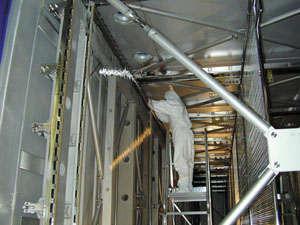
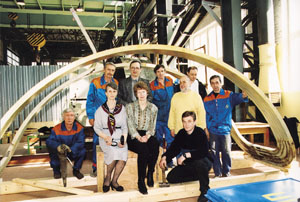
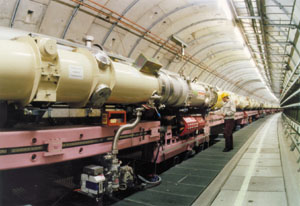
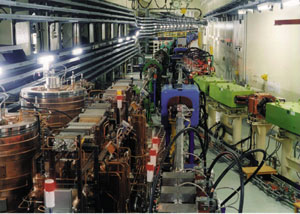
Taking shape in the Italian Gran Sasso underground laboratory is a large module for the Imaging Cosmic And Rare Underground Signals (ICARUS) detector.
ICARUS uses the liquid argon time projection chamber idea initially proposed by Carlo Rubbia in 1977 which combines the advantages of visible particle tracks (like a bubble chamber) with the flexibility of fully electronic data acquisition. The drift time of electrons released by ionization drift over long distances can be picked up via an arrangement of readout wires giving simultaneous imaging in different views.
A large continuously active detector could be used to record neutrino interactions from terrestrial beams sent over long distances, from atmospheric and solar neutrinos, or from particles from cosmic and atmospheric sources. Track chambers provided important milestones in neutrino physics history, and the hope is that this tradition will continue with the new technique. In addition the detector could also monitor for proton decay.
From 1991 until 1995, a 3 t prototype chamber at CERN demonstrated proof of the principle. With the ultimate goal of building a 5000 t detector, a stepwise strategy foresaw:
* developing the infrastructure needed to build and operate a large detector;
* acquiring the in situ safety experience with a still modest liquid argon volume; and
* evaluating a definitive and practical engineering choice for the final phase.
For this, the most efficient and economical approach was to build and test a module of intermediate size outside Gran Sasso before moving it underground for final assembly. The module thus has to be transportable, which limited its size to about 600 t (twin sub-modules of 3.9 x 4.2 m and a length of 19 m).
As well as testing design and logistics, such an intermediate detector would at the same time be an important first step in the ICARUS scientific programme, with a target mass close to that of the Japanese Kamiokande detector, but with the advantages of the new technology. En route to this T600 prototype, a 10 m3 (15 t) prototype built by Air Liquide was first shipped to INFN Pavia for cryogenic testing and to check operation of the inner wire chamber at liquid argon temperatures before trials in situ at Gran Sasso. Track lengths of up to 4 m have been achieved. Assembly and tests of the T600 module are taking place during this year at Pavia prior to initial cooldown. Much longer tracks are hoped for and expected.
T600 modules could be piled up, lego fashion, for the 5000 t detector. Another objective is “ICANOE” (ICARUS for a Neutrino Oscillation Experiment) to intercept the neutrino beam from CERN at Gran Sasso (January p5).
Initially a CERN-Italian venture, ICARUS has grown to also involve groups from the US (UCLA), Switzerland (ETH Zurich), China (Beijing) and Poland.
The ALICE collaboration of some 900 physicists is preparing a detector to study lead-ion collisions at CERN’s Large Hadron Collider (LHC) starting in 2005. By observing the results of such collisions, ALICE will continue CERN’s pioneering investigations through the phase transition from ordinary nuclear matter to the state of matter as it is believed to have existed when the universe was just a few microseconds old.
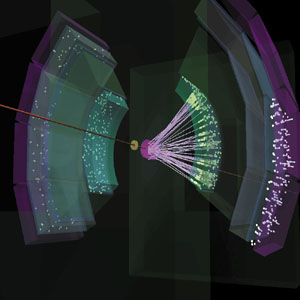
The ALICE detector is being built around the existing magnet of the L3 detector, which is currently taking its last data at the Large Electron Positron collider (LEP), CERN’s current flagship accelerator. ALICE has the same Russian-doll structure as most collider detectors, but with the addition of a dedicated spectrometer at one end. This will have the job of reconstructing the particles produced in lead-lead collisions that decay into muons.
The overall design of the muon spectrometer was finalized in 1999, and was the subject of one of the collaboration’s technical design reports (TDRs) – the documents that mark the transition from R&D to production phases for all the LHC’s experiments. A full-scale prototype of the muon spectrometer’s momentum analysing dipole magnet was completed in April. The spectrometer’s sensitive elements, 10 multi-wire proportional chambers with a total of around a million read-out channels, have been the subject of test-beam studies this summer.
Particle tracking
Another of ALICE’s TDRs concerns the experiment’s inner tracking system (ITS). This is the innermost layer of the detector, responsible for tracking emerging particles where their density will be at its highest.
ALICE physicists have been working with colleagues from fellow LHC experiment LHCb to develop silicon pixel chips for the inner two layers of the ITS. The result is a chip with 50 x 425 mm cells; a prototype detector based on this chip is being tested this year. The ITS has six layers, all using silicon technology, and about 10 million digital and 2 million analogue readout channels to digest the huge number of particles produced in LHC lead-ion collisions. The collaboration has opted for a hybrid ITS structure combining sensors, electronics and mechanical support. Beam tests so far have indicated that the ITS should achieve position resolution better than 20 mm.
Surrounding the ITS is the core of the ALICE detector – its time projection chamber (TPC). The TPC is a gas-filled detector with an electric field applied across it. Electrons liberated by ionization of the gas caused by a passing charged particle drift in the electric field and are detected at the end of the chamber. By measuring the arrival time of these electrons, the TPC reconstructs the path of the original charged particles. Several of the TPC’s most crucial elements have been extensively tested over recent years, and its largest element – a gas-filled cylinder made of composite structures similar to those used in space applications – will enter the production phase early next year.
The TPC in turn will be inside a transition radiation detector (TRD) that will be used to identify electrons and positrons. Several physical processes of interest to lead-ion physics give rise to electron-positron pairs. These include pairs directly produced in the initial stages of the collision or pairs produced as the result of the decays of heavier particles. The TRD, in conjunction with the ITS and TPC, will be able to identify the sources of electron pairs. It will work by measuring the radiation emitted when charged particles cross the boundary between two media with different refractive indices.
Special detectors
Unlike a conventional “Russian doll” collider detector, several of ALICE’s subdetectors will cover only a part of the full solid angle surrounding the collisions. Among these are the experiment’s high-momentum particle identification system (HMPID), its photon spectrometer (PHOS) and four detectors designed to measure particles emerging very close to the beam direction – the zero-degree calorimeters (ZDCs), the CASTOR small-angle calorimeter, the photon multiplicity detector (PMD), and a forward-charged particle multiplicity detector (FMD).
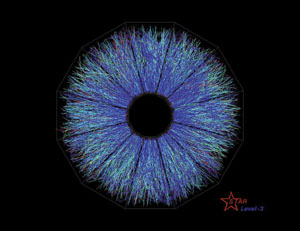
A prototype HMPID was put through its paces in 1998 using particles produced when a 350 GeV pion beam from the proton synchrotron struck a beryllium target. This allowed the collaboration to test both the detector’s performance and the pattern-recognition programs that will identify individual particles. That prototype was then shipped to Brookhaven in the US where it is now operational in the STAR detector at the laboratory’s Relativistic Heavy Ion Collider. ALICE, meanwhile, has started construction of its full-scale HMPID detector.
The PHOS will be made of lead tungstate crystals and will sample emerging photons over a limited area. This means that a relatively modest number of 18 000 crystals is needed. These will be supplied from production plants in China and Russia. For comparison, the LHC’s CMS experiment, whose electromagnetic calorimeter is based on the same crystals, will require around 80 000. By summer 2000, ALICE crystal production was getting under way with several hundred crystals having been produced in Russia.
One of the small-angle detector systems will serve primarily for triggering purposes – telling the electronics when an interesting collision has taken place. The ZDCs will be placed about 100 m away on each side of the main ALICE detector to measure the energy carried by particles emerging very close to the beam direction.
The CASTOR calorimeter will be placed about 16 m away from the interaction point on the opposite side to the muon spectrometer. It will have a sandwich structure of quartz fibre planes separated by tungsten plates. CASTOR’s job will be to search for exotic particles.
The FMD will consist of a number of discs, each divided into sensitive pads, placed at varying distances from the interaction point so as to cover the largest possible area. It will count the number of charged particles in the forward region and provide information for the experiment’s trigger.
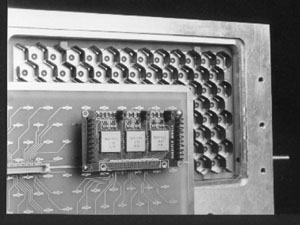
The PMD will be embedded within the main detector, attached to the magnet return yoke at 5.8 m from the interaction point opposite the muon spectrometer. It will be used primarily with the FMD to measure the ratio of photons to charged particles emerging on an event-by-event basis. This will give ALICE physicists information about event shapes and fluctuations in the forward region. The PMD has a honeycomb geometry, the cells of which are 8 mm deep with a surface of about 1 cm2. Copper walls separate the cells in order to prevent signals from blowing up by confining low-energy electrons to a single cell. A 96-cell prototype has been successfully tested in beams at CERN.
Time of flight
Another critical measurement for ALICE is the time of flight of emerging particles. Conventional time-of-flight detectors use fast scintillator detectors with coarse granularity. For ALICE, where a very fine granularity is required, this would have presented a very costly option and several alternatives were studied.
The one that the collaboration has adopted is multigap resistive plate chambers (MRPCs). These consist of a series of gas-filled gaps separated by high-resistivity plates. A strong electric field across the gaps gives rise to electron avalanches when charged particles pass through the chambers. The design of ALICE’s MRPCs involves optimizing the gap size – a small gap gives a faster response but a large gap gives a stronger signal. Multiple gaps allow for a smaller gap size since the signal can be integrated over several gaps. Extensive tests in 1999 with varying gap size and using different material for the resistive plates gave very encouraging results with time resolution better than 80 ps at more than 95% efficiency – easily competitive with classical scintillator detectors. Further tests aimed at finalizing the detector design are under way.
The ALICE collaboration is currently putting the finishing touches to its last few TDRs. With these completed, the entire detector blueprint will be in place and the collaboration expects its detector to be in full-scale production by the end of the year – right on schedule to be ready for the LHC’s first lead-ion collisions in 2005.
In colliding beam physics, the luminosity (collision rate) of a machine determines the yields of interesting high -energy events. Future linear colliders could significantly benefit if the colliding beams were additionally focused to a smaller transverse size beyond that which is possible with conventional or superconducting magnetic beam transport elements.
The theory of a self-focusing plasma lens was first proposed in 1987 by Pisin Chen who also leads the current experiment at the Stanford Linear Accelerator Center (SLAC). If such lenses were, for example, located at the interaction point of a collider, they could focus both the electron and positron beams, thereby reducing beam spot size and increasing the luminosity, perhaps by one order of magnitude or more.
The Experiment E-150 Plasma Lens Collaboration was formed to investigate this process and study the feasibility of its application at proposed future linear colliders like the Next Linear Collider. The collaboration contains members from four laboratories and three universities (see the complete list at the end of this article).
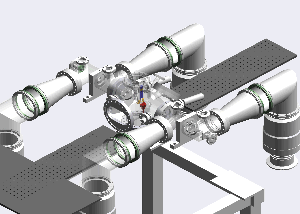
The process started with a positron beam from the SLAC PEP-II positron source. This was sent through a damping ring and then accelerated to 28.5 GeV in the SLAC linac with a bunch intensity of 1-2 x 10¹⁰. The beam was delivered to the Final Focus Test Beam Facility (FFTB) at a rate of 1 or 10 Hz. At the focal point of the FFTB transport, a special plasma chamber contains a 3 mm diameter pulsed gas nozzle (see diagram) through which either hydrogen or nitrogen gas is “puffed” into the ultrahigh vacuum system at plenum gas pressures up to 75 atm with a discharge time of 800 ms. The gas is pumped off by a Roots-type pump. On either side of the central chamber are differential pumping sections semi-isolated from each other by thin titanium windows with small (2-5 mm diameter) apertures for the positron beams to pass through. These sections are evacuated by turbomolecular pumps and allow operation of the plasma lens with ultrahigh vacuum systems on either side.
The plasma lens was generated by ionizing the gas using a pulsed YAG laser operating at 10 Hz in the infrared region (wavelength 1064 nm) and delivering a pulse energy of 1.5 J. The relativistic positron beam exhibits effects from both its charge and its current. For a beam propagating in a vacuum, the Lorentz force induced by the collective electric and magnetic fields is nearly cancelled, which is why a high-energy beam can travel over kilometres without much increase in spread (emittance).
Plasma response
Upon entering an initially quiescent plasma, the plasma response to the intruding charge and current is such that the plasma electrons are attracted into the positron beam so as to neutralize the space charge of the beam and thereby cancel its radial electric field, which tends to self-repel the positrons. However, if the beam radius is much smaller than the natural plasma wavelength, the neutralization of the intruding beam current by the plasma return current is ineffective. This leaves the azimuthal magnetic field unbalanced, and this field focuses the beam.
The plasma lens concept also works for electron beams. In that case, the plasma electrons are expelled from the beam volume. The result is a near uniform focusing of the beam due to the less mobile ions – the beam is “pinched”.
In the FFTB experiment, typical plasma densities were of the order of 1018/cm3, corresponding to a plasma wavelength of about 30 mm. This is indeed much larger than the incoming beam radius, which is about 5 mm.
The focusing strength of such a lens is equivalent to that of focusing magnets like quadrupoles with gradients of the order of 106 T/m. For comparison, a conventional small aperture (1 cm diameter) iron core quadrupole can maximally be excited to about 250 T/m.
The focusing effect of the plasma lens was measured using proven wire scanner technology developed for the SLC and FFTB. The wires are 4 mm and 7 mm carbon fibres. The scanner is located just downbeam of the plasma lens and is adjustable to allow mapping of the transverse beam size and pinpointing the longitudinal location of the beam waist.
Measuring the beam
The bremsstrahlung photons emitted by the positron scattering off the wires are detected in a Cherenkov cell type detector located 33 m downbeam of the lens. The variation in photon yield as the beam “dithers” across the wire provides a measure of the transverse beam profile from which the beam size can be determined.
A second, independent method to measure the strength of the plasma lens is a segmented synchrotron radiation monitor some 35 m downbeam of the lens. The harder the beam is focused, the higher the energy of the emitted synchrotron radiation. As the plasma focusing effect is transient, the monitoring of this synchrotron radiation provides an “on-line” measurement of the plasma focusing gradient. Such a plasma focusing induced synchrotron radiation signal was also observed for the first time. The energy was determined to be a few mega-electron-volts, which confirms the gradients derived from the plasma density.
Smaller beams
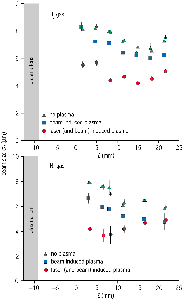
Figure 1 shows a typical set of scans for hydrogen and nitrogen (Z is in the direction of the momentum vector of the beam), illustrating the beam’s convergence toward a waist.
The plasma lens concept also works if there is no pre-ionization by the laser, a process called self or impact ionization. Here, the head of the positron bunch ionizes the gas and the remainder of the bunch is focused. The head of the bunch is not focused, so the efficiency in spot size reduction is lower than for laser pre-ionization. For the latter, the beam size was approximately halved for nitrogen. The reduction in the orthogonal dimension was comparable, so that the reduction in spot size was approximately a factor of four. The maximum possible spot size decrease is much higher, but in the SLAC experiment, the beam current had to be lowered and the incoming beam size enlarged so the fragile carbon fibres in the wire scanner would not melt in the very-high-energy density of the focused beam.
Earlier, the experimental setup was used to focus a 30 GeV electron beam using the self-ionization method. The collaboration is excited about potential future applications of the plasma lens concept and is presently repeating this electron focusing experiment using also laser pre-ionization.
The members of the collaboration, by institution, are: Fermilab (C Crawford and R Noble); KEK-Japan (K Nakajima); Lawrence Livermore (H Baldis and P Bolton); SLAC (P Chen, W Craddock, F-J Decker, C Field, R Iverson, F King, RKirby, J Ng, P Raimondi and D Walz); Hiroshima University, Japan (A Ogata), UCLA (D Cline, Y Fukui and V Kumar); University of Tennessee (A Weidemann).
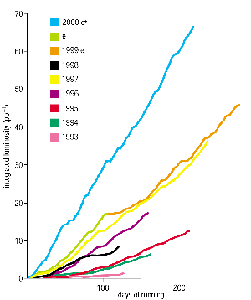
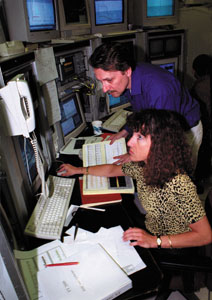
For the machine crew at the DESY laboratory, Hamburg, the result of the 2000 run of the HERA electron-proton collider is something to be proud of. As the ever-rising curves of the accelerator’s luminosity show, the performance of DESY’s 6.3 km flagship accelerator has been increasing steadily ever since it was commissioned in 1992 – an evolution that reached its peak with this year’s particle physics run.
A total of only 18 days were spent on maintenance work and machine studies since the beginning of the run on 17 January. The rest of the time, HERA was operated around the clock with the same efficiency as in 1999, with almost all the accelerator parameters achieving or exceeding their original design values.
In particular, HERA reached the peak value of 67 pb-1 integrated luminosity (luminosity is a measure of the “impact rate” of the electrons and protons circulating inside the storage ring facility and the particle collisions delivered to the experiments), thereby nearly doubling its performance when compared to the design specification of 35 pb-1.
From 4 September, HERA is enjoying a well-deserved nine-month break: activities in the tunnel are buzzing to get the accelerator back with a luminous 150 pb-1 per year next summer.
Getting the machine to reach its planned luminosity target by 1997 – five years after commissioning – had already required a range of improvements. In particular, HERA and its preaccelerator PETRA were fitted with new control systems, which considerably improved the quality of the proton beam.
Electron compatibility
However, a few nagging problems persisted. Operating HERA with electrons proved especially problematic. At just two hours, the lifetime of the particle beam was unexpectedly short, probably due to positively ionized impurities disturbing the beam. To get round this problem, it was decided to switch to positron operation in 1994. In general, the lifetime of the beam has proved to be much better when running with positrons (by a factor of up to two). The energy of the HERA electrons (or positrons) is 27.5 GeV.
The problem of making HERA “electron compatible” was reduced during the 1997/1998 winter shutdown by changing the vacuum pumps of the electron storage ring. The original ion getter pumps were replaced by passive non-evaporating getter (NEG) pumps – adsorption pumps without high voltage that do not accelerate dust particles into the beam vacuum. At the same time, additional measures were carried out to improve the reliability and efficiency of the machine: for example, an additional radiofrequency power reserve improved the operational stability; complete reorganization of HERA’s control system extended its functionality and improved operating efficiency; the radiofrequency couplers for the superconducting cavities of the electron ring were reconstructed; and the old, often reused main power supply of the superconducting ring was replaced. These extensive modifications paid off. HERA’s particle collision rate with electrons was just as high in 1999 as the rate obtained with positrons two years before.
Higher energy protons
The increase of the proton energy from 820 to 920 GeV was carried out without problems as well, despite its pushing the superconducting magnet system closer to its limits. What’s more, HERA provided the fixed target experiment HERMES with a stable supply of longitudinally spin-polarized electrons, with polarization of the beam routinely lying between 50 and 60% (and peak values reaching 65%).
This year also saw the full integration into operations of the fourth HERA experiment HERA-B, a fixed target experiment using the proton beam of the accelerator. HERA’s increase in efficiency was thus achieved, although both particle beams are used in parallel by the collider experiments H1 and ZEUS and two fixed-target experiments.
More luminous
HERA’s exceptional performance this year was the crowning touch before extensive work to improve luminosity began in September. The goal is to increase the luminosity four- to five-fold in order to provide experimental access to extremely rare processes.
To achieve this, it will be necessary to reduce the cross-sections of the particle beams at the north and south interaction points to a third of their current area, that is from 21 mm2 to 7 mm2. This is quite a challenge, as it also entails a complete rearrangement of the interaction zones.
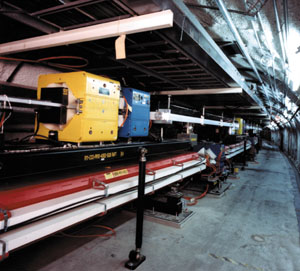
In particular, it will be necessary to move the low-beta quadrupoles closer to the collision points. The first low beta quadrupoles will be fitted right into the H1 and ZEUS detectors. These quadrupoles also provide the fields which merge and separate the protons and electrons before and after the collisions respectively.
The powerful synchrotron radiation due to the magnetic beam separation will be absorbed downstream, far away from the detectors. Several unconventional components had to be designed to handle this synchrotron radiation problem, including extremely small superconducting magnets that will be integrated into the H1 and ZEUS detectors, as well as keyhole-shaped vacuum chambers, which will be built into the machine at the end of 2000.
Thanks to these major improvements, HERA will be in excellent shape to take on the challenges of the new millennium when it restarts with five times its old luminosity in the summer of 2001.
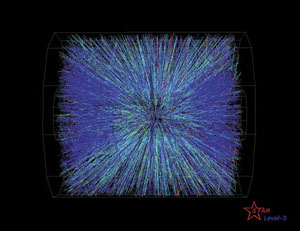
After achieving first collisions of gold ion beams on the night of 12 June, the gleaming new Relativistic Heavy Ion Collider (RHIC) facility at Brookhaven wasted no time in ramping up in energy and intensity and starting the process of analysing data.
A few days after the first gold ions collided at a collision energy of 56 GeV/nucleon, all four of the RHIC detectors (BRAHMS, PHENIX, PHOBOS and STAR) began recording data at a collision energy of 130 GeV/nucleon. By the end of July the first physics result – a measurement of charged particle density at mid-rapidity for central gold -gold collisions at these two energies – was submitted for publication by the PHOBOS collaboration.
With these data points in hand, and further analysis results in the pipeline from each of the four experiments, theorists who were at Brookhaven to attend a series of summer workshops immediately began to ponder the first glimpse of high-density matter in this new energy regime.
In the meantime the machine staff shifted focus from first collisions to achieving sustained collider operation. The goal for machine operation over the summer was to bring the collider and its injector complex, consisting of tandem Van de Graaff, booster and AGS synchrotron, to the level at which all of the experiments would obtain an initial data run with event rates approaching 10% of the final design luminosity.
By mid-August, RHIC’s two superconducting rings were routinely colliding stored beams of gold ions, with the full complement of 55 ion bunches in each ring, beam lifetimes of more than 4 h and some storage cycles lasting 10 h and more. The four experiments simultaneously recorded data throughout these runs, transferring data to the RHIC Computing Facility at peak rates of more than 40 Mbyte/s.
RHIC ran through mid-September, with continued data taking as well as accelerator physics work to complete the commissioning of the collider systems. A comprehensive look at the first physics results from this year’s run will take place at the Quark Matter 2001 meeting on 15-20 January, which is being jointly hosted by the State University of New York at Stony Brook and Brookhaven. It is expected that the collider will start up again early in 2001 and begin operating soon after at the full design energy of 200 GeV/nucleon for gold-gold collisions.
The PEP-II asymmetric B-factory at the Stanford Linear Accelerator Center (SLAC) continues to exceed expectations, having nearly reached its design performance after only a year of operations. This innovative electron-positron collider was designed and built by SLAC and the Lawrence Berkeley and Lawrence Livermore National laboratories with $177 million from the US Department of Energy, and it has been creating millions of B-meson pairs.
A collaboration of more than 500 physicists who designed and built the 1200 t BaBar detector is eagerly sifting through this burgeoning mountain of data. Coming to Stanford from Canada, China, France, the UK, Germany, Italy, Norway, Russia and all across the US, they are searching for evidence of CP violation – an asymmetry between matter and antimatter – in B meson decays.
As reported at the International Conference on High Energy Physics in Osaka, Japan (September p5), the SLAC B-factory recently hit a peak luminosity of 2.3 x 1033 cm-2s-1 – 76% of its goal of 3.0 x 1033. When combined with better than expected operating efficiencies on both the collider and the BaBar detector, this facility has exceeded its expected daily output of B-meson events on several different occasions. Having already created more than 10 million B-meson pairs, or more than has been recorded on all previous accelerators, it is indeed operating like a factory, thanks to the untiring efforts of the commissioning team, led by John Seeman.
A distinctive feature of the B-factory and the reason that it is called “asymmetric” is that the electrons and positrons circulate at different energies. When an electron and a positron meet and annihilate, the B meson and its antiparticle that are often produced lurch forward in the direction of the more energetic electron beam. This feature makes it much easier to isolate the daughter particles that arose from each of the two B decays and to determine the time that elapsed between them. Knowing this time difference is vital for physicists trying to measure any CP-violating asymmetries among B mesons.
Normally a new particle collider with such innovative features must be coaxed through a long tuning period, often taking several years, before it performs at its full potential. The particle detector surrounding the collision point is another complex, sensitive device that must be carefully adjusted to function as designed. However, the entire B-factory – both collider and detector – has come on line smoothly and in record time, to the delight of the hundreds of BaBar scientists now trying to cope with the flood of new data.
At Osaka, BaBar spokesman David Hitlin of Caltech presented results based on more than 9 million B-meson pairs. In addition to precision measurements of B meson lifetimes and mixing parameters as good as any that have been made by the CLEO collaboration at Cornell, he revealed a surprisingly large branching ratio for decays into pion pairs – more than twice the CLEO value. This preliminary result augurs well for further measurements of a possible CP asymmetry in these decays, but it must be confirmed by further measurements on BaBar and KEK’s Belle experiment.
By far the most anticipated number that Hitlin presented was the collaboration’s preliminary result for the CP violation parameter sin 2b, which is extracted from decays of neutral B and anti-B mesons into a J/psi particle and a short-lived neutral kaon. Any significant difference between these two decay rates corresponds to a non zero value of sin 2b and gives solid evidence for CP violation.
The preliminary value that Hitlin announced at Osaka, based on 120 such “golden events”, was 0.12 ± 0.37 (stat) ± 0.09 (syst) – consistent with no CP violation at all. However, the errors are large at this early stage. They will come down steadily as millions more B mesons are produced and recorded over the next few months. “The rapid launch of the B-factory has given us our first glimpse into the new domain of CP violation measurements in the B-meson system,” observed Hitlin. “We hope to double our data by the end of October and to begin to make truly definitive tests of the Cabibbo-Kobayashi-Maskawa mechanism for this intriguing phenomenon.”
The Belle experiment at the KEKB asymmetric-energy electron-positron B-meson factory recently completed a successful first year of operation. The KEKB luminosity, which was about 1031 cm-2s-1 at start-up in June 1999, reached 2 × 1033 by the end of July 2000. This was achieved with only a fraction of the design values for beam currents in each ring, so the prospects for ultimately achieving the design goal of luminosity of 1034 seem good.
The beam currents were limited by the excessive heating of some accelerator components. These are being replaced by more robust versions during the current shutdown. In addition, four more superconducting radiofrequency accelerating cavities are being installed in the high-energy electron ring. With these improvements there should be no technical problems to limit the beam currents below design values.
The luminosity was also limited by an instability that causes the low-energy positron vertical beam size to grow at high-beam currents. This beam blow-up problem may be caused by photoelectrons produced by synchrotron radiation X-rays hitting the walls of the vacuum chamber and attracted to the positively charged positron beam bunches.
This problem is also being dealt with. Wire coils being wound round the positron beampipe will provide a weak solenoid field that will curl photoelectrons back into the vacuum chamber wall soon after they are produced. Simulations indicate that these will be effective at suppressing photoelectron interactions with the beam. Happily, many of the novel design features of KEKB appear to be verified. Beam-beam limits to the luminosity have not yet been observed and no deleterious effects caused by the finite beam-crossing angle are evident. This crossing angle scheme, in addition to KEKB’s ability to produce high luminosity at relatively low total beam currents, reduces beam-induced background radiation levels in the Belle detector to reasonably comfortable levels.
At the ICHEP 2000 meeting in Osaka (September p5), the Belle group reported preliminary results based on most of its total data sample of more than 6 million B meson particle-antiparticle pairs. It submitted 17 papers, including a number of new results. A clear signal was reported for the interesting B decay into phi and a negative kaon, in which a b quark gives three strange quarks (a gluonic “penguin” process). First observations of charged and neutral B meson decays to J/psi and K1(1270) were reported. These modes may provide new possibilities for future CP violation studies. Belle’s high-quality particle identification system was exploited to make almost background-free first measurements of Cabibbo-suppressed B decays into D* and a kaon.
Other results included competitive measurements of D0 and Ds lifetimes, the neutral B mixing parameter, exclusive B meson semileptonic decay modes, angular correlations in B decays into J/psi and K* and the best limit so far for the rare decay B to rho and a photon. This latter result is interesting because it provides an important constraint on the elusive Vts element of the Kobayashi-Maskawa matrix.
A number of rare decay measurements are dominated by backgrounds from continuum quark-antiquark production processes. Belle did not accumulate much off-resonance running, so new analysis techniques were developed that enable B meson decays to be separated from these continuum events. These techniques enabled Belle to report measurements at interesting levels of precision for rare B decays into a kaon and a pion, into a K* and a photon, and the inclusive photon radiative penguin process.
In a plenary session talk, Belle spokesperson Hiroaki Aihara of Tokyo reported Belle’s first results on the relevant CP-violating parameter as 0.45 + 0.44 – 0.45. Although Belle’s current data sample is only about half that of BaBar’s at SLAC, Belle managed to get a competitive measurement by including many CP eigenstate decay channels, including the important but experimentally challenging J/psi and long-lived kaon B decay.
Although the precision of the Belle measurement is not yet sufficient to make a definitive statement about the Kobayashi-Maskawa theory, the results are important in that they demonstrate that Belle is capable of doing the measurements that it was designed to do.
Belle’s research activities are not confined to B-mesons. Three of the Osaka papers deal with tau lepton physics: two on searches for CP violations in the lepton sector and one on a search for lepton-flavour-violating tau decays. In addition, Belle’s particle identification capabilities are being exploited to make interesting measurements of the two-photon production of kaon pairs. Although all of the results are preliminary – some of them are based on data that were collected only a few days prior to the start of the conference – and there is still lots of work to be done before they can be published, they demonstrate that all components of the Belle detector and the data analysis software are functioning at near design levels. More important is that they demonstrate that the Belle collaboration is up to the job at hand and able to produce new and interesting results in a timely manner.
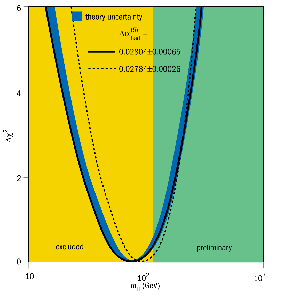
After commencing 2000 operations in fine style, CERN’s flagship machine, the LEP electron-positron collider, has been regularly delivering experiments with beams of 103 GeV or more. The machine has been running in “Higgs discovery mode” – the objective being to uncover at last the mysterious mechanism that breaks electroweak symmetry and provides particles with mass.
For the interconsistency of all results amassed so far anywhere, LEP is operating at the most likely place for the Higgs particle to turn up. This is not new, and a lot of potential Higgs territory has already been excluded.
What makes the Higgs hunt so dramatic is that LEP soon has to be decommissioned and dismantled to allow work to begin on CERN’s LHC collider, to be constructed in the same 27 km tunnel. Under such pressure and on such fertile physics ground, tantalizing hints of Higgs effects around 114 GeV are being seen. LEP runs until 2 November.
Jefferson Laboratory’s CEBAF accelerator, which was originally designed to provide 4 GeV continuous-wave electron beams, has demonstrated 6 GeV continuous-wave operation. In early August the superconducting radiofrequency (SRF) machine reached 6.07 GeV at a substantial current of 109 mA.
Energies in the 5.65 GeV range had already become routine as a result of incremental improvements since CEBAF began operation in the mid-1990s. Once 6 GeV has become the routine energy level, nuclear physics users will capitalize on it during the coming years, pending the completion of a proposed 12 GeV upgrade, which is to be discussed later this year by the US Nuclear Science Advisory Committee.
The Jefferson Laboratory’s SRF electron-acceleration technology also drives the laboratory’s Infrared Demonstrator Free Electron Laser and is now beginning to see application elsewhere as well. Under a $70 million contract, the laboratory is providing SRF and related cryogenic engineering, assembly and installation support for the Spallation Neutron Source project at Oak Ridge National Laboratory, Tennessee.
A new device that can operate in close proximity to highly sensitive superconducting sensors could open up new detector possibilities. For years a superconducting three-terminal device with transistor-like properties has been the missing link in the development and utilization of superconducting electronics.
A superconducting computer was the major goal of Josephson junction technology in the 1980s. Since then the field of superconducting electronics has broadened tremendously. There are extensive developments with superconducting quantum interference devices, logic circuits and passive microwave components with many applications to telecommunications.
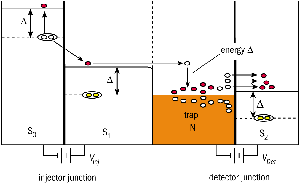
Now a Naples-Oxford collaboration has fabricated a superconducting device that behaves in a similar way to a transistor – the “quasiparticle trapping transistor”, or quatratran – and it demonstrates large current- and power amplifying capability at liquid-helium temperature (Pepe et al. 2000).
Quatratrans can operate in close proximity to the sensitive superconducting sensor arrays that are increasingly being used in astronomy, X-ray microanalysis and time-of-flight mass spectrometry. They can also be fabricated to act as radiation detectors with internal amplification. Conventional semiconductor transistor-like devices do not work well at low temperatures and dissipate too much power.
The idea of quasiparticle trapping (Booth 1987) grew out of attempts to develop a solar neutrino detector based on superconducting indium. Extensions of the idea are being applied to cryogenic detectors, which are being used to search for possible weakly interacting massive particles that may constitute the dark matter of the universe (Irwin et al. 1995), and to superconducting tunnel junction detectors being used in arrays of single-photon counting spectrometers in astronomy (Peacock 2000; Peacock et al. 1996).
Another idea by a Harvard-Oxford collaboration led to the concept of a superconducting transistor (Booth et al. 1999; 2000). A collaboration between Oxford and the Naples group, which has a long tradition in superconductive device fabrication and studies of Josephson effects and non-equilibrium superconductivity (Barone and Paterno 1982), has produced devices that have very interesting properties.
Possible applications of the device are in the area of the preamplification and read-out of multipixel arrays of superconducting sensors and detectors.
To provide the best experiences, we use technologies like cookies to store and/or access device information. Consenting to these technologies will allow us to process data such as browsing behavior or unique IDs on this site. Not consenting or withdrawing consent, may adversely affect certain features and functions.
Functional
Always active
The technical storage or access is strictly necessary for the legitimate purpose of enabling the use of a specific service explicitly requested by the subscriber or user, or for the sole purpose of carrying out the transmission of a communication over an electronic communications network.
Preferences
The technical storage or access is necessary for the legitimate purpose of storing preferences that are not requested by the subscriber or user.
Statistics
The technical storage or access that is used exclusively for statistical purposes.The technical storage or access that is used exclusively for anonymous statistical purposes. Without a subpoena, voluntary compliance on the part of your Internet Service Provider, or additional records from a third party, information stored or retrieved for this purpose alone cannot usually be used to identify you.
Marketing
The technical storage or access is required to create user profiles to send advertising, or to track the user on a website or across several websites for similar marketing purposes.