It’s 2 a.m. in Chicago, 9 a.m. in Geneva and 5 p.m. in Melbourne. Around the world, particle physicists in labs, lecture theatres and in their homes are full of anticipation. They are all waiting to hear the latest update in the search for the Higgs boson at the LHC, following the tantalizing hints presented on 13 December. Everyone knows that something exciting is in the air. The seminar has been rapidly scheduled to align with the start of the 2012 International Conference of the High-Energy Physics in Melbourne. It will be webcast not only to an audience in Melbourne but to the many teams around the world who have contributed over the years.
The news has its roots in the 1960s. The work of Robert Brout, François Englert, Peter Higgs, Gerald Guralnik, Carl Hagen and Tom Kibble in 1964 was to become a key piece of the Standard Model, giving mass to the W and Z bosons of the electroweak force. From the 1970s, searches for the so-called Higgs boson progressed as particle accelerators grew to provide beams of higher energies, with experiments at Fermilab’s Tevatron and CERN’s Large Electron–Positron providing the best limits before the LHC entered the game in 2010.
It was a day that many will remember for years to come. Englert, Higgs, Guralnik and Hagen were all in the audience at CERN to hear the news directly. (Sadly, Brout died last year and Kibble was unable to attend.) The ATLAS and CMS collaborations announced that they had observed clear signs in the LHC’s proton–proton collisions of a new boson consistent with being the Higgs boson, with a mass of around 126 GeV.
On 4 July 2012, particle physics was headline news around the world thanks to a scientific success story that began over 60 years ago. It was a great day for science and a great day for humanity: a symbol of what people can achieve when countries pool their resources and work together, particularly when they do so over the long term.
This particular success story is called CERN, a European laboratory for fundamental research born from the ashes of the Second World War with support from all parties, in Europe and beyond. The headline news was the discovery of a particle consistent with the long-sought after Higgs boson, certainly a great moment for science. In the long term, however, the legacy of 4 July may well be that CERN’s global impact endorses the model established by the organization’s founding fathers in the 1950s and shows that it still sets the standard for scientific collaboration today. CERN’s success exemplifies what people can achieve if we keep sight of the vision that those pioneers had for a community of scientists united in diversity pursuing a common goal.
CERN is a European organization, founded on principles of fairness to its members and openness to the world. Accordingly, its governance model gives a fair voice to all member states, both large and small. Its funding model allows member states to contribute according to their means. Its research model welcomes scientists from around the world who are able to contribute positively to the laboratory’s research programmes. Through these basic principles, CERN’s founding fathers established a model of stability for cross-border collaboration in Europe, for co-ordinated European engagement with the rest of the world, and they laid down a blueprint for leadership in the field of particle physics. The result is that today, CERN is undisputedly the hub of a global community of scientists advancing the frontiers of knowledge. It is a shining example of what people can do together.
This fact has not been lost on other fields and over the years several European scientific organizations have emulated the CERN model. The European Space Agency (ESA) and European Southern Observatory (ESO), for example, followed CERN’s example and have also established themselves as leaders in their fields. Today, those thinking of future global science projects look to the CERN model for inspiration.
Scientific success stories like this are now more important then ever. At a time when the world is suffering the worst economic crisis in decades, people – particularly the young – need to see and appreciate the benefits of basic science and collaboration across borders. And at a time when science is increasingly estranged from a science-dependent society, it is important for good science stories to make the news and encourage people to look beyond the headlines. For these reasons, as well as the discovery itself, 4 July was an important day for science.
By David Kaiser W W Norton & Company
Hardback: £17.99 $26.95
Paperback: $17.95
In this curious book, David Kaiser presents a detailed “biography” of a group of young physicists, the “Fundamental Fysics Group”, based in Berkeley, California, and their unconventional impact on the development of “the new quantum age”. Most of the action takes place in the 1970s and includes a surprising mixture of characters and plots, as suitably summarized in these illuminating words: “Many of the ideas that now occupy the core of quantum information science once found their home amid an anything-goes counterculture frenzy, a mishmash of spoon-bending psychics, Eastern mysticism, LSD trips, CIA spooks chasing mind-reading dreams and comparable ‘Age of Aquarius’ enthusiasms.” These people regularly gathered to discuss all sorts of exotic topics, including telepathy and “remote viewing”, as well as faster-than-light communication and the fundamental concepts of quantum theory.
Among many other things, I liked learning about early discussions regarding Bell’s theorem, the Einstein-Podolsky-Rosen paradox and the nature of reality, sometimes taking place in workshops with sessions in hot baths, interspersed by drum playing and yoga exercises. I also enjoyed reading about the first experimental tests of Bell’s work by John Clauser and about the genesis of the bestseller The Tao of Physics, by Fritjof Capra. It was particularly interesting to learn about a paper on superluminal communication (published despite negative reports from referees), which triggered the development of rebuttal arguments that ended up being quite revolutionary and leading to quantum encryption etc. It was thinking outside the “establishment” way that led to a wrong but fruitful idea about implications of Bell’s theorem, which forced others to improve the understanding of quantum entanglement and gave rise to a new and highly successful branch of physics: quantum information. Kaiser’s basic message is that, sometimes, crazy ideas push the understanding of science beyond the frontiers set by people working in conventional environments, within universities, and by government grants.
I know that we should not judge a book by its cover but with such a title I expected this book to be an interesting summertime read and was surprised to find that it is written in a rather heavy style that is more suitable for historians of science than for physicists relaxing on the beach. The topic of the book is actually quite curious, the language is fluid and the narrative is well presented but the level of detail is such that many readers will often feel like jumping ahead. It is elucidating to note that almost 25% of the book’s 400 pages are devoted to listings of notes and of bibliography. Essentially every sentence, every paragraph, is justified by an “end note”, which is an overkill for a book targeting a general audience. Writing this dense book must have been a long-term job for Kaiser, who is both a physicist and a historian. The result does not really qualify as an easy read. I enjoy reading biographies if they have a nice rhythm, some suspense and a few anecdotes here and there – which is not exactly the case for this book. I wonder how many readers end up moving it aside after realizing that they have been misled by the spirited title?
By Robert Laughlin Basic Books
Hardback: £17.99 $24.99
Nearly 90% of the world’s economy is driven by the massive use of fossil fuels. The US spends one-sixth of its gross domestic product on oil alone, without counting the important costs of coal and natural gas, even though its use of oil and the other fossil fuels has progressively decreased since the mid-1970s. While the debate on fossil fuels continues to rage on both sides of the Atlantic, Robert Laughlin, professor of physics at Stanford University and Nobel Laureate for the fractional Hall effect, has written Powering the Future – a hypothetical voyage through the future, where the human race will have demands and expectations similar to those of today but where technologies will probably be quite different.
The book is essentially one of two halves. The first half contains the main chapters, where all of the essential statements and the logical lines of the various arguments are developed with an informal style. These are then complemented by the second half, which consists of a delightful set of notes. The notes encourage readers to form their own opinions on specific subjects using a number of tools, which range from assorted references to simplified quantitative estimates.
Treatises on energy problems that are written by political scientists are often scientifically inaccurate; specialized monographs are sometimes excessively technical. This book uses an intermediate register where the quantitative aspects of a problem are discussed but the overall presentation is not pedantic. Of the numerous examples, here are two short ones. What is the total precipitation that falls in one year on the world? The answer is “one metre of rain, the height of a golden retriever” (page 7 and note on page 127). What is the power-carrying capacity for the highest voltage currently used in North America? The answer is “2 billion watts” (page 46 and note on page 156) and is derived with simple mathematical tools.
Laughlin’s chain of arguments forms a composite approach to the energy challenge, where fossil fuels will still be needed 200 years from now to fly aeroplanes. Nuclear power plants will inevitably (but cautiously) be exploited and solar energy will offer decisive solutions in limited environments (see chapter nine, “Viva Las Vegas!”). While the author acknowledges that market forces (and not green technology) will be the future driver of energy innovation, the book does not explicitly support any partisan cause but tries to inspect thoroughly the issues at stake.
A few tweets may not suffice to develop informed views on the energy future of the human race. On the other hand, Powering the Future will certainly stimulate many readers (including, I hope, physicists) to form their own judgements and to challenge some of the canned statements that proliferate on the internet these days.
By Jacqueline Stedall Oxford University Press
Paperback: £7.99 $11.95
What a wonderful surprise. I was going to review another book before this one but it wasn’t to my liking (actually it was pretty bad) and I gave up after the first few chapters. So I settled instead on this book, mainly because it is short, or “very short” as the subtitle suggests.
Seeing that it was part of a series, I was expecting a typical history starting with Pythagoras and Euclid, then Newton and possibly Leibniz, Euler, Gauss and Riemann, followed by a collection of moderns, depending on how much space was left. I looked in the (excellent) index at the back (opening Q–Z) and was surprised to find no entry for Riemann. Was this British bias? No, Hardy was missing as well – but instead there were other people who I’d never heard of: William Oughtred, for example, (author of the first maths book published in Oxford) and Etienne d’Espagnet (who supplied Fermat with essential earlier works). Samuel Pepys also makes an appearance but more as an example of how little maths educated people knew in the 17th century.
I learnt in this charming book that what I had been expecting is called the “stepping stone” approach to the history of mathematics, focusing on elite mathematicians. This book is refreshingly different. It is actually more about the subject “history of mathematics”, i.e. about how we compile and recount a history of mathematics rather than about a sequence of events. However, it does this by focusing on intriguing stories that show the various features that must be considered. In doing so, it fills in the water between the stepping stones, for example, in the story of Fermat’s last theorem. It also tells the story of the majority of people who actually do maths – schoolchildren – by discussing the class work in a Babylonian classroom (around 1850 BC), as well as in a Cumbrian classroom around 1800.
After reading this “preview version”, I am now going to get the “director’s cut” – The Oxford Handbook of the History of Mathematics, which is co-authored by the same author with Eleanor Robson.
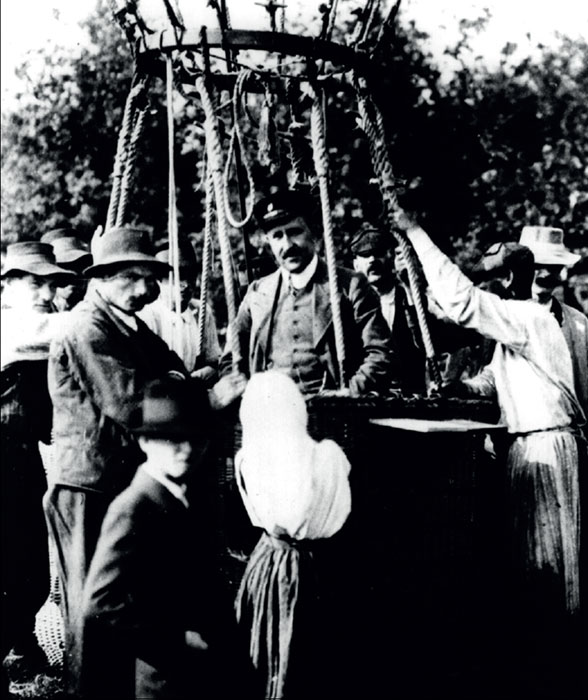
On 7 August 1912, Victor Hess took a now famous balloon flight in which he observed a “clearly perceptible rise in radiation with increasing height” and concluded that “radiation of very high penetrating power enters our atmosphere from above”.
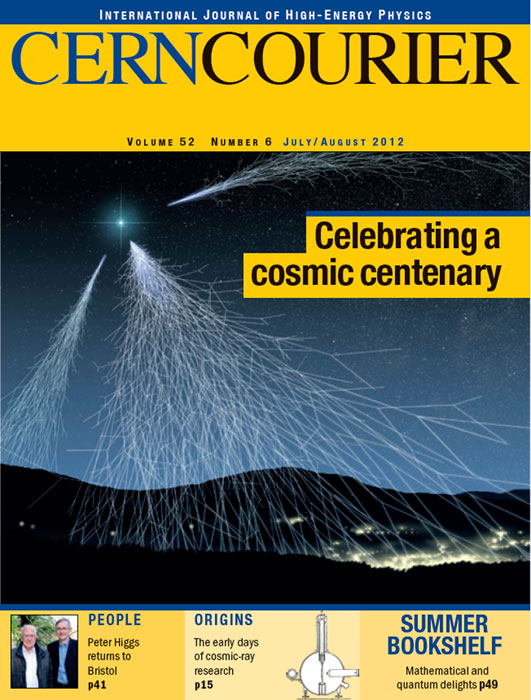
This issue of the CERN Courier marks this discovery of cosmic rays with a look at cosmic-ray research in the past as well as at its future directions.
“We took off at 6.12 a.m. from Aussig on the Elbe. We flew over the Saxony border by Peterswalde, Struppen near Pirna, Birchofswerda and Kottbus. The height of 5350 m was reached in the region of Schwielochsee. At 12.15 p.m. we landed near Pieskow, 50 km east of Berlin.”
The flight on 7 August 1912 was the last in a series of balloon flights that Victor Hess, an Austrian physicist, undertook in 1912 with the aid of a grant from what is now the Austrian Academy of Sciences in Vienna. The previous year, he had taken two flights to investigate the penetrating radiation that had been found to discharge electroscopes above the Earth’s surface. He had reached an altitude of around 1100 m and found “no essential change” in the amount of radiation compared with observations near the ground. This indicated the existence of some source of radiation in addition to γ-rays emitted by radioactive decays in the Earth’s crust.
For the flights in 1912 he equipped himself with two electroscopes of the kind designed by Wulf, which were “perfectly airtight” and could withstand the pressure changes with altitude. The containers were electrolytically galvanized on the inside to reduce the radiation from the walls. To improve accuracy the instruments were equipped with a new “sliding lens” that allowed Hess to focus on the electroscopes’ fibres as they discharged without moving the eyepiece and hence changing the magnification.
Hess undertook the first six flights from his base in Vienna, beginning on 17 April 1912, during a partial solar eclipse. Reaching 2750 m, he found no reduction in the penetrating radiation during the eclipse but indications of an increase around 2000 m. However, on the following flights he found that “the weak lifting power of the local gas, as well as the meteorological conditions” did not allow him to ascend higher.
So, on 7 August he took off instead from Aussig [today Ústí nad Labem in the Czech Republic], several hundred kilometres north of Vienna. Although cumulus clouds appeared during the day, the balloon with Hess and the electrometers were never close to them; there was only a thin layer above him, at around 6000 m. The results of this flight were more conclusive. “In both γ-ray detectors the values at the greatest altitude are about 22–24 ions higher than at the ground.”
Before reporting these results, Hess combined all of the data from his various balloon flights. At altitudes above 2000 m the measured radiation levels began to rise. “By 3000 to 4000 m the increase amounts to 4 ions, and at 4000 to 5200 m fully to 16 to 18 ions, in both detectors.”
He concludes: “The results of the present observations seem to be most readily explained by the assumption that a radiation of very high penetrating power enters our atmosphere from above … Since I found a reduction … neither by night nor at a solar eclipse, one can hardly consider the Sun as the origin.”
Although continuing research discovered more about the particles involved, the exact location of the source remains a mystery that continues to drive adventurous research in astroparticle physics.
• The extracts are from a translation of the original paper by Hess, taken from Cosmic Rays by A M Hillas, in the series “Selected readings in physics”, Pergamon Press 1972.
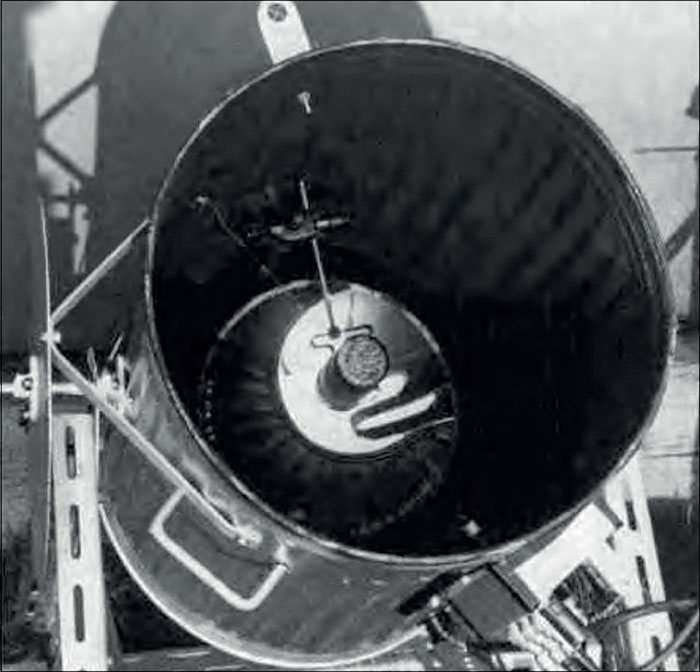
Sixty years ago, in September 1952, two young researchers at the UK’s Atomic Energy Research Establishment went out on a moonless night into a field next to the Harwell facility equipped with little more than a standard-issue dustbin containing a Second World War parabolic signalling mirror only 25 cm in diameter, with a 5 cm diameter photomultiplier tube (PMT) at its focus, along with an amplifier and an oscilloscope. They pointed the mirror at the night sky, adjusted the thresholds on the apparatus and for the first time detected Cherenkov radiation produced in the Earth’s atmosphere by cosmic rays (Galbraith and Jelley 1953).
William (Bill) Galbraith and John Jelley were members of Harwell’s cosmic-ray group, which operated an array of 16 large-area Geiger-Müller counters for studying extensive air showers (EAS) – the huge cascades of particles produced when a primary cosmic particle interacts in the upper atmosphere. Over several nights, by forming suitable coincidences between the Geiger-Müller array and their PMT, Jelley and Galbraith demonstrated – unambiguously – a correlation between signals from the array and light pulses of short duration (<200 ns) with amplitudes exceeding 2–3 times that of the night-sky noise. By cross-calibrating with alpha particles from a 239Pu source, they were further able to estimate that they were detecting three photons per square centimetre per light flash in the wavelength range of 300–550 nm. A new age of Cherenkov astronomy was born.
The sky at night
Five years before this observation, at a meeting of the Royal Society’s Gassiot Committee in July 1947 on “The emission spectra of the night sky and aurorae”, Patrick Blackett had presented a paper in which he suggested, for the first time, that Cherenkov radiation emitted by high-energy cosmic rays should contribute to the light in the night sky. Blackett estimated the contribution of cosmic-ray-induced Cherenkov light to be 0.01% of the total intensity, concluding: “Presumably such a small intensity of light could not be detected by normal methods.” Blackett’s work went largely unnoticed until a chance meeting at Harwell in 1952, which Jelley later recounted (Jelley 1986): “… hearing of our work on Cherenkov light in water, [Blackett] quite casually mentioned that … he had shown that there should be a contribution to the light of the night sky, amounting to about 10–4 of the total, due to Cherenkov radiation produced in the upper atmosphere from the general flux of cosmic rays.” Jelley continued: “Blackett was only with us a few hours, and neither he nor any of us ever mentioned the possibility of pulses of Cherenkov light, from EAS. It was a few days later that it occurred to Galbraith and myself that such pulses might exist and be detectable.”
The work of 1952 demonstrated the presence of short-duration pulses of light in coincidence with EAS but it did not prove that the light was, indeed, Cherenkov radiation. In particular, Galbraith and Jelley were aware that the light that they had observed could be also be produced either by bremsstrahlung or by recombination following ionization in the atmosphere. Thus, in the summer of 1953, they set out to establish the Cherenkov nature of the light pulses that they had observed.
Daunted by the vagaries of the British weather, they headed to the Pic du Midi observatory in France where, over six moonless weeks in July to September 1953, they carried out a series of experiments to determine the polarization and directionality of the light and also performed a rudimentary wavelength determination. This time they were equipped with four mirrors and two types of PMT. Conscious that the light-pulse counting rate would change with the noise level of the night sky, which in turn would depend on which part of the sky they were looking at, they devised a method of keeping the mean PMT current and, hence the noise, constant by using a small lamp next to the mirror.
Experimental conditions at the top of the mountain were challenging. EAS correlations were provided by requiring coincidences of signals from the PMTs with those from a linear array of five trays of Geiger-Müller counters, each tray 800 cm2 in area and aligned over almost 75 m – the positioning of these units was somewhat limited by the available space on the mountain (Galbraith and Jelley 1955). PMT pulses were recorded on an oscilloscope and subsequently photographed. Evidence for polarization of the observed light, a known characteristic of Cherenkov radiation, was clearly established by taking readings of a PMT with a polarizer placed over the PMT’s photocathode and calculating the ratio of the number of events seen when the polarizer was aligned parallel or perpendicular to the Geiger-Müller array. The result was a ratio of 3.0±0.5 to 1 for events seen in coincidence with two Geiger-Müller counter trays (Jelley and Galbraith 1955).
The two researchers also investigated the directionality of the observed light by plotting the coincidence rate of pulses seen in two light receivers (normalized accordingly) as a function of the angle between the two receivers. This experiment was done using pairs of receivers 1 m apart and was repeated with mirrors having different fields of view. The results fell between the two theoretical curves for Cherenkov and ionization light but they gave additional support for the premise that the light being observed was, indeed, Cherenkov light. In addition, the use of wide-band filters enabled Galbraith and Jelley to demonstrate that the light contained more blue light than green, which was another expected feature of Cherenkov radiation.
During their studies on the Pic du Midi, Jelley and Galbraith went on to explore the relationship between the light yield in the atmosphere and the energy of the shower, confirming, as expected, that larger light pulses were correlated with showers with higher particle densities. Finally, aware that their light receivers had both a considerable effective area and good angular resolution, they went on to search for possible point sources of cosmic rays in the night sky. The search yielded no statistically significant variations, and Galbraith and Jelley subsequently estimated that the receiver was sensitive to showers of energies of 1014 eV and above.
Following these studies in the early 1950s, it soon became apparent that use of the atmosphere as a Cherenkov radiator was a viable experimental technique. By the end of the decade, Cherenkov radiation in the atmosphere had been developed further as a means for studying cosmic rays – far away from the generally unsuitable British climate. In the Soviet Union, Aleksandr Chudakov and N M Nesterova of the Lebedev Physical Institute deployed a series of large-area Geiger counters along with eight light receivers at 3800 m in the Pamir Mountains to detect the lateral distribution of the Cherenkov light and thereby study the vertical structure of cosmic-ray showers. In Australia, around the same time, Max Brennan and colleagues of the University of Sydney used two or more mis-aligned light receivers to demonstrate the effects of Coulomb scattering of the charged particles in the cosmic-ray shower.
Meanwhile, at the International Cosmic Ray Conference in Moscow in 1959, Giuseppe Cocconi made a key theoretical prediction – that the Crab Nebula should be a strong emitter of gamma rays at tera-electron-volt energies. This stimulated further work, both by a British–Irish collaboration that included Jelley, and by Chudakov and his colleagues. The work at the Lebedev Physical Institute led in the early 1960s to the construction of the first air-Cherenkov telescope, with 12 searchlight mirrors, each 1.5 m in diameter and mounted on railway cars at a site in the Crimea close to the Black Sea.
The legacy
So, just a decade after the initial pioneering steps by Galbraith and Jelley, the first operational air-Cherenkov telescope had been built, setting in motion a chain of events that would ultimately lead in 1989 to the observation of gamma rays from the Crab Nebula by Trevor Weekes and colleagues at the Whipple telescope in the US. This breakthrough came nearly 25 years after Weekes had worked with Jelley in a collaboration between AERE and the University College Dublin, making the first attempts to detect gamma rays from quasars – a feat achieved only recently by the MAGIC air-Cherenkov telescope in the Canary Islands. Now, researchers around the world are teaming up to build the most sensitive telescope of this kind yet – the Cherenkov Telescope Array (Cherenkov Telescope Array is set to open new windows).
In writing only a few years ago about the work at Harwell, Weekes stated: “The account of these elegant experiments is a must-read for all newcomers to the field” (Weekes 2006). He also summed up well that first experiment by Galbraith and Jelley: “It is not often that a new phenomenon can be discovered with such simple equipment and in such a short time, but it may also be true that it is not often that one finds experimental physicists with this adventurous spirit!”
By Claude Leroy and Pier-Giorgio Rancoita World Scientific
Hardback: £153 $232
E-book: $302
Like its predecessors, this third edition addresses the fundamental principles of the interaction between radiation and matter and the principles of particle detection and detectors in a range of fields, from low to high energy, and in space physics and the medical environment. It provides abundant information about the processes of electromagnetic and hadronic energy deposition in matter, detecting systems, and performance and optimization of detectors, with additional information in the third edition. A part of the book is also directed towards courses in medical physics.
By Michael Mark Woolfson Imperial College Press
Hardback: £65 $98
Paperback: £32 $48
E-book: £87 $127
The range of imaging tools, both in the type of wave phenomena used and in the devices that utilize them, is vast. This book illustrates this range, with wave phenomena that cover the entire electromagnetic spectrum, as well as ultrasound, and devices that vary from those that simply detect the presence of objects to those that produce images in exquisite detail. The aim also is to give an understanding of the principles behind the imaging process and a general account of how those principles are utilized, without delving into the technical details of the construction of specific devices.
To provide the best experiences, we use technologies like cookies to store and/or access device information. Consenting to these technologies will allow us to process data such as browsing behavior or unique IDs on this site. Not consenting or withdrawing consent, may adversely affect certain features and functions.
Functional
Always active
The technical storage or access is strictly necessary for the legitimate purpose of enabling the use of a specific service explicitly requested by the subscriber or user, or for the sole purpose of carrying out the transmission of a communication over an electronic communications network.
Preferences
The technical storage or access is necessary for the legitimate purpose of storing preferences that are not requested by the subscriber or user.
Statistics
The technical storage or access that is used exclusively for statistical purposes.The technical storage or access that is used exclusively for anonymous statistical purposes. Without a subpoena, voluntary compliance on the part of your Internet Service Provider, or additional records from a third party, information stored or retrieved for this purpose alone cannot usually be used to identify you.
Marketing
The technical storage or access is required to create user profiles to send advertising, or to track the user on a website or across several websites for similar marketing purposes.