By Eugenio Nappi and Vladimir Peskov Wiley-VCH
Hardback: €139
Paperback: €124.99
For those who belong to the Paleozoic era of R&D on gas detectors, this book evokes nostalgic memories of the hours spent in dark laboratories chasing sparks under black cloths, chasing leaks with screaming “pistols”, taming coronas with red paint and yellow tape and, if you belonged to the crazy ones of Building 28 at CERN, sharing a glass of wine and the incredible maggoty Corsican cheese with Georges Charpak. Subtitle it “The sorcerer’s Apprentice”, and an innocent student might think they have entered the laboratory of Merlin: creating electrons from each fluttering photon, making magical mixtures of liquids, exotic vapours, funny thin films and all of the strange concoctions that inhabited the era of pioneering R&D and led step-by-step to today’s devices.
The historical memory behind this book recalls all sorts of gaseous detectors that have been dreamt up by visionary scientists over the past 50 years: drift chambers, the ambitious time-projection chamber, resistive plate chambers, ring-imaging Cherenkov counters, parallel-plate avalanche counters, gas electron multipliers, Micromegas, exotic micro-pattern gaseous detectors (MPGDs) and more. All are included, both the ones that behaved and the ones that did not pay off – providing no excuse for anyone to re-make mistakes after reading the book. All of the basic processes that populate gas counters are reviewed and their functioning and limitations are explained in a simple and concise manner offering, to the attentive reader, key secrets and the solutions to obviate hidden traps. From the basic ionization processes to the trickiness of the streamer and breakdown mechanism, from the detection of a single photon to the problems of high rates – only lengthy, hands-on experience supported by a profound understanding of the physics of the detection processes could bring together the material that this book covers. Furthermore, it includes many notable explanations that are crystal clear yet also suitable for the theoretical part of a high-profile educational course.
Coming to more recent times, the use of microelectronics techniques in the manufacturing process of gas counters has paved the road to the new era of MPGDs. The authors follow this route, the detector designs and the most promising future directions and applications, critically but with great expectation, leaving the reader confident of many developments to come.
Each of us will find in this book some corner of our own memory, the significance of our own gaseous detector in recent and current experiments, together with a touch of the new in exploring the many possible applications of gas counters in medicine, biology or homeland security and – when closing the book – the compelling need to stay in the lab. Chapeau!
In the autumn of 1982, I was invited to give a series of seven lectures at CERN under the title “Electroweak Interactions”. These were part of the Academic Training Programme, which was aimed at young experimenters working on projects at CERN. The lectures were to be given on successive days on 18–26 November, excluding the weekend of 21–22 November. I had given seminars at CERN on earlier occasions and the response had always been positive. Giving seven lectures in a row could be stressful but at least the subject was in my own domain. I expected the number of people attending to be between 50 and 100.
When I arrived to give my lecture on the first day, I was astonished to see that the auditorium was chock-full of people. (Somebody mentioned later that the number was 400.) For a moment I thought that I had wandered into the wrong auditorium. Seated in the first row were stalwarts of CERN, such as Rolf Hagedorn, Jacques Prentki, Maurice Jacob and André Martin. I could see in the crowd several experienced people whom I knew from the heyday of neutrino physics. It was not at all the kind of audience that I had expected. I began to wonder what I could tell them that they had not heard a dozen times before.
A bold venture
When the opening lecture ended I hastened to return to the dormitory to prepare my second talk. On the way I saw Jack Steinberger, one of the veterans of CERN, for whose course I had once acted as a tutor. I told him that I had come to CERN to give Academic Training lectures and he said, with dismay: “I know that. I looked for my people this morning and there was nobody around, because they had all gone to your lecture.”
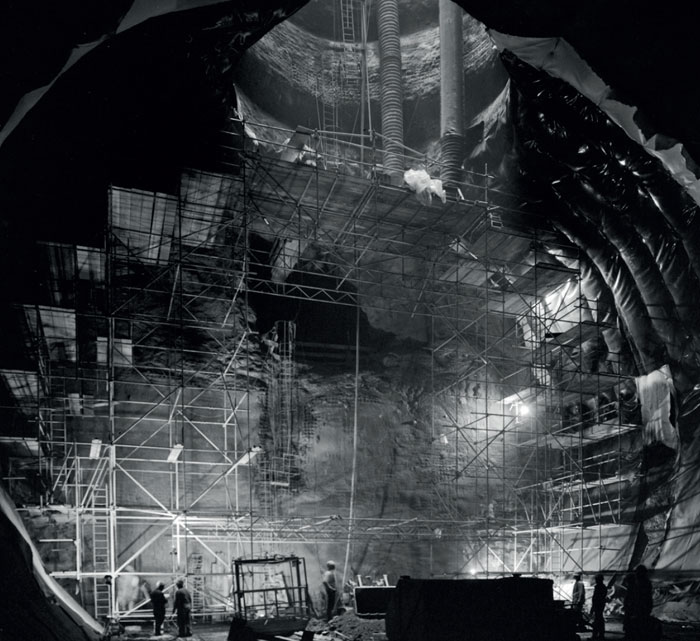
That evening I went to the CERN cafeteria for a coffee and there I saw something that I had not noticed before. There was a monitor on the wall and people were watching the screen with great interest. The monitor was showing the rate of proton–antiproton collisions in CERN’s latest challenge – a bold venture designed to produce the intermediate bosons, W and Z. These bosons were predicted by electroweak theory to occur at masses of 80 GeV and 90 GeV, respectively. The synchrotron at CERN that accelerated protons to 400 GeV was, by itself, not capable of producing such massive particles. So CERN had built a smaller ring in which antiprotons produced in conventional proton interactions were accumulated. These antiprotons were compressed to compact beams, then accelerated to 270 GeV in the Super Proton Synchrotron and finally brought into head-on collision with 270 GeV protons. And this audacious idea appeared to be working! The collision rate was low but it was climbing from hour to hour. Now I understood the reason for the crowd in my lecture. CERN was on the way to testing the crucial prediction of electroweak theory, namely the existence of intermediate bosons with masses and properties that were precisely predicted. A confirmation of this prediction would be a triumph for CERN and would probably bring the laboratory its first Nobel prize.
I returned to my room in the dormitory and resumed the writing of my overhead transparencies. I now knew that my lectures would have to focus on precisely the questions that the physicists at CERN would be interested in: the cross-sections for W and Z production; the expected event rates; the angular distribution of the W and Z decay products, etc. People would also want to know how uncertain the predictions for the W and Z masses were and why certain theorists (J J Sakurai and James Bjorken among them) were cautioning that the masses could turn out to be different. The writing of the transparencies turned out to be time consuming. I had to make frequent revisions, trying to anticipate what questions might be asked. To make corrections on the film transparencies, I was using my after-shave lotion, so that the whole room was reeking of perfume. I was preparing the lectures on a day-by-day basis, not getting much sleep. To stay awake, I would go to the cafeteria for a coffee shortly before it closed. Thereafter I would keep going to the vending machines in the basement for chocolate – until the machines ran out of chocolate or I ran out of coins.
After the fourth lecture, the room in the dormitory had become such a mess (papers everywhere and the strong smell of after-shave) that I decided to ask the secretariat for an office where I could work. Office space in CERN is always scarce but they said I could use the office that was previously occupied by Sakurai. At that point I recalled, with sorrow, his tragic and totally unexpected death that I had read about some weeks earlier. I had forgotten that he was a visitor at CERN at the time. I had high regard for him as a physicist. There was a period of some years when we were doing parallel things in connection with the structure of neutral currents. He was always fair and correct in attributing credit and was an excellent lecturer. I had met him quite recently at the Neutrino ’82 Conference in Balatonfüred and at the 1982 International Conference on High-Energy Physics in Paris. When the secretary opened the office for me, many of Sakurai’s books and papers were still in the room. Lying on his desk were a couple of preprints that he had been reading on his last day at the office. I felt uncomfortable about disturbing that scene by bringing in my own papers and I told the secretary that I would continue to work in the dormitory.
Champagne times
The lectures went well. The attendance declined after I had finished with the discussion of intermediate bosons (vector quanta) and Higgs particles (scalar quanta). On the eve of the last lecture, I went rather late to the CERN cafeteria for dinner. The place was almost deserted. I saw that there was one corner that had been screened off for a private get-together. There were sounds of a party, with clinking glasses and the pop of a champagne bottle. Glancing inside the screen, I saw Steinberger and a number of American visitors at CERN. I realised that it was Thursday and they were celebrating Thanksgiving. For a moment I had a desire to join them but my natural diffidence held me back. As I was about to leave, one person emerged from the enclosure. It was Gary Feldman from SLAC. He greeted me and said: ” I have been attending your lectures. What are you going to talk about tomorrow?” When I said CP violation he said: “What a shame. I should have loved to hear that but I have to leave in the morning.” He wished me luck.
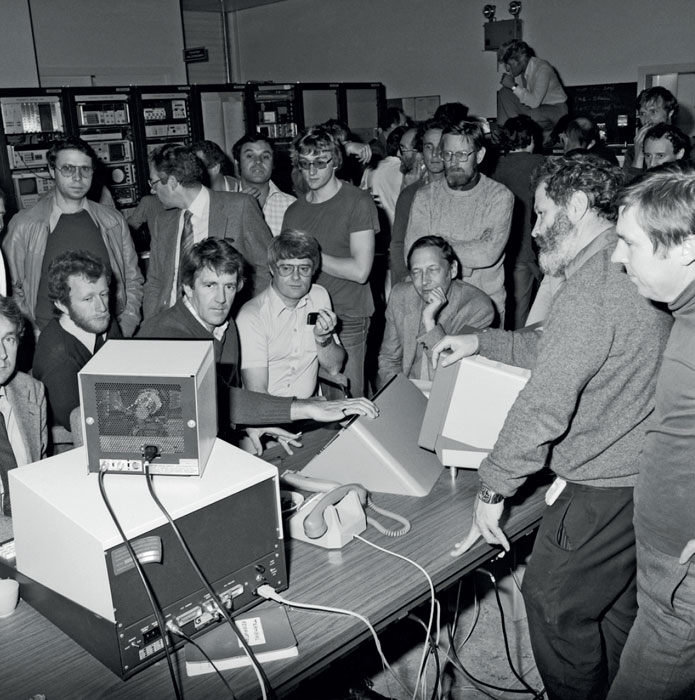
Before leaving the cafeteria, I glanced at the monitor showing the status of the beams in the collider. The luminosity was still rising. The next morning, after my final lecture, I went over to the analysis room of the UA1 experiment in which physicists from Aachen were participating. They showed me a couple of events that were candidates for the W and Z. It seemed that CERN would have occasion to open champagne bottles, before too long.
I returned to Aachen quite exhausted. I resolved not to give so many lectures again (they had asked for only four/five). I also resolved not to use after-shave as a correcting fluid. But it had been a satisfying visit. I had come to CERN at a time full of suspense. There was a scent of discovery in the air.
On 25 January 1983, eight weeks after my return, CERN held a press conference to announce the discovery of the W boson. The announcement of the Z boson followed on 1 June
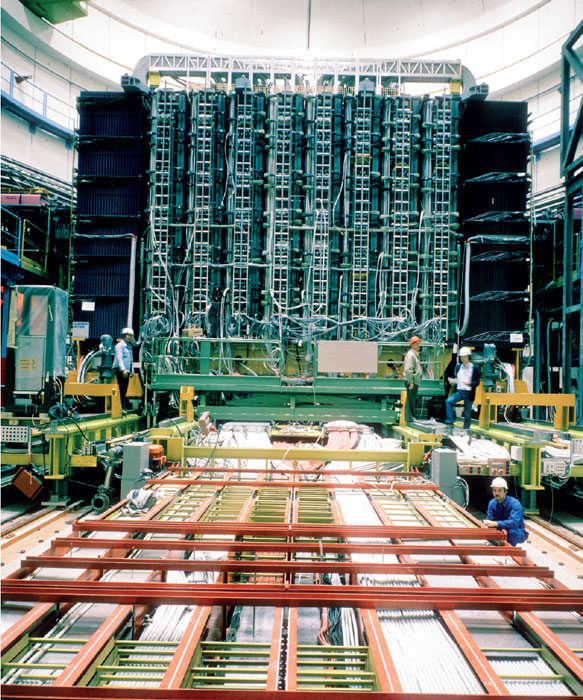
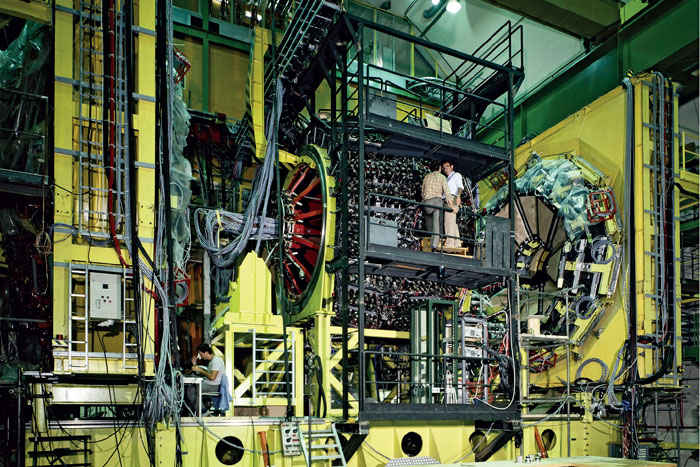
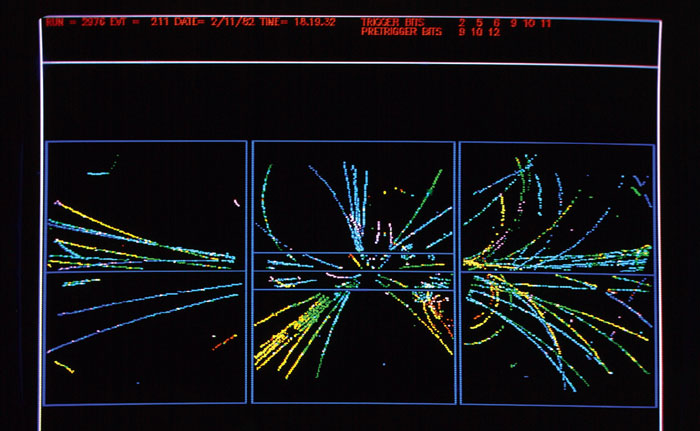
In February 1981, the Proton Synchrotron received and accelerated antiprotons from the Antiproton Accumulator, thus becoming the world’s first Antiproton Synchrotron. On 7 July, transfer to the Super Proton Synchrotron, acceleration and brief storage at 270 GeV were achieved. Carlo Rubbia delayed his departure to the Lisbon High Energy Physics Conference by a day so that on 10 July he was able to announce that the UA1 detector had seen its first proton–antiproton collisions. There were runs at modest intensities in the second half of the year and the first visual records of the collisions came from another experiment (UA5) using large streamer chambers. UA5 was then moved out to make way for UA2, which took its first data in December.
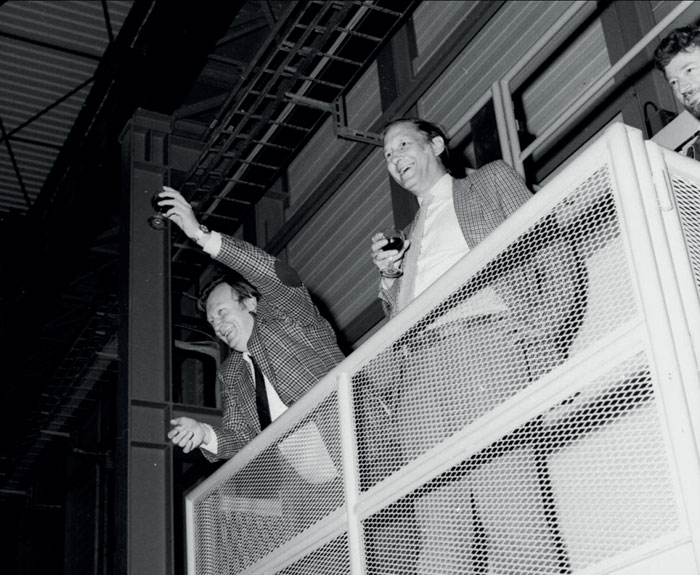
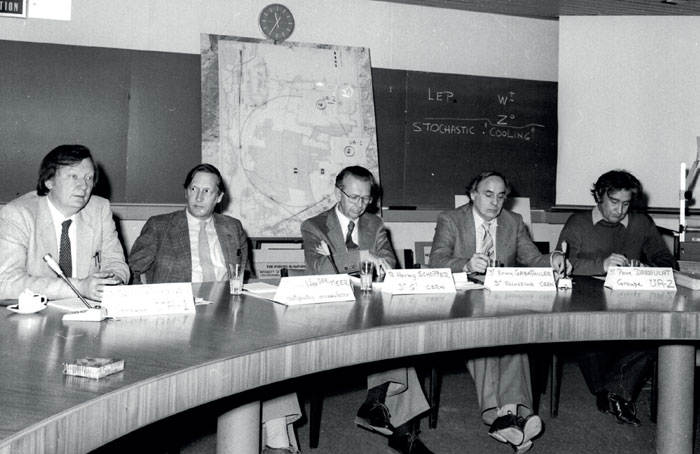
In 1982, an accident to UA1 forced a concentration of the scheduled proton–antiproton running into a single two-month period at the end of the year (October to December). In terms of operating efficiency, it proved a blessing in disguise and research director Erwin Gabathuler happily sacrificed a crate of champagne to the machine-operating crews as the collision rate was taken to 10 times that of the year before. This was the historic run in which the W particles were first observed.
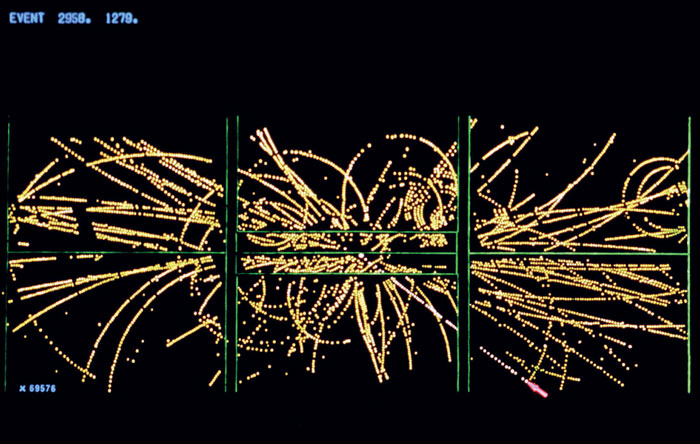
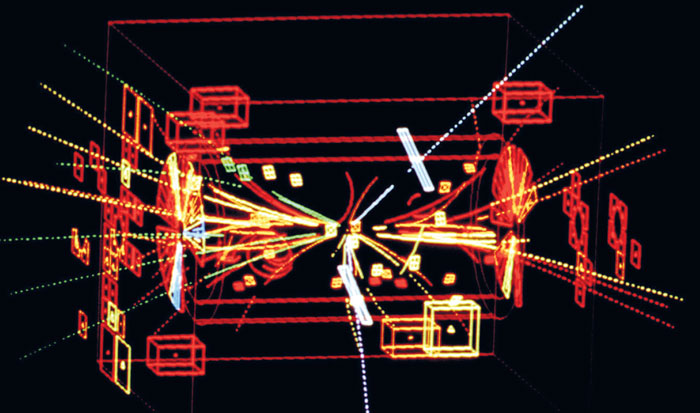
It was astonishing how fast physics results were pulled from the data accumulated up to 6 December 1982. At a Topical Workshop on Proton-Antiproton Collider Physics held in Rome from 12–14 January 1983, the first tentative evidence for observation of the W particle by the UA1 and UA2 collaborations was there. Out of the several thousand-million collisions that had been seen, a tiny handful gave signals that could correspond to the production of a W in the high-energy collision and its subsequent decay into an electron (or positron if the W was positively charged) and a neutrino. The detectors were programmed to look for high-energy electrons coming out at a relatively large angle to the beam direction. Also, energy imbalance of the particles around a decay indicated the emergence of a neutrino, which itself cannot be detected in the experimental apparatus.
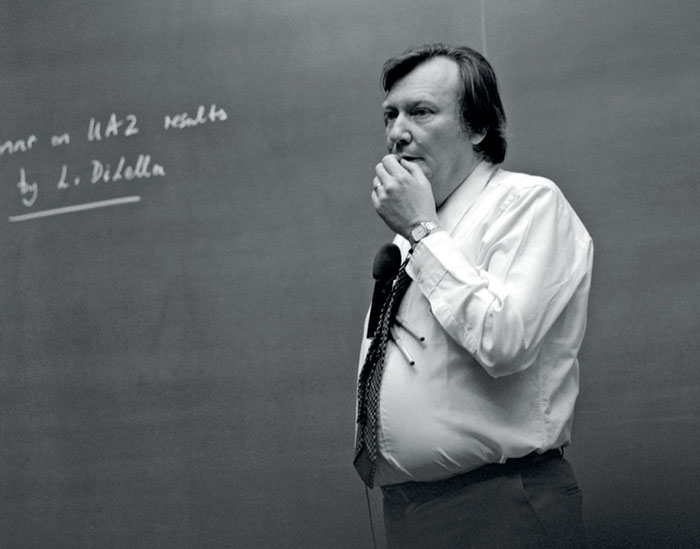
The tension at CERN became electric, culminating in two brilliant seminars, from Carlo Rubbia (for UA1) on Thursday 20 January and Luigi Di Lella (for UA2) the following afternoon, both with the CERN auditorium packed to the roof. UA1 announced six candidate W events; UA2 announced four. The presentations were still tentative and qualified. However, over the weekend of 22–23 January, Rubbia became more and more convinced. As he put it, “They look like Ws, they feel like Ws, they smell like Ws, they must be Ws”. And, on 25 January, a press conference was called to announce the discovery of the W. The UA2 team reserved judgement at this stage but further analysis convinced them also. What was even more impressive was that both teams could already give estimates of mass in excellent agreement with the predictions (about 80 GeV) of the electroweak theory.
It was always clear that the Z would take longer to find. The theory estimated its production rate to be some 10 times lower than that of the Ws. It implied that the machine physicists had to push their collision rates still higher, and this they did in style in the second historic proton–antiproton run from April to July 1983. They exceeded by 50% the challenging goal that had been set and this time it was director-general Herwig Schopper who forfeited a crate of champagne.
Again there was tension as the run began because the Z did not seem keen to show itself. Although more difficult to produce than the W, its signature is easier to spot because it can decay into an electron–positron pair or a muon pair. Two such high-energy particles flying out in opposite directions were no problem for detectors and data-handling systems that had so cleverly unearthed the W.
On 4 May, when analysing the collisions recorded in the UA1 detector a few days earlier, on 30 April, the characteristic signal of two opposite high-energy tracks was seen. Herwig Schopper reported the event at the “Science for Peace” meeting in San Remo on 5 May. However, the event was not a clean example of a particle–antiparticle pair and it was only after three more events had turned up in the course of the month that CERN went public, announcing the discovery of the Z to the press on 1 June. Again, the mass (near 90 GeV) looked bang in line with theory. Just after the run, Pierre Darriulat was able to announce in July that UA2 had also seen at least four good Z decays.
In addition to the Ws and Zs, the observed behaviour was everything that the electroweak theory predicted. Two independent experiments had confirmed a theory of breathtaking imagination and insight.
By Mohammad Saleem and Muhammad Rafique CRC Press/Taylor and Francis
Hardback: £44.99
Although group theory has played a significant role in the development of various disciplines of physics, there are few recent books that start from the beginning and then go on to consider applications from the point of view of high-energy physicists. Group Theory for High-Energy Physicists aims to fill that role. The book first introduces the concept of a group and the characteristics that are imperative for developing group theory as applied to high-energy physics. It then describes group representations and, with a focus on continuous groups, analyses the root structure of important groups and obtains the weights of various representations of these groups. It also explains how symmetry principles associated with group theoretical techniques can be used to interpret experimental results and make predictions. This concise introduction should be accessible to undergraduate and graduate students in physics and mathematics, as well as to researchers in high-energy physics.
By Chun Wa Wong Oxford University Press
Hardback: £45 $84.95
Introduction to Mathematical Physics explains how and why mathematics is needed in the description of physical events in space. Aimed at physics undergraduates, it is a classroom-tested textbook on vector analysis, linear operators, Fourier series and integrals, differential equations, special functions and functions of a complex variable. Strongly correlated with core undergraduate courses on classical and quantum mechanics and electromagnetism, it helps students master these necessary mathematical skills but also contains advanced topics of interest to graduate students. It includes many tables of mathematical formulae and references to useful materials on the internet, as well as short tutorials on basic mathematical topics to help readers refresh their knowledge. An appendix on Mathematica encourages the reader to use computer-aided algebra to solve problems in mathematical physics. A free Instructor’s Solutions Manual is available to instructors who order the book.
By Milutin Blagojevićand Friedrich W Hehl (eds.) World Scientific
Hardback: £111 $168 S$222
With a foreword by Tom Kibble and commentaries by Milutin Blagojević and Friedrich W Hehl, the aim of this volume is to introduce graduate and advanced undergraduate students of theoretical or mathematical physics – and other interested researchers – to the field of classical gauge theories of gravity. Intended as a guide to the literature in this field, it encourages readers to study the introductory commentaries and become familiar with the basic content of the reprints and the related ideas, before choosing specific reprints and then returning to the text to focus on further topics.
By Ian D Lawrie CRC Press/Taylor and Francis
Paperback: £44.99
A Unified Grand Tour of Theoretical Physics invites readers on a guided exploration of the theoretical ideas that shape contemporary understanding of the physical world at the fundamental level. Its central themes – which include space–time geometry and the general relativistic account of gravity, quantum field theory and the gauge theories of fundamental forces – are developed in explicit mathematical detail, with an emphasis on conceptual understanding. Straightforward treatments of the Standard Model of particle physics and that of cosmology are supplemented with introductory accounts of more speculative theories, including supersymmetry and string theory. This third edition includes a new chapter on quantum gravity and new sections with extended discussions of topics such as the Higgs boson, massive neutrinos, cosmological perturbations, dark energy and dark matter.
By Anton Rebhan, Ludmil Katzarkov, Johanna Knapp, Radoslav Rashkov and Emanuel Scheidegger (eds.) World Scientific
Hardback: £104
E-book: £135
This book contains invited contributions from collaborators of Maximilian Kreuzer, a well known string theorist who built a sizeable group at Vienna University of Technology (TU Vienna) but sadly died in November 2010 aged just 50. Victor Batyrev, Philip Candelas, Michael Douglas, Alexei Morozov, Joseph Polchinski, Peter van Nieuwenhuizen and Peter Wes are among others giving accounts of Kreuzer’s scientific legacy and original articles. Besides reviews of recent progress in the exploration of string-theory vacua and corresponding mathematical developments, Part I reviews in detail Kreuzer’s important work with Friedemann Brandt and Norbert Dragon on the classification of anomalies in gauge theories. Similarly, Part III contains a user manual for a new thoroughly revised version of PALP (Package for Analysing Lattice Polytopes with applications to toric geometry), the software developed by Kreuzer and Harald Skarke at TU Vienna.
By Alexander W Chao and Weiren Chou (ed.) World Scientific
Hardback: £111
E-book: £144
Of about 30,000 accelerators at work in the world today, a majority of these are for applications in industry. This volume of Reviews of Accelerator Science and Technology contains 14 articles on such applications, all by experts in their respective fields. The first eight articles review various applications, from ion-beam analysis to neutron generation, while the next three discuss accelerator technology that has been developed specifically for industry. The twelfth article tackles the challenging subject of future prospects in this rapidly evolving branch of technology. Last, the volume features an article on the success story of CERN by former director-general, Herwig Schopper, as well as a tribute to Simon van der Meer, “A modest genius of accelerator science”.
The Compact Linear Collider (CLIC) and the International Linear Collider (ILC) – two studies for next-generation projects to complement the LHC – now belong to the same organization. The Linear Collider Collaboration (LCC) was officially launched on 21 February at TRIUMF, Canada’s national laboratory for particle and nuclear physics.
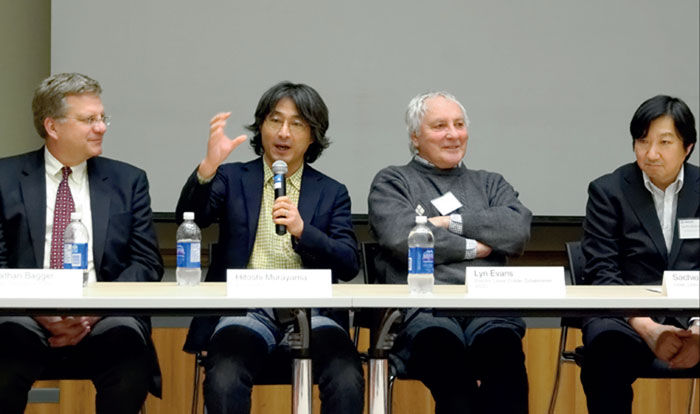
The ILC and CLIC have similar physics goals but use different technologies and are at different stages of readiness. The teams working on them have now united in the new organization to make the best use of the synergies between the two projects and to co-ordinate and advance the global development work for a future linear collider. Lyn Evans, former project leader of the LHC, heads the LCC, while Hitoshi Murayama, director of the Kavli Institute for the Physics and Mathematics of the Universe, is deputy-director.
The LCC has three main sections, reflecting the three areas of research that will continue to be conducted. Mike Harrison of Brookhaven National Laboratory leads the ILC section, Steinar Stapnes of CERN leads the CLIC section and Hitoshi Yamamoto of Tohoku University leads the section for physics and detectors. The Linear Collider Board (LCB), with the University of Tokyo’s Sachio Komamiya at the head, is a new oversight committee for the LCC. Appointed by the International Committee for Future Accelerators, the LCC met for the first time at TRIUMF in February. The ILC’s Global Design Effort and its supervisory organization, the ILC Steering committee, officially handed over their duties to the LCC and LCB in February but they will continue to work together until the official completion of the Technical Design Report for the ILC.
Both the ILC and CLIC will continue to exist and carry on their R&D activities – but with even more synergy between common areas. These include the detectors and the planning of infrastructure, as well as civil-engineering and accelerator aspects. The projects are at different stages of maturity. The CLIC collaboration published its Conceptual Design Report in 2012 and is scheduled to complete the Technical Design Report, which demonstrates feasibility for construction, in a couple of years.
For the ILC collaboration, which will publish its Technical Design Report in June this year, the main focus is on preparing for possible construction while at the same time further advancing acceleration technologies, industrialization and design optimization. The final version of the report will include a new figure for the projected cost. The current estimate is 7.8 thousand million ILC Units (1 ILC unit is equivalent to US$1 of January 2012), plus an explicit estimate for labour costs averaged over the three regional sites, amounting to 23 million person-hours. With the finalization of the Technical Design Report, the ILC’s Global Design Effort, led by Barry Barish, will formally complete its mandate.
With the discovery of the Higgs-like boson at the LHC, the case for a next-generation collider in the near future has received a boost and researchers are thinking of ways to build the linear collider in stages: first as a so-called Higgs factory for the precision studies of the new particle; second at an energy of 500 GeV; and third, at double this energy, to open further possibilities for as yet undiscovered physics phenomena. Japan is signalling interest to host the ILC.
“Now that the LHC has delivered its first and exciting discovery, I am eager to help the next project on its way,” says Evans. “With the strong support the ILC receives from Japan, the LCC may be getting the tunnelling machines out soon for a Higgs factory in Japan while at the same time pushing frontiers in CLIC technology.”
To provide the best experiences, we use technologies like cookies to store and/or access device information. Consenting to these technologies will allow us to process data such as browsing behavior or unique IDs on this site. Not consenting or withdrawing consent, may adversely affect certain features and functions.
Functional
Always active
The technical storage or access is strictly necessary for the legitimate purpose of enabling the use of a specific service explicitly requested by the subscriber or user, or for the sole purpose of carrying out the transmission of a communication over an electronic communications network.
Preferences
The technical storage or access is necessary for the legitimate purpose of storing preferences that are not requested by the subscriber or user.
Statistics
The technical storage or access that is used exclusively for statistical purposes.The technical storage or access that is used exclusively for anonymous statistical purposes. Without a subpoena, voluntary compliance on the part of your Internet Service Provider, or additional records from a third party, information stored or retrieved for this purpose alone cannot usually be used to identify you.
Marketing
The technical storage or access is required to create user profiles to send advertising, or to track the user on a website or across several websites for similar marketing purposes.