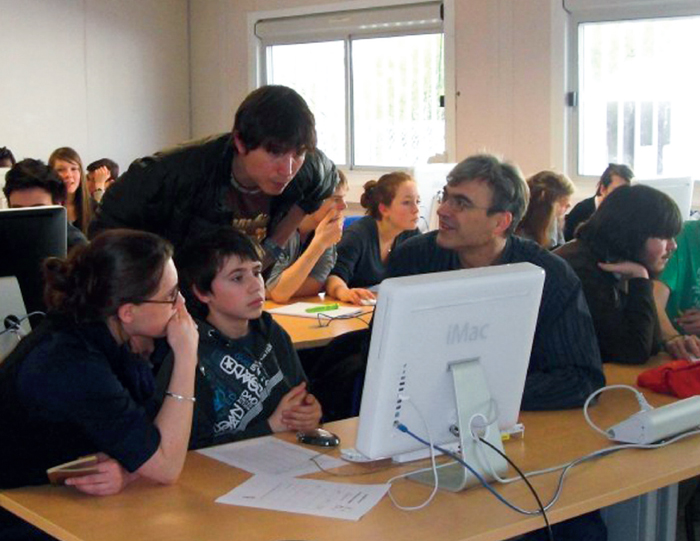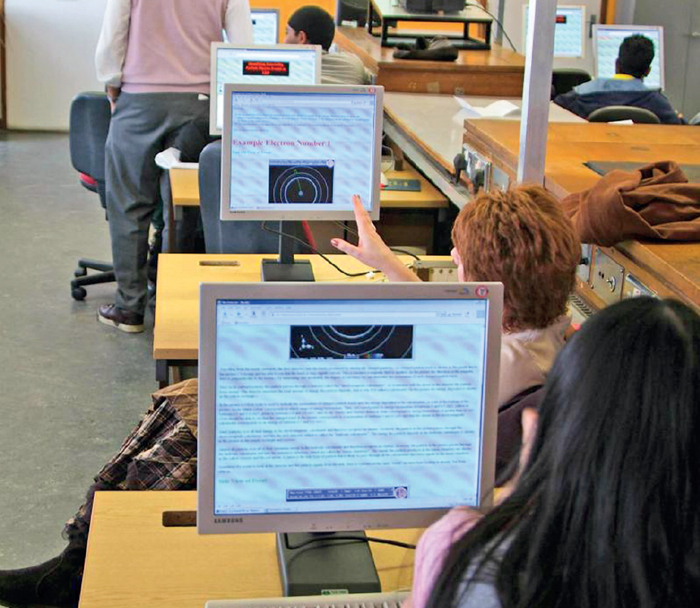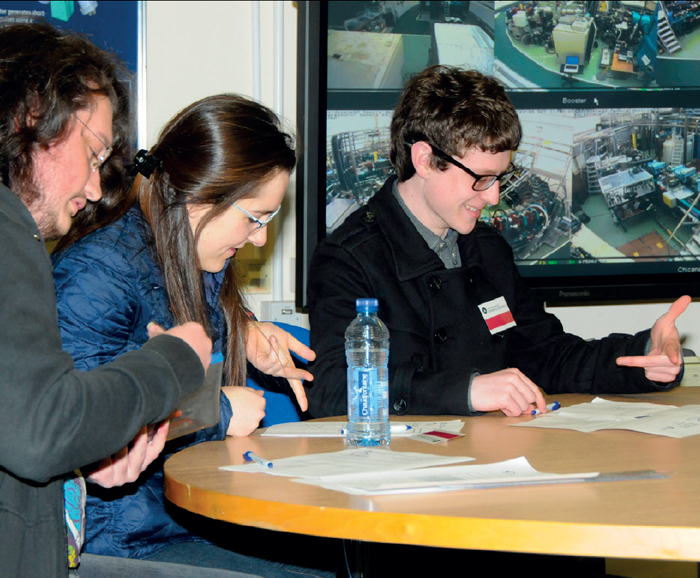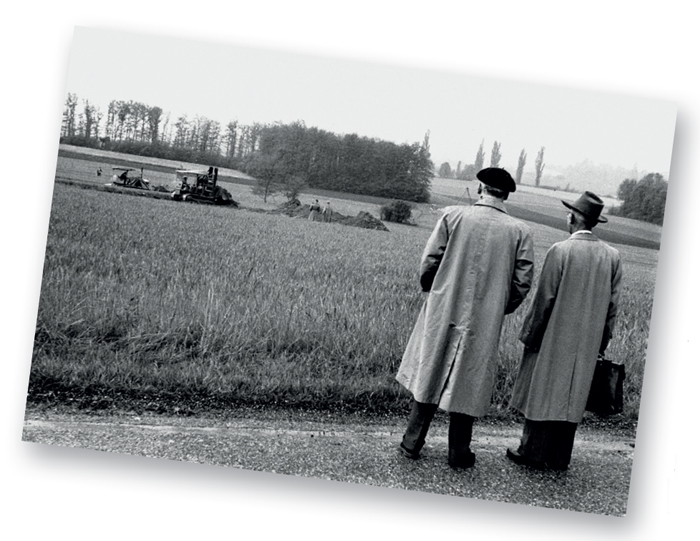
CERN Open Days 2013 saw 70,000 people visit more than 40 activities on the surface across CERN’s Meyrin and Prévessin sites, with 20,000 of them able to see something of the accelerators and detectors underground. Highlights for visitors included seeing one of the large experiments on the LHC – ALICE, ATLAS, CMS or LHCb – or operating robotic arms and forklift trucks, or even making superconducting magnets levitate. A taskforce of 2300 volunteers acted as guides and helpers, explaining the variety of activities at CERN – from particle physics and computing to logistics and firefighting – to enthusiasts young and old.
As well as the public open days on Saturday and Sunday, events before and after made this a weekend to remember. On Friday 27 September, CERN welcomed local officials and industrial contacts from throughout its member states for exclusive tours of the laboratory. In the evening – and to celebrate European Researchers’ Night – CERN and the Istituto Nazionale di Astrofisica organized “Origins 2013”, an event that included simultaneous activities at CERN, Paris and Bologna, with participation from UNESCO, ESA, ESO and INFN. During a webcasted event in the Globe of Science and Innovation at CERN, those onstage took questions both from the audience and online.
There was also a flurry of activity on social media. Online events began with a CERN tweetup on Friday, when 12 lucky people visited CERN as citizen journalists to share their exclusive preview of the open days with the world via Twitter.
• Max Brice, the CERN photographer, led a team of 26 photographers recording the open-days’ events, with Anna Pantelia, Fons Rademakers, Laurent Egli, Mike Struick, Didier Steyaert, Mathieu Augustin, Pierre Gildemyn, Matthias Schroder, Dmytro Kovalskyi, Lelia Laureyssens, Sylvain Chapeland, Jan Fiete Grosse-Oetringhaus, Antonella Vitale, Jean-Francois Marchand, Neli Ivanova, Olga Driga, Doris Chromek-Burckhart, Sebastian Lopienski, Tomek photographe, Nicolas Voumard, Erwin van Hove, Stephan Russenschuck, Ilknur Colak, Laura Rossi and Alban Sublet. A selection of photographs is shown here, for many more, see http://cds.cern.ch/collection/Open Days 2013 Photos.
Translated by Bertrand Nicquevert, a research engineer at CERN, this French edition also contains a preface by Lyn Evans, former LHC project leader, and a postface written by the translator together with ATLAS physicist Pauline Gagnon, Indiana University. For a review of the English edition see CERN Courier July/August 2013 p52.
Par Gilles Cohen-Tannoudji et Michel Spiro. Postface de Michel Serres. Gallimard
Broché: €9.90
Format numérique: €9.40
Gilles Cohen-Tannoudji et Michel Spiro revisitent plusieurs siècles de physique, en s’attardant bien sûr sur le XXe, qui a vu les révolutions de la théorie de la relativité et de la mécanique quantique. Si la partie consacrée au passage de la mécanique quantique à la théorie quantique des champs n’est pas de lecture vraiment aisée pour le non-spécialiste, celui-ci peut vite retrouver le rythme grâce à l’introduction des diagrammes et amplitudes de Feynman, qui sont une mise en musique de la théorie dynamique des interactions fondamentales. Le Modèle standard est évoqué rapidement, ainsi que les théories de jauge. La nécessité de mécanisme de BEH (pour Brout, Englert et Higgs) est alors introduite avec l’émergence des masses. Il faut noter que jamais les auteurs ne se laissent aller au raccourci facile de l’expression ” boson de Higgs ” ni ne parlent de ” particule de Dieu ” : tout au long de l’ouvrage, le boson est nommé, à juste titre, ” BEH “.
Le non-physicien devra s’armer de courage pour parcourir le chapitre sur la chromodynamique quantique mais en sera récompensé en découvrant l’explication de l’énigmatique titre du livre, qui associe le boson et le chapeau mexicain.
L’histoire du CERN, de sa compétition avec les laboratoires à accélérateurs d’outre-Atlantique et de ses succès, tient une grande place dans ce livre. Les auteurs n’hésitent pas à développer les aspects techniques de l’aventure. Le plaisir que j’ai eu à lire ce livre a été d’autant plus grand que j’ai eu le privilège d’interagir avec Michel Spiro durant son mandat de président du Conseil du CERN. Il m’appelait souvent tôt le matin afin d’avoir des nouvelles de la santé du LHC et voulait savoir pourquoi on ne poussait pas plus rapidement les performances de cette fantastique machine à découvertes. C’est dire l’importance qu’il attache à la découverte du boson BEH, annoncée le 4 juillet 2012 au CERN : consécration d’une longue traque mondiale qui n’a pu être obtenue que grâce à la conception, à la construction et à la mise en service de l’accélérateur LHC.
Les aspects politiques du CERN ne sont pas oubliés : ils sont décrits comme des ingrédients essentiels du succès de l’organisation, et cette description est magistralement développée dans la postface de Michel Serres, ode au CERN et à son mode de gouvernance, o¥ le philosophe défend l’idée que le modèle fonctionne si bien qu’il devrait être reproduit dans d’autres domaines des sciences. Cette postface remarquable de clarté et de richesse aurait pu être mieux valorisée – si le texte avait servi de préface, il aurait permis au lecteur de mesurer encore mieux le rôle du CERN dans la découverte du boson.
Ce livre, que les auteurs ont voulu à moins de 10 €, est écrit dans la langue de Louis de Broglie et François de Rose, pères fondateurs du CERN. Il décrit avec précision et passion la quête du boson BEH qui ouvre les portes la physique au-delà du Modèle standard. Ne boudons pas cette chance de pouvoir lire un tel ouvrage en français !
Il précise que l’aventure n’est pas terminée. Le boson BEH n’est qu’une étape et de nombreuses questions demeurent : le Modèle standard ne décrit que 4% de la matière de l’Univers. Comme le mentionnent les auteurs, il faut dès maintenant semer les graines des prochaines technologies des accélérateurs et des détecteurs afin d’être en mesure de construire les machines post-LHC. En fonction des résultats du LHC quand il fonctionnera à une énergie de 13–14 TeV après le long arrêt technique de 2013–2014, il faudra financer et construire un accélérateur capable d’atteindre des énergies proches de 100 TeV.
By Ian J R Aitchison and Anthony J G Hey CRC Press
Hardback: £82
The fourth edition of this well-established, highly regarded two-volume set continues to provide a fundamental introduction to advanced particle physics while incorporating new experimental results, especially in the areas of CP violation and neutrino oscillations. It offers an accessible and practical introduction to the three gauge theories included in the Standard Model of particle physics: QED, QCD and the Glashow-Salam-Weinberg (GSW) electroweak theory.
In the first volume, a new chapter on Lorentz transformations and discrete symmetries presents a simple treatment of Lorentz transformations of Dirac spinors. Along with updating experimental results, this edition also introduces Majorana fermions at an early stage, making the material suitable for a first course in relativistic quantum mechanics.
Covering much of the experimental progress made in the past 10 years, the second volume remains focused on QCD and the GSW electroweak theory – the two non-Abelian quantum gauge field theories of the Standard Model – and includes a new chapter on CP violation and oscillation phenomena. This new edition also discusses the exciting discovery of a boson with properties consistent with those of the Standard Model Higgs boson. It also updates many other topics, including jet algorithms, lattice QCD, effective Lagrangians, and three-generation quark mixing and the Cabibbo-Kobayashi-Maskawa matrix.
The ILC site evaluation committee of Japan has announced the result of the assessment of the two candidate sites for an International Linear Collider (ILC). In a press conference held at the University of Tokyo on 23 August, the committee recommended the Kitakami mountains in the Iwate and Miyagi prefectures as the preferred location.
The search for an appropriate candidate site for the construction of an ILC in Japan has been ongoing since 1999, with more than 10 candidates announced in 2003. In 2010, the list was further reduced to two, consisting of Kitakami in the north-east of the main island of Japan and Sefuri in Kyushu, on Japan’s south-west island. The process to assess these two remaining candidates to narrow them down from a scientific point of view began in January this year.
A site-evaluation committee of eight members was formed within Japan. In addition, two sub-committees of 16 technical experts and 12 socio-environmental experts were created separately to provide expertise on issues such as geological conditions, environmental impact, possible problems during construction and the social infrastructure of each candidate site.
After more than 300 hours of meetings, the site-evaluation committee made a tentative choice in early July. This choice was then submitted and reviewed by an international review committee. The committee recognized that the process to choose the site had been conducted with great care and that the selected site has excellent geological conditions for tunnelling and stability.
• For more information, see the Japanese ILC Strategy Council website http://ilc-str.jp/.
The origins of the LHC trace from the early 1980s, in the days when construction of the tunnel for the Large Electron–Positron (LEP) collider was just getting under way. In 1983, Steve Myers was given an unexpected opportunity to travel to the US and participate in discussions on future proton colliders. He recalls: “None of the more senior accelerator physicists was available, so I got the job.” This journey, it turned out, was to be the start of his long relationship with the LHC.
Myers appreciated the significance for CERN of the discussions in the US: “We knew this was going to be the future competition and I wanted to understand it extremely well.” So he readied himself thoroughly by studying everything on the subject that he could. “With the catalyst that I had to prepare myself for the meeting, I looked at all aspects of it,” he adds. After returning to CERN, he thought about the concept of a proton collider in the LEP tunnel and wrote up his calculations, together with Wolfgang Schnell. “Wolfgang and I had many discussions and then we had a very good paper,” he says.
The paper (LEP Note 440) provided estimates for the design of a proton collider in the LEP tunnel and was the first document to bring all of the ideas together. It raised many of the points that were subsequently part of the LHC design: 8 TeV beam energy, beam–beam limitation (arguing the case for a twin-ring accelerator), twin-bore magnets and the need for magnet development, problems with pile-up (multiple collisions per bunch-crossing) and impedance limitations.
After Myers’ initial investigations, the time was ripe to develop active interest in a future hadron collider at CERN
After Myers’ initial investigations, the time was ripe to develop active interest in a future hadron collider at CERN. A dedicated study group was established in late 1983 and the significant Lausanne workshop took place the following year, bringing experimental physicists together with accelerator experts to discuss the feasibility of the potential LHC. Then began the detailed preparation of the project design.
In the meantime in the US, the Superconducting Super Collider (SSC) project had been approved. Myers was on the accelerator physics subcommittee for both of the major US Department of Energy reviews of the SSC, in 1986 and 1990. He recalls that the committee recommended a number of essential improvements to the proposed design specification, which ultimately resulted in spiralling costs, contributing to the eventual cancellation of the project. “The project parameters got changed, the budget went up and they got scrapped in the end.”
The LHC design, being constrained by the size of the LEP tunnel, could not compete with the SSC in terms of energy. Strategically, however, the LHC proposal compensated for the energy difference between the machines by claiming a factor-10 higher luminosity – an argument that was pushed hard by Carlo Rubbia. “We went for 1034 and nobody thought we could do it, including ourselves! But we had to say it, otherwise we weren’t competitive,” Myers says, looking back. It now gives Myers enormous satisfaction to see that the LHC performance in the first run achieved a peak stable luminosity of 7.73 × 1033 cm–2 s–1, while running at low energy. He adds confidently: “We will do 1034 and much more.”
The decision to use a twin-ring construction for the LHC was of central importance because separate rings allow the number of bunches in the beam to be increased dramatically. To date, the LHC has been running with 1380 bunches and is designed to use twice that number. For comparison, Myers adds: “The best we ever did with LEP was 16 bunches. The ratio of the number of bunches is effectively the ratio of the luminosities.”
At CERN, it was difficult to make significant progress with the LHC design while manpower and resources were focused on running LEP. Things took off after the closure of LEP in 2000, when there was a major redeployment of staff onto the LHC project and detailed operational design of the machine got under way. The LHC team, led by Lyn Evans, had three departments headed by Philippe Lebrun (magnets, cryogenics and vacuum), Paulo Ciriani (infrastructure and technical services) and Myers (accelerator physics, beam diagnostics, controls, injection, extraction and beam dump, machine protection, radio frequency and power supplies).
Myers makes a typical understatement when asked about the challenges of managing a project of this size: “You do your planning on a regular basis.” This attitude provides the flexibility to exploit delays in the project in a positive way. “Every cloud has a silver lining,” he comments, illustrating his point with the stark image of thousands of magnets sitting in car parks around CERN. A delay that was caused by bad welds in the cryogenic system gave the magnet evaluation group the benefit of extra time to analyse individual magnet characteristics in detail. The magnets were then situated around the ring so that any higher-order field component in one is compensated by its neighbour, therefore minimizing nonlinear dynamic effects. Myers believes that is one of the reasons the machine has been so forgiving with the beam optics: “You spend millions getting the higher-order fields down, so you don’t have nonlinear motion and what was done by the magnet sorting gained us a significant factor on top of that.”
When asked about the key moments in his journey with the LHC, he is clear: “The big highlight for us is when the beam goes all of the way round both rings. Then you know you’re in business; you know you can do things.” To that end, he paid close attention to the potential showstoppers: “The polarities of thousands of magnets and power supplies had to be checked and we had to make sure there were no obstacles in the path of the beam.” During the phase of systematically evaluating the polarities, it turned out that only about half were right first time. There were systematic problems to correct and even differing wiring conventions to address. In addition, a design fault in more than 3000 plug-in modules meant that they did not expand correctly when the LHC was warmed up. This was a potential source of beam-path obstacles and was methodically fixed. These stories illustrate the high level of attention to detail that was necessary for the successful switch-on of the LHC on 10 September 2008.
The low point of Myers’ experience was, of course, the LHC accident on 19 September 2008, which occurred only a matter of hours after he was nominated director of accelerators and technology. The incident triggered a shutdown of more than a year for repairs and an exhaustive analysis of what had gone wrong. During this time, an unprecedented amount of effort was invested in improvements to quality assurance and machine protection. One of the most important consequences was the development of the state-of-the-art magnet protection system, which is more technically advanced than was possible at the time of the LHC design. The outcome is a machine that is extremely robust and whose behaviour is understood by the operations team.
In November 2009 the LHC was ready for testing once again. The first task was to ramp up the beam energy from the injection energy from the Super Proton Synchrotron of 0.45 TeV per beam. The process is complicated in the early stages by the behaviour of the superconducting magnets but the operations team succeeded in achieving 1.18 TeV per beam and established the LHC as the highest-energy collider ever built. By the end of March 2010, the first collisions at 7 TeV were made and from that point on the aim was to increase the collision rate by introducing more bunches with more protons per bunch and by squeezing the beam tighter at the interaction points. Every stage of this process was meticulously planned and carefully introduced, only going ahead when the machine protection team were completely satisfied.
In November 2009, when the LHC was ready to start up, both the machine and its experiments were thoroughly prepared for the physics programme ahead. The result was a spectacular level of productivity, leading to the series of announcements that culminated in the discovery of a Higgs boson. By the end of 2011 the LHC had surpassed its design luminosity for running with 3.5 TeV beams and the ATLAS and CMS experiments had seen the first hints of a new particle. The excitement was mounting and so was the pressure to generate as much data as possible. At the start of 2012, given that no magnet quenches had occurred while running with 3.5 TeV beams, it was considered safe to increase the beam energy to 4 TeV. With a collision rate of 20 MHz and levels of pile-up reaching 45, the experiments were successfully handling an almost overwhelming amount of data. Myers finds this an amazing achievement, as he says, “nobody thought we could handle the pile-up,” when the LHC was first proposed. He views the subsequent discovery announcement at CERN on 4 July 2012 as one of the most exciting moments of his career and, indeed, in the history of particle physics.
Reflecting on his journey with the LHC, Myers is keen to emphasize the importance of the people involved in its development, as well as the historical context in which it happened. In his early days at CERN in the 1970s, he was working with the Intersecting Storage Rings (ISR), which he calls “one of the best machines of its time”. As a result, “I knew protons extremely well,”he says. The experience he gained in those years has, in turn, contributed to his work on the LHC.
In the following years of building and operating LEP – as the world’s largest accelerator – many young engineers developed their expertise, just as Myers had on the ISR. “I think that’s why it worked so well,” he says, “because these guys came in as young graduates, not knowing anything about accelerators and we trained them all and they became the real experts, in the same way as I did on the ISR.” He sums up the value of this continuum of young people coming into CERN and becoming the next generation of experts: “That for me is what CERN is all about.”
From the first 3.5 TeV collisions in March 2010 to the start of the first long shutdown in March 2013, the LHC went through three years of improving performance. This led in 2012 to the discovery of a Higgs boson, which made headlines around the world and brought many accolades to CERN, including the 2013 EPS-HEPP prize (EPS-HEP2013: these are good times for physics). This issue takes a look behind the scenes at what underpinned the successful operation of the LHC during this first long run. With thanks to Theresa Harrison, Warwick University, for her editorial work with the authors of these articles. Thanks also to Jesse Karjalainen, IOP Publishing, for his work on the design of what will be his last issue of CERN Courier as he heads for pastures new after six years.
By Brian E Carpenter Springer
Paperback: £15 €21.09 $19.99
E-book: £11.99 €15.46 $9.99
In Network Geeks, Brian Carpenter weaves the history of the early internet into an entertaining personal narrative. As head of CERN’s computer-networking group throughout the 1980s, he is well placed to describe the discussions, the splits, the technical specifications and countless acronyms that made up the esoteric world of networking in the early days of the internet in Europe. Just don’t expect to be spared the technical details.
Carpenter joined CERN in 1971, at a time when computers filled entire rooms, messages were relayed by paper tape or punched card and numerous local networks ran bespoke software packages around the laboratory. Simplifying the system brought Carpenter into the world of the internet Engineering Task Force – the committee charged with overseeing the development of standards for internet technology.
I enjoyed the fictional account of a meeting of the Task Force in 1996, which gives a vivid idea of the sheer number of technical issues, documents and acronyms that the group tackled. That year, traffic was doubling every 100 days. Keeping up with the pace of change and deciding which standards and protocols to use – TCP/IP or OSI? – were emotive issues. As with any new technology, there was lobbying, competition and elements of luck. Nobody knew where the internet would lead.
Carpenter’s enthusiasm is the strength of Network Geeks. He recounts his early interest in science – a childhood of Meccano and Sputnik – with an easy nostalgia and his memories of informal meetings with often-bearded computer scientists show genuine warmth. But it is no easy read. The autobiographical narrative jumps jarringly between lyrical descriptions of the author’s youth and the rather mundane details of computer networking. At times I felt I was drowning in specifics when I was really hoping for a wider view, for implications rather than specifications.
Networks Geeks reminded me that the evolution of technology can be as much down to politics and luck as to scientific advances. It gave me a great overview of the climate in the early days on the internet. At the same, the heavy layers of jargon also reminded me why I’m no computer scientist.
By Chandra Wickramasinghe and Kamala Wickramasinghe (ed.) World Scientific
Paperback: £28
E-book: £21
Fred Hoyle was undoubtedly among the most original thinkers of his time and one of the leading figures of 20th-century physics. From the purely scientific viewpoint, his name is associated with at least three ideas: the synthesis of heavy nuclear elements in the cores of supernovae (developed in collaboration with William Fowler, Margaret and Geoffrey Burbidge); the steady-state model of the universe (formulated together with Hermann Bondi and Thomas Gold); and some of the early applications of anthropic arguments to astrophysics and cosmology. Hoyle also contributed to many other fields – such as stellar structure, planetary formation, galactic dynamics and the origin of large-scale magnetism – where his creative imagination often made the difference.
A Journey with Fred Hoyle – now in a second edition that incorporates relevant developments that have occurred since the original was published in 2005 – is a respectful, lively and at times exciting tribute to an independent thinker, a capable teacher and an inventive scientist. It is an extremely well written collection of scientific memoirs and an intriguing journey in the realm of scientific controversies, which often accompany the achievements of those who like to think a little differently. The author started his PhD under the guidance of Hoyle in the early 1960s and was still collaborating with him in 2001 when Hoyle passed away. His narration begins in Cambridge where, from the mid-1950s to the mid-1960s, three disciplines thrived serendipitously: biology (with the monumental discovery of James Watson and Francis Crick of the famous double helix structure of genetic material); cosmology and astrophysics (with the work of Hoyle at the institute of astronomy and of Martin Ryle with the radio-astronomy group) and particle physics (with the Lucasian professorship of Paul Dirac).
The Cambridge atmosphere probably inspired a quest for the unification between astrophysics and biology – a field that later became known as astrobiology and gained funding and respect from the whole scientific community. The starting observation made by Hoyle and Wickramasinghe was that interstellar clouds are not made of ice, as originally thought in the 1950s and early 1960s, but rather of carbon. By analysing the way that interstellar dust dims starlight the authors proposed, in a crescendo, that the carbon was part of complex organic molecules and, eventually, bacteria or even viruses. This combination of science and inventiveness led to the theory of panspermia, i.e. the hypothesis that life exists throughout the universe distributed in meteorites and asteroids.
Is it really true that life on the Earth came from the cosmos? This is probably not the most relevant question. What matters here is to appreciate that the current success of astrobiology started – amid inevitable controversies – from the analysis of organic compounds in interstellar space. This is an interesting book and worth reading for those who like to follow the complicated fate of successful ideas. Recalling the title of Hoyle’s autobiography, we could say that “home” for scientists is, sometimes, “where the wind blows”.
By Richard P Feynman, Michael A Gottlieb and Ralph Leighton Basic Books
Paperback: £11.99 $16.99
Originally published in hardback not long ago (Addison Wesley 2006), Feynman’s Tips on Physics is now available as a slim paperback, complete with some additional material. It is essentially a collection of four “lost” lectures and could be thought of as four chapters that somehow didn’t make it into The Feynman Lectures on Physics – the well known three-volume set by Feynman and colleagues Robert Leighton and Matthew Sands. To complement these, Michael A Gottlieb and Ralph Leighton (Robert’s son) have added a fifth chapter with selected problems from Exercises in Introductory Physics by Leighton Sr and Rochus Vogt. To set the scene, they also include a “memoir” by Sands on the origins of the famous three books in their distinctive red covers and – new for this edition – three interviews, with Leighton Sr, Vogt and Feynman himself.
The first thing to say is that the scientific level of the four lectures is far below that of the other published lectures. The first lecture, “Prerequisites”, is an elementary reminder about the importance of learning basic calculus and vector algebra and it is unlikely that anyone reading this review will find anything new. Perhaps the main point of interest is Feynman’s discussion on how to deal with not being the top member of a group comprised of many talented people. This might provide some inspiration to bright high-school students who go from being top of their class to no longer being at the top at a good university.
The second lecture, “Laws and Intuition” attempts to explain to students the importance of having a feel for the material and using physical intuition to back up mathematical calculations. This could help students, who far too often, in my experience, just want to know “what formula to use”.
“Problems and Solutions”, the third lecture, is pitched at a slightly more advanced level. It would be suitable for a good high school student or first-year university student and covers a range of interesting topics from satellite motion to rockets (including ion and photon propulsion) as well as a couple of simple particle-physics examples: electrostatic deflection of a proton beam and the determination of the charged-pion mass.
Last, “Dynamical Effects and Their Applications”, is essentially about gyroscopes. It contains little mathematics and the technology is quite dated but it is fun to read. In fact, even the datedness of some of the material has its charm. Feynman says: “Computing is mostly analogue at the moment, but it is likely that it’ll turn into digital – in a year or two, probably – because that has no errors in it.” How things have changed since 1962!
While there is not much here for the practising physicist, it is a quick and easy read and contains many interesting things about the history of The Feynman Lectures in Physics in the introduction (and the surprising statement that there are more than 170 errors in the 3 volume set). As such, it is worth the hour or two that it will take to read – and, after all, it is Feynman. While it is unlikely to find much use as a reference work, it would make a nice gift for someone about to start studying physics – but together with the full 3-volume set.
To provide the best experiences, we use technologies like cookies to store and/or access device information. Consenting to these technologies will allow us to process data such as browsing behavior or unique IDs on this site. Not consenting or withdrawing consent, may adversely affect certain features and functions.
Functional
Always active
The technical storage or access is strictly necessary for the legitimate purpose of enabling the use of a specific service explicitly requested by the subscriber or user, or for the sole purpose of carrying out the transmission of a communication over an electronic communications network.
Preferences
The technical storage or access is necessary for the legitimate purpose of storing preferences that are not requested by the subscriber or user.
Statistics
The technical storage or access that is used exclusively for statistical purposes.The technical storage or access that is used exclusively for anonymous statistical purposes. Without a subpoena, voluntary compliance on the part of your Internet Service Provider, or additional records from a third party, information stored or retrieved for this purpose alone cannot usually be used to identify you.
Marketing
The technical storage or access is required to create user profiles to send advertising, or to track the user on a website or across several websites for similar marketing purposes.