By James Lequeux, translated from the original Naissance, évolution et mort des étoiles, published by EDP Sciences World Scientific
Paperback: £17
How stars form from interstellar matter, how they evolve and die, was understood only relatively recently. All of these aspects are covered in this book by Lequeux, who directed the Marseilles observatory from 1983 to 1988 and served for 15 years as chief editor of the European journal Astronomy & Astrophysics. The text is accompanied by many images, while the theory is explained as simply as possible, but without avoiding mathematical or physical developments when they are necessary for a good understanding of what happens in stars.
By Paul Baillon World Scientific
Hardback: £57
Also available at the CERN bookshop
The theory of differential manifolds is a common substratum of much of our current theoretical descriptions of physical phenomena. It has proved to be well adapted to many branches of classical physics –mechanics, electromagnetism, gravitation – for which it has provided a framework for a precise formulation of fundamental laws. Its use in quantum physics has led to spectacular discoveries associated with the unification of electromagnetic, weak and strong interactions. In this connection, manifolds appear not only in the description of the substratum of these phenomena but also in the description of the phenomena themselves, in terms of the so-called gauge theories.
This mathematical theory constitutes an important body of contemporary mathematics. Baillon’s book, which aims at making the subject accessible to a readership that is rich in a completely different culture, adopts an unconventional expository style. Instead of appealing to intuition based on mathematically non-rigorous images and analogies – a common practice – it insists on providing complete proofs of most of the elementary mathematical facts on which the theory is grounded.
A substantial part of the book is devoted to a detailed description of the necessary mathematical equipment. Applications culminate in an introduction to some delicacies of the electroweak theory, as well as of general relativity.
By Mark Thomson Cambridge University Press
Hardback: £40 $75
Also available as an e-book, and at the CERN bookshop
Mark Thomson has written a wonderful new introductory textbook on particle physics. As the title suggests, it is modern and up-to-date. It contains several chapters on the latest developments in neutrino physics, B-meson physics, on the LHC and of course also on the Higgs boson. All the same, as new data pour in, the latter part on the Higgs boson will have to be updated in future editions, of which I expect there to be many.
The book is aimed at students who are already familiar with quantum mechanics and special relativity, but not quantum field theory. Interestingly, although written by an experimentalist, I would say that this book, in level, is most closely comparable to the well-known textbook by Francis Halzen and Alan Martin, both theorists. However, it is an improvement in many ways.
It starts out with an extensive discussion on what can be measured by detectors, as well as the basics of scattering theory, and the Klein–Gordon and Dirac equations. Thomson then guides the reader carefully through pedagogical steps to the computation of matrix elements and cross-sections for scattering processes at fixed-target experiments and colliders. He uses the helicity-eigenstate basis, which helps to make the underlying physics in the reactions more evident. As a theorist, I might have enjoyed an emphasis on two-component fermions, but this might not be so readily digestible for experimentalists.
I found the chapter on flavour SU(3) well written and elucidating. The chapter on neutrino physics discusses the implications of the measurements of θ13 nicely, and presents the MINOS and Sudbury Neutrino Observatory experiments and their relevance to the determination of the neutrino parameters. Regarding neutrino oscillations, Thomson points out rightly the necessity of the wave-packet treatment, but unfortunately gives no reference to a more detailed discussion, such as the paper by Boris Kayser. The gauge principle and spontaneous symmetry breaking are explained in great detail. The emphasis throughout is always on explicit and concrete computations.
The book is well written – it is easy to read, with clear pedagogical lines of reasoning, and the layout is pleasing. There are numerous homework problems at the end of each chapter. My only criticism would be that since Thomson is an experimentalist, I expected a modern version of Don Perkins’ book, with many details on experimental techniques – that is, a different book. However, as I am teaching an introduction to theory this autumn, I will definitely be using this book.
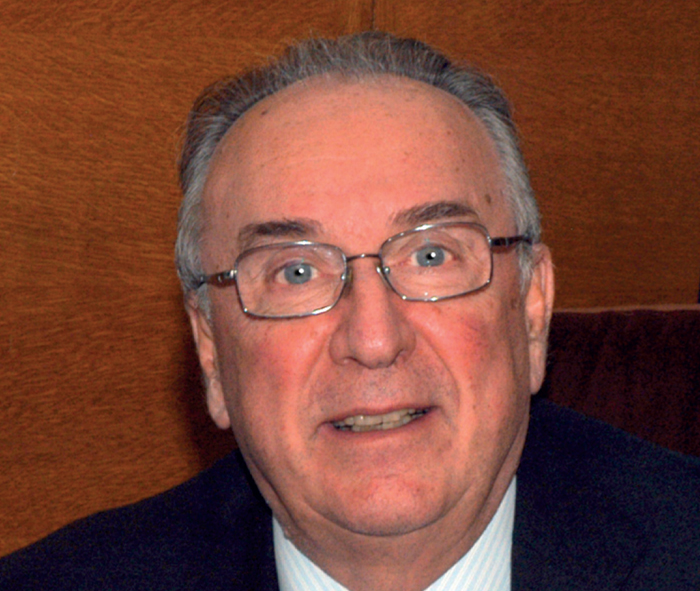
To paraphrase lines from the title song of a well-known film: “If there’s something big in your neighbourhood, who ya gonna call?” If the neighbourhood is particle physics, then it could well be Jim Yeck, who delights in seeing things built. This enthusiasm has underpinned his leadership of a number of successful big scientific infrastructure projects in the US, including the important US hardware contribution to the LHC and the ATLAS and CMS experiments.
Yeck’s first exposure to big science projects was as a graduate engineer in the late 1980s at the Princeton Plasma Physics Laboratory, where there was a proposal to build the $300 million Compact Ignition Tokomak. However, in 1989 the project was cancelled, because plasma ignition could not be guaranteed and the international ITER initiative was on the horizon. “It was a formative experience,” says Yeck, and instead of nuclear fusion, he found himself working on risk assessment for large science projects, which was to prove valuable for his future career.
In the autumn of 1990, he was asked by the US Department of Energy (DOE) to become the project manager for the construction of the Relativistic Heavy-Ion Collider (RHIC) at Brookhaven National Laboratory. Like its ancestor – the Intersecting Storage Rings at CERN – RHIC was built with two interlaced rings, but broke new ground by incorporating 1740 superconducting magnets, most of which were made in industry. Looking back, Yeck points out that the project was approved in a different era, “when you knew you had issues that you would have to work out later”. Basically underfunded, it was built against a background of tight budget constraints. “Such a project needs strong leadership, which we had in Nick Samios, the lab director, Satoshi Ozaki, the project director, and others,” he says.
Yeck remained with RHIC until the autumn of 1997, when the US was in the final stages of signing an agreement to contribute to building hardware for the LHC and the ATLAS and CMS experiments, and to become an Observer State of CERN. The DOE and the National Science Foundation (NSF) appointed him project director for this $531 million contribution, which comprised $200 million from the DOE for the LHC accelerator, and $331 million from the DOE and the NSF for ATLAS and CMS. At the time more than 550 US scientists from nearly 60 universities and six of the DOE’s national laboratories were involved.
“This was on the heels of the cancellation of the SSC [the Superconducting Super Collider] and the community recognized that it was imperative that the LHC should work and that the US should be part of it,” Yeck recalls. “People rallied together – it was beautiful.” There were to be many difficult issues to resolve and compromises to be made, but with a background in engineering rather than particle physics, Yeck had the advantage of being a clearly defined “enabler”, with no bias.
In late 2003, with the LHC’s progress on firm ground, Yeck moved on again, to become director of a rather different astroparticle-physics project. The IceCube Neutrino Observatory at the South Pole is not only at an exotic location with an international collaboration, it is run principally by the University of Wisconsin, and Yeck says that it interested him to show that a university can take on leadership of a large infrastructure project. IceCube was funded to the tune of $280 million, in this case mostly by the NSF, who had less experience of big projects than the DOE. There was also the interesting logistical challenge of constructing and operating the huge 1 km3 detector at the South Pole.
The old model of a country going it alone doesn’t work for such projects
Jim Yeck
During the long construction phase linked to summers at the South Pole, Yeck agreed to help launch construction of the National Synchrotron Light Source II back at Brookhaven, and served as deputy project director in the years 2006–2008. Then, 10 years after taking on IceCube, he made his latest change – to another kind of facility, another continent, and a different user community. In March 2013 he became chief executive officer (CEO) of the European Spallation Source (ESS), taking over from the first CEO, Colin Carlile.
The ESS will serve a research community dispersed across many fields of science, with potential users numbering in the thousands. “The old model of a country going it alone doesn’t work for such projects,” says Yeck. Instead, the ESS is furthering the approach of bringing many nations to work together, and with 17 partner countries it is approaching CERN in terms of the number of members. Using an analogy that should appeal to physicists, Yeck says: “CERN is an existence proof, and others have drawn on this. But the initial conditions have to be right.” When setting up rules for the governance of the new facility, ESS based many of the principles on those established 60 years ago for CERN.
Yeck’s experience has taught him what is important in making a success of such a project: “The facility has to be a priority for the scientific community”, he says. “If you don’t have that foundation, it’s a problem. Then you need commitments and a strong role from the facility host. And the leadership has to see itself as enabling the success of others.” A particular challenge of the ESS is that it is new in more ways than one – a new organization on a green-field site, much like CERN was in 1954. “Such an organization needs experienced people who can catalyse the successful efforts of many,” says Yeck. “We also have to establish realistic goals – it’s a case of putting experience over hope.”
The ESS management has been working hard during the past year on a realistic plan, which was reviewed in November by a committee of 33 members from a broad community, chaired by CERN’s Mario Nessi. Yeck learnt to appreciate the value of such reviews during his time in the US. “If you have problems, you can also seek collective ownership of solutions,” he explains. “And there will be problems. To pretend that you are not going to have them is a big mistake.” However, Yeck is a man who delights in seeing things built and the ESS is no exception. “It’s fantastically challenging, with contributions from many people,” he says, “but that’s what’s captivating.”
1952: The first meeting of the provisional CERN Council on 15 February 1952, with key people including Sir Ben Lockspeiser, Edoardo Amaldi, Felix Bloch, Lew Kowarski, Cornelis Bakker and Niels Bohr (at the back).
1953: The convention establishing the organization was signed, subject to ratification, by the representatives of 12 future member states, at the sixth session of the CERN Council in Paris on 29 June–1 July.
Could this be the first photo taken of the CERN site? Recently found in the archives, this montage shows the road from Meyrin as it crosses the border into France – now close to the location of the main entrance into CERN.
1953: The edition of 30 October of the newspaper La Suisse shows Albert Picot from the State of Geneva and members of CERN Council visiting the site of the future laboratory the day before. Geneva was selected as the site for CERN at the third Council session in Amsterdam in October 1952, and the choice was approved by a referendum in the Canton of Geneva in June 1953, by 16,539 votes to 7332.
1954: The Villa de Cointrin at the airport in Geneva was the first seat for CERN’s management and administrative offices. It is still visible through fences today.
1954: By November, the foundations of the machine hall and experimental halls for the Synchrocylcotron, CERN’s first accelerator, were taking the shape of a rigid “raft”.
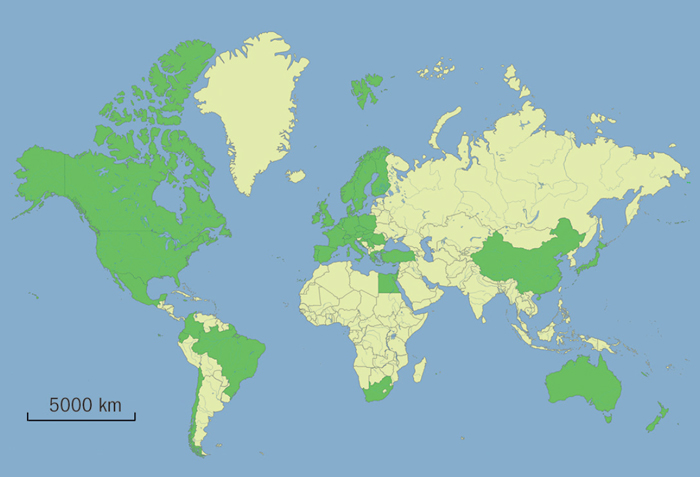
The International Masterclasses (IMCs) began in 2005 as an initiative of what was then the European Particle Physics Outreach Group (EPPOG). Since then, EPPOG has become the International Particle Physics Outreach Group (IPPOG), and the masterclasses have grown steadily beyond a group of IPPOG member countries. This year, the 10th edition of the IMCs included 200 institutions in 41 countries worldwide. Several of the initiatives have attracted new partners, including some from the Middle East and Latin America, enabling IMCs to be held in diverse locations – from Israel and Palestine to South Africa, and from New Zealand to Ecuador – in addition to the many sites in Europe and North America. Now, well into the LHC era, the masterclasses use fresh data from the world’s biggest particle accelerator, as collected by the four big experiments.
All of the LHC collaborations involved acknowledge the potential – and the success – of educational programmes that bring important discoveries at the LHC to high-school students by providing large samples of the most recent data. For example, 10% of the 8-TeV ATLAS “discovery” data are available for students to search for a Higgs boson; CMS approved 13 Higgs candidates in the mass region of interest, which are mixed with a more abundant sample of W and Z events, for “treasure hunt” activities; ALICE data allow students to study the relative production of strange particles, which could be a tell-tale signal of quark–gluon plasma production; LHCb teaches students how to measure the lifetime of the D meson; and particles containing b and c quarks are studied extensively to shed light on the mystery of antimatter in the universe.
Students quickly master real event-display programmes
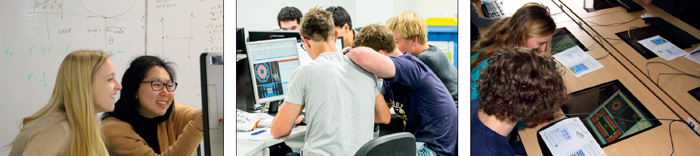
Students quickly master real event-display programmes – such as iSpy-online, Hypatia and Minerva – software tools and analysis methods. First, they practice particle identification by exploiting the characteristic signals left by particles in various detector elements, where electrons, muons, photons and jets are recognizable. They go on to select and categorize events, and then proceed with measurements. Typically, two students analyse 50–100 events, before joining peers to combine and discuss data with the tutors at their local IMC institution. Then they join students at several other locations to combine and discuss all of the data from that day in a video conference from CERN or Fermilab (see table 1).
The IMCs make five measurements available. Typically, a local institution selects one that their physicists have deep knowledge of, guaranteeing that experts are available to talk to the students about what they know best.
The ATLAS Z-path measurement relies on invariant mass for particle identification. It is first applied to measure the mass and width of the Z boson, and of the J/ψ and ϒ mesons. These parameters are all inferred from the decay products – pairs of e+e– or μ+μ– leptons. When a hypothetical new heavy gauge boson, Z´, is mixed with the data, the simulated signal shows up in the dilepton mass distribution. The students apply the same technique to di-photons and pairs of dileptons to search for decays of a Higgs boson to γγ and ZZ*, leading to a four-lepton final state.
The ATLAS W-path deals with the structure of the proton and the search for a Higgs boson. Students look for a W-boson decaying into a charged lepton and a neutrino (missing energy), and build the charge ratio NW+/NW–. The simple view of a proton structure of uud quarks leads to a naive approximation of NW+/NW– = 2. The presence of sea quarks and gluons complicates the picture, bringing the ratio down to around 1.5, compatible with the measurements by ATLAS and CMS. The next challenge is to study events containing W+W– pairs, which are characterized by two oppositely charged leptons and neutrinos. Decays of a Higgs boson to W+W– would enhance the distribution of the azimuthal angle between the charged leptons at low values.
The CMS measurement is called “WZH” for the W, Z, and Higgs bosons. Based on the signatures of leptonic decays, students determine whether each event is a W candidate, a Z candidate, a Higgs candidate, or background. For W bosons, they use the curvature of the single measurable lepton track to decide if it is a W+ or W– and so derive the charge ratio of W-boson production. They can also characterize events as having a muon or an electron to measure the electron-to-muon ratio. For Z and Higgs candidates, students put the invariant masses of lepton and dilepton pairs, respectively, in a mass plot. They discover the Z and Higgs peaks, including a few other resonances they might not have expected.
ALICE’s ROOT-based event-display software enables students to reconstruct strange particles (Ks, Λ, Λ) decaying to ππ and pπ. As a second step, they analyse large event samples from lead collisions in different regions of centrality, and normalize to the mean number of nucleons participating in the collision for each centrality region. Data from proton collisions and from lead-ion collisions lead to a measurement of the relative production of strangeness, which the students compare with theoretical predictions.
All of these educational packages are tuned and expanded to follow the LHC’s “heartbeats”
The LHCb measurement allows students to extract the lifetime of the D0 meson after having studied and fitted an invariant-mass distribution of identified kaons and pions. The next step is to compare and discuss properties of D0 and D0 decays.
All of these educational packages are tuned and expanded to follow the LHC’s “heartbeats”. The intention is for the IMCs to bring measurements for new discoveries in the coming years.
A model for science education
The IMCs have led to other masterclass initiatives. National programmes bring masterclasses to students in areas far from the research institutes that host the international programme. In several countries, programmes for teachers’ professional development include masterclass elements, as does CERN’s national teacher programme. Masterclasses also reach locations other than schools, such as science centres or museums, and other fields of physics, including astroparticle and nuclear physics, have embarked on national and international masterclass programmes.
The largest national programme is the German four-level “Netzwerk Teilchenwelt”, which has been active since 2010. In its basic level, more than 100 young facilitators, mostly PhD and Masters’ students from 24 participating universities and research centres, take CERN’s data to schools. Throughout the year, on at least every other school day, a local masterclass takes place somewhere in Germany. Annually, about 4000 students are invited to further qualification and specialization levels in the network, which can lead to their own research theses. Another example is the Greek “mini-masterclasses” at high-schools, which are usually combined with virtual LHC visits where students link with a physicist at the ATLAS or CMS experimental areas.
Elements of particle-physics masterclasses for teachers’ professional development have become standard in most of the national teacher programmes at CERN and in countries such as Austria, France, Germany, Greece, Italy and the US. Masterclasses for the general public have taken place in science centres in Norway and Germany.
Other physics fields are also using the masterclasses as a model for physics education and science communication. For example, in the UK, nuclear-physics masterclasses cover nuclear fusion and stellar nucleosynthesis. Astroparticle physics is also joining the masterclass scene. In Germany, the Netzwerk Teilchenwelt hosts masterclasses that use data from the Pierre Auger Observatory to reconstruct cosmic showers or energy spectra, or data on cosmic muons that the students take themselves using Cherenkov or scintillation detectors. Since 2012, students at the Notre Dame Exoplanet Masterclass in the US have used data and tools from the Agent Exoplanet citizen science project run by the Las Cumbres Observatory Global Telescope Network to measure characteristics of exoplanets from their effects on the light curves of stars that they orbit during a transit. New international masterclasses on the search for very high-energy cosmic neutrinos at the IceCube Neutrino Observatory at the South Pole will connect three countries in May 2014, with more countries joining in 2015.
Behind the scenes
An international steering group manages the IMCs in close co-operation with IPPOG. Co-ordination is provided through the Technische Universität (TU) Dresden and the QuarkNet project in the US, and funding is provided by institutions in Europe (CERN, the European Physical Society and TU Dresden) and the US (the University of Notre Dame and Fermilab). While the co-ordination based at TU Dresden is responsible for the whole of Europe, Africa and the Middle East, co-ordination through QuarkNet covers North and South America, Australia and Oceania and the Far East. Co-ordinators are in close contact with all of the participating institutions. They issue circulars, create the schedule, maintain websites, provide orientation and integrate new institutions into the IMCs. As QuarkNet is a US programme for teachers’ professional development, the co-ordination also includes visiting and preparing educators at schools and at IMC institutions.
One of the highlights of the IMCs is the final video conference, where students present and combine their results
One of the highlights of the IMCs is the final video conference, where students present and combine their results with other student groups and moderators at CERN or Fermilab. Co-ordinators take special care to create the schedule so that every video conference is an international collaboration that lets the students explore part of the daily life of a particle physicist, doing science across borders. Young physicists at CERN and Fermilab moderate the sessions and represent the face of particle physics to the students. The co-ordinators maintain excellent collaboration with the moderators, for example arranging training and monitoring video conferences.
IPPOG – an umbrella for more
The IMCs in the LHC era are a major activity of IPPOG, a network of scientists, educators and communication specialists working worldwide in informal science education and outreach for particle physics. Through IPPOG, the masterclasses profit from scientists taking an active role, conveying the fascination of fundamental research and thereby reaching young people. IPPOG offers a reliable and regular discussion forum and information exchange, enabling worldwide participation. In addition to organizing the IMCs and hosting a collection of recommended tools and materials for education and outreach, IPPOG facilitates participation in a variety of activities such as CERN’s new Beam Line for Schools project and the celebrations for the organization’s 60th anniversary.
IPPOG is poised to support recommendations outlined in the 2013 update to the European Strategy for Particle Physics and the US Community Summer Study 2013, to engage a greater proportion of the particle-physics community in communication, education and outreach activities. This engagement should be supported, facilitated, widened and secured by measures that include training, encouragement and recognition. Many individuals, groups and institutions in the particle-physics community reach out to members of the public, teachers and school students through a variety of activities. IPPOG can help to lower the barriers to engagement in such activities and make a coherent case for particle physics.
International collaboration in physics was born in Europe, after the Second World War, to explore subnuclear particle physics. An entirely new world, unveiled by the interactions of cosmic rays in the Earth’s atmosphere, could be studied only with particle accelerators so big that no country in Europe could afford to build them. The vision of distinguished European scientists and statespersons led to CERN’s creation in 1954.
In the 1980s a mutation took place as CERN entered the era of the Large Electron Positron (LEP) collider. The experiments needed large human and financial resources, which CERN could not provide. Universities and their associated countries formed large-scale collaborations, with extensive funds for the construction and operation of detectors and to support the travel of professors and students to collect and translate into new physics the data produced at LEP. This phenomenon has since repeated itself, on a larger scale, with the LHC. Today CERN has more than 10,000 “users” from around the world.
At the end of 2003, Juan Antonio Rubio, Verónica Riquer and I realized that a major obstacle for Latin American scientists to take part in experiments at the LHC was the lack of regular funds for their, and their students’, mobility. The outcome was the High-Energy physics Latin-American European Network – HELEN – financed by ALFA, a programme created by the European Union (EU) to facilitate the scientific interchange between Europe and Latin America.
High-energy physics already had a considerable tradition in Latin America. In the early 1930s, Manuel Sandoval Vallarta in Mexico discovered the “east-west effect”, which showed that cosmic rays are charged particles. (Bruno Rossi obtained a similar result with an expedition in Africa.) Cesar Lattes and Beppo Occhialini created a vital school in experimental particle physics in Brazil, which produced important physicists such as Roberto Salmeron, Alberto Santoro and many others. On the theory side, Marcos Moshinski made significant contributions to group theory in nuclear physics, and the beginning of the Standard Model witnessed important results by José Leite Lopez, Juan José Gianbiagi, Carlos Guido Bollini, Miguel Virasoro and many others. Richard Feynman’s lectures in Rio had a profound influence, and the efforts of Leon Lederman definitely oriented the experimental school in South America towards Fermilab.
The aim with HELEN was to change the tendency to work with the US, which had been only marginally affected by the participation of Brazilian groups in LEP. Among the objectives for mobility, we listed training of the younger generations, through participation in advanced experiments, and access to technological benefits in accelerator, detector and information technology. The result was a network of 22 universities from eight Latin American countries, 16 universities from six European countries, CERN and the Pierre Auger Observatory in Argentina.
Starting in July 2005 and ending in April 2009, HELEN enabled mobility totalling 1596 man months, mainly from Latin America to Europe, but also from Europe to Latin America, and within Latin America – where the grants helped to foster collaboration. The total cost was €3.0 million, with €2.7 million coming through EU support.
The exciting adventure of creating a Latin-American community in the scientific heart of Europe started in January 2006, with the arrival at CERN of the first HELEN grant-holders from Latin America. Several events were organized by HELEN in Argentina and in Mexico to transfer CERN technologies in accelerator physics and computing. For example, members of the CMS collaboration travelled to Brazil to help set up an LHC Computing Grid Tier-2 centre for CMS at the Rio de Janeiro State University and in Sao Paulo.
Prompted by the success of HELEN, in 2009 we proposed a new project that started in February 2011 – the European Particle physics Latin-American NETwork (EPLANET), funded by the EU in the Marie Curie Actions of the 7th Framework Programme. Supported by EPLANET, professors and graduate students can participate in the exciting research that began at the LHC in 2010, when the first physics run started.
The objective of EPLANET is to train scientific personnel in the collaborating institutions through participation in world-class experiments performed at CERN and the Pierre Auger Observatory. The rules of the Framework Programme allowed the admission of only four countries from Latin America – namely Argentina, Brazil, Chile and Mexico. CERN has provided additional funds to continue the collaboration with Colombia, Peru and Venezuela that started with HELEN.
All in all, HELEN and EPLANET are perceived in the high-energy physics community as unprecedented and successful efforts to integrate the particle-physics communities of Europe and Latin America. HELEN made possible the full participation of Latin American groups in the LHC experiments and as a consequence, Latin American physicists contributed to the discovery of a Higgs boson by the ATLAS and CMS experiments. Now, EPLANET continues to promote sustainable collaboration between Europe and Latin America in high-energy physics and its associated technologies. I am confident that the two initiatives will have a major impact on multilateral Latin America–EU co-operation.
By Luciano Rezzolla and Olindo Zanotti Oxford University Press
Hardback: £55
Also available as an e-book
This book provides an up-to-date, lively and approachable introduction to the mathematical formalism, numerical techniques, and applications of relativistic hydrodynamics. It presents a well-organized description of the subject, from the basic principles of statistical kinetic theory, through the technical aspects of numerical methods devised for the solution of the equations, to applications in modern physics and astrophysics. There are numerous figures and diagrams, as well as a variety of exercises, which support the material in the book.
By Ernest M Henley and Stephen D Ellis (eds.) World Scientific
Hardback: £58
Paperback: £32
E-book: £24
Also available at the CERN bookshop
By 1911, radioactivity had been discovered for more than a decade but its origin remained a mystery. Ernest Rutherford’s discovery of the nucleus and the subsequent discovery of the neutron by James Chadwick started the field of subatomic physics – a quest to understand the fundamental constituents of matter. This book reviews the important achievements in subatomic physics in the past century. The chapters are divided into two parts – nuclear physics and particle physics – with contributions by many eminent researchers, from Steven Weinberg’s overview of the subject to John Schwarz on string theory and M-theory.
By Chen Ning Yang World Scientific
Hardback: £65
Paperback: £32
E-book: £24
Since receiving his PhD from the University of Chicago in 1948, Chen Ning Yang has had great impact in both abstract theory and phenomenological analysis in modern physics. In 1983 he published Selected Papers (1945–1980), With Commentary. Freeman Dyson considered it to be one of his favourite books. This sequel to that previous volume is a collection of Yang’s personally selected papers (1971–2012), supplemented by his insightful commentaries. Its contents reflect his changing interests after he reached the age of 30. It also includes commentaries that he wrote in 2011 when he was 89. The papers and commentaries in this collection comprise a remarkable personal and professional chronicle, shedding light on both the intellectual development of a great physicist and on the nature of scientific inquiry.
To provide the best experiences, we use technologies like cookies to store and/or access device information. Consenting to these technologies will allow us to process data such as browsing behavior or unique IDs on this site. Not consenting or withdrawing consent, may adversely affect certain features and functions.
Functional
Always active
The technical storage or access is strictly necessary for the legitimate purpose of enabling the use of a specific service explicitly requested by the subscriber or user, or for the sole purpose of carrying out the transmission of a communication over an electronic communications network.
Preferences
The technical storage or access is necessary for the legitimate purpose of storing preferences that are not requested by the subscriber or user.
Statistics
The technical storage or access that is used exclusively for statistical purposes.The technical storage or access that is used exclusively for anonymous statistical purposes. Without a subpoena, voluntary compliance on the part of your Internet Service Provider, or additional records from a third party, information stored or retrieved for this purpose alone cannot usually be used to identify you.
Marketing
The technical storage or access is required to create user profiles to send advertising, or to track the user on a website or across several websites for similar marketing purposes.