Comsol -leaderboard other pages

Topics

Making a song and dance about physics

The Cernettes have been pulling in the crowds at CERN since 1990 with their unique blend of ’60s pop and physics lyrics from the pen of computer scientist Silvano de Gennaro. Singer­songwriter Lynda Williams is a relative newcomer, but ever since she hit the road in 1996 at the 44th Midwest Solid State Conference her feet have hardly touched the ground.
spice1_11-98

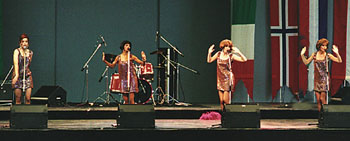
Les Horribles Cernettes are the original physics entertainers. Their name is a play on the title of CERN’s next major particle accelerator, the Large Hadron Collider, and the song Collider was their first hit. It was an anthem to unrequited love in the time of coloured quarks, and it was also a plea from the heart.

Back in 1990 a CERN employee was dating a particle physicist but she hardly ever saw her Romeo because he was always too preoccupied with his experiment. In desperation she asked CERN’s de-facto songwriter in residence, Silvano de Gennaro, to put her tragic tale to music.

Soon after, the Cernettes came together. Michelle Muller, the only original Cernette still in the band, teamed up with Catherine Decosse, Caroline Good and Ruth Rubio Marin. That summer they were on stage for the first time at the CERN Music Club’s annual “Hardronic Festival”. (Mix “hadron” with “hard rock” and that’s what you get.) As they belted out for the first time Collider’s unforgettable refrain, “You don’t go out with other girls either, You only love your collider”, there was more than one amorous physicist blushing with shame. Particle-physics partners the world over must have heaved a collective sigh of recognition at that sad story.

Since their first gig in 1990 the band has never looked back. Over the years Michelle has been joined by Angela Byrne, Angela Higney, Anne MacNabb, Patty McBride, Colette Reilly, Sue Swannel, Linda Timms, and Lynn Veronneau. The Cernettes played to thousands at the World Expo in Seville in 1992. They thrilled them to bits at the Computing in High Energy Physics conference, CHEP’92. They’ve recorded a CD, starred on the Franco German TV channel ARTE, and they still top the bill at the CERN Hardronic Festival. But the final seal of their success came this year with a copy-cat band. All the top groups have them. The Beatles had the Monkeys, Oasis have No-Way-Sis, and at the latest Hardronic festival, the Cernettes had the Canettes (“large beers” in the Geneva dialect). Show me a CERN physicist, male or female, who hasn’t felt their attraction (it’s a strong interaction) and I’ll show you a pig that can fly.

There are many bands out there claiming to be first on the Web, but that honour belongs to the Cernettes whose site includes pictures, sound clips, and even a fan club set up by some ardent admirers in Norway. True, the Cernettes had a head start, being based at the lab where the Web was invented, but they haven’t rested on their cyber-laurels. With their latest number, Surfing on the Web, they’ve made another breakthrough with the world’s first interactive pop video. You’ll need to be equipped with a VRML (Virtual Reality Mark-up Language) browser to get the full benefit, but once you’ve got it you can sail off into cyberspace with your favourite Cernette (but only for as long as the song lasts).
French green light for LHC civil engineering

news1-10-98

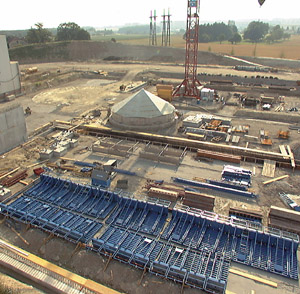
Progress on CERN’s next major particle accelerator, the Large Hadron Collider (LHC), took another step forward recently when French Prime Minister Lionel Jospin signed the decree allowing LHC civil engineering work to commence on French territory. This important landmark comes after a long and painstaking study of the environmental impact of the project and follows approval of civil engineering on Swiss territory earlier this year ) where work is already underway.

The LHC collider, scheduled to begin operations in 2005, will be constructed in the 27 kilometre tunnel under the Franco-Swiss frontier, which currently houses CERN’s LEP electron­positron collider.

LHC civil engineering contracts are being awarded in three separate packages. Excluded from these packages is one of the tunnels which will supply the LHC with protons from CERN’s Super Proton Synchrotron accelerator. This tunnel is being built by Switzerland as part of its special host-state contribution to the LHC.

While awaiting the French green light, a collaboration between CERN and the regional directorate for cultural affairs has allowed archaeologists to undertake preliminary excavations at a Roman site adjacent to one of the LHC’s experimental areas. Their findings have pieced together a fascinating picture of life in the area some 1700 years ago. A report will feature in a forthcoming issue.

KODEL establishes Korea as major physics player

Marking the emergence of Korea as a major player on the world physics scene, the Korea Detector Laboratory (KODEL) was established this year under director Sung Keun Park of Korea University, Seoul. Its aim is to carry out research and development for high-energy physics detectors and international high-energy physics programmes, and to provide the infrastructure for the ever-increasing scope of major international high-energy physics projects.

About 11 Korean universities have links with KODEL and participate in the research at Brookhaven, CERN, DESY (Hamburg), Fermilab, GSI (Darmstadt), and KEK (Japan).

A guest of honour at the KODEL opening ceremony was 1992 Physics Nobel prizewinner Georges Charpak of CERN. His lecture was televised throughout the country.

news2-10-98

While at KODEL, Charpak stressed the importance of research and development for high-energy physics detectors in Korea, and Korea’s collaboration with CERN in the LHC Collider project.

At a news conference Charpak affirmed that present economic problems could be alleviated by higher investment in basic research to provide a solid foundation for future technological advancement.

Charpak also met with the Korean Prime Minister, the Minister of Science and Technology and the Minister of Information and Communication, and gave a talk to the Korean Physical Society entitled “Recent advances on gaseous detectors and their applications for medicine and biology”, a subject for which his enthusiasm never wavers.

KODEL produces prototypes of forward resistive plate chamber for the CMS detector at the LHC and is obtaining very encouraging results. It will be the main Korean laboratory for mass production of these units.

Experiments wanted for CERN neutrino beam to Gran Sasso

The Scientific Committees of the SPS at CERN and of the Gran Sasso laboratories will meet at CERN on 2­4 November for a thorough discussion of the opportunities offered by a neutrino beam pointing from CERN to Gran Sasso. There is a call for ideas for experiments that could exploit this beam to elucidate neutrino masses and mixings. Documents of up to 10 pages describing these experiments, along with a cost estimate, should be submitted to both Committees before 10 October.

To make the meeting more effective, the documents describing appearance and/or disappearance experiments with or without a near station should contain, in the usual Dm2 versus sin22q plot:

i) the exclusion curve if no signal is observed;
ii) the limit curve within which a discovery of neutrino oscillations can be made at the 4 sigma level.

These curves should be based on the reference beams with a shared mode of operation (3×10¹⁹ proton/year on target) and for three years of running.

Documents on the high-energy and low-energy beams, prepared by the CERN/INFN Working Group should soon be available.

US ‘reneges’ on SSC decision

US President Bill Clinton has questioned the momentous decision to cancel the Superconducting Supercollider,
in a recent speech to MIT graduates.

news3-10-98

The world of particle physics was stunned in October 1993, when the US Senate voted to cancel the Superconducting Supercollider (SSC), an 87 kilometre ring then being built in Texas to collide 20 TeV proton beams. On 28 October 1993, the giant machine’s death warrant was officially signed by Clinton. The decision changed the face of world particle physics, with the emerging US involvement more outward looking. A major US commitment now constitutes a significant part of CERN’s LHC proton collider project and its physics programme.

However, on 5 June this year, speaking to graduates at the Massachusetts Institute of Technology, President Clinton said: “Scientific research is a basic prerequisite for growth. Just yesterday in Japan, physicists announced a discovery that tiny neutrinos have mass. Now that may not mean much to most Americans [or anyone else ­ Ed], but it may change our most fundamental theories ­ from the nature of the smallest subatomic particles to how the universe itself works.

“This discovery was made in Japan, but it had the support of of the US Department of Energy. This discovery calls into question the decision … to disband the Superconducting Supercollider, and reaffirms the importance of the work now being done at the Fermi National Accelerator Facility.”

Physicist dies in air crash

Klaus Kinder-Geiger, 35, a leading theorist in relativistic heavy-ion physics, died tragically on 2 September aboard the Swissair New York to Geneva flight which crashed near Nova Scotia.

His Parton Cascade Model has decisively influenced our view of high-energy nuclear reactions, with important implications for future programmes at Brookhaven’s RHIC and CERN’s LHC colliders.

After his thesis on glueball decays at Frankfurt in 1989, Klaus spent postdoctoral years at Duke University and Minnesota, where he developed the Parton Cascade Model. While a Fellow in CERN’s Theory Division from 1994 96, he worked with John Ellis on hadronization theory. He joined Brookhaven’s nuclear theory group in 1996. His recent research also covered the application of the renormalization group to QCD transport theory.

His enthusiasm and vision was an inspiration to his many friends and collaborators, who mourn his untimely death.

Niels Bohr and the 20th century

Niels Bohr (1885­-1962) did not coincide entirely with the 20th century, but was nevertheless one of its great motive powers. The meeting, organized by the Niels Bohr Institute in Copenhagen, brought together about 200 eminent physicists at UNESCO’s headquarters in Paris from 27­29 May to consider his scientific legacy.

bohr1-10-98

After presenting the wide variety of Bohr’s seminal ideas and paradigms, speakers turned to the present vitality of these concepts at the frontiers of modern physics, emphasizing also the growing symbioses between physics and biology, and between physics and information theory.

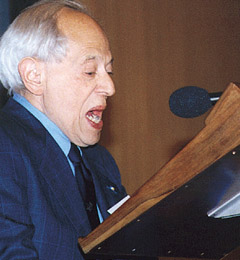
The opening talks on Bohr, by biographer Abraham Pais and by Ove Nathan of the Niels Bohr Institute, recalled the deep involvement of science with the everlasting challenge to express ourselves in a way which is both philosophically correct and reflects profound personal integrity.

Examples are the contest early this century between Bohr and Einstein on the interpretation and understanding of the quantum mechanical concepts of measurement and evidence; and the subsequent contests between Bohr and, in turn, Roosevelt, Churchill (who suggested keeping Bohr under house arrest), and later the UN, in the struggle to prevent world politics degenerating into an atomic arms race. Both of these avenues of confrontation remain strikingly topical, as reflected in the talk by Anton Zeilinger on modern quantum information theory, and in the parallel news of the spread of nuclear arms in the East.

Turning to the present frontiers of science first embraced by Bohr and other monumental personalities of the 1920s, the younger contemporary observer must feel more comfortable with the development of a much wider physics community.

Here an enormous interpersonal web of co-operation and exchange of ideas and resources, aided by public revenue support still driven by the evolutionary spirit of the scientific revolution at the dawn of the century, supports a complex of frontier projects.

This encompasses not only the spectacular “big science” effort as exemplified by the Hubble Space Telescope, CERN’s LHC proton collider, or Japan’s Superkamiokande underground detector, but also the international communities pushing the underlying theoretical understanding beyond the standard models of their respective disciplines.

Small science

And there is modern table-top science ­ “small is beautiful” ­ splitting photon states for quantum teleportation, fixing single atoms in nano-Kelvin states to measure time to an accuracy of 10­19 (to check the time variation of Nature’s “constants”), developing DNA strains to catalyse organic manufacture of photomasks for quantum-level semiconductor chips, and synthetic muscular mini-machines built from multi-polymeric “soft matter” complexes.

bohr2-10-98

These specialist subjects are vibrant with excitement, both for the open horizon of learning about the universe of Nature, and the transition from an initial qualitative to a precision quantitative understanding of the quantum world, inorganic and organic.

Astrophysics left a particularly strong impression, with new results from Hubble on the dark matter problem (Martin Rees), and with Superkamiokande’s tentative evidence for neutrino oscillations (John Bahcall) giving the first hints of physics beyond the Standard Model.

The symposium was a memorable experience for participants, achieving its basic but ambitious objective of surveying the evolution of phyics this century. It was in some ways a modern revival of the dramatic meetings held at the beginning of the century, such as the historic 1911 Solvay Conference, but with a small number of insular scientific luminaries replaced by a host of enthusiastic heirs.

Notably absent were the prophets of doom, predicting the imminent end of science. Regrettably, as the symposium would have convinced them otherwise.

SLC perched on a high

slc1-10-98

Just before noon on 8 June, operators at the Stanford Linear Accelerator Center (SLAC) shut down the SLC Stanford Linear Collider for what may have been the last time.

It had been a record-breaking year-long run in which the world’s first-ever linear collider more than tripled its collision rate, or luminosity, and generated over 350,000 massive Z particles for physicists on the SLD experiment collaboration to study. But unless the US Department of Energy provides the funding for an extension, the 1997­98 run will have been the SLC’s last hurrah.

The data-taking phase of the run had begun slowly in July 1997. Although the peak luminosity matched that of prior years, it was not quite up to the levels of the 1996 run. Accelerator physicists and operators were taking extra time to tune the machine carefully in preparation for the long run.

In October and November the collider really hit its stride, however, often exceeding a hundred hours of successful operations and 10, 000 Zs per week. After recovering from the Christmas shutdown, the machine surpassed even those levels, occasionally delivering over 20,000 Zs per week during the rest of the run.

Under the leadership of Nan Phinney, who was aided by the untiring efforts of Pantaleo Raimondi and Tracy Usher, the SLC performed beyond expectations. Often working through the night, this pair found clever solutions to long-standing problems and helped achieve large luminosity gains without any major hardware upgrades.

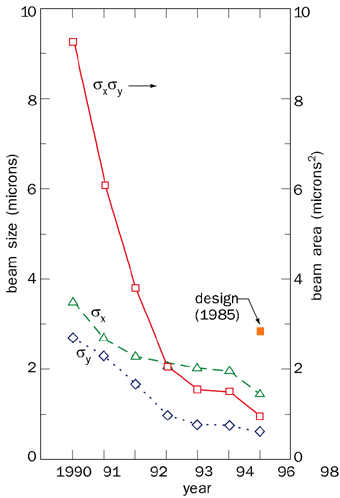
With beam profiles at the interaction point as small as 0.65 by 1.5 microns (rms half height and width), physicists finally began to observe the long-awaited phenomenon of “disruption”, in which a bunch is compressed by the macroscopic electromagnetic fields of the bunch it passes through. According to estimates, this enhancement doubled the peak luminosity, leading to the high values attained toward the end of the run. Experimenters marvelled at occasional events in which they could clearly discern the crossing of two Zs produced in a single bunch.

The collider was roaring along, generating 5300 Zs in the previous 24 hours, when a vacuum failure in the positron source forced its premature shutdown a week early. At the time the SLC was spewing out about 300 Zs per hour, or a peak luminosity of about 3×1030 per sq cm per s ­ half its design value.

The number of Zs the SLC produced in the 1997­98 run is nearly twice that generated in all previous runs, bringing the cumulative total to more than half a million. When combined with electron beam polarization levels of 73%, this bonanza means that SLD physicists will have plenty of work in the coming months extracting the world’s best measurement of the weak mixing angle. And using the SLC’s narrow beams together with what is the world’s most sophisticated vertex detector, the collaboration may also be able to uncover other unique physics results ­ such as measuring the mass difference that determines the frequency of particle­-antiparticle mixing in Bs mesons.

Undoubtedly there will be important questions left unanswered, however, and collaboration leaders are already lobbying for a final SLC run to raise the total number of Zs to more than a million. Another run could also allow them to boost its peak luminosity above the design value to 1031, Phinney estimates. Such an achievement would help advance the state of the linear collider art in preparation for the TeV-scale linear collider that many now agree is the next major project for high-energy physics.

Whatever else happens, the SLC will go down in history as the machine that proved the feasibility of the linear collider concept. Although outgunned by CERN’s LEP collider ring in terms of the sheer output of Z particles, physicists at SLAC fought back successfully by emphasizing narrow beams and polarization as important tools for doing precision physics measurements. With nearly twice the beam polarization originally planned, the SLC has now essentially achieved the overall performance goals set for it more than a decade ago ­ despite falling a bit short on the luminosity front. And even that shortcoming could be erased in a final run.

bright-rec iop pub iop-science physcis connect