The UK Particle Physics and Astronomy Research Council (PPARC) has outlined its latest research goals in its Strategic Plan for 2003-2008. Among its aims are to increase UK industrial competitiveness and gain leadership roles in the construction of the next generation of major particle-physics facilities.
Top of the agenda for particle physics is to fulfil the UK’s commitment to the Large Hadron Collider (LHC) at CERN, and its contribution to the ALICE, ATLAS, CMS and LHCb experiments. Involvement with the construction of these detectors is essential to maintain PPARC’s role in funding research that will improve scientists’ understanding of the precise structure of matter, our universe and the forces that bind it together. In recognizing that the future of experimental particle physics lies in global accelerator facilities, PPARC also plans to build up the UK’s capacity in accelerator R&D, enabling UK scientists to play a leading role in their design. As part of the process, PPARC intends to create centres of expertise in particle physics and invite UK universities to host them.
Following the experimental confirmation of neutrino masses and the subsequent need for a neutrino factory to study neutrino properties, PPARC also intends to increase investment in neutrino R&D. The council hopes that such an effort will create sufficient expertise in the UK to host a neutrino factory facility. Existing UK infrastructure would allow a neutrino factory to be in place by the end of the next decade.
PPARC is also concerned with improving the computing infrastructure required to handle LHC data. In a bid to maintain the UK’s competitive edge in high-performance computing, £16 million (€22 million) was announced in December to create a massive computing grid. Known as GridPP2, it will be equivalent to Japan’s Earth simulator computer – the second largest in the world – and will eventually form part of the larger European Grid. GridPP2 will thus enhance the overall data-processing capability when the LHC comes online in 2007.
The International Committee for Future Accelerators (ICFA), chaired by director of SLAC Jonathan Dorfan, has announced the members of a 12-person International Technology Recommendation Panel (ITRP) for a future linear collider. The ITRP, with four members each from Europe, North America and Asia, is charged with recommending which of two leading accelerating technologies will form the best choice for a future international linear collider.
In 2002 ICFA set up its International Linear Collider Steering Committee (ILCSC), chaired by Maury Tigner of Cornell, to guide the community through the R&D phase to construction of a linear collider. However, to commence an international design, the community must decide between two leading linac RF technologies based on conventional, room-temperature copper cavities or superconducting cavities.
At its meeting in Paris on 19 November, the ILCSC finalized the selection of the ITRP, its chair and charter. Barry Barish of Caltech is to be chair, and the ITRP is to hold its first meeting in January 2004.
• The charge to ITRP, the panel membership and the parameters for a linear collider are in “Recent ICFA Linear Collider Activities” at www.fnal.gov/directorate/icfa/icfa-home.html.
The US Department of Energy’s Office of Science has unveiled its 20 year science facility plan. This is in effect a roadmap for future scientific facilities to support the department’s basic science and research missions. The plan prioritizes new, major scientific facilities as well as upgrades to current ones. The 28 facilities listed cover the range of science supported by the Office of Science, including high-energy physics, nuclear physics and advanced scientific computation.
The list begins with 12 facilities that are identified as near-term priorities. Priority one is ITER, the international collaboration to build the first fusion experiment capable of producing a self-sustaining fusion reaction. Priority two is an UltraScale Scientific Computing Capability, to be located at multiple sites, which would increase the computing capability available to support open scientific research by a factor of 100.
Four facilities tied for priority three, including the Joint Dark Energy Mission, a space-based probe being considered in partnership with NASA; the Linac Coherent Light Source to provide laser-like radiation 10 billion times greater in power and brightness than any existing X-ray light source; and the Rare Isotope Accelerator that would be the world’s most powerful research facility dedicated to producing and exploring new rare isotopes not found naturally on Earth. Six others complete the near-term priorities. These include the 12 GeV upgrade for CEBAF at the Thomas Jefferson Laboratory and the BTeV experiment at Fermilab.
A linear collider operating in the TeV energy region heads the list of eight mid-term priorities. These also include a Double Beta Decay Underground Detector and an upgrade to provide a 10-fold increase in the luminosity of Brookhaven’s RHIC II. The eight far-term priorities include a Super Neutrino Beam, 10 times more intense than those currently available, and eRHIC, a project to add an electron accelerator ring to the existing RHIC complex.
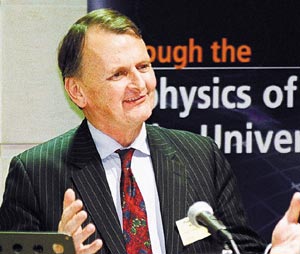
Scientists, policy makers and stakeholders from around the world came together at CERN on 8 and 9 December 2003, when the laboratory hosted The Role of Science in the Information Society (RSIS) conference. Organized by CERN in collaboration with UNESCO, the International Council for Scientific Unions and the Third World Academy of Science, the conference took place immediately prior to the World Summit on the Information Society (WSIS), held in Geneva on 10-12 December.
Basic science made the technologies that underlie the information society possible, and the needs of the scientific community have often driven new developments in information and communication technologies (ICTs), such as the Internet and the World Wide Web. As Ismail Serageldin, director-general of the Library of Alexandria, Egypt, told the conference: “Today, when we stand at the threshold of the new ICT revolution and can barely see the contours of the new organization of knowledge, we must be willing to re-invent ourselves and to think of radical change, not just incremental change.”
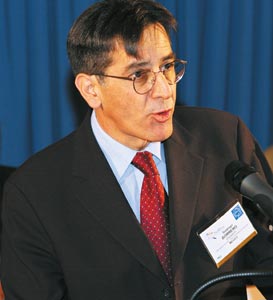
During the first half-day of the conference, plenary speakers gave their perspectives on the past, present and future of science, ICTs, and society. The following morning, attendees divided into parallel sessions where they explored five areas in more depth: enabling technologies, economic development, health, environment and education. The plenaries then reconvened in the afternoon, when participants heard the results of the parallel sessions, a visionary panel and closing remarks.
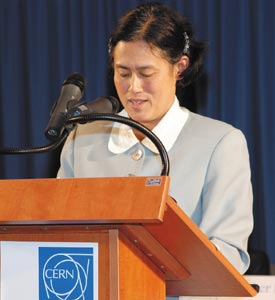
Among the key plenary speakers were Princess Maha Chakri Sirindhorn of Thailand, who reminded the conference that there is no single formula for development; Tim Berners-Lee, director of the World Wide Web Consortium (W3C), who articulated the vision that led him to create the World Wide Web while working at CERN; Ismail Sarageldin, who described in particular the “hole in the wall” project for bringing the Web to slum children; and Lidia Brito from Mozambique, who emphasized the importance of fair trade in knowledge. Koichiro Matsuura, the director-general of UNESCO, and Yoshio Utsumi, the secretary-general of the International Telecommunication Union, also addressed the conference.
Several general themes emerged and received clear support at RSIS:
• that fundamental scientific information be made freely available;
• that the software tools for the dissemination of this information be also made freely available;
• that networking infrastructure for distributing this information be established worldwide;
• that training of people and equipment to use this information be provided in the host nations;
• and that general education underpins all these goals and is an indispensable basis for the information society.
“This event has helped to develop a vision for how information and communication technologies can be applied for the greater benefit of all,” said Luciano Maiani, director-general of CERN, in his summary of the conference. Immediately following RSIS, Maiani made a statement at WSIS on behalf of the participants. He was instructed by RSIS to urge the heads of state gathered at WSIS to endorse fully the guidelines that emerged from the RSIS discussions.
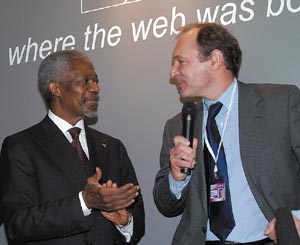
CERN also held a Science and the Information Society Forum at the “ICT for Development” platform in Geneva’s Palexpo Centre, which was open to the public during the world summit. The forum served as a venue for scientific organizations to exhibit their ICT-related initiatives. Also on display was the first Web server and information about CERN and the RSIS conference. Using the server, United Nations secretary-general Kofi Annan and Tim Berners-Lee sent a message to 800 schools around the world.
The timely construction and commissioning, in November 1959, of CERN’s Proton Synchrotron (PS) clearly demonstrated both the ability of the young European laboratory to turn a new concept into reality and the wisdom of the decision, taken as early as October 1952, to build an alternating-gradient synchrotron. Nobody involved could have imagined that the PS would remain the backbone of CERN’s scientific activities for more than 50 years.
The origins of the PS date back to May 1952, when the provisional CERN Council decided to build a 600 MeV synchro-cyclotron (similar to the one at Liverpool in the UK) and a “high-energy” PS (similar to the 2 GeV Cosmotron at Brookhaven), and to set up “SC” and “PS” groups. The initial members of the PS group were: Hannes Alfen (Sweden), Odd Dahl (Norway), D W Fry (UK), Wolfgang Gentner (Germany), Frank Goward (UK), Kjell Johnsen (Norway), F Regenstreif (France), Chris Schmelzer (Germany) and Rolf Wideröe (Switzerland).
Concept and design
The PS group set out to work on a synchrotron of the weak-focusing type, similar to the Cosmotron at Brookhaven, but with an energy of 10 GeV. Three members of the group, Dahl, Goward and Wideröe, went to Brookhaven in August 1952 for discussions with the Cosmotron’s designers. The American scientists, however, presented their visitors with a revolutionary concept for the design of future high-energy accelerators. Alternating the magnetic-field gradients while increasing them as much as possible would afford strong focusing of the beam, as occurs in a sequence of optical lenses, allowing smaller beam apertures and magnets for the synchrotron. Conversely, for a given magnet mass of a synchrotron, substantially higher particle energies could be obtained. This proposal became at once the subject of intense discussions with the inventors Ernest Courant, Stanley Livingston and Hartland Snyder. (This principle had been proposed independently by Nicholas Christophilos two years earlier.)
Two problem areas soon emerged: very high gradients would lead to very strong sensitivity to magnetic-field or alignment errors, and at a critical energy level – the “transition” energy – total beam loss would occur unless countermeasures were found. All the same, only two months later, in October 1952, the PS group convinced Council to launch a feasibility study of an alternating-gradient PS of “about 30 GeV” as the main project of the new laboratory. That demonstrated extraordinary insight as well as foresight and courage. The scene was thus set for the successful history of CERN as it developed – it surely would have been quite different had they opted for the old, “safe” way. In that session Council also selected Geneva as the seat of the laboratory. (We really should have celebrated CERN’s 50th anniversary two years earlier!)
Things proceeded with extraordinary speed in the following months. While the design of an alternating-gradient machine took shape in intense collaboration between the European and Brookhaven teams, diplomats, administrators and several eminent scientists worked hard on pushing the convention for the new international laboratory, in itself something never heard of before, through governments and parliaments to ratification.
In October 1953 the first members of the PS group, up to then split between half-a-dozen national laboratories, moved into preliminary premises at the Institut de Physique in Geneva, and at the end of the month a Conference on the Alternating-Gradient Proton Synchrotron was held there. Good progress in solving the problems inherent in the alternating-gradient principle was reported, and a conceptual machine design presented by the CERN group proved to be surprisingly similar to the PS as built six years later.
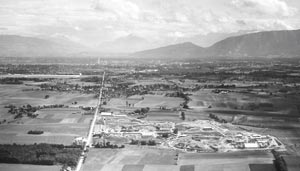
On 17 May 1954 ground was broken in Meyrin on the site proposed by Switzerland, and soon afterwards – with the formal beginnings of the European Organization for Nuclear Research on 29 September – staff could be recruited and contracts for equipment awarded on a firm basis. It may be hard in today’s world to imagine the excitement of those lucky enough to be recruited by CERN. It was an extraordinary privilege to collaborate on a truly pioneering European project and to work in one team with colleagues from neighbouring countries on, in the PS division, an almost unbelievable project: a high-precision machine of 200 m diameter that stretched technologies to their very limit and presented a need for initiative and invention in many areas. New arrivals experienced the continued hospitality – including a beautiful view from the rooftop at tea time – of the Institute de Physique, where some temporary buildings had been set up to cope with the numbers. These were wooden barracks, which only enhanced the feeling of being real pioneers. Time and again bursts of laughter pervaded the corridor, coming from the office of the leader of the magnet group, Colin Ramm, when ways were being discussed both to produce and reduce the cost of the thousands of tonnes of equipment that had to be purchased. In February 1956 the southern end of Lake Geneva (known as “la rade de Genève”) froze up – the last time this occurred during the 20th century! – and so did the heating pipes in those temporary barracks.
In June 1956, when the community gathered for the Symposium on High Energy Accelerators and Pion Physics, the viability of strong focusing was beyond doubt, though it had only been tested on a small-scale model at Brookhaven. The basic design of the PS was ready, staff numbers in the PS division were approaching 140, many of the important contracts with industry were being prepared and Kees Zilverschoon’s construction schedule (handwritten, since there were no computers yet) was established for finishing the project before the end of 1959.
Surprisingly, a Russian delegation (including a taciturn “expert” whose name nobody had ever heard before or after) obtained permission to participate in the symposium. Its members contributed a number of interesting proposals for advanced accelerating techniques, and above all, a good quantity of the drinks any Russian is brought up with – plus the quantity of caviar necessary to accompany them. Ivan Chuvilo of the Institute of Theoretical and Experimental Physics (ITEP) in Moscow never forgot his struggle with the Swiss customs about his “diplomatic” luggage, and surely all the conference participants will remember the Russian party at Hotel Metropol of 18 June (the day this author joined CERN).
First operation
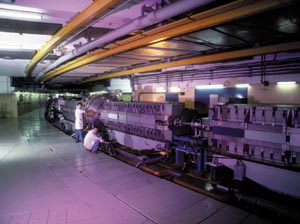
Early in 1957 staff and laboratories moved to the new buildings at the Meyrin site. As from January, with parts of the roof still missing, the South and North Halls were fitted out for two years of testing, assembly, re-testing and storage of the accelerator components produced by industry in various member states. On 3 February 1959 the first of 100 magnet units was installed in the PS tunnel and the assembly of the synchrotron was finished by the end of July 1959 (see “CERN Courier Archive: 1959-2009”).
The injector – the 50 MeV linear accelerator – produced beam at the end of August, and beam circulating in the PS was obtained on 16 September, but all acceleration tests resulted in erratic beam behaviour for several weeks.
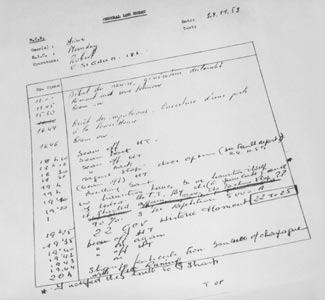
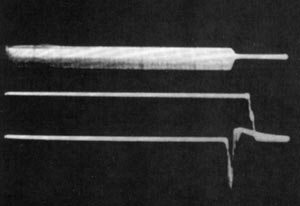
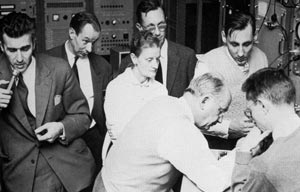
On 24 November, a memorable date indeed, Wolfgang Schnell installed new “phase lock” electronics in the beam-control system, with the grudging consent of Schmelzer, the RF group leader. (The original Nescafé tin containing the essential circuits is still available in his office.) When beam tests were resumed, the beam was accelerated at once, and even went through transition energy without difficulty; moreover, the team present (see “November 1959” photo below) hardly believed their eyes as they watched acceleration continue right through to 24 GeV. Finally on 8 December, after they corrected for magnet saturation, the peak energy of 28.3 GeV was attained.
The PS thus became the highest energy accelerator in the world for seven or eight months. Then its sister machine, the Alternating Gradient Synchrotron (AGS) at Brookhaven, was ready, which was somewhat larger and hence of higher energy capability. However, for the PS at CERN this was only the beginning of an extraordinary “career” of improvements and modifications, such that it has remained for 50 years the central member – the real heart – of the ever-increasing system of accelerators that has made CERN such a unique laboratory worldwide.
Improvements and new functions
While the machine was being carefully coached into routine operation and delivered first beams from internal targets, additional facilities and always higher intensities were already requested. A “fast” (short-pulse) ejection system was developed for neutrino experiments in the South Hall (soon to be relocated to a dedicated area). Also, to keep up with the steep increase in the number of users, another experimental area, the East Hall, was built, for which a “slow” (very long pulse) ejection system was needed for experiments on very rare or short-lived particles. Then, in 1965, when the Intersecting Storage Rings (ISR) project, designed to collide high-energy protons from the PS, was authorized as CERN’s first major extension, a second fast-ejection system and a dedicated transfer line were implemented.
Later in the 1960s, the construction of the “Booster” synchrotron was initiated to raise the injection energy to 1 GeV, and hence increase the beam intensity accepted by the PS, in response to continued requests. Simultaneously a programme to replace most of the first-generation subsystems of the PS was launched (see “A first round of improvements” box). The 50 MeV Linac could by then no longer provide the necessary intensity nor the reliability, and had to be replaced during the mid-1970s by an improved machine (Linac 2).
Also, just to make sure that no trick was missed, a working group at the time investigated whether different magnet structures for the PS tunnel, such as separate function magnets, might provide improved capabilities. The result was unambiguous: the machine as designed 20 years previously was the best to satisfy all requirements – an excellent job had been done.
In the late 1960s a 300 GeV Super Proton Synchrotron (SPS) became seen as a necessary step by European physicists, although finding a suitable site seemed like an imbroglio of geotechnical and political considerations impossible to solve, until in 1970 the proposal (dating from 1961) was resuscitated to build the machine under land adjacent to the original CERN site. After due discussion the proposal was formally submitted to Council in December 1970, and a special session approved it in February 1971, not least because the use of the PS as injector (and of other existing infrastructure) emerged quite naturally as an additional benefit. New beam-ejection and transfer modes, a dedicated acceleration system and delicate beam-matching procedures had to be developed for the PS in parallel with the improvement programme outlined above. Computer control then became a necessity, and refined operation procedures were conceived so that the ISR and the SPS, as well as the secondary beams, could run simultaneously.
Thus towards the end of the 1970s the intensity per cycle had been increased from about 1010 to more than 1013 protons, the cycle time had been shortened by a factor of three and machine availability had reached more than 95% of scheduled time. Operated and maintained by a superb team of competent and dedicated staff who were enthusiastic about the intricate system of accelerators and beam lines under their responsibility, the PS clearly was fit for even more demanding years ahead.
All these programmes were not quite finished when Carlo Rubbia, in 1976, brought forward the proposal for proton-antiproton experiments, which implied new challenges again for the PS. For antiproton production a 26 GeV proton beam of the highest intensity and density had to be provided, with all the beam concentrated in one-quarter of the PS circumference. Furthermore, the antiprotons from the antiproton accumulator were to be brought back to the PS for acceleration and transfer to the SPS.
The PS thus became a central element of the experiments in which the W and Z bosons were discovered, bringing the first Nobel prizes to CERN staff, with the awards in 1984 to Carlo Rubbia and Simon van der Meer. Also in the 1980s the PS became an antiproton decelerator supplying the Low Energy Antiproton Ring (LEAR). It still provides the high-intensity primary proton beam for LEAR’s successor, the Antiproton Decelerator (AD), where delicate experiments continuing the tradition of LEAR are running today.
A universal accelerator
For some time, ideas for a programme of research with heavy ions had been looming in the physics community. Early in the 1970s tests with deuterons and alpha particles were run in the “old” Linac 1, which was dedicated to ions after the construction of Linac 2. Equipped with a new front end, Linac 1 provided beams of oxygen and sulphur ions for acceleration in the PS, so that by the mid-1980s experiments with these ions could run at SPS energies.
Eventually Linac 1 was replaced by a dedicated heavy-ion Linac (Linac 3) constructed by a collaboration involving CERN, GANIL, GSI, IAP (Frankfurt), Indian institutes and INFN (Lugnano), as well as financial contributions from the Czech Academy of Science, and the Swedish and the Swiss delegations. Since 1994 the PS has therefore been fit for providing ions as heavy as lead for experiments at the SPS and, in future, the Large Hadron Collider (LHC).
The 1980s and 1990s were the main decades for CERN’s Large Electron Positron collider (LEP). This was originally planned to have a dedicated injector synchrotron for electrons and positrons, but when Council put the brakes on the budget, people’s minds turned once again to the PS.
It turned out that the combination of the PS and the SPS, equipped with suitable acceleration systems, would make an adequate injector for LEP. Space was made available near the PS circumference for the electron and positron sources and pre-accelerators, to which the Laboratoire de l’Accelerateur Linéaire (LAL) at Orsay made significant contributions. New inflectors, a new vacuum chamber, wiggler magnets and a dedicated acceleration system for electrons and positrons had to be installed in the PS so that, for a dozen years or so, it became the universal accelerator for all stable charged particles.
Finally, protons and heavy ions for the LHC will of course come from the PS (through the SPS). The beam current will have to be increased once more with a new front end for Linac 2. To accommodate the increased current, the transfer energy from the booster to the PS has been raised to 1.4 GeV, and both machines need, among a number of other adaptations, to be equipped with new acceleration systems synchronized to the acceleration systems of the SPS and the LHC.
For 45 years this machine has been adapted successfully to the requirements of the physics programme, while both in the minds of people and in fact (its basic focusing structure has remained untouched), it is still “the PS”. Understanding the physics of beams in accelerators, refined beam observation and measurements, ingenious inventions, powerful computers for beam simulation and controls, as well as a few decades of general progress in many technologies (vacuum, electronics, RF, high stable and fast power sources, materials, etc), along with motivated staff, were all necessary ingredients for this development.
Young physicists of the 21st century, as enthusiastic to work at CERN as those of 50 years ago, will surely not hesitate to teach the old lady a few new tricks. When one day, maybe quite remote, the PS finally faces retirement, people should remember CERN’s founding fathers and the participants in the historic Council session in October 1952 for their courageous decision, and the original machine designers for their excellent job.
On 8 and 9 December 2003, CERN hosted a conference on The Role of Science in the Information Society (RSIS), immediately prior to the World Summit on the Information Society (WSIS). Our efforts to organize this conference were stimulated by a challenge that the UN secretary-general Kofi Annan made to the world scientific community. Last March in the magazine Science, he wrote that “recent advances in information technology, genetics and biotechnology hold extraordinary prospects for individual well-being and humankind as a whole,” but noted that “the way in which scientific endeavours are pursued around the world is marked by clear inequalities.” Annan called on the world’s scientists to work with the UN to extend the benefits of modern science to developing countries.
The open exchange of information, made possible by the World Wide Web and other information technologies, has revolutionized everything from global commerce to how we communicate with friends and family. We live in the age of the “information society”, but without science there would be no such thing; it was basic science that made the underlying technologies possible. Moreover, continuing scientific research is necessary to underpin the future development of the information society – through the sharing of distributed computing resources via the Grid, for example.
The information society has the potential to empower scientists from regions of the world that have not been prominent in recent scientific research, but have valuable human resources and original perspectives on many of the problems we all face. This could create, in the words of Adolf Ogi, special advisor to the Swiss Federal Council on WSIS, “science sans frontières”, making use of what Adama Samassékou, president of WSIS PrepCom, described as “indigenous knowledge”.
Prior to the conference CERN conducted an online forum where scientists, policy makers and stakeholders from around the world reviewed the prospects that developments in science and technology offer for the future of the information society, especially in education, health, environment, economic development and enabling technologies. These issues formed the basis for discussions in five parallel sessions at RSIS, which complemented the plenary sessions. The result is a vision for how information and communication technologies can be applied for the greater benefit of all.
Education is a key element for development. Information and communication technologies (ICTs) are vital for learning at all stages of life. Here, south-south co-operation is as important as north-south co-operation. In the area of health, ICTs can help in priority public-health areas by promoting the dissemination of health information, enhancing capacity-building and permitting telemedicine. In the case of environmental issues, planners and decision-makers need accurate, local and timely information – global collaboration is vital to ensure access to appropriate environmental data. To accelerate economic development, education and the dissemination of scientific knowledge and technological know-how through ICTs is a critical component of local and national development. It is important for scientists in all countries to unite to define their local needs in terms of ICT infrastructure and content.
Through these examples in particular, RSIS was able to formulate a vision of how ICTs can be applied to benefit all. The following themes emerged as guidelines and received clear support at RSIS: that fundamental scientific information be made freely available; that the software tools for disseminating this information be also made freely available; that networking infrastructure for distributing this information be established worldwide; that the training of people and equipment to use this information be provided in the host nations; that general education underpins all these goals and is an indispensable basis for the information society.
Several of the objectives defined at RSIS are already making headway. In particular, the WSIS draft Declaration of Principles recognizes that “science has a central role in the development of the information society.” Moreover, the WSIS draft Action Plan aims to promote high-speed Internet connections for all universities and research institutions; the dissemination of knowledge through electronic publishing and peer-to-peer technology; and the efficient collection and preservation of essential scientific data.
In hosting the RSIS conference, CERN took a bold step forward into the policy arena. Since scientific research underpins the past and future development of ICTs and thereby the information society, we scientists have a particular moral responsibility to prevent the “digital divide” from further increasing the gap between rich and poor. Moreover, the information society offers scientists from all parts of the world the opportunity to contribute to the global scientific adventure of which CERN’s Large Hadron Collider is just one example.
It is vital that the global scientific community engages fully in the policy arena, through the development of new and affordable technologies to overcome the digital divide. The scientific community should commit its best efforts to implementing the WSIS Action Plan and to demonstrating real progress by the time of the next WSIS meeting in Tunis in 2005.
by A Deloff, World Scientific. Hardback ISBN 9812383719, £46 ($68).
This is the first book to describe the theory of hadronic atoms and the unique laboratory they provide for studying hadronic interactions at threshold. With an emphasis on recent developments, it is aimed at advanced students and researchers in nuclear, atomic and elementary particle physics.
by Isaac Elishakoff and Yongjian Ren, Oxford University Press. Hardback ISBN 0198526318, £45 ($74.50).
Published in the series of Oxford texts on applied and engineering mathematics, this book is the first to discuss the finite-element method for structures with large stochastic variations. It has an impressive bibliography.
by Steven Weinberg, Cambridge University Press. Hardback ISBN 052182351X, £18.95 ($25).
I have been an admirer of this book since its first edition 20 years ago, and have recommended it on many courses for the general public, where people might be making their first encounter not only with particle physics but with physics itself. In my opinion that is the great strength of Weinberg’s book: it sets the discoveries of the first subatomic particles – the electron, proton and neutron – against a background of experimentation in physics, explaining in simple terms how we know that this is the way that matter is.
The electron, the longest- and best-known of subatomic particles, takes up the first half of the book, which is enriched by “flashbacks” to discuss topics such as energy and electric and magnetic forces. These subjects may be the bread-and-butter of the physicist’s world, but they are often less than obvious to most other people, who left these ideas behind when they left school. By presenting such concepts in an historical manner, Weinberg allows the reader to learn in a way that mirrors how the physicists of the 18th and 19th centuries themselves learned.
The members of the subatomic “zoo” discovered in the second half of the 20th century – from neutrinos to gluons – are covered in 10 or so pages at the end of the book. As Weinberg points out, it was not his intention to write another popular book on modern physics, and nowadays there are other books that readers can pick up once they have read Weinberg’s. This revised edition, however, brings the section on the modern particles up to date, and Weinberg has also taken the opportunity to point out the links between the historic discoveries and the work of particle physics today. I’m pleased the book is back in print and shall certainly continue to recommend it.
by T J M Boyd and J J Saunderson, Cambridge University Press. Hardback ISBN 0521452902, £80 ($120). Paperback ISBN 0521459125, £29.95 ($50).
Plasma physics is the study of the ionized state of matter; most of the baryonic matter in the universe is in the plasma state. Plasmas occur quite naturally whenever ordinary matter is heated to temperatures greater than 104 K. The resulting plasmas are electrically charged gases or fluids. They are profoundly influenced by the long-range Coulomb interactions of the ions and electrons, and by magnetic fields, either applied externally or generated by currents within the plasma.
The plasma medium is inherently nonlinear because the electromagnetic fields are produced self-consistently by the charge density and currents associated with the plasma particles. The dynamics of such systems are complex, and understanding them requires new concepts and techniques. Plasma physics describes elementary processes in completely or partially ionized matter, using well-known principles at the microscopic level.
The Physics of Plasmas provides a systematic approach to the subject by discussing the models used to describe plasmas, starting with particle-orbit theory, then proceeding to the fluid description, magneto-hydrodynamics, wave modes, the kinetic description, radiation processes, nonlinear effects, and ending with a chapter on the mathematical structure underlying the theoretical models used in plasma physics.
The book provides a comprehensive and refreshing view of plasmas concentrating on the physical interpretation of plasma phenomena. It is advertised as ideally suited to advanced graduate and graduate students of physics, astronomy, applied physics and engineering, with which I wholly agree. The advanced researcher will also find the book of interest and value in its treatment of both natural and laboratory plasmas. In fact anyone interested in plasma physics will find it a very useful book.
To provide the best experiences, we use technologies like cookies to store and/or access device information. Consenting to these technologies will allow us to process data such as browsing behavior or unique IDs on this site. Not consenting or withdrawing consent, may adversely affect certain features and functions.
Functional
Always active
The technical storage or access is strictly necessary for the legitimate purpose of enabling the use of a specific service explicitly requested by the subscriber or user, or for the sole purpose of carrying out the transmission of a communication over an electronic communications network.
Preferences
The technical storage or access is necessary for the legitimate purpose of storing preferences that are not requested by the subscriber or user.
Statistics
The technical storage or access that is used exclusively for statistical purposes.The technical storage or access that is used exclusively for anonymous statistical purposes. Without a subpoena, voluntary compliance on the part of your Internet Service Provider, or additional records from a third party, information stored or retrieved for this purpose alone cannot usually be used to identify you.
Marketing
The technical storage or access is required to create user profiles to send advertising, or to track the user on a website or across several websites for similar marketing purposes.