by C Bertulani and P Danielewicz, Institute of Physics Publishing. Paperback ISBN 0750309326, £40 ($60).
This graduate textbook is based on lectures given at Michigan State University. It leads the reader from basic laws to the final formulae used to calculate measurable quantities, and examines in detail different models of the nucleus and discusses their inter-relations. It combines a thorough theoretical approach with applications to recent experimental results.
CERN and the Joint Institute for Nuclear Research (JINR) in Dubna are celebrating their 50th anniversaries within a year and a half of each other. During the past 50 years both centres have become famous for their first-class achievements at the forefront of natural science – the origin and structure of the universe. Their fundamental results have been achieved through the joint efforts of scientists from many countries, who were united by one common goal – to gain new knowledge about nature and to enhance their understanding of it. At the same time these efforts have also helped bring together nations of widely differing cultures.
It was in 1949 at the European Cultural Conference in Lausanne, Switzerland, that the distinguished French scientist Louis de Broglie first proposed the idea for a European research laboratory: “…Our attention has turned to the question of developing this new international unit, a laboratory or institution where it would be possible to carry out scientific work above and beyond the framework of the various nations taking part…This body could be endowed with greater resources than those available to the national laboratories and could then embark upon tasks whose magnitude and nature preclude them from being done by the latter on their own.” The following year Isidor Rabi took up this theme at the Fifth General Conference of UNESCO (the United Nations Educational, Scientific and Cultural Organization), and a series of meetings held under the auspices of UNESCO led ultimately to the establishment of CERN in 1954 (CERN Courier October 2004 p11).
CERN has since evolved to become the world’s largest particle-physics laboratory, exploring some of nature’s most fundamental questions. Today CERN’s membership comprises 20 European countries, and more than half the world’s particle physicists use CERN’s facilities. This international collaborative effort has enabled CERN to become greater than the sum of its parts and a centre of excellence in research. Over the years the accelerator complex has allowed many discoveries by researchers at CERN, including in the 1970s the discovery of weak neutral currents and in the 1980s the W and Z bosons that carry the weak interaction. In the 1990s the Large Electron Positron collider (LEP), in a tunnel 27km in circumference and 100 m underground, contributed significantly to establishing the current Standard Model of particles and their interactions. Now LEP has been dismantled and the Large Hadron Collider (LHC) is being installed in its place.
The LHC project, including its four major detectors, is being implemented by the efforts of more than 400 research laboratories from dozens of countries around the world. These include Russia, which as an observer state of CERN is actively participating in the LHC construction and experiment collaborations. Around 20 scientific institutions belonging to various agencies and more than 30 industrial enterprises from Russia are involved in the work on this large-scale project.
Russia also has its own succeess story in fundamental research and international collaboration. JINR, located in the picturesque town of Dubna on the bank of the Volga river, has been closely collaborating with CERN for nearly half a century. The first contacts began in the mid-1950s, immediately after the foundation of JINR in 1956, with conferences and the first visits of scientists. In 1958 the distinguished Russian physicist Nikolai Nikolaevic Bogoliubov, director of the JINR Laboratory of Theoretical Physics, suggested that there should be systematic exchanges of scientists between JINR and CERN. This idea was given impetus at an informal meeting on international co-operation in the field of high-energy accelerators held at CERN in 1959, which was attended by senior scientists from the US, Russia and Western Europe. In the 1960s and 1970s co-operation with CERN was developed further with the organization of joint seminars, summer schools for young scientists and a wider exchange of scientists.
During the 48 years of its existence JINR, like CERN, has played the role of a bridge between East and West, contributing to the development of international scientific co-operation among dozens of countries. Now JINR has scientific relations with nearly 700 research centres and universities in 60 countries.
In the early 1990s, after the disintegration of the USSR, JINR entered a new stage of its development. Eighteen countries became its member states, and bilateral agreements at governmental levels were concluded with Germany, Hungary and Italy. In 1992 JINR established an international scientific council, whose membership included leading scientists from the world’s largest research laboratories. Independent and international programme advisory committees were also established. For the first time representatives of the JINR member states have been able to indicate which specific fields of research were for them the most interesting and important.
JINR today offers a unique choice of experimental facilities: the Nuclotron, which is the only superconducting accelerator for nuclei and heavy ions operating in Russia; the U400 and U400M cyclotrons with record beam parameters, which are used for experiments on the synthesis of heavy and exotic nuclei; the unique pulsed neutron reactor IBR-2, and the Phasotron, a proton accelerator used for hadron therapy. JINR also has powerful and high-performance computing facilities integrated into the global computing network.
As a recognition of the achievements of JINR’s research staff, in 1997 the International Committee of Pure and Applied Chemistry awarded the name “Dubnium” to element 105 of the periodic table. The international scientific community was impressed by the experiments carried out during 1999-2003 at the U400 cyclotron of the JINR Flerov Laboratory of Nuclear Reactions on the synthesis of new elements with atomic numbers 114, 116, 118, 115 and 113. Today JINR is a world-recognized leader in this area of research.
In the past few years the positive experiences accumulated by CERN and JINR in overcoming political barriers through mutually beneficial scientific co-operation has been succeessfully used in the development in Jordan, again under the auspices of UNESCO, of a new international centre for research and advanced technology “in the image and likeliness of CERN and JINR”. The Synchrotron light for Experimental Science and Applications in the Middle East (SESAME) project will produce synchrotron radiation over a broad range of wavelengths from the infrared to X-rays, with various fields of application (CERN Courier November 2002 p6). Its participants include Israel, the Palestinian National Authority, Iran, Jordan, Turkey, Egypt and other countries. The president of the council of the SESAME centre is German physicist Herwig Schopper, who is playing the key role in the realization of this project. In the past Schopper served as CERN director-general (1981-1988), and was president of the European Physical Society (1994-1996) and a member of the JINR Scientific Council (1993-2002). He was awarded the Russian Order of Friendship in 1997.
The establishment of the new international SESAME centre will not only make a significant contribution to the scientific, technical and economic development of the Middle East countries but will also undoubtedly promote the coming together of the people of this region, the mutual understanding of people with different traditions, religious and political views, and, hopefully, the peaceful settlement of existing conflicts.
SESAME is thus set to continue the tradition of co-operation begun by CERN and JINR, who are justly called a “permanently operating peace congress”, as they have never stopped their extensive collaboration, even during the gloomiest years of the Cold War. Today, the world at large recognizes that the major merits of JINR and CERN are not only their remarkable achievements in the field of basic science but also their extremely important contributions to the rapprochement and understanding among nations. By their practical activities over the decades these two international laboratories have proved that the fundamental principles that were declared at their foundation, namely the openness and peaceful nature of joint scientific research, the equality of all member states, and wide applications of scientific results for the benefit of mankind, have turned out to be most profound, humane and promising for the future.
The Abdus Salam International Centre for Theoretical Physics (ICTP) is celebrating its 40th anniversary this year. The anniversary conference, “Legacy for the Future”, took place on 4-5 October in the centre’s main building, which is adjacent to the Adriatic Sea about 10 km from Trieste in northeastern Italy. Some 300 scientists, many of whom are long-time associates and friends of ICTP, came to Trieste to celebrate the anniversary of an institution that is widely respected and revered. Among them were four Nobel laureates: Walter Kohn of the University of California at Santa Barbara; Rudolph A Marcus and Ahmed H Zewail of the California Institute of Technology; and John Nash, Jr, of Princeton University.
Exactly 40 years earlier, on 5 October 1964, a group of public officials, largely from Italy, joined eminent scientists from around the world at the Jolly Hotel in downtown Trieste for the inaugural meeting of the newly created ICTP. A seminar on plasma physics served as the scientific platform from which the centre was officially launched. Abdus Salam, who had led the effort for the creation of the centre, hosted the meeting. Marshall Rosenbluth, professor of physics at the University of California, San Diego, and a former student of Edward Teller, served as one of the main organizers. Sigvard Eklund, director-general of the International Atomic Energy Agency (IAEA) was there. So too were Guido Gerin, the Italian government’s representative to IAEA, and Begum Liaquat Ali Khan, Pakistan’s ambassador to Italy. In all, more than 70 scientists were in attendance, representing 14 countries in the West, five in the East and 12 from the South.
Four years later, on 7-29 June 1968, ICTP had organized a star-studded symposium on contemporary physics. The event took place not in downtown Trieste but in the centre’s then newly completed main building, not far from Miramare Castle Park, which was once the private estate of Maximilian, younger brother of the Hapsburg Emperor Franz Josef who had ruled the Austro-Hungarian empire from 1848 to 1916. The symposium, attended by nearly 300 scientists from some 40 countries, brought 21 current and future Nobel prize winners to Trieste. Eminent scientists in attendance included Hans Bethe, Francis Crick, Paul Dirac, Werner Heisenberg and Eugene Wigner.
During the four years leading up to the creation of the centre and the first four years of its existence, many of the principles and programmes that have guided ICTP ever since were put in place. The centre has evolved over the past 40 years, but that evolution has unfolded within the context of its long-standing mandate. Indeed the centre’s guiding principles have remained remarkably unchanged throughout its history. These include:
• Promoting and, where possible, providing world-class research facilities for scientists from the developing world.
• Conducting and fostering advanced scientific research at a high level, especially in theoretical physics and mathematics.
• Creating an international forum for the exchange of scientific information through courses, workshops and seminars in high-energy physics, condensed-matter physics, mathematics and a host of disciplines in which physics and mathematics play a critical role in analyses and research.
ICTP achieves its goals through a variety of programmes, many of which were established in the 1960s and have since become the “standard models” for efforts to build scientific capacity in developing nations. One of the most notable initiatives has been the Associateship Programme, which enables scientists from the developing world to visit ICTP for extended periods several times over a number of years (under the current rules each associate may visit three times for at least 40 days over a six-year period). The strategy is designed to enable scientists to keep abreast of developments within their fields without having to leave their home countries permanently. Over the past four decades nearly 2000 scientists from 77 developing nations have been appointed ICTP associates. Many have gone on to distinguished careers both as scientists and as science administrators.
Other ICTP programmes include the Federation Scheme, which enables institutions to regularly send members of their research staff to ICTP; the Office of External Activities, which sponsors a variety of research activities in developing countries; the Diploma Course Programme, which provides young students with a year’s training in Trieste, leading to a certificate that is equivalent to a master’s degree; and the Training and Research in Italian Laboratories Programme, which offers scientists in the developing world opportunities to work in scientific institutions in Italy. Over the past 40 years some 100 000 scientists from more than 170 countries have participated in ICTP’s schools, workshops and conferences or have come to the centre as visiting scientists with the opportunity to pursue their own research and forge new collaborations.
Today the centre sponsors more than 40 research and training activities annually that attract on average a total of 4000 scientists. Another 1000 come to ICTP each year to participate in activities that the centre hosts for other organizations, including local institutions and organizations both in Italy and around the world.
In today’s world, when it comes to economic and social well being, developing nations face the dual challenge of trying to catch up with developed countries while simultaneously keeping abreast of the latest technologies. While the statistics provide precise indicators of the centre’s success they fail to reveal how ICTP has been able to do what it does, the challenges that it has faced and its ability to adapt to changing circumstances. The centre’s early history and its struggles and triumphs during the 1960s and 1970s not only shed revealing light on ICTP, but also on how much science, particularly science in the developing world, has changed over the past four decades – and how much it hasn’t.
The centre’s roots lie post-World War Two, in an era marked by a conflicting sense of heady optimism and deep concern. On the one hand the end of the colonial era laid the groundwork for developing countries to seek independence and to pursue initiatives that would provide their citizens with the necessary skills that their nations would need to succeed on their own, including improved abilities in science and technology. On the other hand the rise of the Cold War, which in many respects reached its most heated moments during the 1960s, sparked tensions between East and West that continually threatened to erupt into global armed conflict between the world’s two superpowers, both of which had extensive nuclear arsenals. ICTP was a response to both of these global concerns.
Abdus Salam, a Pakistani-born prodigy, who had earned a PhD from the University of Cambridge in the UK under a programme designed to assist gifted young scientists from developing countries in the Commonwealth, called for the creation of an institution that would allow developing-world scientists to avoid the dilemma he had faced as a young scientist in the 1950s: to remain in his native Pakistan and forego his career or to return to the UK to continue his research and teaching in an environment that would allow him to reach his full potential. As a member of the Pakistani delegation to the IAEA General Conference in 1960 in Vienna, Austria, he used his position to seek the agency’s support for his proposal to create an international physics centre that would provide training and research opportunities for scientists from the developing world. His goal was to enable scientists from the South to pursue their careers without having to leave their home countries.
At the same time Paolo Budinich, professor of physics at the University of Trieste and an Italian citizen born in what became part of Yugoslavia after World War One, set his sights on creating an institution that would serve as an open forum for scientists from the East and West, especially from the United States and the Soviet Union.
Budinich and his colleagues at the University of Trieste were keen to locate the proposed centre in Trieste. World War Two had left this once-proud port city stranded at the southern edge of the “iron curtain”, a circumstance that was fuelling poisonous nationalist sentiments. One of the few remedies, envisioned by Budinich, was to establish cultural collaborations, especially in science, that would help part the curtain that had been drawn between East and West.
It was this vision of an international physics centre serving as an intellectual crossroads between north, south, east and west that gave the proposal its broad purpose and appeal. Nevertheless the debate over the utility of such an institution was fierce.
Critics contended that the goals of the proposed centre could be better met by establishing special research and training programmes for developing-world scientists within existing centres – for example, the Princeton Institute for Advanced Study in the United States or the Joint Institute for Nuclear Research in Dubna in the Soviet Union (see p25). Others argued that the developing world should focus on more pressing social and economic concerns – for example, combating hunger or alleviating poverty. Still others maintained that physics conducted by third-world scientists would fall short of international standards, relegating the proposed institution to third-rate status.
Despite the opposition, Salam and Budinich’s persistence eventually won the day. After nearly three years of discussion and debate the IAEA board of governors decided to back the proposal, providing United Nations (UN) approval for the concept. At the same time the Italian government agreed to supply sufficient funding – some $275 000 annually for the first four years of the centre’s existence – to ensure that the initiative would be able to function, at least at a base level, during its early years. IAEA, in addition to providing the UN’s endorsement, agreed to provide $55 000 a year to ICTP. In 1970 the United Nations Educational, Scientific and Cultural Organization (UNESCO) joined the effort as an additional partner.
The agreement, signed in 1963, between the Italian government and IAEA represented a sterling example of global co-operation – proof that governments and international organizations can work together on initiatives capable of achieving sustainable progress.
Given the events of the past few years, marked by a fraying of global alliances and an overall coarsening of the dialogue between nations, it is good to remember a time when our global community came together to advance the cause of international harmony and understanding. The business of ICTP is science – and more specifically physics and mathematics – but its “legacy for the future” extends far beyond the scientific community to our global society itself. That is just one more reason to celebrate the 40th anniversary of ICTP.
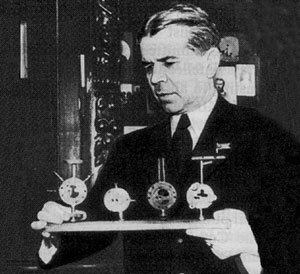
Sergei Vavilov was born in Moscow in 1891. His father, a prosperous textile merchant, gave a good education to his two sons and hoped they would inherit and continue his business. However, Sergei and his elder brother Nikolai both decided to become scientists. Nikolai chose biology, while in 1909 Sergei entered the Department of Physics and Mathematics at Moscow University. As a second-year student he started work in the laboratory of Pyotr Nikolaevich Lebedev (1866-1912), who was famous for his experiments on the pressure of light on solids and gases. Vavilov became a great admirer of Lebedev’s style of work – an interest in the fundamental problems of physics blended with careful experiments.
After graduating with honours in 1914, Vavilov was called up for military service; a month later the First World War began. Vavilov served in various technical regiments, but by the end of 1917 the Russian front had collapsed because of the revolution and he was taken prisoner. He was interrogated by a German officer who happened to be a physicist and they spent all night discussing physics, especially Max Planck’s new theory of light. By morning the officer had helped Vavilov escape, and in February 1918 he appeared in Moscow. His father had by then lost all his property and emigrated from Russia, but Sergei and Nikolai did not want to leave their country; they realized that they had to coexist with the Soviet government as many other Russian scientists did. The government had decided that use should be made of scientific and technical specialists “in spite of the fact that they have been nourished upon capitalist ideology”. The 1920s were thus a period of great liberty for Russian scientists, despite civil war, widespread famine and economic collapse.
Bouger’s law and non-linear optics
In 1918 Vavilov started to work in the Physics and Biophysics Institute headed by Pyotr Petrovich Lazarev, a disciple of Lebedev who proposed that Vavilov pursue the topic of physical optics. He also lectured at Moscow University. From the start Vavilov was fascinated by the fundamental questions of the nature of light. He began with photoluminescence studies of solutions of organic dye molecules, and in 1919 conceived the idea for an experiment to confirm Max Planck’s quantum theory of light by measuring the coefficient of light absorption in optical media. According to Bouger’s law, this coefficient does not depend on its intensity; however, if Planck’s theory were correct it should be possible to see quantum fluctuations at very low or very high intensities of light, thus violating the law. Using dye solutions Vavilov and his students verified the law over a large range of incident light power, 10-11-108erg/cm2/s, and in 1920 they published a negative result; they did not see a violation of Bouger’s law.
During the following years Vavilov and his co-workers elucidated the principal laws of luminescence, introducing the term “luminescent yield” as the ratio of the luminescent energy to the energy of exiting light. They also investigated the mechanisms of luminescent quenching and Vavilov pioneered work on the development of new and economical light sources – luminescent lamps.
Continuing the work on the quantum nature of light, Vavilov decided to use an optical medium with a very-long-lived molecular excitation state to make it possible to see a violation of Bouger’s law. After a long search his team found a uranium glass with a glow lasting hundreds of thousands of times longer than that of dye solutions, and in 1926 Vavilov and Vadim Levshin finally discovered a violation of Bouger’s law at high intensities. They found a reduction in the absorption of light by uranium glass as the intensity of the light increased. Now known as the photorefractive effect, this was explained as resulting from the depopulation of the ground state by the incident beam. Vavilov introduced the term “non-linear optics”, which has since become a special subject of physics.
At the beginning of the 1930s the political climate in the USSR changed abruptly for the worse as Stalin consolidated his power. Numerous scientists were persecuted in Moscow, Leningrad and other cities. In March 1931 Lazarev was suddenly arrested and later exiled in the Urals. Colleagues lost their jobs at the institute, including Vavilov, although he kept his position as university professor. Academicians trying to preserve the Lebedev-Lazarev scientific school recommended Vavilov as a full member of the USSR Academy of Sciences, and he was elected in 1932.
Around the same time the director of the Optical Institute in Leningrad, Dmitri Rojdestvenski, invited Vavilov to join the staff in a bid to save the scientific programme from being stopped by the government to make way for the production of optical apparatus, especially for the military. Vavilov accepted and in 1932 was appointed head of research of the State Optical Institute. The same year he was asked by the Academy of Sciences to take charge of the academy’s small Physics Department in Leningrad. Vavilov invited several young physicists to join and organized investigations on the properties of neutrons, radiation-induced luminescence and coloured crystals.
The Vavliov-Cherenkov effect
In 1932 Vavilov and Eugeny Brumberg developed a photometric technique using the human eye as an instrument for measuring low light intensities close to the threshold of vision. This visual photometric method was very useful at a time when photomultipliers did not yet exist, and it was used in experiments performed in 1932-1941 that confirmed the statistical character of fluctuations in line with the ideas of quantum theory.
The same visual technique played a large role in the discovery of the Vavilov-Cherenkov effect. In 1933 Vavilov proposed to his postgraduate student, Pavel Cherenkov, the PhD topic: “The luminescence of the uranyl salt solutions under the influence of hard gamma radiation.” The task was to compare to what extent the luminescence properties of a salt solution in sulphuric acid exposed to gamma rays coincide with the previously studied luminescence of the same solution under light and X-ray irradiation.
The observed blue light was very weak, and to adapt his eyes Cherenkov had to stay in a totally dark room for an hour or more. In the course of measurements he found that a glow is emitted not only by the salt solution but by pure sulphuric acid as well. This situation proved to be a great nuisance to Cherenkov, who considered the glow to be a background obscuring the luminescence of the uranyl salt, so he asked to change the topic of his thesis. But Vavilov persuaded Cherenkov to continue the experiments and carefully purify the acid. When this did not help, Vavilov proposed checking if other pure solvents also emit light. Cherenkov investigated 16 different solvents of very high purity and found that the pure liquids all gleamed with nearly equal intensities under the action of gamma rays. Despite attempts to quench it by various means the mysterious radiation persisted.
Vavilov analysed all the measurements and arrived at the firm conclusion: “This is not a luminescence, this is a new optical phenomenon not known to science.” He also presented a first explanation – that the new radiation was produced by Compton electrons knocked out from the atoms of the liquid by gamma rays. In 1934 two articles were published in the same volume of the Reports of the Academy of Sciences, one signed by Cherenkov with his experimental results, the other by Vavilov in which he correctly postulated fast electrons as the origin of the new phenomenon.
In 1934 the Academy of Sciences moved from Leningrad to Moscow, and Vavilov’s Physics Department moved there too, to occupy what had been Lazarev’s building. Vavilov was determined to turn the small Physics Department into an institute covering the most important fields of physics. He obtained financial support from the government and began to organize the new Physics Institute of the Academy of Sciences. He was appointed as the first director and suggested that the new institute be named after Lebedev. He invited distinguished physicists to head the divisions he intended to create and some excellent young physicists to join the staff.
Though the 1930s were a very difficult time of political persecutions in the USSR, Vavilov managed to preserve a positive internal ambience in the Lebedev Institute, allowing the possibility for productive work. Vladimir Veksler wrote later: “I was lucky in that as a young scientist I was invited in 1936 to join the staff of the Lebedev Institute. An exciting atmosphere of complete commitment to science prevailed in the institute. My first impression of Vavilov was that his attitude was extremely affable and straightforward.”
In the laboratory of the Atomic Nucleus Division, Vavilov and Cherenkov continued to explore in detail the new radiation. They established that the radiation is emitted in a narrow cone close to the direction of the incident gamma-ray flux and is polarized along this direction. A magnetic field deflected the radiation, confirming Vavilov’s claim that it originated with charged particles. Vavilov constantly discussed the results of the experiments with theorists in the institute, trying to push them to work on the theory of effect. Finally, Ilya Frank and Igor Tamm became interested and in 1937 they gave a complete theoretical interpretation. “Vavilov enthralled me by his fascination with Cherenkov experiments,” Frank later wrote. In 1946 Vavilov, Cherenkov, Frank and Tamm were awarded the USSR State Prize in Science (the Stalin prize) for this discovery, and in 1958, seven years after Vavilov’s death, Cherenkov, Frank and Tamm received the accolade of the Nobel Prize in Physics. In his Nobel lecture Tamm said: “I should perhaps explain that we in the USSR use the name ‘Vavilov-Cherenkov radiation’ instead of just ‘Cherenkov radiation’ in order to emphasize the decisive role of the late Professor S Vavilov in the discovery of this radiation.”
By the 1930s Soviet nuclear physicists had reached a high level, mainly in the Leningrad Physics-Technical and Radium institutes and in Kharkov’s Polytechnical Institute. After visiting the USSR in 1936 Victor Weisskopf wrote: “Soviet physicists did not lag behind in their understanding of nuclear structure.” In 1938 Vavilov wrote a report about nuclear physics for the presidium of the Academy of Sciences, who decided to set up the Nuclear Physics Committee with Vavilov as chairman and Abram Ioffe, Igor Kurchatov, Pyotr Kapitza and Abram Alikhanov among its members.
Vavilov believed that experiments in nuclear physics required an accelerator bigger than the Radium Institute’s 10 MeV cyclotron, so in 1940 he organized a “cyclotron group” in the Lebedev Institute, consisting of young physicists whose goal was to find a way to construct a big cyclotron. When the members of this group told Vavilov about the huge difficulties, the answer was: “I don’t think there is no possibility of jumping over the relativistic barrier.” Then in 1944 Veksler wrote his famous two papers about the principle of phase stability, used in all modern particle accelerators. Vavilov immediately recommended them for publication and the decision was taken to start the construction of a 30 MeV synchrotron at the Lebedev Institute.
It was around this time that Vavilov was struck with the blow of the arrest, and later death, of his older brother Nikolai (1887-1943), an outstanding plant breeder and geneticist. The two brothers loved and influenced each other all their lives. Both were men of encyclopaedic knowledge, retentive memory, prodigious energy and personal charm, with a deep devotion to science. In the 1920s Nikolai had carved out a brilliant carrier in Russia. He was elected president of the Agricultural Academy and was at the head of research institutes of plant breeding in Leningrad and genetics in Moscow. He organized many expeditions throughout the world and created a huge seed collection. He also preserved and set up many experimental stations in different regions of the USSR and directed their programmes. However, Nikolai gained enemies driven by agronomist Trophim Lysenko and Marxist philosopher Isaak Present. Lysenko promised quick crop improvements, compared with Nikolai’s slow process of systematic hybridization and selection, and from 1935 Nikolai had to bear constant accusations of holding “idealist” Mendelian theories. Thousands of his colleagues and followers were removed from their teaching and research positions; many were arrested and some were shot. Nikolai’s agricultural programme was devastated and in 1940 he was arrested, tortured, tried and sentenced to be shot “for sabotaging Soviet agriculture and spying for England”. (He had worked on genetics in the UK in 1913-1914.) A year later the sentence was commuted to 20 years of forced labour, and in 1943 he died of starvation in Saratov prison. After Nikolai’s death, Sergei actively helped the family of his brother, and two of Nikolai’s sons became cosmic-ray physicists at the Lebedev Institute.
Not all of the sciences suffered as badly as biology, but Marxist philosophers assailed the “idealism” inherent in quantum mechanics and relativity theory. In 1937-1938 many physicists were arrested, and some were persecuted in the Lebedev Institute. Vavilov shielded the head of the Optics Division, Grigori Landsberg, the head of the Theory Division, Tamm (whose brother, the chief engineer of the chemical factory, was arrested), and others; he wrote directly to the chief prosecutor when Sergei Rytov, head of the Radiophysics Division, was arrested in 1937 (he was released in 1939).
Towards the hydrogen bomb
When Soviet physicists learned about the discovery of nuclear fission in 1939 they immediately proceeded to investigate the new phenomenon experimentally and theoretically. Most, including Ioffe and Kapitza, were sceptical about the possibility of utilizing atomic energy, but Tamm is reported to have said in August 1939, upon hearing a talk by Yakov Zeldovich and Yuly Khariton on their calculations of the number of neutrons emitted by fission: “Do you know what this discovery means? It means a bomb can be built that will destroy a city out to a radius of maybe ten kilometres.” (Halloway 1994.) Soviet authorities at the time thought that nuclear physics was a useless science, but Vavilov had a notion that in future it would be very significant. He had himself stayed as head of the Atomic Nucleus Physics Division of the Lebedev Institute until 1938, and gathered a team including Frank and Veksler. Later, in 1945, an engineer from the munitions plant, Andrei Sakharov, became Tamm’s postgraduate student.
On 22 June 1941 German armies unexpectedly crossed the Soviet border and rapidly progressed towards Leningrad and Moscow. This led the government to organize the evacuation of vital economic organizations towards the east of the country. By the end of July the Lebedev Institute was moved to Kazan and the Optics Institute was evacuated from Leningrad to a town 300 km from Kazan. Vavilov was appointed as adviser on optics to the USSR State Defence Committee and many research themes were changed to military tasks – every division in both institutes tried to produce equipment useful for the army.
In 1942 the Soviet government endorsed an atomic-bomb research programme and appointed Igor Kurchatov as its head. After the war Vavilov was ordered to participate in the state’s nuclear-weapons programme and he persuaded Tamm to create a special group including Vitaly Ginsburg and Sakharov. In 1948 Vavilov wrote to the government to inform them that significant results had been obtained in Tamm’s group on the development of the physical principles of a hydrogen bomb. The group was moved to the classified town of Arzamas-16, and on 12 August 1953 the world’s first compact hydrogen bomb, deliverable by plane or rocket, was successfully tested in the USSR, to the great surprise of Western physicists. Earlier, in 1950, Tamm and Sakharov created the theoretical basis for controlled thermonuclear fusion, so thermonuclear power could be used for peaceful means. Twenty-five years later, Sakharov, who had played a crucial role in the development of the Soviet hydrogen bomb, was awarded the Nobel Peace Prize for his championship of human rights, beginning in the 1960s. He was the sixth Lebedev physicist to be awarded the Nobel prize. (In 1964 Alexandre Prokhorov and Nikolai Basov received the Nobel Prize in Physics for the construction of oscillators based on the maser-laser principle.)
Vavilov was elected president of the USSR Academy of Sciences in July 1945. Many academicians thought there was not another scientist of so high a cultural level and such a provident, skillful administrator as Vavilov, and some recommended him for presidency. However, this could only have taken place if he were Stalin’s choice, so it was very hard for him to accept, as his brother Nikolai had been murdered by Stalin’s regime. The opinion of people close to Vavilov is that he accepted the post because he considered it his duty to serve science and the nation, rather than Stalin. During the time he was president he accomplished much to foster science in the USSR – the laboratories were better supplied with equipment and instruments, and the salaries of the researchers were increased.
Vavilov initiated the establishment of tens of new scientific and cultural institutions (research institutes, publishing houses, societies) but he understood and accepted the fact that he could do so only if the Communist Party saw them as useful politically or militarily. He briefed the authorities on the possibilities of new institutions and bargained to obtain the support he needed. In so doing he often had to act against his conscience and agree to distasteful compromises. Academician Leon Orbeli said in 1945: “Sergei Vavilov is a victim. He stayed on as head of the academy to save what could still be saved.” It was common knowledge that Vavilov was a kind and responsive person, and if he were able to help somebody by writing or signing a letter, acting as an intercedent or finding them a job, he would do so.
Vavilov was not only a distinguished researcher. From 1932 until the end of his life he had to spend part, and later most of his time, performing administrative functions in science and supervising young scientists. He made a great contribution to the growth of the State Optics Institute, which now bears his name, and the Lebedev Physics Institute.
All his life he was greatly interested in the history and popularization of science. He wrote popular books on optics and scientific biographies of Galileo, Grimaldi, Huygens, Faraday, Michelson, Newton, Euler, Lomonosov, Lebedev, Lazarev and others. He also translated Newton’s Optics and Lectures on Optics and Lucretius’ De rerum Natura from Latin to Russian, and published them with his own comments.
What Vavilov did during his five-year presidency is so beautiful and extensive that future generations will remember him with deep respect and gratitude.
Ilya Frank
In the end, being president of the academy under the brutal dictatorial regime of Stalin was a source of appalling stress. Vavilov’s health was seriously damaged and he died of a heart attack in 1951, two months before his 60th birthday (and two years before Stalin’s death).
Frank preserved his respect and affection for his beloved teacher until the end of his days. He compiled and edited a collection of reminiscences about Vavilov, which was published in three volumes. Frank was very ill when he was working on the third volume in 1991 and afraid he would die without finishing the work. When he completed the manuscript he emerged from his study at home and joyfully informed his family that the book had been finished, adding: “Now at last I can die.” He died a few days later.
Frank wrote: “What [Vavilov] did during his five-year presidency is so beautiful and extensive that future generations will remember him with deep respect and gratitude.”
CERN is 50 years old this year, just as ICTP turns 40. Both are international institutions of advanced scientific research with similar aspirations and, understandably, their histories are intertwined. Two members of the CERN theory division, Jacques Prentki and Léon Van Hove, took part in panels of experts that encouraged the setting up of an international centre for theoretical physics. After the formation of ICTP in Trieste, its scientific council has been served, at various times, by Van Hove, Victor Weisskopf and Herwig Schopper, all at one time director-generals of CERN; Alvaro De Rújula, a young researcher at ICTP during its early years who later became director of CERN’s theory division; and Abdus Salam, founding director of ICTP who served for several years on CERN’s scientific policy committee.
ICTP’s creators intended to raise the level of science in developing countries by reducing scientific isolation through any means possible. The centre has been an institution run by a few scientists for the benefit of many. It operates on the principle that it can make a difference to the levels of science of individual scientists independent of the level of their home institutions.
These principles have remained unchanged, though it has become necessary for ICTP to adapt itself to changing circumstances. In particular, the unevenness of the progress made by developing countries has made it necessary to adopt different types of programmes for different regions of the world.
Forty years on, what exactly has ICTP accomplished? A brief list includes:
• Around 2000 scientific activities – from introductory schools to advanced workshops – organized on ICTP’s premises.
• Around 100 000 scientific visitors – about half of whom come from developing countries and many of whom regard ICTP as a scientific home away from home.
• Thousands of research papers that have been published by the ICTP community in scholarly international journals.
Some of ICTP’s scientific staff and many of its visitors are among the best in the world.
During the Cold War years ICTP was where the best scientists from both sides of the iron curtain met. It has also spun off intellectual centres elsewhere in the world, where they were needed most, and nurtured bright young scientists when their careers needed a boost. It has helped create new scientific institutions in Trieste, adding substance to the city’s claims of caring for global science, and has rightly earned itself a high standing as a unique institution. We are indeed proud of our accomplishments.
But the magnitude of what remains to be done is immense. If we assume that a viable ratio of scientists to the overall population is a modest 1 in 1000, and that a third of these belong to physical sciences – which is ICTP’s domain, despite the name – we ought to be connected to about two million scientists. By this measure, we fall short by a factor of 20, even on a cumulative count.
How do we motivate well-meaning scientists to be engaged in their work if they have to wait several days to download a four-page article in Physical Review Letters, or see the library in their university burn down in political conflict? Without working at some point at an institutional level how do we help create a cadre of adequate scientific capacity in countries where it’s needed most? If scientists aren’t suitably engaged, who shall advise governments across the world about the opportunities and responsibilities science affords in shaping the economic and physical well-being of their populations?
We must be involved in these issues, not simply as a moral imperative but because no part of the world today can prosper in exclusion, and if we leave some parts too far behind the consequences can be both adverse and unforeseen. This is the lesson forcefully inflicted upon us in the 21st century.
As ICTP celebrates its 40th anniversary, these concerns weigh on our minds. While we shall continue, as now, to support first-rate scientists individually, we have to develop several new avenues. Despite the continuing and generous support of the Italian government, we have neither the physical facilities nor the financial resources to arrange for every needy scientist to visit ICTP, or to support them in their own countries. So we have to work with the few outstanding and like-minded institutions to raise regional levels of science, in part through “South-South” co-operation. Where scientific traditions are great but resources scant, new centres must be created by raising money from all countries. We have to go beyond our support of individuals to groups of scientists who can be mutually supportive and multiply ICTP’s effect. Taking advantage of our sponsoring institutions, namely UNESCO and the International Atomic Energy Agency, and others such as the International Telecommunication Union, we should strive to provide fast access at least to major research institutions throughout the world. At the same time we should work with scientific publishers to provide access to electronic publications and encourage distance learning.
The spirit of what we do is to spread the notion of scientific excellence. Obviously what we don’t have ourselves we cannot impart to others. To support diversity without losing sight of quality is not easy: we cannot demand the same accomplishments from all those we support, but there can be no compromise on personal excellence and commitment to learning. In the end this is what matters most and will be most telling of ICTP’s effectiveness.
The 2004 Nobel Prize for Physics has been awarded to David Gross, David Politzer and Frank Wilczek for their “discovery of asymptotic freedom in the theory of the strong interaction”. This honour comes a year after they received the High Energy and Particle Physics Prize of the European Physical Society – and just over 30 years since they made the remarkable proposal that the interaction strength between quarks becomes weaker as they come closer together.
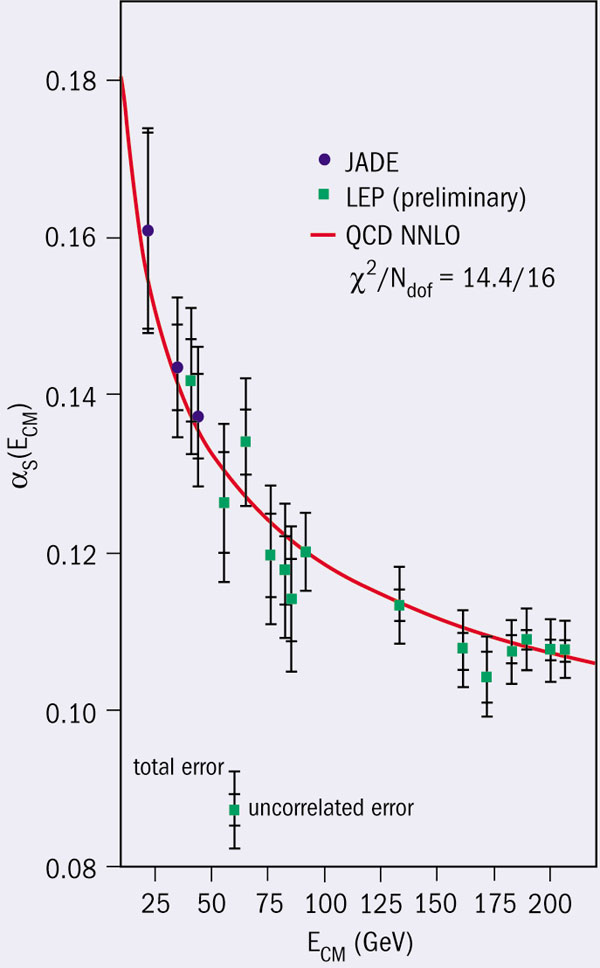
Politzer and Wilczek were both still graduate students in June 1973 – Wilczek working with Gross – when their work appeared in two consecutive papers in Physical Review Letters, in fact the last two papers of volume 30. The key factor they discovered was that the beta function, which describes how the coupling constant of an interaction changes with energy, can be negative, contrary to what was generally believed. This means that the interaction strength can decrease with increasing energy, making quarks “asymptotically free” at high energies.
Earlier, in 1970, Kurt Symanzik had shown that only a theory with a negative beta function could lead to the effect of “scaling” derived by James Bjorken (where the probability for the interaction depends on a dimensionless variable), which had been observed in electron-proton interactions at SLAC. However, this was unknown in any other theory. In quantum electrodynamics, the quantum-field theory par excellence, the beta function is positive – charges become free from each other’s grasp as they are separated and the force between them becomes smaller. Could a quantum-field theory for the strong force, with a negative beta function, be found? The question became particularly pressing after Gerard ‘t Hooft’s work in 1971 that overcame problems in the gauge-field theory for the unified electroweak theory.
Indeed, in 1972 in a discussion with Symanzik at a conference in Marseille, ‘t Hooft himself realized what kind of theory could have a negative beta function. Although he did mention it at the conference, he did not follow it up. It fell to others to pursue the problem, including Gross’s group at Princeton and Sidney Coleman’s at Harvard, in which Politzer worked. The rest, as they say, is history, as the discovery of Gross, Politzer and Wilczek in a sense not only liberated quarks deep within the proton but also liberated theorists to develop a quantum-field theory of the strong interaction. In particular, it focused attention on the development of quantum chromodynamics (QCD), in which the strong interaction is mediated by massless spin-1 particles, the gluons.
The decrease of the strong coupling constant with energy has since been dramatically confirmed with high precision, most recently at DESY’s electron-proton collider, HERA, and in studies at the mass scale of the Z boson at CERN’s Large Electron Positron (LEP) collider. It is fitting that following this clear support for their original ideas, Gross, Politzer and Wilczek have now been rewarded with the Nobel prize.
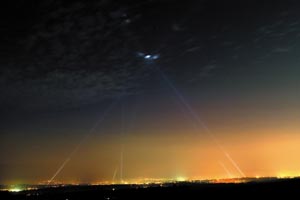
On the date of CERN’s 50th anniversary, 29 September 2004, the organization’s host state authorities lit up the sky in celebration. As night fell, 24 powerful floodlights blazed up from the eight access points around the 27 km tunnel that will be oCCEupied by the Large Hadron Collider (LHC). These beams emanating from the Geneva plain marked out the extent of the huge ring.
Spectators were invited to a celebration above the village of Crozet, in the foothills of the Jura mountains. Before the illuminations began, speeches by local dignitaries from France and Geneva were followed by a series of live addresses by teleconference link. CERN’s director-general, Robert Aymar, spoke from the CHEP 2004 conference in Interlaken, and two of his predecessors, Luciano Maiani and Chris Llewellyn Smith, joined in from Rome and London respectively. Tim Berners-Lee, inventor of the Web, also made an appearance by video link to wish CERN many happy returns. People born in 1954 were then invited to blow out the candles on an anniversary cake.
Organized by the Department of Justice, Police and Security of the Canton of Geneva, with the participation of the local council of Crozet and the support of local councils in the Canton of Geneva, the Communauté des communes of the Pays de Gex, and the Ain Préfecture, this Franco-Swiss event had great symbolic value because CERN plays host to scientific collaborations from all over the world.
The parties had in fact begun earlier in the month on 17 September, when the people at CERN and their families filled the rooms of Restaurant 1 and the terrace beyond.
In a short speech the director-general Robert Aymar toasted the CERN staff, praising their competence throughout the history of the organization. He noted also how CERN’s diversity of nationalities is its strength, as people from different backgrounds come to collaborate at the laboratory. For musical entertainment, the CERN Big Bang Orchestra, made up mostly of members of various CERN music clubs and l’Ensemble de Jazz de Divonne, played an original composition by Jean-François Mathieu, created especially for CERN’s anniversary, called Acceleration/Celebration.
The celebrations also continued into October. The most ambitious open day in the history of the organization took place on 16 October, and was followed by the official VIP celebration on 19 October. Reports on these events will appear in the December issue of the CERN Courier.
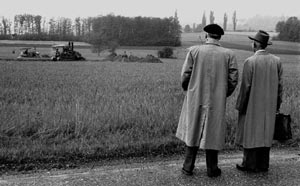
Geneva was selected as the site for the CERN laboratory at the third session of the provisional council in 1952. This selection successfully passed a referendum in the canton of Geneva in June 1953, and on 17 May 1954 the first shovel of earth was dug on the Meyrin site under the eyes of Geneva officials and members of CERN staff.
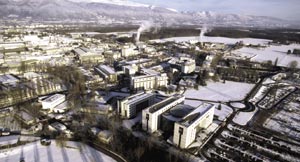
An aerial view of modern-day CERN taken in January 2004 shows how the Meyrin site has developed in 50 years. In the background are the buildings at Point 1 on the Large Hadron Collider (LHC) ring, where the ATLAS detector is being installed. In the foreground is Building 40, which was built to provide offices for the physicists working on the LHC experiments.
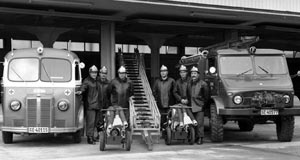
The CERN fire brigade was set up in July 1956 to provide a rapid response in the event of an accident and to tackle the risks specific to the organization’s activities. Here are six members of the brigade in 1959.
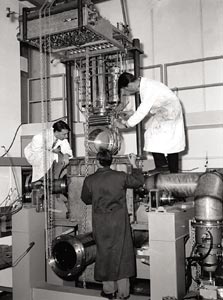
The upper magnet coil of CERN’s first machine, the Synchrocyclotron (SC), is moved over the upper pole discs. Each coil weighed 60 tonnes and measured 7.2 metres in diameter. The SC was commissioned in 1957 and was operational for 34 years.
During the night of 24 November 1959 the PS reached its full energy. The next morning John Adams announced the achievement in the main auditorium. In his hand is an empty vodka bottle, which he had received from Dubna with the message that it was to be drunk when CERN passed the Synchrophasotron’s world-record energy of 10 GeV. The bottle contained a polaroid photograph of the 24 GeV pulse ready to be sent back to Dubna.
CESAR (the CERN Electron Storage and Accumulation Ring) was built as a machine model for the ISR. The model had to be small, but the particles had to be relativistic, so electrons were chosen. Running from 1964 to 1967 CESAR demonstrated techniques essential for the ISR (and later the proton-antiproton collider), in particular ultrahigh vacuum techniques.
The Intersecting Storage Rings (ISR), the world’s first proton-proton collider, started up in 1971, and later provided the first proton-antiproton collisions and the first collisions of beams of heavier ions (alpha particles). This image shows the vacuum chamber at one of the points where the proton beams crossed in the ISR.
Assembly in progress inside the Gargamelle heavy-liquid bubble chamber, which was built at Saclay in France and came into operation at the PS in 1971. The chamber had a cylindrical body 4.8 m long and 1.85 m wide, with a volume of 12 cubic metres.
In 1973 the Gargamelle collaboration announced the discovery of weak neutral currents. Here in a neutral-current event, a neutrino interacts with an electron in the chamber liquid. The neutrino continues unseen, while the electron creates the horizontal branched track.
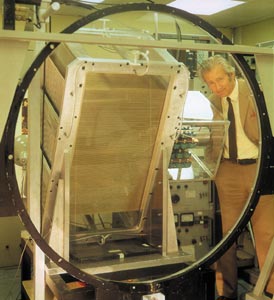
In 1968 Georges Charpak (seen here in 1978) invented the multi-wire proportional chamber, which was to revolutionize the field of particle detection and gain him the 1992 Nobel Prize in Physics.
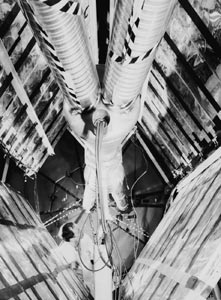
The SPS, with its 7 km circular tunnel, extended CERN beyond the Meyrin site. Construction began in 1972. Here the metal structure of the shuttering used when pouring the concrete walls of the tunnel gives a remarkable optical effect.
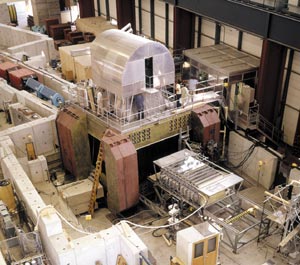
The Omega spectrometer came into action in the West Area at the SPS during 1972. An array of optical spark chambers can be seen withdrawn from the magnet aperture. The “igloo” above the magnet housed the Plumbicon camera system that recorded information from the chambers. No fewer than 48 experiments made use of Omega, exploiting beams of various particles at various energies – first from the PS and then from the higher energy SPS.
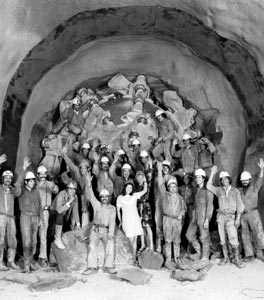
Two years after the construction of the SPS began, on 31 July 1974, the Robbins boring machine that was excavating the tunnel returned to its starting point.
On 21 January 1983 the UA1 collaboration, led by Carlo Rubbia, announced the discovery of the charged carrier of the weak interaction, the W, in proton–antiproton collisions at the SPS. Three months later they had also found the Z0 , responsible for the weak neutral currents discovered 10 years previously in Gargamelle. In this colour-treated picture of tracks reconstructed in UA1, a Z has decayed into an electron and a positron, which fly off in opposite directions (yellow).
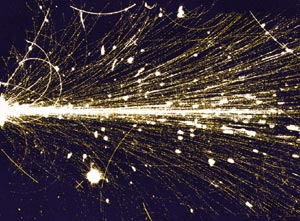
The SPS also had a pioneering role in CERN’s programme of heavy-ion physics, beginning with beams of oxygen and sulphur ions in 1986. Here a sulphur ion, with a total energy of 6400 GeV, strikes a nucleus in a gold target in the NA35 experiment. A streamer chamber records the resulting shower of particles.
In 1984 Carlo Rubbia (centre) and Simon van der Meer (left) received the Nobel prize for the discovery of the W and Z particles at CERN. Here they are talking in 1983 with Sir Alec Merrison, then president of Council.
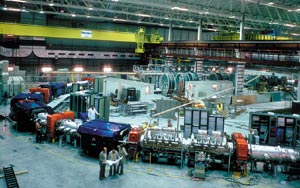
The final stages of preparation in the SPS tunnel in April 1976. The red magnets are some of the 800 or so 6 m long dipole magnets that guide the beams round the machine.
The Antiproton Accumulator, seen here in June 1980, was an important step in converting the SPS to a proton-antiproton collider. It used Simon van der Meer’s “stochastic cooling” technique to produce useful beams of antiprotons.
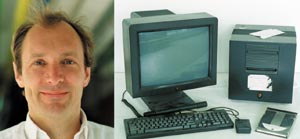
Tim Berners-Lee, seen here in 1994, invented and developed the World Wide Web as an essential tool for high-energy physicists. He conceived HTML, http and URLs using the machine shown on the right in 1990 to develop and run the first Web server, multimedia browser and Web editor.
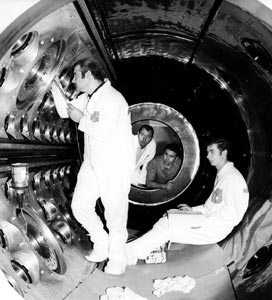
In 1985 excavation work began for the 27 km tunnel of the Large Electron Positron collider (LEP). This was the most formidable civil-engineering venture in the history of CERN and Europe’s largest civil-engineering project prior to the Channel Tunnel.
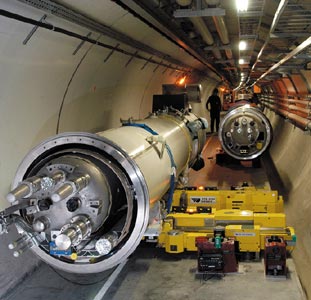
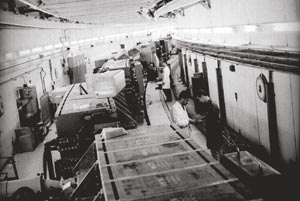
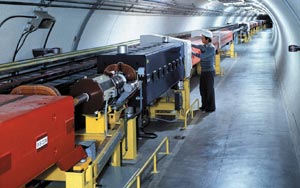
One of the monorail trains suspended from the ceiling above the magnet ring in the 27 km long LEP tunnel. The trains were used for transporting goods and people.
Looking rather as if surrounded by a collection of ornate urns, a technician surveys copper-accelerating cavities used in LEP. From 1996 these were gradually replaced by superconducting cavities that were to double the total collision energy from 100 GeV to just over 200 GeV.
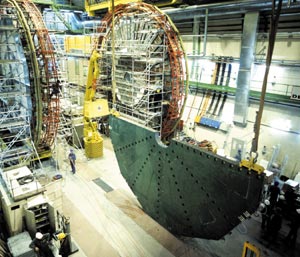
The construction of DELPHI, one of the four detectors at LEP, in January 1989, only seven months before the first collisions. This picture shows the installation of a “half-moon” section for one of the end caps.
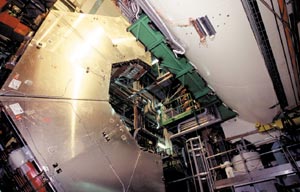
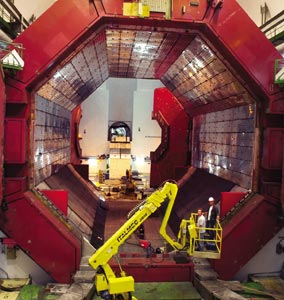
A feature of the L3 experiment at LEP was its huge magnet, with much of the detector located within the magnet coils. One of the huge “doors” of the magnet is seen in this view from February 2000.
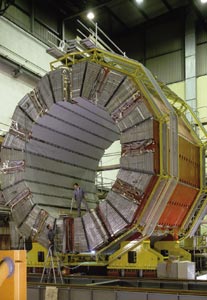
The segmented barrel of the hadron calorimeter for the ALEPH detector at LEP during construction in 1987; the iron also formed the return yoke for the electromagnet.
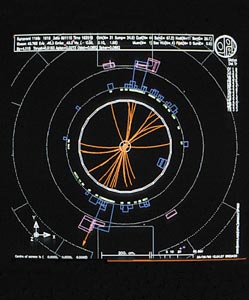
After LEP started operation in August 1989 it became a veritable “factory” for the production of Z0 particles. This display from OPAL shows the decay of a Z into two jets of particles, originating from a quark-antiquark pair, recorded in June 1990.
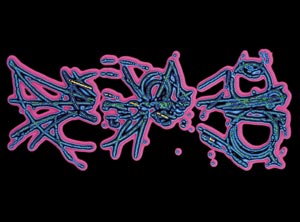
The world’s first atoms of antihydrogen were observed in the PS210 experiment at CERN in 1995. Seven years later in 2002, the ATRAP and ATHENA experiments began to make antihydrogen atoms by the thousand. This display shows an antihydrogen event recorded by ATHENA in August 2002.
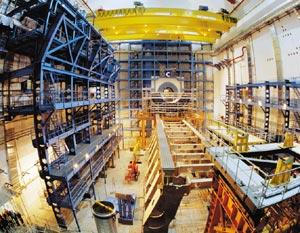
The ALICE experiment, which will study lead-lead collisions in the LHC, is being installed in the cavern previously occupied by the L3 detector. It also makes use of L3’s huge magnet.
The LHCb detector will occupy the cavern used by the DELPHI experiment at LEP, and will investigate matter-antimatter differences in B mesons at the LHC. The coils of the detector’s huge dipole magnet are seen here in April 2004.
In 1946 a commission of the United Nations Security Council was entrusted with the task of making proposals to bring atomic energy under international control. It was one year after the devastation of Hiroshima, and the idea of such control had been approved by all the governments. The commission was made up of influential scientists who had the knowledge that was needed to understand the problem fully and of politicians and diplomats representing the governments’ interests. It was in this capacity as a diplomat that I represented France on the commission and was able to establish trusting and friendly relations with many of my countrymen who were scientists, as well as with foreign scientists, first and foremost among whom was Robert Oppenheimer, who was to play a very important role in the creation of CERN.
In the course of the many conversations I had with Oppenheimer in the US, in which we were often joined by other Frenchmen, who were my scientific and technical advisers, he confided his worries about the future development of fundamental physics in Europe. “Almost all we know, we have learnt in Europe” is the substance of what he said. He himself had been a pupil of Niels Bohr in Copenhagen. “But in the future,” he continued, “research is going to require industrial, technical and financial resources that will be beyond the means of individual European countries. You will therefore need to join forces to pool all your resources. It would be fundamentally unhealthy if European scientists were obliged to go to the US or the Soviet Union to conduct their research.”
Early in 1950, convinced by this argument, Francis Perrin, then high commissioner for atomic energy in Paris, and I began to visit the main European research centres that would need to be persuaded. We met with a favourable response from Edoardo Amaldi in Italy, Niels Bohr in Copenhagen, Paul Scherrer in Switzerland and possibly Werner Heisenberg in Germany, if I remember correctly, but we were given a cooler reception in other capitals. Nevertheless, the idea was now on the table and was no doubt starting to take root in people’s minds. Moreover, it came on top of an appeal on similar lines from the European Centre for Culture in Geneva, led by Denis de Rougemont from Switzerland and Raoul Dautry from France. It was then that Isidore Rabi, a Nobel prize winner, made his crucial speech at the UNESCO General Conference in Florence in June 1950. Speaking on behalf of the US, he more or less said the same thing that Oppenheimer had said to us in private.
This speech marked a definite turning point, persuading the majority of European scientists and their governments to adopt a resolution authorizing UNESCO to “assist and encourage the formation and organization of regional centres and laboratories in order to increase and make more fruitful the international collaboration of scientists”. Pierre Auger, UNESCO’s director of natural sciences, took matters in hand and, at the end of 1951, managed to organize a conference of all European scientists and government representatives, which I had the honour to chair and at which it was decided to establish the European Council for Nuclear Research.
The fundamental ideas, namely the goals that all the pioneers of what was to become CERN set themselves, consisted first of all in promoting European co-operation in this vital area. CERN was thus the first venture on a European scale and I can say that Robert Schuman, who was then French minister of foreign affairs and one of Europe’s founding fathers, was immediately in favour of it. A second goal was to reintroduce complete freedom of communication and the sharing of knowledge into this branch of science.
It should be realized that, in the wake of Hiroshima, people were afraid of science and of nuclear science in particular. “The physicists have known sin” said Oppenheimer, and the consequence of using scientists’ work for military purposes was the imposition of secrecy and the lack of communication between research centres. By immediately taking the opposite approach to fundamental research in its statutes, CERN was following the great tradition of science knowing no boundaries. The ambitions of these pioneers were more than fulfilled, since CERN is today home to scientists from all over the world, including the US, China, Japan and Russia, all working together and in teams on the same research, the results of which are published in full.
Another of my memories concerns the extension of the CERN site into France. After the construction of the 28 GeV Proton Synchrotron, it soon became apparent that, in the time-honoured fashion, this was only a scale model of more powerful machines to come. The area that Switzerland had been able to set aside for CERN could not be extended on the Swiss side. Luckily, the site ran alongside the border with France, and the land in that area was essentially being used for farming. The continuation and development of CERN’s activities were therefore dependent on extending the site into France, thus requiring a parcel of around 500 hectares of French land to be made available to an international organization with its headquarters in Switzerland. I prepared a dossier, which was submitted to the then French president, General de Gaulle, by the minister of foreign affairs, Maurice Couve de Murville. That is how CERN became – and I think remains to this day – the only research centre to straddle the border of two countries.
by V V Anisovich, M N Kobrinsky, Yu M Shabelski and J Nyiri, World Scientific. Hardback ISBN 9812386998, £73 ($98).
This second edition is an updated version of the book published in 1985. QCD-motivated, it gives a detailed description of hadron structure and soft interactions in the additive quark model, and is aimed at graduate students and researchers in particle and nuclear physics.
To provide the best experiences, we use technologies like cookies to store and/or access device information. Consenting to these technologies will allow us to process data such as browsing behavior or unique IDs on this site. Not consenting or withdrawing consent, may adversely affect certain features and functions.
Functional
Always active
The technical storage or access is strictly necessary for the legitimate purpose of enabling the use of a specific service explicitly requested by the subscriber or user, or for the sole purpose of carrying out the transmission of a communication over an electronic communications network.
Preferences
The technical storage or access is necessary for the legitimate purpose of storing preferences that are not requested by the subscriber or user.
Statistics
The technical storage or access that is used exclusively for statistical purposes.The technical storage or access that is used exclusively for anonymous statistical purposes. Without a subpoena, voluntary compliance on the part of your Internet Service Provider, or additional records from a third party, information stored or retrieved for this purpose alone cannot usually be used to identify you.
Marketing
The technical storage or access is required to create user profiles to send advertising, or to track the user on a website or across several websites for similar marketing purposes.