Comsol -leaderboard other pages

Topics

Large Hadron Collider Phenomenology

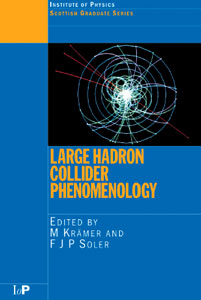
by M Krämer and F J P Soler (eds), Institute of Physics Publishing. Hardback ISBN 0750309865, £75 ($125).

The Large Hadron Collider (LHC) is often described as the machine needed by the worldwide community of high-energy particle physics experimentalists and theorists to search for and, it is hoped, discover physics signals beyond those expected from the Standard Model of particle interactions. The general-purpose experiments now completing construction (ATLAS and CMS) are often described as huge facilities optimized for the search for the elusive Higgs boson, the one key element missing in the Standard Model. About three years from now, the whole community in our field will focus on new and, we hope, unexpected physics results. These will cover a wide range of topics, extending over all possible theoretical conjectures published to date, that are relevant to experiments at the scale of tera-electron-volts.
CCEboo1_05-05

Given the dearth of guidance from experiments (aside from the beautiful but maddening agreement of even the most precise measurements with the predictions of the Standard Model), the driving goal of all theoretical developments beyond this very same Standard Model is that of solving the many fundamental issues in particle physics, which today are also relevant to cosmology, a science that has become much more mature experimentally over the past 10 years or so.

This book presents a series of lectures attempting to cover LHC phenomenology in the broadest possible sense. They range on one side from the intricacies of scalar fields, string theory and extra dimensions, to the basics of detector physics, which for more than 10 years has guided R&D in our field. This has led to the optimized design of the huge and complex detectors needed to extract minute signals from the huge backgrounds, involving today’s exciting physics (electroweak gauge-boson production, quantum chromodynamic multi-jet events, and heavy flavour production). But the lectures also range from accelerator science to modern e-science (the birth of the computing Grid) and from the less well known intricacies of heavy-ion physics to those of forward physics, where diffractive and quasi-elastic phenomena dominate.

These lectures were meant for today’s young physicists, many of whom will surely be the driving force behind the physics analyses and publications of the LHC experiments over the coming years. They were delivered on the occasion of the 57th Scottish Universities Summer School in Physics in summer 2003, by a well balanced mix of experienced theorists (D Ross, K Ellis and J Ellis) and seasoned experimentalists (V Gibson, H Hoffmann, B Müller, M A Parker, A de Roeck, R Schmidt and T S Virdee).

The emphasis in most of the lectures was on giving a snapshot of the current status of understanding in theory, phenomenology and accelerator and detector performance. The inevitable fate of such snapshots is to become fairly quickly obsolete, given the huge ongoing development of both the hardware and the software (should one add the middleware?) needed to operate the experiments, to simulate their performance accurately, to analyse their data quickly but unerringly, and to give a fair chance to all participants on all continents to join in the fun in the summer of 2007. Another drawback of such attempts is that, unavoidably, certain topics are treated superficially. However, I believe upon reading large sections of the book that this is largely outweighed by the benefit, for the young and less young reader, of finding in one volume a really complete coverage of all aspects relevant to LHC physics with a sufficiently rich bibliography to pursue in-depth reading.

For example, the reader interested in the phenomenology of quantum chromodynamic (QCD) beyond its direct application to LHC physics is referred to the book QCD and Collider Physics (by K Ellis, J Stirling and B Webber, 1996), the reader interested in more in-depth studies of accelerator physics and technology is referred to the Handbook of Accelerator Physics and Engineering (by A Chao and M Tigner, 2002), and the reader interested in the design and optimization of the general-purpose ATLAS and CMS detectors is referred to “Experimental challenges in high luminosity collider physics” (by N Ellis and T S Virdee, Ann. Rev. Nucl. Part. Sci. 44 609, 1994) and to all the Technical Design Reports published from these experiments between 1996 and 2005.

In summary, this book is an excellent introduction to LHC physics for any person entering the field now, at a moment when a huge effort from the whole community is still ongoing to meet the difficult challenge of assembling the various jigsaws needed to observe the first proton-proton collisions at the tera-electron-volt scale in summer 2007.

The reader has to be aware though that, apart from the foundations of the Standard Model, of supersymmetric and string theories, and of particle interactions in matter, many of the details provided in the lectures to illustrate the wonderful and exciting potential of the LHC and its associated detectors are to be considered as examples only. These will most likely bear little resemblance to the results published in the final publications a few (or many) years from now. I believe that most experimentalists, who have devoted a large fraction of their professional lives to make the LHC dream come true, hope that reality at the tera-electron-volt scale is something quite different from what has been envisaged to date by our theory colleagues. It is indeed the fulfilment of such a hope that can give a new and much needed impetus to our field, thereby surely opening up rich and thrilling prospects for the generations of theorists and experimentalists to come.

US budget changes priorities for HEP

On 8 February the White House released its budget proposal for the financial year 2006. The science and technology budget of the US Department of Energy has been reduced overall by about 3.8% compared with 2005, whereas the budget for high-energy physics (HEP) is reduced by about 3%. The proposal is pending approval by Congress.

The HEP programme for 2006 has been structured in such a way “not only to maximize the scientific returns on our investment in these facilities, but also to invest in R&D now for the most promising new facilities that will come online in the next decade”. This has necessitated some prioritization.

The planned operations, upgrade and infrastructure for the Tevatron at Fermilab are cited as the highest priority, with a high priority also given to operations, upgrades and infrastructure of the B-factory at SLAC. However, B-factory operations will be terminated by 2008 at the latest. Support for a leadership role for US research groups in the physics programme for the Large Hadron Collider at CERN will also continue to be a high priority, and the preconceptual R&D needed to explore the nature of dark energy will continue in 2006.

A major casualty is the engineering design of the B Physics at the Tevatron (BTeV) experiment, which was scheduled to begin in 2005 as a new “major item of equipment” and will instead be terminated by the end of 2005. The reasons given are the timescale and the “lesser scientific potential” compared with other projects, although it is “still important scientifically”. Support was strong only if the project could be completed by 2010, which is “not feasible given schedule and funding constraints”.

Support for a future electron-positron linear collider, however, has increased relative to 2005 for “the continued international participation and leadership in linear collider R&D and planning by US scientists”. R&D for other new accelerator and detector technologies, particularly in the emerging area of neutrino physics, will also increase.

Cornell gets funding for brighter X-rays

The US National Science Foundation (NSF) has awarded Cornell University $18 million to begin developing a high-brilliance, high-current Energy Recovery Linac (ERL) synchrotron radiation X-ray source.

CCEnew7_04-05

All existing hard X-ray synchrotron radiation facilities are based on storage rings. Equilibrium emittance considerations limit the X-ray brilliance that is practically attainable and the ability to make short intense X-ray pulses. In an ERL the electron bunches are not stored; rather, electron bunches with very low emittance are created then accelerated by a superconducting linac.

After one circuit around a transport loop, where the X-rays are produced, the electron energy is extracted back into the radio-frequency (RF) field of the linac and used to accelerate new bunches. The energy-depleted bunches are dumped.

The beams from ERLs are predicted to be around 1000 times better in terms of brightness, coherence and pulse duration than current X-rays. They will enable investigations that are impossible to perform with existing X-ray sources.

The ERL is based on accelerator physics and superconducting microwave technology in which Cornell’s Laboratory of Elementary Particle Physics is a world leader. The NSF award to Cornell will fund the prototyping of critical components of the machine. The design team, led by Cornell’s professors Sol Gruner and Maury Tigner, has already almost completed the prototype design; scientists from Jefferson Laboratory worked with Cornell on the initial design. Prototype construction and testing should finish in 2008. Cornell then will seek funding for a full-scale ERL facility as an upgrade of the present synchrotron radiation facility, the Cornell High Energy Synchrotron Source (CHESS), which is based on the Cornell Electron Storage Ring (CESR).

Very High Energy Cosmic Gamma Radiation: A Crucial Window on the Extreme Universe

by Felix A Aharonian, World Scientific. Hardback ISBN 9810245734, £65 ($107).

Astronomy – the study of all kinds of cosmic radiation – meets particle physics at the highest gamma-ray energies. This book offers the opportunity for particle physicists to cross the bridge between the two disciplines. They will discover the nature and properties of the extreme sources in the universe able to emit photons at energies higher than 10 GeV.

CCEboo1_04-05

Very-high-energy astrophysics is entering a new era with the recent achievement by the High Energy Stereoscopic System (HESS) of the first spatially resolved high-energy gamma-ray image of an astronomical object, the supernova remnant RX J1713.7-3946. This image confirms that supernova remnants are at the origin of cosmic rays.

The lead author of the paper in Nature that described the HESS results was Felix Aharonian, the author of this book. Here he uses his expertise to provide a broad and comprehensive overview of the study of cosmic gamma rays, from energies of about 10 GeV to 10 TeV. In nearly 500 pages, he covers all aspects of the field including the theoretical ground of gamma-ray emission and absorption mechanisms, as well as the status of detection facilities. The main part of the book is, however, devoted to the phenomenology of the various sources of very-high-energy gamma rays.

With more figures than equations, the author guides us through the world of supernova remnants, pulsars, jets of quasars and microquasars, and clusters of galaxies. He even discusses the implications for cosmology, as derived from the interaction of very-high-energy gamma rays with the diffuse extragalactic background radiation. As complete as this book tends to be, however, I am a little surprised to find notable omissions, including gamma-ray bursts and the possible annihilation-radiation of weakly interacting massive particules (WIMPs), which are mentioned but not discussed.

Nevertheless, this book with its extensive list of references is a very valuable introduction to the astrophysics of high-energy gamma-ray radiation. Well structured and with its more mathematical parts left for the appendix, it is also suitable for a quick search for a specific topic. It can therefore be used as a reference book for this fascinating “last electromagnetic window” on the cosmos, a topic destined to evolve very rapidly in the coming years.

Debunked! ESP, Telekinesis and Other Pseudoscience

by Georges Charpak and Henri Broch, translated by Bart K Holland, Johns Hopkins University Press. Hardback ISBN 0801878675, $25.

CCEboo1_03-05

Georges Charpak will, as they say, need no introduction to most readers of the CERN Courier. Henri Broch, author of Au Coeur de l’Extraordinaire and a contributor to the American magazine Skeptical Inquirer, is perhaps less familiar to English-speaking readers. Now, their short book Devenez Sorciers, Devenez Savants has been translated into English by Bart Holland, with the title Debunked! ESP, Telekinesis and Other Pseudoscience.

Pseudoscientific mumbo-jumbo has been engulfing the US long enough for an extensive sceptical literature to have grown up around it. Stories about firewalking, dowsing and spoon-benders have already been dealt with by James Randi in Flim-Flam!, Martin Gardner in Science: Good, Bad and Bogus, and, less originally in my opinion, by Victor Stenger in Physics and Psychics. Charpak and Broch treat all these matters with new insight and humour, but include many new examples to show that even France, home of the Cartesian philosophy of doubt and scepticism, is now apparently ready to believe almost anything, provided it is vouched for by fashionable figures in show business or the media.

Thus, in 1982, Broch found that among undergraduate science students at Nice, 52% believed relativistic time dilatation to be pure theoretical speculation, while 68% thought that paranormal spoon-bending was scientifically proven. More recently, Elizabeth Teissier, astrological adviser to millions (including, she would have us believe, François Mitterrand), was awarded a PhD by the Sorbonne for a thinly disguised PR job vaunting her craft.

I cannot resist mentioning two of my own favourites here: Paco Rabanne, the famous fashion designer, ran away from Paris before the 1999 eclipse because he was afraid the sky might fall on his head; and the failed rock musician and racing-car writer Claude Vorilhon, a.k.a. Rael, recently got word about particle physics from the Elohim – the “extraterrestrial guardians”, he says, “of peace, non-violence and harmony at all levels of infinity”. Vorilhon e-mailed many physicists to pass on the message not to mess with the universe by constructing super-colliders; science is good and should be unlimited as long as it fuses elements, it would seem, but it should never be used when breaking or cracking infinitely small particles. As Charpak and Broch point out, the more vague, hollow and absurd the claim, the deeper the truth drawn from it – a phenomenon they term the “Well Effect”.

In his introduction, Bart Holland explains that he has tried to be true to the French original. The result will sometimes be quite confusing to English-speaking readers unfamiliar with what he calls the “glorious Gallic rhetorical style”. In addition, he has not always followed his own rule of keeping sections dealing with popular French culture and public figures intact, but has supplemented them with explanatory footnotes. In several cases, I had to turn to the original version to put arguments into context.

In their final chapter, Charpak and Broch strongly criticize the media, which they see as the natural ally of science and reason, for often (unwittingly or not) promoting the bogus claim that all ideas are of equal value, under the guise of journalistic even-handedness. The authors also differ from their English-language counterparts in that they see wider dangers in pseudoscience, such as its threat to democracy and the emergence of a multinational big business to market it. The authors’ parting advice to the reader is that critical faculties should be allied with human ones. This was more or less the position taken by Sir Walter Raleigh, who once wrote, “The skeptick doth neither affirm nor deny any position but doubteth of it, and applyeth his Reason against that which is affirmed, or denied, to justify his non-consenting.” He was beheaded shortly afterwards.

Celebratory year lifts off in Paris

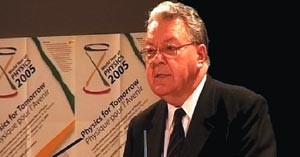
More than 1000 people including eight Nobel laureates and close to 500 students from 70 countries took part in the Physics for Tomorrow conference in Paris on 13 January. The event took place at the headquarters of the United Nations Educational, Scientific and Cultural Organization (UNESCO). It marked the official launch of the International Year of Physics proclaimed by the UN, which aims to highlight the importance of physics and its contribution to society.

CCEnew2_03-05

The conference was organized by UNESCO, the lead UN organization for the International Year, together with other organizations from the physics community, including the CNRS and CEA in France and CERN. CERN itself was founded under the auspices of UNESCO, which is one of the observer organizations to the CERN council, so it was appropriate that Carlo Rubbia and Georges Charpak, Nobel laureates from CERN, together with the director-general, Robert Aymar, were among the invited speakers.

During the opening ceremony, Aymar emphasized the crucial roles of physics as the driving force for innovation, as the magnet for attracting and training the most talented people, and in forging partnerships of nations. Rubbia participated in the round table on “What can physics bring to the socio-economical challenges of the 21st century?” and Charpak talked about “Teaching and education in physics”.

• This inaugurated a series of events that are taking place all over the world in 2005 to celebrate physics and emphasize its role. For further information see www.wyp2005.org.

Countries sign up to XFEL agreement

A milestone has been reached on the way towards the realization of the European X-ray Free Electron Laser facility (XFEL). France, Germany, Greece, Italy, Poland, Spain, Sweden, Switzerland and the UK have signed a Memorandum of Understanding in which they agree to prepare the ground for a governmental accord on the construction and operation of the European XFEL research facility until mid-2006. Denmark will also sign up soon. Together with Hungary, the Netherlands, Russia, Slovakia and the European Union, which are present as observers, the signatory countries form a steering committee that coordinates the preparations for the construction of XFEL.

Following a recommendation by the German Science Council, the German federal government decided in February 2003 to go ahead with XFEL as a European joint project to be situated at the DESY laboratory in Hamburg. Commissioning this research facility, which will be unique in Europe, is to start in 2012. Its cost amounts to about €900 million, which will be borne jointly by Germany and the partner countries.

The memorandum includes working out proposals for detailed time schedules and financing schemes, the future organization structure, the exact technical design and the operation of the X-ray laser. XFEL, with its ultra-short X-ray pulses with laser-like properties, will open up completely new opportunities in a wide range of research, from geological studies to nanotechnology.

A fundamental base for the future

CCEwop1_03-05

In 1905 a young man working in the Bern patent office produced three publications on light quanta, special relativity, and the sizes and movements of molecules. The young man was, of course, Albert Einstein and 1905 was later called his annus mirabilis. The resulting theories provided insight into the cosmos, elementary particles and states of matter, and paved the way to our current understanding of matter and the universe. However, these papers also helped to lay the foundations for the economy of today, and it is for this reason that we should consider the International Year of Physics of 2005 more about looking forward than looking back.

In his work 100 years ago, Einstein was driven by his innate desire to understand the universe about him. Such curiosity-driven research creates new “breaking” knowledge – discoveries with the potential to have new, revolutionary effects in all domains of human interest. From televisions and electron microscopes to global-positioning systems (GPS) and mobile phones, there are numerous examples of breakthroughs that might not have been achieved through applied research and technology alone.

Nowadays many of the fundamental questions in physics continue to concern the structure of the universe. We can describe many of the features of the matter we know in the universe to considerable precision, but we also know that this “visible” matter constitutes only about 5% of the total energy of the universe. We know almost nothing about the remaining 95% – dark matter and dark energy. Extending our knowledge of this unknown 95% is by itself a good reason for pursuing fundamental research in this direction; and CERN, with the Large Hadron Collider project, is leading one of the efforts to further this understanding. More important, however, is the potential for this fundamental research of today to lead to the technological innovations of tomorrow, possibly as unsuspected as GPS and the World Wide Web were in 1905.

The Year of Physics also offers an important opportunity to emphasize why continued basic research, particularly in the field of physics, is essential for the 21st century in solving key problems – such as sustainable energy and protecting the environment – and in contributing to health and education, not only in the developed nations, but throughout the world. The late Abdus Salam, a physics Nobel laureate, believed that the gap between rich and poor nations was one of science and technology. In 1988, he wrote that “in the final analysis, creation, mastery and utilization of modern science and technology is basically what distinguishes the South from the North. On science and technology depend the standards of living of a nation”.

The European Union has acknowledged this view of the importance of science and technology, since it wants to become the most advanced knowledge-based economy on the planet before the end of the decade. The US believes itself to be in that position anyway for the foreseeable future. But what of the developing world? With the support of most nations, the UN has declared eight “Millennium Development Goals”, which are aimed at cutting world poverty by half in the coming decade and saving tens of millions of lives in the process. However, as Calestous Juma, the coordinator of the Task Force on Science, Technology, and Innovation for the UN Millennium Project 2005, has stated, “It is inconceivable that the eight Millennium Development Goals can be achieved by 2015 without a focused science, technology and innovation policy.”

Such a focused effort requires the will of many nations to work together. Fifty years ago, CERN came into being in the wake of the Second World War. A handful of scientists and politicians, in Europe and America, had the vision and energy to launch a unique undertaking: the establishment of a centre of excellence for Europe. Today CERN is known to be open to the world. Forgetting their differences of nationality, religion or culture, scientists from around the globe converge at CERN to work together, all sharing a common goal. This melting pot is one of the keys to the laboratory’s success. Based in their own countries, members of collaborations not only provide most of the ambitious experimental apparatus, but they also contribute to a novel, global, powerful information and communication infrastructure using their own countries’ industries and talents in a fair and constructive partnership. And the motivation for all this: cutting-edge physics.

Such collaborative efforts can be obviously applied to the current goals of the developed world. Similar collaborative and global scientific efforts also need to be applied to the goals of the countries on the less fortunate side of the digital and other divides. But underlying all must be the will to continue with curiosity-driven research, which will surely bring unknown benefits. We must allow scientists to keep on asking questions and searching for the answers. To quote Einstein: “We shall require a substantially new manner of thinking if mankind is to survive.”

The shock of the known

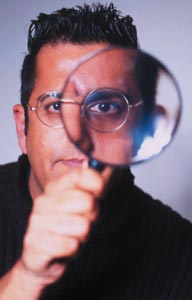
Naturally, researchers take for granted that which is known, and instead focus on the unknown. Indeed, when I was at CERN working on the UA2 experiment, everyone was obsessed wih those areas of physics that were not yet understood. The public is also interested in those scientific subjects that still remain a mystery – where is the Higgs boson? Is string theory correct? What is dark matter? So when I left particle physics and became a science journalist, I continued to concentrate on unexplored territory. It was those research topics at the frontiers of knowledge and at the centre of controversy that inevitably resulted in the best stories.

CCEvie1_01-05

However, when I sat down to write Big Bang, I decided to adopt a different approach – I wanted to celebrate how much we do know, and glory in the fact that we belong to the first generation of humans that have access to a coherent, consistent, compelling and verifiable model of the universe. The public is told so much about contentious issues, such as arguments over the existence, type and quantity of dark matter, that they probably have the impression that cosmologists know very little about the universe. In fact, I think the public would be staggered if they realized how much we do know.

The fact that the universe is expanding might seem dull to those of us within science, but to outsiders it probably sounds incredible. I suspect that the majority of the public perceive the expansion of the universe as a weird new hypothesis that will be overturned in a few years. If only they realized that the expansion of the universe was detected more than 75 years ago and has since been measured in detail and verified in a multitude of ways, then they might begin to engage with the staggering and profound implications of an expanding cosmos.

As well as spreading the gospel of our understanding of the universe, including the Big Bang model, I also wanted to show how superior models emerge in science and how they are eventually accepted, regardless of how controversial they are initially and no matter how powerful their detractors might be. Although we should be celebrating Albert Einstein in the centenary of his annus mirabilis, it is still worth noting that he vehemently opposed the Big Bang model when it was explained to him by the Belgian cosmologist (and priest) Georges Lemaître. Einstein told him, “Your calculations are correct, but your physics is abominable.” But a few years later, the observations showed that Lemaître was right, and Einstein had to concede defeat in the light of reality. The Big Bang model turned out to be basically correct and remains the best game in town.

Despite all the successes of modern cosmology and the Big Bang model, my book does feature an epilogue that explains the ways in which the model is incomplete. There are, of course, still aspects of our universe that cause bewilderment and arguments among cosmologists. For example, was there an inflationary period in the early universe, what is dark matter, what is dark energy and what is the fate of the universe? Such questions currently belong to the realm of speculation, and answering them sometimes seems impossible.

However, perhaps my book offers a note of optimism for cosmologists, because they can take heart by looking back through the history of their subject. After all, what now seems completely obvious was itself mysterious to scientists of the past. There was a time when nobody had any idea of how to measure the distances to the nebulae, but in 1923 Edwin Hubble solved the puzzle and showed that many of them were remote galaxies. He relied on the periodic variation in brightness of a type of star, known as a Cepheid variable, which he spotted in the Andromeda Nebula. The time between peaks in brightness betrays the absolute brightness of a Cepheid star and this could be compared to its apparent brightness in order to deduce its distance – and the distance to the Andromeda Nebula that it inhabited. Today, measuring the distances to galaxies is still not routine, but it is clearly no longer impossible.

Perhaps the best example of a once impossible problem that soon became trivial was discussed in 1835 by the French philosopher Auguste Comte. He had tried to identify areas of knowledge that would forever remain beyond the wit of scientific endeavour. In particular, he thought that some qualities of the stars could never be ascertained. “We see how we may determine their forms, their distances, their bulk, and their motions, but we can never know anything of their chemical or mineralogical structure.” In fact, Comte would be proved wrong within a few years of his death, as scientists began to discover which types of atom exist in the Sun.

CERN, the violin and the music of the spheres

Music has always seemed to attract physicists, perhaps because its clear and complex mathematical structure is somehow familiar, perhaps because creativity in music is refreshingly different from that in science. This link can be traced back to the ancient Greek philosophers, such as Heraclitus and Pythagoras, who discovered the mathematical basis of harmony and applied it to the movements of the planets.

CCEmus1_01-05

In modern times at CERN, Vicky Weisskopf (director-general 1961-1964) was a gifted pianist and famously said, “When things get tough, there are two things that make life worth living: Mozart, and quantum mechanics.” One of his successors, Herwig Schopper (director-general 1980-1988), is also a keen pianist. It was music that brought together Jack Steinberger and Konrad Kleinknecht to work on CP violation in the K meson system. Steinberger played the flute and Kleinknecht the violin in the CERN chamber orchestra; over a beer after a rehearsal in 1965 the two agreed to collaborate. The collaboration extended to many memorable chamber-music sessions at Steinberger’s house, involving Heinrich Wahl, Jürgen May, Günther Lütjens, Yves Goldschmidt-Clermont and others.

Kleinknecht also forms a link to another great physicist-musician prominent in the pioneering days of CERN, Werner Heisenberg, a very fine pianist; Kleinknecht was part of a small orchestra brought together to celebrate Heisenberg’s 60th birthday by accompanying him in a performance of Mozart’s Piano Concerto, K488.

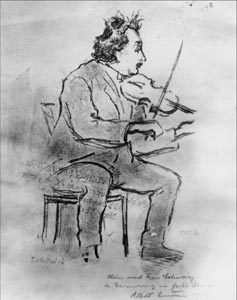
Turning specifically to the violin, many physicists, including the author of this article, have been fascinated by it, and found relaxation and fulfilment in playing. Of these, the most famous is Einstein. His violin rarely left his side and he played it often, at an accomplished level, throughout his life, saying that “life without playing music is inconceivable to me”. Max Planck was also a highly gifted pianist, composer and singer. Lise Meitner once remembered a musical evening at the Plancks’ house in Berlin, in which Planck, Einstein and a professional cellist played Beethoven’s Piano Trio in B-flat major. “Listening to this was marvellously enjoyable, despite a couple of unimportant slips from Einstein… Einstein was visibly filled with the joy of the music and smiled in a light-hearted way that he was ashamed of his dreadful technique. Planck stood quietly by with a blissfully happy face and, hand on heart, said ‘That wonderful second movement!’ ”

CCEmus2_01-05

Einstein was an inveterate concert-goer. He attended the famous debut of Yehudi Menuhin with the Berlin Philharmonic under Bruno Walter, in which the 13-year-old Menuhin was soloist in a programme of the Bach, Beethoven and Brahms concertos that would be nowadays inconceivable. Einstein was so moved by Menuhin’s playing that he rushed into the boy’s room after the performance and took him in his arms, exclaiming “Now I know that there is a God in heaven!” He once said that had he not been a physicist, he would have been a musician: “I often think about music. I daydream about music. I see my life in the form of music.”

The other side of the coin is violinists who have been interested in physics. In the modern age, the well known American violinist, Joshua Bell, has a great interest in physics and has collaborated with physicists and engineers at the Massachusetts Institute of Technology in a project to enhance and expand the violin electronically. There is indeed a curious though tenuous link between Bell and Einstein. The great virtuoso Bronislav Huberman was a friend of Einstein, and visited him at his home in Princeton, no doubt together with his great Stradivarius violin, known as the “Gibson” Strad, made in 1713 during the “golden period” of his work. One day, the Strad was stolen from Huberman’s dressing room at Carnegie Hall in New York. It disappeared and was lost for more than 50 years, during which time the thief played it around the backstreet bars of New York City until he died. In 2001, Bell acquired the “Gibson” for almost $4 million and now uses it as his sole concert instrument.

Given their friendship and mutual interest, it seems likely that Huberman would have allowed Einstein to play this marvellous instrument, providing a link between Bell and Einstein through this great masterpiece of the violin-maker’s art.

CCEmus3_01-05

Another violinist who is keenly interested in the work of CERN is Jack Liebeck, one of Britain’s outstanding young violinists. Liebeck, who was born in 1980, has been playing the violin since he was eight. He made his first public appearance playing the young Mozart on BBC television at the age of 10. Liebeck plays one of the finest instruments by another great maestro of Italian violin-making, Giovanni Battista Guadagnini. The violin dates from 1785 and is known as the “ex-Wilhemj”.

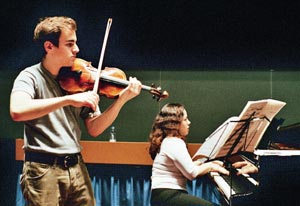
On 11 October 2004 Liebeck played with Russian pianist Katya Apekisheva in the CERN Auditorium. The occasion was a special gala concert sponsored by the UK Particle Physics and Astronomy Research Council as a tribute to the CERN staff on the organization’s 50th anniversary. In the morning, Liebeck toured CERN and visited the locations where the ATLAS and CMS detectors are being installed for the Large Hadron Collider. The concert that evening featured an electrifying performance of the Prokofiev Sonata No. 1, as well as very fine readings of the Debussy Sonata and Beethoven’s “Kreutzer” Sonata. After a brief tuning-up variation on “Happy birthday to you”, the pair played a beautiful encore: “Vocalise” by Rachmaninov. A further concert in honour of CERN’s 50th anniversary, sponsored by the UK’s Central Laboratory of the Research Councils, was held at the Rutherford Appleton Laboratory in Oxfordshire on 9 December, when Liebeck was accompanied by the British pianist Charles Owen.

Hardly was CERN’s birthday over when an even bigger cause for celebration arrived at the start of 2005 with the World Year of Physics, designated by the Institute of Physics as Einstein Year in the UK. Liebeck is embarking on a world tour giving concerts to celebrate this, and is also accompanying the author on a world lecture tour in which descriptions of Einstein’s universe and modern ideas in particle physics, including superstrings, will be illustrated with demonstrations on Liebeck’s Guadagnini and specially commissioned music from two young British composers, Emily Hall and Anna Meredith. Thus the long tradition of cross-fertilization between physics and music continues.

Einstein’s own words form a fitting conclusion: “I am happy because I want nothing from anyone. I do not care for money. Decorations, titles, or distinctions mean nothing to me. I do not crave praise. The only thing that gives me pleasure, apart from my work, my violin, and my sailboat, is the appreciation of my fellow workers.”

bright-rec iop pub iop-science physcis connect