By Jack W Ekin, Oxford University Press. Hardback ISBN 9780198570547, £65 ($125).
This extensively illustrated book presents a step-by-step approach to the design and construction of low-temperature measurement apparatus. The main text describes cryostat design techniques, while an appendix provides a handbook of materials-property data for carrying out designs. Tutorial aspects include construction techniques for measurement cryostats, operating procedures, vacuum technology and safety. Many recent developments in the field not previously published are covered in this volume.
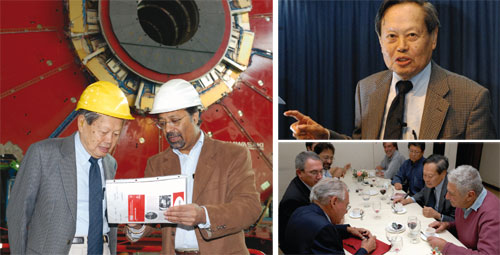
Chen Ning Yang first came to CERN in 1957, the year he shared the Nobel Prize in Physics with Tsung-Dao Lee for their proposal that the weak interaction violates parity symmetry – at a fundamental level, the mirror symmetry between left and right is broken. Almost 50 years later, Yang was again at CERN speaking to a packed auditorium about his thoughts on the important themes in physics over the second half of the 20th century. He can do so with authority: he not only knew great physicists such as Wolfgang Pauli and Paul Dirac, but he has also made many fundamental contributions to physics from the 1950s onwards.
When Yang arrived at CERN in 1957 the theory group was housed in a hut at Cointrin by the villa visible still behind fences surrounding the airport, and he recalls meeting people such as Jack Steinberger, Oreste Piccioni and Bruno Ferretti. But the visit also had a personal significance for Yang, who had lived in the US for 12 years, having left his native China in 1945. In the US he had gained his PhD, working under Edward Teller at Chicago University, and by 1957 he was married with a six-year-old son. It was a time of difficult relations between China and the US, with no possibility for Yang and his new family to meet with his parents in either country. However, the trip to Geneva offered Yang the opportunity to arrange for his father to come from China for a six-week visit and meet his wife and son. This happy experience was repeated on further visits to CERN in 1960 and 1962.
Throughout his long career Yang made many contributions to physics, achieving two of his best-known contributions to particle physics – Yang–Mills theory and parity violation – by the time he was 34. Yang says that he was fortunate to come into physics when the concept of symmetry was beginning to be appreciated.
In the 1920s people did not like the concept of symmetry, as they were sceptical of its new mathematics of groups – there were those who even talked of “the group pest”. But in the 1930s physicists began to realize that symmetry was necessary to describe atomic physics; in particular, symmetry groups explained the structure of the Periodic Table. By the 1940s its application had extended to nuclear and particle physics.
Yang worked on group theory for his PhD thesis under Teller, and this firmly anchored his interest in groups and the emerging field of symmetry in particle physics. He now reflects: “When young, the best thing that you can do is to launch yourself into a field that is just beginning.” This is exactly what Yang did.
Yang–Mills theory
By 1954 he had written with Robert Mills what he still regards as his most important paper, laying out the basic principles of what has become known as Yang–Mills theory. The theory is now a cornerstone of the Standard Model of particle physics, but at the time it did not agree with experiment. “We couldn’t escape the question of the mass of the spin-1 particles that come out of it,” recalls Yang, “although we did discuss it at the end of the paper and implied that there may be other reasons for the mass not being zero.” So why did they write the paper? Yang says that he appreciated the beauty of the structure and believed that it should be published. Samuel Goudsmit, who together with George Uhlenbeck had discovered the electron’s spin, was the editor and speedily published the paper.
On the subject of his Nobel prize-winning work with Lee, Yang says he was very proud of the paper on parity violation. “It caused a great sensation because of its ‘across the board’ character,” he recalls. “It was relevant to nuclear physics as well as high-energy physics. There were hundreds of experiments in the following two years.” The paper was published on 1 October 1956, and on 27 December C S Wu and her colleagues had the results that demonstrated that the parity is violated in weak decays. Yang says that Wu contributed more than just her technical expertise: “She did not believe the experiment would be so exciting, but believed that if an important principle had not been tested, it should be. No-one else wanted to do it!”
Since 1957 Yang has visited CERN many times and has seen the latest accelerator installations, each larger and more complex than the previous generation. This time he was taken to see preparations for ATLAS and CMS, the huge general-purpose detectors being built for the LHC. Yang says that seeing these installations is “very educational for a theorist who doesn’t tangle with these complex detectors and the engineers who are putting it all together”. He was “more than impressed” he says: “It is quite unbelievable. My only regret is that I may not be around to see the results.”
The changing face of particle physics
As the detectors become larger and more complex they are also being built and run by physicists and engineers who are collaborating on a very large scale. How particle physics is done has changed a great deal in the 50 years since Yang’s first visit to CERN. “Now group members are named by countries,” Yang says. “We have progressed from teams of colleagues in an institute, to several institutes, to several countries.” At CMS in particular he was impressed by all the young people from different countries who were participating in data-taking tests during his visit.
Looking to the future, Yang believes that astronomy is going to be an exciting field because so many peculiar aspects not yet understood will provide many opportunities for exploration. More fundamentally, he thinks that while the nature of physics has changed in the 21st century it will continue to thrive, resulting in important contributions to science.
So what of high-energy physics? Is it coming to an end? Yang believes that the type of particle physics studied over the past 50 years is not likely to continue for two reasons: one external and one internal. He points out that his generation was fortunate in that they launched into the unknown where there was a great deal to be discovered. Now, he says, we have reached marvellous collaboration efforts with the LHC, but there are limits to what governments will support. This is the external factor: funding will limit expansion unless there is some bright new idea. “We need to reduce the budget by a factor of 10,” he says.
As for the internal factor, he sees that the subject faces more difficult mathematical structures. He notes that field theory today has become highly nonlinear and is very difficult compared with what was thought to be difficult in the 1940s.
In the meantime, what does he think will be the most important discovery at the LHC? “Everybody is focusing on the Higgs and most feel it will be discovered,” he observes. “But,” he adds, “it may be more exciting eventually if it is not discovered.”
I started a company, Research In Motion, while I was still at the University of Waterloo in Ontario, Canada. By the late 1990s we had developed the BlackBerry handheld mobile device. As a result I found myself in a position where I could invest in an area that I am passionate about and one that could make a big difference.
Spot an opportunity. Having observed that research funding is usually thinly spread, I decided to start a theoretical-physics institute that would focus on science that is fundamental to all human progress and at which Canada can excel.
Promote scientific openness. My driving motivation for establishing the Perimeter Institute (PI), located next to the University of Waterloo, is that I feel fundamental science needs more support. What worries me is that governments all around the world seem to be listening to the same consultant. They ask scientists to do something that will benefit the economy within five years. Of course, governments are under pressure to balance budgets and be accountable – that’s reasonable. But some of that pressure is getting transferred to universities, with unfortunate results.
Science is a global enterprise based on co-operation and openness. If you say to universities that they must justify their research with patents and licences, you collapse that openness. Efforts to commercialize too early are making researchers more secretive, hampering their ability to excel, without necessarily helping business. I wanted to challenge this trend.
Concentrate on core competencies. A strategic decision we made when creating the Institute in 1999 was to focus on a couple of very specialized fields, quantum gravity and quantum foundations, because we felt these were areas where a relatively small, high-quality team could make a big difference. This is the same strategy that originally made BlackBerry a success: it focused on doing one thing – “push e-mail” – very well rather than competing on all features. So for the first few years, PI focused on recruiting top-class researchers in these two areas to ensure that research efforts were of international calibre within a relatively short period. As the Institute’s reputation builds, we are branching out a bit more.
Build a focal point. The other decision we made early on was to house the Institute in an outstanding building. Before we built it, we spent two years going around the world and talking to people in theoretical-physics institutes and theory departments at universities, asking them what works and what doesn’t. Based on this, we put together some specifications and organized a competition, where we really let the architects go wild. The result is a building with a design that has won several prizes and is internationally recognized.
Attract investment. I invested C$100 million of my own money in PI to get it started. For the longer term it was critical to get government support. Convincing government officials took a huge effort. Part of the challenge is that not many politicians understand basic science, let alone know how to value it. This means that a lot of funding is done almost entirely on your ability to explain the benefits and on their faith in you. Early on, all levels of government (local, provincial and federal) saw the benefit of PI and decided to support the Institute with a total of about C$55 million dollars. More recently, and now that the Institute is established, a further C$50 million in public investment was warmly received.
Present your product. In the long run, you can’t rely on faith alone. So although excellent science is crucial to success that’s really only half of the story. The other half of the Institute’s activities is about outreach. For example, PI has a summer-school programme for students from all over Canada and around the world. PI also goes on tour across Canada to give classroom instruction about physics to both students and teachers.
PI also has a programme of monthly public lectures. Sometimes we’ll have scientists like Roger Penrose discuss a weighty topic; other times we’ll have debates about science with well-known historians and journalists. Waterloo has a population of only about 100,000, yet every month we fill a 550 seat lecture theatre, and there’s always a queue outside on standby. That’s how much interest you can generate in science, if you make the effort to open it up for people and make the research accessible.
And that’s success. Because ultimately, these are the people who vote for the governments which fund the research. If they don’t benefit from and believe in what we’re doing, it’s always going to be an uphill struggle. So in addition to directly helping students, teachers and members of the general public, there’s reason for balancing good science with good outreach. We have to move beyond relying on faith.
Mike Lazaridis is founder and co-CEO of Research In Motion, makers of BlackBerry handheld devices, as well as chancellor of the University of Waterloo. Additional information about PI is available at www.perimeterinstitute.ca.
by Ashok Das, World Scientific. Hardback ISBN 9812568476 £45 ($78). Paperback ISBN 9812568484 £28 ($48).
This book describes quantum-field theory within the context of path integrals. With its utility in a variety of fields in physics, the subject matter is primarily developed within the context of quantum mechanics before going into specialized areas. Adding new material keenly requested by readers, this second edition is an important expansion of the popular first edition. Two extra chapters cover path integral quantization of gauge theories and anomalies, and a new section extends the supersymmetry chapter, describing the singular potentials in supersymmetric systems.
by D S Sivia and J Skilling, Oxford University Press. Hardback ISBN 9780198568315 £39.95 ($74.50). Paperback ISBN 9780198568322 £22.50 ($39.50).
Statistics lectures can be bewildering and frustrating for students. This book tries to remedy the situation by expounding a logical and unified approach to data analysis. It is intended as a tutorial guide for senior undergraduates and research students in science and engineering. After explaining the basic principles of Bayesian probability theory, their use is illustrated with a variety of examples ranging from elementary parameter estimation to image processing. Other topics covered include reliability analysis, multivariate optimization, hypothesis testing and experimental design. This second edition contains a new chapter on extensions to the ubiquitous least-squares procedure.
by Wolfgang Rindler, Oxford University Press. Hardback ISBN 9780198567318, £55 ($99.50). Paperback ISBN 9780198567325, £27.50 ($49.50).
Relativistic cosmology has recently become an active and exciting branch of research. Consequently, this second edition mostly affects the section on cosmology, and the purpose remains the same: to make relativity come alive conceptually. The emphasis is on the foundations and on presenting the necessary mathematics, including differential geometry and tensors. With more than 300 exercises, it promotes an in-depth understanding and the confidence to tackle basic problems in this field. Advanced undergraduates and beginning graduate students in physics and astronomy will be interested in this book.
by Richard W Robinett, Oxford University Press. Hardback ISBN 9780198530978, £39.95 ($74.50)
This second edition is a comprehensive introduction to non-relativistic quantum mechanics for advanced undergraduate students in physics and related fields. It provides a strong conceptual background in the most important theoretical aspects of quantum mechanics, and extensive experience of the mathematical tools required to solve problems. It also gives the opportunity to use quantum ideas to confront modern experimental realizations of quantum systems, and numerous visualizations of quantum concepts and phenomena. This edition includes many new discussions of modern quantum systems, such as Bose–Einstein condensates, the quantum Hall effect and wave-packet revivals.
The Goldilocks Enigma is the latest in a series of books from the past 20 plus years by physicist, cosmologist and internationally acclaimed outreach expert Paul Davies, covering the often vexed issue of the boundary between science and theology. The central theme of this book is the baffling truism, the so-called anthropic principle, that the universe is surprisingly bio-friendly, consistent with the evolution of life, at least on Earth and possibly elsewhere. Like Goldilocks’s third porridge, the universe seems to be just right for “us”, but why?
Davies guides the reader comprehensively and comprehensibly through the properties and interactions of the components of the universe, small and large, observable and imagined. He presents an equation-free exposé of particle physics and cosmology, from strings to multiverses, and in so doing reveals the wonder of the physical universe. He then augments the “facts” with an impressive sequence of analyses of how and why they came about. But is “our” universe the only one that exists? Is it the only one that can exist? If so, why? If not, what, where and when could other universes be? And does it all point to an Intelligent Designer?
Getting rid of God, numinous, eternal and responsible for all universes at all times, is a popular pursuit for some science communicators these days – Richard Dawkins springs to mind. However Davies is not relentlessly driven to deicide: “You can’t use science to disprove the existence of a supernatural God, and you can’t use religion to disprove the existence of self-supporting physical laws.” This attitude ought to leave many an agnostic armchair physicist patiently waiting for Davies’s next book.
Goldilocks is not always easy to read, but each chapter ends with a helpful shortlist of the important facts and ideas to be retained. A couple of typos and the erroneous statement, appearing twice, that the Large Hadron Collider will collide protons with antiprotons, blemish a text that otherwise bears all the hallmarks of intelligent design.
Dans l’édition de novembre l’article “Exotic atoms cast light on fundamental questions” a malencontreusement été publié avec le résumé en français d’un autre article, sur l’expérience OPERA. Le résumé correct est publié ci-dessous avec toutes nos excuses pour la confusion occasionnée par cette erreur.
Des atomes exotiques pour comprendre des questions fondamentales. Un atelier d’été, tenu à Trente, s’est attaché à étudier l’apport des expériences sur les atomes exotiques, les formes kaoniques fortement liées et l’antihydrogène pour explorer la physique fondamentale à basse énergie. L’atelier a rassemblé des experts dans le domaine des atomes et noyaux exotiques, afin d’examiner l’état actuel des expériences et de la théorie et de déterminer quels sont les sujets les plus prometteurs. Le programme, très fourni, allait des variétés pioniques, kaoniques et antiprotoniques des atomes exotiques à l’antihydrogène, et aux clusters nucléaires exotiques, plus généralement appelés de nos jours noyaux kaoniques fortement liés. Les participants ont pris connaissance des derniers résultats obtenus par de nombreuses expériences sur ces atomes exotiques, et ont discuté de projets futurs fondés sur des techniques d’expérimentation améliorées.
Nuclear science is undergoing a renaissance as it confronts new and previously unapproachable research opportunities. One such opportunity, the study of short-lived nuclei far from stability, is emerging as a major frontier in nuclear science. Rare-isotope research is tied to astrophysics and mesoscopic science, fields in which voracious demand for new data is generating worldwide interest in high-power, next-generation accelerators.
New facilities will probe the limits of nuclear stability and determine nuclear properties in uncharted regions of nuclei with unusual proton-to-neutron ratios. The new data will challenge descriptions of nuclei that are based on data limited to nuclei near the valley of nuclear stability. These improved models of nuclei – two component, open mesoscopic systems – will increase our understanding of mesoscopic systems in fields such as chemistry, biology, nanoscience and quantum information. More directly, the models will greatly boost our understanding of the cosmos.
Today, our descriptions of stellar evolution, and especially of explosive events, such as X-ray bursts, core-collapse supernovae, gamma-ray bursts, thermonuclear (Type Ia) supernovae and novae, are limited by inadequate knowledge of important nuclear properties. We need new data for nuclei far from stability and better nuclear theories to develop accurate models of these astrophysical phenomena. Improved models, in turn, will help astrophysicists make better use of data from ground- and space-based observatories, understand the nuclear processes that produce the elements observed in the cosmos and learn about the environments in which they were formed.
We already have the first concrete evidence that nuclear structure, well established for nuclei near the line of stability, can change dramatically as we move away from the line of stability. The effective interactions far from stability – pairing, proton–neutron, spin-orbit and tensor – are different, but largely unknown. We need quantitative experimental information to refine theoretical treatments that describe these exotic isotopes.
There are several particularly promising research directions. For example, nuclei with unusual density distributions have been discovered for the lighter elements, but little is known about the properties of heavier, very neutron-rich nuclei. These heavier nuclei may have multi-neutron halo distributions with unusual cluster or molecular structures, which otherwise only occur at the surface of neutron stars. Such nuclei provide a unique opportunity to study the nucleon–nucleon interaction in early pure neutron matter.
Intense beams of neutron-rich isotopes will be used to synthesize transactinide nuclei that are more neutron-rich than is possible with stable beams. These nuclei are predicted to be sufficiently strongly bound and long-lived for detailed chemical study.
Energetic nucleus–nucleus collision experiments with beams of very neutron-rich and very neutron-poor isotopes will explore the asymmetry energy term in the equation of state of neutron-rich nuclear matter. This term is important in understanding the properties of neutron stars.
Nuclei are self-sustaining finite droplets of a two-component – neutron and proton – Fermi-liquid. Selectively prepared nuclei will allow us to study, on a femtoscopic scale, typical mesoscopic phenomena: self-organization and complexity arising from elementary interactions, symmetry and phase transformations, coexistence of quantum chaos and collective dynamics. The openness of loosely bound nuclei owing to strong coupling to the continuum allows us to probe general mesoscopic concepts, such as information processing and decoherence, which are key ideas in quantum computing.
The interplay of strong, electromagnetic and weak interactions determine detailed nuclear properties. Selecting nuclear systems that isolate or amplify the specific physics of interest will allow better tests of fundamental symmetries and fuel the search for new physics beyond the Standard Model.
Beyond advancing basic research questions, new accelerators should yield practical benefits for science and society. In fact, nuclear science has a long record of such applications. Technologies rooted in nuclear science – such as positron-emission tomography, the use of radioactive isotopes for treating or diagnosing disease, and more recently, the use of dedicated accelerators for treating cancer patients – have transformed medicine. Sterilization of fresh produce or surgical instruments with ionizing radiation is growing in importance. Ultra-sensitive nuclear detection, such as Rutherford backscattering, proton-induced X- and gamma-ray emission and accelerator mass spectrometry, has provided diagnostic tools for archaeology and material science.
Next-generation rare-isotope research and this tradition of applied work promise new opportunities for cross-disciplinary collaboration on national and international security, biomedicine, materials research and nuclear energy. Nuclear science is well positioned to deliver new benefits to physics and society in the coming decades.
To provide the best experiences, we use technologies like cookies to store and/or access device information. Consenting to these technologies will allow us to process data such as browsing behavior or unique IDs on this site. Not consenting or withdrawing consent, may adversely affect certain features and functions.
Functional
Always active
The technical storage or access is strictly necessary for the legitimate purpose of enabling the use of a specific service explicitly requested by the subscriber or user, or for the sole purpose of carrying out the transmission of a communication over an electronic communications network.
Preferences
The technical storage or access is necessary for the legitimate purpose of storing preferences that are not requested by the subscriber or user.
Statistics
The technical storage or access that is used exclusively for statistical purposes.The technical storage or access that is used exclusively for anonymous statistical purposes. Without a subpoena, voluntary compliance on the part of your Internet Service Provider, or additional records from a third party, information stored or retrieved for this purpose alone cannot usually be used to identify you.
Marketing
The technical storage or access is required to create user profiles to send advertising, or to track the user on a website or across several websites for similar marketing purposes.