par André Krzywicki, L’Harmattan. Broché ISBN 2296011934, €17.50.
André Krzywicki connaît certainement trop bien la théorie des probabilités pour ne pas réaliser que le titre de son autobiographie est une contradiction dans les termes. Un événement envisagé dans le futur peut être probable ou improbable, mais ce qui est déjà arrivé est déjà arrivé, un point c’est tout. Cependant tout le monde comprend très bien ce que veut dire le titre, à savoir que tout ce qui est arrivé était, a priori, très improbable. Improbable qu’il survive à la terreur nazie, comme ce fut le cas pour nos amis du CERN, Georges Charpak, Jacques Prentki et Marcel Vivargent par exemple. Improbable qu’il survive à la poliomyélite. Improbable qu’il s’en tire avec un handicap sérieux mais supportable lui permettant d’avoir une vie sentimentale normale. Improbable enfin de pouvoir s’installer à l’Ouest, à Orsay (près de Paris), où il terminera sa carrière comme physicien théoricien au plus haut niveau. Incontestablement, tout cela valait la peine d’être raconté.
André Krzywicki est né à Varsovie d’un père aristocrate catholique et d’une mère juive, écrivain célèbre déjà avant la guerre. Officier, son père est fait prisonnier par les Russes et exécuté à Kharkov, massacre peut être moins connu que celui de Katyn. L’auteur a un frère aîné, le préféré de sa mère. Cette dernière comprend qu’accepter de porter l’étoile de David est tomber dans un piège. Elle se réfugie avec ses deux enfants sous un faux nom à la campagne. Mais ils se font repérer par les Allemands qui, par chance, s’y prennent à deux fois pour venir les chercher. La seconde fois, la famille avait disparu, cachée par des voisins. Elle retourne à Varsovie. Elle est témoin de l’insurrection du ghetto (de l’extérieur!) et de l’insurrection de Varsovie écrasée à cause du cynisme de Staline.
Ensuite, surviennent la mort catastrophique de son frère aîné, puis l’adaptation au régime communiste. Avec beaucoup d’honnêteté, André Krzywicki reconnaît qu’il s’est lancé à fond dans les jeunesses communistes tandis que sa mère semblait louvoyer avec le régime. Par deux fois, elle est envoyée en mission culturelle dans des ambassades à l’étranger. Il décrit son amour pour le sport brutalement bloqué par la polio dont il risque de mourir. D’autres, autour de lui, y resteront par manque de soins. Il parvient à force d’efforts à surmonter une partie de sa paralysie, mais il devra utiliser des béquilles toute sa vie comme le savent ceux qui le connaissent.
C’est peut-être à cause de son handicap qu’il s’oriente vers la physique théorique et atterrit à l’institut de la rue Hoza, sur lequel il porte un jugement un peu trop sévère à mon goût. Il y avait là de bons éléments, par exemple, mon regretté ami Lukaszuk qui, lui, est resté en Pologne et a été exilé sur la Baltique à cause de sa participation à Solidarité.
Lors d’une première escapade à l’Ouest, à Copenhague, André Krzywicki invite son ami Ziro Koba qui lui présente son élève, l’excentrique mais génial Holger Nielsen que nous connaissons bien au CERN. Ensuite, pour des raisons idéologiques et scientifiques, il part à l’Ouest définitivement. Au CERN, dont il fait beaucoup d’éloges, il bénéficie de l’aide de Jacques Prentki, alors que Léon Van Hove essaie de le persuader de retourner à Varsovie (un peu comme Van Hove avait réexpédié Martin Veltman à Utrecht, ce qui valut à ce dernier de recontrer Gerard ‘t Hooft avec lequel il partagea le prix Nobel!). Finalement, avec l’aide de Louis Leprince-Ringuet et de Maurice Lévy, il s’installe à Orsay. J’admire qu’il ait réussi ce prodige car ces deux personnalités marquantes du monde scientifique français n’avaient pas d’atomes crochus.
Ses témoignages de la vie scientifique parisienne sont très intéressants. Il y décrit, avec un oeil critique, le fonctionnement de la recherche et de l’enseignement et surtout, il dresse une peinture impitoyable des événements de Mai 1968. Il raille la veulerie de la plupart des enseignants et des chercheurs. Il décrit la séquestration de Jean Nuyts accusé d'”élitisme” parce qu’il enseignait la théorie des champs. Pour lui, Mai 1968 a été surtout l’occasion pour les médiocres de se pousser en avant! Dans l’ensemble, c’est vrai. Mais il y avait parmi les meneurs, des gens qui avaient fait d’excellents travaux avant (par exemple, Jean Marc Lévy-Leblond). Nous avons aussi droit à une description réaliste du milieu scientifique où, il n’y a pas que des saints, mais parfois des voleurs, agissant de différentes façons, dont nous avons tous été victimes un jour ou l’autre. Ce qui rend la compétition entre les physiciens pire que celle entre les hommes d’affaires, disait un ancien ingénieur du CERN, Pierre Amiot, c’est que les hommes d’affaires luttent pour l’argent tandis que les physiciens se battent pour la gloire. Roy Glauber (bien avant de recevoir le Prix Nobel), lui fait une intéressante remarque: “Vers 50 ans les gens souffrent de ne pas recevoir la considération qu’ils méritent”. Il explique aussi le pour et le contre du système des citations qui “rapporte” surtout aux plus connus.
Sur son œuvre personnelle André Krzywicki est relativement discret. C’est un mérite du livre qu’il ne contienne pas de formules. Tout au plus, on lit “nucléon , quark, couleur”. L’homme peut être d’une très grande modestie: “il n’est pas exclus que cet ouvrage (de mathématiques pour la physique) soit la seule chose qui reste de moi” (p117). Mais il ne résiste pas à l’envie de répéter les compliments (et les emprunts) que lui ont fait les grands de ce monde comme Ken Wilson et Dick Feynman.
Sur sa vie sentimentale complexe, l’auteur est très honnête, donnant même des détails d’ordre sexuels. Mais on voit bien que parmi toutes les femmes qu’il a rencontrées, il n’y en a qu’une qui a été le grand amour. Il s’agit d’Ela, décédée d’un cancer à Orsay. C’est un peu comme Feynman qui a eu beaucoup d’aventures, mais un seul grand amour, Arlene, morte de la tuberculose à Albuquerque, alors qu’il travaillait à Los Alamos. Une dernière remarque : alors qu’il conserve un attachement viscéral à la Pologne, on comprend qu’il se sent vraiment chez lui en France.
Ma conclusion est que ce livre vaut vraiment la peine d’être lu, non seulement par des physiciens, mais aussi par des personnes connaissant le milieu de la physique, par exemple des époux ou épouses de physiciens ou des membres non scientifiques du personnel du CERN. Je pense qu’il serait très souhaitable qu’une traduction en Anglais en soit faite.
It was a little odd for me, a physicist whose work has been mainly on the theory of elementary particles, to be invited to speak at a meeting of condensed-matter physicists celebrating a great achievement in their field. It is not only that there is a difference in the subjects that we explore. There are deep differences in our aims, in the kinds of satisfaction that we hope to get from our work.
Condensed-matter physicists are often motivated to deal with phenomena because the phenomena themselves are intrinsically so interesting. Who would not be fascinated by weird things, such as superconductivity, superfluidity, or the quantum Hall effect? On the other hand, I don’t think that elementary-particle physicists are generally very excited by the phenomena they study. The particles themselves are practically featureless, every electron looking tediously just like every other electron.
Another aim of condensed-matter physics is to make discoveries that are useful. In contrast, although elementary-particle physicists like to point to the technological spin-offs from elementary-particle experimentation, and these are real, this is not the reason that we want these experiments to be done, and the knowledge gained by these experiments has no foreseeable practical applications.
Most of us do elementary-particle physics neither because of the intrinsic interestingness of the phenomena that we study, nor because of the practical importance of what we learn, but because we are pursuing a reductionist vision. All of the properties of ordinary matter are what they are because of the principles of atomic and nuclear physics, which are what they are because of the rules of the Standard Model of elementary particles, which are what they are because…well, we don’t know, this is the reductionist frontier, which we are currently exploring.
I think that the single most important thing accomplished by the theory of John Bardeen, Leon Cooper, and Robert Schrieffer (BCS) was to show that superconductivity is not part of the reductionist frontier (Bardeen et al. 1957). Before BCS this was not so clear. For instance, in 1933 Walter Meissner raised the question of whether electric currents in superconductors are carried by the known charged particles, electrons and ions. The great thing that Bardeen, Cooper, and Schrieffer showed was that no new particles or forces had to be introduced to understand superconductivity. According to a book on superconductivity that Cooper showed me, many physicists were even disappointed that “superconductivity should, on the atomistic scale, be revealed as nothing more than a footling small interaction between electrons and lattice vibrations”. (Mendelssohn 1966).
His testimony was so scrupulously honest that I think it helped the SSC more than it hurt it.
The claim of elementary-particle physicists to be leading the exploration of the reductionist frontier has at times produced resentment among condensed-matter physicists. (This was not helped by a distinguished particle theorist, who was fond of referring to condensed-matter physics as “squalid state physics”.) This resentment surfaced during the debate over the funding of the Superconducting Super Collider (SSC). I remember that Phil Anderson and I testified in the same Senate committee hearing on the issue, he against the SSC and I for it. His testimony was so scrupulously honest that I think it helped the SSC more than it hurt it. What really did hurt was a statement opposing the SSC by a condensed-matter physicist who happened at the time to be the president of the American Physical Society. As everyone knows, the SSC project was cancelled, and now we are waiting for the LHC at CERN to get us moving ahead again in elementary-particle physics.
During the SSC debate, Anderson and other condensed-matter physicists repeatedly made the point that the knowledge gained in elementary-particle physics would be unlikely to help them to understand emergent phenomena like superconductivity. This is certainly true, but I think beside the point, because that is not why we are studying elementary particles; our aim is to push back the reductive frontier, to get closer to whatever simple and general theory accounts for everything in nature. It could be said equally that the knowledge gained by condensed-matter physics is unlikely to give us any direct help in constructing more fundamental theories of nature.
So what business does a particle physicist like me have at a celebration of the BCS theory? (I have written just one paper about superconductivity, a paper of monumental unimportance, which was treated by the condensed-matter community with the indifference it deserved.) Condensed-matter physics and particle physics are relevant to each other, despite everything I have said. This is because, although the knowledge gained in elementary-particle physics is not likely to be useful to condensed-matter physicists, or vice versa, experience shows that the ideas developed in one field can prove very useful in the other. Sometimes these ideas become transformed in translation, so that they even pick up a renewed value to the field in which they were first conceived.
The example that concerns me is an idea that elementary-particle physicists learnt from condensed-matter theory – specifically from the BCS theory. It is the idea of spontaneous symmetry breaking.
Spontaneous symmetry breaking
In particle physics we are particularly interested in the symmetries of the laws of nature. One of these symmetries is invariance of the laws of nature under the symmetry group of three-dimensional rotations, or in other words, invariance of the laws that we discover under changes in the orientation of our measuring apparatus.
When a physical system does not exhibit all the symmetries of the laws by which it is governed, we say that these symmetries are spontaneously broken. A very familiar example is spontaneous magnetization. The laws governing the atoms in a magnet are perfectly invariant under three-dimensional rotations, but at temperatures below a critical value, the spins of these atoms spontaneously line up in some direction, producing a magnetic field. In this case, and as often happens, a subgroup is left invariant: the two-dimensional group of rotations around the direction of magnetization.
Now to the point. A superconductor of any kind is nothing more or less than a material in which a particular symmetry of the laws of nature, electromagnetic gauge invariance, is spontaneously broken. This is true of high-temperature superconductors, as well as the more familiar superconductors studied by BCS. The symmetry group here is the group of two-dimensional rotations. These rotations act on a two-dimensional vector, whose two components are the real and imaginary parts of the electron field, the quantum mechanical operator that in quantum field theories of matter destroys electrons. The rotation angle of the broken symmetry group can vary with location in the superconductor, and then the symmetry transformations also affect the electromagnetic potentials, a point to which I will return.
The symmetry breaking in a superconductor leaves unbroken a rotation by 180°
The symmetry breaking in a superconductor leaves unbroken a rotation by 180°, which simply changes the sign of the electron field. In consequence of this spontaneous symmetry breaking, products of any even number of electron fields have non-vanishing expectation values in a superconductor, though a single electron field does not. All of the dramatic exact properties of superconductors – zero electrical resistance, the expelling of magnetic fields from superconductors known as the Meissner effect, the quantization of magnetic flux through a thick superconducting ring, and the Josephson formula for the frequency of the AC current at a junction between two superconductors with different voltages – follow from the assumption that electromagnetic gauge invariance is broken in this way, with no need to inquire into the mechanism by which the symmetry is broken.
Condensed-matter physicists often trace these phenomena to the appearance of an “order parameter”, the non-vanishing mean value of the product of two electron fields, but I think this is misleading. There is nothing special about two electron fields; one might just as well take the order parameter as the product of three electron fields and the complex conjugate of another electron field. The important thing is the broken symmetry, and the unbroken subgroup.
It may then come as a surprise that spontaneous symmetry breaking is mentioned nowhere in the seminal paper of Bardeen, Cooper and Schrieffer. Their paper describes a mechanism by which electromagnetic gauge invariance is in fact broken, but they derived the properties of superconductors from their dynamical model, not from the mere fact of broken symmetry. I am not saying that Bardeen, Cooper, and Schrieffer did not know of this spontaneous symmetry breaking. Indeed, there was already a large literature on the apparent violation of gauge invariance in phenomenological theories of superconductivity, the fact that the electric current produced by an electromagnetic field in a superconductor depends on a quantity known as the vector potential, which is not gauge invariant. But their attention was focused on the details of the dynamics rather than the symmetry breaking.
This is not just a matter of style. As BCS themselves made clear, their dynamical model was based on an approximation, that a pair of electrons interact only when the magnitude of their momenta is very close to a certain value, known as the Fermi surface. This leaves a question: How can you understand the exact properties of superconductors, like exactly zero resistance and exact flux quantization, on the basis of an approximate dynamical theory? It is only the argument from exact symmetry principles that can fully explain the remarkable exact properties of superconductors.
Though spontaneous symmetry breaking was not emphasized in the BCS paper, the recognition of this phenomenon produced a revolution in elementary-particle physics. The reason is that (with certain qualification, to which I will return), whenever a symmetry is spontaneously broken, there must exist excitations of the system with a frequency that vanishes in the limit of large wavelength. In elementary-particle physics, this means a particle of zero mass.
The first clue to this general result was a remark in a 1960 paper by Yoichiro Nambu, that just such collective excitations in superconductors play a crucial role in reconciling the apparent failure of gauge invariance in a superconductor with the exact gauge invariance of the underlying theory governing matter and electromagnetism. Nambu speculated that these collective excitations are a necessary consequence of this exact gauge invariance.
Nambu put this idea to good use in particle physics
A little later, Nambu put this idea to good use in particle physics. In nuclear beta decay an electron and neutrino (or their antiparticles) are created by currents of two different kinds flowing in the nucleus, known as vector and axial vector currents. It was known that the vector current was conserved, in the same sense as the ordinary electric current. Could the axial current also be conserved?
The conservation of a current is usually a symptom of some symmetry of the underlying theory, and holds whether or not the symmetry is spontaneously broken. For the ordinary electric current, this symmetry is electromagnetic gauge invariance. Likewise, the vector current in beta decay is conserved because of the isotopic spin symmetry of nuclear physics. One could easily imagine several different symmetries, of a sort known as chiral symmetries, that would entail a conserved axial vector current. However, it seemed that any such chiral symmetries would imply either that the nucleon mass is zero, which is certainly not true, or that there must exist a triplet of massless strongly interacting particles of zero spin and negative parity, which isn’t true either. These two possibilities simply correspond to the two possibilities that the symmetry, whatever it is, either is not, or is, spontaneously broken, not just in some material like a superconductor, but even in empty space.
Nambu proposed that there is indeed such a symmetry, and it is spontaneously broken in empty space, but the symmetry in addition to being spontaneously broken is not exact to begin with, so the particle of zero spin and negative parity required by the symmetry breaking is not massless, only much lighter than other strongly interacting particles. This light particle, he recognized, is nothing but the pion, the lightest and first discovered of all the mesons. In a subsequent paper with Giovanni Jona-Lasinio, Nambu presented an illustrative theory in which, with some drastic approximations, a suitable chiral symmetry was found to be spontaneously broken, and in consequence the light pion appeared as a bound state of a nucleon and an antinucleon.
So far, there was no proof that broken exact symmetries always entail exactly massless particles, just a number of examples of approximate calculations in specific theories. In 1961 Jeffrey Goldstone gave some more examples of this sort, and a hand-waving proof that this was a general result. Such massless particles are today known as Goldstone bosons, or Nambu–Goldstone bosons. Soon after, Goldstone, Abdus Salam and I made this into a rigorous and apparently quite general theorem.
Cosmological fluctuations
This theorem has applications in many branches of physics. One is cosmology. You may know that today the observation of fluctuations in the cosmic microwave background are being used to set constraints on the nature of the exponential expansion, known as inflation, that is widely believed to have preceded the radiation-dominated Big Bang. But there is a problem here. In between the end of inflation and the time that the microwave background that we observe was emitted, there intervened a number of events that are not at all understood: the heating of the universe after inflation, the production of baryons, the decoupling of cold dark matter, and so on. So how is it possible to learn anything about inflation by studying radiation that was emitted long after inflation, when we don’t understand what happened in between? The reason that we can get away with this is that the cosmological fluctuations now being studied are of a type, known as adiabatic, that can be regarded as the Goldstone excitations required by a symmetry, related to general co-ordinate invariance, that is spontaneously broken by the space–time geometry. The physical wavelengths of these cosmological fluctuations were stretched out by inflation so much that they were very large during the epochs when things were happening that we don’t understand, so they then had zero frequency, which means that the amplitude of these fluctuations was not changing, so that the value of the amplitude relatively close to the present tells us what it was during inflation.
Werner Heisenberg continued to believe this into the 1970s
But in particle physics, this theorem was at first seen as a disappointing result. There was a crazy idea going around, which I have to admit that at first I shared, that somehow the phenomenon of spontaneous symmetry breaking would explain why the symmetries being discovered in strong-interaction physics were not exact. Werner Heisenberg continued to believe this into the 1970s, when everyone else had learned better.
The prediction of new massless particles, which were ruled out experimentally, seemed in the early 1960s to close off this hope. But it was a false hope anyway. Except under special circumstances, a spontaneously broken symmetry does not look at all like an approximate unbroken symmetry; it manifests itself in the masslessness of spin-zero bosons, and in details of their interactions. Today we understand approximate symmetries such as isospin and chiral invariance as consequences of the fact that some quark masses, for some unknown reason, happen to be relatively small.
Though based on a false hope, this disappointment had an important consequence. Peter Higgs, Robert Brout and François Englert, and Gerald Guralnik, Dick Hagen and Tom Kibble were all led to look for, and then found, an exception to the theorem of Goldstone, Salam and me. The exception applies to theories in which the underlying physics is invariant under local symmetries, symmetries whose transformations, like electromagnetic gauge transformations, can vary from place to place in space and time. (This is in contrast with the chiral symmetry associated with the axial vector current of beta decay, which applies only when the symmetry transformations are the same throughout space–time.) For each local symmetry there must exist a vector field, like the electromagnetic field, whose quanta would be massless if the symmetry was not spontaneously broken. The quanta of each such field are particles with helicity (the component of angular momentum in the direction of motion) equal in natural units to +1 or –1. But if the symmetry is spontaneously broken, these two helicity states join up with the helicity-zero state of the Goldstone boson to form the three helicity states of a massive particle of spin one. Thus, as shown by Higgs, Brout and Englert, and Guralnik, Hagen and Kibble, when a local symmetry is spontaneously broken, neither the vector particles with which the symmetry is associated nor the Nambu–Goldstone particles produced by the symmetry breaking have zero mass.
This was actually argued earlier by Anderson, on the basis of the example provided by the BCS theory. But the BCS theory is non-relativistic, and the Lorentz invariance that is characteristic of special relativity had played a crucial role in the theorem of Goldstone, Salam and me, so Anderson’s argument was generally ignored by particle theorists. In fact, Anderson was right: the reason for the exception noted by Higgs et al. is that it is not possible to quantize a theory with a local symmetry in a way that preserves both manifest Lorentz invariance and the usual rules of quantum mechanics, including the requirement that probabilities be positive. In fact, there are two ways to quantize theories with local symmetries: one way that preserves positive probabilities but loses manifest Lorentz invariance, and another that preserves manifest Lorentz invariance but seems to lose positive probabilities, so in fact these theories actually do respect both Lorentz invariance and positive probabilities; they just don’t respect our theorem.
Effective field theories
The appearance of mass for the quanta of the vector bosons in a theory with local symmetry re-opened an old proposal of Chen Ning Yang and Robert Mills, that the strong interactions might be produced by the vector bosons associated with some sort of local symmetry, more complicated than the familiar electromagnetic gauge invariance. This possibility was specially emphasized by Brout and Englert. It took a few years for this idea to mature into a specific theory, which then turned out not to be a theory of strong interactions.
Perhaps the delay was because the earlier idea of Nambu, that the pion was the nearly massless boson associated with an approximate chiral symmetry that is not a local symmetry, was looking better and better. I was very much involved in this work, and would love to go into the details, but that would take me too far from BCS. I’ll just say that, from the effort to understand processes involving any number of low-energy pions beyond the lowest order of perturbation theory, we became comfortable with the use of effective field theories in particle physics. The mathematical techniques developed in this work in particle physics were then used by Joseph Polchinski and others to justify the approximations made by BCS in their work on superconductivity.
The story of the physical application of spontaneously broken local symmetries has often been told, by me and others, and I don’t want to take much time on it here, but I can’t leave it out altogether because I want to make a point about it that will take me back to the BCS theory. Briefly, in 1967 I went back to the idea of a theory of strong interactions based on a spontaneously broken local symmetry group, and right away, I ran into a problem: the subgroup consisting of ordinary isospin transformations is not spontaneously broken, so there would be a massless vector particle associated with these transformations with the spin and charges of the ρ meson. This, of course, was in gross disagreement with observation; the ρ meson is neither massless nor particularly light.
The theory requires a massless vector particle, but it is not the ρ meson, it is the photon
Then it occurred to me that I was working on the wrong problem. What I should have been working on were the weak nuclear interactions, like beta decay. There was just one natural choice for an appropriate local symmetry, and when I looked back at the literature I found that the symmetry group I had decided on was one that had already been proposed in 1961 by Sheldon Glashow, though not in the context of an exact spontaneously broken local symmetry. (I found later that the same group had also been considered by Salam and John Ward.) Even though it was now exact, the symmetry when spontaneously broken would yield massive vector particles, the charged W particles that had been the subject of theoretical speculation for decades, and a neutral particle, which I called the Z particle, to mediate a “neutral current” weak interaction, which had not yet been observed. The same symmetry breaking also gives mass to the electron and other leptons, and in a simple extension of the theory, to the quarks. This symmetry group contained electromagnetic gauge invariance, and since this subgroup is clearly not spontaneously broken (except in superconductors), the theory requires a massless vector particle, but it is not the ρ meson, it is the photon, the quantum of light. This theory, which became known as the electroweak theory, was also proposed independently in 1968 by Salam.
The mathematical consistency of the theory, which Salam and I had suggested but not proved, was shown in 1971 by Gerard ‘t Hooft; neutral current weak interactions were found in 1973; and the W and Z particles were discovered at CERN a decade later. Their detailed properties are just those expected according to the electroweak theory.
There was (and still is) one outstanding issue: just how is the local electroweak symmetry broken? In the BCS theory, the spontaneous breakdown of electromagnetic gauge invariance arises because of attractive forces between electrons near the Fermi surface. These forces don’t have to be strong; the symmetry is broken however weak these forces may be. But this feature occurs only because of the existence of a Fermi surface, so in this respect the BCS theory is a misleading guide for particle physics. In the absence of a Fermi surface, dynamical spontaneous symmetry breakdown requires the action of strong forces. There are no forces acting on the known quarks and leptons that are anywhere strong enough to produce the observed breakdown of the local electroweak symmetry dynamically, so Salam and I did not assume a dynamical symmetry breakdown; instead we introduced elementary scalar fields into the theory, whose vacuum expectation values in the classical approximation would break the symmetry.
This has an important consequence. The only elementary scalar quanta in the theory that are eliminated by spontaneous symmetry breaking are those that become the helicity-zero states of the W and Z vector particles. The other elementary scalars appear as physical particles, now generically known as Higgs bosons. It is the Higgs boson predicted by the electroweak theory of Salam and me that will be the primary target of the new LHC accelerator, to be completed at CERN sometime in 2008.
But there is another possibility, suggested independently in the late 1970s by Leonard Susskind and me. The electroweak symmetry might be broken dynamically after all, as in the BCS theory. For this to be possible, it is necessary to introduce new extra-strong forces, known as technicolour forces, that act on new particles, other than the known quarks and leptons. With these assumptions, it is easy to get the right masses for the W and Z particles and large masses for all the new particles, but there are serious difficulties in giving masses to the ordinary quarks and leptons. Still, it is possible that experiments at the LHC will not find Higgs bosons, but instead will find a great variety of heavy new particles associated with technicolour. Either way, the LHC is likely to settle the question of how the electroweak symmetry is broken.
It would have been nice if we could have settled this question by calculation alone, without the need for the LHC, in the way that Bardeen, Cooper and Schrieffer were able to find how electromagnetic gauge invariance is broken in a superconductor by applying the known principles of electromagnetism. But that is just the price we in particle physics have to pay for working in a field whose underlying principles are not yet known.
• This article is based on the talk given by Steven Weinberg at BCS@50, held on 10–13 October 2007 at the University of Illinois at Urbana–Champaign to celebrate the 50th anniversary of the BCS paper. For more about the conference see www.conferences.uiuc.edu/bcs50/.
Within one week in December 2007, particle physicists in the UK and the US received unexpectedly bad budget news, which rocked the two communities. The funding decisions have together provided a large blow to work on a future International Linear Collider (ILC).
On 11 December the UK’s Science and Technology Facilities Council (STFC) announced its Delivery Plan for 2008/9 to 2011/12. The plan sets out how the council intends to deliver world-class science, in part through providing access to international facilities, within the finances allocated in the 2007 Comprehensive Spending Review. Though this review gave the STFC an increase of some 13.5% over the period in question, the news for UK particle physicists – and their colleagues in astronomy – was far from good. The most serious aspect for particle physicists was summed up in a simple statement: “We will cease investment in the International Linear Collider.” Astronomers received the news of withdrawal from “future investment in the twin 8-m Gemini telescopes”. The consequences of the overall UK budget announcement are still being assessed, but redundancies are likely.
This news immediately reverberated around the world, as the UK was a major contributor to the ILC, but bad news was also in store for their colleagues in the US. A week later on 18 December, the US budget for fiscal year 2008 was finally announced after several delays. In the rush to get the budget approved, several projects suffered big reductions, including “$0 for the US contribution to ITER [the international fusion project]”, and no funds for the NOvA project at Fermilab’s Tevatron. In addition the budget allowed for only 25% – $15 million instead of $60 million – of the amount requested for R&D on the ILC. This is much worse than it appears, as the US system works in such a way that FY2008 began last October, so this allocation may already have been spent.
While these two adverse developments represent a major setback for the ILC, there are also immediate ramifications for personnel at Fermilab and SLAC. Pierre Oddone, Fermilab’s director, had the unenviable task of announcing that some 200 layoffs from a workforce of about 2000 would probably be necessary, and that employees would now have two days enforced unpaid leave a month. Persis Drell, in her new role as director of SLAC, had to announce that work on the ILC had to stop on 1 January and that the B-factory would have to shut down prematurely. The laboratory would have to reduce its workforce by about 15%, implying 125 layoffs in addition to the nearly 100 announced previously as SLAC changes focus in its research.
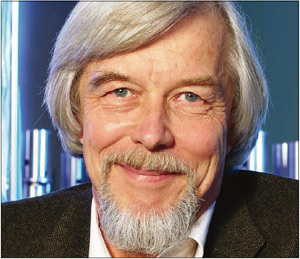
On 14 December, at its 145th meeting, CERN Council appointed Rolf-Dieter Heuer to succeed Robert Aymar as CERN’s director-general. Heuer will take office on 1 January 2009 and serve a five-year term. His mandate will cover the early years of operation of the LHC and its first scientific results.
Heuer is currently research director for particle and astroparticle physics at the DESY laboratory in Hamburg, but is no stranger to CERN. From 1984 to 1998, he was a staff member at the laboratory, working for the OPAL collaboration at LEP. He was also OPAL’s spokesperson from 1994 to 1998.
After obtaining a doctorate in 1977 from the University of Heidelberg, Heuer has spent much of his career involved with the construction and operation of large particle detector systems for studying electron–positron collisions. After leaving CERN in 1998 and joining the University of Hamburg he founded a group working on preparations for experiments at a possible future electron–positron collider. With his appointment at DESY in 2004, he became responsible for research at the HERA collider, DESY’s participation in the LHC, and R&D for a future electron–positron collider.
By Weimin Wu, World Scientific Publishing. Hardback ISBN 9812705600 £29 ($54).
Weimin Wu has led an extraordinary life. Arriving at Fudan University in 1960 at age 17, he was inducted into a special “Section Zero” – by day he studied nuclear physics, in the evenings he helped with research into uranium-enrichment techniques for China’s atomic bomb.
In 1965 he moved to Lanzhou University as a graduate student, but a year later the Great Proletarian Cultural Revolution burst over China and graduate students were a major target. Wu was packed off to an arid mountain region, where he worked as a shepherd, lived in a cave and survived on potatoes, wild plants, rainwater and melted snow. When he was allowed back to Lanzhou, he found that his supervisor had been accused of reactionary scholarship and landlordism, and assigned to clean toilets. Wu himself was soon sent to be a labourer. A commissar rescued him in 1969 and employed his skills to help develop the launch control system of China’s first artificial satellite.
After the end of the Cultural Revolution in 1976, the Chinese government discovered that intellectuals were “part of the working class”. But as Wu writes, “the era that destroyed the talents of many also had cast a dark shadow over them for a lifetime”.
In 1978 Wu joined the group tasked with building China’s first particle accelerator and in 1980 he came to CERN for two years, joining Jack Steinberger’s CDHS neutrino group. Back in Beijing he led the Chinese group involved in ALEPH’s muon detectors, and in June 1989 he observed the first J/Ψ particle to be seen at BES, the Beijing spectrometer. Three weeks earlier he had participated in pro-democracy demonstrations and witnessed the army’s repression in Tiananmen Square. Shortly afterwards he left China and found sanctuary at Fermilab, where he now works on the CMS experiment.
Of the two achievements closest to his heart, one occurred on 25 August 1986 when, despite technical and political obstacles, he sent the first e-mail from China (to Jack Steinberger at CERN). The other achievement was this book of photographs.
Wu has been taking photographs since he was 12. His takes his subjects mostly from nature and from the places and people in his life. Many of his photographs are romantic images of flowers, sunsets, rainbows and landscapes. Several are more mysterious, such as a green swimming pool, lit from within, in a city at night. “To me,” Wu writes, “physics and photography are like a pair of twin sisters.” Both require elegance, conciseness and the good luck that “is granted only to those who are prepared”.
The book includes 12 pages of episodes from Wu’s life, 12 pages by him about his photography, and more than 100 pages of his photographs divided into “Flowers”, “Landscape”, “People” and “The Beauty of Physics” – a selection of photos that remind him of physical concepts, with titles such as Latticework and Multidimensional Space, including the cover, which shows Birds of a Feather Flock Together.
By Frank Close, Taylor & Francis. Paperback ISBN 9781584887980 £22.99 ($39.95).
Back in 1983, the world of particle physics was very different: LEP was under construction and the LHC was just a dream for a few people; the top quark had not been discovered; the amount of dark matter in the universe was not known; and dark energy was not even imagined. However, high-school physics was much the same as it is now, with most lessons focusing on the basics and rarely touching on “modern” state-of-the-art science. “Popular science” books were not in abundance, so it came as a breath of fresh air when the first edition of The Cosmic Onion was published. According to Close, the original “inspired a generation of students to take up science”. A grand claim indeed, but not without substance – the author of this review is living proof.
Like the original version, the revised one takes the reader through the most important periods in particle physics, from the discoveries of atoms and nuclei to our most up-to-date theories, including the Higgs mechanism, supersymmetry and grand unified theories. Close tackles some difficult topics along the way, such as QCD and the electroweak force, yet manages to convey their intricacies in a clear and concise manner. This is helped by the fact that each chapter contains a number of self-contained boxes that explain the more advanced concepts. The book finishes with a chapter devoted to the relationship between particle physics, cosmology and the Big Bang – a fitting end, or should that be start?
I found the chapter on the LEP era particularly good. Although it is relatively short, it provides a good summary of the most important findings of the previous “big accelerator” at CERN. It includes hints of new physics that should become clearer once the LHC is operating. Much of the book can be seen as explaining why we are building the LHC, and this should appeal to high school students interested in a career in particle physics – some of whom may end up analysing LHC data in years to come.
There are many differences in the content between the original and The New Cosmic Onion, bringing it up to date without changing the overall style. Close also manages to avoid delving into the realms of fiction, sticking with the most likely theories and avoiding the more exotic ones. This does not make the book any less enjoyable – far from it. Even though the world has changed and the number of popular particle-physics books available has grown enormously, The New Cosmic Onion remains distinct and one of the few books that is enjoyable to read, plus it is a useful reference for physics students. Let’s hope it will inspire another generation of particle physicists.
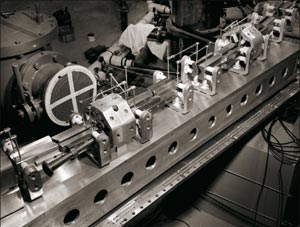
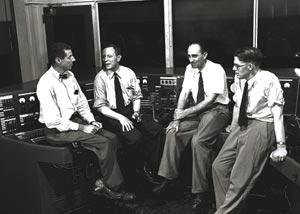
In the spring of 1947, Philip Morse and M Stanley Livingston visited Cornell University, where I was a post-doc working in nuclear physics under Hans Bethe. They talked about the newly established Brookhaven National Laboratory (BNL), where Morse was the director and Livingston was in charge of a project to build a gigantic accelerator that would reach 3 GeV – which was 10 times what anyone had achieved previously. This fascinated me, and I accepted their invitation to join the project for the summer. I worked with Nelson Blachman at BNL on some of the orbit problems of the proposed machine, and discovered that I enjoyed this type of work. I returned to Cornell, and joined the laboratory permanently the following year.
The project to build the Cosmotron (so called because it would almost emulate cosmic rays) proceeded, and by early 1952 success was in sight. French physicist Edouard Regenstreif of the University of Rennes visited us in the spring. He represented a consortium of 12 European countries (Conseil Européen pour la Recherche Nucléaire – the provisional CERN) that aimed to establish a new laboratory featuring an accelerator like the Cosmotron, only bigger. We showed him what we had, and he was duly impressed.
On 20 May 1952, the Cosmotron accelerated a beam of protons to a little more than 1 GeV – by far the highest energy ever attained by artificial acceleration – just 20 years after Livingston and Ernest Lawrence had achieved the first million volts with a cyclotron. The energy soon came close to the design value of 3 GeV and almost immediately we started to ask ourselves how our success could be extended to higher energy. Livingston (who had returned to the Massachusetts Institute of Technology in 1948) came back for the summer to lead a study group.
A delegation from CERN was due to follow up on Regenstreif’s visit to see whether they could pick up some pointers from us. They were planning to build a proton synchrotron similar to the Cosmotron as the centrepiece of their new international laboratory, but with an energy of around 10 GeV. Our study group considered what advice we could give them.
The story of how we came upon the “strong focusing” or “alternating gradient” scheme, which enhances orbit stability, has been told many times. The most important consequence of this enhanced stability is that the magnets for an accelerator may be much smaller, making it feasible to go to higher energy at a reasonable cost. We promptly considered the possibility of building new accelerators in the range of 30–100 GeV.
A week or two later the delegation from CERN arrived, comprising Odd Dahl, who had worked with high-voltage machines in Washington before the war; Frank Goward, one of the first people to make a working synchrotron; and Rolf Wideröe, the Norwegian who had first devised a scheme to use radio frequency repeatedly to produce more energy than the corresponding voltage, and whose 1928 paper led to Lawrence’s invention of the cyclotron. The visitors were impressed, and they returned home recommending the new method to build an accelerator for 30 GeV, rather than the planned 10 GeV.
Shortly afterwards, John and Hildred Blewett and I received an invitation to travel to Europe to discuss the new idea with CERN physicists. We set out in November – in sleeper berths on a Boeing Stratocruiser – on a 12-hour, non-stop flight to Paris. We met a number of interested people in a meeting led by Pierre Auger at UNESCO headquarters. It was there that I met Kjell Johnsen, leading to a friendship lasting until his death this summer. A number of people went to Geneva to look at an empty field as a possible site for the accelerator.
I left Geneva for my native city of Göttingen, to give a talk (the only one I have ever given in German) to Werner Heisenberg and people at the Max Planck Institute. I went on to Copenhagen to see Niels Bohr and his people, some of whom had built a mechanical model illustrating how alternating focusing and defocusing can give stability. The Blewetts went to Bergen for discussions with Dahl and I concluded my European trip with a visit to Harwell in England – which, as far as I can recall, is when I first met John Adams and Mervyn Hine.
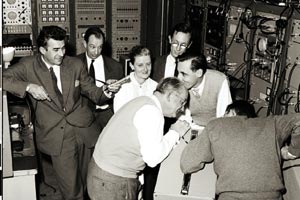
Back at BNL, we went to work on exploring the requirements for actually building an accelerator – and of course the CERN people did the same. Both groups decided to aim for an energy of around 30 GeV – and the race was on. However, we collaborated in this race as much as we competed, sharing internal reports and informal communications. The Blewetts took six months’ leave in 1953 to work with Dahl in Bergen. At the time, CERN was scattered over several sites prior to the establishment of the central laboratory in Geneva. At a conference at the University of Geneva in October 1953, participants discussed the theoretical and technical design issues for an alternating gradient synchrotron. I was one of several American participants and Hildred Blewett edited the proceedings – I still have a copy after all these years.
The rivalry and collaboration between the projects at BNL and CERN continued. As a result, the two accelerators are similar in overall design, not only in size but in most of the details. The machine at BNL is called the Alternating Gradient Synchrotron (AGS) and the one at CERN is the Proton Synchrotron (PS); in fact, both names apply to both machines.
There were still some differences. One possible problem was a phenomenon called the “transition energy”, an energy where the mechanism of phase stability demands a sudden change of phase of the accelerating field. All the theory – by Kjell Johnsen at CERN and me at BNL – predicted that this should be easy to deal with. The people at CERN were convinced that this was correct, while some of the powers-that-be at BNL decided that they would feel safer if there was an experimental demonstration of the feasibility of going through this critical energy. As a result, BNL built a small-scale model (the Electron Analog) to verify that calculation, while CERN did not. The Electron Analog worked perfectly, but it cost us some time. Consequently, CERN won the race – they had an accelerated beam in 1959, while ours came in 1960. Each was the world’s highest-energy accelerator when it came on.
There are numerous accelerators and colliders today with energies exceeding the PS and the AGS. These two venerable machines are approaching their 50th anniversaries and are breaking records in longevity rather than energy. They now function as injectors for their successors: the AGS for RHIC at BNL, and the PS for the SPS at CERN – which the LHC will soon succeed. Continued collaboration between BNL and CERN – and other high-energy laboratories around the world – is a matter of course.
DESY is to establish a new research group in which young scientists from DESY and three Russian institutes will work together to resolve current questions in particle physics. DESY’s proposal for “Physics and Calorimetry at the Terascale” is one of eight applications selected from 26 submissions to form a Helmholtz–Russia Joint Research Group. This comes as part of an initiative launched in 2006 by the president of the Helmholtz Association, Jürgen Mlynek, and the chair of the Russian Foundation for Basic Research, Vladislav Khomich. One aim of the new three-year support programme is to promote scientific co-operation between DESY and Russia and to provide attractive research opportunities for young scientists in particle physics. Within the joint research group, DESY will collaborate with three institutes based in Moscow: the Institute for Theoretical and Experimental Physics, Moscow State University and Moscow Engineering Physics Institute. The group will be involved in physics analyses of experiments at HERA and the LHC and for the proposed International Linear Collider (ILC), as well as in detector design and construction for the LHC and ILC.
The approval of this joint research group acknowledges the long and successful collaboration between DESY and its Russian partner institutes. The proposed activities will complement those of the Helmholtz Analysis Centre at DESY and the strategic alliance between DESY and German universities.
March: Precision is the name of the game as, once in position in the tunnel, the LHC’s magnets are carefully aligned.
March: The Train Inspection Monorail, affectionately referred to as “TIM,” will allow teams to view the LHC tunnel and take measurements remotely when it is inaccessible to humans.
The last of 1746 superconducting magnets is lowered into the LHC tunnel via a specially constructed pit at 12.00 on 26 April. This 15 m long dipole magnet is one of 1232 dipoles that will guide the two proton beams in opposite directions around the 27 km circumference.
Gently does it: In January, the lorry transporting the time projection chamber for the ALICE experiment took an hour to travel the 200 m from the assembly hall to the access shaft for the underground cavern.
The first half of the CMS barrel hadron calorimeter cylinder was lowered into the underground cavern in February. It weighs almost 600 tonnes.
In July the CMS forward pixel detector, which was built at Fermilab, underwent an installation test. The photo shows the central opening of the silicon strip tracker where the beam pipe and pixel detector will be located.
January: The CMS tracker outer barrel is inside the tracker support tube, fully cabled. The golden rectangles are digital optohybrid modules for distributing clock and trigger signals.
ALICE’s inner tracking system (ITS) was installed into the heart of the experiment in March. It was a delicate task to fit the ITS within the time projection chamber.
The 42nd and final module for LHCb’s vertex locator arrived from Liverpool in March, marking the culmination of 10 years of development. The detector will be placed just 5 mm from the beam line.
The outer layers of ALICE’s ITS, seen prior to installation in March, contain almost 5 m2 of double-sided silicon strip detectors.
The first inner detector endcap for the ATLAS experiment is fully inserted into the liquid-argon cryostat in May.
March: End view of the heat shield and cryostat of one of the ATLAS endcap toroids while still in the assembly hall before the mounting of detectors.
Lowering the second ATLAS endcap toroid magnet into the cavern in July.
By Frederick James, World Scientific Publishing. Hardback ISBN 9789812567956 £33 ($58). Paperback ISBN 9789812705273 £17 ($30).
In this second edition many chapters now include considerable new material, especially in areas concerning the theory and practice of confidence intervals, including the important Feldman–Cousins method. Both frequentist and Bayesian methodologies are presented, with a strong emphasis on techniques that are useful to physicists and other scientists in the interpretation of experimental data and comparison with scientific theories. This textbook is suitable for advanced graduate students in the physical sciences, as well as a reference for active researchers.
To provide the best experiences, we use technologies like cookies to store and/or access device information. Consenting to these technologies will allow us to process data such as browsing behavior or unique IDs on this site. Not consenting or withdrawing consent, may adversely affect certain features and functions.
Functional
Always active
The technical storage or access is strictly necessary for the legitimate purpose of enabling the use of a specific service explicitly requested by the subscriber or user, or for the sole purpose of carrying out the transmission of a communication over an electronic communications network.
Preferences
The technical storage or access is necessary for the legitimate purpose of storing preferences that are not requested by the subscriber or user.
Statistics
The technical storage or access that is used exclusively for statistical purposes.The technical storage or access that is used exclusively for anonymous statistical purposes. Without a subpoena, voluntary compliance on the part of your Internet Service Provider, or additional records from a third party, information stored or retrieved for this purpose alone cannot usually be used to identify you.
Marketing
The technical storage or access is required to create user profiles to send advertising, or to track the user on a website or across several websites for similar marketing purposes.