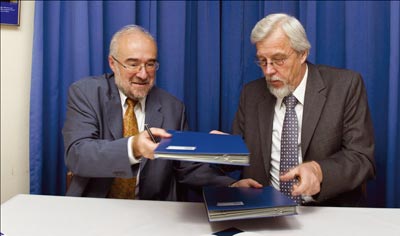
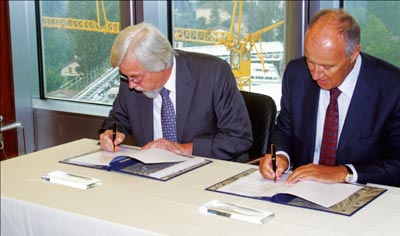
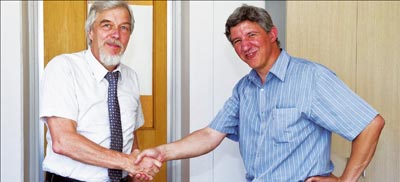
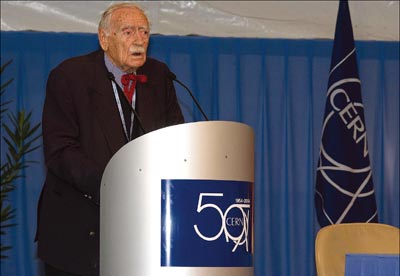
On 11 February the Romanian minister of education, research, youth and sport, Daniel Petru Funeriu, and CERN’s director-general, Rolf Heuer, signed an agreement that formally recognizes Romania as a candidate for accession to membership of CERN.
Romania’s pre-membership will cover a five-year period during which the country’s contributions will increase to normal member-state levels, in parallel with Romania’s participation in CERN projects. At the end of this five-year period CERN Council will decide on Romania’s application for full membership, as the organization’s 21st member state.
Romania entered into direct collaboration with CERN in the early 1990s. In recent years the country has constantly increased its expenditure on R&D, in particular since the country’s accession to the EU in January 2007. Romania is involved in three LHC experiments: ATLAS, ALICE and LHCb. It also contributes to the DIRAC and ISOLDE programmes and to Grid computing.
by Arthur I Miller, W W Norton. Hardback ISBN 9780393065329, £18.99 ($27.95). Paperback, published as 137: Jung, Pauli, and the Pursuit of a Scientific Obsession. ISBN 9780393338645, £11.99 ($16.95).
Do you think there is a sense beyond numbers? Do they have any special meaning? Are there some more powerful than others? Many great men throughout the centuries have exercised their minds to find answers to these questions. In his latest book, the distinguished historian of science Arthur I Miller (p17) investigates one of the possible responses in the unique blend of two extraordinary lives, those of Carl Jung and Wolfgang Pauli.
The book tells the story of the fruitful friendship between two of the greatest thinkers of our times, who were obsessed with the power of certain numbers. The two personalities are central to the narrative and the author masters their story with plenty of interesting details that hold our attention with humour. In the course of reading, we sometimes encounter complex physics formulas, but Miller expertly translates them into a refined interpretation that novices can understand.
Among the accurate account of the enormous and lasting contributions to their respective fields, such as Pauli’s hypothesis of the neutrino in physics and Jung’s theory of a collective unconscious in psychoanalysis, we find indeed “the” number: 137. This pure number, the fine structure constant, which to the eyes of a layman may appear harmless and meaningless, was the “step toward the great goal of finding a theory that would unite the domains of relativity and quantum theory, the large and the small, the macrocosm and the microcosm”. But it is not only that. Through the unfolding of dreams, mandalas, archetypes and symbols, this number turns out to be the golden gate between rational and emotional, creativity and intelligence, science and belief. This tale provides us with a window across time and space into enlightenments of genius.
Deciphering the Cosmic Number is a revelation of something beyond intuition that compels us to participate in the human torment in those whose lives are marked by the quest to find answers to questions transcending centuries and ages. It describes, looking through a magnifying glass, the lives of two human beings who achieved so much in their fields through a “strange friendship” during the difficult period of the Second World War.
It should come as no surprise then, that the work at the Large Hadron Collider at CERN has been the jumping-off point for some of Keith’s most critically acclaimed work. His 2002 exhibition “Supercollider”, shown at the South London Gallery in the UK, took its title from the goings on at CERN. The title piece of the exhibition (right) was a giant studio drawing with the subtitle “From the Action of Four Forces on 103 elements within four dimensions, we get…” and needs no explanation to any scientist. Random quotes drawn from everything from planetary charts to entries in anonymous diaries, combined with splashes of colour and pictures of a red-haired model wearing an itsy-bitsy, green bikini, are some of the myriad miscellaneous items that collide on this giant painting and which reflect the wonderful diversity of the world created “from the action of four forces…”. Another mixed-media piece, Bubble Chambers: 2 Discrete Molecules of Simultaneity, bursts with random quotes with random dates from 1325 to 2002 dotted across a surface that is crammed with molecules represented as bubbles in reds, blacks, blues, pinks and whites.
Both of these pieces are like a mirror held up to the viewer. Look at them both and, inevitably, the temptation kicks in to start drawing conclusions or to make narratives out of the random juxtapositions: the mind’s processes writ large. Like much of Keith’s work, he is interested in the way that we make sense of the world: as the observer and the observed; the viewer and the artist; and the ways in which we use logic, counter-intuition and intuition to make these discoveries. In essence, we are all in this artistic experiment together, discovering who and what we are in the act of looking – the artist included.
But if looking is important to Keith, it wasn’t until 2009 that he finally came to take his own look at CERN. Talk to him about his visit and he says that what impressed him above everything was “not so much the LHC or the machines themselves, as the way in which the scientists at CERN meet ideas head on and change the way we think about ourselves”.
He came as part of a private party of artists, including fellow British artist Cerith Wynn-Jones and the German experimentalist Ali Janka, who were shown round the CERN complex by the communication team in September 2009. In many ways, visting CERN was a homecoming for Keith and one that he found profoundly moving. He encountered an international community dedicated to breaking the boundaries of knowledge and challenging the world of appearances – ideals that are so close to his heart and mind too.
For someone who is so omnivorous in his wish to gain knowledge, physics isn’t the only science that fascinates him. Chemistry and mathematics engage him too. Some of his most famous pieces include the fractal dice, part of the Geno Pheno series (2005), which explores the worlds of cause and effect and takes its title from genetics. The work explores the idea of what is a starting point – an artwork’s DNA, so to speak; its physical manifestation or where it leads. The fractal dice pieces are three-dimensional aluminium and plastic sculptures, in vibrant primary colours – reds, blacks, greens and yellows. They are assembled in galleries around the world where they are shown according to a mathematical system, known as random iterative-functions systems, which is supplied to the curators by the artist. The form of each piece – sometimes as many as 14 are shown at any one time, sometimes fewer – is determined by the rolls of a dice and by the rules set out by the artist. For example, rule number one determines which colour a particular side of the sculpture should be. Complexity and unpredictability are both shown to be crucial components of the creative process, which involves both decisions and chance.
This love of engaging with different sciences and their processes shows how critical Keith is of being enslaved by any one knowledge system. His sculptural piece, Teleological Accelerator (2003), clearly shows this (top right). It is a massive wall installation measuring 5 m across, with two interlocking metal discs made of aluminium and steel that comprise a diagram of words and concepts written in pencil, ranging over all kinds of human achievements as well as an accumulation of scientific definitions. The flexible indicators can be twisted by the viewer so that the artist playfully conveys his idea that teleology is whatever you can make of it. Meaning is not a fixed point: it is always changing.
If much of Keith’s work shows a great indebtedness to science and a love of it as a knowledge system, and form of enquiry about the world, some of his latest work also shows an awe-inspiring sense of nature. After all, as Keith so eloquently says, “Science and art are the ways in which we describe the world. Nature is the world.” The 2009 work Mathematical Nature Painting Nested (bottom right), currently being shown at the Royal Academy of Art, London, is a portrait of original transformations. Paints and chemicals have been poured onto a primed aluminium sheet and a painting takes shape thanks to the hydrophic reaction that forms the basis of the painting. This is the first phase. In the second phase, Keith determines the appearance of the painting, as far as he can, to make it resemble cells structures or geographical strata, according to the way that he dries the paint over the following month.
Like particle physics itself, Keith is pushing boundaries, working within limits and constraints and outside them too: “I am not interested in the role of the artist as creator. Art is a vehicle of enquiry and the role of the artist is much more like that of Christopher Columbus – we are navigators and discoverers of what is already out there in the world but has yet to be discovered.”
He could just as easily be talking about the role of the scientist, but he is clear about how different artists and scientists are, as well as the ways in which the arts and science could and should interact: “Artists, unlike scientists, are not attempting to model the world. They are trying to engage the viewer with the wonder of it. If you attempt to marry and equate art with science, then you fail. If you allow what is not similar about art and science, and their different methods and processes to co-exist and thrive, then a real art/science collaboration and aesthetic will emerge. But at the end of the day, both art and science are united by one logic and one impulse – both are attempts to understand what it is to be human and the world around us.”
• For more information about Keith Tyson’s latest creations, see his official website at www.keithtyson.com.
by Eugenie Samuel Reich, Palgrave Macmillan. Hardback ISBN 9780230224674, £15.99 ($26.95). Paperback ISBN 9780230623842, £12.99 ($17).
This book devotes 266 dense pages – 20 of them listing hundreds of notes – to a case of scientific misconduct staged at Bell Labs between 2000 and 2002, with Jan Hendrik Schön as the central figure. The plot follows the path leading up to the discovery that Schön’s breakthroughs on “molecular electronics” (which included lasers and superconductors made of organic plastics) were fraudulent.
Reich makes a good case in defending the argument that the economic situation at Bell Labs and the need to justify keeping a strong basic-research department in the company made the ground fertile for an ambitious young person to flourish and enchant (fool) the senior people. It is actually quite amazing to see that the co-authors of Schön’s papers knew so little about important points of the reported work, and that the fabrication of data was not uncovered earlier than it was, given the frequent questions being asked by many Bell people, including close collaborators, managers and other staff. It helped that many of his papers presented “measurements” that matched predictions. He seemed to write his papers backwards: first the conclusions, then the “data” that supported them, often generated from equations rather than from the apparatus.
In hindsight, it looks preposterous to think that Schön could possibly write more than 20 groundbreaking publications in such a short time period, including seven papers in a single month, November 2001. This, alone, should have alerted people to the possibility that the reported results may have been fabricated. The journals Nature and Science emerge from this book as not being very careful about reviewing the articles that they publish, placing the emphasis on selecting papers that will make the headlines (the “breakthrough of the year”) rather than in ensuring that they provide enough technical details to allow for a good scrutiny of their plausibility and for an efficient verification by other labs. Many people wasted time and money trying to replicate the fabricated results. Schön’s publication “success” surely benefited from having signed the papers with a senior co-author, a well known expert who gave further credibility to the fraudulent results by giving a multitude of seminars on the subject, to the point of being awarded, and accepting, prizes for the “discoveries”.
This is an interesting book and Reich clearly convinces the reader that, despite our natural tendency to think that scientists can be trusted (honest people, who might make mistakes), some of them deliberately fudge the measurements to fit with preconceived ideas, old or new. The scientific method needs to be learned, sometimes through years of careful training, modulated by sceptical professors (who can notice patterns that look “too good to be true”). However, I would gladly have exchanged many of the specific details about this single case for more information about other cases, together with a global discussion of the factors that lead to such frauds. Are they caused by young people with inadequate training and supervision? Or by ambitious senior people desperately looking for an important prize and pushing their young partners to search for anomalies and “new physics”, neglecting the importance of time-consuming validation checks? Are there branches of science where they are more frequent?
Reich was very meticulous and gives all sorts of details that interrupt the fluidity of the reading. She could have redesigned the narrative, avoiding some repetition, placed the introductory text of chapter 9 (!) at the start of the book, and removed a few of the lines and paragraphs containing little information. Without an introductory chapter preceding the main plot and giving a broad overview of this field, most readers will lack the minimum background knowledge needed to appreciate the reported saga. As a side remark, it is curious to learn that Nobel laureate Bob Laughlin repeatedly claimed that Schön’s results had to be fraudulent but his opinion “didn’t count because he was known to be too sceptical”.
by G Kane and A Pierce (eds), World Scientific. Hardback ISBN 9789812779755, $99/£55. Paperback ISBN 9789812833891, $54/£30. E-book ISBN 9789812779762, $129.
This book could hardly seem more timely, with the Large Hadron Collider (LHC) having started operations and new discoveries being eagerly awaited (but quite possibly a few years off yet). It consists of 17 chapters, each on a different topic, ranging from a description of the detectors to discussions of naturalness in quantum-field theories of particle physics.
The contributors are particle physicists, several of whom are prominent in the field. However, each chapter has different authors, so the result is inevitably a little patchy. The chapters differ widely in scope, in character and in the level of expertise assumed for the reader. For instance, the chapter on dark matter at the LHC is very basic and could be read by undergraduates, whereas the informative chapter on top physics is of a graduate level. There are also some much more general expansive essays, such as one that explores similarities between the BCS theory of superconductivity and particle physics, and the introductory chapter. The introduction assumes a fair amount of prior knowledge and is much too optimistic for my taste about the chance of discovering supersymmetry at the LHC. The author asserts that supersymmetry must be correct because of several pieces of circumstantial evidence, but I really think that other such a posteriori scraps could be used to prop up the evidence for competing theories.
There are a couple of obvious omissions, for example quark-gluon plasma physics and the ALICE detector. After all, the LHC will spend some of its time providing collisions between heavy ions, rather than protons, and ALICE will be trying to divine the properties of the resulting soup of quarks and gluons. The other missing topic is that of diffractive physics. It is likely that both the ATLAS and CMS experiments will eventually have forward detectors to measure protons that have just grazed another one in a collision. Under certain theoretical circumstances, it is even possible to produce Higgs bosons in the central detector during these collisions. Such rare events could provide useful experimental constraints on the properties of Higgs bosons. The chapter about the ATLAS and CMS detectors is welcome, but it could benefit from some basics about how particles interact as they travel through matter. This important link in the logical chain is missing from the discussion.
Perspectives on LHC Physics is a timely, heterogeneous offering, with some interesting gems and informative parts, as well as some fairly off-the-wall speculation. I think that there should be sections of it to interest most readers in the physical sciences, but that they may well wish to choose particular chapters to read. Luckily, the format of the book makes this easy to achieve.
A new international player has entered the arena of intense short-pulse coherent light technology, with the latest developments in the Extreme Light Infrastructure (ELI) European project, which was launched in November 2007 in its preparatory phase and involves nearly 40 research and academic institutions from 13 EU member states. At the end of 2009, ELI decided to create a pan-European Extreme Light Facility based at several research sites. The first three sites have been selected and a decision on a fourth site, to deal with “ultrahigh peak power”, will be taken in 2012 after validation of the technology.
The field of “extreme light” is opening up a new direction in fundamental and applied research. It is currently carried out in Europe – mainly in France, Germany, Russia and the UK – as well as in China, Japan, South Korea and the US. With the new initiative, other European countries hosting the three sites for the new facility are set to take a leading role.
The site in Prague, Czech Republic, will focus on providing ultrashort-pulse beams of energetic particles (10 GeV) and radiation (up to a few mega-electron-volts) produced from compact pulsed-laser plasma accelerators with a planned overall laser peak-power reaching 50 PW. In Hungary, a site in Szeged will be dedicated to extremely fast dynamics, taking snap-shots at the attosecond scale (10–18 s) of electron dynamics in atoms, molecules, plasmas and solids based on an optical few-femtosecond laser with an average power of several kilowatts.
The third site in Magurele, near Bucharest, Romania, will produce radiation and beam particles at energies high enough to address nuclear processes. With this facility a renaissance in the field of nuclear physics is expected. The planned laser peak-power will reach 30 PW. Intense radiation created at ELI could help to clarify the processes limiting the lifetime of nuclear power reactors, offer new avenues to control the lifetime of nuclear waste, fabricate new nuclear pharmaceutical products, and lead to laser-driven hadron therapy, and phase-contrast imaging as a medical diagnostic tool.
Completion of the fourth ELI site will afford new fundamental investigations into particle physics, nuclear physics, acceleration physics and ultrahigh-pressure physics, leading on to applications in astrophysics and cosmology. It will offer new research directions in high-energy physics relating to particle acceleration and the study of the vacuum structure and critical acceleration conditions.
ELI’s host countries have been mandated to form a pan-European Research Infrastructure Consortium (ERIC), which will be open to all European countries, and possibly others, willing to contribute to the realization of the project. A unique centralized management will preside over the integrated infrastructure. The host countries are to provide about 15% of the funding, while the EU is contributing the balance under its infrastructure investment programme. A total of €750 million is currently earmarked for the initial three sites.
On 30 November, representatives from Denmark, Germany, Greece, Hungary, Italy, Poland, Russia, the Slovak Republic, Sweden and Switzerland signed the “Convention concerning the Construction and Operation of a European X-ray Free-Electron Laser Facility”. Six language versions each of the Convention and the Final Act now carry the signatures of 11 government representatives, including two from the Federal Republic of Germany. These two documents lay the foundations of the European XFEL project, define the financial contributions of the current partner countries, and confer the responsibility for the construction and operation of the X-ray free-electron laser facility on the nonprofit company European XFEL GmbH.
For internal reasons France and Spain will sign the Convention later and China plans to join within the next six months.
The fourth meeting of the Steering Committee of the CERN/ITER Collaboration Agreement took place at CERN on 19 November. It marked not only the end of a second year of successful collaboration between ITER and CERN on superconducting magnets and associated technologies but also the establishment of CERN as the ITER reference laboratory for superconducting strand testing for the next five years.
The implementation agreement for 2009 encompassed a variety of topics. These included expertise in stainless steel and welding, high-voltage engineering, the design of high-temperature superconductor current leads, and testing and consultancy in cryogenics and vacuum technology.
The main role of CERN as the ITER reference laboratory will be: to carry out yearly benchmarking of the acceptance test facilities at the six domestic agencies involved in superconducting strand production; to help in the training of the personnel involved in these tests around the world; and to carry out third-party inspection and expertise in case of problems during production. To this end, CERN will use the facilities that were set up for strand qualification for the LHC, but with an important modification: the upgrade of magnetic fields from 10 T to 15 T to properly test samples of niobium-tin (Nb3Sn) superconductors.
This programme has considerable synergy with the study for high-gradient quadrupoles in Nb3Sn that CERN is pursuing to prepare new technology for the LHC luminosity upgrade. Nb3Sn has a superior performance to the niobium-titanium alloy employed in the LHC. However, the brittleness of Nb3Sn and the need for high-temperature heat treatments mean that much R&D is still required. ITER will see the first large-scale use of Nb3Sn: some 400 tonnes of the conductor will be used for the toroidal field coils and the central solenoid.
by David Lyth and Andrew Liddle, Cambridge University Press. Hardback ISBN 9780521828499, £40 ($75). E-book ISBN 9780511536922, $60.
In the early 1990s, the discovery of minute inhomogeneities in the temperature of the cosmic microwave background (CMB) marked the beginning of an observational endeavour that continues today thanks to dedicated satellite missions, such as the Wilkinson Microwave Anisotropy Probe and Planck. Current observations seem to suggest that the CMB anisotropies and polarization stem from inhomogeneities of the spatial curvature, which are related via general relativity to the fluctuations of the energy density. The latter fluctuations are often called, in the jargon, density perturbations. This monograph by David Lyth and Andrew Liddle unveils the different facets of the interplay between density inhomogeneities, quantum field theory and observational astrophysics. It follows (and partly overlaps with) Cosmological Inflation and Large-Scale Structure, written less than nine years ago by the same pair of authors.
The Primordial Density Perturbation is organized into three parts. The first and second parts provide a swift reminder of concepts connected to relativity (both special and general) and the Standard Cosmological paradigm (sometimes dubbed the ΛCDM model where Λ stands for the dark-energy component and CDM is the acronym for cold dark matter). The third part of the book, titled “Field Theory”, collects all of those aspects of quantum-field theory that are germane to the evolution and normalization of cosmological perturbations. The section’s main focus is organized around the description of space–time geometry in its most relativistic regime, i.e. when the typical wavelengths of the fluctuations in the spatial curvature are comparable with the Hubble radius, whose size is a million times larger than the extension of a typical spiral galaxy, such as the Milky Way.
Despite the excellent effort made by the authors, it seems necessary – especially for students and novices – to keep other dedicated books about quantum field theory on hand as well as books about cosmology (appropriately quoted through the 29 chapters of the text), such as the monumental Cosmology by Steven Weinberg (Oxford University Press 2008) and the reference treatise of the early 1990s Principles of Physical Cosmology by Jim Peebles (Princeton University Press 1993).
The rich literature that is flourishing these days on the mutual interplay between the microphysics probed by particle accelerators and the macrophysics scrutinized by astrophysics and cosmology suggests an increasing interest in these themes among a community that ranges from undergraduate students to skilled practitioners of the field. The different treatises are in agreement on one aspect: the unknown territory to be charted by the LHC will influence not only the forthcoming path of particle physics but also the development of cosmology and high-energy astrophysics during the next two decades.
by Howard Burton, Key Porter Books. Paperback ISBN 9781554701759, $24.95.
Science, usually an also-ran in the major funding stakes, is nevertheless occasionally surprised by generous benefactors. Just before the Wall Street crash in 1929, the Bloomberger family sold their department store to Macy’s of New York and altruistically invested the proceeds in what would become the Institute for Advanced Study (IAS), Princeton. This was not to be a university, and its research would not be dictated or contracted. With mathematical science high on its agenda, early members included Albert Einstein, John von Neumann and Kurt Gödel.
The IAS soon became a template for other research centres, both in the US and abroad. One of these was Israel’s Weizmann Institute, whose initial benefactors were the Sieff family, from another retailer, Britain’s Marks and Spencer. Another was India’s Tata Institute, supported by the mighty eponymous industrial combine. More recently came the foundation established by the Norwegian-American innovator Fred Kavli.
Another fresh venture is the Perimeter Institute (PI) for Theoretical Physics in Waterloo, Ontario, established in 1999 by Mike Lazaridis, co-founder of Research in Motion, the developers of the ubiquitous BlackBerry handsets. Lazaridis thrust an unsuspecting Howard Burton into the role of PI’s first executive director, with the job of getting the new institute up and running. This book is Burton’s memoirs of those heady days.
After labouring towards a PhD in theoretical physics, and with financial organizations snapping up numerate scientists, in 1999 Burton started looking for a job. The covering letter for his CV concluded with the line: “Please help save me from a lucrative career on Wall Street.” One CV went to Research in Motion. To Burton’s surprise a prompt and enthusiastic reply came from Lazaridis, who had an idea at the back of his mind and was looking for help to make it crystallize. Burton vividly conveys the difficulties of trying to sound enthusiastic in an interview for a job he didn’t even begin to understand.
Nevertheless, he was hired. To clarify his own ideas, he went far and wide to explore possibilities and seek out recruits. One early candidate was Roger Penrose at Oxford, whose foreword to the book is characteristically stimulating and enigmatic by turns. There is a hilarious anecdote about trying to make a telephone call from Penrose’s office. Another amusing episode comes when Burton goes to ask his former teacher at Guelph University to join the board of the new institute. On arrival, Burton is wrong-footed by being offered a postdoc position, which he immediately has to turn down and instead make his counter-offer to an even more surprised former teacher.
Soon, Burton was seeking other recruits and looking for suitable premises. With the first physicists in residence, attention turned towards establishing a working environment. Burton’s initial confusion was now inherited by scientists unused to Lazaridis’ work style. Burton’s chapter, “The trouble with physicists”, illustrates the culture shock when the brash commercial world meets the passive serenity of academia. Commendably, outreach was soon identified as a major objective at PI, with a successful series of public lectures and other events.
The book’s “crazy” subtitle and the offbeat cover illustration could be misleading: at first glance it is easy to assume that the book is eccentric. However, its informal style masks serious issues. PI aims to redress the balance in a world dominated – culturally, intellectually, technologically and economically – by scientific research, but which is nevertheless largely uncaring and unappreciative of the importance of science.
Because PI is an institute for theoretical physics, theorists especially will enjoy the book, and many well known figures flit across the pages. There is no official collective noun for theoretical physicists, but Burton’s acknowledgements include a list of about 200 of them, which surely qualifies for one (“galaxy”, “group”, “resonance”?).
To provide the best experiences, we use technologies like cookies to store and/or access device information. Consenting to these technologies will allow us to process data such as browsing behavior or unique IDs on this site. Not consenting or withdrawing consent, may adversely affect certain features and functions.
Functional
Always active
The technical storage or access is strictly necessary for the legitimate purpose of enabling the use of a specific service explicitly requested by the subscriber or user, or for the sole purpose of carrying out the transmission of a communication over an electronic communications network.
Preferences
The technical storage or access is necessary for the legitimate purpose of storing preferences that are not requested by the subscriber or user.
Statistics
The technical storage or access that is used exclusively for statistical purposes.The technical storage or access that is used exclusively for anonymous statistical purposes. Without a subpoena, voluntary compliance on the part of your Internet Service Provider, or additional records from a third party, information stored or retrieved for this purpose alone cannot usually be used to identify you.
Marketing
The technical storage or access is required to create user profiles to send advertising, or to track the user on a website or across several websites for similar marketing purposes.