Yves Baconnier, who made important technical and managerial contributions to a surprising number of CERN accelerators, passed away on 21 January 2024.
Born in 1934 in the Ardèche in the South of France, Yves completed his studies at the Institut Polytechnique de Grenoble. He joined CERN in 1963 as engineer-in-charge of the Proton Synchrotron (PS) and quickly took a strong interest in analysing and improving the slow-ejection procedure. He became leader of the machine study team before moving to the Super Proton Synchrotron (SPS) project in the early 1970s, where his experience with beam extraction was very welcome.
Once the SPS extraction was operational at the end of the 1970s, Yves moved on to the Large Electron Positron (LEP) collider and, in particular, its injection system, which at the beginning was imagined as a new system without a link to the existing accelerators. His decisive idea to use the deadtime between the proton cycles of the SPS – dictated by limited cooling power – to insert the low-dissipation e+e– acceleration cycles from 3.5 to 20 GeV was the key element for accepting the existing accelerator chain PS and SPS with all its infrastructure as the LEP injector. This cut short all discussions on other possible LEP sites in Europe.
After this memorable success with LEP, Yves moved back to his first love, the PS, and took responsibility for the PS ring proper to define and oversee an upgrade programme enabling the elderly machine to accelerate electrons and positrons from 0.6 to 3.5 GeV. The complete vacuum system had to be modified to withstand the synchrotron radiation emitted from the lepton beams, and the campaign reached its climax during a very long shutdown in 1987, during which a stainless-steel vacuum chamber was installed around the ring. Since the PS magnets had combined-focussing, i.e. a quadrupole magnetic field on top of the dipole field, the synchrotron radiation would not allow for stable operation. To counter this, two Robinson-type wiggler magnets had to be inserted. Yves and his team designed this unique magnet, tested the prototype in the PS and at the DCI ring at LAL in Orsay and, finally, introduced it successfully in the PS.
In the early 1990s, Yves went on to join the teams designing a beauty factory to be housed in the tunnel of the former Intersecting Storage Rings, and took the lead in the design of a tau–charm factory to be built on a green-field site in Spain. However, since these projects did not then materialise, he continued his work at the CLIC test facility to which the linear accelerator of LEP had to be converted. In 1984, in parallel with his other widespread activities, Yves took an active interest in the LHC design study, leading to the project’s official approval in 1994. He moved into project management in the mid-1990s and was entrusted with chairing the influential LHC parameter committee until his retirement in 1999.
Yves will be remembered for his thorough and well-thought approach to his work, always seeking to understand ab initio, and for his meticulous insistence on checking hardware through prototyping and extended testing. Unassuming but sharp and exacting, he was a well-respected colleague, an appreciated lecturer and a leader with wide-ranging interests.
Stefano Catani, a theoretical particle physicist in the Florence section of Istituto Nazionale di Fisica Nucleare (INFN), passed away on 16 January 2024. Stefano was one of the world’s leading experts in quantum chromodynamics (QCD) and its phenomenological application to high-energy collider physics, leaving an irreplaceable void among his colleagues, friends and family.
Stefano studied physics at the University of Florence and obtained his PhD in 1987 under the supervision of Marcello Ciafaloni, who passed away in September 2023. He was a postdoctoral fellow at the University of Cambridge from 1989 to 1991, and a member of CERN’s theory division from 1991 to 1993. After 1993 he developed his scientific career at INFN Florence, with a period as a CERN staff member between 1997 and 2002.
Discussing physics with Stefano was a fantastic experience. His depth and vision were simply unique. He was one of the great pioneers in the development of QCD as a precision science, thanks to his extraordinary ability to embrace the entire field without interruption, from the physics of “soft” gluons and their resummation to the perturbative regime. His research achievements are internationally recognised as being fundamental to the success of the high-energy collider physics programme, in particular for precision studies of the Higgs boson and the top quark.
His work is recognised as fundamental to the success of the high-energy collider physics programme
Among his most important contributions are the formulation of jet clustering algorithms at lepton and hadron colliders (a key component of most experimental analyses), a general expression for the determination of the infrared singularities of scattering amplitudes (the so-called Catani formula), the design of general algorithms for the perturbative calculation of cross sections and differential observables, which have become a standard in the community (the well-known Catani–Seymour dipole subtraction and the qT subtraction schemes), and the innovative Catani–Krauss–Kuhn–Webber algorithm for Monte Carlo simulations of many-jet processes.
Stefano’s work was especially motivated by the application of QCD to collider data. He was convinced that our understanding of QCD singularities could be formulated in a way that any user could make a next-to-leading-order calculation of any suitable observable, not just dedicated calculations by experts. He also studied factorisation properties and coherence effects in the high-energy limit (the Catani–Ciafaloni–Fiorani–Marchesini equation) and proposed a generalisation of collinear factorisation that accounts for potential factorisation breaking effects at very high perturbative orders. The countless messages received from collaborators and colleagues all over the world, affected by the premature loss of a dear friend and extraordinary colleague, highlight Stefano’s great qualities of generosity, human warmth and scientific rigour that will be sorely missed by all.
Jacques Haissinski, who played an important role in major particle-physics experiments, passed away on 25 March 2024 at the age of 89. His father Moïse worked with Marie Curie and had been a long-time collaborator of her daughter Irène Joliot-Curie.
Jacques entered Ecole Normale Supérieure in 1954 and later went to Stanford, where he worked under Burton Richter on the pioneering Colliding Beam machine to collide electrons in flight using two storage rings. After his military service, Jacques joined the Laboratoire de l’Accélérateur Linéaire in Orsay, to undertake a doctorate on the AdA (Anello di Accumulazione) ring. Built in Frascati from an idea of Bruno Touschek to collide in-flight electrons and positrons stored in the same vacuum chamber, AdA had been brought to Orsay by Pierre Marin to take advantage of the high intensity of the linac beams. Jacques mastered all aspects of the ground-breaking experiment and succeeded in detecting the very first time-in-flight collisions in 1963.
In accelerator physics, following a discovery on the ACO ring at Orsay, Jacques published, in 1967, a basic paper on the longitudinal equilibrium of particles in a storage ring that contained the now widely used “Haïssinski equation”. He also collaborated with Stanford on the commissioning of SPEAR and later SLC, the very first and so-far only linear collider. In phenomenology, following Touschek, he led a programme on radiative corrections and later gave lectures on this subject in preparation for LEP at Ecole de Gif in 1989.
But the main scientific activity of Jacques Haïssinski was experimental particle physics. He took part in many experiments, directed theses in Orsay on ACO, and was spokesperson of the CELLO experiment at DESY. During the construction of LEP, Jacques served as chairperson of the LEP committee at CERN.
After LEP, Jacques turned his interests to astroparticle physics and cosmology, notably giving courses on the subject and collaborating on the EROS experiment and the Planck mission. During that time, he also took responsibilities in the management of Paris-Sud University (at Orsay), and later as a leader in IN2P3 and in the Saclay Laboratory DAPNIA (now IRFU). His leadership was greatly appreciated by the French high-energy physics community.
An outstanding teacher, Jacques also campaigned for the dissemination of knowledge to the public. He was a great humanist who was deeply concerned with social injustice and criminal wars. He presented his views publicly and believed that other physicists should do so. Generous with his precious time, he was always available to pass on his knowledge and vast scientific culture. He marked and inspired several generations of particle and accelerator physicists.
Mats Lindroos, who made major contributions to accelerator technology, passed away on 2 May 2024 aged just 62.
Mats received his PhD in subatomic physics from Chalmers University of Technology in Gothenburg, Sweden in 1993 under the supervision of Björn Jonson. As a PhD student he studied decay properties and hyperfine interactions from oriented nuclei, making use of the low-temperature nuclear orientation facilities at ISOLDE, Daresbury and Studsvik. He joined CERN as a research fellow in 1993 and became a staff member in 1995.
While at CERN, Mats filled a number of diverse roles including being responsible for PS Booster operation and the technical coordination of the ISOLDE facility. He was one of the driving forces behind the HIE-ISOLDE project that commenced construction in 2009 and is now one of the major accelerated radioactive beam facilities worldwide. While at CERN he also played leading roles in several European Union-supported design studies for future conceptual accelerator facilities: the nuclear-physics radioactive beam facility EURISOL and the beta-beam neutrino factory.
In 2009, when Sweden and Denmark were selected to be the host countries for the European Spallation Source (ESS), Mats returned to his roots in Sweden on secondment from CERN, formally joining the ESS in 2015. As one of the earliest members of the ESS organisation, he was responsible for establishing the nascent accelerator organisation as well as the accelerator collaboration, set up as a CERN-like collaboration, between major European accelerator laboratories across 10 countries to undertake the technical design of this important part of the facility. Mats led the technical design for the 5 MW proton linac of the ESS, and from 2013 as head of the 100-strong accelerator division he led the linac project that is now in the late stages of construction and installation. Even after stepping down from his leadership roles because of illness, he enthusiastically accepted a new one to advise the ESS management. He was fully involved in the process, and undoubtedly would have been instrumental in guiding the future evolution of the facility.
He set up a CERN-like collaboration between major European accelerator laboratories across 10 countries
As a globally recognised expert on accelerator technology, Mats served on many committees in an advisory role, such as the IJC Lab strategic advisory board (France), IN2P3 scientific committee (France), J-PARC technical advisory committee (Japan), PIP-II Fermilab technical advisory committee (US) and CERN’s scientific policy committee. As an adjunct professor at Lund University he enjoyed teaching and supervising students in addition to his numerous research, management and committee roles. Despite all these work activities, Mats found time to oversee, together with his partner Anette, the construction of a house on the south Swedish coast, where they enjoyed walking, gardening and being active in the local community.
Mats has touched all our lives with his energy and passion for research, his creativity for new ideas, his worldly knowledge, his sense of humour, and most importantly, his humanity and kindness. He will be greatly missed by all of us who had the privilege to count him as a friend and colleague.
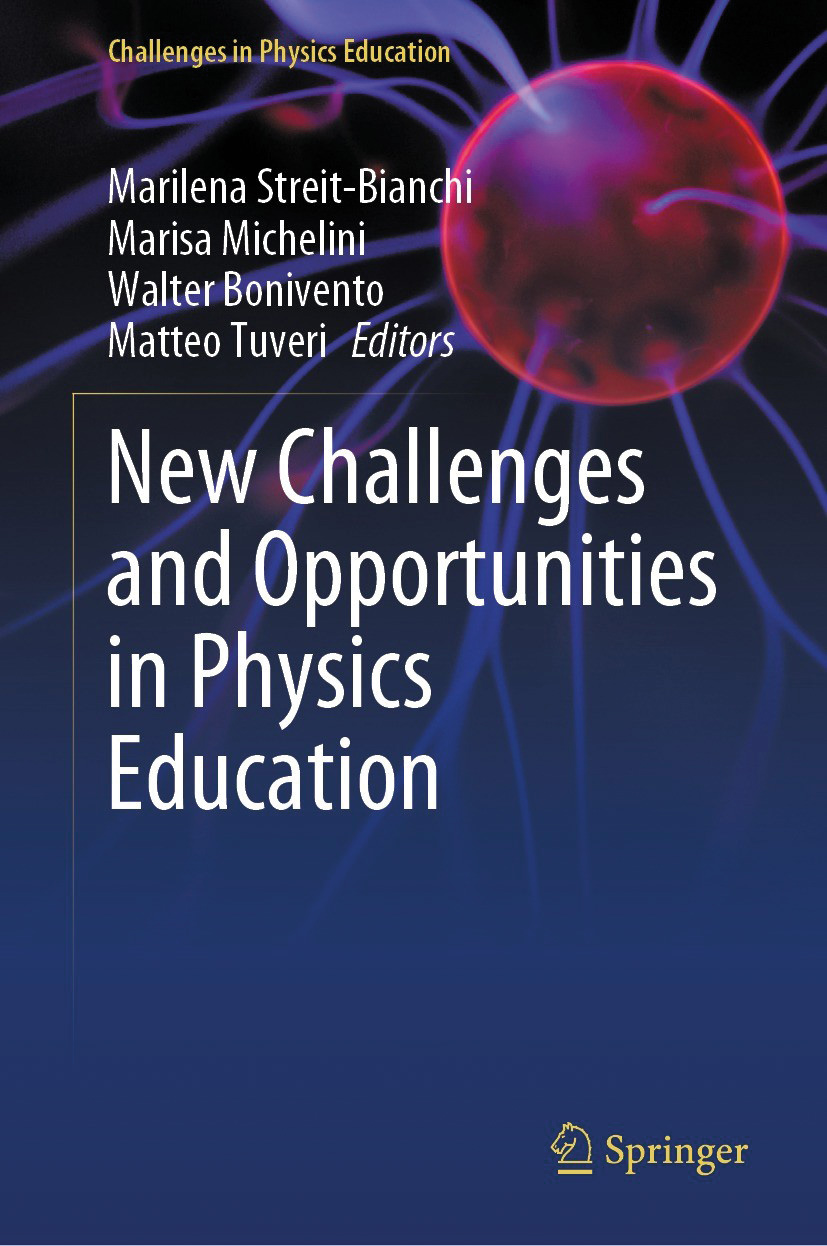
New Challenges and Opportunities in Physics Education presents itself as a guidebook for high-school physics educators who are navigating modern challenges in physics education. But whether you’re teaching the next generation of physicists, exploring the particles of the universe, or simply interested in the evolution of physics education, this book promises valuable insights. It doesn’t aim to cater to all equally, but rather to offer a spark of inspiration to a broad spectrum of readers.
The book is structured in two distinctive sections on modern physics topics and the latest information and communication technologies (ICTs) for classrooms. The editors bring together a diverse blend of expertise in modern physics, physics education and interdisciplinary approaches. Marilena Streit-Bianchi and Walter Bonivento are well known names in high-energy physics, with long and successful careers at CERN. In parallel, Marisa Michelini and Matteo Tuveri are pushing the limits of physics education with modern educational approaches and contemporary topics. All four are committed to making physics education engaging and relevant to today’s students.
The first part presents the core concepts of contemporary physics through a variety of narrative techniques, from historical recounting to imaginary dialogues, providing educators with a toolbox of resources to engage students in various learning scenarios. Does the teacher want to “flip the classroom” and assign some reading? They can read about the scientific contributions of Enrico Fermi by Salvatore Esposito. Does the teacher want to encourage discussions? Mariano Cadoni and Mauro Dorato have got their back with a unique piece “Gravity between Physics and Philosophy”, which can support interdisciplinary classroom discussions.
The second half of the book starts with an overview of ICT resources and classical physics examples on how to use them in a classroom setting. The authors then explore the skills that teachers and students need to effectively use ICTs. The transition to ICT feels a bit too long, and the book struggles to weave the two sections into a cohesive narrative, but the second half nevertheless captures the title of the book perfectly – ICTs are the epitome of new opportunities in physics education. While much has been said about them in other works, this book offers a cherry-picked but well rounded collection of ideas for enhancing educational experiences.
The authors not only emphasise modern physics and technology, but also another a very important characteristic of modern science: collaboration. This is an important message that we need to convey to students, as mere historical examples from classical physics sometimes show an elitist view of physics. Lone-genius narratives are often explicitly transitioned to a collaborative understanding of breakthroughs.
The book would not be complete without input from actual teachers. One notable contribution is by Michael Gregory, a particle-physics educator who shares his experiences with distance learning together with Steve Goldfarb, the former IPPOG co-chair. During the pandemic, he used online tools to convey physics concepts not only to his own students, but to students and teachers around the world. As such, his successful virtual science camps and online particle-physics courses reached frequently overlookedaudiences in remote locations.
Overall, New Challenges and Opportunities in Physics Education emerges as a valuable resource for a diverse audience. It is a guidebook for educators searching for innovative strategies to spice up their physics teachings or to better weave modern science into their lessons. Although it might fall short of flawlessly joining the modern-physics content with educational elements in the second half, its value is undeniable. The first part, in particular, serves as a treasure trove not only for educators but also for science communicators and even particle physicists seeking to engage with the public, using the common ground of high-school physics knowledge.
This book provides a rich glimpse into written science communication throughout a century that introduced many new and abstract concepts in physics. It begins with Einstein’s 1905 paper “On the Electrodynamics of Moving Bodies”, in which he introduced special relativity. Atypically, the paper starts with a thought experiment that helps the reader follow a complex and novel physical mechanism. Authors Harmon and Gross analyse and explain the terminological text and bring further perspective by adding comments made by other scientists or science writers during that time. They follow this analysis style throughout the book, covering science from the smallest to the largest scales and addressing the controversies surrounding atomic weapons.
The only exception from written evaluations of scientific papers is the chapter “Astronomical value”, in which the authors revisit the times of great astronomers such as Galileo Galilei or the Herschel siblings William and Caroline. Even back then, researchers were in need of sponsors and supporters to fund their research. In Galilei’s case, he regularly presented his findings to the Medici family and fuelled fascination in his patrons so that he was able to continue his work.
While writing the book, Gross, a rhetoric and communications professor, died unexpectedly, leaving Harmon, a science writer and editor at Argonne National Laboratory in communications, to complete the work.
While somewhat repetitive in style, readers can pick a topic from the contents and see how scientists and communicators interacted with their audiences. While in-depth scientific knowledge is not required, the book is best targeted at those familiar with the basics of physics who want to gain new perspectives on some of the most important breakthroughs during the past century and beyond. Indeed, by casting well-known texts in a communication context, the book offers analogies and explanations that can be used by anyone involved in public engagement.
Since his birth in Bohemia in 1924, Herwig Schopper has been a prisoner of war, an experimentalist with pioneering contributions in nuclear, accelerator and detector physics, director general (DG) of DESY and then CERN during a golden age for particle physics, and a celebrated science diplomat. Shortly after his centenary, his colleagues, family and friends gathered on 1 March to celebrate the life of the first DG in either institution to reach 100.
“He is a restless person,” noted Albrecht Wagner (DESY), who presented a whistlestop tour of Schopper’s 35 years working in Germany, following his childhood in Bohemia. Whether in Hamburg, Erlangen, Mainz or Karlsruhe, he never missed out on an opportunity to see new places – though always maintaining the Austrian diet to which his children attribute his longevity. On one occasion, Schopper took a sabbatical to work with Lise Meitner in Stockholm’s Royal Institute of Technology. At the time, the great physicist was performing the first nuclear-physics studies in the keV range, said Wagner, and directed Schopper to measure the absorption rate of beta-decay electrons in various materials using radioactive sources and a Geiger–Müller counter. Schopper is one of the last surviving physicists to have worked with her, observed Wagner.
Schopper’s scientific contributions have included playing a major part in the world’s first polarised proton source, Europe’s first R&D programme for superconducting accelerators and the development of hadronic calorimeters as precision instruments, explained Christian Fabjan (TU Vienna/HEPHY). Schopper dubbed the latter the sampling total absorption calorimeter, or STAC, playing on the detector’s stacked design, but the name didn’t stick. In recognition of his contributions, hadronic calorimeters might now be renamed Schopper total absorption calorimeters, joked Fabjan.
As CERN DG from 1981 to 1988, Schopper oversaw the lion’s share of the construction of the LEP, before it began operations in July 1989. To accomplish this, he didn’t shy away from risks, budget cuts or unpopular opinions when the situation called for it, said Chris Llewellyn Smith, who would himself serve as DG from 1994 to 1998. Llewelyn Smith credited Schopper with making decisions that would benefit not only LEP, but also the LHC. “Watching Herwig deal with these reviews was a wonderful apprenticeship, during which I learned a lot about the management of CERN,” he recalled.
After passing CERN’s leadership to Carlo Rubbia, Schopper became a fulltime science diplomat, notably including 20 years in senior roles at UNESCO between 1997 and 2017, and significant contributions to SESAME, the Synchrotron-light for Experimental Science and Applications in the Middle East (see CERN Courier January/February 2023, p28). Khaled Toukan of Jordan’s Atomic Energy Commission, CERN Council president Eliezer Rabinovici and Maciej Nałecz (Polish Academy of Science, formerly of UNESCO) all spoke of Schopper’s skill in helping to develop SESAME as a blueprint for science for peace and development. “Herwig likes building rings,” Toukan fondly recounted.
As with any good birthday party, Herwig received gifts: a first copy of his biography, a NASA hoodie emblazoned with “Failure is not an option” from Sam Ting (MIT), who is closely associated with Schopper since their time together at DESY, and the Heisenberg medal. “You’ve even been in contact with the man himself,” noted Heisenberg Society president Johannes Blümer, referring to several occasions Schopper met Heisenberg at conferences and even once discussed politics with him.
Schopper continues to counsel DGs to this day – and not only on physics. Confessing to occasionally being intimidated by his lifetime of achievements, CERN DG Fabiola Gianotti intimated that they often discuss music. “Herwig likes all composers, but not baroque ones. For him, they are too rational and intellectual.” For this, he will always have physics.
In March, CERN selected a new experiment called SHiP to search for hidden particles using high-intensity proton beams from the SPS. First proposed in 2013, SHiP is scheduled to operate in the North Area’s ECN3 hall from 2031, where it will enable searches for new physics at the “coupling frontier” complementary to those at high-energy and precision-flavour experiments.
Interest in hidden sectors has grown in recent years, given the absence of evidence for non-Standard Model particles at the LHC, yet the existence of several phenomena (such as dark matter, neutrino masses and the cosmic baryon asymmetry) that require new particles or interactions. It is possible that the reason why such particles have not been seen is not that they are too heavy but that they are light and extremely feebly interacting. With such small couplings and mixings, and thus long lifetimes, hidden particles are extremely difficult to constrain. Operating in a beam-dump configuration that will produce copious quantities of photons and charm and beauty hadrons, SHiP will generically explore hidden-sector particles in the MeV to multiple-GeV mass range.
Optimised searching
SHiP is designed to search for signatures of models with hidden-sector particles, which include heavy neutral leptons, dark photons and dark scalars, by full reconstruction and particle identification of Standard Model final states. It will also search for light–dark-matter scattering signatures via the direct detection of atomic–electron or nuclear recoils in a high-density medium, and is optimised to make measurements of tau neutrinos and of neutrino-induced charm production by all three neutrinos species.
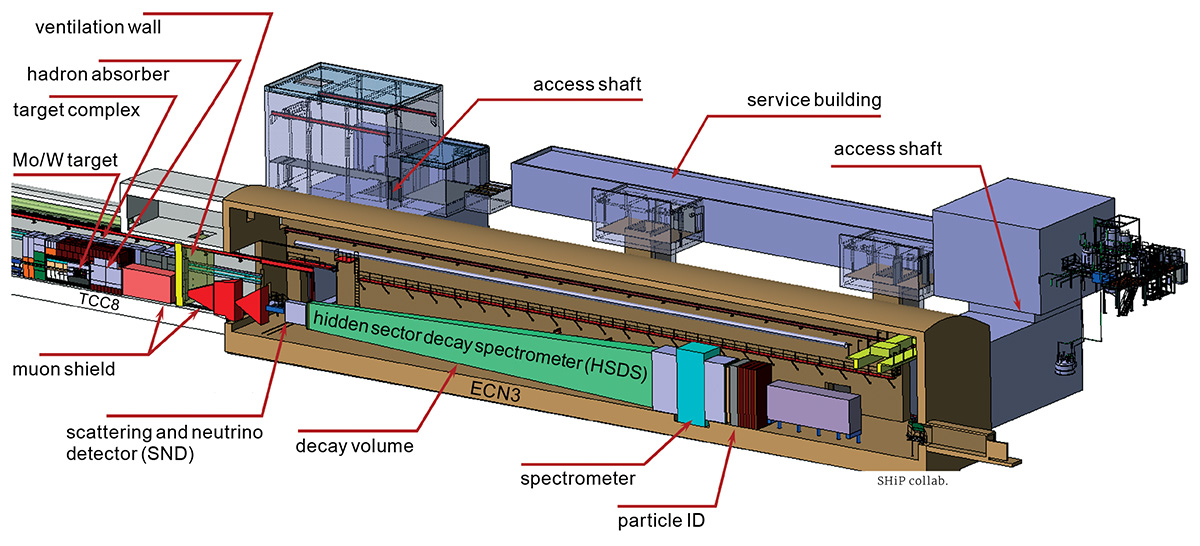
The experiment will be built in the existing TCC8/ECN3 experimental facility in the North Area. The beam-dump setup consists of a high-density proton target located in the target bunker, followed by a hadron stopper and a muon shield. Sharing the SPS beam time with other fixed-target experiments and the LHC should allow around 6 × 10²⁰ protons on target to be produced during 15 years of nominal operation. The detector itself consists of two parts that are designed to be sensitive to as many physics models and final states as possible. The scattering and neutrino detector will search for light dark matter and perform neutrino measurements. Further downstream is the much larger hidden-sector decay spectrometer, which is designed to reconstruct the decay vertex of a hidden-sector particle, measure its mass and provide particle identification of the decay products in an extremely low-background environment.
One of the most critical and challenging components of the facility is the proton target, which has to sustain an energy of 2.6 MJ impinging on it every 7.2 s. Another is the muon shield. To control the beam-induced background from muons, the flux in the detector acceptance must be reduced by some six orders of magnitude over the shortest possible distance, for which an active muon shield entirely based on magnetic deflection has been developed.
One of the most critical and challenging components of the facility is the proton target
The focus of the SHiP collaboration now is to produce technical design reports. “Given adequate funding, we believe that the TDR phase for BDF/SHiP will take us about three years, followed by production and construction, with the aim to commission the facility towards the end of 2030 and the detector in 2031,” says SHiP spokesperson Andrey Golutvin of Imperial College London. “This will allow up to two years of data-taking during Run 4, before the start of Long Shutdown 4, which would be the obvious opportunity to improve or consolidate, if necessary, following the experience of the first years of data taking.”
The decision to proceed with SHiP concluded a process that took more than a year, involving the Physics Beyond Colliders study group and the SPS and PS experiments committee. Two other experiments, HIKE and SHADOWS, were proposed to exploit the high-intensity beam from the SPS. Continuing the successful tradition of kaon experiments in the ECN3 hall, which currently hosts the NA62 experiment, HIKE (high-intensity kaon experiment) proposed to search for new physics in rare charged and neutral kaon decays while also allowing on-axis searches for hidden particles. For SHADOWS (search for hidden and dark objects with the SPS), which would have taken data concurrently with HIKE when the beamline is operated in beam-dump mode, the focus was low-background searches for off-axis hidden-sector particles in the MeV-GeV region.
“In terms of their science, SHiP and HIKE/SHADOWS were ranked equally by the relevant scientific committees,” explains CERN director for research and computing Joachim Mnich. “But a decision had to be made, and SHiP was a strategic choice for CERN.”
On 21 March the CERN Council decided to launch the process for updating the European strategy for particle physics – the cornerstone of Europe’s decision-making process for the long-term future of the field. Mandated by the CERN Council, the European strategy is formed through a broad consultation of the particle-physics community and in close coordination with similar processes in the US and Japan, to ensure coordination between regions and optimal use of resources globally.
The deadline for submitting written input for the next strategy update has been set for 31 March 2025, with a view to concluding the process in June 2026. The strategy process is managed by the strategy secretariat, which the Council will establish during its June 2024 session.
The European strategy process was initiated by the CERN Council in 2005, placing the LHC at the top of particle physics’ scientific priorities, with a significant luminosity upgrade already being mooted. A ramp-up of R&D for future accelerators also featured high on the priority list, followed by coordination with a potential International Linear Collider and participation in a global neutrino programme.
The final report of the FCC feasibility study will be a key input for the next strategy update
The first strategy update in 2013, which kept the LHC as a top priority and attached increasing importance to its high-luminosity upgrade, stated that Europe needs to be in a position to propose an ambitious post-LHC accelerator project at CERN by the time of the next strategy update. The latter charge was formulated in more detail in the second strategy update, completed in 2020, which recommended a Higgs factory as the highest priority to follow the LHC and that a technical and financial feasibility study should be pursued in parallel for a next-generation hadron collider at the highest achievable energy. A mid-term report on the resulting Future Circular Collider feasibility study was submitted for review at the end of 2023 (CERN Courier March/April 2024 pp25–38) and the final report, expected in March 2025, will be a key input for the next strategy update.
More information about the third update of the European strategy, together with the call for input, will be issued by the strategy secretariat in due course.
I was first trained as a mathematician, and then as a physicist. I’ve always worked at the interface between theory and data, where one of the most interesting things is to test cosmological models inspired by some fundamental theory. For example, you can create a model based on string theory or on a non-perturbative approach to quantum gravity, and then use data to constrain the quantum gravity theory. Today we receive a wealth of data from different kinds of experiments, which allows us to test early-universe models without relying on ad hoc ideas. Although it is not something I directly work on, the current tension in the value of the Hubble constant serves as an example. This of course could be telling us something about new physics, but it seems to me it is more likely to be an issue with the way we interpret data and apply the same models across different scales. Supernovae are taken as “standard candles” when measuring the expansion rate of the universe, for example, and one may wonder how correct this assumption is. It is important to perform systematic studies of the raw data before we rush to new theories.
My current work mainly bears on gravitational waves. I am also editor-in-chief of the journal General Relativity and Gravitation. I joined the LIGO collaboration the year of the discovery, studying the implications of gravitational-wave background searches for new physics. I am working on similar studies for the proposed Einstein Telescope. Gravitational waves allow us to test high-energy models beyond the Standard Model at energy scales that are above those that can be reached by accelerators. There are also new results coming from pulsar timing arrays. We live in a time where many exciting results are coming fast.
How big is the European Physical Society, and what led you to be elected president?
The European Physical Society (EPS) is the federation of all national physics societies in Europe. It was founded in 1968 by particle physicist Gilberto Bernardini, who contributed to the foundation of CERN and later became director of the Synchrocyclotron division and directorate member for research.
Several years ago, following the LIGO/Virgo discoveries, I initiated the gravitational physics division of the EPS and, in doing so, entered the EPS council. Then I was elected a member of the executive committee and was eventually contacted to run for election. I admit that I was reluctant at first because it’s another task with a lot of responsibilities. But it turned out I was elected, and I took up the position formally on April 27th. I am proud to have been elected as president and I will do my best to serve the EPS and respect the confidence that representatives of so many European national societies have put in me.
What do you hope to achieve during your two-year mandate?
I have several goals as president. The most important one is to strengthen the position of Europe. What do I mean by that? There are important issues that we all face together, such as our economic independence (for instance, sources of energy, technological advances in electronics, biophysics and medical applications) and the preservation of the environment. The EPS can play a role by building teams of experts to address these issues, to be in a position to advise policy makers at the European level.
Scientific policy is another example. We live in an era with very large changes in the scale of experiments, the size of datasets, as well as advanced data-analysis techniques such as artificial intelligence. We should be able to have a say about how these things are dealt with and what the priorities are. The EPS can have a solid dialogue with large experimental teams and important research centres such as CERN. We can pass the message, for example via the national physics societies, and provide lists of experts able to advise politicians on such matters.
Last but not least is education. We need to adapt the programmes offered to the students because there is huge demand for soft skills, and I am not sure they are adequately provided. We also need to offer opportunities to welcome students and early-career researchers from regions around the world that need support. We should collaborate with them and provide scholarships to enable them to spend time at a facility such as CERN or DESY and develop key skills.
To achieve all that, we should strengthen the links between the EPS and the national societies (be they small or large). We represent the interest of all physicists in Europe equally. We also need to have a more active dialogue with our colleagues in North America and Asia because we share common challenges. Of course, to do that requires hard work and commitment.
How can the EPS support fundamental research such as particle physics?
We have a high-energy physics division, of course. From my point of view, we need to accentuate the motivation for exploring the laws of the universe. CERN obviously plays a key role in this because colliders are one of the basic experimental devices to do so. Gravitational-wave observatories are another example. These experiments have to go hand-in-hand because they have a common ambition. The EPS can give an extra voice to the scientific aspects of this enterprise. Of course, the question of financing next-generation experiments remains to be solved, as well as the balance between fundamental science and applied research. For me there is no doubt that such experiments should continue. Unfortunately, today one often has to state the implications for industry and the applications for society. This can sometimes be difficult to square with curiosity-driven science.
If approved, would a new collider at CERN take away funding from other fields?
This is a very simplistic view. Science funding is not a zero-sum game. As CERN did for the LHC, it’s good to find external sources. Money can’t go to everyone in equal amounts, so we need a way to set scientific priorities in Europe. First and foremost, this should take into account the scientific case. Then we should look at the number of countries that are interested and the level of investments that have been made – for example, also involving industry.
Money can’t go to everyone in equal amounts, so we need a way to set scientific priorities in Europe
Is the scientific case for the Future Circular Collider sufficiently clear in this respect?
If the argument is to find super-symmetry, or particles predicted by some other framework of physics beyond the Standard Model, then I’m afraid it will fail. Of course, in scientific working groups you need to go into specifics such as which hypotheses will be tested, and which signatures are possible. But such detail is a trap when engaging with broader audiences because we can’t be sure that such things exist at the energies we can explore. Instead, the argument should be that we try to understand better the elementary particles and laws. We need to pass the message to politicians, to the person on the street and to scientists that there are some important questions that can only be addressed with future colliders. While CERN and particle physicists should not be defensive, they should be clearer about what the role and ultimate hope of a collider is. Then there is no argument that can go against it. This is something that could be elaborated by the high-energy physics division of the EPS, for example by providing a document stating the views of particle physicists. We should also be prepared for a critical dialogue, to identify the strengths and weaknesses of the arguments. One should in any case ensure that anyone invited to give their views should have an established scientific reputation within their field, a prerequisite that is not met in some high-level discussions and media outlets.
Does the existence of several future-collider options pose a problem from a communications perspective?
I think it’s problematic if, scientifically, a consensus cannot be reached. There is something similar going on in the gravitational-wave community, where divisions exist about where to build the Einstein Telescope and which configuration it should have. This may lead to a healthy process of course, but discussions should be kept between experts. Indeed, it can weaken the case for a new experiment if scientists are seen to be disagreeing strongly.
What effects are current political shifts in Europe having on physics?
I’m afraid that there could be very negative effects. To this we have to add the risks created by the conflicts we see expanding. One effect could also be the changes in priorities for funding. As one of the largest scientific societies, we need to keep supporting collaborations among scientists no matter their country of origin, ethnicity, gender, or any other discriminating factor. We also need to provide financial support where possible, for example as we have done recently for Ukrainian colleagues to participate in our activities, and to make statements in response to events going way beyond the world of physics.
To provide the best experiences, we use technologies like cookies to store and/or access device information. Consenting to these technologies will allow us to process data such as browsing behavior or unique IDs on this site. Not consenting or withdrawing consent, may adversely affect certain features and functions.
Functional
Always active
The technical storage or access is strictly necessary for the legitimate purpose of enabling the use of a specific service explicitly requested by the subscriber or user, or for the sole purpose of carrying out the transmission of a communication over an electronic communications network.
Preferences
The technical storage or access is necessary for the legitimate purpose of storing preferences that are not requested by the subscriber or user.
Statistics
The technical storage or access that is used exclusively for statistical purposes.The technical storage or access that is used exclusively for anonymous statistical purposes. Without a subpoena, voluntary compliance on the part of your Internet Service Provider, or additional records from a third party, information stored or retrieved for this purpose alone cannot usually be used to identify you.
Marketing
The technical storage or access is required to create user profiles to send advertising, or to track the user on a website or across several websites for similar marketing purposes.