In November 1911, Heike Kammerlingth Onnes reported on the abrupt disappearance of resistance in mercury at 4.20 K. To mark the centenary of the discovery of superconductivity, this issue of CERN Courier looks at some of the aspects of its application – in particular in the context of particle accelerators – and at some more anniversaries. It is 75 years since type-II superconductivity was first observed in Kharkov (The discovery of type-II superconductors). Although sadly overlooked for 25 years, this made superconducting magnets a real possibility and led to the Tevatron – the first superconducting synchrotron – (Farewell to the Tevatron) and most recently the LHC, with its particular challenges (Superconductivity and the LHC: the early days), as well as to applications in medical scanners (PET and MRI: providing the full picture). First proposed 50 years ago, RF superconductivity also has an important role in many accelerators (Advances inacceleration: the superconducting way), exemplified in several of the applications of superconductivity at KEK, founded 40 years ago (Progress in applied superconductivity at KEK).
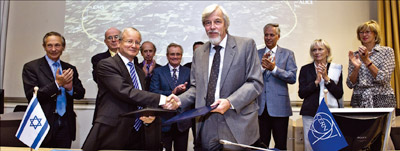
On 16 September, CERN’s director-general, Rolf Heuer, and the Israeli ambassador and permanent representative of Israel to the United Nations Office and other international organizations in Geneva, Aharon Leshno-Yaar, signed a document admitting Israel to associate membership of CERN, subject to ratification by the Knesset. Following ratification, Israel will become an associate member for a minimum of 24 months. Following this period, CERN Council will decide on the admission of Israel to full membership, taking into account the recommendations of a task force to be appointed for this purpose.
Israel has a strong tradition in both experimental and theoretical particle physics, with a major involvement at CERN during the 1990s in the OPAL experiment at the Large Electron–Positron (LEP) collider. Israel’s accession to observer status in 1991 followed an agreement to contribute funds to the CERN budget to support Israeli scientists, as well as providing equipment to CERN. The Israeli fund also contributed to running LEP and supported LHC construction and R&D for future accelerators. During its association with CERN, Israel has in addition supported Palestinian students at CERN, notably sending mixed Israeli–Palestinian contingents to CERN’s summer-student programme.
“It is a vital part of our mission to build bridges between nations. This agreement enriches us scientifically and is an important step in that direction,” says CERN director-general, Rolf Heuer. “I am very pleased that CERN’s relationship with Israel is moving to a higher level.”
In 2009, Israel was accepted as a special observer state, with the right to attend restricted Council sessions for discussions of LHC matters. Israel currently has strong involvement in the ATLAS experiment at the LHC and participates in a number of other experiments at CERN.
The end of September marks the end of an era at Fermilab, with the shut down of the Tevatron after 28 years of operation at the frontiers of particle physics. The Tevatron’s far-reaching legacy spans particle physics, accelerator science and industry. The collider established Fermilab as a world leader in particle-physics research, a role that will be strengthened with a new set of facilities, programmes and projects in neutrino and rare-process physics, astroparticle physics and accelerator and detector technologies.
The Tevatron exceeded every expectation ever set for it. This remarkable machine achieved luminosities with antiprotons once considered impossible, reaching more than 4 × 1032 cm–2s–1 instantaneous luminosity and delivering more than 11 fb–1 of data to the two collider experiments, CDF and DØ. Such luminosity required the development of the world’s most intense, consistent source of antiprotons. The complex process of making, capturing, storing, cooling and colliding antiprotons stands as one of the great achievements by Fermilab’s accelerator team.
As the world’s first large superconducting accelerator, the Tevatron developed the technology that allowed later accelerators – including CERN’s LHC – to push beam energy and intensity even higher. But beyond its scientific contributions, an enduring legacy to mankind is the role it played in the development of the superconducting-wire industry. The construction of the accelerator required 135,000 lb of niobium-titanium-based superconducting wire and cable at a time when annual world production of these materials was only a few hundred pounds. Fermilab brought together scientists, engineers and manufacturers who developed a large-scale manufacturing capability that quickly found huge demand in another emerging field: MRI machines.
The life of the Tevatron is marked by historic discoveries that established the Standard Model. Tevatron experiments discovered the top quark, five B baryons and the Bc meson, and observed the first τ neutrino, direct CP violation in kaon decays, and single top production. The CDF and DØ experiments measured top-quark and W-boson masses, as well as di-boson production cross-sections. Limits placed by CDF and DØ on many new phenomena and the Higgs boson guide searches elsewhere – and continuing analysis of Tevatron data may yet reveal evidence for processes beyond our current understanding. Chris Quigg’s article in this issue gives further details on the Tevatron’s scientific legacy and results still to come (Long live the Tevatron).
As we bid farewell to the Tevatron, what’s next for Fermilab? Over the next decades, we will develop into the foremost laboratory for the study of neutrinos and rare processes – leading the world at the intensity frontier of particle physics.
Fermilab’s accelerator complex already produces the most intense high-energy beam of neutrinos in the world. Upgrades in 2012 will allow the NOνA experiment to push neutrino oscillation measurements even further. The Long-Baseline Neutrino Experiment, which will send neutrinos 1300 km from Fermilab to South Dakota, will be another leap forward in the quest to demystify the neutrino sector and search for the origins of a matter-dominated universe.
The cornerstone for Fermilab’s leadership at the intensity frontier will be a multimegawatt continuous-beam proton-accelerator facility known as Project X. This unique facility is ideal for neutrino studies and rare-process experiments using beams of muons and kaons; it will also produce copious quantities of rare nuclear isotopes for the study of fundamental symmetries. Coupled to the existing Main Injector synchrotron, Project X will deliver megawatt beams to the Long-Baseline Neutrino Experiment. A strong programme in rare processes is developing now at Fermilab with the muon-to-electron conversion and muon g-2 experiments. A strong foundation for Project X exists at Fermilab, with expertise in high-power beams, neutrino beamlines, and superconducting RF technology.
Project X’s rare-process physics programme is complementary to the LHC
Project X’s rare-process physics programme is complementary to the LHC. If the LHC produces a host of new phenomena, then Project X experiments will help elucidate the physics behind them. Different models postulated to explain the new phenomena will have different consequences for very rare processes that will be measured with high accuracy using Project X. If no new phenomena are discovered at the LHC, the study of rare transitions at Project X may show effects beyond the direct reach of particle colliders. Project X could also serve as a foundation for the world’s first neutrino factory, or – even further in the future – as the front end of a muon collider.
In parallel with the development of its intensity frontier programme, Fermilab will remain a strong part of the LHC programme as the host US laboratory and a Tier-1 centre for the CMS experiment, as well as through participation in upgrades of the LHC accelerator and detectors. Fermilab will also continue to build on its legacy as the birthplace of the understanding of the deep connection between cosmological observations and particle physics. The Dark Energy Survey, which contains the Fermilab-built Dark Energy Camera, will see first light in 2012. Better detectors are in development for the Cryogenic Dark Matter Search, and the COUPP dark-matter search is now operating a 60 kg prototype at Fermilab.
As Fermilab’s staff and users say goodbye to the Tevatron, we look forward to working with the world community to address the field’s most critical and exciting questions at facilities in the US, at CERN and around the world.
By Robert K Logan World Scientific
Hardback: £42 $64
Paperback: £30 $43
E-book: $83
Robert Logan is a physicist who since 1971 has taught an interdisciplinary course, “The Poetry of Physics and the Physics of Poetry”, at the University of Toronto. In this book, which grew out of the course, he introduces the evolution of ideas in physics by first briefly recalling the ancient science of Mesopotamia, Egypt and China before addressing in detail the revolutions that started in the 16th century and the more modern advances, including the birth of the Standard Model of particle physics. Sprinkled with quotations from leading physicists of the respective times, the book reports in an interesting way the historical connections that lead from one discovery to another and the impact physics had on (and received from) other branches of science, philosophy, arts, theology, etc. Thus he hopes to convey not only the poetry or beauty of physics but also how physics has influenced the humanities.
The word “physics” derives from the Greek word phusis, meaning “nature”, and Logan wonders what physics would be without the ancient Greek philosophers. However, even with them, interest in science declined as theology became the dominant concern of the day. It was mainly thanks to René Descartes, who refused to accept past philosophical truths that he could not verify for himself (“Cartesian doubt”), and to other contemporary philosophers, that a change in attitude towards science began to develop in the beginning of the 17th century. During that period, Galileo Galilei, Johannes Kepler and several other scientists uncovered many mysteries of nature, which eventually led to Isaac Newton’s breakthroughs. In return, the philosophy of the British (Locke, Berkeley, Hume) and French (Voltaire, Condillac, Diderot, Condoret) movements was heavily influenced by Newton’s physics: their reflections were based directly on the scientific method.
Moving on, the scientific advances of the 20th century would not have been possible without the abstract mathematical concepts developed in the 19th century or technological breakthroughs such as the invention of the vacuum pump, which paved the way for the study of all gas-discharge experiments and led to the discovery of X-rays and the electron. Logan connects these and other discoveries very naturally, claiming along the way that the distinction between physics and chemistry is artificial and a “historic accident”.
Breakthroughs in science are based on the gift of abstract thinking, astronomy being one of the earliest examples. It is interesting to realize that the structure of certain languages is intimately connected to abstract thinking. According to the Toronto school of thought in communication theory, to which Logan has contributed, “the use of a phonetic alphabet and its particular coding led the Greeks to deductive logic and abstract theoretical science”. This was probably one of the main reasons that “abstract theoretical science is a particular outgrowth of Western culture” – as opposed to Eastern cultures, which use a much more complex alphabet.
Apart from discussing major physics discoveries, Logan also triggers readers (or at least his students) to acquire a critical attitude, quoting thinkers such as Thomas Kuhn and Karl Popper: “Science cannot prove that a hypothesis is correct. It can only verify that the hypothesis explains all observed facts and has passed all experimental tests of its validity.” After all, a physics course is more than just conveying acquired knowledge.
I can gladly recommend this book to anyone wanting to refresh their physics basics or who would like to learn about the implications that physics has for other disciplines, and vice versa. I certainly enjoyed reading it and nostalgically recalled several moments from my undergraduate studies. It is a pity that there are many misprints and some unclear sentences.
Introduction to the Theory of the Universe: Hot Big Bang Theory By Dmitry S Gorbunov and Valery A Rubakov World Scientific
Hardback: £103 $158
Paperback: £51 $78
E-book: $200
Introduction to the Theory of the Universe: Cosmological Perturbations and Inflationary Theory By Dmitry S Gorbunov and Valery A Rubakov World Scientific
Hardback: £101 $156
Paperback: £49 $76
E-book: $203
When a field is developing as fast as modern particle astrophysics and cosmology, and in as many exciting and unexpected ways, it is difficult for textbooks to keep up. The two-volume Introduction to the Theory of the Early Universe by Dmitry Gorbunov and Valery Rubakov is an excellent addition to the field of theoretical cosmology that goes a long way towards filling the need for a fully modern pedagogical text. Rubakov, one of the outstanding masters of beyond-the-Standard Model physics, and his younger collaborator give an introduction to almost the entire field over the course of the two books.
The first book covers the basic physics of the early universe, including thorough discussions of famous successes, such as big bang nucleosynthesis, as well as more speculative topics, such as theories of dark matter and its genesis, baryogenesis, phase transitions and soliton physics – all of which receive much more coverage than is usual. As the choice of topics indicates, the approach in this volume tends to be from the perspective of particle theory, usefully complementing some of the more astrophysically and observationally oriented texts.
The second volume focuses on cosmological perturbations – where the vast amounts of data coming from cosmic-microwave background and large-scale structure observations have transformed cosmology into a precision science – and the related theory of inflation, which is our best guess for the dynamics that generate the perturbations. Both volumes contain notably insightful treatments of many topics and there is a large variety of problems for the student distributed throughout the text, in addition to extensive appendices on background material.
Naturally, there are some missing topics, particularly on the observational side, for example a discussion of direct and indirect detection of dark matter or of weak gravitational lensing. There are also some infelicities of language that a good editor would have corrected. However, for those wanting a modern successor to The Early Universe by Edward Kolb and Michael Turner (Perseus 1994) or John Peacock’s Cosmological Physics (CUP 1999), either for study of an unfamiliar topic or to recommend to PhD students to prepare them for research, the two volumes of Theory of the Early Universe are a fine choice and an excellent alternative to Steven Weinberg’s more formal Cosmology (OUP 2008).
Jean Louis Basdevant, ancien professeur à l’Ecole Polytechnique où il donna d’excellents cours, et auteur de nombreux livres pédagogiques, vient de réussir un tour de force en écrivant un livre sur les problèmes du nucléaire en moins d’un mois à la suite de la catastrophe de Fukushima. C’est un livre très pédagogique qui commence par un historique de la radioactivité, puis un exposé du b-a ba de la physique nucléaire, suivi d’une description des avantages et des dangers de la radioactivité dont il quantifie les effets. Suit une description de la fission, puis de la production d’énergie nucléaire présente et future (si les hommes le veulent!), y compris la proposition de fission induite par accélérateur tel que celui proposé par Carlo Rubbia. Vient alors la description de accidents : Lucens (négligeable), Three Mile Island, Tchernobyl (y compris une mise au point sur les doses reçues en France, en fait faibles), et Fukushima, avec une analyse des erreurs et même des fautes qui ont conduit à ces catastrophes.
On passe alors à la fusion, par confinement magnétique et aussi inertielle. Le diagnostic n’est pas très optimiste. Le calendrier d’ITER est sans cesse repoussé et ITER ne produira pas d’énergie électrique. Tout ceci suivi de quelques données sur l’énergie.
On passe aux armes nucléaires et thermonucléaires et leur fonctionnement ou encore les affreuses bombes à neutrons, la lutte contre la prolifération, les dangers du terrorisme, avec la facilité de construire des bombes artisanales, et aussi les bombes classiques contenant des matériaux radioactifs.
Finalement le dernier chapitre est intitulé : « que penser et que faire après Fukushima ». L’auteur se contente de donner des éléments de réponse, sans prendre explicitement parti. Les décideurs devraient certainement lire ce livre pour se faire une opinion sérieuse au lieu de se laisser aller à des réactions émotionnelles incontrôlées. Je recommande vivement la lecture de ce livre.
Bien qu’il soit en Français, je recommande également ce livre aux anglophones : le Français est simple et compréhensible.
Symmetries are a powerful tool for solving specific problems in all areas of physics. However, there are situations where both exact and approximate symmetries are lacking and, therefore, it is necessary to employ numerical methods. This, in essence, is the main motivation invoked for the use of large-scale simulations in relativistic systems where gravity plays a key role, such as black-hole formation, rotating stars, binary neutron-star evolution and even binary black-hole evolution.
Numerical Relativity by Thomas Baumgarte and Stuart Shapiro is an interesting and valuable contribution to the literature on this subject. Both authors are well known in the field. Shapiro, together with Saul Teukolsky, wrote a monograph on a related subject – Black Holes, White Dwarfs and Neutron Stars (John Wiley & Sons 1983) – that is familiar to students and researchers. The careful reader will recognize various similarities in the overall style of the presentation, with systematic attention to the details of the mathematical apparatus. In Numerical Relativity, 18 chapters are supplemented by a rich appendix. The first part could be used by students and practitioners for tutorials on the so-called Adler-Deser-Misner formalism and, ultimately, on the correct formulation of the Cauchy problem in general relativity.
It seems that the authors implicitly suggest that the future of numerical relativity is closely linked to our experimental ability to observe directly general relativistic effects at work. While astrophysics and gravitational waves have so far provided a rich arena for the applications, the intrinsic difficulties in detecting high-frequency gravitational waves with wide-band interferometers, such as LIGO and VIRGO, might suggest new cosmological applications of numerical techniques in the years to come. This book will take you into an exciting world populated by binary neutron stars and binary black holes.
Still, the achievements of numerical relativity (as well as those of all of the other areas of physics where large-scale computer simulations are extensively used) cannot be reduced simply to the quest for the most efficient algorithm. At the end of nearly 700 pages, the reader is led to reflect: is it wise to commit the research programme of young students and post-docs solely to the development of a complex code? After all, the lack of symmetry in a problem might just reflect the inability of physicists to see the right symmetries for the problem. A balanced perspective for potential readers can be summarized in the words of Vicky Weisskopf, when talking about the proliferation of numerical methods in all areas of physics: “[…] We should not be content with computer data. It is important to find more direct insights into what a theory says, even if such insights are insufficient to yield the numerical results obtained by computers” (Joy of Insight: Passions of a Physicist, Basic Books, 1991).
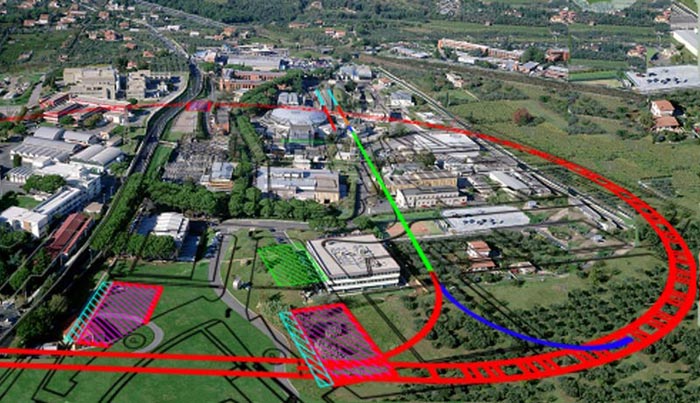
Roberto Petronzio, president of INFN has announced that the SuperB Factory, will be built at the University of Rome ‘Tor Vergata’. The facility tops the list of 14 flagship projects of the National Research Plan of the Italian Ministry for Education, Universities and Research.
The SuperB project involves the construction underground of a new asymmetric high-luminosity electron–positron collider. It will occupy approximately 30 hectares on the campus of the University of Rome ‘Tor Vergata’ and be closely linked to the INFN Frascati National Laboratories, located nearby. The project, which will ultimately cost a few hundred-million euros, obtained funding approval for €250 million in the Italian government’s CIPE Economic Planning Document. It has also attracted interest from physicists in many other countries. At the end of May, some 300 physicists from all over the world gathered on the island of Elba for a meeting that started the formal formation of the SuperB collaboration, a crucial milestone on the road towards realization of the accelerator.
SuperB will be a major international research centre for fundamental and applied physics. The high a design luminosity of 1036 cm–2 s–1 will allow the indirect exploration of new effects in the physics of heavy quarks and flavours through the studies of large samples of B, D and τ decays. The same infrastructure will also provide new technologies and advanced experimental instruments for research in solid-state physics, biology, nanotechnologies and biomedicine.
The second annual meeting of the European Co-ordination for Accelerator Research and Development (EuCARD) project took place on 11–13 May at the headquarters of the Centre National de Recherche Scientifique in Paris, attended by more than 120 participants. EuCARD is a four-year project co-funded by the European Union’s Framework Programme 7 and involves 37 European partners.
Among the many results and issues discussed was the progress of the engineering design for a 13 T niobium-tin (Nb3Sn) dipole. The first results on its high-temperature superconductor coil insert showed the need for a second iteration; the Nb3Sn undulator also requires optimization with respect to instabilities. New materials have been identified for more robust collimators; intelligent collimators for the LHC and cold collimators for the Facility for Antiproton and Ion Research are undergoing beam tests.
Linear collider technologies are on the move as well and new findings were reported on the origin of breakdowns in cavities. Stabilization to below 0.5 nm at 1 Hz has been demonstrated and there have been advances in instrumentation and femtosecond synchronization. Several superconducting bulk or coated cavities are in either final design, construction or test stages. These include crab cavities for both the LHC and the Compact Linear Collider study. Finally, novel concepts are progressing, including the new crab-waist crossing being tested at DAFNE, the commissioning of EMMA (the fixed-field alternating gradient machine at Daresbury) and the emittance measurement of tiny laser-driven, plasma-accelerated beams.
The networking activities in neutrino facilities, accelerator performance and RF technologies have confirmed their efficiency as exchange platforms. They have made the case for their expansion in the EuCARD2 proposal, which is under preparation and will be submitted by November 2011. Transnational access to the UK Science and Technology Facilities Council’s MICE facility (precision beams and muon-ionization cooling equipment) is continuing. HiRadMat at CERN, which offers pulsed irradiation, will open this autumn. Potential external users can benefit from financial support from the European Commission.
This year, the meeting dedicated one day to accelerator research and development in France, as well as to topics outside the scope of EuCARD, including the SuperB project (SuperB Factory set to be built at the University of Rome ‘Tor Vergata’), neutrino facilities and Siemens medical accelerators. There was also a visit to the large accelerator platforms at the Institut de Physique Nucléaire d’Orsay and CEA-Saclay.
The European Network for Novel Accelerators (EuroNNAc) was formally launched at a workshop held at CERN on 3–6 May as part of the EuCARD project. The aim was to form the network and define the work towards a significant Framework Programme 8 proposal for novel accelerator facilities in Europe.
The workshop was widely supported, with 90 participants from 51 different institutes, including 10 from outside Europe, and had high-level CERN support, with talks by Rolf Heuer, Steve Myers and Sergio Bertolucci. There were also contributions from leading experts in the field such as Gerard Mourou of the Institute Lumiere Extreme and Toshi Tajima of Ludwig Maximilians Universität, two senior pioneers in this field.
The field of plasma wakefield acceleration, which the new network plans to develop, is changing fast. Interesting beams of 0.3–1 GeV, with 1.5–2.5% energy spread, have now been produced in several places including France, Germany, the UK and the US, with promising reproducibility. Conventional accelerator laboratories are now interested to see if an operational accelerator can be built with these parameters. To avoid replication of work, a distributed test facility spread across many labs is envisaged for creating such a new device.
If a compact, 1 GeV test accelerator were pioneered, it could be copied for use around the world. Possible applications include tests in photon science or as a test beam for particle detectors. This could ease the present restrictions on beam time experienced by many researchers. These developments are currently being restricted to electron accelerators because they can be useful even when not fully reliable. Proton machines for medical purposes would, however, need to be more reliable.
In addition to the R&D aspects, the network discussed plans to create a school on Conventional to Advanced Accelerators – possibly linked to the CERN Accelerator School – and to establish a European Advanced Accelerator Conference.
The network activities will be closely co-ordinated with the TIARA and ELI projects. There is currently high funding support for laser science in Europe – about €4 billion in the next decade. EuroNNAc will help in defining the optimal way towards a compact, ultra-high-gradient linac. CERN will co-ordinate this work with help from the École Polytechnique and the University of Hamburg/DESY.
To provide the best experiences, we use technologies like cookies to store and/or access device information. Consenting to these technologies will allow us to process data such as browsing behavior or unique IDs on this site. Not consenting or withdrawing consent, may adversely affect certain features and functions.
Functional
Always active
The technical storage or access is strictly necessary for the legitimate purpose of enabling the use of a specific service explicitly requested by the subscriber or user, or for the sole purpose of carrying out the transmission of a communication over an electronic communications network.
Preferences
The technical storage or access is necessary for the legitimate purpose of storing preferences that are not requested by the subscriber or user.
Statistics
The technical storage or access that is used exclusively for statistical purposes.The technical storage or access that is used exclusively for anonymous statistical purposes. Without a subpoena, voluntary compliance on the part of your Internet Service Provider, or additional records from a third party, information stored or retrieved for this purpose alone cannot usually be used to identify you.
Marketing
The technical storage or access is required to create user profiles to send advertising, or to track the user on a website or across several websites for similar marketing purposes.