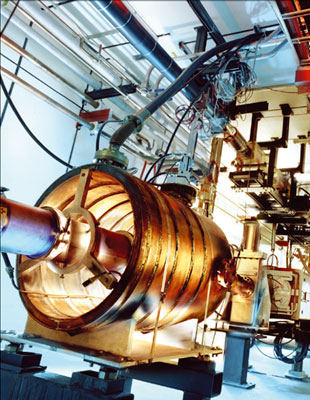
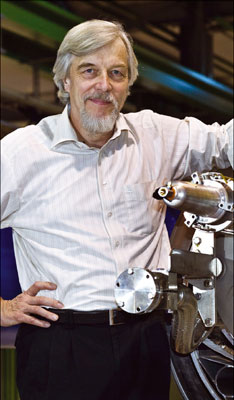
Many people in the high-energy physics community were deeply saddened to learn that Simon van der Meer passed away on 4 March. A true giant of modern particle physics, his contributions to accelerator science remain vital to the operation of accelerators such as the LHC.
Simon studied electrical engineering at Delft University. After a short time with Philips, he came to CERN in 1956 and remained with the laboratory until his retirement in 1990. He is best known for his invention of stochastic cooling, which made possible the conversion of CERN’s Super Proton Synchrotron to become the world’s first proton–antiproton collider. He was awarded the Nobel Prize in Physics, jointly with Carlo Rubbia, in 1984 for the decisive contributions to this project, which led to the discovery of the W and Z particles.
Simon also developed the magnetic horn, which allows the production of focused beams of neutrinos, as well as the eponymous technique to measure luminosity in particle colliders: “van der Meer scans”.
A full tribute and obituary will appear in a later issue of CERN Courier.
Access to six European test facilities is now available as part of a new EU project funded by the FP7 Capacities Programme. The Advanced European Infrastructures for Detectors at Accelerators (AIDA) project was launched in February and will last for four years.
Three of AIDA’s nine work packages are dedicated to transnational access. Under this scheme, researchers from EU member states (including FP7-associated countries) can apply for access to facilities at DESY, CERN, the Jožef Stefan Institute (JSI), the Université catholique de Louvain (UCL) and the Karlsruhe Institute of Technology (KIT). Access is offered free to the users. In addition, travel and subsistence costs can be covered by the EU funding. The majority of the user group must not be based in the same country as the facility (CERN, as an international organization, is not subject to this requirement). In addition, the research team should publish the results from the experiments carried out at the AIDA facility.
The primary criterion for selection of a proposal will be scientific merit but factors such as previous use of the facility and availability of similar facilities in the user’s home country will also be taken into account. User groups who have not accessed such facilities before are strongly encouraged to apply to this scheme.
At DESY there will be access to test beams of electrons with energies of up to 6 GeV. One of four different test areas can be used for the work. All areas have magnet control to select momentum and access to beam telescopes can be provided on request.
In the CERN East Area there will be access to several beam lines providing protons, neutrons or mixed particles with energies in the range 1–25 GeV. In the North Area, proton and electron beams of several hundred giga-electron-volts are available.
There is also access to three European irradiation facilities. At JSI in Slovenia, access to the Triga-Mark-III reactor will provide neutron irradiation facilities. At UCL in Belgium access to deuterons and protons will be available. Protons for irradiation will also be available at KIT in Germany.
The Facility for Rare Isotope Beams (FRIB) Project, which was awarded two years ago to Michigan State University by the US Department of Energy Office of Science (DOE-SC) is making significant progress towards start-up in 2020. An important milestone was passed in September 2010 when DOE-SC approved the preferred alternative design in Critical Decision-1 with an associated cost up to $614.50 million and a schedule range from the autumn of fiscal year 2018 to spring of 2020.
When FRIB becomes operational, it will be a new DOE national user facility for nuclear science, funded by the DOE-SC Office of Nuclear Physics and operated by Michigan State University. FRIB will provide intense beams of rare isotopes – short-lived nuclei not normally found on Earth. The main focus of FRIB will be to produce such isotopes, study their properties and use them in applications to address national needs. FRIB will provide researchers with the technical capabilities not only to investigate rare isotopes, but also to put this knowledge to use in various applications, for example in materials science, nuclear medicine and the fundamental understanding of nuclear material important to stewardship of nuclear-weapons stockpiles.
An optimization from the layout initially proposed for FRIB to the preferred alternative design moves the linac from a straight line extending to the northeast through Michigan State University’s campus to a paperclip-like configuration next to the existing structure at the National Superconducting Cyclotron Laboratory (NSCL). The linac will have more than 344 superconducting RF cavities in an approximately 170 m-long tunnel about 12 m underground and will accelerate stable nuclei to kinetic energies of a minimum of 200 MeV/nucleon for all ions, with beam power up to 400 kW. (Energies range from 200 MeV/nucleon for uranium to above 600 MeV for protons.)
The Critical Decision (CD)-2 review to approve the performance baseline is planned for spring 2012 and the CD-3 review to approve the start of construction is planned for 2013. The selected architect/engineering firm and FRIB construction manager are exploring options to advance civil construction to the summer of 2012.
Recent meetings between NSCL and FRIB User Groups have put a merger in the works, expected to be initiated this year with the final merger for more than 800 members and functions by the end of the year or early in 2012.
The final particles will collide in Fermilab’s Tevatron this September at the end of the machine’s historic 26-year run. The Tevatron, the world’s largest proton–antiproton collider, is best known for its role in the discovery in 1995 of the top quark, the heaviest elementary particle known to exist.
The Tevatron has out-performed expectations, achieving record-breaking levels of luminosity. Fermilab had planned to shut down the collider in the autumn of 2011 but in August 2010 the laboratory’s international Physics Advisory Committee endorsed an alternative idea: extend the run of the Tevatron through into 2014. The US government’s advisory panel on high-energy physics agreed with the committee’s recommendation, provided that US funding agencies could increase annual support for the field by about $35 million for four years. This would have maintained the laboratory’s ability to continue with its variety of other high-energy physics experiments, some of them being in their critical first stages.
However, this was not to be. In January, Bill Brinkman, director of the US Office of Science, announced that the agency had not located the additional funds required to extend the Tevatron’s operations. The decision disappointed Tevatron physicists, but it also made more secure funding for the other experiments that will carry Fermilab into the future.
Following the closure of the Tevatron, Fermilab will continue on course with a world-leading scientific programme, addressing the central questions of 21st century particle-physics on three frontiers: the energy frontier, the intensity frontier and the cosmic frontier. At the energy frontier, the laboratory will continue its close collaboration with CERN and the international LHC community and will also pursue R&D for future accelerators. At the intensity frontier, Fermilab already operates the highest-intensity neutrino beam in the world and researchers there are about to begin taking data with the laboratory’s largest neutrino detector yet. At the cosmic frontier, Fermilab scientists will continue the search for dark matter and dark energy.
A new, 4-year project co-funded by the European Union FP7 Research Infrastructures programme and worth €26 million began on 1 February. The AIDA project (Advanced European Infrastructures for Detectors at Accelerators) will develop detector infrastructures for future particle-physics experiments in line with the European Strategy for Particle Physics.
The project, which is co-ordinated by CERN, has more than 80 institutes and laboratories involved either as beneficiaries or as associate partners, thus ensuring that the whole European particle detector community is represented. The project will receive a contribution of €8 million from the European Commission.
The particle detectors developed in the AIDA project will be used in a planned upgrade to the LHC; at the proposed International Linear Collider, which will study the Standard Model of physics and beyond with higher precision; Super-B factories, which aim to understand the matter–antimatter asymmetry in the universe; and neutrino facilities.
The AIDA project is divided into three main activities: networking, joint research and transnational access. The networking activity will study promising new technologies, such as 3D detectors and vital electronics, as well as specifying technological needs for the future. Interactions with appropriate industrial partners will also be planned.
The joint research activity will see many of the beneficiary institutes working together to improve beam lines that already exist to test particle detectors. The equipment and technology needed to produce these detectors will also be upgraded.
The transnational access activity will see access to beam lines for testing particle detectors at CERN, DESY and irradiation facilities across Europe opened up to new users. Experts in this area can contribute to the field through their findings made at these facilities.
• For details about the project and the full list of participants, see http://cern.ch/aida.
Our story begins in 1911, with the first International Women’s Day celebrated in Austria, Denmark, Germany and Switzerland. That same year, Marie Skłodowska-Curie won the Nobel Prize in Chemistry for the discovery of two new elements: radium and polonium. This was the second time that she had been called to Stockholm – eight years earlier, she received the Nobel Prize in Physics, which she and her husband Pierre Curie shared with Henri Becquerel for their research on radioactivity. The Nobel Prize in Chemistry has only been awarded to three other women: Curie’s daughter Irène Joliot-Curie in 1935, Dorothy Crowfoot-Hodgkin in 1964 and Ada Yonath in 2009. The only other woman to receive the Nobel Prize in Physics is Maria Goeppert Mayer for her work on the structure of atomic nuclei (1963).
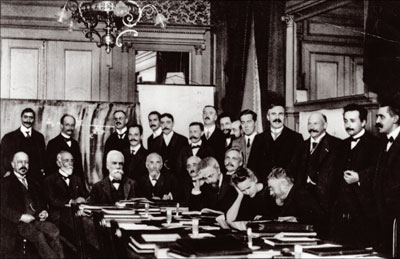
Marie Curie achieved several “firsts”. She was the first woman to receive the Nobel Prize (in 1903), the first person to receive it twice, the first female professor at the University of Paris and, as the photograph on this page shows, the only female among the 24 participants at the first international physics conference – the Solvay Conference – held in Brussels in 1911. A century later, the situation has changed. At the recent -International Conference on High-Energy Physics, ICHEP2010, 15.4% of the participants were women.
Nuclear physics pioneers
The 1940s and 1950s were exciting years in physics. The first accelerators were being built, and with them physicists took the first steps towards the current understanding of particle physics. At this challenging time after the Second World War, many women joined physics groups around the world and helped to open doors for the future generations of women in science.
Marietta Blau (1894–1970) pioneered work in photographic methods to study particle tracks and was the first to use nuclear emulsions to detect neutrons by observing recoil protons. Her request for a better position at Vienna University was rejected because she was a woman and a Jew. Blau left Austria and was appointed professor in Mexico City after the war. She was nominated for the Nobel Prize several times.
Nella Mortara (1893–1988), one of the most beloved assistant professors of physics at the University of Rome in the late 1930s, faced a similar ordeal and was expelled for being Jewish. She escaped to Brazil but returned secretly during the war to be reunited with her family in Rome, living in great danger. After the war Mortara was reappointed as a professor, to the great joy of her students, many of whom were women.
Lise Meitner (1878–1968) also suffered from this double discrimination. She became the second woman to obtain a PhD from Vienna in 1903. She moved to Berlin where she was “allowed” by Max Planck to attend his lectures – the first woman to be granted this privilege – and then later became his assistant. Many believe that Meitner should have been co-awarded the Nobel Prize in Chemistry with Otto Hahn in 1944 for the discovery of nuclear fission. She had the courage to refuse to work on the Manhattan Project, saying: “I will have nothing to do with a bomb!”
Maria Goeppert Mayer (1906–1972) lectured at prestigious universities, published numerous papers on quantum mechanics and chemical physics, and collaborated with her husband on an important textbook. Despite her accomplishments, antinepotism rules forbade Mayer from receiving an official post and for many years she taught physics at universities as an unpaid volunteer. Finally, in 1959, four years before receiving the Nobel Prize, the University of California at San Diego offered her a full-time position.
Leona Marshall Libby (1919–1986) was an innovative developer of nuclear technology. She built the tools that led to the discovery of cold neutrons and she also investigated isotope ratios. Libby was the first woman to be part of Enrico Fermi’s team for the Manhattan Project and eventually became professor of physics at that institution, leaving a legacy of exploration and innovation.
Closer to particle physics, Hildred Blewett (1911–2004) was an accelerator physicist from Brookhaven. In the early 1950s she contributed to the design of CERN’s first high-energy accelerator, the Proton Synchrotron, while also working on a similar machine proposed for Brookhaven.
Maria Fidecaro has spent her life dedicated to her research at CERN, where she still works. She arrived at CERN in 1956 after working in Rome on cosmic-ray experiments and, for a year, at the synchrocyclotron in Liverpool. Maria remembers fondly what it was like to be a physics student just after the war, the challenges of balancing a career with family and collaborating with other pioneers of modern physics from all over the world, including many women. “I remained dedicated to research throughout the changing circumstances,” she says, “and always to the best of my ability.”
These are just a few of the women physicists who were around during the mid-20th century; courageous women dedicated to their science, they served as role models for later generations.
Women and the growth of CERN
CERN was founded in 1954 during the post-war period of renewal. The CERN Convention was very modern because it mentioned all of the professional categories needed to form a large international organization such as that which exists today. Women were initially recruited in supportive administrative positions, but this changed as they began to enter all areas of university training, physics and technical professions. CERN was willing to provide and encourage working opportunities for women, which they needed to be able to flourish in these new areas.
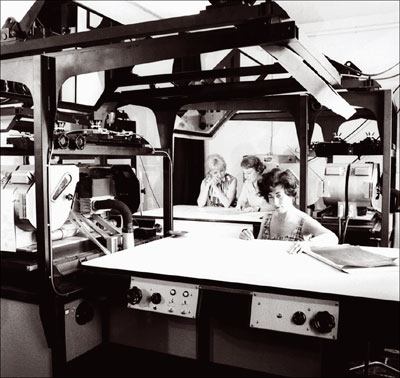
Between the 1960s and the mid-1980s, dozens of women worked at CERN and elsewhere as scanners. Their job consisted of finding interesting events among the many tracks left by particles in bubble chambers and captured on photographs. Madeleine Znoy recalls how tedious it was: “Initially, the work was done manually, using a pencil and a sheet of paper to note down the co-ordinates where the interactions had taken place. Scanning took place round the clock, because the quantity of films to be scanned was enormous. From 7.00 am to 10.00 p.m., female scanners studied the films, and from 10.00 p.m. until 7.00 a.m., men (often students) took over,” she explains. Each shift lasted only four hours due to the work being so strenuous, working in complete darkness with three projectors illuminating the film. Znoy once beat a record, scanning more than 750 photographs in one day. “At first, some physicists thought that this was impossible, that surely I had missed interesting events. But all was fine and they were very surprised!”
Anita Bjorkebo started as a scanner in 1965. After her scanning shift she compiled data and classified events, all by hand, and even made the histograms.
Later, as scanning became more automated, the scanners moved on to operating the computers connected to the measuring equipment. Some, including Bjorkebo and Znoy, would set them up for other scanners or streamline the operation for new experiments. Bjorkebo became so interested in her work that she signed up for two particle-physics classes, attending lectures and doing homework after work. “A Swedish physicist only had five students here so he invited the technical staff to join in,” she explains.
Even though these women did not get their names on publications, they felt appreciated. “We were part of the team, we had a role to play,” says Znoy proudly. “With the scanning, we could really see the particles. I really enjoyed working with the physicists and technicians, and collaborating with other laboratories. We were young and full of enthusiasm. It was a great period.”
Nevertheless, after more than 50 years, the situation for women at CERN could still be improved, especially in the intermediate administrative categories where they are most represented. Recruitment in this area is now often based on standardized job criteria that leave less room to appreciate the level of education and professional skills needed for a post. However, the administrative staff category is essential to the day-to-day life of CERN. To function properly CERN depends on good communication within the organization, the dedication of its staff and proper advancement prospects at all levels. Danièle Lajust, an administrative assistant who joined CERN in 1978, is quick to add: “We are proud of belonging to an organization that now welcomes a gender mix at all levels and of participating in our own way in its great and passionate adventure.”
Showing the way
CERN also has an important part to play in educating young scientists and hence providing role models. In 2000, Melissa Franklin, an alumna of the CERN Summer Student programme in 1977, returned as a lecturer on Classic Experiments. She then became the first tenured female professor of physics at Harvard University, and now works on the ATLAS experiment at CERN. Franklin’s is just one of the many amazing careers experienced by former CERN summer students.
Started in 1962 by the then director-general of CERN, Viki Weisskopf, the Summer Student programme began with just 70 students. Nowadays, walk through any of the buildings at CERN in mid-July and you can see evidence of about 140 students participating in the programme. Although half of the students today are women, there are still only a handful of female lecturers – in 2010, only three of the 31 lecturers were women. Providing the summer students with adequate role models is just as important as enhancing diversity in their ranks, because the teachers, authors and educators that we encounter have a great influence on our lives and careers.
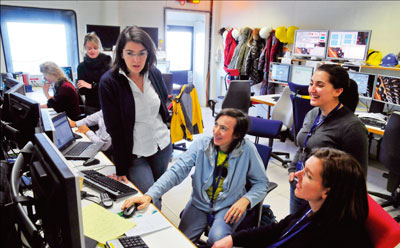
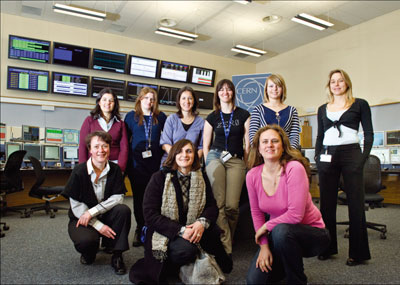
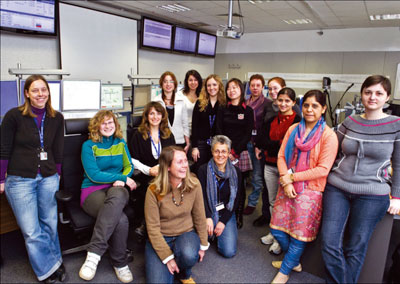
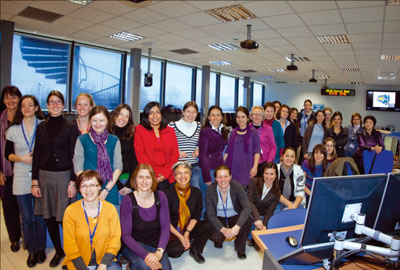
Today, women make up about 17% of the many thousand scientists, engineers and technicians who work on the LHC experiments, from graduate students to full professors. Nearly half of these women are students or post-docs, showing that more women are joining the field.
The day-to-day operation of the LHC is in the hands of eight “engineers in charge”, half of whom are women. One of them, Giulia Papotti, thanks the management for having an open mind: “They were looking for someone with radio-frequency expertise, which is my field. Other considerations such as nationality or gender were secondary.” It proved to be the greatest challenge of her career, training to be an LHC operator during the high-intensity period of the first days of operation. “I had to learn fast,” she recalls. The workload was additionally taxing because two people were still in training and two were on parental leave. “Our work is to think about how to improve things. We are meant to be critical. We are paid to think,” says Papotti.
Amalia Ballarino, a scientist working on superconductivity, designed and managed the production of the high-temperature superconducting components that power the LHC magnets. For this work she won the international Superconductor Industry Person of the Year award in 2006 (p37). “We had to work to a tight schedule,” she says of building a system that consists of 3000 components made across the world. “Working at CERN gives you the opportunity to contribute to innovative projects. Basic science is the primary driver of innovation.” Ballarino adds: “Working here is an opportunity to create something new.” Lene Norderhaug, a CERN fellow working on software development and looking towards the future says enthusiastically: “In five years I hope to have my PhD and my second job at CERN. We like it here!”
Women in science have been passionate about their chosen field, undertaking tasks with great responsibility and continuously striving to push science and technology beyond their limits. Looking back on 100 years of International Women’s Day, we have progressed from just one woman at a conference to females representing 17% of the field. What will the next 100 years bring?
At the end of January, a small fraction of CERN decamped to Chamonix along with experts from around the world – not to ski but to work out the plans for the coming year’s LHC run. It is a tradition that began with CERN’s previous accelerator, the Large Electron–Positron (LEP) collider, and time and again it has proved its worth.
Chamonix is an important fixture on the CERN calendar, not only because it sets the agenda for the coming year but also because it is particle physics in microcosm. Chamonix embodies the spirit of our field. It is an intense week of discussion and debate, involving a wide community base drawn from CERN, the LHC experiments and beyond. The CERN machine advisory committee is there and everyone has the chance to air opinions, before the meeting invariably winds up with a broad consensus.
It is this ability to reach consensus that makes our science so remarkable. Particle physicists can be every bit as opinionated and attached to their own ideas as anyone else but, at the end of the day, we are all united by the overriding goal of doing our research and finding out more about this wonderful universe that we live in. That is what allows us to reach consensus – and always has. In the past, whenever a big particle-physics project involved 50 people or so – or even the 300 or so from my old LEP experiment, OPAL – consensus was maybe not so surprising. But with collaboration sizes today numbering in the thousands, this model still holds true and management gurus are beginning to take notice. My message to them? It is amazing what people can do when they are united by a common goal.
So what of this year’s deliberations at Chamonix? They were all about maximizing discovery potential while minimizing risk to the LHC and the experiments. The problems with the LHC’s high-current splices, which became so painfully evident in 2008 when one of them failed and put the machine out of action, are not completely resolved. That is why the LHC is not yet running at its full design energy of 7 TeV per beam. In 2010, 3.5 TeV per beam was selected as a safe energy to run at for the LHC’s first physics, and experience has clearly demonstrated the wisdom of that choice.
The big question at Chamonix this year was whether we could safely move up a notch. Some argued for; others against. But at the workshop’s conclusion the participants were united in recommending that we stay at 3.5 TeV until at least the end of 2011.
Why? Well, we know that the LHC performs fantastically at this energy, and that exciting new physics is potentially within our reach. We have also developed new techniques to sniff out bad splices that could spoil the show if we go to a higher energy. These will be in place by the end of 2011, giving us the input needed to take a fully informed decision on a possible increase in energy at next year’s Chamonix meeting.
Being CERN’s director-general is sometimes a tough job but the consensual model of particle physics makes some aspects easy
Which brings me to the next big question on the table at Chamonix: what about next year? It has long been clear that with lengthy warm-up and cool-down periods, an annual cycle does not make sense for major maintenance shutdowns at the LHC. And we also know that the first long shutdown involves substantial work to make good the high-current interconnects that will allow us to reach the design energy of 7 TeV per beam. Originally foreseen for 2012, it was almost a foregone conclusion that the Chamonix workshop would recommend postponing the first long shutdown to 2013, and that is indeed what happened.
The reason is that the LHC’s performance in 2010 was so good, with the promise of much better to come. That led to simple extrapolations clearly showing that if there’s new physics to be found in the 3.5 TeV-per-beam energy range, two years of running will be enough to find it. On the other hand, one year alone could leave us with just tantalizing hints. Under these circumstances, stopping at the end of 2011 makes little sense.
Taken together, the recommendations that emerged from Chamonix optimize the LHC’s discovery potential, not just for 2011 but for the longer term as well, and they do it while minimizing the risk of damage to the LHC’s infrastructure.
Being CERN’s director-general is sometimes a tough job but the consensual model of particle physics makes some aspects easy, as Chamonix once again showed this year. Following a recommendation arrived at by consensus, which has the buy-in of the whole community, is a simple choice to make. That consensus is our strength.
By Jesper Jacobsen, Stephane Ouvry, Vincent Pasquier, Didina Serban and Leticia Cugliandolo (eds.)
Oxford University Press
Hardback: £45 $85
Recent years have shown spectacular convergences between traditional techniques in theoretical physics and methods emerging from modern mathematics, such as combinatorics, topology and algebraic geometry. These techniques, and in particular those of low-dimensional statistical models, are instrumental in improving the understanding of emerging fields, such as quantum computing and cryptography, complex systems, and quantum fluids. This book sets these issues into a larger and more coherent theoretical context than is currently available, through lectures given by international leaders in the fields of exactly solvable models in low-dimensional condensed matter and statistical physics.
This book attempts to bridge in one step the enormous gap between introductory quantum mechanics and the research front of modern optics and scientific fields that make use of light. Hence, while it is suitable as a reference for the specialist in quantum optics, it will also be useful to non-specialists from other disciplines. With a unique approach it introduces a single analytic tool, the density matrix, to analyse complex optical phenomena encountered in traditional as well as cross-disciplinary research. It moves from elementary to sophisticated topics in quantum optics, including laser tweezers, laser cooling, coherent population transfer, optical magnetism and squeezed light.
By Frank W J Olver, Daniel W Lozier, Ronald F Boisvert and Charles W Clark, (eds.)
Cambridge University Press
Hardback £65 $99 Paperback £35 $50
Modern developments in theoretical and applied science depend on knowledge of the properties of mathematical functions, from elementary trigonometric functions to the multitude of special functions. Using them effectively requires practitioners to have ready access to a reliable collection of their properties. This handbook results from a 10-year project conducted by the National Institute of Standards and Technology with an international group of expert authors and validators. Printed in full colour, it is destined to replace its predecessor, the classic but long-outdated Handbook of Mathematical Functions, edited by Abramowitz and Stegun. It includes a DVD with a searchable PDF of each chapter.
To provide the best experiences, we use technologies like cookies to store and/or access device information. Consenting to these technologies will allow us to process data such as browsing behavior or unique IDs on this site. Not consenting or withdrawing consent, may adversely affect certain features and functions.
Functional
Always active
The technical storage or access is strictly necessary for the legitimate purpose of enabling the use of a specific service explicitly requested by the subscriber or user, or for the sole purpose of carrying out the transmission of a communication over an electronic communications network.
Preferences
The technical storage or access is necessary for the legitimate purpose of storing preferences that are not requested by the subscriber or user.
Statistics
The technical storage or access that is used exclusively for statistical purposes.The technical storage or access that is used exclusively for anonymous statistical purposes. Without a subpoena, voluntary compliance on the part of your Internet Service Provider, or additional records from a third party, information stored or retrieved for this purpose alone cannot usually be used to identify you.
Marketing
The technical storage or access is required to create user profiles to send advertising, or to track the user on a website or across several websites for similar marketing purposes.