The LHCb experiment was initially designed for the study of B physics (the “b” in its name stands for beauty, or b quark). However, the LHC is also a copious source of particles that contain the charm quark, such as the D meson, which also makes the experiment well suited to their study. The rate at which data are selected by the LHCb trigger and written to storage was therefore increased last year by 50%, to 3 kHz, with the extra capacity dedicated to charm. This has now paid off spectacularly, with one of the most interesting (and unexpected) results to come from the LHC so far: evidence of CP violation in charm decays.
CP symmetry, the combination of charge-conjugation, C, and parity, P, is known to be violated in B and K decays. It is an important property to study because it is a necessary ingredient for explaining the matter–antimatter asymmetry in the universe. The CP violation observed so far in B and K decays is consistent with the predictions of the Standard Model but is far too small to explain the observed matter–antimatter asymmetry. The prediction for D mesons in the Standard Model is that they should have little CP violation, at the level of 10–3 or less, but this may be enhanced by new physics.
The LHCb collaboration performed its search by measuring the difference in the CP asymmetry for two final states
CP violation can be observed as a difference in the rate of D0 decays to a given final state, compared with the rate of the antiparticle D0 decays to the same final state. Because the effect being looked for is tiny, the LHCb collaboration performed its search by measuring the difference in the CP asymmetry for two final states, D0 → K–K+ and D0 → π–π+, which is denoted by ΔACP. In this way, systematic uncertainties in the production and detection of particles compared with antiparticles should cancel, while the CP asymmetry, which is expected to have opposite sign for the two modes, should remain visible.
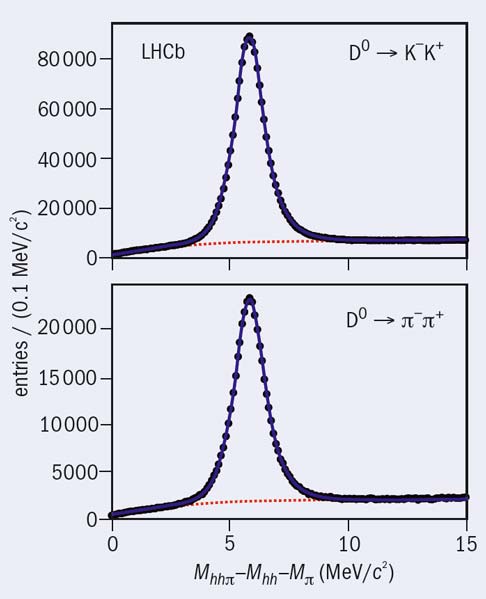
D*± → D0π± decays are used as the source of the neutral D-meson sample because the charge of the pion tags the produced particle as a D0 or D0 (see figure). The experiment has collected more than a million of these decays, a total more than 10 times greater than in measurements by experiments at B-factories. It is also larger than the data sample used to obtain the previously most precise result, from the CDF experiment at Fermilab’s Tevatron, and benefits from the clean selection made possible by LHCb’s ring-imaging Cherenkov detectors.
LHCb measures the asymmetry to be ΔACP = (–0.82 ± 0.21 ± 0.11)%, where the first error is statistical and the second systematic. The significance of the measured deviation from zero is 3.5 σ, giving the first evidence for CP violation in the charm sector, at a level that is higher than was expected. Establishing whether this result is consistent with the Standard Model, or the first hint of new physics, will require the analysis of additional data and improved theoretical understanding. LHCb has already collected almost a factor of two more data, with more to come this year, so this exciting first indication should be clarified soon.
The ATLAS collaboration has announced the discovery of the χb(3P), which is a bound state of a bottom quark and bottom antiquark (bb).
Bound states of a heavy quark and its antiquark – collectively called quarkonium – are the QCD analogues of the hydrogen atom, with each particle corresponding to a different energy level. For bb states, the S states are the well known ϒ particles, while the P states are known as χb. As with the hydrogen atom, transitions between these states can be observed through the emission of a photon (γ).
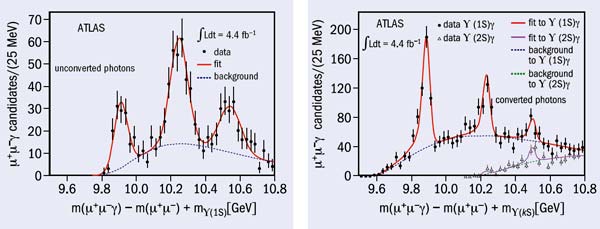
The collaboration discovered the new state through the radiative transitions χb(3P) → ϒ(1S) + γ and χb(3P) → ϒ(2S) + γ, followed by the decay of the ϒ to two muons. The figure shows the spectrum of the χ states: the leftmost peak is the χb(1P), the middle one the χb(2P) and the rightmost the new state, χb(3P). The photons were detected either by the electromagnetic calorimeter (in which case they remained unconverted) or, if they had interacted with material and converted to an e+e– pair, by the ATLAS tracking detectors.
Usually, a new particle is discovered in one or at most two channels, and the first observation is at the very edge of statistical significance. However, ATLAS has seen the χb(3P) with three different signatures, in both the ϒ(1S) and ϒ(2S) channels, and the peaks are unmistakable. The outstanding performance of both the LHC and the ATLAS detector made such a clear observation possible.
Also in analogy with atomic physics, the visible peaks contain internal structure from hyperfine splitting among states of different angular momentum. These could be resolved with future data samples.
Studying the energy levels of quarkonium states provides information about the forces that bind quarks together. One surprise is that the χb(3P) is slightly heavier than predicted, implying that the quark–antiquark pair is a little more loosely bound than expected. The χb(3P) is just at the very limit of being bound, so the quark and antiquark are about as far apart from each other as they can possibly be.
In current understanding, the matter created in heavy-ion collisions – the quark–gluon plasma (QGP) – behaves as a nearly perfect liquid. The confirmation of this hydrodynamic behaviour, previously observed at Brookhaven’s Relativistic Heavy Ion Collider (RHIC), was one of the most eagerly awaited results from the first Pb–Pb collisions at the LHC. One of the crucial measurements for the characterization of the fireball produced in the collisions centres on the spectra of identified hadrons, which encode the collective expansion velocity in the QGP and hadronic stages. Moreover, their overall abundances are believed to be fixed at hadronization.
The ALICE detector was designed to perform these measurements with a unique combination of detectors for particle identification (PID): the silicon inner-tracking-system, the time-projection chamber and the time-of-flight detector. The collaboration has used these to measure the production of pions, kaons and protons in the range in transverse-momentum, pt, where most of the particles are produced (0.1 to about 3 GeV/c).
The figure shows the results compared with the expectation from a hydrodynamic model, revealing a good agreement with the predicted shapes (Floris 2011). Together with the results on the azimuthal anisotropy also reported by ALICE and the other LHC experiments, this represents the most direct confirmation of the hydrodynamic interpretation at the LHC. On an absolute scale, however, the model calculations shown in the figure significantly over-predict the production of protons – a surprise revealed by the first LHC data.
The production of soft hadrons (pt < 1–2 GeV/c) is generally described in a statistical language: it is assumed that particles are created in thermal equilibrium. This idea, dating back to a classic 1950 paper by Enrico Fermi, has proved successful over a range of collision energies (√s ˜ 2 GeV – 200 GeV) and provides a possible link to the temperature of the hadronization (or deconfinement phase transition).
At present, however, the yield ratios measured by ALICE seem to challenge both previous experiments and theory. While the K/π, Ξ/π and Ω/π ratios are compatible with the expectations from the thermal model with T ≈ 165 MeV, as in previous observations, the p/π ratio points to a significantly lower temperature. On the experimental side, there are indications of a similar effect at lower energies, which call for further investigations. On the theoretical side, a number of different possibilities are being investigated, none of them conclusive at the moment.
The unique PID capabilities of the ALICE experiment will continue to be crucial for the characterization of the deconfined matter produced in Pb–Pb collisions at the LHC. They also pave the way for a rich programme in proton–proton physics, especially in the soft physics domain, e.g. with the forthcoming measurement of fragmentation constraints with identified particles and spectra in high-multiplicity events.
A team at the National Superconducting Cyclotron Laboratory (NSCL) at Michigan State University has developed a new experimental technique for measuring (p, n) charge-exchange reactions at intermediate energies (˜100 MeV/nucleon) on rare isotopes. The main virtue of the technique is that it can be applied to study the isovector response of rare isotopes of any mass and up to high excitation energies. Previously, charge-exchange experiments with rare isotopes were restricted to light isotopes and final states at low excitation-energies.
The new technique has been applied first to study Gamow-Teller (GT) transitions from 56Ni – an important case for modelling electron-capture rates of interest for the late evolution of core-collapse and thermonuclear supernovae (Sasano et al. 2011 and Langanke 2011). Nuclear charge-exchange reactions at intermediate energies have long been used to study the spin-isospin response of stable nuclei and weak reaction rates, in particular for astrophysical purposes.
To study the (p, n) reaction on the rare nickel isotope, the experiment was performed in inverse kinematics. A beam of 56Ni particles at 110 MeV/u, produced by fast-fragmentation of 58Ni particles from the NSCL coupled-cyclotron facility on a thick production target, was directed at a liquid hydrogen target, which provided the proton “probe”. The newly constructed Low-Energy Neutron Detector Array detected recoil neutrons, allowing the excitation energy of the 56Cu reaction product and the centre-of-mass scattering angle to be deduced by measuring the neutron angle and energy. The S800 spectrograph detected heavy fragments (56Cu, or one of its decay products). After isolating the ΔL=0 components of the excitation-energy spectrum via their distinct forward-peaked angular distribution, the team was able to extract the GT transition strength, using the well established proportionality between the differential cross-section at vanishing momentum transfer and the GT strength.
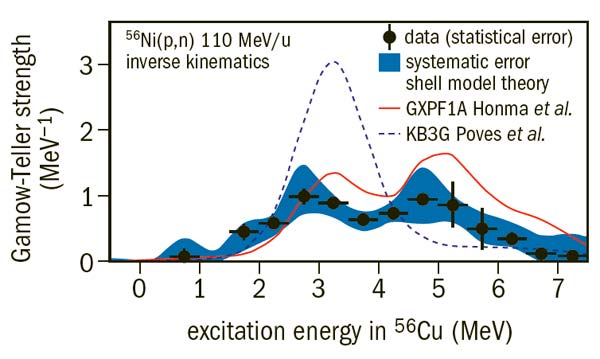
The figure shows the extracted GT strength as a function of excitation energy and the comparison with two shell-model calculations based on different Hamiltonians. Because isospin symmetry-breaking effects are small and 56Ni has isospin I=0, the strength distribution for the 56Ni→56Cu reaction is nearly identical to that for the 56Ni→56Co reaction. The latter is of relevance for electron captures in stellar environments, while 56Ni plays a central role in the studies of weak reaction rates for supernovae. By benchmarking and improving the shell-model calculations for the N=Z=28 nucleus 56Ni, more reliable calculations of electron-capture rates for many nuclei in the iron group will be possible.
The quark model of hadron classification proposed by Murray Gell-Mann and George Zweig in 1964 motivated the opinion that a new state of matter, namely strongly interacting matter composed of subhadronic constituents, may exist. Soon thereafter, quantum chromodynamics (QCD) was formulated as the theory of strong interactions, with quarks and gluons as elementary constituents. As a natural consequence, the existence of a state of quasi-free quarks and gluons – the QCD quark–gluon plasma (QGP) – was suggested by Edward Shuryak in 1975. These events, together with the rapid development of particle-accelerator and detector techniques, mark the beginning of the experimental search for this hypothetical, subhadronic form of matter in nature.
First indications
The experimental efforts received a boost from the first acceleration of oxygen and sulphur nuclei at CERN’s Super Proton Synchrotron (SPS) in 1986 (√sNN ≈ 20 GeV) and of lead nuclei in 1994 (√sNN ≈ 17 GeV). Measurements from an array of experiments were surprisingly well described by statistical and hydrodynamical models. They indicated that the created system of strongly interacting particles is close to at least local equilibrium (Heinz and Jacob 2000). Thus, a necessary condition for QGP creation in heavy-ion collisions was found to be fulfilled. The “only” remaining problem was the identification of unique experimental signatures of QGP.
The strategy is clear: look for a rapid change of energy dependence of hadron production properties.
Unfortunately, precise quantitative predictions are currently impossible to calculate within QCD and predictions of phenomenological models suffer from large uncertainties. Therefore, the results of the measurements were only suggestive of the production of QGP in heavy-ion collisions at the top SPS energy. The same situation persisted at the top energies of Brookhaven’s Relativistic Heavy Ion Collider (RHIC) and seems to be repeated at the LHC. Despite many arguments in favour of the creation of QGP at these energies, its discovery cannot be claimed from these data alone.
A different strategy for identifying the creation of QGP was followed by the NA49 experiment at the SPS and is now being continued by its successor NA61/SHINE, as well as by the STAR experiment at RHIC. The idea is to measure quantities that are sensitive to the state of strongly interacting matter as a function of collision energy in, for example, central lead–lead collisions.
The reasoning is based on simple arguments. First, the energy density of matter created at the early stage of heavy-ion collisions increases monotonically with collision energy. Thus, if two phases of matter exist, the low-energy density phase is created in collisions at low energies and the high-energy density phase in collisions at high energies. Second, the properties of both phases differ significantly, with some of the differences surviving until the freeze-out to hadrons and so can be measured in experiments. The search strategy is therefore clear: look for a rapid change of the energy dependence of hadron production properties that are sensitive to QGP, because these will signal the transition to the new state of matter and indicate its existence.
This strategy, and the corresponding NA49 energy-scan programme, were motivated in particular by a statistical model of the early stage of nucleus–nucleus collisions (Gazdzicki and Gorenstein 1999). It predicted that the onset of deconfinement should lead to rapid changes of the collision-energy dependence of bulk properties of produced hadrons, all appearing in a common energy domain. Data from 1999 to 2002 on central Pb+Pb collisions at 20A, 30A, 40A, 80A and 158A GeV were recorded and the predicted features were observed at low SPS energies.
An independent verification of NA49’s discovery is vital and calls for further measurements in the SPS energy range. Two new experimental programmes are already in operation: the ion programme of NA61/SHINE at the SPS; and the beam-energy scan at RHIC. Elsewhere, the construction of the Nuclotron-based Ion Collider at JINR, Dubna, is in preparation. The basic goals of this experimental effort are the confirmation and the study of the details of the onset of deconfinement and the investigation of the transition line between the two phases of strongly interacting matter. In particular, the discovery of the hypothesized second-order critical end-point would be a milestone in uncovering properties of strongly interacting matter.
Four pointers
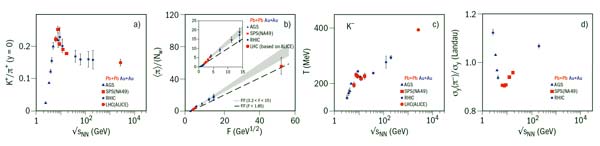
Last year rich data from the RHIC beam-energy scan programme were released (Kumar 2011, Mohanty 2011). Furthermore, the first results from Pb+Pb collisions at the LHC were revealed (Schukraft et al. 2011, Toia et al. 2011). It is therefore time to review the status of the observation of the onset of deconfinement. The plots in figure 1 summarize relevant results that became available in June 2011. They show the energy dependence of four hadron-production properties measured in central Pb+Pb (Au+Au) collisions, which reveal structures referred to as the “horn”, “kink”, “step” and “dale” – all located in the SPS energy range.
The horn. The most dramatic change of the energy dependence is seen for the ratio of yields of kaons and pions (figure 1a). The steep threshold rise of the ratio characteristic for confined matter changes at high energy into a constant value at the level expected for deconfined matter. In the transition region (at low SPS energies) a sharp maximum is observed, caused by the higher production ratio of strangeness-to-entropy in confined matter than in deconfined matter.
The kink. Most particles produced in high-energy interactions are pions. Thus, pions carry basic information on the entropy created in the collisions. On the other hand, entropy production depends on the form of matter present at the early stage of collisions. Deconfined matter is expected to lead to a final state with higher entropy than confined matter. Consequently, the entropy increase at the onset of deconfinement is expected to lead to a steeper increase with collision energy of the pion yield per participating nucleon. This effect is observed for central Pb+Pb collisions (figure 1b). When passing through low SPS energies, the slope of the rise in the ratio <π>/<NP> with the Fermi energy measure F ≈ √√sNN increases by a factor of about 1.3. Within the statistical model of the early stage, this corresponds to an increase of the effective number of degrees of freedom by a factor of about 3.
The step. The experimental results on the energy dependence of the inverse slope parameter, T, of K– transverse-mass spectra for central Pb+Pb (Au+Au) collisions are shown in figure 1c. The striking features of these data can be summarized and interpreted as follows (Gorenstein et al. 2003). The T parameter increases strongly with collision energy up to low SPS energies, where the creation of confined matter at the early stage of the collisions takes place. In a pure phase, increasing collision energy leads to an increase of the early-stage temperature and pressure. Consequently the transverse momenta of produced hadrons, measured by the inverse slope parameter, increase with collision energy. This rise is followed by a region of approximately constant value of the T parameter in the SPS energy range, where the transition between confined and deconfined matter with the creation of a mixed phase is located. The resulting softening of the equation of state “suppresses” the hydrodynamical transverse expansion and leads to the observed plateau or even a minimum structure in the energy dependence of the T parameter. At higher energies (RHIC data), T again increases with collision energy. The equation of state at the early stage again becomes stiff and the early-stage pressure increases with collision energy, resulting in a resumed increase of T.
The dale. As discussed above, a weakening of the transverse expansion is expected to result from the onset of deconfinement because of the softening of the equation of state at the early stage. Clearly, the latter should also weaken the longitudinal expansion (Petersen and Bleicher 2006). This expectation is confirmed in figure 1d, where the width of the π– rapidity spectra in central Pb+Pb collisions relative to the prediction of ideal Landau hydrodynamics is plotted as a function of the collision energy. In fact, the ratio has a clear minimum at low SPS energies.
A smooth evolution is observed between the top SPS energy and the current energy of the LHC.
The results shown in figure 1 include new results on central Pb+Pb collisions at the LHC and data on central Au+Au collisions from the RHIC beam-energy scan. The RHIC results confirm the NA49 measurements at the onset energies while the LHC data demonstrate that the energy dependence of hadron-production properties shows rapid changes only at low SPS energies. A smooth evolution is observed between the top SPS energy (17.2 GeV) and the current energy of the LHC (2.76 TeV). This strongly supports the interpretation of the NA49 structures as arising from the onset of deconfinement. Above the onset energy only a smooth change of the QGP properties with increasing collision energy is expected.
The first LHC data thus confirm the following expected effects:
• an approximate energy independence of the K+/π+ ratio above the top SPS energy (figure 1a);
• a linear increase of the pion yield per participant with F ≈ √√sNN with the slope defined by the top SPS data (figure 1b);
• a monotonic increase of the kaon inverse-slope parameter with energy above the top SPS energy (figure 1c).
The width of the π– rapidity spectra in central Pb+Pb collisions should increase continuously from the top SPS energies to the LHC energies, as predicted by ideal gas Landau hydrodynamics. LHC data on rapidity spectra are required to verify this expectation.
The NA61/SHINE experiment
The confirmation of the NA49 measurements and their interpretation in terms of the onset of deconfinement by the new LHC and RHIC data strengthen the arguments for the NA61/SHINE experiment, which will use secondary proton and Be, as well as primary Ar and Xe beams in the SPS beam momentum range (13A–158A GeV/c). The basic components of the NA61 detector were inherited from NA49. Several important upgrades – in particular, the new and faster read-out of the time-projection chambers, the new, state-of-the-art resolution Projectile Spectator Detector and the installation of background-reducing helium beam pipes – allow the collection of data of high statistical and systematic accuracy. In parallel to the ion programme, the NA61/SHINE experiment is also making precision measurements of hadron production in proton- and pion-nucleus collisions for the Pierre Auger Observatory’s studies of cosmic rays and the T2K long-baseline neutrino experiment.
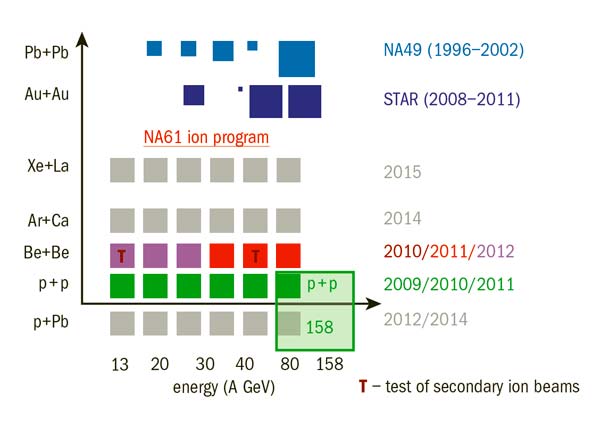
NA61 has already begun a two-dimensional scan in collision energy and the size of the colliding nuclei (figure 2). Data on proton–proton interactions at six collision energies were recorded in 2009–2011 and a successful test of secondary ion beams took place in 2010. The first physics run with secondary Be beams came in November/December 2011. Most important for the programme are runs with primary Ar and Xe beams, expected for 2014 and 2015, respectively. The collaboration between CERN and the iThemba Laboratory in South Africa is ensuring a timely optimization of the ion-source parameters. This all adds up to a future where the results from NA61 will allow a detailed study of the properties of the onset of deconfinement and a systematic search for the critical point of strongly interacting matter.
Located under 1700 m of rock in the Modane Underground Laboratory (LSM) at the middle of the Fréjus Rail Tunnel, the NEMO 3 experiment was designed to search for neutrinoless double beta decay, with the aim of discovering the nature of the neutrino – whether it is a Majorana or Dirac particle – and measuring its mass. The experiment ran for seven years before it finally stopped taking data in January 2010. While the sought-after decay mode remained elusive, NEMO 3 nevertheless made impressive headway in the study of double beta decay, providing new limits on a number of processes beyond the Standard Model.
Standard double beta decay (ββ2ν) involves the simultaneous disintegration of two neutrons in a nucleus into two protons with the emission of two electrons accompanied by two antineutrinos, (A,Z) → (A,Z+2) + 2e– +2ν. It is a second-order Standard Model process and for it to occur the transition to the intermediate nucleus accessible by normal beta decay, (A,Z) → (A,Z+1) + e– + ν, must be forbidden by conservation of either energy or angular momentum. In nature, there are 70 isotopes that can decay by ββ2ν and experiments have observed this process in 10 of these, with half-lives ranging from 1018 to 1021 years. However, ββ2ν decay is not sensitive to the nature or mass of the neutrino, unlike double beta decay with no emitted neutrinos (ββ0ν). This process, (A,Z) → (A,Z+2) + 2e–, is forbidden by the Standard Model electroweak interaction because it violates the conservation of lepton number (ΔL = 2). Such a decay can occur only if the neutrino is a Majorana particle (a fermion that is its own antiparticle). Non-Standard Model processes that can lead to ββ0ν decay include the exchange of a light neutrino, in which case the inverse of the ββ0ν half-life depends on the square of the effective neutrino mass. Other possible processes involve a right-handed neutrino current, a Majoron coupling or supersymmetric particle exchange.
The experimental signature for double beta-decay processes appears in the sum of the energy of the two electrons. For ββ0ν decay, this would have a peak at the Qββ transition energy (typically 2–4 MeV), while for ββ2ν decay it takes the form of a continuous spectrum from zero to Qββ. There are also two other observables: the angular distribution between the two electrons and the individual energy of the electrons. These two variables can distinguish which process is responsible for ββ0ν decay, if it is observed.
The NEMO collaboration – where NEMO stands for the Neutrino Ettore Majorana Observatory – has been working on ββ0ν decay since 1989. The design of the NEMO 3 detector, which evolved from two prototypes, NEMO 1 and NEMO 2, began in 1994 and construction started three years later. The method uses a number of thin source foils of enriched double beta-decay emitters surrounded by two tracking volumes and a calorimeter.
The challenge for any search for ββ0ν decay is the control of the backgrounds from cosmic rays, natural radioactivity, neutrons and radon. The background comes from any particle interactions or radioactive decays that can produce two electrons in the source foils. Because the signal level is so low, even third- and fourth-order processes can be a problem. Cosmic rays are suppressed by installing the experiment in a deep underground laboratory, as at the LSM. Natural radioactivity is reduced by material selection and purification of the source isotopes: the source foils in NEMO 3 had a radioactivity level a million times less than the natural level of radioactivity (around 100 Bq/kg). Neutrons and high-energy γ-rays are suppressed by specially designed and adapted shielding.
The NEMO 3 detector
The principle of NEMO 3 was to detect the two emitted electrons and to measure their energy as well as their angular distribution and their individual energies. The identification of the electrons reduces drastically the background compared with the calorimetric techniques of other experiments. The price of this advantage is a rather modest energy resolution, partly as a result of the electron’s energy loss in the source foils. However, the experimental sensitivity for ββ0ν depends on the product of the energy resolution and the number of background events. The source foils in NEMO 3 had a thickness of around 100 μm, which corresponded to a compromise between the amount of radioactive isotope and the electrons’ energy losses.
Another advantage of this experimental technique is the possibility of using different isotopes. The double beta-decay source inside NEMO 3 had a total mass of 10 kg, which was shared as follows: 6.914 kg of 100Mo, 0.932 kg of 82Se, 0.405 kg of 116Cd, 0.454 kg of 130Te, 37.0 g of 150Nd, 9.4 g of 96Zr and 7.0 g of 48Ca. These isotopes were enriched in Russia. In addition, two ultrapure sources of copper (0.621 kg) and natural tellurium (0.491 kg) were used to measure the external background. It is the first time that a detector has measured seven different double beta-decay emitters at the same time.
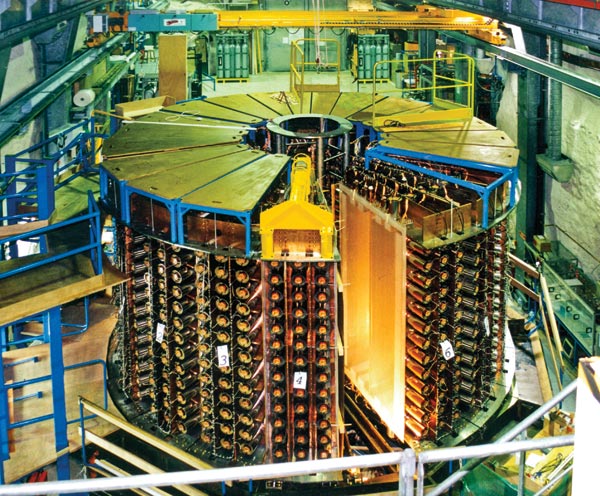
The NEMO 3 detector was made of 20 identical sectors. The tracking volume consisted of 8000 drift chambers working in Geiger mode. The volume was filled with a mixture of helium, 4% alcohol, 1% argon and a few parts per million of water to ensure the stable behaviour of the chamber. Electrons could be tracked with energy down to 100 keV with an efficiency of greater than 99%.The calorimeter was made of 2000 plastic scintillators coupled to low-radioactivity Hamamatsu phototubes. The choice of plastic scintillator was driven by the low Z to reduce back scattering, the low radioactivity and the cost. The calorimeter allowed measurements of both the energy (σ=3.6% at 3 MeV) and the time of flight (σ= 300 ps at 1 MeV).
A coil created a magnetic field of 0.003 T to enable the identification of the sign of the electrons. The shielding was made of 20 cm of iron to reduce γ-ray background and 30 cm of water to reduce the neutron background. A tent flushed with air containing just 15 mBq/m3 of radon surrounded the whole detector.
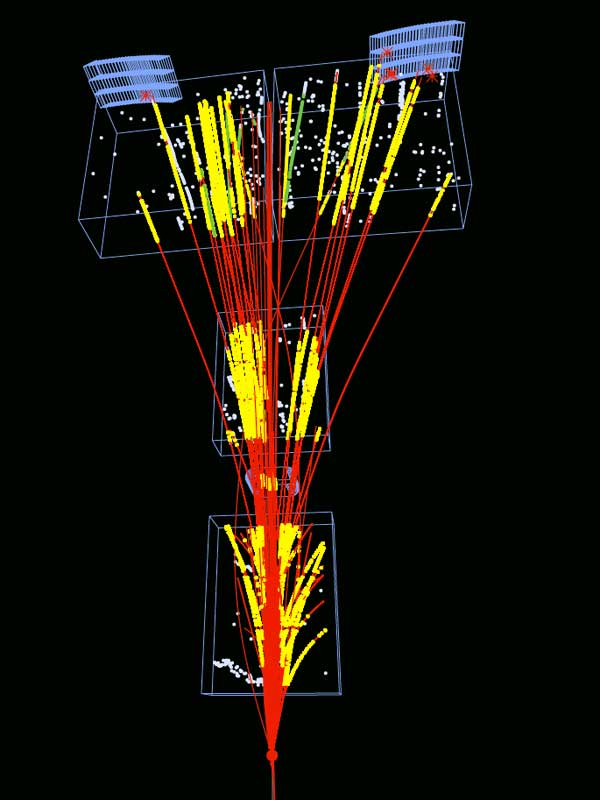
The unique feature of the NEMO 3 experiment was its ability to identify electrons, positrons, γ-rays and delayed α-particles. Figure 2 shows a typical double beta-decay event in NEMO 3 with two electrons emitted from a source foil, with the track curvature in the magnetic field identifying the charge and the struck scintillator blocks measuring the energy and the time of flight. The timing is important to distinguish a background electron crossing the detector (Δt=4 ns) from two electrons coming from a source foil (Δt=0 ns).
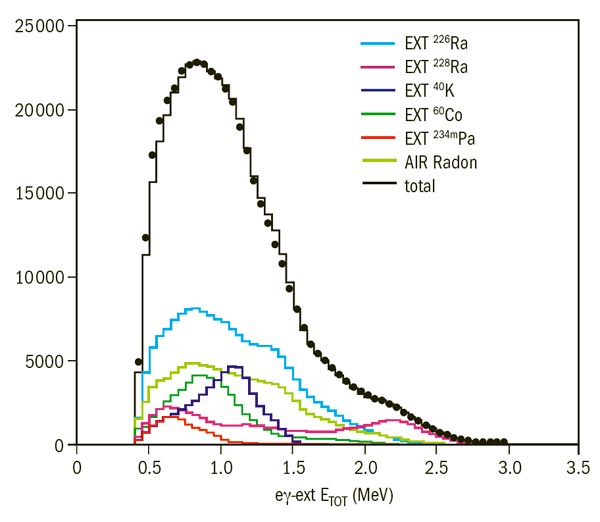
The experiment has measured the background through various analysis channels: single e–, e–+γ, e+α, e–+α+γ, e–+γ+γ, e–+e+ and so on. This allows measurements to be made of the actual backgrounds from residual contamination of the source foils as well as from the surrounding materials. Figure 3 demonstrates the ability of the experiment to identify the many sources of external background in the e–γ channel (as an example) for the 100Mo source foil.
NEMO 3 has produced an impressive list of results. The main result is, of course, related to the search for ββ0ν decay. Figure 4 shows the sum of the electron energy for 7 kg of 100Mo after 4.5 years of data-taking, zoomed into the region where the signal for ββ0ν decay is expected. The measurement of all of the kinematic parameters and the identification of all of the sources of background allows a 3D likelihood analysis to be performed. The result is a limit on the half-life of T1/2 > 1×1024 years, corresponding to a neutrino mass limit <mν> < 0.3–0.9 eV. The range corresponds to the spread associated with the different nuclear matrix-element calculations that must be used to extract the effective neutrino mass. This limit obtained with 7 kg of 100Mo is one of the best limits, together with the result of <mν> <0.3 – 0.7 eV from the Cuoricino experiment (12 kg of 130Te) and of <mν> < 0.3–1.0 eV from the Heidelberg-Moscow experiment (11 kg of 76Ge).
One possible scenario for ββ0ν involves the emission of the Majoron, the hypothetical massless boson associated with the spontaneous breaking of baryon-number minus lepton-number (B-L) symmetry. NEMO 3 has obtained the best limit so far for the Majoron-neutrino coupling, with gM < (0.4–1.8) × 10–4. The experiment has also set a limit on the λ parameter in models where a right-handed current exists for neutrinos, with λ < 1.4 × 10⁻⁶. These limits were obtained by analysing the angular distributions of the decay electrons and they are therefore unique to NEMO 3.
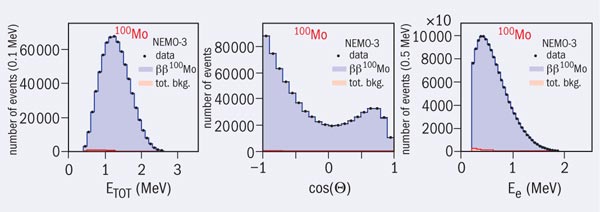
In addition, NEMO 3 has measured the half-lives for seven ββ2ν decays, providing a high-precision test of the Standard Model and nuclear data that can be used in theoretical calculations. In seven years, more than 700,000 events were recorded for ββ2ν emission from 100Mo. Figure 5 shows the energy spectrum, angular distribution and single energies measured for 100Mo. The first direct detection of ββ2ν decay to the 0+ excited state has also been measured for this nucleus and the first limit on the bosonic component of the neutrino has been obtained.
The NEMO 3 detector has demonstrated a powerful method for searching for neutrinoless double beta decay, with the unique capability of measuring all kinematic parameters of the decay. The next step for the NEMO collaboration is to build the SuperNEMO detector, which will accommodate 100 kg of source foil (82Se, 150Nd or 48Ca) to reach a sensitivity of 50 meV on the effective mass of the neutrino. A demonstrator module is under construction in several laboratories around the world and will start operation in 2013 in the LSM, with 7 kg of 82Se. The main improvement in this larger detector over NEMO 3 will be the energy resolution (σ=1.7% at 3 MeV) and the reduction of the background by a factor of 10. This demonstrator will improve the current limit on the effective neutrino mass and is expected to reach the goal of a zero-background experiment for 7 kg of source and two years of data-taking, which has never been done before. With this demonstration, the collaboration will be ready to build more Super NEMO modules up to the maximum source mass possible.
• The NEMO and SuperNEMO collaboration is formed by laboratories from France, the UK, Russia, the US, Japan, the Czech Republic, Slovakia, Ukraine, Chile and Korea. The LSM is operated by the CNRS and the CEA.
The ALICE collaboration has measured the production of baryons containing two or three strange quarks in lead–lead collisions at the LHC, at an energy of 2.76 TeV per nucleon pair, nearly 14 times larger than that obtained previously at Brookhaven’s Relativistic Heavy Ion Collider (RHIC). The yields and transverse-momentum spectra of multi-strange baryons and antibaryons in heavy-ion collisions are important in characterizing the evolution of the hot-matter created, as it passes from the strange quarks and antiquarks of the early partonic stages to the subsequent hadronization.
The collaboration identified multi-strange baryons mainly by a topological method, looking for their weak-decay products originating from secondary vertices well separated from the main interaction vertex. The researchers also exploited particle identification via specific energy loss in the time projection chamber (TPC). For example, the Ω– baryon (consisting of three strange quarks) decays into a negative K meson and a neutral Λ baryon, which in turn decays into a proton and a negative π meson. A peak in the invariant mass spectrum of all (Λ, K–) combinations provides a clearly identifiable signal (figure 1).
Good momentum resolution and a precise secondary-vertex reconstruction were essential for this result. A key element was the excellent performance of the main tracking detectors in ALICE’s central barrel – the TPC and the internal tracking system (ITS) – in the challenging environment of central (head-on) lead–lead collisions.
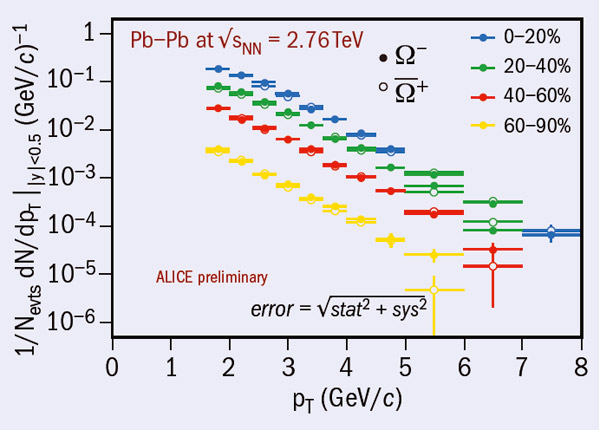
The data were analysed in transverse momentum intervals up to 6–9 GeV/c for the doubly-strange baryons (Ξ– and charge conjugate separately) and 6–8 GeV/c for the triply-strange baryons (Ω– and charge conjugate separately), made possible by the examination of 30 million minimum-bias nuclear interaction candidate events. In addition, the centrality of the selected events was determined from signals collected in two scintillator hodoscopes at backward and forward rapidities (K Aamodt et al. 2011). This allowed the analysis to be repeated in four different centrality intervals, from the 0–20% most central (almost head-on) collisions to the 60–90% peripheral collisions, in order to compare with previous results at RHIC. Figure 2 shows the resulting transverse-momentum spectra, fully corrected for detector acceptance and efficiency; it also shows clearly how multi-strange baryon production increases with the centrality of the collision at LHC energy. The results were presented at the recent conference on Strangeness in Quark Matter (Strangeness and heavy flavours in Krakow).
Previous experiments at CERN’s Super Proton Synchrotron (SPS) and at RHIC obtained multi-strange baryon spectra and yields in 17 GeV lead–lead and 200 GeV gold–gold collisions, respectively. The ALICE experiment not only finds higher yields in lead–lead collisions at the LHC energy, but also finds that the enhancement with respect to proton–proton collisions is greater for the Ω than for the Ξ, confirming the trend observed at both SPS and RHIC. Moreover, the enhancement with respect to proton–proton data increases with the centrality of the collision, in a similar way to previous observations.
Supersymmetry (SUSY) is still one of the strong candidates for physics beyond the Standard Model that could be detected in proton–proton collisions at the LHC. It could solve many of the outstanding issues in particle physics, such as the gauge hierarchy problem. SUSY can reveal itself through the production of new heavy particles and could therefore deliver a natural candidate particle to explain the large density of dark matter in the universe. However, it has so far evaded the current searches in both the CMS and ATLAS experiments.
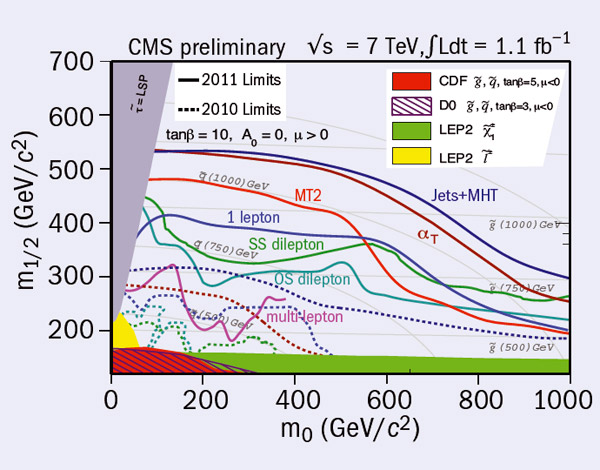
The figure shows a compilation of many of the most recent public results of CMS for integrated luminosities of about 1–2 fb–1. It illustrates the reach of the analyses with respect to pre-LHC experiments in the plane of the universal scalar and gaugino masses (m0 and m1/2, respectively) at the grand unified theory scale of the constrained minimal supersymmetric extension of the Standard Model (CMSSM).
A large increase in sensitivity was clearly obtained at the LHC with the data analysed, obtained in 2010 and until August 2011, but this parameter space is just one reference point among possible SUSY scenarios. Additional data will allow the exploration of other scenarios where each of the signatures, from no-leptons to multileptons, may have the most sensitivity. The search channels shown varied from having a few to many jets (αT, Jets+MHT, MT2), and jets plus one lepton (i.e. generally one muon or electron), jets plus two leptons, with either opposite (OS) or the same (SS) charge. All of these channels were also required to have a large missing transverse energy. The latter is a key characteristic of many SUSY searches, reflecting the supposition that the lightest SUSY particle is expected to be neutral, stable and weakly interacting – thereby escaping detection.
CMS recently released the results of SUSY searches for candidates containing at least three leptons. For these search channels, the Standard Model background is low, mostly di-boson events; this allows the missing transverse energy requirement to be relaxed considerably and so provide sensitivity to SUSY models with so-called R-parity violation. In these models, SUSY particles decay to Standard Model particles and no dark-matter candidate can escape detection. Moreover, such studies are sensitive to the channel of direct electroweak gaugino production, important in scenarios that conserve R-parity.
CMS analysed a total of 2.1 fb–1 of data. In general no significant excess was observed in this new analysis – so SUSY, if it exits, still manages to hide away. As many as 52 different channels have now been looked into and although a few of them show a slight excess over the background estimated from data, all of them currently have a significance of less than 2σ. CMS will certainly continue to “watch this space”.
At the time of this writing, more than 5 fb–1 of data have been recorded and are now being analysed. It promises to be an interesting winter for SUSY searches.
Searches for dilepton resonances have a history of discoveries, from the J/ψ and Υ to the Z boson. Now new neutral gauge bosons, Z’, which would appear as resonances, are predicted by a number of theories. They are the mediators of new forces that allow the unification of all fundamental forces at some very large energy scale. Dilepton resonances are also predicted as gravitons in models of extra-dimensional gravity.
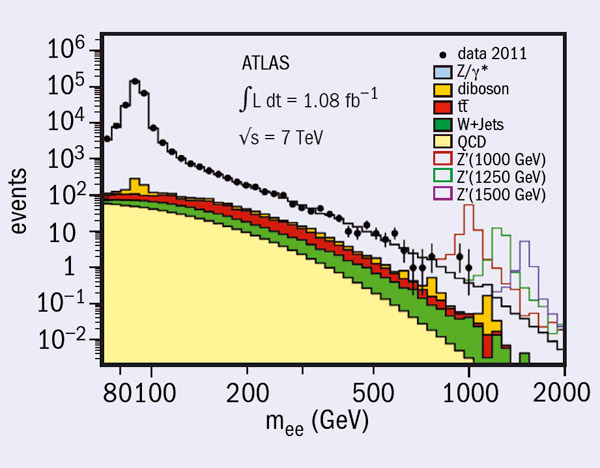
The analysis by ATLAS used a data sample corresponding to an integrated luminosity of 1.1 fb–1. The sensitivity to new physics extends to 1.8 TeV, similar to that of recent preliminary results from CMS and far beyond the limits achieved at lower-energy accelerators. The observed dilepton mass distributions (for example, the di-electron distribution of figure 2) are in good agreement with the spectrum predicted by the Standard Model including higher-order QCD and electroweak corrections.
The search technique employed by ATLAS involves the comparison of the dilepton mass distribution with the predicted spectrum over the entire high-mass range. The prediction includes a series of hypothetical resonance line-shapes with different masses and couplings. The dominant sources of systematic uncertainty are of a theoretical nature, arising from the calculations of the production rates.
The ATLAS detector will measure the mass of any resonance observed quite accurately. The liquid argon calorimeter provides a linear and stable response for electrons up to the highest energy, and the combination of the inner detector and the muon spectrometer provides muon measurement at the highest momenta. ATLAS will also measure the cross-section, couplings, spin and interference properties of a resonance.
Work is ongoing to increase the lepton acceptance further, and ATLAS will extend the kinematic reach of these exciting measurements with much larger datasets in 2011–2012.
A new component of gravity, the scalar gravitational field, may explain the mechanism that allows the immense explosions of type II supernovae to take place. However, this could happen only through a dynamic process – parametric instability – that dates back to work by Lord Rayleigh in the 1880s.
When the central core of a massive star runs out of nuclear fuel (having been converted mainly into iron), it collapses under its own weight in less than a second into an extremely dense neutron star, releasing an enormous amount of gravitational energy. A supernova results, but only a small fraction of the total energy released appears as electromagnetic radiation (light) of the “new star”. The kinetic energy of the exploding stellar envelope is 10 times greater, but the greatest part of the energy by far is carried away by neutrinos, which can more easily escape the dense material of the core.
Detection of neutrinos from supernova SN1987A did much to verify this picture. During core-collapse, the density at the centre of the star rapidly increases, finally forming dense nuclear matter that is extremely difficult to compress. The collapsing material rebounds from this nuclear matter, resulting in an outgoing pressure wave, which soon becomes a huge shock wave.
Extensive studies have attempted to decide whether this “prompt shock” travels all of the way out and ejects the outer part of the star. Indeed, simulations suggest that it stalls at distances of about 300 km from the centre because of the immense energy required to dissociate iron and other nuclei. However, further simulations have found that the shock could restart if the electrons could absorb about 1% of the energy carried by neutrinos. In the neutrino-plasma coupling model, collective interactions between the neutrinos and the plasma could initiate the required energy transfer. Alternatively, recent research suggests that the solution to re-energizing the shock may lie in a fundamental field that takes the simple form of a scalar (like the Higgs field).
Gravity containing a scalar field (originally proposed by Carl Brans and Robert Dicke in the 1960s as an additional component of the gravitational field) has been considered as a promising extension to Einstein’s general relativity in connection with quantum gravity and grand unification. The theory of Brans and Dicke was based on a relatively simple linear coupling to the scalar gravitational field. A few years ago, this linear coupling was shown to be negligible, using radio signals transmitted from the Cassini spacecraft when it was near Saturn.
Now, researchers in the UK and Portugal have analysed the nonlinear coupling to a scalar gravitational field. They find that under extreme conditions with strong time-varying gravity such as may be found in the interior of a newly born neutron star, the scalar gravitational field may be stimulated via parametric instability. The resulting emission of scalar gravitational waves from the neutron core of a collapsing heavy star may be sufficient to re-energize the stalled shock, thus providing a 19th-century solution to a 20th-century problem.
To provide the best experiences, we use technologies like cookies to store and/or access device information. Consenting to these technologies will allow us to process data such as browsing behavior or unique IDs on this site. Not consenting or withdrawing consent, may adversely affect certain features and functions.
Functional
Always active
The technical storage or access is strictly necessary for the legitimate purpose of enabling the use of a specific service explicitly requested by the subscriber or user, or for the sole purpose of carrying out the transmission of a communication over an electronic communications network.
Preferences
The technical storage or access is necessary for the legitimate purpose of storing preferences that are not requested by the subscriber or user.
Statistics
The technical storage or access that is used exclusively for statistical purposes.The technical storage or access that is used exclusively for anonymous statistical purposes. Without a subpoena, voluntary compliance on the part of your Internet Service Provider, or additional records from a third party, information stored or retrieved for this purpose alone cannot usually be used to identify you.
Marketing
The technical storage or access is required to create user profiles to send advertising, or to track the user on a website or across several websites for similar marketing purposes.