Although no sign of supersymmetry (SUSY) has been observed so far, it is still the front-runner as a signal for new physics that could be discovered at the LHC. Not only does it neatly solve several shortcomings of the Standard Model, it also provides a candidate for the as-yet undiscovered dark-matter particle. Unfortunately, the masses of the SUSY particles are not constrained by theory, but it does provide some interesting hints. For SUSY to solve in a natural way the fine-tuning problems that arise in the Standard Model from the presence of a low-mass Higgs, the lightest of the two supersymmetric partners of the top quark (stop quarks) should have a mass not too much beyond that of the Standard Model counterpart, and the mass of the gluon’s superpartner (gluino) should not be too far above that of the stop quarks.
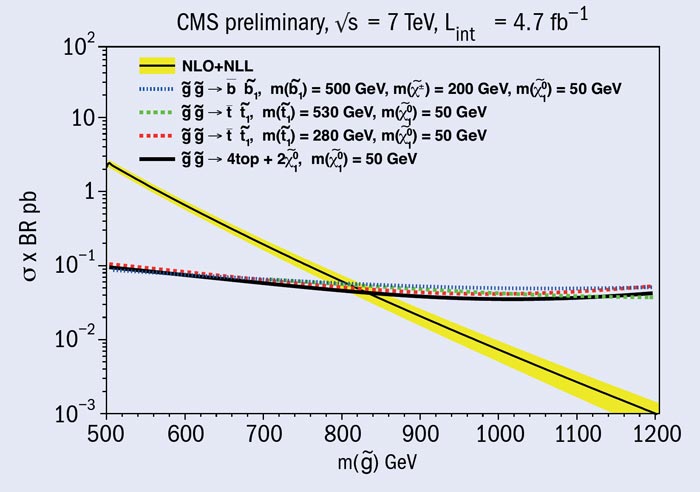
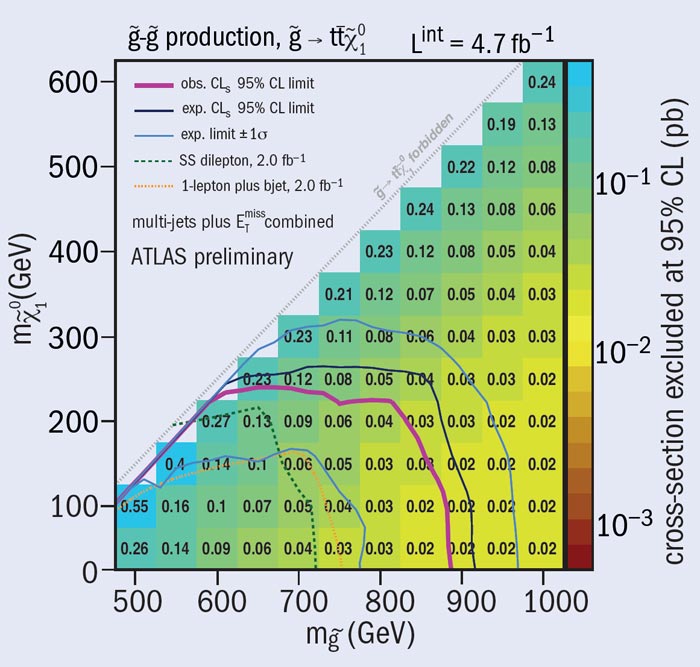
Both the ATLAS and CMS collaborations have made significant progress in searching for possibly light third-generation squarks (stop and sbottom), produced either directly or in the decays of gluinos, and first results based on the full data set recorded in 2011, equivalent to about 5 fb–1, have been released. CMS has presented a search for events containing multiple b-quarks and two leptons of the same charge, thus effectively eliminating most of the Standard Model backgrounds. ATLAS has released a novel interpretation of its updated multi-jet analysis, which explores events with up to nine high-transverse-momentum jets.
The figures show the current constraints that both collaborations are imposing on the gluino, pushing its allowed mass above 850 GeV in some cases. In addition, constraints from experiments at Fermilab’s Tevatron on direct sbottom pair-production have been extended by both ATLAS and CMS, and first results constraining direct production of stop in a simplified model of stop decays were recently presented by ATLAS. These are just appetizers for more results that will be released by both collaborations over the next few months.
The collaborations have also updated the more canonical searches that look for multiple energetic jets, the eventual presence of leptons and large missing transverse momentum – a striking signature for the presence of a dark-matter particle that escapes the detectors. Both collaborations invested a large effort in refining their analysis techniques, thus boosting their sensitivities. In certain SUSY scenarios, gluinos and squarks with masses below 1.4 TeV are now excluded.
Last, the large data set produced by the LHC in 2011 allowed the collaborations to begin exploring the electroweak sector of the SUSY particle spectrum with the study of multilepton final states. New and updated results have been released for many other SUSY decay signatures, including photons and τ leptons, and also in the context of searches for long-lived particles, disappearing tracks, and signatures without missing momentum, which are becoming increasingly interesting as possible ways to discover SUSY.
While no indications for the presence of supersymmetric particles have been found in the LHC collisions so far, the hunt continues and more results from additional search channels will appear in the coming months. Only a small part of the SUSY parameter space has been challenged by direct searches so far. Relatively light stops and gluinos are still allowed by the present data, and more dedicated searches will show if “natural SUSY” prevails. The increase of the LHC centre-of-mass energy to 8 TeV and the foreseen increase of data to be delivered in 2012 will open a new window to search for the presence of SUSY particles. Combined with the collaborations’ ever-growing experience and new analyses dedicated to specific signatures, this guarantees exciting developments during the rest of the year.
Researchers in the Modular Neutron Array (MoNA) collaboration have found evidence for a new nuclear-decay mode at the National Superconducting Cyclotron Laboratory (NSCL) at Michigan State University. Artemis Spyrou, Zach Kohley and their colleagues have recently published results on the first confirmation of dineutron decay, which has long been hypothesized but never detected directly (A Spyrou et al. 2012).
Beginning with a beam of 17B at 53 MeV/u produced by the Coupled Cyclotron Facility, the nucleus of interest, 16Be, was created by knocking out a proton from the beam. The 16Be decayed immediately into a 14Be fragment and two neutrons. The charged fragment, 14Be, was deflected by the sweeper-dipole magnet and detected in a suite of position- and energy-sensitive detectors. The neutrons were detected in MoNA.
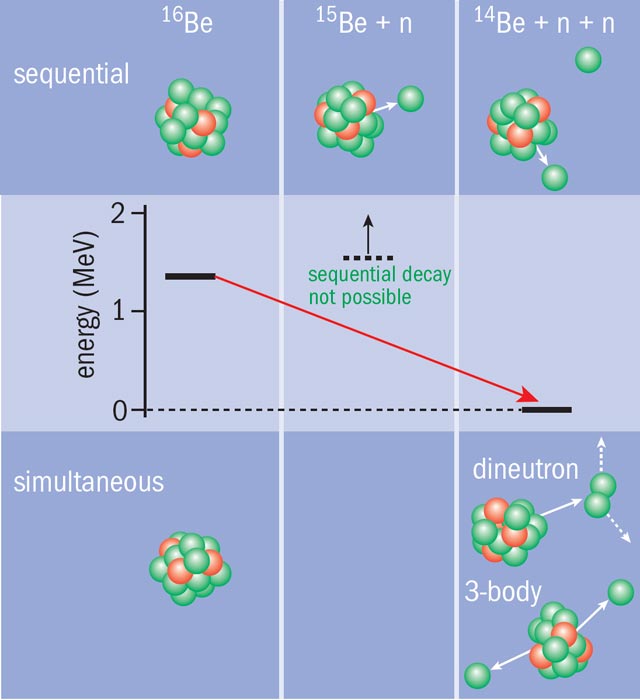
There are three decay-modes that the dineutron emission could proceed through: a sequential emission of the two neutrons through the intermediate system 15Be; a simultaneous emission of the two neutrons via a three-body break-up; and a dineutron decay, where the two neutrons are assumed to be clustered together inside the nucleus. Only the latter model was able to reproduce the experimental results and, in particular, the two-neutron correlation parameters. By observing a small angle between the two neutrons the team could demonstrate that these were emitted together as a cluster, and thus as a dineutron. 16Be was found to be a rare case where the two neutrons are emitted simultaneously because the decay through the intermediate system, 15Be, is not energetically favourable.
This experiment showed for the first time that a dineutron decay is possible in these extremely neutron-rich systems. The observation can improve understanding of nuclear binding, especially at the limits of nuclear stability, and help to create more reliable models for describing the astrophysical processes.
The measurements of the electron- and muon-neutrino fluxes published by the Super-Kamiokande collaboration in 1998 marked a turning point in the history of particle physics. This team showed that fewer muon-neutrinos arrive at the surface of the Earth than are produced by cosmic-ray interactions in the upper atmosphere (atmospheric neutrinos). This in turn indicated evidence for neutrino oscillations, the phenomenon in which the flavour of the neutrino changes (oscillates) as the neutrino propagates through space and time. Since the publication of Super-Kamiokande’s seminal paper, the phenomenon of neutrino oscillations has been established through further measurements of atmospheric neutrinos, as well as of neutrinos and antineutrinos produced in the Sun, by nuclear reactors and by high-energy particle accelerators. It is arguably the most significant advance in particle physics of the past decade.
Extending the Standard Model
Neutrino oscillations imply that the Standard Model is incomplete and must be extended to include neutrino mass as well as mixing among the three neutrino flavours. The mechanism by which neutrino mass is generated is not known. An intriguing possibility is that the tiny neutrino mass is the result of physics at extremely high energy scales. Such a “see-saw” mechanism might also help to explain why neutrino mixing is so much stronger than the mixing among quarks. Mixing among three massive neutrinos admits the possibility that symmetry between matter and antimatter (CP-symmetry) is violated via the neutrino mixing matrix. Nonzero neutrino mass implies that lepton number must be used to distinguish a neutrino from an antineutrino. If lepton number is not conserved then a neutrino is indistinguishable from an antineutrino, i.e. the neutrino is a Majorana particle – a completely new state of matter. The determination of the properties of the neutrino, therefore, is fundamental to the development of particle physics.
These exciting new measurements imply that it may be possible to observe CP-violation in neutrino oscillations
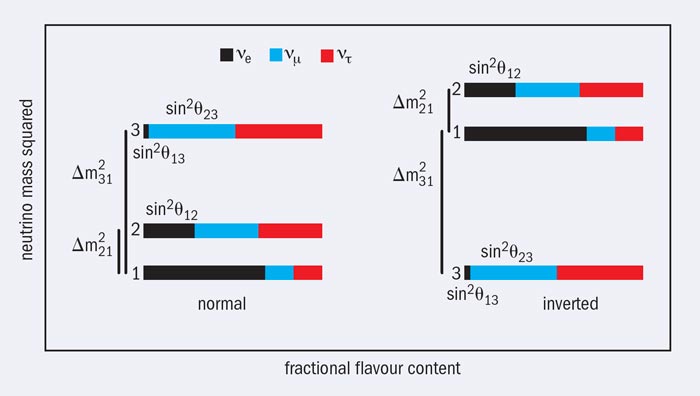
Neutrino oscillations are readily described by extending the Standard Model to include three neutrino-mass eigenstates, ν1, ν2 and ν3, such that the neutrino-flavour eigenstates, νe, νμ and ντ, are quantum-mechanical mixtures of the mass eigenstates (figure 1). Neutrino oscillations arise from the “beating” of the phase of the neutrino-mass eigenstates as a neutrino produced as an eigenstate of flavour propagates through space and time. The matrix by which the mass-basis is rotated into the flavour-basis is parameterized in terms of three mixing angles (θ12, θ23 and θ13) and one phase parameter (δ). If δ is nonzero (and not equal to π), then CP-violation in the neutrino sector will occur so long as θ13 > 0. Measurements of neutrino oscillations in vacuum can be used to determine the moduli of the mass-squared differences Δm231 = m23 – m21 and Δm221 = m22 – m21 and, with the aid of interactions with matter, also the sign.
The bulk of the measurements of neutrino oscillations to date have been collected using the dominant “disappearance” channels νe → νe and νμ → νμ. These data have yielded values for the three mixing angles, as well as for the magnitude of the mass-squared differences Δm231 and Δm221, and have shown that m2 > m1 (i.e. that Δm221 > 0). Last year, the T2K, MINOS and Double Chooz experiments presented evidence that θ13 may be greater than zero. Then, in March this year, the Daya Bay collaboration reported that sin22θ13 = 0.092 ± 0.016 (stat.) ± 0.005 (syst.), i.e. that sin22θ13 = 0 is excluded at 5.2 σ. The announcement was soon followed by the report of a similar result from the RENO experiment. These exciting new measurements imply that it may be possible to observe CP-violation in neutrino oscillations. The challenge for the neutrino community, therefore, is to refine the measurement of θ13 to determine the sign of Δm231 (the “mass hierarchy”), to discover CP-violation (if, indeed, it does occur) by measuring δ and to improve the accuracy with which θ23 is known.
Over the next few years, several experiments – MINOS, T2K, NOνA, Double Chooz, Daya Bay and RENO – will exploit the νμ→ νe and νe → νx channels to improve significantly the precision with which θ13 is known. The NOνA long-baseline experiment might also be able to determine the mass hierarchy. However, it is unlikely that either T2K or NOνA will be able to discover CP-violation, i.e. that δ ≠ 0 or π.
The Neutrino Factory
Neutrino oscillations also have implications well beyond the confines of particle physics. The possibility of CP-violation through the neutrino mixing matrix, combined with the possibility that the neutrino is a Majorana particle, makes it conceivable that the interactions of the neutrino led to the observed domination of matter over antimatter in the universe. The abundance of neutrinos in the universe is second only to that of photons. Even with a tiny mass, the neutrino may make a significant contribution to dark matter and thereby play an important role in determining the structure of the universe.
Such a breadth of impact justifies an ambitious, far-reaching experimental programme. Determining the nature of the neutrino – whether Majorana or Dirac – through the search for neutrinoless double-beta decay (2β0ν) is an important part of this programme. The absolute neutrino mass must also be determined either through observations of 2β0ν decay or from the measurement of the end-point of the electron spectrum in beta decay. Equally important is the accurate determination of the parameters that determine the properties of the neutrino. This requires intense, high-energy neutrino and antineutrino beams – precisely what the Neutrino Factory is designed to produce.
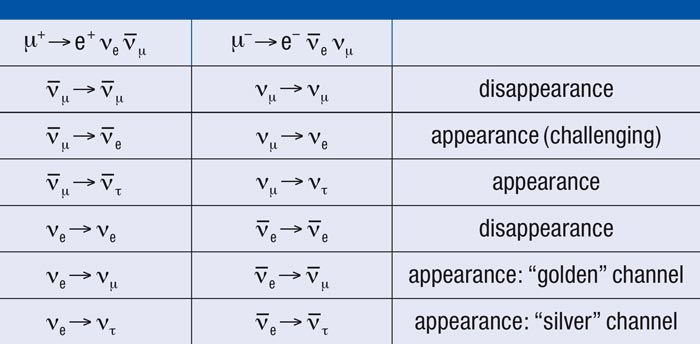
In the Neutrino Factory, beams of νe and νμ (νe,νμ) are produced from the decays of μ+ (μ–) circulating in a storage ring. High neutrino-energies can readily be achieved because the neutrinos carry away a substantial fraction of the energy of the muon. Time-dilation is beneficial, allowing sufficient time to produce a pure, collimated beam. The table above lists the oscillation channels that are available at the Neutrino Factory. Charged-current interactions induced by νe → νμ oscillations – the “gold channel” – produce muons that are opposite in charge to those produced by the νμ in the beam, so a magnetized detector is required. The additional capability to investigate the “silver” (νe → ντ) and “platinum” (νμ → νe) channels also makes the Neutrino Factory an excellent place to look for oscillation phenomena that are outside the standard three-neutrino mixing paradigm. It would be the ideal facility to serve the precision-era of neutrino-oscillation measurements.
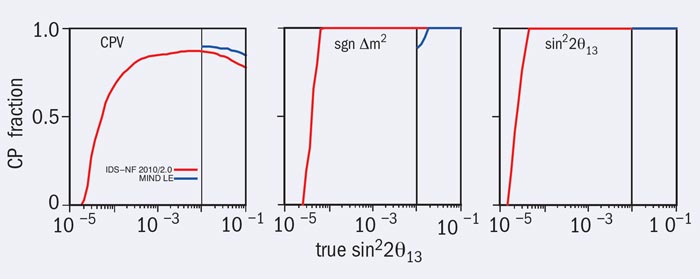
In 2011, the International Design Study for the Neutrino Factory (the IDS-NF) collaboration presented two options for the facility in its Interim Design Report (IDR) (Choubey et al. 2011). The first, optimized for discovery reach at small θ13 (sin22θ13 < 10–2), calls for two distant detectors, with baselines of 2500–5000 km and 7000–8000 km, and a stored-muon energy of 25 GeV. The second option, optimized for sensitivity at large θ13, requires a single detector at a distance of around 2000 km and a stored-muon beam with an energy of only 10 GeV. Figure 2 shows the discovery reach of the facility presented in terms of the fraction of all possible values of δ (the “CP fraction”) and plotted as a function of sin22θ13.
In the past few weeks, the Daya Bay and RENO collaborations have announced the first measurements of sin22θ13 with a value around 0.1. Figure 2 shows that at such a large value of θ13, excellent performance can be achieved using the “low-energy” option. At such a large value of θ13, the precision and discovery reach of a “low energy” Neutrino Factory is significantly better than the realistic alternatives (IDS-NF 2011).
Novel techniques
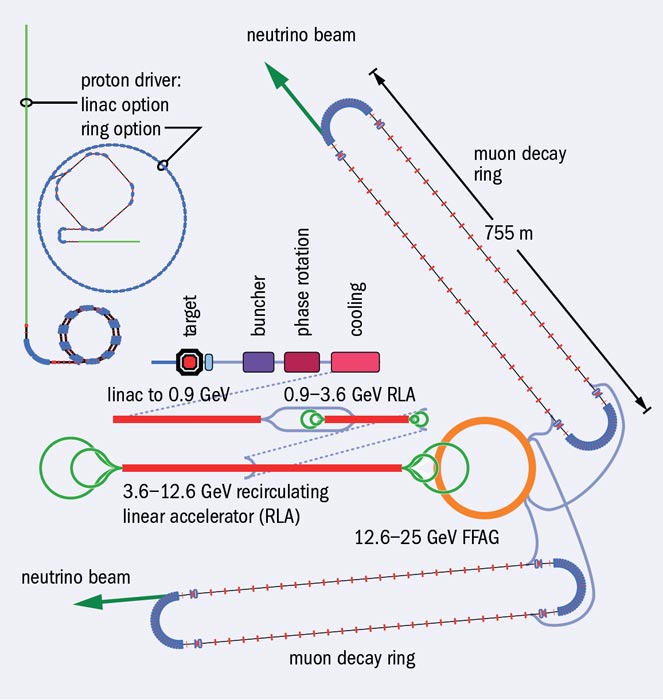
The IDS-NF baseline accelerator facility sketched in figure 3 provides a total of 1021 muon decays per year, split between the two distant neutrino detectors. The process of creating the muon beam begins with the bombardment of a pion-production target with a pulsed proton beam. The pions are captured in a solenoidal channel in which they decay to produce the muon beam. A sequence of accelerators is then used to manipulate and reduce (cool) the muon-beam phase space and to accelerate the muons to their final energy.
The muon’s short lifetime has required novel techniques to be developed to carry out these steps. Ionization cooling, the technique by which it is proposed to cool the muons, involves passing the beam through a material in which it loses energy through ionization and then re-accelerating it in the longitudinal direction to replace the lost energy. Muon acceleration will be carried out in a series of superconducting linear and recirculating linear accelerators. The final stage of acceleration, from 12.6 GeV to the stored-muon energy of 25 GeV, is provided by a fixed-field alternating-gradient (FFAG) accelerator. The baseline neutrino detector is a MINOS-like iron-scintillator sandwich calorimeter with a sampling fraction optimized for the Neutrino Factory beam. The baseline calls for a fiducial mass of 100 kilotonnes to be placed at the intermediate baseline and a detector of 50 kilotonnes at the magic baseline.
Much of the Neutrino Factory facility, the accelerator complex and the neutrino detectors exploit state-of-the-art technologies. To achieve the ultimate performance (1021 muon decays per year) the IDS-NF baseline calls for: a proton-beam power of 4 MW, delivered at a repetition rate of 50 Hz in short (around 2 ns) bunches; a pion-production target capable of accepting the high proton-beam power; an ionization-cooling channel that increases the useful muon flux by a factor of around 2; and an FFAG to boost the beam energy rapidly to 25 GeV. R&D programmes that address each of these issues are underway. CERN, along with other proton-accelerator laboratories, is actively developing the technologies necessary to deliver multimega-watt, pulsed proton beams. The principle of a mercury-jet pion-production target was demonstrated by the MERIT experiment in 2008 that ran in the beamline of n_TOF, the neutron time-of-flight facility at CERN. The nonscaling FFAG accelerator EMMA (the Electron Model of Muon Acceleration, also known as the Electron Model of Many Applications) has been commissioned at the Daresbury Laboratory in the UK and used to demonstrate the “serpentine acceleration” characteristic of the nonscaling FFAG. The international Muon Ionization Cooling Experiment (MICE) at the Rutherford Appleton Laboratory will provide the engineering demonstration of the ionization-cooling technique (see box, previous page).
The Neutrino Factory is the facility of choice for the study of neutrino oscillations. It has excellent discovery reach and offers the best precision on the mixing parameters. The ability to vary the stored-muon energy and, perhaps the detector technology, gives the necessary flexibility to respond to developments in understanding neutrino physics and in the discovery of new phenomena. The R&D programme required to make the Neutrino Factory a reality will directly benefit the development of a muon collider and experiments that seek to discover charged lepton-flavour violation. The case for the Neutrino Factory as part of a comprehensive muon-physics programme is compelling indeed.
I gratefully acknowledge the help, advice, and support of my many colleagues within the IDS-NF, EUROnu and MICE collaborations and the Neutrino Factory community who have freely discussed their results with me and from whose work and results I have drawn freely.
MICE is a single-particle experiment in which the position and momentum of each muon is measured before it enters the MICE cooling channel and is measured again after it has left (Gregoire et al. 2003 and 2005). Muons with momenta between 140 MeV/c and 240 MeV/c, with normalized emittance between 2 πmm and 10 πmm, will be provided by a purpose-built beamline at the 800 MeV proton synchrotron, ISIS, at the Rutherford Appleton Laboratory.
The MICE cooling channel, a single lattice cell, comprises three 20-l volumes of liquid hydrogen and two short linac modules each consisting of four 201 MHz cavities. Beam transport is achieved by a series of superconducting solenoids: the “focus coils” focus the beam into the liquid-hydrogen absorbers, while a “coupling coil” surrounds each of the linac modules. A particle-identification system, with scintillator time-of-flight (TOF) hodoscopes and threshold Cherenkov counters, upstream of the cooling channel allows a pure muon beam to be selected. Downstream of the cooling channel, a final hodoscope and a calorimeter system allow muon decays to be identified. The calorimeter is composed of a lead-scintillator section, of a similar design to that of the KLOE detector at DAΦNE but with thinner lead foils, followed by a fully active scintillator detector (the electron-muon ranger) in which the muons are brought to rest.
Charged-particle tracking in MICE is provided by two solenoidal spectrometers that together determine the relative change in transverse emittance of the beam, which is expected to be approximately 10%, with a precision of ±1% (i.e. a 0.1% measurement of the change in absolute emittance). The trackers themselves are required to have high track-finding efficiency in the presence of background that is induced by X-rays produced in the RF cavities.
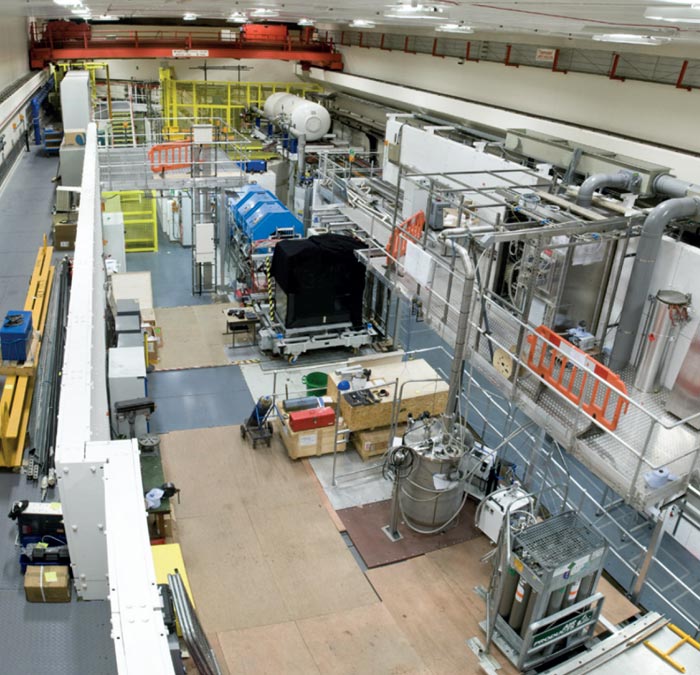
In the first “step” of the experiment, the muon beam for MICE has been characterized using the beamline instrumentation and the TOF, Cherenkov and lead-scintillator systems (figure 5). The results, which are being prepared for publication, show that the muon beam can provide the range of momentum and emittance required by MICE. The trackers and a prototype of the electron-muon ranger have been tested and shown to perform to specification. The cavities that make up the two short linac sections have been manufactured by Lawrence Berkeley National Laboratory (LBNL). The superconducting magnets required for the cooling channel are all under construction. By the end of 2012, the collaboration will commission the two spectrometer modules and the first liquid-hydrogen absorber and focus-coil module. This will allow preliminary studies of the ionization-cooling effect to be performed. The full MICE cooling cell will be constructed once the initial cooling studies are complete.
The first week of the 47th Rencontres de Moriond, devoted to weak interactions and unified theories, came to a close on 10 March, leaving participants not only impressed but also puzzled by the new results presented at the conference held in La Thuile. The focus this year was to look at the results on searches for the Higgs boson, exclusion limits, searches for dark matter, precision measurements, flavour and neutrino physics, and to assess their impact on theoretical models, in particular those based on supersymmetry (SUSY) and extra dimensions.
The first excitement came from new measurements of the branching ratio for the decay Bs→ μμ from the LHCb, CMS and ATLAS experiments at CERN’s LHC. LHCb and CMS have a sensitivity within a factor of around two of the rate expected in the Standard Model for this extremely rare decay, where contributions from new physics could be detected. LHCb is setting the best limit to date, of less than 4.5 × 10⁻⁹, barely above the Standard Model prediction of around 3.5 × 10⁻⁹. This leaves little room for new physics. However, David Straub, a theorist affiliated with Scuola Normale Superiore and INFN in Pisa, showed that finding a branching ratio smaller than predicted by the Standard Model would also open the door to new physics, something that has previously received little attention but is now becoming possible with the increase in precision at the LHC.
The ATLAS and CMS collaborations showed updates to the results reported in December 2011. These include further analyses of the full 2011 data sample. In the low-mass Higgs region, the ranges not excluded at 95% confidence level (CL) have shrunk a little more. For ATLAS, all possible Higgs masses below 122.5 GeV (except at 118 GeV) are now excluded, together with those from 129 GeV up to 539 GeV; for CMS all masses between 127.5 and 600 GeV are excluded. This leaves only a small range where the Higgs boson could still be found.
The small excesses reported in December are still there, coming mostly from H → γγ for both experiments and also from Higgs → llll for ATLAS. Having analysed the whole 2011 data set and included new decay channels, CMS observes a 2.8 σ deviation at 125 GeV, while ATLAS has a 2.5 σ excess at 126 GeV. When the “look-elsewhere effect” is taken into account in the 110–145 GeV range, the significance of this excess goes down to about 2.1 σ.
Fermilab’s Tevatron experiments provided a surprise. Having analysed almost all of their data and greatly improved their analyses, the DØ collaboration sees a slight excess of events in the Higgs mass range of 115–145 GeV while CDF sees it for mH < 150 GeV, coming mostly from the H → b-b and H → WW channels. The combined effect corresponds to a 2.2 σ excess above the predicted background. In addition, CDF and DØ greatly improved the precision on the masses of the W boson and the top quark. Both play an important role in determining the consistency of the Standard Model. In particular, CDF has measured the W mass to be 80.387 ± 0.019 GeV, while DØ finds a mass of 80.375 ± 0.023 GeV. These recent measurements now confine the Higgs mass to mH = 94+29–24 GeV.
While all four collaborations – ATLAS, CMS, CDF and DØ – insisted that it was too early to jump to conclusions about the Higgs boson, theorists have already been checking the effects of the mass of the Higgs and find that the currently allowed range is already putting constraints on SUSY models.
Away from the colliders, the announcement during the conference of the measurement of the neutrino mixing angle θ13 caused excitement (Daya Bay experiment measures θ13). Another highlight concerned the 8 σ annual modulation observed by the DAMA/LIBRA dark-matter experiment, which the collaboration interprets as a signal of dark matter. It has been suggested that the effect could be caused by cosmic muons, but new calculations show that the data are inconsistent with the cosmic muon hypothesis at 99% CL.
Possible signs of a Higgs boson with production cross-sections and branching ratios compatible with the Standard Model coupled with no signs of new physics despite extremely precise tests, left all of the participants of this first week of “Moriond” rather puzzled. Perhaps it is time to go back to the drawing board.
The Daya Bay Reactor Neutrino Experiment, a multinational collaboration operating in the south of China, has reported its first results. The team has analysed tens of thousands of interactions of electron-antineutrinos caught by six massive detectors buried in the mountains adjacent to the powerful nuclear reactors of the China Guangdong Nuclear Power Group.
The copious data revealed for the first time a strong signal of the mixing angle θ13, related to the type of neutrino oscillation in which electron-neutrinos morph into the other two flavours. This is the last mixing angle to be measured precisely and could reveal clues leading to an understanding of why matter predominates over antimatter in the universe. Once thought to be near zero, the first results indicate that sin22θ13 is equal to 0.092 ± 0.017.
The Daya Bay experiment counts the number of electron-antineutrinos detected in the halls nearest the Daya Bay and Ling Ao reactors and calculates how many would reach the detectors in the Far Hall if there were no oscillation. The number that apparently vanish on the way (by oscillating into other flavours) gives the value of θ13. Because of the near-hall/far-hall arrangement, it is unnecessary to have a precise estimate of the antineutrino flux from the reactors.
The initial results will in the coming months and years be honed by collecting more data and reducing statistical and systematic errors. Refined results will open the door to further investigations and influence the design of future neutrino experiments, including how to determine which neutrino flavours are the most massive and whether there is a difference between neutrino and antineutrino oscillations.
The search for the neutrinoless double-beta decay (ββ0ν decay) aims to solve a long-standing question concerning the nature of neutrinos. The decay, in which a nucleus decays by emitting two electrons but no neutrinos, can occur only if the neutrino is its own antiparticle, i.e. a Majorana particle. If it occurs, it must be extremely rare, with a half-life greater than 1024 years. This poses an enormous experimental challenge regarding its unambiguous detection, with just a few nuclear isotopes offering a useful hunting ground. Now an experiment at the ISOLDE facility at CERN has identified a new potential candidate, the palladium isotope 110Pd.
The signature for ββ0ν decay appears in the sum of the energies of the two emitted electrons, which should have a single peak at the Q value for the decay, i.e. at the energy corresponding to the mass difference between the initial and final nuclide. (In double-beta decay with neutrinos (ββ2ν), the emitted electrons have a broad energy spectrum.) Calorimetric experiments searching for ββ0ν require detectors fabricated from sufficient quantities of the transmuting material to allow the detection of a decay within a reasonable amount of time. In addition, the energy of the decay peak must be known precisely if the detector is to have a high resolution at the correct energy.
With its high natural abundance, 110Pd offers a promising alternative for double-beta decay searches, now that its Q value has been measured directly with unprecedented accuracy. An experiment using the Penning-trap mass spectrometer ISOLTRAP at ISOLDE has determined the Q value from the cyclotron frequency ratio of 110Pd and its decay-product 110Cd by manipulating a few, singly charged ions in an isolated environment (Fink et al. 2012).
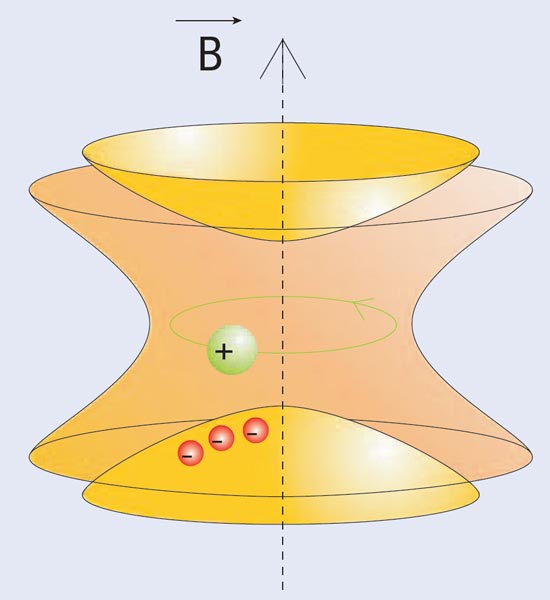
In a Penning trap, a charged particle is bound radially on the cyclotron orbit by a homogeneous magnetic field, while an electrostatic potential between the hyperbola-shaped electrodes provides axial confinement (see figure). Since the ions are trapped in three dimensions, they exhibit three eigenmotions (only one of which is shown in the figure for simplicity). An applied radio-frequency field can modify the energy stored in the eigenmotions, resonantly enhancing the energy transfer when it reaches the exact eigenfrequency. This can be measured using a technique known as time-of-flight ion-cyclotron-resonance. Usually, fewer than 10 ions of one species are excited in the trap and the cyclotron frequency is determined. The other species is then loaded into the trap and excited. This measurement cycle is repeated many times in order to collect statistics and minimize systematic effects.
In this experiment, the Q value was determined after roughly two days of measurement to be Q = 2017.85(64) keV. This value is shifted by 14 keV compared with previous results and is 17 times more precise. While the shift leads to a new value for the 110Pd half life, the lower uncertainty should enable future experiments on ββ0ν decay to have higher resolution.
The LHCb collaboration has determined the sign of the width difference in the Bs system, ΔΓs, through the influence of quantum-mechanical interference. This shows for the first time that the heavier of the two Bs meson states has the longer lifetime, a result that is in agreement with the Standard Model expectation and similar to the situation in the kaon system.
The Bs meson, made up of a b quark and s antiquark, has some fascinating properties. Because it is neutral, it can mix with its antiparticle (which has a b antiquark and s quark), and this quantum-mechanical effect leads to the Bs system having two states with well defined mass, mH and mL (for “heavy” and “light” respectively). The Bs oscillates from its particle to antiparticle state, with a frequency that is proportional to the difference in those masses, Δms = mH – mL, a frequency that is now well measured. However, the two states are also expected to have different lifetimes, so that their widths (defined as the inverse of their lifetimes) should differ by ΔΓs ≡ ΓL – ΓH. Until now, the sign of ΔΓs was not known.
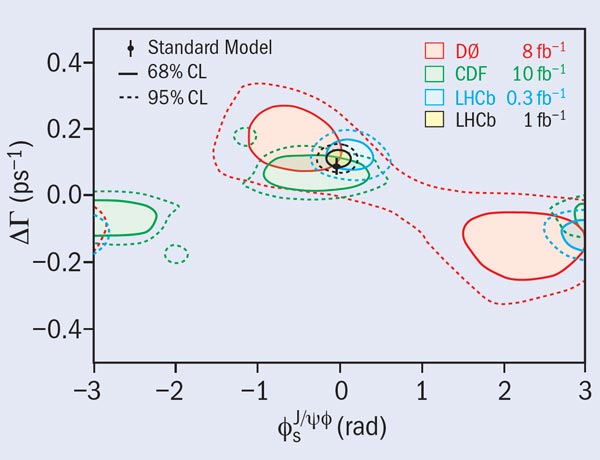
This parameter is intimately involved in the study of CP-violation in Bs mixing, where the phase of the Bs oscillations, φs, is measured. In the Standard Model, the phase is expected to be small but accurately predicted, φs = –0.036 ± 0.002 rad. It has been studied using the decays of the Bs to two lighter mesons, Bs → J/ψ φ. Because of correlations between ΔΓs and φs, the experimental searches have been presented until now as contours in the ΔΓs vs φs plane, as shown in the figure, which is an update of a previous measurement. However, because the sign of ΔΓs was unknown, there was an ambiguity in the solution, seen as two selected regions in the ΔΓs vs φs plane.
The new analysis from LHCb uses the fact that, when the spin-1 φ meson is reconstructed in its decay to K+K– , a small admixture of spin-0 kaon pairs is also included in the selected events, because – at any given K+K– mass value – the two possible spin states are quantum-mechanically indistinguishable, interference effects can be observed in the data. The relative phase of these two components varies as a function of the reconstructed mass and the trend of that variation is to increase or decrease depending on the sign of ΔΓs. The experimental data show clearly a decreasing trend, with 4.7 σ significance, demonstrating that ΔΓs is positive (LHCb 2012a). As a consequence, in the latest update of the CP-violation study there is only a single solution in the plane.
This new result was presented at the Moriond conference (Much food for thought at Moriond) and uses the full data set collected by LHCb so far (LHCb 2012b). When combined with another channel (J/ψ f0), the result is φs = –0.002 ± 0.083 (stat.) ± 0.027 (syst.) rad. While this is consistent with the Standard Model prediction, there is still room for contributions from new physics to this phase. Another exciting step forward is expected with the further doubling of the LHCb data set, expected this year.
Despite the current absence of direct experimental evidence, supersymmetry (SUSY) at the weak scale remains among the most motivated and studied extensions of the Standard Model.
A common feature of many models is that third-generation SUSY particles – the stop (t~), sbottom (b~) and stau (τ~), which are the partners of the third-generation quarks and of the τ lepton – are lighter than the partners of the first two generations. Hence, they can be produced at large rates via pair production or in the decay of gluinos, the scalar partners of gluons. Furthermore, they should decay to heavy quarks (t, b) or τ leptons, providing characteristic and striking experimental signatures. The ATLAS collaboration recently presented the results from several searches for third-generation SUSY particles based on 2 fb–1 of data (ATLAS 2012). Different strategies are used in each of these analyses, which rely on signatures with one or two hadronic taus in τ~ searches, b-jets with a lepton veto in b~ searches and two same-sign leptons or b-jets with a lepton in t~ searches. In the models considered, each SUSY decay-chain ends with the production of a stable, lightest supersymmetric particle (LSP), which is only weakly interacting and escapes detection. Therefore, high missing transverse-momentum is also required in all of these analyses.
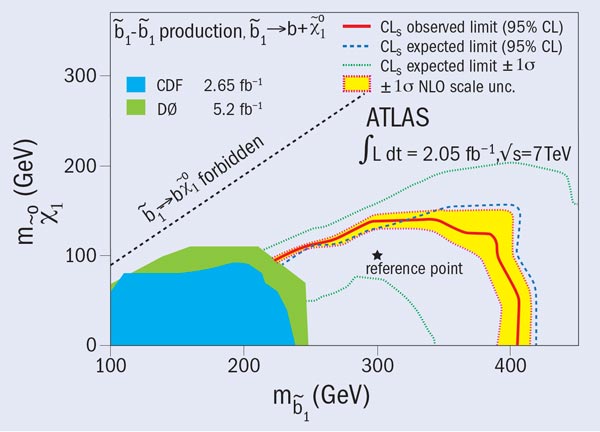
The searches found no significant excess over the Standard Model background and provide the most stringent limits to date on models that are characterized by the decay of third-generation SUSY particles. The figure shows, as an example, that the exclusion limits obtained in the search for scalar bottom pair-production – using events with exactly two b-jets – extend the existing limits on the b~ mass by about 150 GeV.
In the coming months and with increasing amounts of data, these analyses will probe unexplored regions, corresponding for example to high-LSP or gluino masses, and so may shed light on the existence of third-generation SUSY particles.
Dark matter may constitute 83% of the particles in the universe, but so far there has been no direct observation of its presence in experiments. With its high-energy collisions, the LHC is a promising hunting ground for this elusive form of “matter”, either by producing dark-matter particles directly or new particles that decay into dark matter. Recently, the CMS collaboration completed a search for dark matter, sifting through the full 2011 data set of proton collisions at a centre-of-mass energy of 7 TeV.
Dark-matter particles produced at the LHC would presumably escape undetected, yielding “missing momentum” in the event. However, they could be accompanied by a jet or a photon, or some other particle. CMS has looked for evidence of these visible companions by studying “monojet” and “monophoton” data. Within the framework of a simple model for the production of dark matter, the CMS analysis significantly extends the sensitivity of direct searches, which look for tiny interactions of dark-matter particles in very sensitive detectors.
The way that the dark-matter particles (χ) are produced and interact depends on their spin. With respect to direct searches, CMS is sensitive in the low-mass region below 3.5 GeV if the spin of the produced particles is ignored, and it can set the world’s best limits at all masses in the spin-dependent case.
The monophoton search looks for single, isolated photons (γ) with transverse energy greater than 145 GeV and more than 130 GeV of missing transverse energy. Events with excessive hadronic activity (jets) are vetoed. After the application of selection criteria, 73 events remain, where 71.9 ± 9.1 would be expected in the absence of dark-matter particles. Standard Model background-events are expected mainly from pp → Zγ – where the Z decays to two neutrinos – and from events with misidentified jets or electrons, or from instrumental sources.
The monojet search requires at least one jet with transverse momentum greater than 110 GeV and more than 350 GeV of missing transverse momentum. Events with isolated leptons or more than two jets are vetoed. After event selection, 1142 events are found in data with an expectation from Standard Model processes of 1224 ± 101 events. Again, a contribution from “invisible” decays to neutrinos dominate this expectation, either from pp → Z+jets with the Z decaying to two neutrinos, or from pp → W+jets where the W escapes detection. There seem to be no signs of a new production mechanism for the two “mono-object” signatures analysed, so CMS can use the null results to place limits on the cross-section for dark matter. The limits depend on the presumed mass of the dark-matter particles and are presented as regions in the plane of cross section vs mass in the figures.
The J/Ψ meson, a bound state of a charm and an anticharm quark, has always been an important testing ground for quantum chromodynamics (QCD). However, understanding J/Ψ production in proton–proton (pp) collisions remains a challenge. While the production of unbound c–c pairs via partonic (quark and gluon) hard-scattering processes can be described within perturbative QCD, the subsequent formation of a colourless bound state, such as the J/Ψ, leaves much room for theoretical modelling. Recently, a new measurement by the ALICE collaboration at the LHC adds yet another challenge for theoretical models.
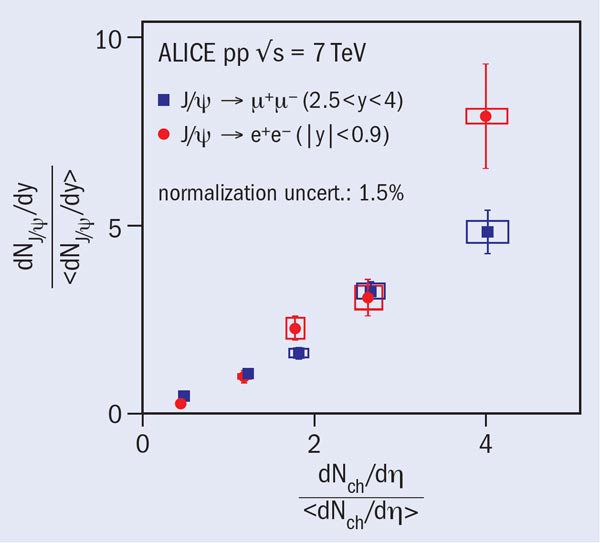
ALICE, which among the LHC experiments has the unique capability to identify J/Ψ at low transverse momenta, measured J/Ψ production in pp collisions at √s = 7 TeV as a function of the charged-particle multiplicity (dNch/dη) of the underlying event. As the figure shows, this study revealed a remarkably linear increase of the J/Ψ yield with dNch/dη (Abelev et al. 2012). Even though the charged-particle multiplicity is measured only at central rapidity, this increase is seen in not only this region but also at forward rapidities.
The charged-particle multiplicity is mostly the result of processes happening with a small momentum transfer, i.e. so-called soft processes. J/Ψ mesons, on the other hand, are expected to be produced in hard processes, as described above. The assumption has been that the two are not necessarily correlated. However, the measurement by ALICE shows that the yields of the heavy J/Ψ scale just like those of any other light hadron. Regardless of its high rest mass (3.097 GeV/c2) the J/Ψ behaves just like a “light” particle.
The event multiplicity dNch/dη could be directly related to the impact parameter of a given pp collision. This would be analogous to heavy-ion physics where, depending on the centrality of the reaction, different numbers of binary collisions occur between the nucleons. A similar situation could arise in pp collisions at LHC energies because the probability is high that many collisions take place between the quarks and gluons inside the protons. Most of these multiparton interactions are usually assumed to have a relatively low momentum-transfer and therefore to affect mainly soft-particle production. That J/Ψ production behaves similarly to the production of other charged particles might indicate that harder processes are also affected by multiparton interactions.
This measurement is an example of the new experimental opportunities that the LHC has opened up, allowing the correlation of observables on soft and hard scales. Further studies on the charged-particle multiplicity dependence of other hard processes, such as the production of Υ, open charm and beauty, should shed more light on the nature of this effect.
To provide the best experiences, we use technologies like cookies to store and/or access device information. Consenting to these technologies will allow us to process data such as browsing behavior or unique IDs on this site. Not consenting or withdrawing consent, may adversely affect certain features and functions.
Functional
Always active
The technical storage or access is strictly necessary for the legitimate purpose of enabling the use of a specific service explicitly requested by the subscriber or user, or for the sole purpose of carrying out the transmission of a communication over an electronic communications network.
Preferences
The technical storage or access is necessary for the legitimate purpose of storing preferences that are not requested by the subscriber or user.
Statistics
The technical storage or access that is used exclusively for statistical purposes.The technical storage or access that is used exclusively for anonymous statistical purposes. Without a subpoena, voluntary compliance on the part of your Internet Service Provider, or additional records from a third party, information stored or retrieved for this purpose alone cannot usually be used to identify you.
Marketing
The technical storage or access is required to create user profiles to send advertising, or to track the user on a website or across several websites for similar marketing purposes.