Comsol -leaderboard other pages

Topics

Plumbing the depths of neutron stars

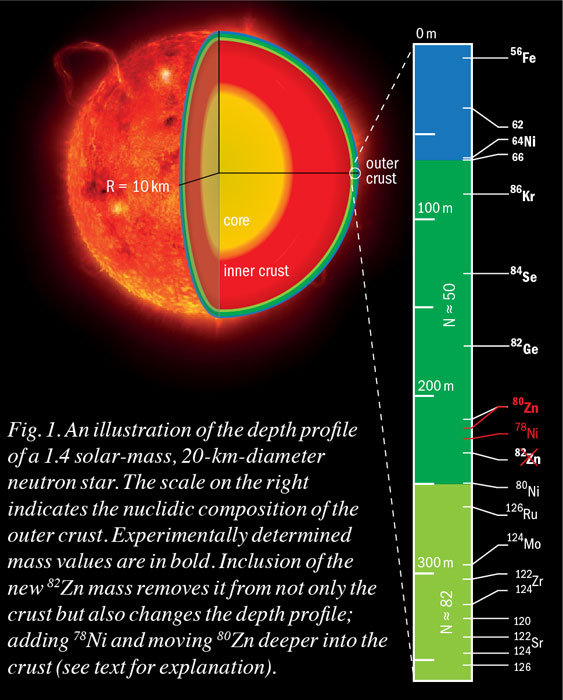
An illustration of the depth profile

Imagine the mass of the entire Sun squeezed into a radius of just 10 km. This is about the density of a neutron star – the highest density known in the cosmos. These extremely dense objects are the residues of core-collapse supernova explosions, so a significant fraction of the stars in the universe finish their lives this way. They are often present as binary systems that eventually merge, in principle radiating detectable gravity waves. Another tantalizing possibility is that the ejecta from these events might enrich the interstellar medium with heavy elements, created by a rapid neutron-capture process (the r process). The composition of neutron stars is therefore important yet the description of these ultracompact objects remains one of the biggest challenges facing nuclear and particle physics today.

As the name implies, neutron stars are essentially – but not wholly – composed of neutrons. As figure 1 shows, neutron stars are thought to consist of three layers: a homogeneous core and two concentric shells (Lattimer and Prakash 2004). The surface of the star contains only nuclei that are stable under natural terrestrial conditions. Below this “outer crust”, however, the rapidly increasing internal densities form nuclei that are increasingly neutron-rich, eventually reaching the “drip line”, or the brink of nuclear stability. This marks the transition to the “inner crust”, which is an inhomogeneous assembly of neutron–proton clusters and unbound neutrons that is neutralized by a quasi-uniform electron gas. Deeper into the star, the clusters start to smooth out, giving way to the inner core whose structure is the source of much debate.

Magic numbers

A landmark paper in 1971 presented a model for neutron stars that assumed cold, catalysed matter in which increasingly heavy and neutron-rich nuclides (resulting from electron capture) exist in a state of equilibrium for beta-decay processes (Baym, Pethick and Sutherland, 1971). The effects of the shell structure of nuclei mean that the nuclides residing in neutron-star crusts will cluster around the “magic” neutron numbers, N = 50 and 82, which correspond to closed shells (see figure 2). Indeed, one of the outstanding questions in nuclear physics is whether these magic numbers retain their “supernatural” characteristics in nuclides far from stability. The most exotic N = 50 and N = 82 species are therefore the priority for many experiments in nuclear physics.
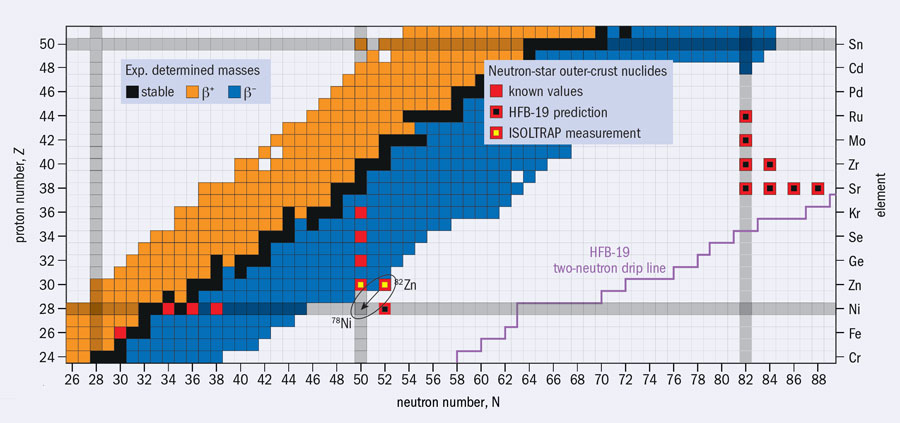
Chart of nuclides

Neutron-star crusts present a situation in which solid-state physics is combined with nuclear physics and relativistic gravitation. Although it will remain impossible to create such conditions in the laboratory, recent developments in nuclear theory are now providing consistent and accurate knowledge of nuclear binding energies and a nuclear equation of state that can help to place the composition of the outer crust on firm ground. In analogy with ice cores, scientists can “drill” into the neutron star to determine the most abundant species in each layer. Using known masses, the composition of the outer crust has been well determined to a depth of about 215 m (for the star shown in figure 1) but deeper knowledge relies on theoretical models of nuclear masses. However, different state-of-the-art mass models do not predict the same composition and they can be tested only by high-precision mass measurements on further exotic species.

Unlike many scenarios in nucleosynthesis, where astrophysical uncertainties dominate those resulting from nuclear physics, those of the neutron-star crust are relatively robust. This is because of its likeness to a crystalline semiconductor in a sea of charge-carriers, except that the crust is a lattice of neutron-rich nuclides surrounded by neutrons. The lattice and thermodynamic conditions are therefore well defined, so the crustal composition will depend mainly on the nuclear binding energies.

The ISOLTRAP Penning-trap mass spectrometer at CERN’s ISOLDE radioactive-beam facility has pioneered the art of online precision mass measurements

The ISOLTRAP Penning-trap mass spectrometer at CERN’s ISOLDE radioactive-beam facility has pioneered the art of online precision mass measurements. It uses static electric and magnetic fields to confine ions in an unperturbed environment to weigh accurately the exotic nuclides produced by ISOLDE. Recently, an advance in mass spectrometry with the ISOLTRAP experiment combined with the state-of-the-art purification techniques at ISOLDE, have enabled a first measurement of the mass of 82Zn, an exotic nuclide predicted to reside in neutron-star crusts (Wolf et al. 2013).

The ISOLDE facility produces exotic zinc isotopes by fission in a uranium-carbide target bombarded by the 1.4 GeV proton beams from CERN’s PS-Booster (PSB). Because protons also induce transmutation through the process of spallation, other neutron-deficient elements having the same mass number (isobars) are also produced. Isobaric contamination is the worst enemy of exotic nuclides because their intensity can be up to a million times higher than that of the isobar being sought.

The first line of defence against this is a special version of an ISOLDE target that includes a tungsten convertor unit. Instead of aiming for the target itself, the PSB operators bear left, to hit the converter. The result is an effusion of slow neutrons that induce fission in the nearby target material but without producing the isobaric contamination that would result from direct spallation reactions. Having produced only neutron-rich isobars, the next line of defence is a highly selective, three-step laser excitation tuned to ionize only zinc isotopes. Yet another trick is then pulled from ISOLDE’s sleeve to eliminate residual surface-ionized isobars: a temperature-controlled quartz transfer-line between the target and the ion source. Nevertheless, despite these state-of-the-art precautions, more than 6000 ions per second of 82Rb were still present in the beam delivered to ISOLTRAP in comparison to just a few ions of zinc, making this one of the most challenging measurements of exotic nuclides to date.

To measure 82Zn, yet another type of ion trap was integrated into the suite of Paul and Penning traps comprising ISOLTRAP’s mass spectrometer. The multi-reflection time-of-flight mass separator (MR-ToF MS), shown in figure 3 (overleaf), allowed residual 82Rb+ contaminants to be separated in time after multiple reflections between electrostatic mirrors. The advantage over purification in Penning traps is a mass-resolving power in excess of 100,000, obtained in about only 15 ms. From the MR-ToF MS, the short-lived 82Zn+ ions were sent through an electronic beam gate, opened quickly for 82Zn but otherwise closed to block the contaminants. The purified sample was transferred to the first of two Penning traps situated in individual superconducting solenoids, where the ions were cooled in a helium buffer-gas in preparation for the final mass measurement in the second, hyperbolic high-precision Penning trap. There, the standard time-of-flight ion cyclotron-resonance technique was used to determine the mass. This successful implementation of the MR-ToF MS represents a pioneering advance in mass spectrometry.

Drilling deeper

Probing neutron-star composition requires solving relativistic equations, known as the Tolman-Oppenheimer-Volkov (TOV) equations, that govern hydrostatic equilibrium in neutron-degenerate matter. The TOV equations relate pressure and mass-energy to the neutron-star radius and therefore require an equation of state. Stable- and radioactive-beam facilities have provided substantial information about the equations of state of finite nuclei but even the most exotic systems studied have proton fractions of 25–30%, which is far larger than the few per cent found in neutron stars. With this in mind, a Brussels-Montréal collaboration has developed a model for predicting nuclear binding energies based on the Skyrme force – an effective interaction between nucleons that also provides an equation of state – within the same theoretical framework (Pearson et al. 2011).
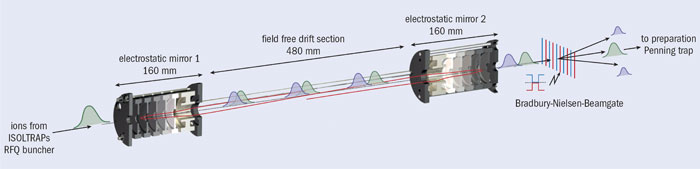
Multi-reflection time-of-flight mass separator

With the new 82Zn mass, calculations were performed to “drill” deeper into the neutron-star crust. This was done by minimizing the Gibb’s free energy per nucleon, where the total pressure at a given depth can be determined by the electron pressure and the lattice pressure. The abundances of all neighbouring nuclides were calculated for an array of nucleon densities and pressures. Last, the depths of the crust at which the nuclides are formed can be found using the TOV equations. Figures 1 and 2 illustrate the results. Because the new mass is considerably less bound than the predictions of the mean-field model HFB-19, 82Zn is no longer present in the neutron-star crust. The nuclide 80Zn remains but its presence is now constrained experimentally – deeper in the core than predicted by HFB-19. This result has extended knowledge of the crust composition of neutron stars to new depths.

This composition may have relevance for the nucleosynthesis of heavy elements by the r process, named for the series of rapid neutron captures that are involved (Arnould et al. 2007). The decompression of a neutron star’s matter brought about by tidal effects from a merger with a black hole or another neutron star, allows an r process to occur as the ejected clump vaporizes into the interstellar medium. While the total ejected mass per event is relatively low, it can still explain the total enrichment of r nuclei in the Galaxy; moreover, the calculated abundance distribution is tantalizingly close to that observed in the Solar System. The robustness of these predictions to the variation of input parameters makes the composition of neutron stars one of the most promising situations for addressing the important question of the origin of the elements.
First measurements of electroweak boson fusion

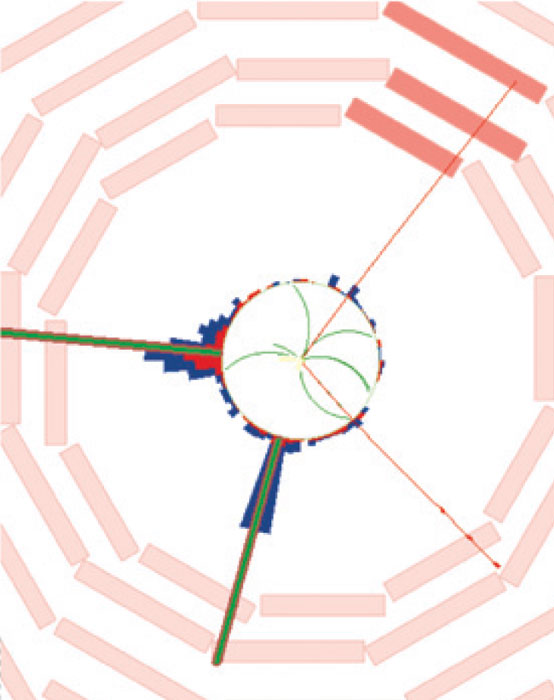
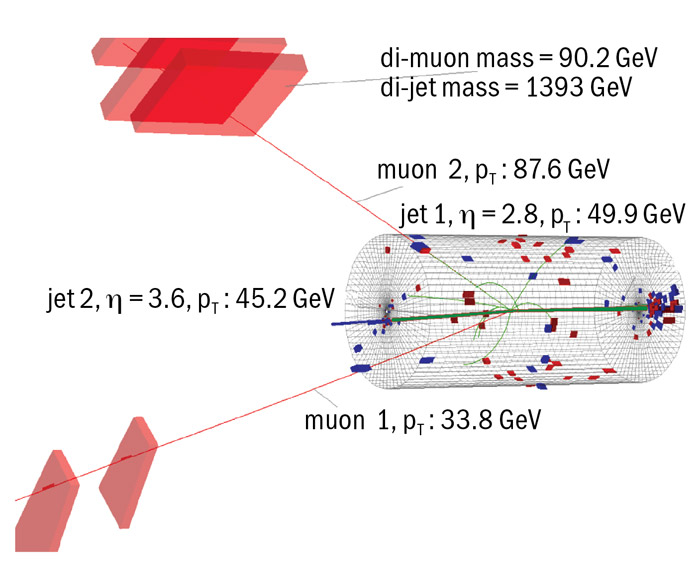
In proton collisions at the LHC, vector boson fusion (VBF) happens when quarks from each one of the two colliding protons radiate W or Z bosons that subsequently interact or “fuse” as in the Feynman diagram shown where two W bosons fuse to produce a Z boson. Each quark radiating a weak boson exchanges four-momentum, Q2, of around m2Z, m2W in the t-channel. In this way, the two quarks scatter away from the beamline, typically inside the acceptance of the detector where they can be detected as hadronic jets. The distinctive signature of VBF is therefore the presence of two energetic hadronic jets (tagging jets), predominantly in the forward and backward directions with respect to the proton beamline.

CCnew9_01_13

The study of VBF production of the Z boson is an important benchmark in establishing the presence of these processes in general and to cross-check measurements of Higgs VBF, where the radiated bosons fuse to form a Higgs boson. However, the VBF production of Z bosons has some intriguing differences with respect to that of Higgs bosons. In VBF Z-boson production, a large number of other purely electroweak non-VBF processes can lead to an identical final state and play an important role: they yield large negative interferences with the VBF production, which are related to the very foundations of the Standard Model. This situation makes VBF production of Z bosons more complicated but also more interesting.

CCnew11_01_13

An additional and peculiar feature of VBF and all other purely electroweak processes is that no QCD colour is exchanged in the processes. This leads to the expectation of a “rapidity gap”, or suppressed hadronic activity between the two tagging jets, which can also be identified in these events.

The CMS collaboration has searched for the pure electroweak production of a Z boson in association with two jets in the 7 TeV proton–proton collision data from 2011. They have analysed both dielectron and dimuon Z decays. The leptons are required to have transverse momenta pT > 20 GeV/c and pseudorapidity |η| < 2.4; in addition, the dilepton invariant-mass is required to be consistent with that of the Z boson. The two associated tagging jets are reconstructed with two alternative algorithms (“particle flow” and “jet-plus-track”) and are required to be within |η| < 3.6 and have pT > 65 GeV/c (for the leading jet) and 40 GeV/c (subleading jet).

CCnew10_01_13

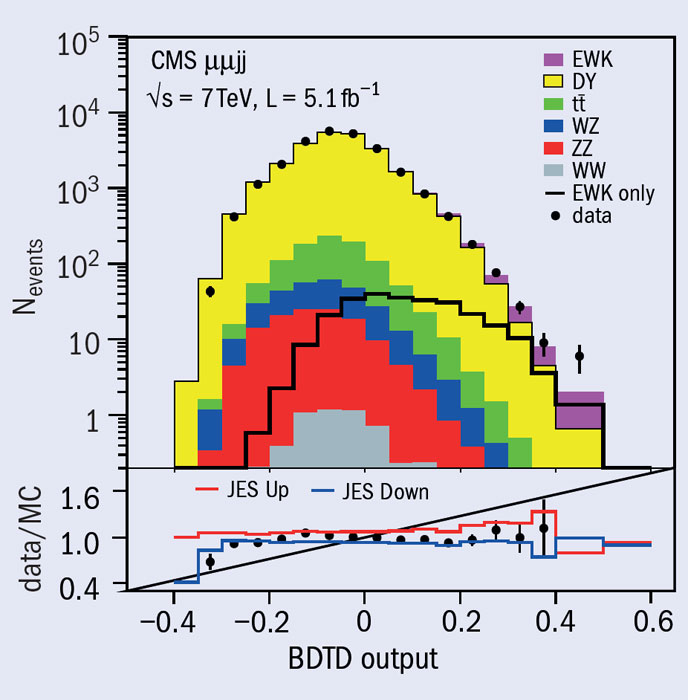
Selected events are passed to a multivariate boosted decision tree (BDT) that is trained to separate signal events from the large background stemming from the Z bosons produced via the Drell-Yan process and associated with two jets from additional QCD radiation. The BDT makes use of the full kinematic information of the three-body (Z+2jets) final state and of internal composition properties of the jet, which can discriminate if the jet originates from a gluon or a light quark. Figure 2a shows output distributions of the BDT for data and different simulated background components, as well as the simulated signal (purple) for selected dimuon Z decays. A fit to the BDT output distribution was used to measure the signal cross-section, σ(EWK Z+2jets) = 154 ± 24 (stat.) ± 46 (exp. syst.) ± 27 (th. syst.) ± 3 (lum.) fb. This is in good agreement with the theoretical expectation of 166 fb calculated at next-to-leading order precision.

CCnew12_01_13

The hadronic activity in the rapidity interval between the two tagging jets and the radiation patterns of the selected Z boson events with two forward jets have also been measured and are in good agreement with the expectations.

LHCb pins down X(3872) quantum numbers

One of the most interesting discoveries of the past decade is that of an unconventional hadron, the X(3872), by the Belle experiment (Belle 2003). Its decay to J/ψπ+π indicates that it is charmonium-like but its narrow width and mass above the threshold for decay to open charm do not fit any of the spectrum of predicted cc states. Several experiments have since confirmed this observation, in different production mechanisms and decay modes. In parallel to these experimental investigations, many theoretical interpretations have been put forward but the fundamental question remains open of whether the X(3872) is a quark–antiquark meson or a more exotic state.

CCnew13_01_13

When any new resonance is observed it is mandatory to determine its quantum numbers. The observation of the decay X(3872)→J/ψγ fixed the charge conjugation: C = +1. However, angular analyses left two possibilities for JPC: 1++ and 2–+ (CDF 2007). Exotic models where the X(3872) is a DD* molecule or a tetraquark state predict JPC = 1++.

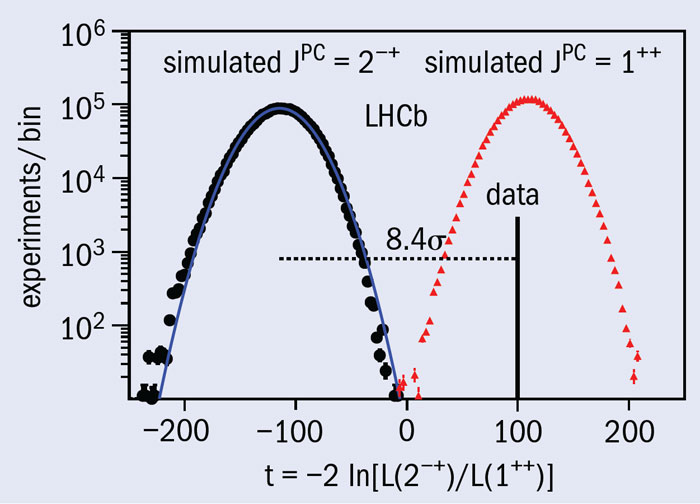
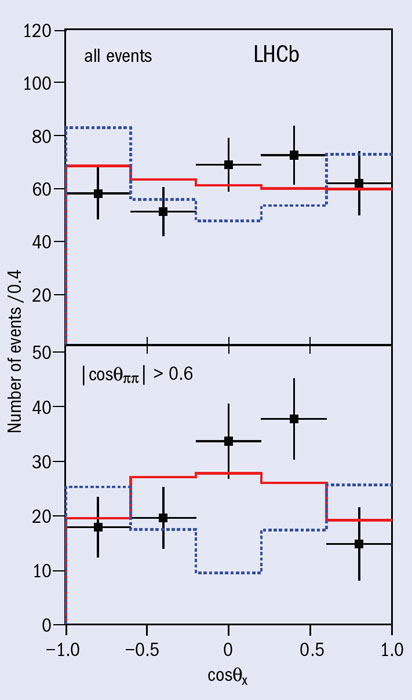
The LHCb collaboration has now reported an analysis of the decay chain B+ → X(3872)K+ → J/ψπ+πK+, with J/ψ → μ+μ, where they use all five angular variables to maximize the separation power between the hypotheses of 1++ and 2–+. The analysis uses the data sample of 1.0 fb–1 that LHCb collected during 2011, which contains 313 ± 26 B+ → X(3872)K+ decays. As figure 1 shows, the outcome of the multidimensional likelihood fit prefers JPC = 1++ with more than 8σ significance. Compared with previous analyses, the measurement benefits from larger statistics but importantly also makes use of the full angular information, which improves the ability to use correlations between angular variables to separate the two hypotheses (figure 2 shows an example).

CCnew15_01_13

This result rules out explanations of the X(3872) as the ηc2(11D2) state. Instead, it favours more exotic interpretations. However, distinguishing between molecular and tetraquark models will require studies of complementary decay modes. The 2.0 fb–1 data sample that LHCb accumulated during 2012, as well as the larger samples that will be recorded in future LHC runs, will allow the collaboration to keep on the trail of these and other puzzles in heavy-flavour spectroscopy.

Charm and beauty in Utrecht

CCutr1_01_13

The historic academic building of Utrecht University provided the setting for the 5th International Workshop on Heavy Quark Production in Heavy-Ion Collisions, offering a unique atmosphere for a lively discussion and interpretation of the current measurements on open and hidden heavy flavour in high-energy heavy-ion collisions. Held on 14–17 November, the workshop attracted some 70 researchers from around the world, a third of the participants being theorists and more than 20% female researchers. The topics for discussion covered recent results, upgrades and future experiments at CERN’s LHC, Brookhaven’s Relativistic Heavy-Ion Collider (RHIC) and the Facility for Antiproton and Ion Research (FAIR) at Darmstadt, as well as theoretical developments. There was a particular focus on the exchange of information and ideas between the experiments on open heavy-flavour reconstruction.

Open and hidden heavy flavour

Representatives from all of the major collaborations nicely summarized recent experimental results and prospects for future measurements. In particular, with the advent of the LHC, an unprecedented wealth of data on the production of heavy quarks and quarkonium in nuclear collisions has become available. One of the more spectacular effects observed at RHIC is the quenching of the transverse momentum (pT) spectra of light hadrons, related to the energy loss of quarks inside the hot quark–gluon plasma (QGP) phase produced in lead–lead (PbPb) collisions. This has now been studied in detail for the first time by the ALICE, ATLAS and CMS collaborations in the heavy-quark sector.

CCutr2_01_13

Among the highlights presented at the workshop, the ALICE collaboration reported a strong suppression (up to a factor around 5) of the production of D mesons in PbPb collisions at a centre-of-mass energy, √sNN, of 2.76 TeV, compared with proton–proton data at the same energy. The CMS experiment has also found a sizeable suppression of the yield of J/ψs coming from the decay of B hadrons. When this effect is compared with the one measured by the same experiments for light hadrons, interesting hints of a hierarchy of suppression are seen, with the beauty hadrons being less suppressed than the charmed hadrons and the latter less suppressed than light hadrons. Such an observation may be connected to the so called dead-cone effect, a reduction of small-angle gluon radiation for heavy compared with light quarks, predicted by QCD and related to the energy density reached in the medium.

In the quarkonium sector, the ALICE and CMS collaborations showed new and intriguing results on J/ψ and Υ production, respectively. A suppression of charmonium states had been previously observed at CERN’s Super Proton Synchrotron (SPS) and at RHIC and was explained as an effect of the screening of the binding colour force in a QGP. With data from the LHC, accurate results on the bottomonium states have proved for the first time – beyond any doubt – that the less-strongly bound Υ(2S) and Υ(3S) are up to five times more strongly suppressed in a QGP with respect to the tightly bound Υ(1S) state, an observation that is expected in a colour-screening scenario. On the contrary, the ALICE collaboration sees a smaller suppression-effect for the J/ψ with respect to RHIC and the SPS, despite the larger energy density reached in nuclear collisions at the LHC. An interesting hypothesis relates this observation to a recombination of cc pairs, which are produced with high multiplicity in each PbPb collision, in the later stages when the system cools down and crosses the transition temperature between the QGP and the ordinary hadronic world.

Theoretical developments

The talks on theory provided quite a comprehensive overview of the vigorous research efforts towards a theoretical understanding of heavy-quark probes in heavy-ion collisions. The experimental findings on open heavy-flavour suppression and elliptic flow have led to many theoretical investigations of heavy-quark diffusion in the strongly coupled QGP. Most models use a relativistic Fokker-Planck-Langevin approach, with drag and diffusion coefficients taken from various microscopic models for the heavy-quark interactions with the hot and dense medium. The microscopic models include estimates from perturbative QCD for elastic- and/or radiative-scattering processes, T-matrix calculations using in-medium lattice potentials (from both the free and the internal thermodynamic potentials) and collision terms in full transport simulations, including 2 ↔ 2 and 2 ↔ 3 processes in perturbative QCD.

First studies of the influence of the hadronic phase on the modifications of the open-heavy-flavour medium were presented at the workshop. Estimates of the viscosity to entropy-density ratio, η/s, from the corresponding partonic and hadronic heavy-quark transport coefficients, lead to values that are not too far from the conjectured anti-de Sitter/conformal field theory lower bound of 1/4π in the phase-transition region, showing the characteristic minimum around the critical temperature, Tc. Results from a direct calculation of the heavy-quark transport coefficients via the maximum-entropy method applied to lattice-QCD correlation functions were also reported.

In the field of heavy quarkonia, the notion of a possible regeneration of heavy quarkonia via qq recombination in the medium in addition to the dissociation/melting processes leading to their suppression in the QGP has in recent years led to detailed studies on the bound-state properties of heavy quarkonia in the hot medium. Here, the models range from the evaluation of static qq potentials in hard-thermal-loop resummed thermal-QCD to a generalization of systematic nonrelativistic QCD and heavy-quark effective theory studies, generalizing from the vacuum to thermal field theory.

These theoretical studies have already led to major progress in understanding the possible microscopic mechanisms behind the coupling of heavy-quark degrees of freedom with the hot and dense medium created in heavy-ion collisions. In future, it might be possible to gain an even better quantitative understanding of fundamental quantities such as the transport coefficients of the QGP (for example η/s) and the dissociation temperatures of heavy quarkonia, which could provide a thermometer for the QGP formed in heavy-ion collisions. Whatever happens, the workshop has provided an excellent framework to discuss this exciting theoretical work and trigger some fruitful ideas for its future development.

The observed signals for the QGP are expected to be even stronger in PbPb collisions at √sNN = 5.1 TeV (foreseen in 2015) and allow the properties of the QGP to be characterized further. Proton–lead data are urgently needed to measure the contribution from the effects in cold nuclear matter, such as nuclear shadowing and Cronin enhancement. The experimental teams at the LHC and at RHIC are working on upgrades of the inner tracking systems of their detectors, aiming for an improved resolution in impact parameter, which will make the measurement of open beauty in heavy-ion collisions feasible in the near future.

• The organizers would like to thank the Lawrence Berkeley National Laboratory and the Foundation for Fundamental Research on Matter (FOM) for financial support.

Spin physics in Dubna

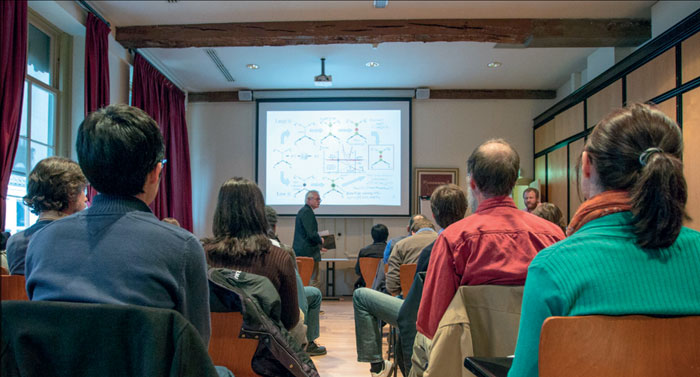
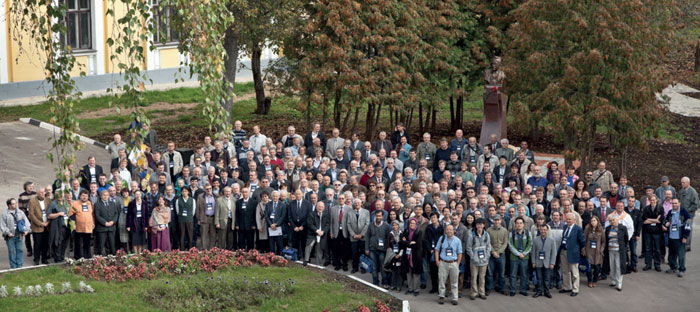
SPIN 2012, the 20th International Symposium on Spin Physics, took place at the Joint Institute for Nuclear Research (JINR) in Dubna on 17–22 September. Around 300 participants attended from JINR and institutes in 22 countries (mainly Germany, Italy, Japan, Russia and the US). It consisted of a traditional mix of plenary and parallel sessions. Presentations covered the spin structure of hadrons, spin effects in reactions with lepton and hadron beams, spin physics beyond the Standard Model and future experiments, as well as the techniques of polarized beams and targets, and the application of spin phenomena in medicine and technology.

CCspi1_01_13

The symposium began with a focus on work at Dubna, starting with the unveiling of a monument to Vladimir Veksler, who invented the principle of phase stability (independently from Edwin McMillan in the US) and founded the 10 GeV Synchro-phasotron in Dubna in 1955. Talks followed about the future projects to be carried out at JINR’s newest facility, the Nuclotron-based Ion Collider fAcility (NICA). The complex will include an upgraded superconducting synchrotron, Nuclotron-M, with an area for fixed-target experiments, as well as a collider with two intersections for polarized protons (at 12 GeV per beam) or deuterons and nuclei (5 A GeV per beam). It will provide opportunities for a range of polarization studies to complement global data and will particularly help to solve the puzzles of spin effects that have been awaiting solutions since the 1970s. The spin community at the symposium supported the plans for these unique capabilities, and JINR’s director, Victor Matveev, announced that the project is ready to invite international nominations for leading positions in the spin programme at NICA.

The experimental landscape

In the US, Jefferson Lab’s programme of experiments on generalized parton distributions (GPDs) will be implemented with upgraded detectors and an increase in the energy of the Continuous Electron Beam Accelerator Facility from 6 GeV up to 12 GeV. The laboratory is also considering the construction of a new synchrotron to accelerate protons and nuclei up to 250 GeV before collision with 12 GeV electrons. In a similar way, a new 10–30 GeV electron accelerator is being proposed at Brookhaven National Laboratory to provide collisions between electrons and polarized protons and ions, including polarized 3He nuclei, at the Relativistic Heavy-Ion Collider (RHIC). The aim will be to investigate the spin structure of the proton and the neutron.

CCspi2_01_13

At CERN, the COMPASS-II project has been approved, firstly to study Drell-Yan muon-pair production in collisions of pions with polarized nucleons, to investigate the nucleon’s parton distribution functions (PDFs). A second aim is to study GPDs via the deeply virtual Compton-scattering processes of exclusive photon and meson production. The latter processes will provide the possibility for measuring the contribution of the orbital angular momenta of quarks and gluons to the nucleon spin. The Institute of High Energy Physics (IHEP), Protvino, has a programme at the U-70 accelerator for obtaining polarized proton and antiproton beams from Λ decay for spin studies at the SPASCHARM facility, which is currently under construction.

The participants heard with interest the plans to construct dedicated facilities for determining the electric dipole moment (EDM) of the proton and nuclei, with proposals by the Storage Ring EDM collaboration at Brookhaven and the JEDI collaboration at Jülich. The dipole moment of fundamental particles violates both parity and time-reversal invariance. Its detection would indicate the violation of the Standard Model and would, in particular, make it possible to approach the problem of understanding the baryon asymmetry of the universe. The proposed experiments would reduce the measurement limit on the deuteron EDM down to 10–29 e cm.

Classical experiments studying the nucleon spin structure at high energies use both lepton scattering on polarized nucleons (e.g. in HERMES at DESY, COMPASS and at Jefferson Lab) and collisions of polarized hadrons (at RHIC, IHEP and JINR). A unified description of these different high-energy processes is becoming possible within the context of QCD, the theory of strong interactions. Related properties, such as factorization, local quark–hadron duality and asymptotic freedom, allow the calculation of the characteristics of the process within the framework of perturbation theory. At the same time, PDFs, correlation and fragmentation functions are not calculable in perturbative QCD, but being universal they should be either parameterized and determined using various processes or calculated within some model approaches. A number of talks at the symposium were devoted to the development and application of such models.

Theory confronts experiment

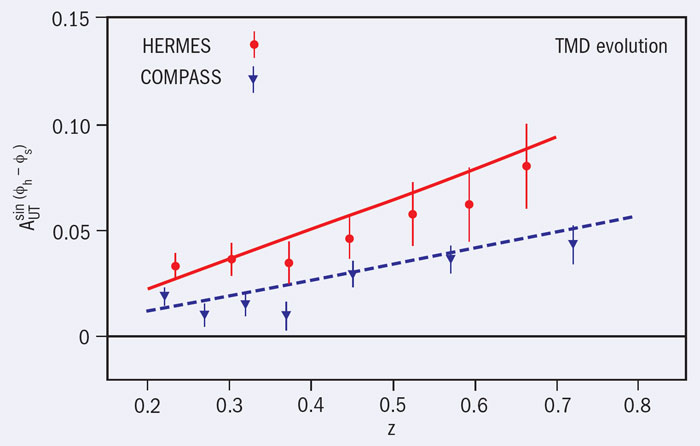
Experiments involving spin have brought about the demise of more theories than any other single physical parameter. Modern theoretical descriptions of spin-dependent PDFs, especially those including the internal transverse-parton motion, were discussed at the symposium. In this case, the number of PDFs increases and the picture that is related to them loses – to a considerable degree – the simplicity of a parton model with its probabilistic interpretation. One of the difficulties here concerns how the PDFs evolve with a change in the wavelength of the probe particle. A new approach to solving this problem was outlined and demonstrated for the so-called Sivers asymmetry measured in data from the HERMES and COMPASS experiments (figure 1).

CCspi3_01_13

The helicity distributions of the quarks in a nucleon are the most thoroughly studied so far. The results of the most accurate measurements by COMPASS, HERMES and the CLAS experiment at Jefferson Lab were presented by the collaborations. The present-day experimental data are sufficiently precise to include them in QCD analysis. Two new alternative methods for the QCD analysis of deep-inelastic scattering (DIS) and semi-inclusive DIS (SIDIS) data allow a positive polarization of strange quarks to be excluded with a high probability. As for the gluon polarization, the results of its direct measurement by the COMPASS experiment, which are confirmed by the PHENIX and STAR experiments at RHIC, also agree with QCD analysis. The low value of gluon polarization indicates that its contribution to nucleon spin is not enough to resolve the so-called nucleon-spin crisis. Hopes to overcome this crisis are now connected to the possible contributions of the orbital angular momenta of quarks and gluons, to be measured from GPDs. There were talks on different theoretical aspects of GPDs, as well as experimental aspects of their measurement, in the context of the HERMES, CLAS and COMPASS experiments.

Other important spin distribution functions manifest themselves in the lepton DIS off transversely polarized nucleons. The processes in which the polarization of only one particle (initial or final) is known are especially interesting. However, although relatively simple from the point of view of the experiment, they are complicated from the theoretical point of view (such complementarities frequently occur). These single-spin asymmetries are related to T-odd effects, i.e. they seemingly break invariance with respect to time reversal. However, it is a case of “effective breaking” – that is, it is not related to a true non-invariance of a fundamental interaction (here, the strong interaction, described by QCD) with respect to time reversal but to its simulation by the effects of re-scattering in the final or initial states. The single asymmetries have been studied by theorists for more than 20 years. These studies have received a fresh impetus in recent years in connection with new experimental data on single-spin asymmetries in the semi-inclusive electroproduction of hadrons off longitudinally and transversely polarized and unpolarized nucleons.

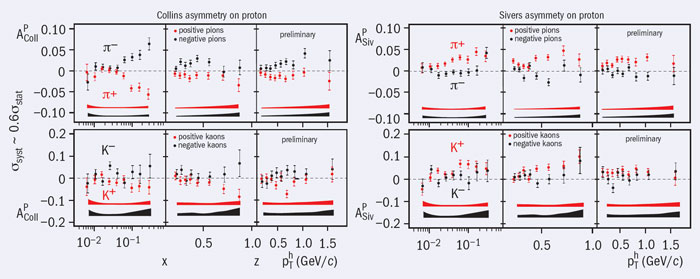
Reports from the COMPASS collaborations on transverse-momentum-dependent (TMD) asymmetries were one of the highlights of the symposium. The experiment is studying as many as 14 different TMD asymmetries. Two of them, the Collins and Sivers asymmetries (figure 2) – which are responsible for the left–right asymmetries of hadrons in the fragmentation of transversely polarized quarks and quark distributions in transversely polarized nucleons – are now definitely established in the global analysis of all of the available data, although other TMD effects require further study. The results of studies of the transverse structure of the proton at Jefferson Lab were also presented at the symposium.

CCspi4_01_13

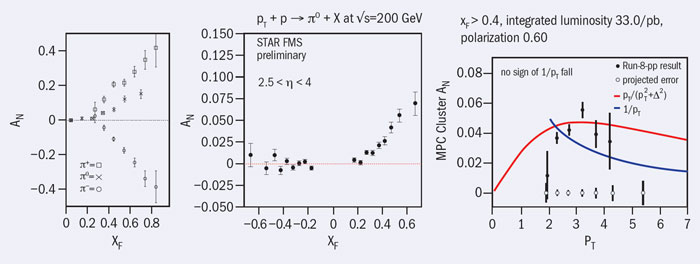
The PHENIX and STAR collaborations have new data on the single-spin asymmetries of pions and η-mesons produced in proton–proton collisions at 200 GeV per beam at RHIC, with one of the beams polarized and the other unpolarized. They observe amazingly large asymmetries in the forward rapidity region of the fragmenting polarized or unpolarized protons, with a fall to zero in the central rapidity region. A similar effect was observed earlier at Protvino and at Fermilab, but at lower energies, thus confirming energy independence (figure 3). In addition, there is no fall with rising transverse momentum in the values of the asymmetry measured at RHIC. The particular mechanism for these asymmetries remains a puzzle so far.

So although single-spin asymmetries on the whole are described by existing theory, developments continue. The T-odd distribution functions involved lose the key property of universality and become “effective”, that is, dependent on the process in which they are observed. In particular, the most fundamental QCD prediction is the change of sign of the Sivers PDF determined from SIDIS processes and from Drell-Yan pair-production on a transversely polarized target. This prediction is to be checked by the COMPASS-II experiment as well as at RHIC, NICA and in the PANDA and PAX experiments at the Facility for Antiproton and Ion Research.

New data from Jefferson Lab on measurements of the ratio of the proton’s electric and magnetic form factors performed by the technique of recoil polarization gave rise to significant interest and discussions at the symposium. The previous measurements from Jefferson Lab showed that this ratio is not constant, as had been suggested for a long time, but decreases linearly with increasing momentum transfer, Q2 – the so-called “form factor crisis”. New data from the GEp(III) experiment indicate a flattening of this ratio in the region of Q2 = 6–8 GeV2. The question of whether this behaviour is a result of an incomplete calculation of radiative corrections – in particular, two-photon exchange – remains open.

The symposium enjoyed hearing the first results related to spin physics from experiments at CERN’s LHC. In particular, many discussions focused on the role of spin in investigating the recently discovered particle with a mass of 125 GeV, which could be the Higgs boson, as well as in studies of the polarization of W and Z bosons, and in heavy-quark physics. A number of talks were dedicated to the opportunities for theory related to searches for the Z’ and other exotics at the LHC and the future electron–positron International Linear Collider.

On the technical side there was confirmation of the method of obtaining the proton-beam polarization at the COSY facility in Jülich by spin filtration in the polarized gas target. This method can also be used for polarization of an antiproton beam, which will be important for measurements of different spin distributions in the nucleon via Drell-Yan muon-pair production in polarized proton–antiproton collisions in the PANDA and PAX experiments. There were also discussions on sources of polarized particles, the physics of polarized-beam acceleration, polarimeters and polarized-target techniques. In addition, there were reports on applications of hyperpolarized 3He and 19F in different fields of physics, applied science and medicine.

The main results of the symposium were summarized in an excellent concluding talk by Franco Bradamante from Trieste. The proceedings will be published in special volumes of Physics of Elementary Particles and Atomic Nuclei. The International Committee on Spin Physics, which met during the symposium, emphasized the excellent organization and success of the meeting in Dubna and decided that the 21st Symposium of Spin Physics will take place in Beijing in September 2014.

BOSS gives clearer view of baryon oscillations

CCnew3_01_13

In November the Baryon Oscillation Spectroscopic Survey (BOSS) released its second major result of 2012, using 48,000 quasars with redshifts (z) up to 3.5 as backlights to map intergalactic hydrogen gas in the early universe for the first time, as far back as 11,500 million years ago.

As the light from each quasar passes through clouds of gas on its way to Earth, its spectrum accumulates a thicket of hydrogen absorption lines, the “Lyman-alpha forest”, whose redshifts and prominence reveal the varying density of the gas along the line of sight. BOSS collected enough close-together quasars to map the distribution of the gas in 3D over a wide expanse of sky.

The largest component of the third Sloan Digital Sky Survey, BOSS measures baryon acoustic oscillations (BAO) – recurring peaks of matter density that are most evident in net-like strands of galaxies. Initially imprinted in the cosmic microwave background radiation, BAO provide a ruler for measuring the universe’s expansion history and probing the nature of dark energy.

In March 2012, BOSS released its first results on more than 350,000 galaxies up to z = 0.7, or 7000 million years ago. However, only quasars are bright enough to probe the gravity-dominated early universe when expansion was slowing, well before the transition to the present, where dark energy dominates and expansion is accelerating. When complete, BOSS will have surveyed 1.5 million galaxies and 160,000 quasars.

To resolve the nature of dark energy will need even greater precision. The BigBOSS collaboration, which, like BOSS, is led by scientists at Lawrence Berkeley National Laboratory (LBNL), proposes to modify the 4-m Mayall Telescope to survey 24 million galaxies to z = 1.7, plus two million quasars to z = 3.5. The Gordon and Betty Moore Foundation recently awarded a grant of $2.1 million to help fund the spectrograph and corrector optics, two key BigBOSS technologies.

ATLAS enlists monojets in search for new physics

Events with a single jet of particles in the final state have traditionally been studied in the context of searches for supersymmetry, for large extra spatial dimensions and for candidates for dark matter. Having searched for new phenomena in monojet final states in the 2011 data, the ATLAS collaboration turned its attention to data collected in 2012, with the first results presented at the Hadron Collider Physics (HCP) symposium in Kyoto in November.

CCnew5_01_13

Models with large extra spatial dimensions aim to provide a solution to the mass-hierarchy problem (related to the large difference between the electroweak unification scale at around 102 GeV and the Planck scale around 1019 GeV) by postulating the presence of n extra dimensions, such that the Planck scale in 4+n dimensions becomes naturally close to the electroweak scale. In these models, gravitons (the particles hypothesized as mediators of the gravitational interaction) are produced in association with a jet of hadrons; the extremely weakly interacting gravitons would escape detection, leading to a monojet signature in the final state.

CCnew6_01_13

Dark-matter particles could also give rise to monojet events. According to the current understanding of cosmology, non-baryonic non-luminous matter contributes about 23% of the total mass-energy budget of the universe but the exact nature of this dark matter remains unknown. A commonly accepted hypothesis is that it consists of weakly interacting massive particles (WIMPs) acting through gravitational or weak interactions. At the LHC, WIMPs could be produced in pairs that would pass through the experimental devices undetected. Such events could be identified by the presence of an energetic jet from initial-state radiation, leading again to a monojet signature. The LHC experiments have a unique sensitivity for dark-matter candidates with masses below 4 GeV and are therefore complementary to other searches for dark matter.

The study presented at HCP uses 10 fb–1 of proton–proton data collected during 2012, at a centre-of-mass energy of 8 TeV. As with the earlier analysis, the results are still in good agreement with the predictions of the Standard Model (figure 2). The new results have been translated into updated exclusion limits on the presence of large extra spatial dimensions and the production of WIMPs, as well as new limits on the production of gravitinos (the supersymmetric partners of gravitons) that result in the best lower bound to date on the mass of the gravitino.

Bs → μμ seen after being sought for decades

Bs → μμ

It has taken decades of hunting but finally the first evidence for one of the rarest particle decays ever seen in nature, the decay of a Bs (composed of a beauty antiquark and a strange quark) into two muons, has been uncovered by the LHCb collaboration.

In the Standard Model, the decay Bs → μμ is calculated to occur only three times in every 1000 million Bs decays. While the Standard Model has been incredibly successful, it leaves many unanswered questions concerning, for example, the origin of the matter–antimatter asymmetry and the essence of dark matter. Extended theories, such as supersymmetry, may resolve some of these issues. These theories allow for new particles and phenomena that can affect measurable quantities. The branching fraction B(Bs → μμ), for example, can be enhanced or reduced with respect to the Standard Model prediction, so the measurement has the potential to reveal hints of new physics. The LHCb experiment is particularly suited for such an indirect search for the effects of new physics, complementary to direct searches for new particles.

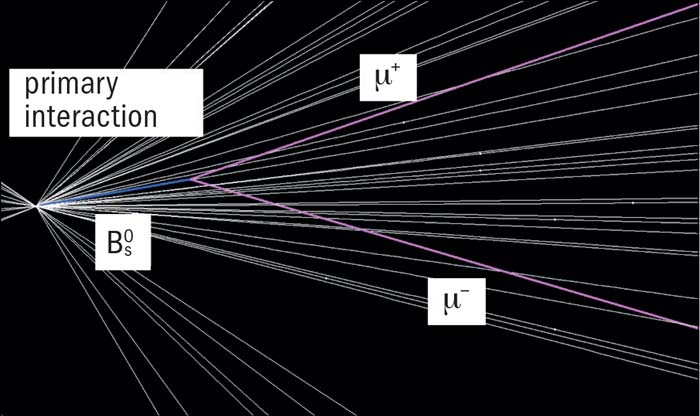
The LHCb collaboration performed the search for Bs → μμ (and B0 → μμ) by analysing 1.0 fb–1 of proton–proton collisions at 7 TeV in the centre of mass (from 2011) and 1.1 fb–1 at 8 TeV (2012). The signal selection starts with the search for pairs of oppositely charged muons that make a vertex that is displaced from the proton–proton interaction vertex (see figure 1). The signal and background are then separated using simultaneously the invariant mass of the two muons as well as kinematic and topological information combined in a multivariate analysis classifier. The particular classifier used is a boosted decision-tree (BDT) algorithm, which is calibrated with data for both signal and background events. The latter are dominated by random combinations of two muons from two different B mesons; this contribution is carefully determined from data.

Invariant mass distribution

The number of B0 → μμ candidates that LHCb observes is consistent with the background expectation, giving an upper limit of B(B0 → μμ) < 9.4 × 10–10 at 95% confidence level. This is the world’s most stringent upper limit from a single experiment on this branching fraction. However, for Bs → μμ, LHCb sees an excess of candidates with respect to the background expectation (figure 2). A maximum-likelihood fit gives a branching fraction of B(Bs → μμ) = 3.2 +1.5–1.2 × 10⁻⁹. The probability that the background could produce an excess of this size or larger is 5.3 × 10–4, corresponding to a signal significance of 3.5σ.

The measurement of Bs → μμ is close to the Standard Model prediction, albeit with a large uncertainty. This eagerly awaited result was presented at the Hadron Collider Physics Symposium in Kyoto and at a CERN seminar, and is now published. While it does not provide evidence for supersymmetry, it does constrain the parameter space for this and other models of new physics, and is a step further in understanding the universe.

Mysterious long-range correlations seen in pPb collisions

The CMS collaboration has published its first result on proton–lead (pPb) collisions (CMS collaboration 2012), related to the observation of a phenomenon that was seen first in nucleus–nucleus collisions but also detected by CMS in 2010 in the first LHC proton–proton (pp) collisions at a centre-of-mass energy of 7 TeV (V Khachatryan et al. CMS collaboration 2010). The effect is a correlation between pairs of particles formed in high-multiplicity collisions – that is, collisions producing a high number of particles – which manifests as a ridge-like structure.

CCnew13_01_13

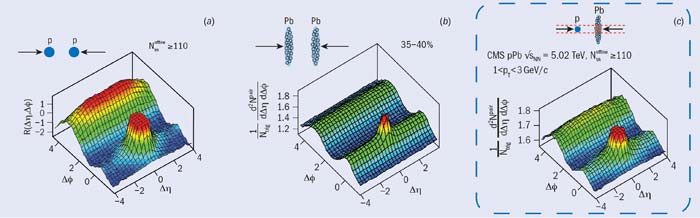
About once in every 100,000 pp collisions with the highest produced particle multiplicity, CMS observed an enhancement of particle pairs with small relative azimuthal angle Δφ (figure 1a). Such correlations had not been observed before in pp collisions but they were reminiscent of effects seen in nucleus–nucleus collisions first at Brookhaven’s Relativistic Heavy-Ion Collider (RHIC) and later in collisions of lead–lead nuclei (PbPb) at the LHC (figure 1b shows peripheral PbPb collisions from CMS).

Nucleus–nucleus collisions produce a hot, dense medium similar to the quark–gluon plasma (QGP) thought to have existed in the first microseconds after the Big Bang. The long-range correlations in PbPb collisions are interpreted as a result of a hydrodynamic expansion of this medium and are used to determine its fluid properties. Remarkably, this matter is found to have low frictional resistance (shear viscosity/entropy density ratio), behaving as a (nearly) perfect liquid. Because a QGP medium was not expected in the small pp system, the CMS results led to a large variety of theoretical models, which attempted to explain the origin of these ridge-like correlations (Wei Li 2012).

In September 2012, the LHC provided a short pilot run of pPb collisions at a centre-of-mass energy of 5 TeV per nucleus, for just a few hours. CMS collected two million pPb collisions (figure 2) – and now the first correlation analysis of these data has revealed strong long-range correlations, most easily visible as the ridge-like structure highlighted in figure 1c. As was the case for the pp data, the most common simulations of pPb collisions do not show ridge-like correlations, thus indicating a new, still unexplained phenomenon. Surprisingly, the effect in pPb collisions is much stronger than in pp collisions. In fact, it is similar to that seen in PbPb collisions.

CCnew14_01_13

The 2013 pPb run should yield at least a 30,000-fold increase in the pPb data sample at the same collision energy. Combined with the surprisingly large magnitude of the observed correlations, this will enable detailed studies and open a new testing ground for basic questions in the physics of strongly interacting systems and the nature of the initial state of nuclear collisions.

New boson’s mirror image looks like the Higgs

More than 20 years ago, the CMS and ATLAS experiments at the LHC embarked on a long road into the unknown and, rather like Christopher Columbus, the two collaborations reached a new land last summer. But did they discover what they expected – the long awaited Higgs boson of the Standard Model – or have they found the first hint of a new unknown world? The only way to find out is to measure the characteristics of the new particle to establish if it is compatible with the expectations of the Standard Model.

CCnew16_01_13

The decay of the new boson to two Z bosons and subsequently to four leptons (figure 1) is an especially powerful tool. This decay channel produces four well measured tracks of particles in a low-background environment and contains a rich set of information that no other channel can provide. The CMS collaboration has exploited this information first to boost the significance of signal observed last summer and then to go even further. By using the decay kinematics – understanding how the masses and angles of all of the particles in the process are correlated – they have attempted to determine if the new particle is the Standard Model Higgs boson or a gateway to a new world.

CCnew17_01_13

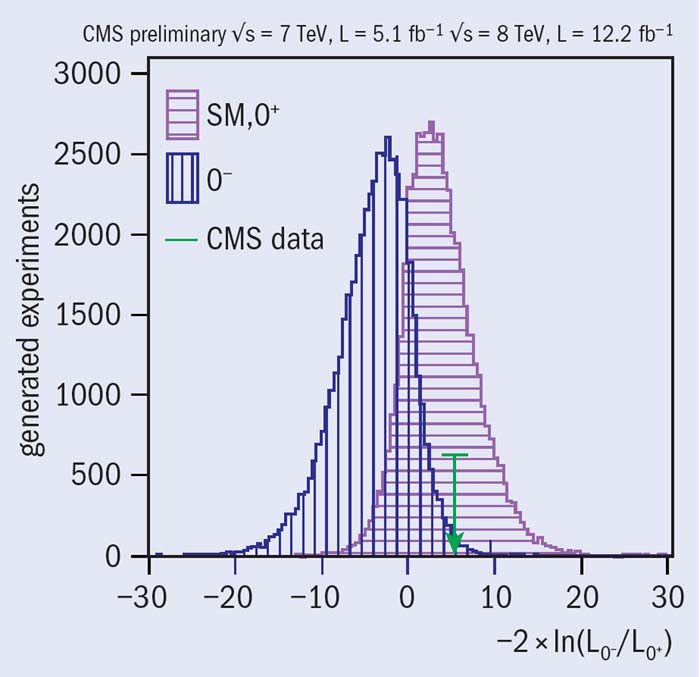
Using the full event information, the analysis assigns to each event the probability that it is a genuine Higgs boson, a more exotic particle or is just background. From these probabilities, it is possible to say how likely one model is compared with another. Figure 2 shows the expected likelihood for a genuine scalar Higgs boson (pink) and a pseudo-scalar boson (blue). The two hypotheses differ in the parity of the particle; in effect, the pseudo-scalar boson has a reversed mirror image. The green arrow on the plot is the measurement showing that the probability of a pure pseudo-scalar boson is small, indicating that this option is largely disfavoured by the data. This observation makes it possible to rule out a set of possible extensions of the Standard Model. A similar test of the hypothesis of a spin-2 particle has also been performed but it requires more data for a conclusive result. These are just the first steps into this new world. Further studies of the new boson will be possible in future as more data become available.

bright-rec iop pub iop-science physcis connect