The OPERA experiment at the INFN Gran Sasso Laboratory has detected a fourth example of neutrino oscillation, with a muon neutrino (νμ) produced at CERN detected as a τ neutrino (ντ) after travelling a distance of 730 km.
The international OPERA experiment, which involves 140 physicists from 28 research institutes in 11 countries, was designed to observe this exceptionally rare phenomenon, gathering data in the neutrino beam produced by the CERN Neutrinos to Gran Sasso (CNGS) project. Generated by decays of pions and kaons made in the interactions of a proton beam from the Super Proton Synchrotron with a graphite target, the beam consisted mainly of νμ that would pass unhindered through the Earth’s crust towards Gran Sasso. The appearance and subsequent decay of a τ lepton in the OPERA experiment provides the telltale sign of νμ to ντ oscillation through a charged-current interaction.
After the first neutrinos arrived at the Gran Sasso Laboratory in 2006, the experiment gathered data for five consecutive years, from 2008 to 2012, during which the CNGS beam delivered a total of 17.97 × 10¹⁹ protons on target, yielding 19,500 neutrino events in the detector. The first ντ was observed in 2010, the second and third ones in 2012 and 2013, respectively.
The detection of the fourth ντ is important confirmation of the events seen previously. It means that the νμ to ντ transition has been seen for the first time with a statistical significance exceeding the 4σ level, so that OPERA can now claim the observation of this extremely rare phenomenon. The collaboration will continue to search for ντ in the data that remain to be analysed.
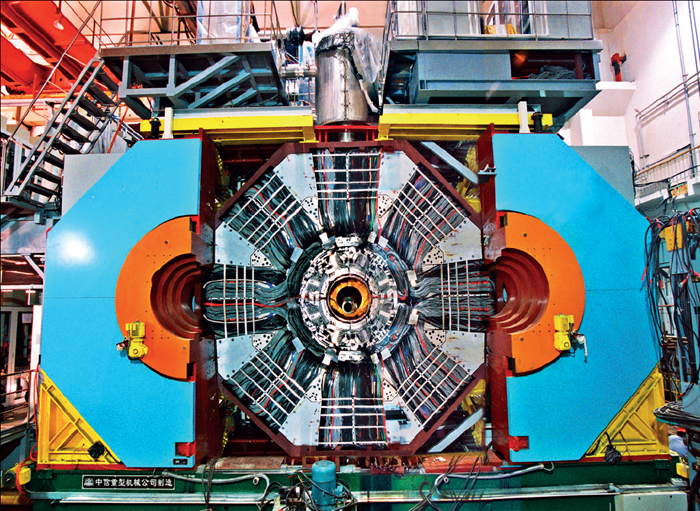
BESIII is the latest incarnation of an experimental programme that began in 1989 when the Beijing Electron–Positron Collider (BEPC) and the Beijing Spectrometer (BES) detector started operation at the Institute of High Energy Physics (IHEP). The focus is on the physics of charm and the τ lepton, which are accessible at the centre-of-mass energies of BEPC. The BES programme is the only one in the world to focus entirely on this area of particle physics through the collection of record numbers of J/ψ, ψ´, D and τ particles. During the past two decades, thanks to the luminosity available first at BEPC and then at BEPCII, the BES collaboration has made many important, high-precision measurements. More recently, this has led to investigations of new particles – the XYZ particles – that appear not to fit in with the standard picture of charmonium states.
One of the first major contributions of the BES programme came in 1992, when the collaboration made a much more precise measurement of the mass of the τ lepton and cleared up a big disagreement between the particle’s mass, its lifetime and its branching ratio to electrons – quantities that are related by the Standard Model. Then from 1993 to 1997, BEPC and BES were upgraded. BES became BESII and received a new main drift chamber (MDC) and time-of-flight (TOF) system. The collaboration soon embarked on a scan of the ratio of hadron to muon-pair production, which measured the hadronic cross-section at 93 energy points in the range 2–5 GeV and improved the precision in this region from 15–20% to less than 6%.
These cross-section results, together with many different measurements from Fermilab, CERN’s Large Electron–Positron collider and the LHC, are used in stringent tests of the Standard Model. The cross-section measurements are required to determine the value of the fine structure constant, αQED – which is not constant – at the mass of the Z boson, αQED(MZ). The new cross-section measurements shifted the value of αQED(MZ) and also moved the mass of the Higgs boson predicted by the Standard Model to be more in line with the measured lower limits on the mass at that time. BES and BESII also produced many other results on J/ψ and ψ´ hadronic decays, ψ´ transitions, and D and Ds decays.
The upgrade of BEPC to BEPCII began in 2004 and finished in 2008. The facility became a two-ring collider with 93 beam bunches in each ring, superconducting micro-β focusing quadrupole magnets, superconducting RF, and a design luminosity of 1 × 1033 cm–2 s–1. At the same time, a brand new detector – BESIII – was constructed with a small-celled, helium-based MDC, a new TOF system, a CsI(Tl) electromagnetic calorimeter, a resistive-plate-chamber muon identifier and a 1 T superconducting solenoidal magnet.
In the first year of operation, 2009, BESIII accumulated 106 million ψ´ events and 226 million J/ψ events. With the ψ´ data, BESIII was able to observe clearly the process ψ´ → π0hc followed by hc → γηc and measure for the first time the individual branching ratios, which allowed comparison with theoretical predictions.
Later, BESIII measured the mass and width of the ηc, taking into consideration for the first time interference between the resonance and the non-resonant background. Previously, the CLEO collaboration had pointed out that the masses and widths of the ηc were different when measured in ψ´ radiative decay and measured in proton–antiproton or two-photon production. Including the interference effect produced results that were consistent with the latter, and the most precise measurements to date. Moreover, BESIII was able to observe for the first time the M1 transition ψ´ → γηc(2S) and measure the mass and width of the ηc(2S) and the branching fraction for this process. With the J/ψ data, BESIII confirmed the X(1835) seen by BESII and observed two new resonances, the X(2120) and the X(2370), in the process J/ψ → γπ+π–η´.
In the following years, BESIII accumulated another 1000 million J/ψ events, 400 million ψ´ events, and approximately 3 fb–1 of data at the ψ(3770) resonance. The ψ(3770) decays more than 90% of the time to quantum-correlated DD pairs, which allow measurement of absolute branching ratios, as well as of DD mixing. The collaboration recently made the most precise determination of the branching ratio of D → μν, which allows determination of the pseudo-scalar decay constant, fD+, using the world-average value of the Cabibbo-Kobayashi-Maskawa matrix element |Vcd|, or determination of Vcd using the lattice QCD value of fD+. The energy region of τ and charm is extremely rich in the variety of physics topics available and BESIII is accumulating world-class data sets to study them.
XYZ physics
The X(3872) was discovered in the decay of B mesons at KEK by the Belle experiment in 2003. This was the first member of a family of exotic particles that do not agree with the predicted masses of charmonium particles in this mass region and decay in a peculiar way. Rather than decaying as expected into a pair of particles with open charm, such as a D meson and its antiparticle D, they decay into π+π–J/ψ. In 2005, the BaBar experiment at SLAC discovered the Y(4260) in initial-state radiation (ISR) production, where much of the electron or positron energy is radiated away leaving the energy remaining at 4260 MeV. Like the X(3872), the Y(4260) has a mass that does not agree with those expected for charmonium and also decays to π+π–J/ψ.
The X(3872) and Y(4260) are members of the XYZ family of particles, which now contains numerous members, although many of them are not yet confirmed. The discovery of the particles, which do not fit into the standard picture, has sparked a great deal of theoretical interest and many theoretical papers.
In December 2012, BESIII jumped into the world of XYZ physics by beginning to take data at 4.26 GeV – the energy of the Y(4260). Running at this energy has the advantage that Y(4260) events might be produced directly rather than indirectly by B decay or ISR production, both of which have a much smaller cross-section.
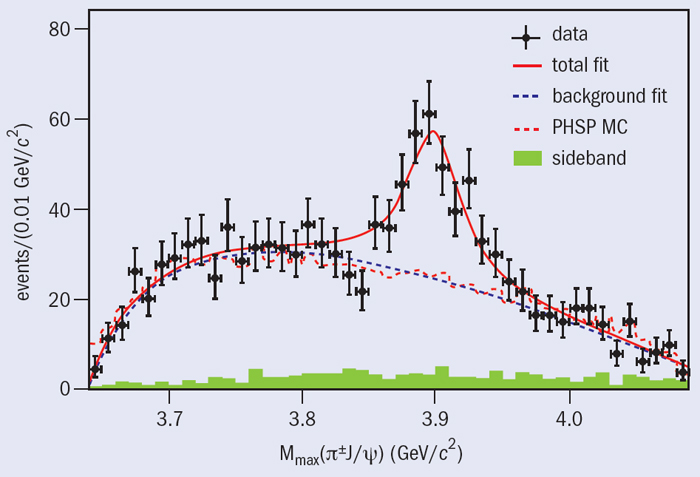
Analysing the accumulated sample after one month of data taking, the collaboration found 1477 e+e– → π+π–J/ψ, J/ψ → l+l– events – where l is an electron or a muon – and obtained a cross-section consistent with Y(4260) production (Ablikim et al. 2013a). The π±J/ψ mass distribution, shown in figure 1, revealed an unexpected structure that was named the Zc(3900). The mass and width of the Zc(3900) are 3899.0±3.6±4.9 MeV/c2 and 46±10±20 MeV, respectively. The decay contains both charmonium – the J/ψ – and a charged pion, suggesting that the Zc(3900) contains four quarks. The discovery was quickly confirmed by the Belle collaboration and by an analysis of CLEO data. Other charged charmonium-like particles had been found earlier by Belle but never confirmed, so this is the first confirmed Z state.
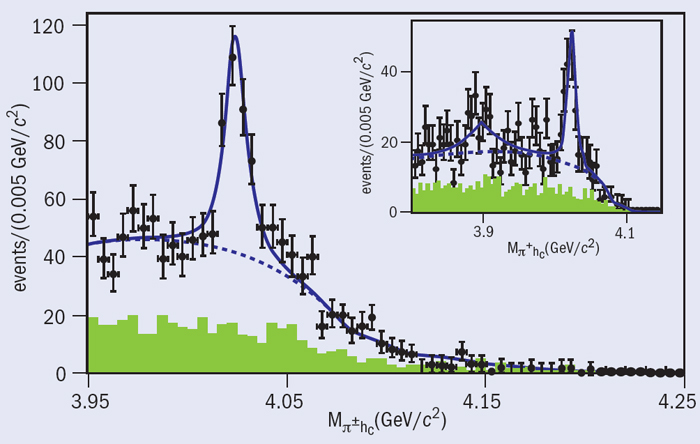
Data taking continued through to June 2013 at 13 energies between 3.9 and 4.4 GeV, bringing the total luminosity to approximately 2.5 fb–1, and the analysis of four other processes has now been completed. The first is e+e– → π+π–hc, where hc → γηc and ηc decays to 16 exclusive hadronic states (Ablikim et al. 2013b). This is similar to the previous analysis with the J/ψ replaced by the hc – another charmonium particle. Here again the π±hc mass distribution reveals a narrow structure, named the Zc(4020), as shown in figure 2. The mass and width of the Zc(4020) are 4022.9±0.8±2.7 MeV/c2 and 7.9±2.7±2.6 MeV, respectively. No significant Zc(3900) is seen in this process.
The second process analysed is e+e– → π±(D*D*)∓, where a partial reconstruction technique is used that requires the identification of the π±, a charged D from the decay of a charged D*, and one π0 from either the D* or the D* decay (Ablikim et al. 2014a). The analysis is based on 827 pb–1 of data at 4.26 GeV. When the mass recoiling from the π± is plotted, an enhancement is seen, as shown in figure 3, so the process is interpreted as e+e– → π±Zc(4025)∓, Zc 4025)∓ → (D*D*)∓, where the mass and width of the Zc(4025) are 4026.3±2.6±3.7 MeV/c2 and 24.8±5.6±7.7 MeV, respectively.
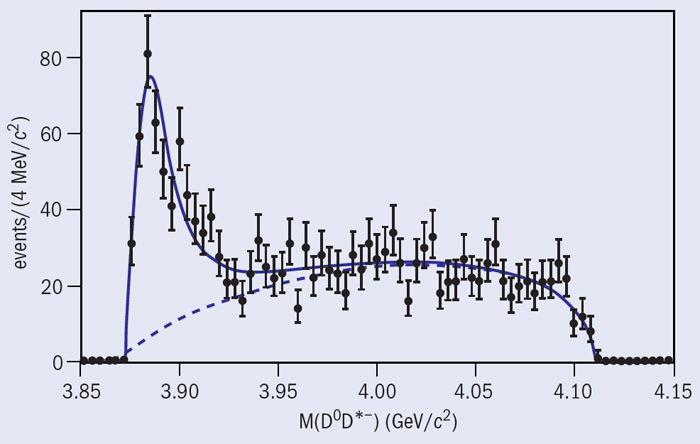
The third process is e+e– → π±(DD*)∓, where again a partial reconstruction technique is used, requiring that the π± and a D be identified (Ablikim et al. 2014b). The analysis is based on 525 pb–1 of data at 4.26 GeV. When the mass of the (DD*)∓ is plotted an enhancement is seen, as shown in figure 4, so the process is interpreted as e+e– → π±Zc(3885)∓, Zc(3885)∓→ (DD*)∓, where the mass and width of the Zc(3885) are 3883.9±1.5±4.2 MeV/c2 and 24.8±3.3±11.0 MeV, respectively. The data prefer that the Zc(3885) has spin-parity JP = 1+.
Some of the Zc states described above might be the same state. Interference has been neglected in the fitting of the peaks, and it could shift the masses and widths obtained. However, there are probably at least two separate Zc states.
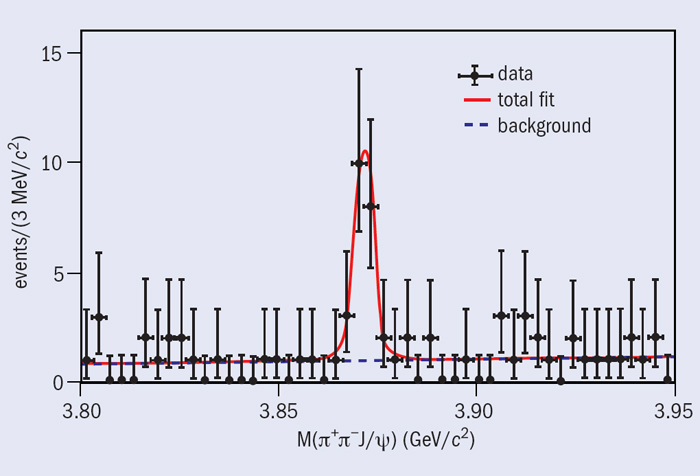
So far the X(3872) has been seen in B decays and hadron collisions only, but its quantum numbers are such that it should be able to be produced in radiative decays of the Y(4260). Figure 5 shows the π+π–J/ψ mass distribution for e+e– → γπ+π–J/ψ events from the combined data at 4.009, 4.229, 4.26 and 4.36 GeV (Ablikim et al. 2014c). The clear peak has a mass of 3872.1±0.8±0.3 MeV, to be compared with the mass m(X(3872)) = 3871.68±0.17 MeV listed in the Particle Data Group tables. Although the events could be produced directly, it is highly plausible that the X(3872) is from radiative decay of the Y(4260).
There are many possible theoretical explanations for the XYZ particles, including the Y(4260) and the recently discovered Zc structures observed by BESIII. They include four-quark models with molecular states comprising charm and anti-charm particles, tetraquark states, and hadro-charmonium, as well as hybrid states (charmonium states with an extra gluon) and a model of initial single-pion emission. More experimental results are necessary to check the predictions of the various models and to decide which ones, if any, describe the physics correctly.
BESIII entered the era of XYZ physics by acquiring about 2.5 fb–1 of data at around 4.26 and 4.36 GeV. Currently, more data are being acquired and many other analyses of the data collected so far are in progress. Future results will help decide among the various models, or rule them all out.
Data from the CDF and D0 experiments at the Tevatron have revealed one of the rarest methods of producing a top quark. The two collaborations announced jointly on 21 February that they have observed s-channel production of single top quarks.
The top quark, t, which was discovered in proton–antiproton collisions at the Tevatron in 1995, is the heaviest elementary particle of the Standard Model, with a mass of 173 GeV. Only the Tevatron and the LHC colliders have so far been capable of making t quarks. In s-channel production, a quark from a proton and an antiquark from an antiproton create a W boson, which decays to a t quark and a b quark. The t quark in turn decays to a new W boson and a b, leading to a final state of Wbb. The production of single t quarks in the s-channel is among the rarest decays of the W boson, given that one of the final state particles (t) has a rest mass more than twice that of the parent W boson.
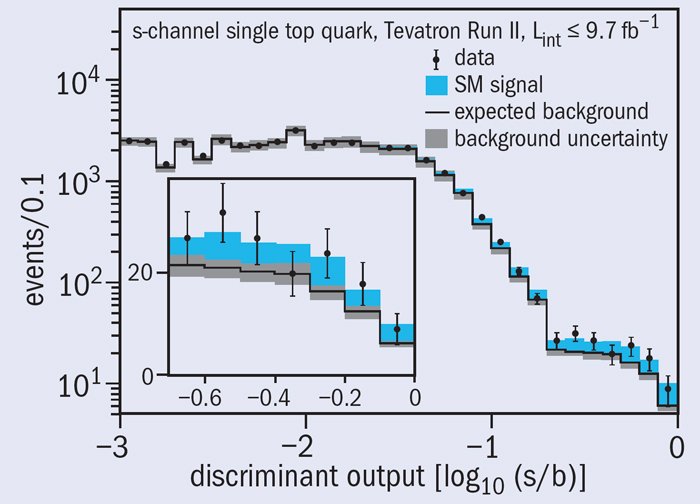
Selecting a region of high signal-to-background, as shown in the figure, required the development of sophisticated analysis methods. These included identifying jets from the hadronization of the b quarks efficiently and with low background. Between them, the CDF and D0 collaborations analysed more than 2 × 10¹⁰ events recorded to tape during operation of the Tevatron as a collider between 2001 and 2011.
Each experiment saw a substantial excess of events – about 40 in total – that could be attributed to single s-channel production of the t quark (CDF 2014 and D0 2013). However, only by combining the results from both experiments to make full use of the Tevatron data set, could the teams push the significance of the observation to 6.3σ, consistent with the discovery of a new process (CDF and D0 2014). The measured production cross-section in the s-channel of 1.29 pb agrees with the Standard Model prediction and so excludes the possibility of a particle other than the W boson, not predicted by the Standard Model, as a source of single t quarks.
Detection of this extremely rare process was one of the final goals of the Tevatron programme to be achieved. However, it is not the end of the story for the top quark because many more studies will continue, both with Tevatron data and at the LHC, to understand fully the heaviest known elementary particle.
While it is now generally accepted that dark matter makes up the majority of the mass in the universe, little is known about what it is. A favoured hypothesis among particle physicists has long been that dark matter is made of new elementary particles. However, experiments searching for such particles face a serious challenge: neither the particles’ mass nor the strength of their interaction with normal matter is known. So the experiments must cast an ever-widening net in search of these elusive particles.
At the end of February, the Cryogenic Dark Matter Search collaboration announced new results, obtained with the SuperCDMS detector. They expanded their search down to a previously untested dark-matter particle-mass range of 4–6 GeV/c2 and a dark-matter nucleon cross-section range of 1 × 10–40–1 × 10–41 cm2. Their exclusion results contradict recent hints of dark-matter detection by another experiment, CoGeNT, which uses particle detectors made of germanium – the same material used by SuperCDMS.
For their new results, CDMS employed a redesigned cryogenic detector known as iZIP that has ionization and phonon sensors interleaved on both sides of the germanium crystals. This substantially improves rejection of surface events from residual radioactivity, which have limited dark-matter sensitivity in previous searches. The collaboration operated these detectors 0.7 km underground in the Soudan mine in northern Minnesota, to shield them from cosmic-ray backgrounds.
There have been several recent hints for low-mass dark-matter particle detection, from previous data using silicon instead of germanium detectors in CDMS, and from three other experiments—DAMA, CoGeNT and CRESST—all finding their data compatible with the existence of dark-matter particles between 5 and 20 GeV/c2. But such light dark-matter particles are hard to pin down. The lower the mass of the dark-matter particles, the less energy they leave in detectors, and the more likely it is that background noise will drown out any signals.
The new CDMS iZIP detectors, with their improved background rejection, are continuing this search at Soudan, and hopefully soon in the lower background environment at SNOLAB. Confirmation of a signal of the direct detection of dark matter, and understanding of the interaction of dark matter with normal matter, is likely to require spotting these particles with different target nuclei in at least two different experiments.
The Standard Model predicts that the photons emitted in b → sγ transitions, which can only occur through loop-level processes, are predominantly left-handed. This means that the asymmetry between the amplitudes with right- and left-handed photons – photon polarization – is close to its minimum value of –1. This quantity has never been observed in a direct measurement and remains largely unexplored. As a consequence, there still exist several extensions of the Standard Model that predict a photon polarization significantly closer to zero but have not been ruled out by other measurements of b → sγ transitions.
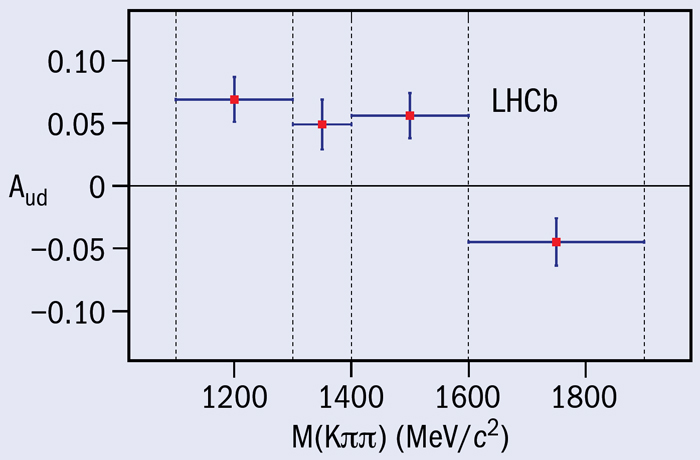
The LHCb collaboration has exploited B+ →K+ π–π+γ decays, which are governed by the b → sγ transition, to probe the photon polarization. The “up–down” asymmetry between the number of photons detected above and below the plane defined by the momenta of the kaon and the two pions in their centre-of-mass frame is proportional to the photon polarization. So, a measurement of a nonzero asymmetry implies observation of photon polarization. The investigation is conceptually similar to the experiment that discovered parity violation in 1957 by measuring a nonzero up–down asymmetry for the electrons emitted in the weak decay of 60Co nuclei with respect to their spin direction.
Using the full data sample collected with the LHCb detector in 2011 and 2012, the collaboration has reconstructed almost 14,000 B+ →K+ π–π+γ events. Their angular distribution has been studied in four regions of the K+ π–π+ system’s mass, where different kaon resonances and their interferences can result in different sensitivities to the photon polarization. From determination of the up–down asymmetry, Aud, in each of these mass regions, LHCb finds a combined significance with respect to the null hypothesis of 5.2σ, and therefore observes photon polarization for the first time in such decays (LHCb collaboration 2014). This important result opens the door to the future determination of the value of the polarization of the photon, which will provide a strong new test of the validity of the Standard Model.
The fusion of two weak bosons is an important process that can be used to probe the electroweak sector of the Standard Model. Measurements of Higgs production via weak-boson fusion are crucial for precise extraction of the Higgs-boson couplings and have the potential to help pin down the charge conjugation and parity of the Higgs boson. A similar process, weak-boson scattering, is sensitive to alternative electroweak symmetry-breaking models and to anomalous weak-boson gauge couplings. These processes are extremely rare and the experimental observation of the production of heavy bosons via weak-boson fusion has become possible only recently with the large centre-of-mass energy and luminosity provided by the LHC. Extracting the signals from the huge backgrounds in the high pile-up conditions at the LHC is a major challenge.
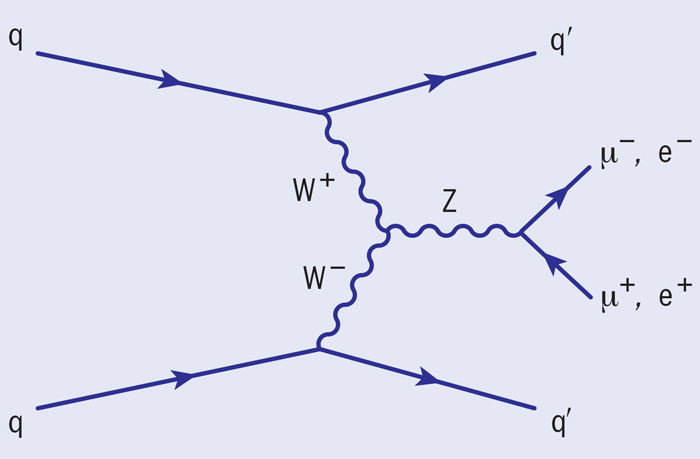
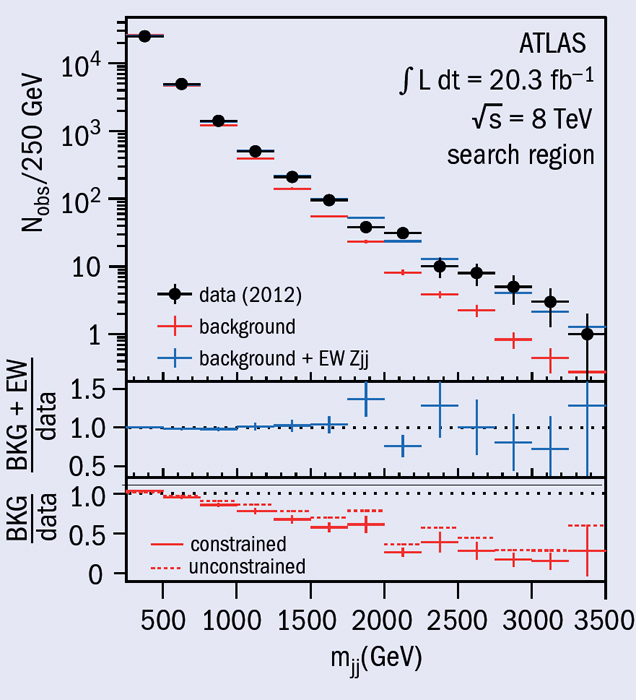
The production of a Z boson via weak-boson fusion (figure 1) is an excellent benchmark for these rare processes. Weak-boson fusion has the characteristic signature of two low-angle jets, one on each side of the detector. These “tagging” jets typically have transverse momentum of the order of the W mass, because they arise from quarks in each proton recoiling against the two W bosons that fuse to produce the Z boson. Another interesting feature is the lack of colour flow between the tagging jets, which means there is little hadronic activity in that region. These features have been exploited by the ATLAS collaboration to extract the purely electroweak contribution to Z-plus-two-jet production, which includes the weak-boson fusion process.
The analysis was carried out using proton–proton collisions at a centre-of-mass energy of 8 TeV recorded by the ATLAS detector in 2012. Events containing a Z boson candidate in association with two high-transverse-momentum jets were selected in the e+e– and μ+μ– decay channels. The electroweak component was extracted by a fit to the dijet invariant mass spectrum in an electroweak-enhanced region that was defined, in part, by a veto on additional jet activity in the interval between the tagging jets. The background model was constrained using data in a signal-suppressed control region that was defined by reversing the jet-veto requirement. This data-driven constraint reduced the experimental and theoretical modelling uncertainties on the background model, allowing the electroweak signal to be extracted with a significance above the 5σ level. Figure 2 clearly demonstrates that the background-only model is inconsistent with the data in the electroweak-enhanced region. The cross-section measured for electroweak Z-plus-two-jet production, σ = 54.7±4.6 (stat.) +9.8–10.4 (syst.) ±1.5 (lumi.)fb, is in good agreement with the Standard Model prediction of 46.1±1.2 fb.
As the LHC experiments improve the precision of their measurements of Standard Model processes, the extent of possibilities for new physics open to exploration is becoming ever more apparent. Even within a constrained framework for new physics, such as the phenomenological minimal supersymmetric standard model (pMSSM), there is an impressive variety of final-state topologies and unique phenomena. For instance, in regions of the pMSSM where the chargino–neutralino mass difference is small, the chargino can become metastable and exhibit macroscopic lifetimes, potentially travelling anywhere between a few centimetres and many kilometres before it decays. An experiment like CMS can identify these heavy stable charged particles (HSCPs) through specialized techniques, such as patterns of anomalously high ionization in the inner tracker, as well as out-of-time signals in the muon detectors.
The CMS collaboration recently released a reinterpretation of a previously published search for HSCPs that used these techniques to constrain several broad classes of new physics models (CMS 2013a). There are two purposes for this reinterpretation. The first is to provide a simplified description of the acceptance and efficiency of the analysis as a function of a few key variables. This simplified “map” allows theorists and others interested to determine an approximate sensitivity of the CMS experiment to any model that produces HSCPs. This is an essential tool for the broader scientific community, because HSCPs are predicted in a large variety of models and it is important to understand if the gaps in their coverage are still present.
The second purpose is to provide a concrete example of a reinterpretation in terms of the pMSSM. In this analysis, CMS chose a limited subspace of the full pMSSM, requiring, among other things, that sparticle masses extend only up to about 3 TeV. The figure shows the number of points in this restricted pMSSM subspace that are excluded as a function of the average decay length, cτ, of the chargino. The red points are excluded by the HSCP interpretation described here (CMS 2013b). The blue points are excluded by another CMS search dedicated to “prompt” chargino production (CMS 2012a). The bottom panel shows the fraction of parameter points excluded by each of these two searches. Only a few parameter points, with chargino cτ >1 km, are still not excluded. This is because the theoretical cross-section for these parameter points is small – around 0.1 fb.
This analysis demonstrates the power of the CMS search for HSCPs to cover a broad range of models of new physics. By mapping the sensitivity of the analysis as a function of the HSCP kinematics and the detector geometry, it also makes the results from the search accessible for studies by the broader scientific community.
Although this analysis searches for metastable particles, another open possibility is the production of new, exotic particles that traverse a short distance – around 1 mm to 100 cm – before decaying to visible particles within the detector. CMS has also released results from two searches for such particles. One search looks for decays of these long-lived particles into two jets, and another into two oppositely charged leptons (CMS 2012b and 2012c). The results from these searches exclude production cross-sections for such particles as low as about 0.5 fb, depending on the lifetime and kinematics of the decay.
Knowledge of the electron mass has been improved by a factor of 13, thanks to a clever extension of previous Penning-trap experiments. A team from the Max-Planck-Institut für Kernphysik in Heidelberg, GSI and the ExtreMe Matter Institute in Darmstadt, and the Johannes Gutenberg-Universität in Mainz, used a Penning trap to measure the magnetic moment of an electron bound to a carbon nucleus in the hydrogen-like ion 12C5+. The cyclotron frequency of the combined system allowed precise determination of the magnetic field at the position of the electron, while the precession frequency allowed for measurement of the mass of the electron.
The result, in atomic-mass units, is 0.000548579909067(14)(9)(2) where the last error is theoretical. This new value for the electron’s mass value will allow comparison of the magnetic moment of the electron to theory – which is good to about 0.08 parts in 1012 – to better than one part in 1012.
Studies of the centrality-dependence of jet production in proton–lead collisions in ATLAS at the LHC are yielding surprising results.
In both proton–ion and ion–ion collisions, many interesting phenomena are influenced by the initial geometry of the collision system. In proton–nucleus collisions, protons that strike the centre of the nucleus (central collisions) see a thicker nuclear target than those that strike the edge (peripheral collisions) and are more likely to undergo a hard scattering. Traditionally, the geometry of the collisions or “centrality” is characterized by a measure of the event activity. For this measurement in ATLAS, the centrality is defined by the total transverse energy in the forward calorimeter in the direction of the lead beam. A model that describes the expected geometric enhancement of hard-scattering rates is used to relate this experimental measure to a factor TA (Miller et al. 2007).
The quantity RCP is defined as the ratio of the per-event jet yields in different centrality bins divided by the ratio of corresponding TA factors, which account for the expected geometric enhancement. The left panels of the figure show RCP values as a function of the jet transverse-momentum, pT, for different ranges in jet rapidity, y*, in the centre-of-mass frame. Negative y* indicates the proton-going direction. The normalized jet ratio, RCP, is suppressed at high pT and large negative y* compared with the expectation from known nuclear effects, which would correspond to a value near unity in RCP. The suppression of jets is strongest in the most central collisions (0–10%) at the highest pT values. Additional studies, independent of the centrality definition, indicate that final-state energy-loss like that observed in ion–ion collisions (jet quenching) is unlikely to be the main source of the effect.
These results suggest either a correlation between hard-jet production and soft-particle production that breaks the traditional geometric paradigm, or that in proton–lead collisions the energy in the forward calorimeter is not a good measure of the centrality of the collision in events with jets.
The right panel of the figure shows the jet RCP as a function of pTcosh(y*), which corresponds closely to the jet’s energy. When recast in terms of this quantity, the RCP values from different y* intervals all fall along the same line. Whether this is coincidence or related to the underlying dynamics is not yet known.
These observations are among the most striking preliminary ATLAS results from the 2013 proton–lead run of the LHC. Further measurements are needed to uncover the mechanism underlying the observed soft–hard correlations.
The top quark remains, nearly 20 years after its discovery by the experiments at Fermilab’s Tevatron, the heaviest particle known. Its production and decays continue to be the subjects of extensive studies, both at the Tevatron and at the LHC. While top quarks are predominantly produced in pairs through the strong interaction, the production of single top quarks is also possible by virtue of the electroweak interaction, albeit with a much smaller production cross-section. This latter production mechanism provides a unique window into the dynamics of the top quark.
Three different production channels for single top quarks can be distinguished: the t-channel, the s-channel and the W-associated channel (figure 1). After many years of intensive searches, the Tevatron experiment collaborations first reported the observation of singly produced top quarks in 2009. These initial searches were optimized for the t- and s-channel production modes combined. Later, the t-channel mode was individually established by experiments at the Tevatron and the LHC, while evidence for s-channel production was reported only recently by the D0 collaboration at the Tevatron, in July 2013.
Meanwhile, the third production mechanism, W-associated production, remained out of the Tevatron’s reach because of its small cross-section and the lack of a sufficiently distinctive signature. At the LHC, however, the production rate for top quarks is much higher. This allowed ATLAS and CMS to report evidence of W-associated production already with the data collected at a centre-of-mass energy of 7 TeV in 2011, although these measurements did not reach the 5σ gold standard for the solid observation of a new signal. Now, thanks to the data collected in 2012 with the LHC operating at a centre-of-mass energy of 8 TeV, the CMS collaboration has been able to complete the experimental picture of the family of single top-quark production mechanisms.
The main background to W-associated production comes from pair-produced top quarks, where the decay of one of the top quarks appears W-like, because the b quark into which it decays fails the b-tagging requirements. No single defining feature separates the two processes sharply, so several kinematic properties have been combined into a single multivariate discriminant by a boosted decision tree – a machine-learning technique that is particularly suited to separating tiny signals from overwhelming backgrounds. Figure 2 shows the discriminant from the boosted decision tree.
The amount of signal in the selected sample is inferred by a fit to the discriminant distribution. To constrain tightly the amount of top-quark pair background with the data, two complementary samples with one additional jet, separated into cases with one or both jets b-tagged, are also included in the fit. The relative population of the samples with one or two b-tagged jets – both of which are almost pure in top-quark pair events – proves to be a powerful handle to reduce the uncertainty on the b-tagging efficiency, and therefore improve the precision of the analysis.
The excess of events with respect to the background-only hypothesis is quantified at a significance of 6.1σ (with 5.4±1.4σ expected from simulation), and the cross-section is found to be 23.4±5.4 pb, in agreement with the Standard Model prediction. Two cross-check analyses, less sensitive but relying on fewer modelling assumptions, confirm the result, therefore further supporting the first-time observation of this new single-top production mode.
This result opens the door to future searches for anomalous interactions of the top quark with the W boson, in a production mode that brings complementary information to studies that have so far been performed only with selections optimized for the more abundant top-pair and single top-quark t-channel events.
To provide the best experiences, we use technologies like cookies to store and/or access device information. Consenting to these technologies will allow us to process data such as browsing behavior or unique IDs on this site. Not consenting or withdrawing consent, may adversely affect certain features and functions.
Functional
Always active
The technical storage or access is strictly necessary for the legitimate purpose of enabling the use of a specific service explicitly requested by the subscriber or user, or for the sole purpose of carrying out the transmission of a communication over an electronic communications network.
Preferences
The technical storage or access is necessary for the legitimate purpose of storing preferences that are not requested by the subscriber or user.
Statistics
The technical storage or access that is used exclusively for statistical purposes.The technical storage or access that is used exclusively for anonymous statistical purposes. Without a subpoena, voluntary compliance on the part of your Internet Service Provider, or additional records from a third party, information stored or retrieved for this purpose alone cannot usually be used to identify you.
Marketing
The technical storage or access is required to create user profiles to send advertising, or to track the user on a website or across several websites for similar marketing purposes.