Comsol -leaderboard other pages

Topics

Physics at the low-energy, high-precision frontier

Isochronous cyclotron

More than 180 physicists from around the world gathered at the Paul Scherrer Institut (PSI) last year for the 3rd workshop on the “Physics of fundamental Symmetries and Interactions” at low energies and the precision frontier – PSI2013. Broadly speaking, the focus was on high-precision experiments, with results complementary to those at the LHC, often covering a parameter space in physics beyond the Standard Model that is inaccessible to direct searches at the LHC or even at future colliders.

PSI’s particle-physics laboratory fosters cutting-edge research using the unmatched high power of its 590 MeV, 2.2 mA proton cyclotron to produce the brightest low-momentum beams of muons and pions and, since 2011, ultracold neutrons. This environment set the scene for lively discussions on the latest results and the future direction of worldwide low-energy precision experiments. Among the many workshop contributions, there were several major topical areas of interest.

Fundamental physics probed with antiprotons and antihydrogen featured prominently, with recent results from experiments at CERN’s Antiproton Decelerator. The now regular production of antihydrogen has moved these experiments closer to final physics measurements. Among the main goals are sensitive tests of CPT symmetry and measurements in antihydrogen spectroscopy, such as determination of the ground-state hyperfine splitting, together with tests of antihydrogen free fall. A recent result is the Penning-trap measurement by the ATRAP collaboration of the antiproton’s magnetic moment to 5 ppm precision. A further highlight, involving Penning traps but with ordinary matter, is determination of the electron’s mass with unprecedented precision by the MPI-Heidelberg group, achieving an order-of-magnitude improvement.

Many presentations covered experiments using cold (CN) or ultracold (UCN) neutrons. A full session was devoted to the neutron lifetime and worldwide progress on improving its precision, to resolve the significant outstanding discrepancy between results from neutron-storage experiments and those using beams. For the latter, a new result from the National Institute of Standards and Technology in the US was presented, consolidating the existing discrepancy.

Neutron-decay parameters and spin correlations of the decay particles are sensitive to physics beyond the Standard Model. Competing CN and UCN experiments using improved experimental techniques such as precision neutron polarimetry at the 100 ppm level were presented, with future plans for UCNs at Los Alamos National Laboratory (LANL) and the Proton Electron Radiation Channel project at the FRM II neutron source at the Technische Universität München. Other parity-violation experiments were also discussed, with a new result for neutron capture on hydrogen by the NPDG experiment at the Spallation Neutron Source (SNS) at Oak Ridge, trapped radium ions at KVI Groningen, and neutron spin rotation in helium.

UCN production with new-generation sources – either in existence or under construction – was extensively covered, including the use of superfluid helium (at Institut Laue–Langevin (ILL) and TRIUMF) and solid deuterium (Mainz, LANL and PSI) as superthermal converters. UCN densities are steadily increasing, despite experimental and technical difficulties that have slowed down the expected progress. The main thrust for these high-intensity UCN sources comes from the search for a permanent electric dipole moment (EDM) of the neutron. Because it is the focus of an experiment at PSI, there was intensive discussion on this topic at the workshop. Several talks elaborated on efforts to search for the neutron EDM by international collaborations at various institutions. These are mainly based on UCN-storage measurements that employ either Ramsey’s Oscillatory Field method (at ILL, SNS, PSI, the Petersburg Nuclear Physics Institute, TRIUMF, Osaka University and FRM II) or crystal diffraction (at ILL).

Complementary atomic (Fr, Ra, Xe) and molecular (YbF, ThO) EDM searches have even higher experimental sensitivities, but sometimes suffer from being more difficult to interpret in terms of the fundamental EDMs. Diamagnetic atoms are usually interpreted in terms of searches for nuclear EDMs, whereas measurements in polar molecules and paramagnetic atoms give limits on the electron EDM. However, the workshop was a little too early to see the result of the new ThO experiment ACME, by a Harvard/Yale University group, which appeared shortly afterwards. Proposed storage-ring-based EDM measurements with protons and deuterons are also being pursued actively.

Common to all of the EDM searches are the many challenging experimental difficulties, especially in terms of magnetic shielding and the control and measurement of the magnetic field. Presentations from the theoretical side underlined that EDM studies in different systems are complementary and necessary in helping to identify the underlying models of CP or T violation. Also in this context, recent results on CP violation were presented from the NA62 experiment at CERN, on the kaon system, and from LHCb at the LHC.

UCNs also allow study of the quantization of gravitational bound states of the neutron, which are sensitive to non-Newtonian gravity and hypothetical extra forces, mediated by, for example, axions, axion-like particles, or chameleons. Such forces can also be probed in clock-comparison experiments, as explained at the workshop for the 3He/129Xe case. These are sensitive to possible Lorentz violations, which can be accommodated in the framework of the so-called Standard Model Extension (SME). In the SME, Lorentz violation stems from an underlying background field in the universe, resulting, for example, in day/night or annual variations of fundamental parameters. Recently calculated effects in neutron decay, as well as in muonium and positronium spectroscopy, were also discussed, with experimental efforts.

Charged-lepton flavour violation was another key topic where increasing worldwide efforts are under way. Lepton flavour violation involving muons is predicted by various models that go beyond the Standard Model, at levels that might be within reach of the next generation of experiments. Nevertheless, major progress is needed, both in experimental techniques and in increased muon-beam intensities, and is being pursued actively.

The international PSI-based MEG collaboration presented its new limit of 5 × 10–13 on the μ → eγ branching ratio. The project to search for the decay μ → 3e at a sensitivity level of 10–16 was presented by the Mu3e collaboration. Impressive efforts towards the construction of the Muon Campus at Fermilab were also shown, with the goal of a new, more precise (g–2)muon measurement to help solve or confirm the present discrepancy with the Standard Model calculation. There are also plans to search for μ → e conversion within Project-X, at a sensitivity of 10–17 and beyond. Similar efforts in Japanese projects that are ongoing at Osaka University and the Japan Proton Accelerator Research Complex (J-PARC) were also detailed. These involve huge efforts in the muon sector towards, for example, μ → e conversion and muon g–2 experiments. The progress shown at J-PARC following repairs of the extensive earthquake damage was impressive.

There was great encouragement on the part of all participants to meet again at PSI for PSI2016

The new result on the pseudoscalar coupling between the muon and the proton from the MuCAP experiment at PSI was presented and discussed, finally solving a long-standing puzzle and providing the first precise value of this Standard Model parameter. Interpretations within recent calculations based on effective field theory were presented, together with relevant ongoing precision measurements in the deuterium system.

In the light of the current construction of the free-electron laser – SwissFEL – at PSI, the possible use of such high photon-intensities or electron beams for particle-physics experiments attracted much interest, for example in using high-intensity lasers for “light shining through the wall experiments”, which search for weakly interacting sub-electronvolt particles. The final session of the workshop – held with the detector workshop of the Swiss Institute of Particle Physics, CHIPP – provided an overview of state-of-the-art detector technology, which is under development to cope with future high-intensity experiments.

Aside from fundamental science, the Hochrhein Bigband jazz concert delighted participants, as did the workshop dinner featuring a “fundamental classic” of Swiss cusine – raclette. A workshop summary of the year 2034 provided an amusing outlook from a theoretician’s point of view of what might be important in particle physics 20 years from now. In the meantime, there was great encouragement on the part of all participants to meet again at PSI for PSI2016.

Antigravity matters at WAG 2013

WAG 2013

Aristotle said that ‘‘An iron ball of one hundred pounds, falling from a height of one hundred cubits [about 5.2 m], reaches the ground before a one-pound ball has fallen a single cubit.” Galileo Galilei replied, “I say that they arrive at the same time.” The universality of free fall illustrated by the latter’s legendary experiment at the tower of Pisa was formulated by Isaac Newton in his Principia and became, with Albert Einstein, the weak equivalence principle (WEP): the motion of any object under the influence of gravity does not depend on its mass or composition. This principle is the cornerstone of general relativity.

The WEP has been verified to incredible precision by dropping experiments and Eötvös-type torsion balances, the latter reaching an amazing accuracy of one part in 1013. The acceleration of the Earth and the Moon towards the Sun has also been determined to the same accuracy by measuring the transit time of laser pulses between the planet and the reflectors left on the Moon by the Apollo and Soviet space missions. But does the WEP also hold for antimatter for which no direct measurement has been performed, in particular for antimatter particles such as positrons or antiprotons? Or does antimatter even fall up?

The purpose of the 2nd International Workshop on Antimatter and Gravity, which took place on 13–15 November, was to review the experimental and theoretical aspects of antimatter interaction with gravity. The meeting was hosted by the Albert Einstein Center for Fundamental Physics of the University of Bern, following the success of the first workshop held in 2011 at the Institut Henri Poincaré in Paris. The highlights are summarized here.

Free-fall experiments with charged particles are notoriously difficult because they must be carefully shielded from electromagnetic fields

Free-fall experiments with charged particles are notoriously difficult because they must be carefully shielded from electromagnetic fields. For example, the sagging of the gas of free electrons in metallic shielding induces an electric field that can counterbalance the effect of gravity. Indeed, measurements based on dropping electrons led to a value of the acceleration of gravity, g, consistent with zero (instead of g = 9.8 m/s2). A free-fall experiment with positrons has not yet been performed, owing to the lack of suitable sources of slow positrons. In the 1980s, a team proposed a free-fall measurement of g with antiprotons at CERN’s Low Energy Antiproton Ring (LEAR), but it could not be performed before the closure of LEAR in 1996.

Using neutral antimatter such as antihydrogen can alleviate the disturbance from electromagnetic fields. The ALPHA collaboration at CERN’s Antiproton Decelerator (AD) has set the first free-fall limit on g with a few hundred antihydrogen atoms held for more than 400 ms in an octupolar magnetic field. The results exclude a ratio of antimatter to matter acceleration larger than 110 (normal gravity) and smaller than −65 (antigravity). Plans to measure this ratio at the level of 1% by using a vertical trap are under way.

Positronium matters

The AEgIS collaboration at the AD uses positronium produced by bombarding a nanoporous material with a positron pulse derived from a radioactive sodium source. Positronium (Ps) is then brought to highly excited states with lasers and mixed with captured antiprotons to produce antihydrogen (H) through the reaction Ps + p → e + H. The highly excited antihydrogen atoms possess large electric dipole moments and can be accelerated with inhomogeneous electric fields to form an antihydrogen beam. The sagging of the beam over a distance of typically 1 m is measured with a two-grating deflectometer by observing the intensity pattern with high-resolution (around 1 μm) nuclear emulsions. AEgIS is currently setting up, with antiprotons (around 105) and positrons (3 × 107) successfully stacked. A first measurement of g is planned in 2015 and the initial goal is to reach 1% uncertainty.

As a neutral system, positronium is also suitable for gravity measurements, but free-fall experiments are not easy because positronium lives for 140 ns only. Such studies require sufficiently cold positronium in long-lived, highly excited states and the appropriate atom optics. Preparations for a free-fall experiment at University College London are under way.

At ETH Zurich, a team is measuring the 1s → 2s atomic transition in positronium with a precision better than one part per billion (1 ppb) by using a high-intensity positron beam that traverses a solid neon moderator and impinges on a porous silica target. The positronium ejected from the target is laser-excited to the 2s state and the γ-decay rate is measured by scintillating crystals, as a function of laser frequency. The 1s → 2s frequency can be calculated from hydrogen data. For hydrogen, the frequency is redshifted in the gravitational potential of the Sun, but the shift cannot be observed because the clocks used to measure the frequency are equally redshifted. However, for positronium (equal amounts of matter and antimatter) and assuming antigravity, measurements should yield a higher frequency than is calculated from hydrogen. At the level of 0.1 ppb, such studies could even test the hypothesis of antigravity as the Earth revolves around the Sun.

A similar experiment with muonium – an electron orbiting a positive muon – is planned at PSI in Switzerland. Ultra-slow muon beams with sub-millimetre sizes and sub-electronvolt energy for re-acceleration could also be used in a free-fall experiment employing gratings (a Mach–Zehnder interferometer).

Free-fall experiments

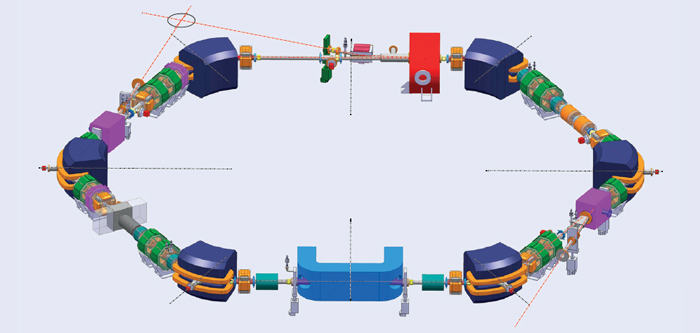
At CERN, the AD delivers bunches of 5.3 MeV antiprotons (3 × 107) every 100 s. However, storing antiprotons requires lower energies, which are reachable by inserting thin foils, albeit at the expense of substantial losses and degradation in beam size. Prospects for improved experiments are now bright with ELENA, a 30 m circumference electron-cooled ring that decelerates the AD beam further to 100 keV (figure 1). ELENA will be installed in 2015 and will be available for physics in summer 2017.

ELENA Ring

The first free-fall experiment to profit from this new facility will be GBAR. Antihydrogen atoms will be obtained by the interaction of antiprotons from ELENA with a positronium cloud. The positrons will be produced by a 4.3 MeV electron linac. In contrast to AEgIS, the antihydrogen atom will capture a further positron to become a positively charged ion, which can be transferred to an electromagnetic trap, cooled to 10 mK with cold beryllium ions and then transported to a launching trap where the additional positron will be photodetached. The mean velocity of the antihydrogen atoms will be around 1 m/s and the fall distance will be about 30 cm. GBAR will be commissioned in 2017 with the initial goal of reaching 1% accuracy on g.

The sensitivity of GBAR, limited by the velocity distribution of the antihydrogen atoms, could be improved substantially by using quantum reflection, a fascinating effect that was discussed at the workshop. Antihydrogen atoms dropped towards a surface experience a repulsive force, which leads to gravitational quantum states. A similar phenomenon was observed with cold neutrons at the Institut Laue–Langevin (ILL) in Grenoble. Now, the ILL team proposes to bounce the atoms in GBAR between two layers – a smooth lower surface to reflect slow enough antihydrogen atoms and a rough upper surface to annihilate the fast ones. Transition frequencies between the gravitational levels – which depend on g – could also be measured by recording the annihilation rate on the bottom surface. Provided that the lifetime of these antihydrogen levels is long enough, orders of magnitude improvements could be obtained on the determination of g.

Atom interferometers might be able to measure g to within 10–6. In a Ramsey–Bordé interferometer, the falling atom interacts with pulses from two counter-propagating vertical laser beams. Having absorbed a photon from the first beam, the atom is stimulated to emit another photon with the frequency of the second beam, thereby modifying its momentum. The signal from the annihilating antihydrogen atom, for example at the top of the interferometer, interferes with the one from another atom that has equal momentum but was not subject to the laser kick. The interference pattern will depend on the value of g.

At FLAIR the antiproton flux will be an order of magnitude higher than at ELENA

In the more distant future, the Facility for Low-energy Antiproton and Ion Research (FLAIR) will become operational at GSI. As an extension to the high-energy antiproton facility, FLAIR will consist of a low-energy storage ring decelerating antiprotons from 30 MeV to 300 keV, followed by an electrostatic ring capable of reducing the energy even further, down to 20 keV. At FLAIR the antiproton flux will be an order of magnitude higher than at ELENA, and slow extracted antiproton beams will be available for experiments in nuclear and particle physics.

The question of how large an effect these free-fall experiments could measure cannot be answered without theoretical assumptions, such as exact symmetry between matter and antimatter (the CPT theorem). However, string theory can break CPT. The standard model extension proposed by the Indiana/Carleton group involves Lorentz and CPT violation. Also, atoms and nuclei contain virtual antiparticles in amounts that depend on the atomic number. The calculable quantum corrections agree with measurements, arguing against antigravity. However, there is a huge discrepancy in the value of the cosmological constant estimated from vacuum particle–antiparticle pair fluctuations, which might question our understanding of the interaction between gravity and virtual particles. As pointed out at the workshop, if all of the theoretical assumptions are valid, then antimatter experiments should not expect to see discrepancies in g at a level larger than 10–7. Ultimately, the issue must be settled by experiments.

To compare with matter, a presentation was given on the 10–9 precision achievable on g at the Swiss Federal Institute of Metrology (METAS) using a free-fall interferometer. Together with improved measurements of Planck’s constant with a watt balance, this might lead to a re-definition of the kilogram based on natural units.

The workshop also included a session on antimatter in the universe. Is there any antimatter and could it repel matter (the Dirac–Milne universe) and provide the accelerating expansion? Can the excess of positrons observed above 10 GeV by balloon experiments, the PAMELA satellite experiment and, more recently, the Fermi Gamma-ray Space Telescope and the Alpha Magnetic Spectrometer (AMS-02), be explained by antimatter annihilation?

In his summary talk, Mike Charlton of Swansea University concluded that “the challenge of measuring gravity on antihydrogen remains formidable”, but that “in the past decade the prospects have advanced from the totally visionary to the merely very difficult”.

The workshop, with 28 plenary talks, was attended by 70 participants. A visit to the house where Einstein spent the years 1903–1905 and dinner at Altes Tramdepot were part of the social programme.

IceCube finds evidence for high-energy extra-terrestrial neutrinos

CCnew2_01_14

The IceCube collaboration has reported evidence, at the 4σ level, for a diffuse (i.e. isotropic) flux of high-energy extra-terrestrial neutrinos, mostly above 60 TeV (Aartsen et al. 2013). Using two years of data, the analysis selected 28 events – including the two events previously reported with energies above 1 PeV. This is substantially above the background estimate of 12.1 events.

In the energy range 60 TeV to 2 PeV, the data are well described by a neutrino energy spectrum that varies as E–2, with a flux Eν2φ <1.2±0.4 × 10–8 GeV cm–2 s–1 sr–1. This is near the Waxman–Bahcall bound – the flux expected if cosmic-ray nuclei undergoing acceleration interact strongly in their sources and transfer most of their energy to secondary particles (mainly π± and K±) whose decays produce neutrinos. For an E–2 spectrum, the data indicate that there must be a cut-off at a few peta-electron-volts, otherwise more energetic events would have been seen. Alternatively, the energy spectrum might be somewhat softer: an E–2.2 spectrum fits the data well.

The analysis combined multiple techniques to isolate the 28 events from a much larger background of downward-going cosmic-ray muons and atmospheric neutrinos. The event selection was simple. It involved choosing events that originated within the detector and produced more than 6000 observed photoelectrons. The origination criteria used the outer portion of the detector as a veto, therefore removing events with early light, which could be from entering tracks. The analysis estimated the muon backgrounds using two independent, nested veto regions around a smaller fiducial volume. Events tagged in the outer veto that missed the inner veto were used to determine the veto-miss fraction. The veto also eliminated energetic, downward-going atmospheric neutrinos, which should be accompanied by a cosmic-ray air shower with energetic muons that should trigger the veto.

The selection criteria were largely insensitive to the event topology, so the analysis selected νe, νμ and ντ interactions, providing they occurred inside the detector. The events fall into two classes: long tracks (muons) from νμ charged-current interactions, plus cascades, electromagnetic or hadronic showers from νe and most ντ charged-current interactions, and neutral-current interactions of any flavour. Most of the events that IceCube sees are atmospheric νμ charged-current interactions, but the requirement that the events originate within the detector, depositing 6000 photoelectrons, changes the fraction. Of the 28 events found, only seven are classed as track-like. While this is consistent with the 1:1:1 ratio of νeμτ, it is a lower fraction of tracks than expected for atmospheric neutrinos, which are mostly νμ.

Figure 1(a) shows the deposited energy for the 28 events, together with the expected backgrounds for muons, conventional atmospheric neutrinos and prompt atmospheric neutrinos from the decay of charmed particles. The atmospheric neutrino fluxes include the effect of the downward-going veto. There is a substantial uncertainty for the prompt flux, which has not yet been observed – the range is based on theoretical estimates, with upper limits from previous IceCube studies. Although the two 1 PeV neutrinos are prominent, the signal rises above the background at energies above 60 TeV. The black line shows the best fit to an E–2 astrophysical signal.

Figure 1(b) compares the zenith angle distribution of the data with the same background estimates. The muon background is entirely downward-going, while the atmospheric neutrino background is largely upward-going, owing to a combination of the downward-going veto and the absorption of high-energy neutrinos in the Earth. An isotropic extra-terrestrial signal would also be mostly downward-going because of this absorption. Of the 28 selected events, 24 are downward-going, which is more than expected from the background plus the astrophysical component from the fit. The excess is about 1.5σ. The angular agreement for a purely atmospheric neutrino flux is even worse.

This analysis shows that cosmic accelerators emit a significant fraction of their energies as neutrinos. The collaboration has also studied the arrival directions of the events, but observes no significant clusters. However, follow-up studies should further characterize the radiation and pin down its source. Already, some tantalizing hints have been presented at the 2013 International Cosmic Ray Conference.

Breakthrough of the Year

The first observations of high-energy cosmic neutrinos by IceCube was named 2013 Breakthrough of the Year by Physics World and also featured in Wired’s list of top scientific discoveries of 2013. Physics World highly commended nine other achievements, including the discovery of pear-shaped nuclei at CERN’s ISOLDE facility, the Planck space telescope’s most precise determination ever of the cosmic microwave background radiation and the South Pole Telescope’s measurement of B-mode polarization in the radiation. Wired also listed the dark-matter results from the LUX experiment.

ATLAS and CMS observe Higgs-boson decays to fermions

Last year, the ATLAS and CMS collaborations confirmed that the new boson found in 2012 was indeed a Higgs boson with a mass around 125 GeV. The discovery relied on the observation of decays to pairs of bosons, namely photons, Ws and Zs – the carriers of the electromagnetic and weak forces – and provided strong support for the idea that the Brout–Englert–Higgs mechanism is responsible for the mass of the W and Z bosons, while leaving the photon massless. Now, with the full LHC data sets from 2011 and 2012, the two collaborations have turned their attention to testing whether the Higgs field also gives mass to fermions, i.e. quarks and leptons.

The CMS collaboration announced its first results on the coupling of the recently discovered Higgs boson to fermion pairs at the Rencontres de Moriond conference, in March 2013. At the time, the search for the Higgs-boson decays to b b and τ+τ had yielded evidence with a combined significance of 3.4σ for the Higgs coupling to third-generation fermions.

Now, the updated search for decays to τ+τ, based on an improved analysis of 4.9 fb−1 of LHC data collected at a collision energy of 7 TeV in 2011 and 19.7 fb−1 collected at 8 TeV in 2012, has revealed a 3.4σ excess at the mass of the Higgs boson in this channel alone. Taken together with the 2.1σ excess found in the earlier searches by CMS for b decays, this gives a combined significance of 4.0σ for the two channels, compared with an expectation of 4.2σ for a Standard Model Higgs boson. The observed rate for Higgs production with subsequent decay into b quarks or τ leptons divided by the expected rate for a Standard Model Higgs gives the ratio μ = 0.90±0.26, which suggests that the particle does indeed behave like a Standard Model Higgs boson.

CCnew6_01_14

By contrast, the search for decays of the Higgs boson to μ+μ yields no signal, just as expected from the fact that the μ has nearly 17 times less mass than the τ, making the decays of the Higgs to μ+μ some 290 times less frequent than those to τ+τ. Likewise, the search for the Higgs-boson decay into a pair of electrons – which should be even more rare, given that the electron is 200 times lighter than the muon – returned empty handed. From this, it can be inferred that the couplings of the Higgs boson to leptons of different generations are not universal, in contrast to, for example, the couplings of the Z bosons, which do not distinguish between lepton flavours.

These measurements used the full capabilities of the CMS experiment, combining information from all of the detector’s components to reconstruct and measure the energy of each individual particle emerging from the proton–proton collision, via a “particle flow” algorithm. This technique allows τ decays to be identified efficiently, while rejecting the background from “jets” of particles originating from quarks and gluons. The precise charged-particle tracking of CMS helps identify jets coming from b quarks. In the case of Higgs-boson decays to τ+τ, the data have a strong peak at a τ+τ mass corresponding to that of the Z boson, which is produced much more copiously than Higgs bosons. The analysis was developed and optimized in a “blinded” way, i.e. not looking at the signal in the data, to avoid introducing a bias.

By carefully measuring and controlling this background, a clear signal from Higgs decays remains after subtracting the background (figure 1).

Armed with an array of techniques and decay modes with which to study the Higgs boson, CMS will continue to measure its properties ever more precisely – using present and future data – and to search for additional new particles, including possible cousins of the Higgs boson.

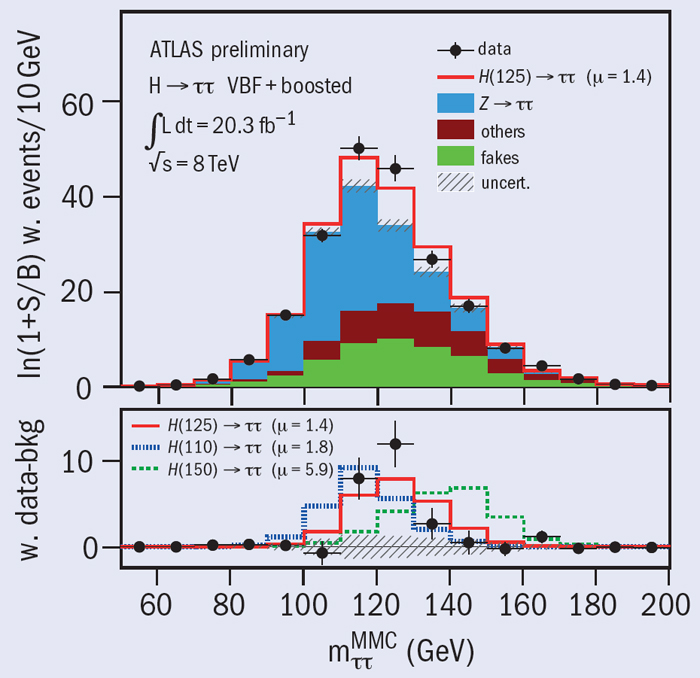
The ATLAS collaboration presented its first results on fermionic decays of the Higgs boson using the full 2012 data set in the di-muon and b b decay channels at the winter and summer conferences in 2013, respectively. However, the results did not yet establish the fermionic decays expected from a Standard Model Higgs boson. ATLAS has now found strong evidence for Higgs decays to fermions, using 20.3 fb−1 of LHC data taken at a proton collision energy of 8 TeV in the centre of mass. This is an important test of the Standard Model, which predicts such decays.

Branching ratios for the Standard Model Higgs boson are predicted to scale with the mass-squared of the decay products. Hence the two fermionic final states expected to be most abundant are b b quark pairs and τ+τ lepton pairs, the most massive of the fermions to which the Higgs boson can decay.

CCnew7_01_14

ATLAS has looked for all possible τ+τ decay channels, namely to two leptons, to one lepton plus hadrons and to hadrons only. The analysis was optimized to test whether a 125 GeV Higgs boson decays to a τ+τ pair and suppresses contributions that have a τ+τ invariant mass away from 125 GeV, including the Z → τ+τ background, although the main remaining background is still Z → τ+τ. Thanks to the detector’s powerful lepton identification capabilities and the application of sophisticated analysis methods, the contamination from backgrounds to the τ+τ final state could be reduced greatly. Remaining backgrounds were estimated directly from the data, or taken from simulation with their rates normalized to data in signal-free control regions. To avoid any possible bias, the analysis was developed and optimized without looking at the signal in the data (blinded).

After “unblinding”, ATLAS observes an excess of events (figure 2) in a region consistent with the previously measured mass of the Higgs boson (125 GeV) and a statistical significance of 4.1σ, against 3.2σ expected. The ratio of the observed signal to that expected for a Standard Model Higgs decaying to a τ+τ pair yields μ = 1.4+0.4–0.5, which is compatible with one.

ATLAS also searched for the decay of a Higgs boson to a muon pair. Because the Higgs boson couples to mass and the mass of the muon is 17 times lower than that of the τ, the H → μ+μ rate is expected to be around 290 times lower than that of H → τ+τ. The absence of a signal in the ATLAS μ+μ search, setting an upper limit of 9.8 times the H → μ+μ rate predicted by the Standard Model, therefore provides strong evidence that the Higgs boson does not decay to leptons in a flavour-blind way, but favours decays to heavy leptons, as predicted by the Standard Model.

These results, which are derived from the LHC’s first run, are so far compatible with the Standard Model predictions. The broad physics programme of ATLAS, which includes precision measurements of the properties of the Higgs boson, will continue to test the Standard Model in the years to come.

These results from the two collaborations now establish the coupling of the Higgs bosons to fermions. More data will allow testing the Higgs couplings at a deeper level, where other models for physics beyond the Standard Model predict differences. The next LHC run, which begins in 2015, is expected to produce several times the existing data sample. In addition, the proton collisions will be at higher energies, producing Higgs bosons at higher rates.

How long can beauty and charm live together?

The LHCb collaboration has recently made the world’s most precise measurement of the lifetime of the B+c meson – a fascinating particle that has both beauty and charm.

The heavy flavours of beauty and charm are produced in proton–proton collisions at the LHC in quark–antiquark pairs. The resulting hadrons usually contain the original pair, as in the case of quarkonia, or a single heavy quark bound to the abundantly produced light quarks. However, in rare cases, a c quark and a b antiquark combine into a B+c. Since the top quark, t, decays too quickly to form hadrons, this is the only meson composed of two particles carrying different heavy flavours. As such, it offers a unique laboratory to test theoretical models of both the strong interaction, which accounts for its production, and the weak interaction, via which the meson has to decay. Indeed, the lifetime of the B+c meson is one of the key parameters that provide a test-bench for theoretical models. Knowledge of the lifetime is also essential to develop selection algorithms and to improve the accuracy of the branching-fraction determination for most B+c decay modes.

CCnew9_01_14

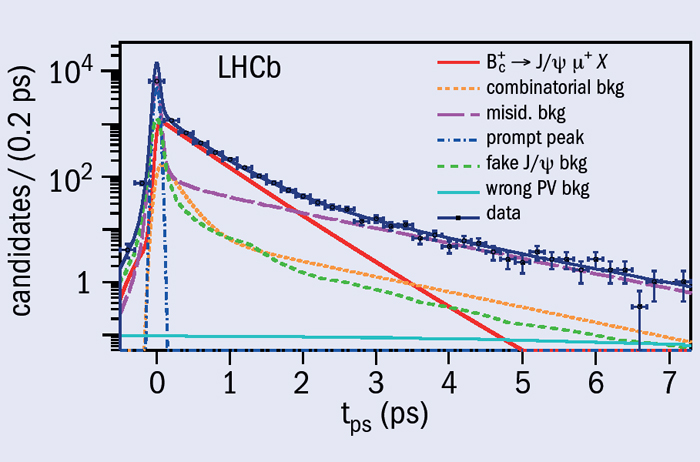
Following initial investigation at the Tevatron, the B+c meson is being studied extensively at the LHC. In particular, the LHCb collaboration has already published several observations of new decay channels and the world’s most precise determination of the B+c mass. Now, the collaboration has achieved the world’s most precise measurement of the lifetime by studying the semileptonic decays B+c → J/ψμν, with the subsequent decay J/ψ → μ+ μ. The particle identification capabilities of LHCb allow a high-purity sample to be selected for these three-muon decays without any requirement on the decay time, therefore not biasing the measured lifetime. Using the data sample collected in 2012, about 10,000 signal decays were selected – the largest sample of reconstructed B+c decays to have ever been reported.

The challenge with semileptonic decays is that the B+c kinematics is not completely reconstructed, because of the impossibility of detecting the neutrino. This effect can be corrected on a statistical basis, although at the cost of introducing an uncertainty owing to the theoretical model of the decay used for the correction. LHCb developed a technique to constrain this model-dependence using data and found that the corresponding systematic uncertainty is small.

The result for the lifetime is 509±15 fs. This is twice as precise as the current world-average from the Particle Data Group, obtained combining measurements by the CDF and D0 experiments at the Tevatron, and opens the door for a new era of precision B+c studies.

New charged charmonium-like states observed at BESIII

CCnew10_01_14

In studies at the Beijing Electron–Positron Collider (BEPCII), the international team that operates the Beijing Spectrometer (BESIII) experiment has found evidence for a family of what could well be four-quark states. The new results follow the discovery of the electrically charged Zc(3900) in March last year.

These breakthroughs are the result of a dedicated study by the BESIII collaboration of the decays of the puzzling Y(4260) state. Discovered by the BaBar collaboration at SLAC in 2005, this state has a well-established mass that is inconsistent with the interpretation that it consists only of a charm quark, c, and an anti-charm quark, c. Moreover, it tends to decay to charmonium (cc states) plus conventional mesons rather than to a pair of charmed particles, as expected for a particle of this mass. So, more complicated models for its composition need to be considered, such as the addition of more quarks to the system, the existence of excited gluons binding the cc system, or even more exotic scenarios. The problem has been to find a way to distinguish experimentally between the different theoretical possibilities.

By tuning the energy at which electrons and positrons annihilate at BEPCII to the mass of the Y(4260), the BESIII collaboration has been able to produce the state directly and collect large samples of its decays. The first surprising result was the discovery of the Zc(3900), a charged state that decays π± J/ψ. To decay this way, the Zc(3900) must contain a charm quark and an anticharm quark (to form the neutral J/ψ), together with something else that is charged, i.e., additional lighter quarks. Hence, it must be (at least) a four-quark object.

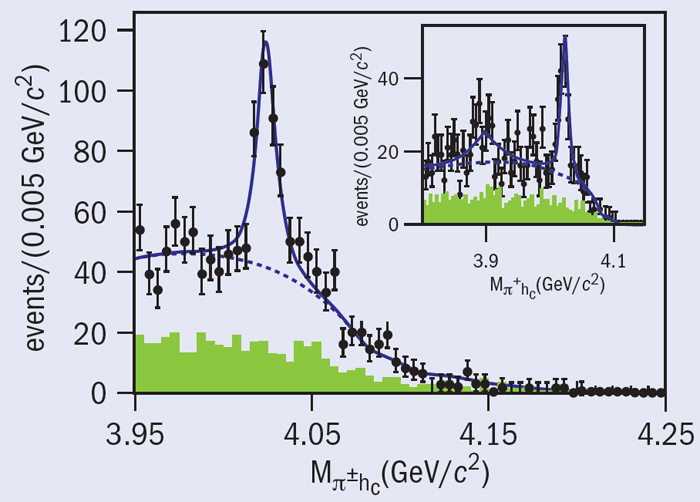
Since then, the BESIII collaboration has discovered a partner to the Zc(3900) – the Zc(4020). The new state appeared in the decay π±hc (BESIII collaboration 2013a). Like the Zc(3900), the Zc(4020) is electrically charged and decays to a particle consisting of a cc – in this case, the hc – so the interpretation is the same: it must also be a four-quark object. It appears, therefore, that the BESIII collaboration has begun to unveil a whole family of four-quark objects.

One possible clue for the interpretation of the Zc(3900) and Zc(4020) is that they appear near the minimum masses required to allow decays to pairs of D mesons (each consisting of a charm quark and an anti-up or anti-down quark). The Zc(3900) has a mass just above the combined mass of the D and D* and the Zc(4020) has a mass just more than twice that of the D*. So one idea is that the Zc(3900) is a four-quark bound state consisting of a D and a D*, each composed of two quarks. Similarly, the Zc(4020) could be a D*D* bound state. BESIII has explored this piece of evidence further by studying experimentally the charged D*D and D*D* systems, both of which show clear enhancements with properties similar to those of the Zc(3900) and Zc(4020) (BESIII collaboration 2013b and 2013c).

Another clue to the nature of all of these states came with the discovery of what appears to be a Y(4260) decaying to a photon and another particle, designated the X(3872) (BESIII collaboration 2013d). Unlike the Zc(3900) and the Zc(4020), the X(3872) is electrically neutral and has been experimentally established for more than 10 years. It has long been suspected of being a four-quark object, but it has been difficult to distinguish this interpretation from others as it has no electric charge. Now that BESIII has observed it alongside the Zc(3900) and Zc(4020), it seems that a definitive theoretical interpretation must be closer at hand.

2013 Nobel Prize in Physics goes to Englert and Higgs

CCnew1_10_13

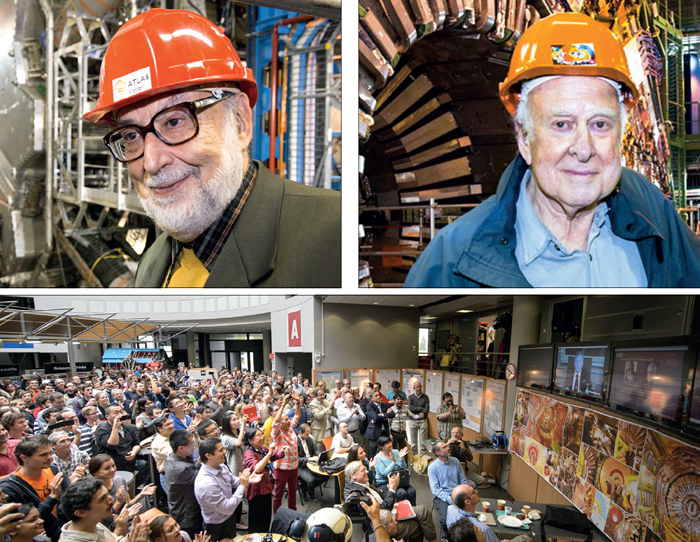
Champagne corks popped at CERN on 8 October, to celebrate the award of the 2013 Nobel Prize in Physics to François Englert, professor emeritus at the Université libre de Bruxelles, and Peter Higgs, professor emeritus at the University of Edinburgh. They received the honour “for the theoretical discovery of a mechanism that contributes to our understanding of the origin of mass of subatomic particles, and which recently was confirmed through the discovery of the predicted fundamental particle, by the ATLAS and CMS experiments at CERN’s Large Hadron Collider”. The announcement of the discovery by the ATLAS and CMS collaborations took place at CERN on 4 July last year.

“I’m thrilled that this year’s Nobel prize has gone to particle physics,” said CERN’s director-general, Rolf Heuer. “The discovery of the Higgs boson at CERN last year, which validates the Brout–Englert–Higgs mechanism, marked the culmination of decades of intellectual effort by many people around the world.”

The Brout–Englert–Higgs (BEH) mechanism was first proposed in 1964 in two papers published independently – the first by Belgian physicists Robert Brout (now deceased) and his colleague Englert, the second by British physicist Higgs. It explains how the force responsible for β decay turns out to be much weaker than electromagnetism, but it is better known as the mechanism that endows fundamental particles with mass. A third paper, published by Americans Gerald Guralnik and Carl Hagen with their British colleague Tom Kibble, further contributed to the development of the new idea, which now forms an essential part of the Standard Model of particle physics. A key prediction of the idea, as was pointed out by Higgs, is the existence of a massive boson of a new type. After searches in earlier experiments, mainly at CERN and Fermilab, the particle was finally discovered by the ATLAS and CMS experiments at the LHC in 2012.

The Standard Model describes both the fundamental particles from which all the visible matter in the universe is made and the interactions that govern their behaviour. It is a remarkably successful theory that has been thoroughly tested by experiment over many years. Until last year, the BEH mechanism was the last remaining piece of the model to be experimentally verified. Now that it has been found, experiments at CERN are searching assiduously for physics beyond the Standard Model.

LHCb and theorists chart a course for discovery

Experimenters from LHCb and theorists recently met at CERN to discuss the best ways to obtain the most out of the rich harvest of data from the LHC.

Despite the large size of modern particle-physics collaborations, every experiment faces issues that arise because resources do not match ambitions. For LHCb, the 70 journal papers the collaboration has submitted this year are only the tip of the iceberg of the interesting and often unique measurements that could be achieved. Because this iceberg might be able to fracture the hull of the Standard Model, it is essential to maximize the output of physics. This makes close communication with theorists crucial.

To facilitate such discussions, on 14–16 October LHCb held a workshop at CERN on “Implications of LHCb measurements and future prospects”. Following the tradition of two earlier meetings in the series, approximately 50 theorists from around the world joined members of the LHCb collaboration for intense discussions. Sessions covered charm mixing and CP violation, B mixing and CP violation, rare decays and “forward exotica”, including topics such as the production of top quarks and Higgs bosons in the LHCb acceptance. There was also a session dedicated to the interplay of LHCb results with, for example, studies of the Higgs boson and searches for supersymmetry at ATLAS and CMS.

One of the hottest topics concerned recent measurements by LHCb of the angular distribution of the decay products of B0 → K*0μμ transitions that have revealed tension with the prediction of the Standard Model (LHCb collaboration 2013). The observable known as P5´ – shown in the figure as a function of the dimuon invariant-mass squared (q2) – is particularly interesting. This parameter is sensitive to the modulation of the angular distribution that depends on the interaction between different operators contributing to the decay. It is therefore sensitive to the effects of physics beyond the Standard Model. Additionally, P5´ is insensitive at leading order to theoretical uncertainties related to the K* hadronic form factor. However, corrections from higher-order terms introduce residual uncertainty. The tension in the data can be reduced if the uncertainty is allowed to be larger than original estimates – an observation that sparked a debate about the best estimate of the size of the so-called “power corrections”.

Several key points emerged from the discussion. On the theory side, further studies can help to understand the uncertainties in the form factor. Experimentally, improved analyses with the full LHCb data sample of 3 fb–1 are keenly anticipated: with this large data sample and exploiting the power of the LHCb particle identification system, it might be possible for the first time to perform a full angular analysis that also separates the subtle Kπ S-wave component from the K* signal. Moreover, continuing discussions between theorists and experimenters will be needed to understand which of several different approaches to control the uncertainties is the most sensitive to physics beyond the Standard Model.

For more about the workshop, see http://indico.cern.ch/conferenceDisplay.py?ovw=True&confId=255380.

First results from LUX on dark matter

CCnew9_10_13

The collaboration that built and runs the Large Underground Xenon (LUX) experiment, operating in the Sanford Underground Research Laboratory, has released its first results in the search for weakly interacting massive particles (WIMPs) – a favoured candidate for dark matter.

The LUX detector holds 370 kg of liquid xenon, with 250 kg actively monitored in a dual-phase (liquid–gas) time-projection chamber measuring 47 cm in diameter and 48 cm in height (cathode-to-gate). If a WIMP strikes a xenon atom it recoils from other xenon atoms and emits photons and electrons. The electrons are drawn upwards by an electrical field and interact with a thin layer of xenon gas at the top of the tank, releasing more photons. Light detectors in the top and bottom of the tank can detect single photons and so the two photon signals – one at the interaction point, the other at the top of the tank – can be pinpointed to within a few millimetres. The energy of the interaction can be measured precisely from the brightness of the signals.

The detector was filled with liquid xenon in February and the first results, for data taken during April to August, represent the analysis of 85.3 live days of data with a fiducial volume of 118 kg. The data are consistent with a background-only hypothesis, allowing 90% confidence limits to be set on spin-independent WIMP–nucleon elastic scattering with a minimum upper limit on the cross-section of 7.6 ×10–46 cm2 at a WIMP mass of 33 GeV/c2. The data are in strong disagreement with low-mass WIMP signal interpretations of the results from several recent direct-detection experiments.

Neutrinos head off again to Minnesota

In August, after a 16-month shutdown, Fermilab resumed operation of its Neutrinos at the Main Injector (NuMI) beamline and sent the first muon neutrinos to three neutrino experiments: MINERvA, MINOS+ and the new NOvA experiment. Numerous upgrades to the Fermilab accelerator complex have laid the groundwork for increasing the beam power of the NuMI beamline from about 350 kW to 700 kW. In addition, Fermilab has changed the NuMI horn and target configurations to deliver a higher-energy neutrino beam compared with pre-shutdown operation.

The NOvA experiment – still under construction – will study the properties of neutrinos, especially the elusive transition of muon neutrinos into electron neutrinos. The results will help to answer questions about the neutrino-mass hierarchy, neutrino oscillations and the role that neutrinos might have played in the evolution of the universe. The construction of the NOvA near and far detectors, both located 14 milliradians off the NuMI beam axis, is advancing quickly.

The near detector – located 100 m underground in a new cavern that has been excavated at Fermilab – has more than a quarter of its structure in place. Meanwhile, 810 km away in northern Minnesota, technicians have installed more than three quarters of the plastic structure that is the skeleton of the huge, 14,000 tonne far detector. More than 70% of the far detector’s plastic modules have been filled with 5.7 million litres of liquid scintillator and the first modules are recording data. The first part of the near detector will turn on before the end of the year.

The MINOS+ experiment uses the existing MINOS near and far detectors and takes advantage of the fact that the post-shutdown NuMI neutrino beam differs from earlier operation. The new beam, which is optimized for the NOvA experiment, yields higher-energy neutrinos at the location of the MINOS detector and should not show measurable oscillations. This means that MINOS+ can look for surprises. New types of neutrino interactions could deform the spectrum at the far detector’s distance of 735 km and the observation of additional neutrinos would indicate new physics. The experiment can even search for extra dimensions.

MINERvA – located in front of the MINOS near detector – is a dedicated neutrino-interaction experiment designed to study a range of nuclei. These measurements will not only improve understanding of the nucleus but will also be important inputs to neutrino-oscillation experiments. The MINERvA detector has several targets including helium, carbon, scintillator, water, steel and lead, followed by precise tracking and calorimetry. Previously, MINERvA took data in a beam around 3 GeV, where quasi-elastic, resonance and deep-inelastic scattering processes contribute roughly equally to the event rates. With the new, higher-energy neutrino beam, the event rate is much higher and the events are dominated by deep-inelastic scattering. While MINERvA will study all processes at higher energy, the huge increase in deep-inelastic scattering events in particular will allow precise measurements of the nuclear structure-functions.

bright-rec iop pub iop-science physcis connect