In late 2011, ATLAS launched a dedicated programme targeting searches for the supersymmetric partner of the top quark – the scalar top, or “stop” – which could be pair-produced in high-energy proton–proton collisions. If not much heavier than the top quark, this new particle is expected to play a key role in explaining why the Higgs boson is light.
While earlier supersymmetry (SUSY) searches at the LHC have already set stringent exclusion limits on strongly produced SUSY particles, these generic searches were not very sensitive to the stop. If it exists, the stop could decay in a number of ways, depending on its mass and other SUSY parameters. Most of the searches at the LHC assume that the stop decays to the lightest SUSY particle (LSP) and one or more Standard Model particles. The LSP is typically assumed to be stable and only weakly interacting, making it a viable candidate for dark matter. Events with stop-pair production would therefore feature large missing transverse momentum as the two resulting LSPs escape the detector.
The first set of results from the searches by ATLAS were presented at the International Conference on High-Energy Physics (ICHEP) in 2012. A stop with mass between around 225 and 500 GeV for a nearly massless LSP was excluded for the simplest decay mode. Exclusion limits were also set for more complex stop decays.
These searches revealed a sensitivity gap when the stop is about as heavy as the top quark – a scenario that is particularly interesting and well motivated theoretically. Such a “stealth stop” hides its presence in the data, because it resembles the top quark, which is pair-produced roughly six times more abundantly.
Use of the full LHC Run-1 data set, together with the development of novel analysis techniques, has pushed the stop exclusion in all directions. The figure shows the ATLAS limits as of the ICHEP 2014 conference, in the plane of LSP mass versus stop mass for each of the following stop decays: to an on-shell top quark and the LSP (right-most area); to an off-shell top quark and the LSP (middle area); to a bottom quark, off-shell W boson, and the LSP (left-most grey area); or to a charm quark and the LSP (left-most pink area). The exclusion is achieved by the complementarity of four targeted searches (ATLAS Collaboration 2014a–2014d). The results eliminate a stop of mass between approximately 100 and 700 GeV (lower masses were excluded by data from the Large Electron–Positron collider) for a light LSP. Gaps in the excluded region for intermediate stop masses are reduced but persist, including the prominent region corresponding to the stealth stop.
Standard Model top-quark measurements can be exploited to get a different handle on the potential presence of a stealth stop. The latest ATLAS high-precision top–antitop cross-section measurement, together with a state-of-the-art theoretical prediction, has allowed ATLAS to exclude a stealth stop between the mass of the top quark and 177 GeV, for a stop decaying to a top quark and the LSP.
The measurement of the top–antitop spin correlation adds extra sensitivity because the stop and the top quark differ by half a unit in spin. The latest ATLAS measurement (ATLAS Collaboration 2014e) uses the distribution of the azimuthal angle between the two leptons from the top decays, together with cross-section information, to extend the limit for the stealth stop up to 191 GeV.
The rigorous search programme undertaken by ATLAS has ruled out large parts of interesting regions of the stop model and closed in on a stealth stop. It leaves the door open for discovery of a stop beyond the current mass reach, or in remaining sensitivity gaps, at the higher-energy and higher-luminosity LHC Run 2.
Ever since the earliest experiments with hadron beams, and subsequently during the era of the hadron colliders heralded by CERN’s Intersecting Storage Rings, it has been clear that hadron collisions are highly complicated processes. Indeed, initially it was far from obvious whether it would be possible to do any detailed studies of elementary particle physics with hadron collisions at all.
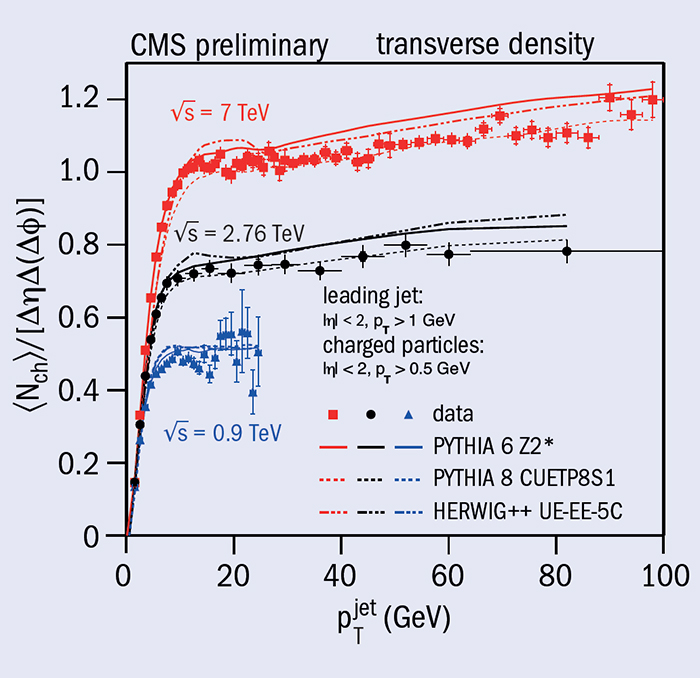
The question was whether the physics of “interesting” particle production could be distinguished from that of the “background” contribution in hadron collisions. While the former is typically a single parton–parton scattering process at very high transverse momentum (pT), the latter consists of the remnants of the two protons that did not participate in the hard scatter, including the products of any additional soft, multiple-parton interactions. Present in every proton–proton (pp) collision, this soft-physics component is referred to as the “underlying event”, and its understanding is a crucial factor in increasing the precision of physics measurements at high pT. Now, the CMS collaboration has released its latest analysis of the underlying event data at 2.76 TeV at the LHC.
The measurement builds on experimental techniques that have been developed at Fermilab’s Tevatron and previously at the LHC to perform measurements that are sensitive to the physics of the underlying event. The main idea is to measure particle production in the region of phase space orthogonal to the high-pT process – that is, in the transverse plane. In its latest analysis of the underlying event data at 2.76 TeV, CMS has measured both the average charged-particle multiplicity as well as the pT sum for the charged particles. The scale of the hard parton–parton scattering is defined by the pT of the most energetic jet of the event.
The measurements are expected to result in more accurate simulations of pp collisions at the LHC. Because the properties of the underlying event cannot be derived from first principles in QCD, Monte Carlo generators employ phenomenological models with several free parameters that need to be “tuned” to reproduce experimental measurements such as the current one from CMS.
An important part of the studies concerns the evolution of the underlying-event properties with collision energy. CMS has therefore presented measurements at centre-of-mass energies of 0.9, 2.76 and 7 TeV. Soon, there will be new data from Run 2 at the LHC. The centre-of-mass energy of 13 TeV will necessitate further measurements, and provide an opportunity to probe the ever-present underlying event in uncharted territory.
The LHCb collaboration has discovered two new particles, the Ξ´–b and Ξ*–b. Predicted to exist by the quark model, they are both baryons containing three quarks, in this case, b, s and d. The new particles – which thanks to the heavyweight b quarks are more than six times as massive as the proton – join the Ξ–b, found several years ago by the D0 and CDF experiments at Fermilab.
The three particles are differentiated by the spin, j, of the sd diquark, and the overall spin-parity, JP, of the baryon, and in turn the relative spins of the quarks affect the masses of the particles. With j = 0 and JP = ½+, the Ξ–b is the lightest, and so decays relatively slowly through the weak interaction, leading to its discovery at Fermilab’s Tevatron. The Ξ´–b and Ξ*–b have j = 1, and JP = ½+ and JP = 3/2+, respectively, and should decay either strongly or electromagnetically, depending on their masses.
LHCb analysed proton–proton collision data from the LHC corresponding to an integrated luminosity of 3.0 fb–1, to observe the new particles through their decay to Ξ0b π–. A third of the data were collected at a centre-of-mass energy of 7 TeV, the remainder at 8 TeV. Signal candidates were reconstructed in the final state Ξ0b π–, where the Ξ0b was identified through its decay Ξ0b → Ξ+c π–, Ξ+c → p K– π+.
The figure shows the distribution of δm, defined as the invariant mass of the Ξ0 bπ– pair minus the sum of the π– mass and the measured Ξ0b mass. This definition means that the lightest possible mass for the Ξ0b π– pair – the threshold for the decay – is at δm = 0. The two peaks are clear observation of the Ξ´–b(left) and Ξ*–b (right) baryons above the hatched-red histogram representing the expected background. The Ξ*–b is clearly the more unstable of the two, because its peak is wider. This is consistent with the pattern of masses: the Ξ´–bmass is just slightly above the energy threshold, so it can decay to Ξ0b π–, but only just – its width is consistent with zero, with an upper limit of Γ(Ξ´–b) < 0.08 MeV at 95% confidence level.
The results show the extraordinary precision of which LHCb is capable: the mass difference between the Ξ´–b and the Ξ0b is measured with an uncertainty of about 0.02 MeV/c2, less than four-millionths of the Ξ0b mass. By observing these particles and measuring their properties with such accuracy, LHCb is making a stringent test of models of nonperturbative QCD. Theorists will be able to use these measurements as an anchor point for future predictions.
It has long been known that, when they are put under a sufficiently energetic microscope, nuclei reveal a complicated structure – the more energetic the probe, the more complex the structure. In recent years, continuing studies of deuteron–nucleus (dA) and proton–nucleus (pA) collisions have demonstrated that many features first observed in heavy-ion (AA) collisions are also present in these lighter collisions, and some of these features have even been seen in high-multiplicity pp collisions. Such factors have generated the present intense interest in nuclear structure that was evident when more than 120 physicists gathered in California’s Napa Valley on 3–7 December, to discuss the initial state in these collisions during the 2nd International Conference on Initial Stages in High-Energy Nuclear Collisions (IS2014).
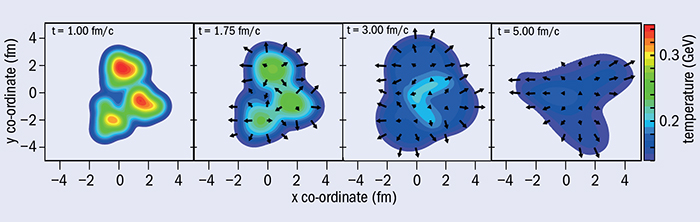
In particular, pA collisions at the LHC have demonstrated the existence of anisotropic particle production. The angular distributions look very similar to those observed in AA collisions, where the anisotropy has been attributed to hydrodynamic flow. The material produced in these collisions appears to flow like a low-viscosity fluid, and the final-state anisotropy mimics that present in the initial elliptic-shaped collision region. Recent studies at Brookhaven’s Relativisitic Heavy-Ion Collider (RHIC) as well as at the LHC have shown that, in addition to the American-football-shaped collision region, there are also event-to-event anisotropies caused by the different random positions of nucleons within the nucleus. Much of the observed anisotropy might be explained by models based on hydrodynamic flow. One focus of IS2014 was the question of how hydrodynamic flow can arise in smaller nuclear systems, particularly pA collisions. One new approach to this question is being pursued at RHIC, in which 3He collided with gold last year, to see how the triangular initial state manifests itself in the collision products (figure 2).
Some of these phenomena also appear in high-multiplicity pp collisions. One example is “the ridge” observed as two-particle correlations between particles with similar azimuthal angles, but separated by large rapidities. In contrast, one other expected consequence of the quark–gluon plasma – jet quenching – appears to be present only in AA collisions, for the most part.
The meeting also covered recent theoretical developments. As the centre-of-mass energies increase, collisions probe partons with smaller and smaller momentum fractions (Bjorken-x values). And as the x-values decrease, the parton density increases, and at low enough x values, saturation must set in. This happens when gluons begin to recombine as well as to split. Although saturation is expected on general principles, the details remain the subject of spirited theoretical discussion. One key question addressed in Napa was the search for the colour-glass condensate (CGC), a hypothetical state of matter where the gluons produce coherent fields. These CGCs lead to new nuclear phenomena.
The meeting included presentations on a variety of experimental techniques. The RHIC and LHC collaborations all made presentations highlighting their data and plans for AA, pA and pp collisions. In addition to hadronic collisions, one session was devoted to ultra-peripheral collisions, where two colliding nuclei interact electromagnetically. Here, reactions such as photonuclear production of vector mesons are sensitive to details of the nuclear initial state.
The congenial atmosphere led to many fruitful discussions, and a third conference is planned in Lisbon in 2016.
Since the inception of the LHC, a central part of its physics programme has been aimed at establishing or ruling out the existence of the Higgs boson, the stubbornly missing building block of the Standard Model of elementary particles. After the discovery of a Higgs boson by the ATLAS and CMS experiments was announced in July 2012, the study of its properties became of paramount importance in understanding the nature of this boson and the structure of the scalar sector. Given the measured mass of the Higgs boson, all of its properties are predicted by the theory, so deviations from the predictions of the Standard Model could open a portal to new physics.
The CMS collaboration recently completed the full LHC Run 1 data analysis in each of the most important channels for the decay and production of the Higgs. Bosonic decays such as H → ZZ → 4 leptons (4l), H → γγ, and H → WW → lνlν, and fermionic decays such as H → bb, H → ττ and H → μμ, were studied, and the results have been published. All of the analyses are based on the proton–proton collision data collected in 2011 and 2012 at the LHC, corresponding to 5 fb–1 at 7 TeV and 20 fb–1 at 8 TeV centre-of-mass energy. The di-boson channels are observed with significance close to or above 5σ. The Standard Model’s hypothesis of 0+ for the spin-parity of the observed Higgs boson is found to be favoured strongly against other spin hypotheses (0– ,1±, 2±). The comparison of off-shell and on-shell production of the Higgs boson in the ZZ channel also sets a constraint on the natural width of the Higgs boson that is comparable to the width expected in the Standard Model. Furthermore, evidence is established for the direct coupling to fermions, with significance above 3σ for the decay to ττ.
The first preliminary results on the full Run 1 data were presented by CMS last July at the International Conference on High Energy Physics
The combination of all of the production and decay channels provides the opportunity to obtain a global view of the most important Higgs-boson parameters, and to disentangle the contributions to the measured rates from the various processes. The first preliminary results on the full Run 1 data were presented by CMS last July at the International Conference on High Energy Physics in Valencia. Now, the collaboration has submitted the final “Run 1 legacy” results on the Higgs boson for publication. The results combining individual channels are remarkably coherent.
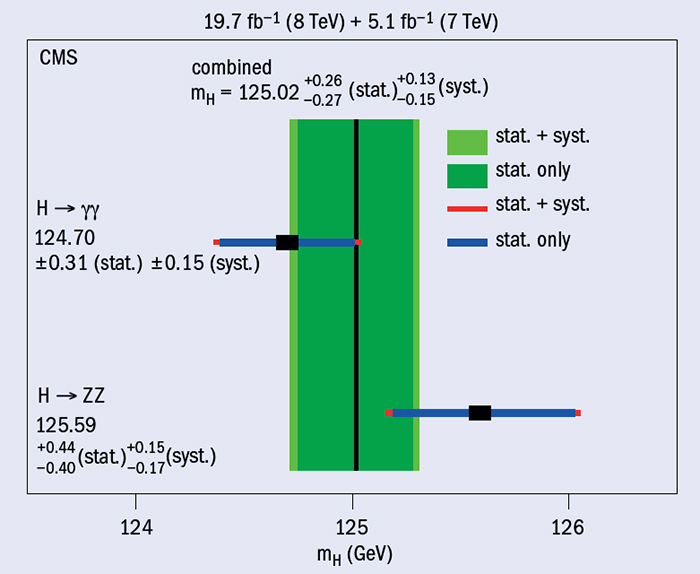
A first major outcome of the combination is a precise measurement of the mass of the Higgs boson. This is achieved by exploiting the two channels with the highest resolution: H → γγ and H → ZZ → 4l. Thanks to the high precision and accurate calibration of the CMS electromagnetic calorimeter, the H → γγ channel gives a most precise single-channel measurement of MH = 124.70±0.34 GeV. Using the combination with the H → ZZ → 4l channel, the final measurement of MH = 125.03+0.29–0.31 GeV is obtained with an excellent precision of two per mille. The measurements in the two channels (figure 1) are compatible at the level of 1.6σ, indicating full consistency with the hypothesis of a single particle. The measured value of the mass is used for further studies of the Higgs-boson’s couplings. It is worth noting that the uncertainty is still dominated by the statistical uncertainty and will therefore improve in Run 2.
The various measurements performed at the two centre-of-mass energies are carried out in a large number (around 200) of mutually exclusive event categories. Each category addresses one or more of the different production and decay channels. Four production mechanisms are considered. Gluon–gluon fusion (ggH) is a purely quantum process, where a single Higgs boson is produced via a virtual top-quark loop. In vector-boson fusion (VBF), the Higgs boson is produced in association with two quarks. Lastly, in VH- and ttH-associated production, the Higgs boson is produced either in association with a W/Z boson or with a top–antitop quark pair. The main decay channels are indicated on the left of figure 2, which shows the measurement of the signal strength μ, defined as the ratio of the measured yield relative to the Standard Model prediction. All of the measurements are found to be consistent with μ = 1, which by definition indicates consistency with the prediction. The combination of all of the measurements gives an overall signal strength of 1.00±0.13. The figure also shows the signal strengths measured for the different decay tags. All of the combinations are obtained using simultaneous likelihood fits of all channels, with all of the systematic and theory uncertainties profiled in the fits.
Signal strengths compatible with Standard Model expectations are also found for each of the production mechanisms, with an observation of ggH production at more than 5σ and evidence for VBF, VH and ttH production at close to or above 3σ.
Another set of tests of consistency with the Standard Model consist of introducing coupling modifiers, κ, that scale the Standard Model couplings. The simplest case is to allow one scaling factor for the coupling of the Higgs boson to the vector bosons (κV) and one for the coupling to fermions (κf), and to resolve the loops – namely gluon–gluon fusion and γγ decay – using Standard Model contributions only.
Figure 3 shows the 1σ contours obtained from the different decay channels in the plane κf versus κV, and from their combination. The only channel that can distinguish between the different relative signs of the two couplings is H → γγ, because of the negative interference between the top-quark and W-boson contributions in the loop. The combination (thick curve) shows that the measurement is consistent within 1σ with κV = κf = 1, while the opposite sign hypothesis, κV = –κf = 1, is excluded with a confidence limit (CL) larger than 95%.
Many other tests of modified couplings with respect to the Standard Model have been carried out, and all of the results indicate consistency with the predictions. For instance, the so-called “custodial” symmetry that fixes the relative couplings κW/κZ of the Higgs boson to W and Z bosons is verified at the 15% precision level and the couplings to fermions of the third family are verified at the 20–30% precision level.
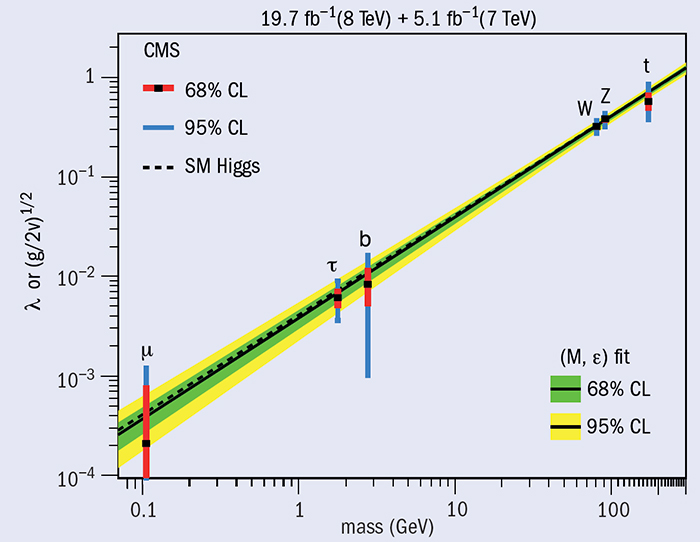
Fig. 4. Graphical representation of the results obtained from likelihood scans for a model where the gluon and photon loop-interactions with the Higgs boson are resolved in terms of other Standard Model particles. The dashed line corresponds to the Standard Model expectation. The inner bars represent the 68% CL intervals, while the outer bars represent the 95% CL intervals. The ordinate differs between fermions and vector bosons to take account of the expected Standard Model scaling of the coupling with mass, depending on the type of particle. The continuous line shows the result of the coupling–mass fit, while the inner and outer bands represent the 68% and 95% CL regions.
The Higgs boson is tightly connected with the mechanism for generating mass in the Standard Model: the Yukawa couplings for the fermions are predicted to be proportional to the mass of the fermions themselves, while the gauge couplings to the vector bosons are proportional to the masses squared of the vector bosons. Figure 4 illustrates this by showing the couplings to the Standard Model particles as a function of the mass of their masses. All of the measurements are in excellent agreement with the expected behaviour of the couplings, indicated by the black line. In this plot the H → μμ channel is also included and, even though it currently has a large uncertainty, it is consistent with the fitted line. This demonstrates beautifully that the Higgs boson is linked to the fundamental field at the origin of the masses of particles.
Summary and conclusions
CMS has just submitted for publication the final Run 1 measurements of the properties of the Higgs boson – mass, couplings and spin-parity parameters – with the highest precision allowed by the current statistics. So far, all of the results are found to be consistent, within uncertainties, with the newly established scalar sector, just as predicted for the spontaneous electroweak symmetry breaking in the Standard Model. The measurements provide overwhelming evidence that the observed Higgs-boson couples to other particles in a way that is consistent with the Standard Model predictions. After achieving the major milestone of completing all of the most important Run 1 Higgs-boson measurements, the CMS experiment will now direct its efforts towards the exploitation of the upcoming LHC run (Run 2) at a centre-of-mass energy of 13 TeV. The new energy frontier promises increased reach into the Higgs sector, but also a unique look at a totally new, unchartered territory.
Charmonia, bound states of charm (c) and anti-charm (c) quarks, are probes for the formation of hot quark–gluon plasma (QGP) in heavy-ion collisions. The suppression of charmonium, already observed at the lower energies of CERN’s Super Proton Synchrotron (SPS) and the Relativistic Heavy Ion Collider at Brookhaven, has been attributed to the screening of the cc binding by the high density of colour charges present in the QGP. However, the modification of charmonium production in heavy-ion collisions can be induced not only by a hot deconfined medium, but also by effects of cold nuclear matter (CNM). The latter can be studied in proton–nucleus interactions, where the temperature and energy density necessary for QGP formation are not expected to be reached.
CNM affects the cc pair throughout its time evolution, from a pre-resonant state to the fully formed resonance, and it can be investigated by comparing the behaviour of the tightly bound J/ψ and the weakly bound ψ(2S) charmonium states. Effects present in the early stages of the cc evolution – such as nuclear-parton shadowing and initial-state energy loss – do not depend on the final charmonium quantum numbers, and should have similar effects on the J/ψ and ψ(2S). On the other hand, final-state mechanisms, such as the break-up of the bound state via interactions with nucleons or with the hadronic matter produced in the collision, will be sensitive to the binding energy of the resonance, and should have a stronger effect on the ψ(2S) than on the J/ψ.
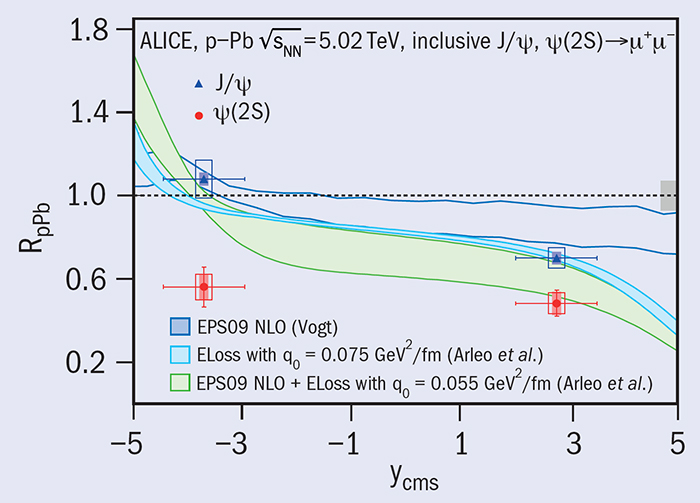
ALICE has studied the production of J/ψ and ψ(2S) in proton–lead collisions at √s = 5.02 TeV, in both the proton-going direction (rapidity 2.03 < ycms < 3.53) and the lead-going direction (–4.46 < ycms < –2.96). The modification of the production yields induced by CNM, with respect to the corresponding proton–proton yield scaled by the number of nucleon–nucleon collisions, is quantified through the nuclear modification factor RpA, which is shown in the figure for J/ψ and ψ(2S). The ψ(2S) suppression is large, and stronger than for the J/ψ, in particular in the backward rapidity region, where the J/ψ is not suppressed at all. This observation implies that final-state effects play an important role, as initial-state mechanisms alone (see also the theory predictions in the figure relative to a pure initial-state scenario) would lead to the same behaviour for both charmonium states.
Such a result was also observed at lower energies (at the SPS, Fermilab and HERA at DESY), where it was related to break-up effects by the nucleons in the nucleus. However, at LHC energies, the resonance formation time (around 0.1 fm/c) is significantly smaller than the time spent by the cc pair in the nucleus, implying that CNM cannot affect the final-state charmonia. This suggests that the difference between the J/ψ and ψ(2S) suppression is due to the interaction with hadrons produced in the proton–lead collision. A detailed study of this effect, still in progress on the theory side, is expected to provide quantitative information on the density and characteristics of such a hadronic medium.
The ATLAS collaboration has updated its measurement of the production of W bosons in association with jets (W+jets), which is an important channel at the LHC for precision comparisons with QCD. A precise understanding of these event topologies is also vital for searches for physics beyond the Standard Model because many new models predict a similar experimental signature.
In recent years, the analysis and understanding of W+jets production has undergone two major advancements. The first is the large amount of data available from the LHC, and the extended kinematic reach that results both from the collider’s centre-of-mass energy – which allows for measurements of jets with a transverse momentum (pT) of up to 1 TeV and multiplicities of up to seven jets – and the expanded detector calorimeter coverage, which can measure jets at large rapidities. Unlike at previous colliders, where the pT values for the jets were a few hundred giga-electron-volts at most, the transverse momentum of the jets at the LHC can be more than an order of magnitude larger than the mass of the W boson itself. In these cases, large QCD corrections can be associated to the multiple scales in the event, and these are difficult to predict by fixed-order calculations. Also, because of the disparity in the scales between the mass of the W boson and the pT of the jet, electroweak corrections can play a major role. The second advancement is the availability of next-to-leading-order (NLO) predictions in perturbative QCD for events with large numbers of associated jets. These calculations have smaller theoretical uncertainties compared with leading-order predictions.
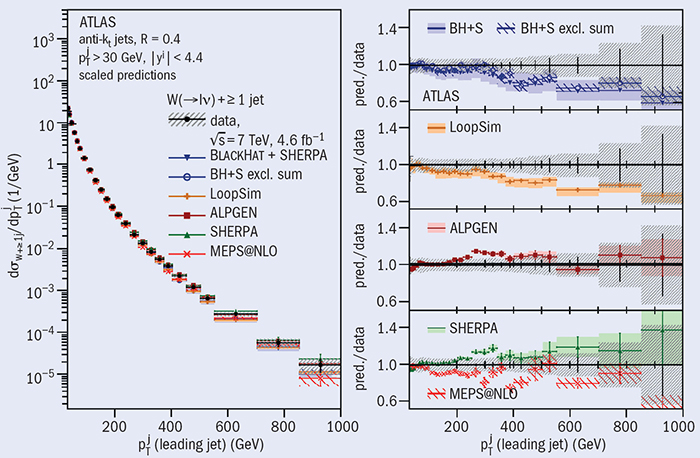
The recent ATLAS measurement of W+jets production focuses on detailed comparisons between the jet and event properties that are observed and several state-of-the-art theory predictions. The figure highlights the differential cross-section as a function of the pT of the leading jet, i.e., the highest transverse momentum. The data are compared with leading-order calculations (Alpgen, Sherpa), NLO calculations (Blackhat+Sherpa, MEPS@NLO), and beyond NLO calculations (LoopSim, Blackhat+Sherpa exclusive sums). At large values of the jet’s pT, the higher-order calculations tend to underestimate the data. In these regions of phase space, additional corrections to the cross-sections from electroweak diagrams are expected to be sizable. However, they are also expected to be negative, and therefore cannot account for this trend. The leading-order predictions model this particular distribution better, but in other kinematic observables, such as the jet rapidity, their description of the data is not as good.
This result is based on the measurement of more than 25 different properties of W+jet events. No single theoretical prediction can describe the data accurately for all distributions. These results will help to improve understanding of QCD and motivate more accurate theoretical calculations for future comparisons with data.
Precise measurements of the mass of the top quark provide key inputs to global electroweak fits and to tests of the internal consistency of the Standard Model. The masses of the Higgs boson and the top quark are the two key parameters that determine whether the vacuum is stable – an issue with broad cosmological implications.
At the LHC, top quarks are predominantly produced in quark–antiquark pairs, and top-quark events are characterized by the decays of the daughter W bosons and bottom quarks, leading to three experimental signatures. In the “lepton+jets” channel, the two bottom-quark jets are accompanied by a single lepton (e or μ) and one undetected neutrino from the decay of one of the W bosons, together with two light-quark jets from the other W. In the dilepton channel, both W bosons decay to leptons, so two leptons (ee, eμ, μμ) and two undetected neutrinos accompany the bottom-quark jets. Last, if the W bosons both decay to quark–antiquark pairs, the signature will include four light-quark jets – the all-jets channel.
At the recent TOP2014 workshop in Cannes, the CMS collaboration presented a new measurement of the mass of the top quark, based on the full LHC data set recorded during 2012. This corresponds to approximately 20 fb–1 of integrated luminosity at √s = 8 TeV, which is roughly four times the size of the combined data sets at √s = 7 TeV from 2010 and 2011. The latest result comes from a new measurement in the dilepton channel (CMS Collaboration 2014a). It complements the results from the lepton+jets and all-jets channels that were announced earlier this year (CMS Collaboration 2014b and 2014c).
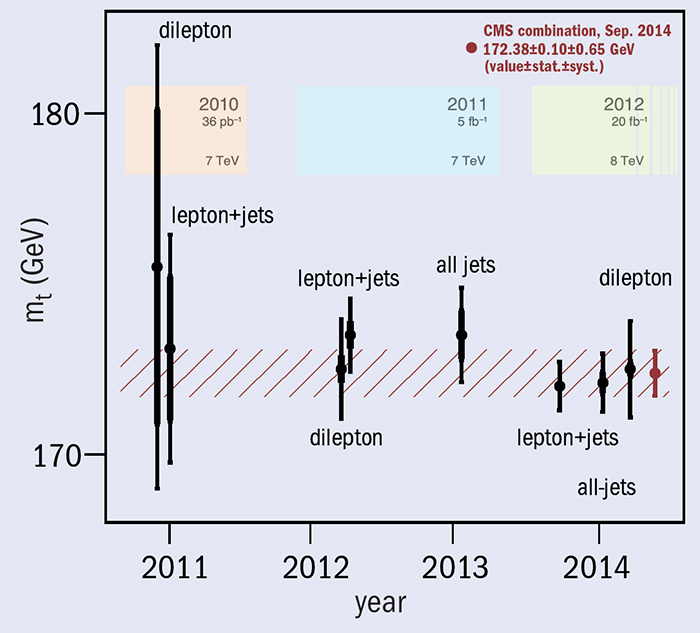
The new measurement uses an analytical matrix-weighting technique to determine the most probable solution for missing transverse energy in the events. The top-quark mass is determined from a fit to the combined results, yielding a value of 172.47±0.17 (stat.) ±1.40 (syst.) GeV. In contrast, for the other two analyses, two-dimensional likelihood functions were used to determine simultaneously the top-quark mass and the overall jet-energy scale. The measurements of 172.04±0.11 (stat.) ±0.74 (syst.) GeV and 172.08±0.27 (stat.) ±0.84 (syst.) GeV, together with the new result, complete the initial set of high-precision analyses using the Run 1 data.
At the TOP2014 workshop, CMS also presented a combination of these results with five previous measurements using the 2010 and 2011 data sets (CMS Collaboration 2014d). The figure shows the combination and the evolution of the CMS measurements as a function of time. The combined value for the top-quark mass is found to be 172.38±0.10 (stat.) ±0.65 (syst.) GeV. With a precision of 0.38%, this is the most precise result from any single experiment. Work continues on additional analyses using alternative techniques, and results from these are expected in the coming months.
Recent observations made by the LHC experiments in proton–lead and high-multiplicity proton–proton events are reminiscent of the collective hydrodynamic-like behaviour observed in lead–lead collisions. However, the results have not been conclusive, and can also be explained in terms of the formation of another state of matter in the initial state – the colour glass condensate. Measuring the space–time extent of the final hadronic state created at “freeze-out” in nuclear collisions – when the majority of particles cease interacting – yields unique information about the initial state and its dynamical evolution. This, in turn, offers an additional constraint on the interpretation of the observed collective-like features. In particular, if the collision proceeds with a hydrodynamic-like expansion, then the final hadronic state should extend to a size significantly larger than that of the initial collision system.
The characteristic length scale of freeze-out is femtoscopic (10–15 m) and cannot be measured directly. However, sizes on this scale can instead be measured indirectly through the quantum interference of identical bosons or fermions. These measurements employ the technique of intensity interferometry that was invented by Robert Hanbury Brown and Richard Twiss in 1956, using the relative arrival time of photons from a distant star. In high-energy particle collisions, instead of the relative arrival time, experiments measure the relative momentum of the emitted particles to learn about the size and structure of the source.
Often, the correlation of two identical charged pions is measured as a function of their relative momentum. In hadron and ion collisions, Bose–Einstein statistics lead to enhanced production of bosons that are close together in phase space, and therefore to an excess of pairs – in this case pions – at low relative momentum. The width of the resulting Bose–Einstein peak at low relative momentum is inversely proportional to the characteristic radius of the source at freeze-out.
In high-multiplicity events such as those produced in lead–lead collisions, all background contributions (i.e. mini jets) to the correlation function are diluted to a negligible amount. However, in events with lower multiplicity, such as those produced in proton–proton and proton-lead collisions, sizable backgrounds exist, and these can significantly bias the extracted radii. One way to overcome the problem is to consider cumulants of higher-order Bose–Einstein correlations. Three-pion Bose–Einstein cumulant correlations are advantageous here in two ways. First, the construction of the three-pion cumulant explicitly removes all of the two-pion background correlations. Second, the genuine three-pion Bose–Einstein signal is twice as large as the two-pion signal, owing to the increased symmetrization possibilities.
The ALICE collaboration has measured three-pion Bose–Einstein correlations in proton–proton (√s =7 TeV), proton–lead (√sNN = 5.02 TeV), and lead–lead (√sNN = 2.76 TeV) collisions at the LHC. The correlation functions were constructed from three types of measured triplet momentum (p) distributions. The first distribution, N3 (p1, p2, p3), is measured by sampling all three pions from the same event. The second distribution, N2 (p1, p2) N1 (p3), is measured by taking two pions from the same event and the third from a different event. Finally, the third distribution, N1 (p1) N1 (p2) N1 (p3), is measured by taking all three pions from different events.
From the measured distributions, the full three-pion correlation function (C3) can be formed and projected onto the relative momentum variable Q3 = √(q122 + q312 + q232), as shown in figure 1, where the invariant relative momentum of a pair is defined as qij = √(– (pi – pj)μ (pi – pj)μ). The figure shows the cumulant correlation function (c3), which subtracts the second distribution as described above, to remove two-pion correlations. The top panels are for same-charge triplets, while the bottom panels are for mixed-charge triplets.
Bose–Einstein correlations occur only for same-charge pions, while Coulomb and strong final-state interactions occur for both same- and mixed-charge combinations. The cumulant correlation functions are corrected for these final-state interactions as well as for the dilution from long-lived emitters (resonance decays and secondary contamination). For same-charge triplets, the three-pion cumulant Bose–Einstein correlation is clearly visible, while for mixed-charge triplets the same cumulant correlation function is consistent with unity, as expected when final-state interactions are removed. In addition, for each of the systems measured, the figure shows model calculations that do not take quantum and final-state interactions into account, demonstrating the power of the three-pion cumulants in removing backgrounds.
The extraction of the source radius at freeze-out is done by means of Gaussian, Edgeworth, as well as exponential fits to the same-charge three-pion cumulant correlations. The Edgeworth fit represents a Hermite polynomial expansion of a Gaussian function, and provides generally a good description of the correlation functions. Figure 2 shows the resulting radii from the Edgeworth fits, as a function of charged-particle multiplicity for each of the three collision systems. For comparison, the radius fit parameters from two-pion correlation functions are shown with hollow points.
The regions of overlapping multiplicity for the lead–lead, proton–lead and proton–proton results provide an interesting comparison of system sizes
The regions of overlapping multiplicity for the lead–lead, proton–lead and proton–proton results provide an interesting comparison of system sizes: the lead–lead radii are 35–55% larger than those in proton–lead at similar multiplicity. This observation points to the importance of the initial state as the number of participating nucleons, and the initial size in a lead–lead collision, is clearly different from that in proton–lead and proton–proton collisions. The proton–proton and proton–lead overlap zone suggests that the proton–lead system is only 5–15% larger than the proton–proton system at similar multiplicity.
These quantitative observations in the zones of overlapping multiplicity are well described with initial conditions alone, without the additional expansion from a phase of hydrodynamics. However, the measurements do not rule out the presence of hydrodynamics simultaneously in all three collision systems.
From stars to hadrons
“Correlations between identical particles emitted simultaneously in hadron collisions can be used to determine the dimensions of the region where the [particles] are produced. The method is similar to that used by radio-astronomers to measure the angular dimensions of sources.” So begins a paper by Giuseppe Cocconi at CERN, published in 1974. Twenty years earlier, Hanbury Brown and Twiss in the UK had developed a new type of interferometer that used correlations in the intensities of radio signals to measure the angular sizes of sources. They extended this later to visible light and stars. In particle physics, around the same time, Gerson Goldhaber and colleagues in the US found correlations in identical pions produced in proton–antiproton annihilations. Subsequent work showed that indeed there are similarities between the statistics in the detection of photons (bosons) and those of the detection of pions (also bosons) in hadron collisions. The energetic collision can be likened to a thermal light source, with correlated pion momenta offering a window on the size of the source.
• Further reading
G Cocconi 1974 Phys. Lett. 49b 459.
R Hanbury Bown and R Q Twiss 1956 Nature 177 27.
G Goldhaber et al. 1960 Phys. Rev. 120 300.
The Alpha Magnetic Spectrometer (AMS) on the International Space Station (ISS) has new results on energetic cosmic-ray electrons and positrons, based on analysis of the first 41 billion events. These results provide a deeper understanding of the nature of high-energy cosmic rays and could shed more light on the existence of dark matter.
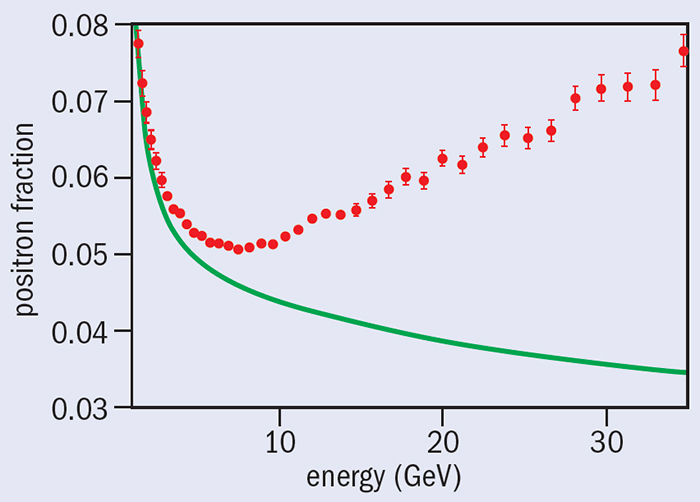
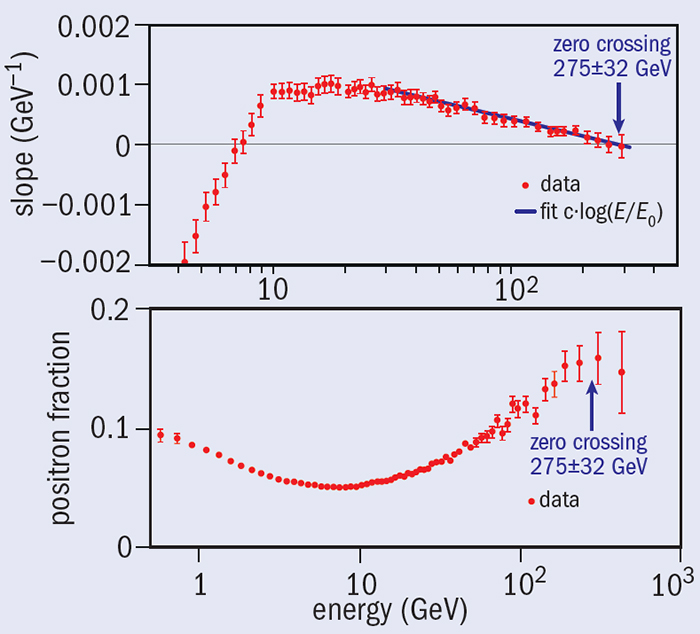
Of the 41 × 109 primary cosmic-ray events analysed so far, 10.9 × 10⁶ have been identified as electrons and positrons. Using these, the AMS collaboration has measured the positron fraction – the ratio of the number of positrons to the combined number of positrons and electrons – in the energy range 0.5–500 GeV (Accardo et al. 2014). When compared with the expectation based on the production of positrons in standard cosmic-ray collisions, the results show that the fraction starts to increase rapidly at 8 GeV (figure 1). This indicates the existence of a new source of positrons.
AMS has also accurately determined the exact rate at which the positron fraction increases with energy, and for the first time observed the fraction reach a maximum (figure 2). The data show that the rate of change of the positron fraction crosses zero at 275±32 GeV – indicating the energy at which the fraction reaches its maximum (Aguilar et al. 2014). The results also show that the excess of the positron fraction is isotropic within 3%, suggesting strongly that the energetic positrons might not be coming from a preferred direction in space. Moreover, the fraction shows no observable sharp structures.
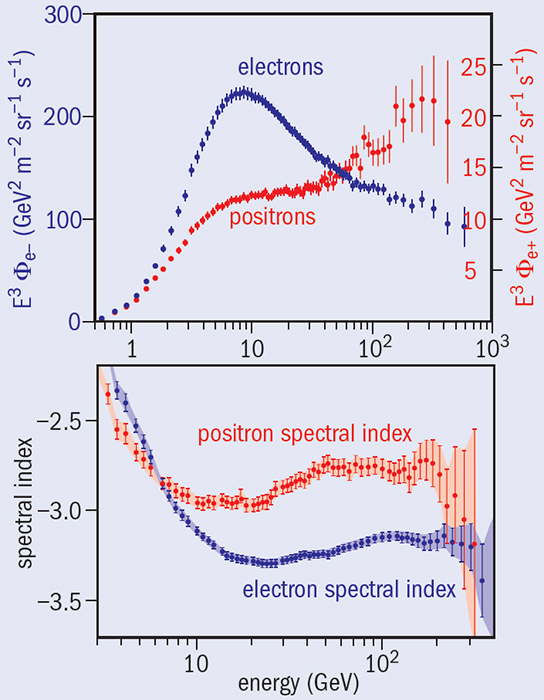
AMS has also precisely determined the flux of electrons (figure 3) as well as for positrons (figure 4). These measurements reveal that the fluxes differ significantly in both their magnitude and energy dependence. The positron flux first increases (0.5–10 GeV) and then levels out (10–30 GeV), before increasing again (30–200 GeV). Above 200 GeV, it has a tendency to decrease. This is totally different from the scaled electron flux. The results show that neither flux can be described with a constant spectral index (figure 4, bottom). In particular, between 20 and 200 GeV, the rate of change of the positron flux is surprisingly higher than the rate for electrons. This is important proof that the excess seen in the positron fraction is from a relative excess of high-energy positrons, and not the loss of high-energy electrons.
Different models for dark matter predict different behaviours for the positron-fraction excess. The new results from AMS put much tighter constraints on the validity of these models. The results are consistent with a dark-matter particle (neutralino) of mass of the order of 1 TeV. To determine if the observed new phenomenon is indeed from dark matter or from astrophysical sources such as pulsars, AMS is now making measurements to determine the rate at which the positron fraction decreases beyond the turning point, as well as to determine the antiproton fraction.
• Fifteen countries from Europe, Asia and America participated in the construction of AMS: Finland, France, Germany, the Netherlands, Italy, Portugal, Spain, Switzerland, Turkey, China, Korea, Taiwan, Russia, Mexico and the US. AMS was launched by NASA to the ISS on 16 May 2011. Data are transmitted to the AMS Payload Operations Control Center, located at CERN.
To provide the best experiences, we use technologies like cookies to store and/or access device information. Consenting to these technologies will allow us to process data such as browsing behavior or unique IDs on this site. Not consenting or withdrawing consent, may adversely affect certain features and functions.
Functional
Always active
The technical storage or access is strictly necessary for the legitimate purpose of enabling the use of a specific service explicitly requested by the subscriber or user, or for the sole purpose of carrying out the transmission of a communication over an electronic communications network.
Preferences
The technical storage or access is necessary for the legitimate purpose of storing preferences that are not requested by the subscriber or user.
Statistics
The technical storage or access that is used exclusively for statistical purposes.The technical storage or access that is used exclusively for anonymous statistical purposes. Without a subpoena, voluntary compliance on the part of your Internet Service Provider, or additional records from a third party, information stored or retrieved for this purpose alone cannot usually be used to identify you.
Marketing
The technical storage or access is required to create user profiles to send advertising, or to track the user on a website or across several websites for similar marketing purposes.