Comsol -leaderboard other pages

Topics

Hubble expansion discrepancy deepens

In the 1920s, Edwin Hubble discovered that the universe is expanding by showing that more distant galaxies recede faster from Earth than nearby ones. Hubble’s measurements of the expansion rate, now called the Hubble constant, had relatively large errors, but astronomers have since found ways of measuring it with increasing precision. One way is direct and entails measuring the distance to far-away galaxies, whereas another is indirect and involves using cosmic microwave background (CMB) data. However, over the last decade a mismatch between the values derived from the two methods has become apparent. Adam Riess from the Space Telescope Science Institute in Baltimore, US, and colleagues have now made a more precise direct measurement that reinforces the mismatch and could signal new physics.

Riess and co-workers’ new value relies on improved measurements of the distances to distant galaxies, and builds on previous work by the team. The measurements are based on more precise measurements of type Ia supernovae within the galaxies. Such supernovae have a known luminosity profile, so their distances from Earth can be determined from how bright they are observed to be. But their luminosity needs to be calibrated – a process that requires an exact measurement of their distance, which is typically rather large.

To calibrate their luminosity, Riess and his team used Cepheid stars, which are closer to Earth than type Ia supernovae. Cepheids have an oscillating apparent brightness, the period of which is directly related to their luminosity, and so their apparent brightness can also be used to measure their distance. Riess and colleagues measured the distance to Cepheids in the Milky Way using parallax measurements from the Hubble Space Telescope, which determine the apparent shift of the stars against the background sky as the Earth moves to the other side of the Sun. The researchers measured this minute shift for several Cepheids, giving a direct measurement of their distance. The team then used this measurement to estimate the distance to distant galaxies containing such stars, which in turn can be used to calibrate the luminosity of supernovae in those galaxies. Finally, they used this calibration to determine the distance to even more distant galaxies with supernovae. Using such a “distance ladder”, the team obtained a value for the Hubble constant of  73.5 ± 1.7   km s–1 Mpc–1. This value is more precise than the 73.2 ± 1.8   km s–1 Mpc–1 value obtained by the team in 2016, and it is 3.7 sigma away from the 66.9 ± 0.6   km s–1 Mpc–1 value derived from CMB observations made by the Planck satellite.

Future data could also potentially help to identify the source of the discrepancy

Reiss and colleagues’ results therefore reinforce the discrepancy between the results obtained through the two methods. Although each method is complex and may thus be subject to error, the discrepancy is now at a level that a coincidence seems unlikely. It is difficult to imagine that systematic errors in the distance-ladder method are the root cause of the tension, says the team. Figuring out the nature of the discrepancy is pivotal because the Hubble constant is used to calculate several cosmological quantities, such as the age of the universe. If the discrepancy is not due to errors, explaining it will require new physics beyond the current standard model of cosmology. But future data could also potentially help to identify the source of the discrepancy. Upcoming Cepheid data from ESA’s Gaia satellite could reduce the uncertainty in the distance-ladder value, and new measurements of the expansion rate using a third method based on observations of gravitational waves could throw new light on the problem.

ATLAS illuminates the Higgs boson at 13 TeV

The ATLAS collaboration has released a set of comprehensive results that illuminates the properties of the Higgs boson with improved precision, using its decay into two photons with LHC collisions recorded at a centre-of-mass energy of 13 TeV.

The Higgs-to-two-photons decay played a crucial role in the discovery of the Higgs boson in 2012 owing to the excellent mass resolution and well-modelled backgrounds in this channel. Following the discovery, the properties of the Higgs boson can be probed more precisely using the large 13 TeV dataset.

One major result of the new study is the measurement of the signal strength μ, defined as the ratio of the number of observed and expected Higgs boson events. The signal strength is measured to be μ = 0.99+0.15–0.14 – in good agreement with the Standard Model expectation. The precision could be improved by a factor of two with respect to the previous measurements at energies at 7 and 8 TeV. The precision of signal-strength measurements of individual Higgs boson production modes are also improved significantly thanks to a better understanding of the ATLAS detector, the increased rate of Higgs production at 13 TeV and the extended use of machine-learning techniques to identify specific production processes.

Another key result of the present study are the measurements of nine simplified template cross sections (STXS), which refer to the cross sections of specific Higgs production channels measured in different kinematic regions. Measurements of STXS are corrected for the impact of the Higgs-boson decay and incorporate the acceptance of the experiment, so that they can be combined across Higgs boson channels and experiments (see figure, left).

The properties of the Higgs boson are further investigated by measuring 20 differential and two double-differential cross sections. The Higgs boson transverse momentum (figure, right) and rapidity, the number and properties of jets produced in association with the Higgs boson, and several angular relations that allow us to probe its spin and CP quantum numbers are measured. Five of these distributions are used to search for new CP-even and CP-odd couplings between the Higgs boson and vector bosons or gluons. No significant deviations from the Standard Model predictions are observed.

Collectively, this new set of results at the highest LHC energies sheds light on the fundamental properties of the Higgs boson and extends our knowledge obtained from the first running period of the LHC.

Spotting the first extragalactic planets

Three decades since astronomers first detected planets outside our solar system, exoplanets are now being discovered at a rate of hundreds per year. Although it is reasonable to assume other galaxies than our own contain planets, no direct detections of such objects have been made owing to their small size and their large distances from Earth.

Now, however, radiation emitted around a distant black hole has revealed the existence of extragalactic planets in a galaxy 3.8 billion light years away, located between the black hole and us. The planets, which have no way of being directly detected using any kind of existing telescope, are visible thanks to the small gravitational distortions they inflict on X-rays emanating from the more distant black hole.

The discovery was made by Xinyu Dai and Eduardo Guerras from the University of Oklahoma in the US using data from the Chandra X-ray Observatory. The distant black hole in question, which forms the supermassive centre of the quasar RX J1131-1231, is surrounded by an accretion disk that heats up as it orbits and emits radiation at X-ray wavelengths. Thanks to a fortunate cosmic alignment, this radiation is amplified by gravitational lensing and therefore can be studied accurately. The lensing galaxy positioned between Earth and the quasar causes light from RX J1131-1231 to bend around it, appearing to us not as a normal point-source but as a ring with four bright spots (see figure). The spots are a result of radiation coming from the same location of the quasar, which initially followed different paths but ended up being directed to the Earth.

Dai and Guerras focused on the spectral features of iron, a strong emission line that reveals details of the accretion disk, and found that this emission line is not just shifted in energy but that the amount of the shift varies with time. Although a shift in the frequency of this line is common, for example due to relative velocities between observers, its position is generally very stable with time when studying a specific object. Based on the 38 times RX J1131-1231 had been observed by the Chandra satellite during the past decade, the Oklahoma duo found that the energy varied significantly between observations in all of the four bright points of the ring.

These observations thus form the best evidence for the existence of extragalactic planets.

This feature can be explained using microlensing. The intermediate lensing galaxy is not a uniform mass but rather consists of small point masses, mainly stars and planets. As the relatively small objects within the lensing galaxy move, the light from the quasar passing through it is deflected in slightly different ways, causing different parts of the accretion disk to be amplified at different levels over time. As the different parts of the disk appear to emit at different energies, the measured variations in the energy of this emission line can be explained by the movement of objects within the lensing galaxy. The question is: what objects could cause such changes over time scales of several years?

Stars, being so numerous and massive, are one good candidate explanation. But Dai and Guerras calculated that the chance for a star to cause such short-term variations is very small. A better candidate, suggest fits to analytical models, is unbound planets which do not orbit a star. The Chandra data were best described by a model in which, for each star, there are more than 2000 unbound planets with masses between that of the Moon and Jupiter. Although the exact population of such planets is not well known even for our own galaxy, their number is well within the existing constraints. These observations thus form the best evidence for the existence of extragalactic planets and, by also providing the number of such planets in that galaxy, teach us something about the number of unbound planets we can expect in our own galaxy.

We need to talk about the Higgs

It is just over five years ago that the discovery of the Higgs boson was announced, to great fanfare in the world’s media, as a crowning success of CERN’s Large Hadron Collider (LHC). The excitement of those days now seems a distant memory, replaced by a growing sense of disappointment at the lack of any major discovery thereafter.

While there are valid reasons to feel less than delighted by the null results of searches for physics beyond the Standard Model (SM), this does not justify a mood of despondency. A particular concern is that, in today’s hyper-connected world, apparently harmless academic discussions risk evolving into a negative outlook for the field in broader society. For example, a recent news article in Nature led on the LHC’s “failure to detect new particles beyond the Higgs”, while The Economist reported that “Fundamental physics is frustrating physicists”. Equally worryingly, the situation in particle physics is sometimes negatively contrasted with that for gravitational waves: while the latter is, quite rightly, heralded as the start of a new era of exploration, the discovery of the Higgs is often described as the end of a long effort to complete the SM.

Let’s look at things more positively. The Higgs boson is a totally new type of fundamental particle that allows unprecedented tests of electroweak symmetry breaking. It thus provides us with a novel microscope with which to probe the universe at the smallest scales, in analogy with the prospects for new gravitational-wave telescopes that will study the largest scales. There is a clear need to measure its couplings to other particles – especially its coupling with itself – and to explore potential connections between the Higgs and hidden or dark sectors. These arguments alone provide ample motivation for the next generation of colliders including and beyond the high-luminosity LHC upgrade.

So far the Higgs boson indeed looks SM-like, but some perspective is necessary. It took more than 40 years from the discovery of the neutrino to the realisation that it is not massless and therefore not SM-like; addressing this mystery is now a key component of the global particle-physics programme. Turning to my own main research area, the beauty quark – which reached its 40th birthday last year – is another example of a long-established particle that is now providing exciting hints of new phenomena (see Beauty quarks test lepton universality ). One thrilling scenario, if these deviations from the SM are confirmed, is that the new physics landscape can be explored through both the b and Higgs microscopes. Let’s call it “multi-messenger particle physics”.

How the results of our research are communicated to the public has never been more important. We must be honest about the lack of new physics that we all hoped would be found in early LHC data, yet to characterise this as a “failure” is absurd. If anything, the LHC has been more successful than expected, leaving its experiments struggling to keep up with the astonishing rates of delivered data. Particle physics is, after all, about exploring the unknown; the analysis of LHC data has led to thousands of publications and a wealth of new knowledge, and there is every possibility that there are big discoveries waiting to be made with further data and more innovative analyses. We also should not overlook the returns to society that the LHC has brought, from technology developments with associated spin-offs to the training of thousands of highly skilled young researchers.

The level of expectation that has been heaped on the LHC seems unprecedented in the history of physics. Has any other facility been considered to have produced disappointing results because only one Nobel-prize winning discovery was made in its first few years of operation? Perhaps this reflects that the LHC is simply the right machine at the right time, but that time is not over: our new microscope is set to run for the next two decades and bring physics at the TeV scale into clear focus. The more we talk about that, the better our long-term chances of success.

To explore all our coverage marking the 10th anniversary of the discovery of the Higgs boson ...

ESO

The new ExTrA facility

A new national facility at La Silla Observatory in Chile, operated by the European Southern Observatory (ESO), made its first observations at the beginning of the year. ExTrA (Exoplanets in Transits and their Atmospheres) will search for Earth-sized planets orbiting nearby red dwarf stars, its three 0.6 m-diameter near-infrared telescopes (pictured) increasing the sensitivity compared to previous searches. ExTrA is a French project also funded by the European Research Council and the telescopes will be operated remotely from Grenoble.

Ancient black hole lights up early universe

Many questions remain about what happened in the first billion years of the universe. At around 100 million years old, the universe was a dark place consisting of mostly neutral hydrogen without many objects emitting detectable radiation. This situation changed as stars and galaxies formed, leading to a phase transition known as reionisation where the neutral hydrogen was ionised. Exactly when reionisation started and how long it took is still not fully clear, but a recent discovery of the oldest massive black hole ever found can help answer this important question.

Up to about 300,000 years after the Big Bang, the universe was hot and dense, and electrons and protons were fully separated. As the universe started to expand, it cooled down and underwent a first phase transition where electrons and protons formed neutral gases such as hydrogen. The following period is known as the cosmic dark ages. During this period, protons and electrons were mostly combined into neutral hydrogen, but the universe had to cool much further before matter could condense to the level where light-producing objects such as stars could form. These new objects started to emit both the radiation we can now detect to study the early universe and also the radiation responsible for the last phase transition – the reionisation of the universe. Some of the brightest and therefore easiest-to-detect objects are quasars: massive black holes surrounded by discs of hot accreting matter that emit radiation over a wide but distinctive spectrum.

Using data from a range of large-area surveys by different telescopes, a group led by Eduardo Bañados from the Carnegie Institution for Science has discovered a distant quasar called J1342+0928, with the black hole at its centre found to be eight million solar masses. After the radiation was emitted by J1342+0928, it travelled through the expanding universe, increasing its wavelength or “red shifting” in proportion to its travel time. Using known spectral features of quasars, the redshift (and therefore the moment at which the radiation was emitted) can be calculated.

The spectrum of J1342+0928, shown in the figure, demonstrates that the universe was only 690 million years old – just 5% of its current age – at the time we see J1342+0928. The spectrum also shows a second interesting feature: the absorption of a part of the spectrum by neutral hydrogen, which implies that at the time we are observing the black hole, the universe was not fully ionised yet. By modelling the emission and absorption, Bañados and co-workers found that the spectrum from J1342+0928 is compatible with emission in a universe where half the hydrogen was ionised, putting the time of emission right in the middle of the epoch of reionisation.

The next mystery is to explain how a black hole weighing eight million solar masses could form so early in the universe. Black holes grow as they accrete mass surrounding them, but the accreting mass radiates and this radiation pushes other accreting mass away from the black hole. As a result, there is a theoretical limit on the amount of matter a black hole can accrete. Forming a black hole the size of J1342+0928 with such accretion limits would require black holes in the very early universe with sizes that challenge current theoretical models. One possible explanation, however, is that this particular black hole is a peculiar case and was formed by a merger of several smaller black holes.

Thanks to continuous data taking from a range of existing telescopes and upcoming new instrumentation, we can expect more objects like J1342+0928 or even older to be discovered, offering a probe of the universe at even earlier stages. The discovery of further objects would allow a more exact date for the period of reionisation, which can be compared with indirect measurements coming from the cosmic microwave background. At the same time, more measurements will show if black holes of this size in the early universe are just an anomaly or if there are more. In either case, such observations would provide important input for research on early black hole formation.

First cosmic-ray results from CALET on the ISS

The CALorimetric Electron Telescope (CALET), a space mission led by the Japan Aerospace Exploration Agency with participation from the Italian Space Agency (ASI) and NASA, has released its first results concerning the nature of high-energy cosmic rays.

Having docked with the International Space Station (ISS) on 25 August 2015, CALET is carrying out a full science programme with long-duration observations of high-energy charged particles and photons coming from space. It is the second high-energy experiment operating on the ISS following the deployment of AMS-02 in 2011. During the summer of 2017 a third experiment, ISS-CREAM, joined these two. Unlike AMS-02, CALET and ISS-CREAM have no magnetic spectrometer and therefore measure the inclusive electron and positron spectrum. CALET’s homogeneus calorimeter is optimised to measure electrons, and one of its main science goals is to measure the detailed shape of the electron spectrum.

Due to the large radiative losses during their travel in space, high-energy cosmic electrons are expected to originate from regions relatively close to Earth (of the order of a few thousand light-years). Yet their origin is still unknown. The shape of the spectrum and the anisotropy in the arrival direction might contain crucial information as to where and how electrons are accelerated. It could also provide a clue on possible signatures of dark matter – for example, the presence of a peak in the spectrum might tell us about a possible dark-matter decay or annihilation with an electron or positron in the final state – and shed light on the intriguing electron and positron spectra reported by AMS-02 (CERN Courier December 2016 p26).

To pinpoint possible spectral features on top of the overall power-law energy dependence of the spectrum, CALET was designed to measure the energy of the incident particle with very high resolution and with a large proton rejection power, well into the TeV energy region. This is provided by a thick homogeneous calorimeter preceded by a high-granularity pre-shower with imaging capabilities with a total thickness of 30 radiation length at normal incidence. The calibration of the two instruments is the key to control the energy scale and this is why CALET – a CERN-recognised experiment – performed several calibration tests at CERN.

The first data from CALET concern a measurement of the inclusive electron and positron spectrum in the energy range from 10 GeV to 3 TeV, based on about 0.7 million candidates (1.3 million in full acceptance). Above an energy of 30 GeV the spectrum can be fitted with a single power law with a spectral index of –3.152±0.016. A possible structure observed above 100 GeV requires further investigation with increased statistics and refined data analysis. Beyond 1 TeV, where a roll-off of the spectrum is expected and low statistics is an issue, electron data are now being carefully analysed to extend the measurement. CALET has been designed to measure electrons up to around 20 TeV and hadrons up to an energy of 1 PeV.

CALET is a powerful space observatory with the ability to identify cosmic nuclei from hydrogen to elements heavier than iron. It also has a dedicated gamma-ray-burst instrument (CGBM) that so far has detected bursts at an average rate of one every 10 days in the energy range of 7 KeV–20 MeV. The search for electromagnetic counterparts of gravitational waves (GWs) detected by the LIGO and Virgo observatories proceeds around the clock thanks to a special collaboration agreement with LIGO and Virgo. Upper limits on X-ray and gamma-ray counterparts of the GW151226 event were published and further research on GW follow-ups is being carried out. Space-weather studies relative to the relativistic electron precipitation (REP) from the Van Allen belts have also been released.

With more than 500 million triggers collected so far and an expected extension of the observation time on the ISS to five years, CALET is likely to produce a wealth of interesting results in the near future.

ATLAS reports direct evidence for Higgs–top coupling

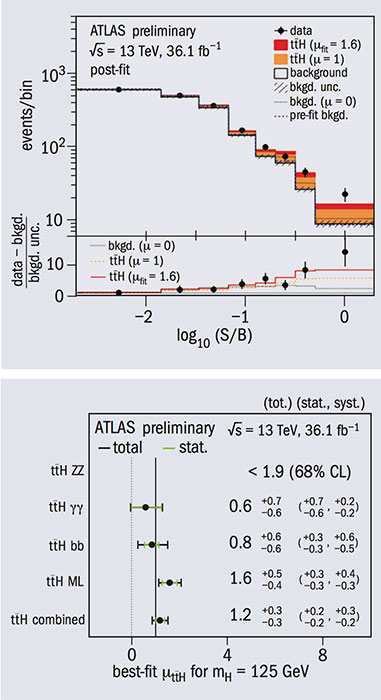
The Higgs boson interacts more strongly with more massive particles, so the coupling between the top quark and the Higgs boson (the top-quark Yukawa coupling) is expected to be large. The coupling can be directly probed by measuring the rate of events in which a Higgs boson is produced in association with a pair of top quarks (ttH production). Using the 13 TeV LHC data set collected in 2015 and 2016, several ATLAS analyses targeting different Higgs boson decay modes were performed. The combination of their results, released in late October, provides the strongest single-experiment evidence to date for ttH production.

The H  bb decay channel offers the largest rate of ttH events, but extracting the signal is hard because of the large background of top quarks produced in association with a pair of bottom quarks. The analysis relies on the identification of b-jets and multivariate analysis techniques to reconstruct the events and determine whether candidates are more likely to arise from ttH production or from background processes.

CCnew8_10_17

The probability for the Higgs boson to decay to a pair of W bosons or a pair of τ leptons is smaller, but the backgrounds to ttH searches with these decays are also smaller and easier to estimate. These decays are targeted in searches for events with a pair of leptons carrying the same charge or three or more charged leptons (including electrons, muons, or hadronically decaying τ leptons). In total, seven different final states were probed in the latest ATLAS analysis.

Higgs boson decays to a pair of photons or to a pair of Z bosons with subsequent decays to lepton pairs (giving a four-lepton final state) are also considered. These decay channels have very small rates, but provide a high signal-to-background ratio.

In the combination of these ttH analyses, an excess with a significance of 4.2 standard deviations with respect to the “no-ttH-signal” hypothesis is observed, compared to 3.8 standard deviations expected for a Standard Model signal. This constitutes the first direct evidence for the ttH process occurring at ATLAS. A cross-section of 590+160–150 fb is measured, in good agreement with the Standard Model prediction of  507+35–50 fb. This measurement, when combined with other Higgs boson production and decay studies, will shed more light on the possible presence of physics beyond the Standard Model in the Higgs sector.

CMS sees Higgs boson decaying to b-quarks

The CMS experiment has added another piece to the Higgs boson puzzle, reporting evidence that the Higgs decays to a pair of b quarks.

In the Standard Model (SM) the Higgs field couples to fermions, giving them their masses, through a Yukawa interaction. The recent CMS observation of the H ττ channel provides direct evidence of this interaction. While it is clear that the Higgs boson couples to up-type quarks (based on overall agreement between the gluon–gluon fusion production channel cross-section and the SM prediction), the Higgs boson decay to bottom quark–antiquark pairs provides a unique tool to directly access the bottom-type quark couplings.

The Higgs boson decays to a pair of b quarks 58% of the time, making it by far the most frequent decay channel. However, at the LHC the signal is overwhelmed by QCD production, which is several orders of magnitude higher. This makes the H  bb process very elusive. The most effective way to observe it is to search for associated production with an electroweak vector boson (VH, with V being a W or a Z boson). Further background reduction is achieved by requiring the Higgs boson candidates to have large transverse momentum and by exploiting the peculiar VH kinematical event properties.

The latest CMS analysis is based on LHC data collected last year at an energy of 13 TeV. To identify jets originating from b quarks, the collaboration used a novel combined multivariate b-tagging algorithm that exploits the presence of soft leptons together with information such as track impact parameters and secondary vertices. A signal region enriched in VH events was then selected, together with several control regions to test the accuracy of the Monte Carlo simulations, and a simultaneous binned-likelihood fit of the signal and control regions used to extract the Higgs boson signal.

An excess of events is observed compared to the expectation in the absence of a H  bb signal. The significance of the excess is 3.3σ, where the expectation from SM Higgs boson production is 2.8σ. The signal strength corresponding to this excess, relative to the SM expectation, is 1.2±0.4. When combined with the Run 1 measurement at a lower energy, the signal significance is 3.8σ with 3.8σ expected and a signal strength of 1.1.

To validate the analysis procedure, the same methodology was used to extract a signal for the VZ process, with Z  bb, which has a nearly identical final state but with a different invariant mass and a larger production cross-section. The observed excess of events for the combined WZ and ZZ processes has a significance of 5σ from the background-only event-yield expectation, and the corresponding signal strength is 1.0±0.2.

Thanks to the outstanding performance of the LHC, the data set will significantly increase by the end of Run 2, in 2018. This will allow a consistent reduction of the uncertainties, and a 5σ observation of the H  bb decay is expected.

Extreme cosmic rays reveal clues to origin

The energy spectrum of cosmic rays continuously bombarding the Earth spans many orders of magnitude, with the highest energy events topping 108 TeV. Where these extreme particles come from, however, has remained a mystery since their discovery more than 50 years ago. Now the Pierre Auger collaboration has published results showing that the arrival direction of ultra-high-energy cosmic rays (UHECRs) is far from uniform, giving a clue to their origins.

The discovery in 1963 at the Vulcano Ranch Experiment of cosmic rays with energies exceeding one million times the energy of the protons in the LHC raised many questions. Not only is the charge of these hadronic particles unknown, but the acceleration mechanisms required to produce UHECRs and the environments that can host these mechanisms are still being debated. Proposed origins include sources in the galactic centre, extreme supernova events, mergers of neutron stars, and extragalactic sources such as blazars. Unlike the case with photons or neutrinos, the arrival direction of charged cosmic rays does not point directly towards their origin because, despite their extreme energies, their paths are deflected by magnetic fields both inside and outside our galaxy. Since the deflection reduces as the energy goes up, however, some UHECRs with the highest energies might still contain information about their arrival direction.

At the Pierre Auger Observatory, cosmic rays are detected using a vast array of detectors spread over an area of 3000 km2 near the town of Malargüe in western Argentina. Like the first cosmic-ray detectors in the 1960s, the array measures the air showers induced as the cosmic rays interact with the atmosphere. The arrival times of the particles, measured with GPS receivers, are used to determine the direction from which the primary particles came within approximately one degree.

The presented dipole measurement is based on a total of 30,000 cosmic rays measured.

The collaboration studied the arrival direction of particles with energies in the range 4-8 EeV and for particles with energies exceeding 8 EeV. In the former data set, no clear anisotropy was observed, whereas for particles with energies above 8 EeV a dipole structure was observed (see figure), indicating that more particles come from a particular part of the sky. Since the maximum of the dipole is outside the galactic plane, the measured anisotropy is consistent with an extragalactic nature. The collaboration reports that the maximum, when taking into account the deflection of magnetic fields, is consistent with a region in the sky known to have a large density of galaxies, supporting the view that UHECRs are produced in other galaxies. The lack of anisotropy at lower energies could be a result of the higher deflection of these particles in the galactic magnetic field.

The presented dipole measurement is based on a total of 30,000 cosmic rays measured by the Pierre Auger Observatory, which is currently being upgraded. Although the results indicate an extragalactic origin, the particular source responsible for accelerating these particles remains unknown. The upgraded observatory will enable more data to be acquired and allow a more detailed investigation of the currently studied energy ranges. It will also open the possibility to explore even higher energies where the magnetic-field deflections become even smaller, making it possible to study the origin of UHECRs, their acceleration mechanism and the magnetic fields that deflect them.

bright-rec iop pub iop-science physcis connect