Charm and beauty quarks are excellent probes of the hot and dense state of deconfined quarks and gluons (quark–gluon plasma, QGP) which is created in high-energy heavy-ion collisions. These heavy quarks are produced in hard-scattering processes at the early stages of the collisions, and interact with the constituents of the newly created QGP through both elastic and inelastic processes. These quarks, which can be studied through their decays into leptons, lose energy while propagating through the QGP medium. Consequently, different production yields are observed at large momenta in nucleus–nucleus collisions compared to proton–proton collisions. This effect can be quantified using the nuclear modification factor, RAA, which is the ratio of nucleus–nucleus and proton–proton particle yields, scaled by the average number of binary nucleon–nucleon collisions. Comparing measurements in different collision systems sheds light on heavy-quark energy-loss mechanisms, and provides high-precision tomography of the QGP.
The results show that collision geometry plays an important role in heavy-quark energy loss
A new analysis by the ALICE collaboration compares the production of leptons from heavy-flavour hadron decays in Pb–Pb and Xe–Xe collisions at √sNN = 5.02 and 5.44 TeV, respectively. The measurements use the muon and electron decay channels at forward rapidity and mid-rapidity. The results show that collision geometry plays an important role in heavy-quark energy loss.
Remarkable agreement
A remarkable agreement is observed between the muon yields in head-on Xe–Xe collisions and slightly offset Pb–Pb collisions (figure 1, left). Given the larger size of the lead nucleus, these collision centrality classes – 0–10% and 10–20%, respectively – give rise to similar charged-particle multiplicities, and thus suggest the creation of similar QGP densities and sizes in the colliding systems.
In both cases, the production of muons from heavy-flavour hadron decays is suppressed up to a factor of about 2.5 for 5 GeV < pT < 6 GeV. This suppression is successfully reproduced by the MC@sHQ+EPOS2 model, which considers both elastic and inelastic energy-loss processes of the heavy quarks in the QGP, but is underestimated by the PHSD model, which only includes elastic processes. The analysis also saw ALICE’s first sensitivity down to pT = 0.2 GeV using a lower magnetic field (0.2 T) in the solenoid magnet (figure 1, right). The suppression pattern for muons and electrons from heavy-flavour hadron decays is similar at both forward and mid-rapidity, indicating that heavy quarks strongly interact with the medium over a wide rapidity interval. The suppression is smaller in these “glancing” semi-central collisions than in the previously discussed head-on collisions. This is compatible with the hypothesis that the in-medium energy loss depends on the energy density and on the size of the system created in the collision.
The precision of the measurements brings new insights into the nature of parton energy loss and new constraints to the modelling of its dependence on the size of the QGP medium in transport-model calculations. Further constraints will be set by future higher precision measurements during Run 3, when ALICE will measure leptons from charm and beauty decays separately, at both central and forward rapidity. A short run with the much smaller oxygen–oxygen system may also be scheduled and contribute to a deeper understanding of the dependence of system size on in-medium energy loss for heavy quarks.
The Cabibbo–Kobayashi–Maskawa (CKM) matrix element Vub describes the coupling between u and b quarks in the weak interaction, and is one of the fundamental parameters of the Standard Model (SM). Though it was first observed to be non-zero 30 years ago, its value is still debated. |Vub| determines the length of the least well-known side of the corresponding unitarity triangle, and is therefore a key ingredient for testing the consistency of the SM in the flavour sector. LHCb has recently published a new result on |Vub| using the first ever measurement of the Bs0 → K–μ+νμ decay.
|Vub| and |Vcb| are the focus of a longstanding puzzle. When comparing the world-average values derived from inclusive and exclusive B-meson decays, respectively, the inclusive and exclusive measurements disagree by more than three standard deviations, for measurements of both |Vub| and |Vcb|. Traditionally, the exclusive |Vub| determination requires the reconstruction of the semileptonic b → u decay B0 → π–μ+νμ. LHCb also has access to Bs0 meson and b-baryon decays, but the missing neutrino makes it difficult to isolate the signal from the copious background. Defying expectations, however, in 2015 LHCb managed to observe the Λb0 → pμ–νμ decay, and used the normalisation channel Λb0 → Λ+cμ–νμ to determine |Vub|/ |Vcb|. The main difficulty in this type of analysis resides in the fact that only two charged particles are reconstructed in decays such as Bs0 → K–μ+νμ and Λb0 → pμ–νμ. A huge background arising from other sources dominates the selected data sample. Machine-learning algorithms are therefore used to isolate the signal from the various background categories consisting of decays with additional charged and/or neutral particles in the final state. The remaining irreducible background is modelled by using both simulation and control samples extracted from data.
This is the first experimental test of the form-factor calculations
First observation
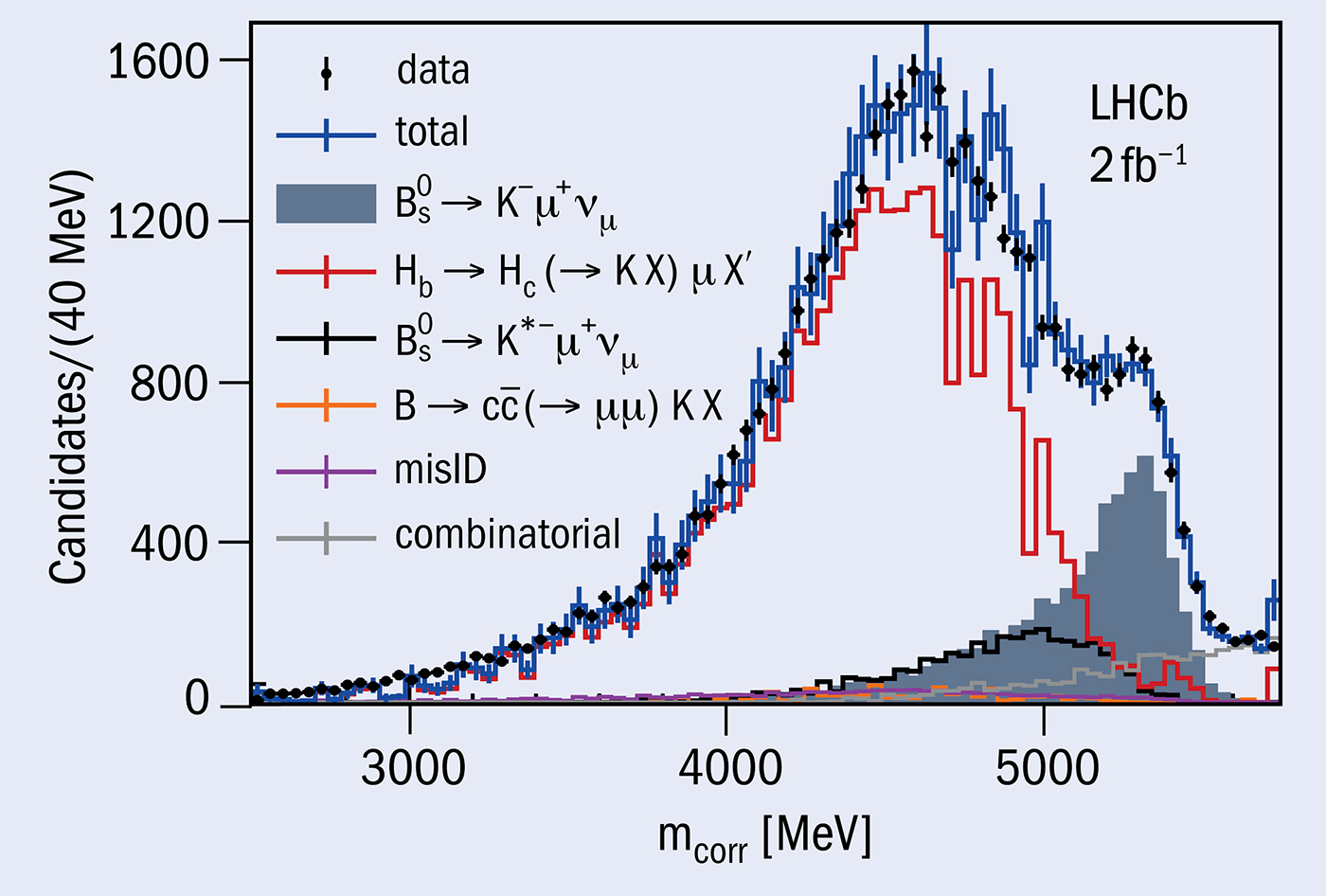
In a recent paper, the LHCb collaboration presented the first observation of the decay Bs0 → K–μ+νμ. The decay Bs0 → Ds– μ+νμ is used as a normalisation channel to minimise experimental systematic uncertainties. The study was performed in two regions of the squared invariant mass (or momentum transfer) q2 of the muon and the neutrino below and above 7 GeV2. The observed total yield was about 13,000 events, corresponding to a branching fraction of (1.06 ± 0.10) × 10–4, of which about one third stemmed from the low q2 range (figure 1).
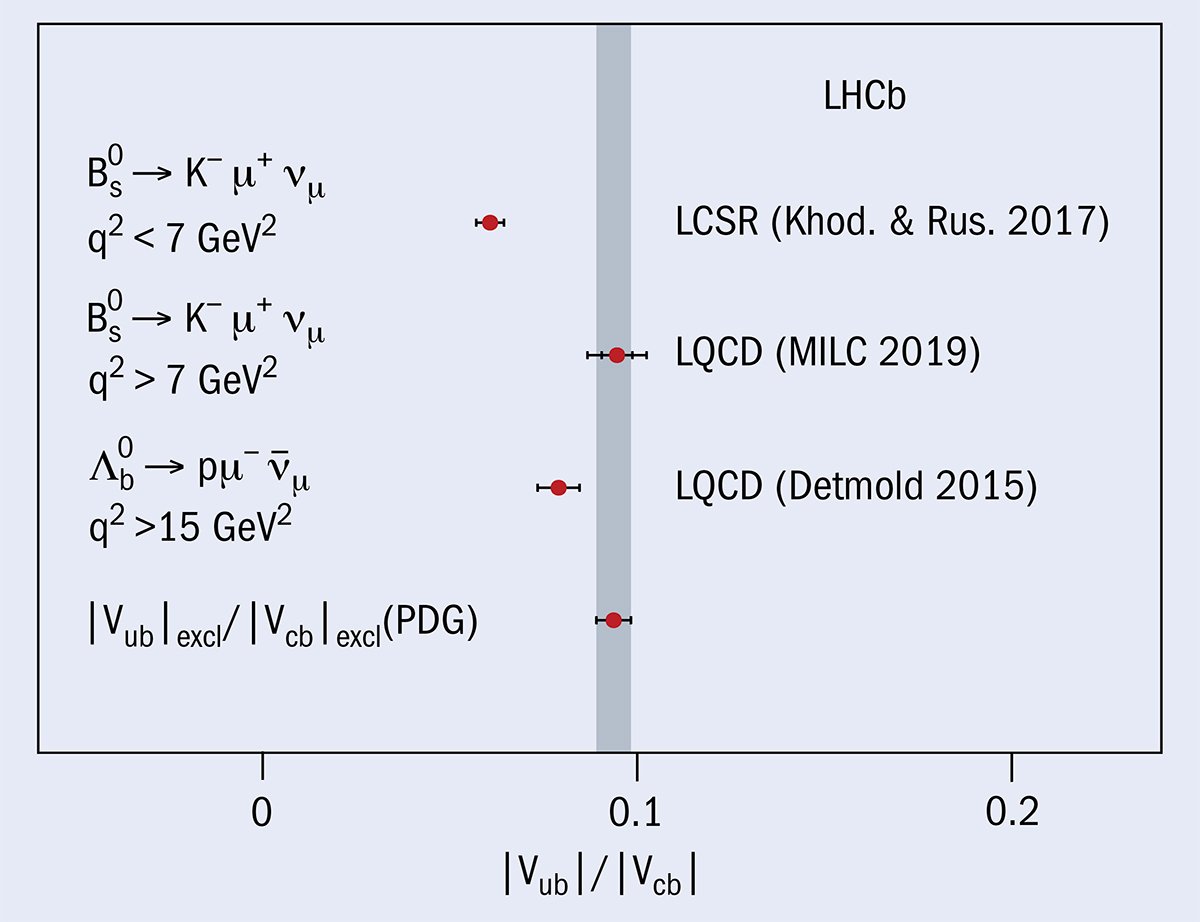
The extraction of the ratio |Vub|/|Vcb| requires external knowledge of the form factors describing the strong Bs0 → K– and Bs0 → Ds– transitions, to account for the interactions of the quarks bound in mesons. These vary with the momentum transfer and are calculated using non-perturbative techniques, such as lattice QCD (LQCD) and light-cone sum rules (LCSR). As LQCD and LCSR calculations are more accurate at high and low q2, respectively, they are used in the corresponding q2 regions. The obtained value of |Vub|/|Vcb| = 0.095 ± 0.008 in the high q2 interval shows agreement with the world average of exclusive measurements, and with the LHCb result using Λb0 → pμ–νμ decays, while in the low q2 region, |Vub|/|Vcb| = 0.061 ± 0.004 is significantly lower (figure 2). This is the first experimental test of the form-factor calculations, and new results are expected in the near future. These will help settle the exclusive versus inclusive debate surrounding the values of |Vub| and |Vcb|, and provide further constraints on the unitarity triangle.
Searches for new physics at high-energy colliders traditionally target heavy new particles with short lifetimes. These searches determine detector design, data acquisition and analysis methods. However, there could be new long-lived particles (LLPs) which travel through the detectors without decaying, either because they are light or have small couplings. Searches for LLPs have been going on at the LHC since the start of data taking, and at previous colliders, but they are attracting increasing interest in recent times, more so in light of the lack of new particles discovered in more mainstream searches.
Detecting LLPs at the LHC experiments requires a paradigm shift with respect to the usual data-analysis and trigger strategies. To that end, more than 200 experimentalists and theorists met online from 16 to 19 November for the eighth workshop of the LHC LLP community.
Dark quarks would undergo fragmentation and hadronisation, resulting in “dark showers”
Strong theoretical motivations underpin searches for LLPs. For example, dark matter could be part of a larger dark sector, parallel to the Standard Model (SM), with new particles and interactions. If dark quarks could be produced at the LHC, they would undergo fragmentation and hadronisation in the dark sector resulting in characteristic “dark showers” — one of the focuses of the workshop. Collider signatures for dark showers depend on the fraction of unstable particles they contain and their lifetime, with a range of categories presenting their own analysis challenges: QCD-like jets, semi-visible jets, emerging jets, and displaced vertices with missing transverse energy. Delegates agreed on the importance of connecting collider-level searches for dark showers with astrophysical and cosmological scales. In a similar spirit of collaboration across communities, a joint session with the HEP Software Foundation focused on triggering and reconstruction software for dedicated LLP detectors.
Heavy neutral leptons
The discovery of heavy neutral leptons (HNLs) could address different open questions of the SM. For example, neutrinos are expected to be left-handed and massless in the SM, but oscillate between flavours as their wavefunction evolves, providing evidence for as-yet immeasurably small masses. One way to fix this problem is to complete the field pattern of the SM with right-handed HNLs. The number and other characteristics of HNLs depend on the model considered, but in many cases HNLs are long-lived and connect to other important questions of the SM, such as dark matter and the baryon asymmetry of the universe. There are many ongoing searches for HNLs at the LHC and many more proposed elsewhere. During the November workshop the discussion touched on different models and simulations, reviewing what is available and what is needed for the different signal benchmarks.
Another focus was the reinterpretation of previous LLP searches. Recasting public results is common practice at the LHC and a good way to increase physics impact, but reinterpreting LLP searches is more difficult than prompt searches due to the use of non-standard selections and analysis-specific objects.
The latest results from CERN experiments were presented. ATLAS reported the first LHC search for sleptons using displaced-lepton final states, greatly improving sensitivity compared to LEP. CMS presented a search for strongly interacting massive particles with trackless jets, and a search for long-lived particles decaying to jets with displaced vertices. LHCb reported searches for low -mass di-muon resonances and a search for heavy neutrinos in the decay of a W boson into two muons and a jet, and the NA62 experiment at CERN’s SPS presented a search for π0 decays to invisible particles. These results bring important new constraints on the properties and parameters of LLP models.
Dedicated detectors
A series of dedicated LLP detectors at CERN — including the Forward Physics Facility for the HL-LHC, the CMS forward detector, FASER, Codex-b and Codex-ß, MilliQan, MoEDAL-MAPP, MATHUSLA, ANUBIS, SND@LHC, and FORMOSA – are in different stages between proposal and operation. These additional detectors, located at various distances from the LHC experiments, have diverse strengths: some, like MilliQan, look for specific particles (milli-charged particles, in that case), whereas others, like Mathusla, offer a very low background environment in which to search for neutral LLPs. These complementary efforts will, in the near future, provide all the different pieces needed to build the most complete picture possible of a variety of LLP searches, from axion-like particles to exotic Higgs decays, potentially opening the door to a dark sector.
ATLAS reported the first LHC search for sleptons using displaced-lepton final states
The workshop featured a dedicated session on future colliders for the first time. Designing these experiments with LLPs in mind would radically boost discovery chances. Key considerations will be tracking and the tracking volume, timing information, trigger and DAQ, as well as potential additional instrumentation in tunnels or using the experimental caverns.
Together with the range of new results presented and many more in the pipeline, the 2020 LLP workshop was representative of a vibrant research community, constantly pushing the “lifetime frontier”.
The international conference devoted to b-hadron physics at frontier machines, Beauty 2020, took place from 21 to 24 September, hosted virtually by Kavli IPMU, University of Tokyo. This year’s edition, the 19th in the series, attracted around 350 registrants, significantly more than have attended physical Beauty conferences in the past. Two days were devoted to parallel sessions, a change in approach necessitated by the online format, stimulating lively discussion. There were 64 invited talks, of which 13 were overviews given by theorists.
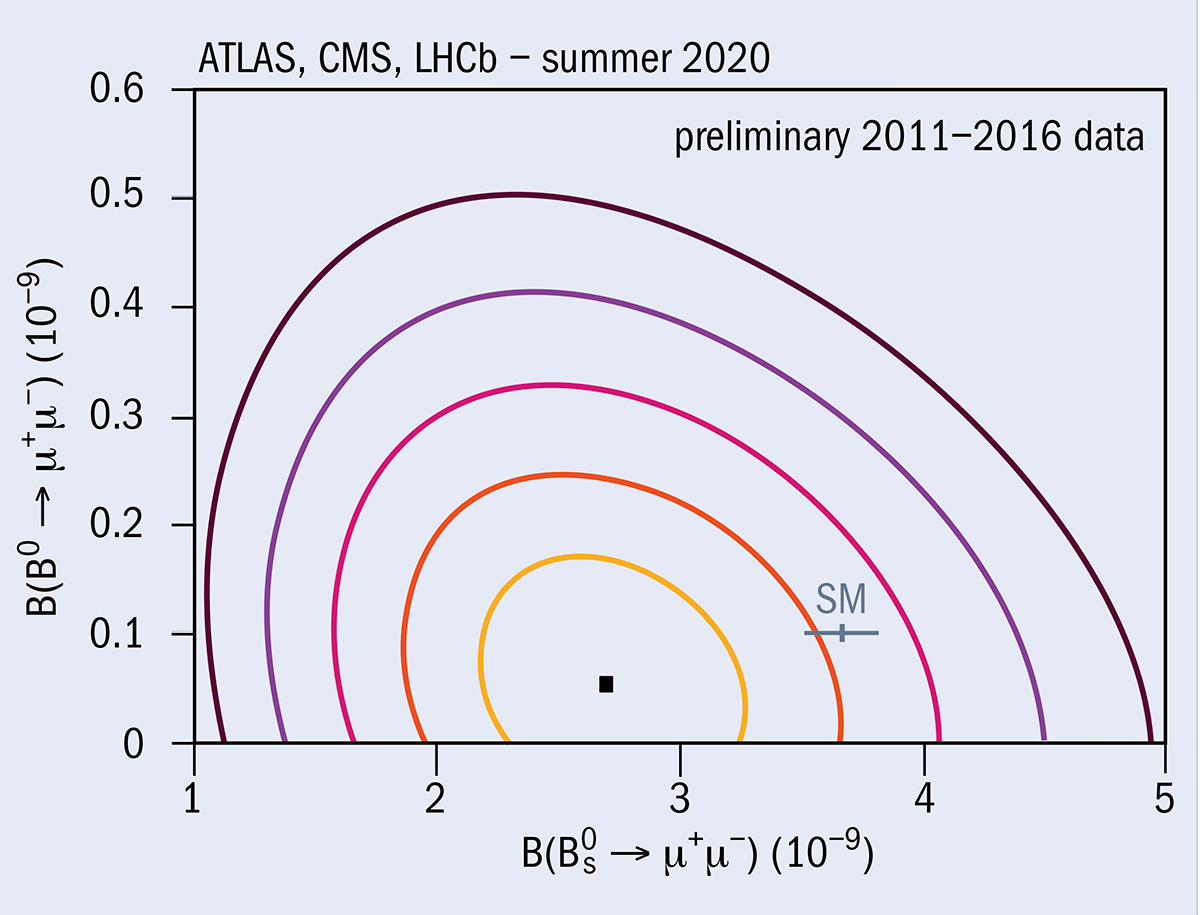
Studies of beauty hadrons have great sensitivity to possible physics beyond the Standard Model (SM), as was stressed by Gino Isidori (University of Zurich) in the opening talk of the conference. Possible lepton-universality anomalies that have emerged from analyses of decays into pairs of leptons and accompanying hadrons are particularly tantalising, as they show significant deviations from the SM in a manner that could be explained by the existence of new particles such as leptoquarks or Z′ bosons. We will know much more when LHCb releases measurements from the updated analysis of the full Run-2 data set. In the meantime, the combined results from ATLAS, CMS and LHCb for the branching ratio of the ultra-rare decay Bs→ μ+μ– generated much discussion. This final state is produced only a few times every billion Bs decays, but is now measured to a remarkable precision of 13%. Intriguingly, the observed value of the branching ratio lies two standard deviations below the SM prediction (see “Ultra-rare” figure) – an effect that some commentators have noted could be driven by the same new particles invoked to explain the other flavour anomalies.
Recent impressive results were shown in the field of CP violation. LHCb presented the first ever observation of time-dependent CP violation in the Bs system – a phenomenon that has eluded previous experiments on account of the very fast (a rate of about 3 × 10¹² Hz) Bs oscillations and inadequate sample sizes. In addition, new LHCb results were shown for the CP-violating phase γ. The most precise of these comes from an analysis that isolates B → DK decays which are followed by D → KSπ+π– decays, and the distributions of the final-state particles compared depending on whether they originate from B– or B+ mesons. This analysis is based on the full Run 1 and Run 2 data sets and constrains γ to a precision of five degrees, which from this single analysis alone represents around a four-fold improvement compared to when the LHC began operation. Further improvements are expected over the coming years.
Participants were eager to learn about the progress of the SuperKEKB accelerator and Belle II experiment. SuperKEKB is now operating at higher luminosity than any previous electron–positron machine, and the data set collected by Belle II (of the order 100 fb–1) is already sufficient to demonstrate the capabilities of the detector and to allow for important early physics studies, which were shown during the week. Belle II has superior performance to the first-generation B-factory experiments, BaBar and Belle, in areas such as flavour tagging and proper-time resolution, and will collect around 50 times the integrated luminosity. By the end of the decade Belle II will have accumulated 50 ab–1 of data, from which many precise and exciting physics measurements are expected.
Recent impressive results were shown in the field of CP violation
Studies of kaon decays provide important insights into flavour physics that are complementary to those obtained from b-hadrons. The NA62 collaboration presented its updated branching ratio for the ultra-rare decay K+→ π+νv, which is predicted to be around 10–10 in the SM. The data set is now sufficiently large to see a signal with a significance of more than three standard deviations. Future running is planned to allow a measurement to be made with a 10–20% precision, which will provide a powerful test of the SM prediction (CERN Courier September/October 2020 p9).
The concluding plenary session focused on the future of flavour physics. The LHCb experiment is currently being upgraded, and a further upgrade is foreseen at the end of the decade. In parallel, the upgrades of ATLAS and CMS will increase their capabilities for beauty studies. In the electron–positron domain, Belle II will continue to accumulate data, and there is the exciting possibility of a super-tau-charm factory, situated in either China or Russia, which will collect very large data sets at lower energies. These prospects were surveyed by Phillip Urquijo (University of Melbourne) in the summary talk of the conference, who stressed the importance of exploiting these ongoing and future facilities to the maximum. Flavour studies have a bright future, and they are sure to retain a central role in our search for physics beyond the SM.
Since the discovery of the Higgs boson in 2012, great progress has been made in our understanding of the Standard Model (SM) and the prospects for the discovery of new physics beyond it. Despite excellent advances in Higgs-sector measurements, searches for WIMP dark matter and exploration of very rare processes in the flavour realm, however, no unambiguous signals of new fundamental physics have been seen. This is the reason behind the explosion of interest in feebly interacting particles (FIPs) over the past decade or so.
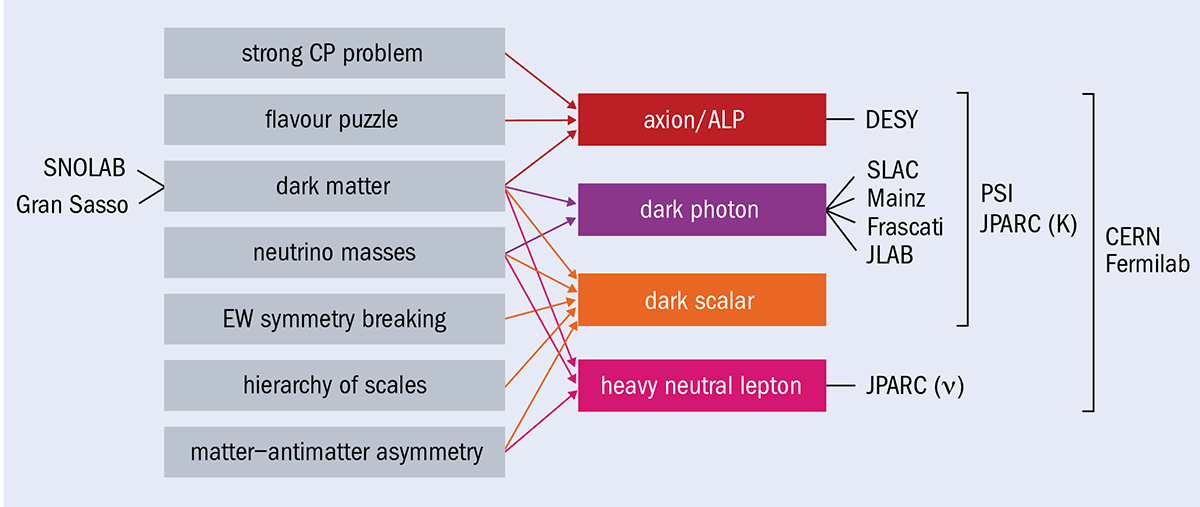
The inaugural FIPs 2020 workshop, hosted online by CERN from 31 August to 4 September, convened almost 200 physicists from around the world. Structured around the four “portals” that may link SM particles and fields to a rich dark sector – axions, dark photons, dark scalars and heavy neutral leptons – the workshop highlighted the synergies and complementarities among a great variety of experimental facilities, and called for close collaboration across different physics communities.
Today, conventional experimental efforts are driven by arguments based on the naturalness of the electroweak scale. They result in searches for new particles with sizeable couplings to the SM, and masses near the electroweak scale. FIPs represent an alternative paradigm to the traditional beyond-the-SM physics explored at the LHC. With masses below the electroweak scale, FIPs could belong to a rich dark sector and answer many open questions in particle physics (see “Four portals” figure). Diverse searches using proton beams (CERN and Fermilab), kaon beams (CERN and JPARC), neutrino beams (JPARC and Fermilab) and muon beams (PSI) today join more idiosyncratic experiments across the globe in a worldwide search for FIPs.
FIPs can arise from the presence of feeble couplings in the interactions of new physics with SM particles and fields. These may be due to a dimensionless coupling constant or to a “dimensionful” scale, larger than that of the process being studied, which is defined by a higher dimension operator that mediates the interaction. The smallness of these couplings can be due to the presence of an approximate symmetry that is only slightly broken, or to the presence of a large mass hierarchy between particles, as the absence of new-physics signals from direct and indirect searches seems to suggest.
Take the axion, for example. This is the particle that may be responsible for the conservation of charge–parity symmetry in strong interactions. It may also constitute a fraction or the entirety of dark matter, or explain the hierarchical masses and mixings of the SM fermions – the flavour puzzle.
Or take dark photons or dark Z′ bosons, both examples of new vector gauge bosons. Such particles are associated with extensions of the SM gauge group, and, in addition to indicating new forces beyond the four we know, could lead to evidence of dark-matter candidates with thermal origins and masses in the MeV to GeV range.
Exotic Higgs bosons could also have been responsible for cosmological inflation
Then there are exotic Higgs bosons. Light dark scalar or pseudoscalar particles related to the SM Higgs may provide novel ways of addressing the hierarchy problem, in which the Higgs mass can be stabilised dynamically via the time evolution of a so-called “relaxion” field. They could also have been responsible for cosmological inflation.
Finally, consider right-handed neutrinos, often referred to as sterile neutrinos or heavy neutral leptons, which could account for the origin of the tiny, nearly-degenerate masses of the neutrinos of the SM and their oscillations, as well as providing a mechanism for our universe’s matter–antimatter asymmetry.
Scientific diversity
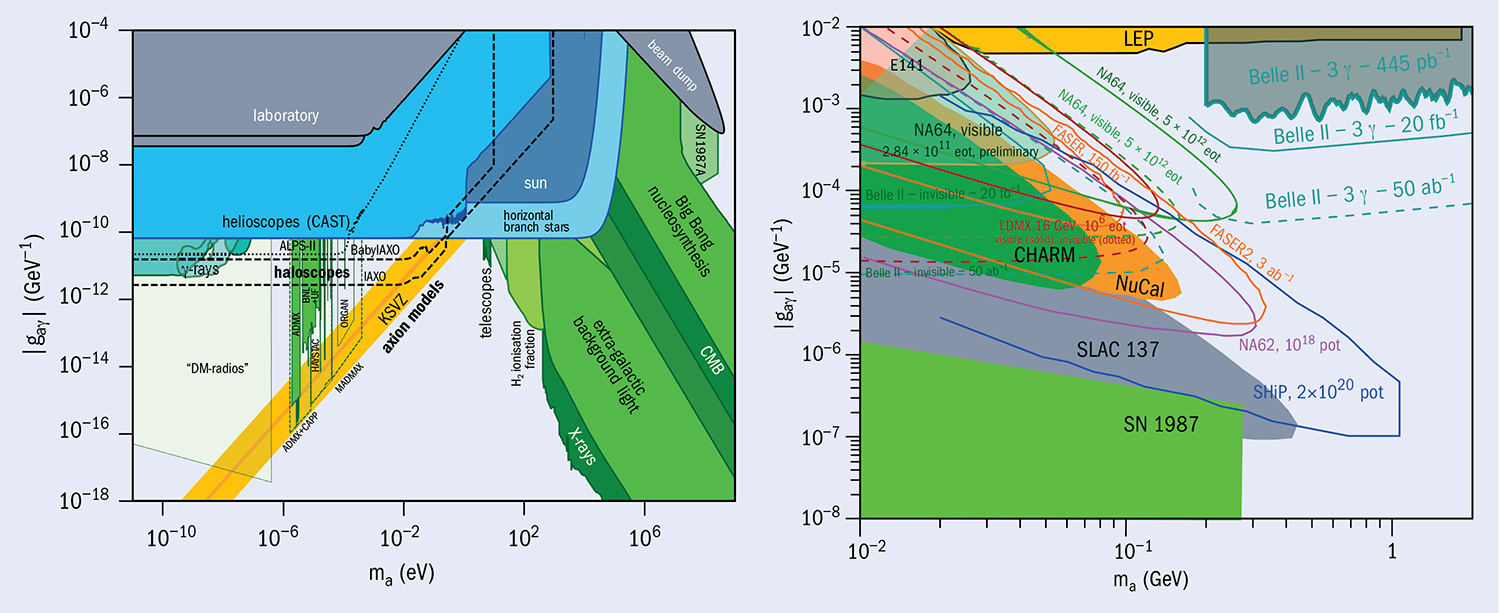
No single experimental approach can cover the large parameter space of masses and couplings that FIPs models allow. The interconnections between open questions require that we construct a diverse research programme incorporating accelerator physics, dark-matter direct detection, cosmology, astrophysics, and precision atomic experiments, with a strong theoretical involvement. The breadth of searches for axions or axion-like particles (ALPs) is a good indication of the growing interest in FIPs (see “Scaling the ALPs” figure). Experimental efforts here span particle and astroparticle physics. In the coming years, helioscopes, which aim to detect solar axions by their conversion into photons (X-rays) in a strong magnetic field, will improve the sensitivity by more than 10 orders of magnitude in mass in the sub-eV range. Haloscopes, which work by converting axions into visible photons inside a resonant microwave cavity placed inside a strong magnetic field, will complement this quest by increasing the sensitivity for small couplings by six orders of magnitude (down to the theoretically motivated gold band in a mass region where the axions can be a dark-matter candidate). Accelerator-based experiments, meanwhile, can probe the strongly motivated QCD scale (MeV–GeV) and beyond for larger couplings. All these results
will be complemented by a lively theoretical activity aimed at interpreting astrophysical signals within axion and ALP models.
FIPs 2020 triggered lively discussions that will continue in the coming months via topical meetings on different subjects. Topics that motivated particular interest between communities included possible ways of comparing results from direct-detection dark-matter experiments in the MeV–GeV range against those obtained at extracted beam line and collider experiments; the connection between right-handed neutrino properties and active neutrino parameters; and the interpretation of astrophysical and cosmological bounds, which often overwhelm the interpretation of each of the four portals.
The next FIPs workshop will take place at CERN next year.
On 17 January 1957, a few months after Chien-Shiung Wu’s discovery of parity violation, Wolfgang Pauli wrote to Victor Weisskopf: “Ich glaube aber nicht, daß der Herrgott ein schwacher Linkshänder ist” (I cannot believe that God is a weak left-hander). But maximal parity violation is now well established within the Standard Model (SM). The weak interaction only couples to left-handed particles, as dramatically seen in the continuing absence of experimental evidence for right-handed neutrinos. In the same way, the polarisation of photons originating from transitions that involve the weak interaction is expected to be completely left-handed.
The LHCb collaboration recently tested the handedness of photons emitted in rare flavour-changing transitions from a b-quark to an s-quark. These are mediated by the bosons of the weak interaction according to the SM – but what if new virtual particles contribute too? Their presence could be clearly signalled by a right-handed contribution to the photon polarisation.
New virtual particles could be clearly signalled by a right-handed contribution to the photon polarisation
The b → sγ transition is rare. Fewer than one in a thousand b-quarks transform into an s-quark and a photon. This process has been studied for almost 30 years at particle colliders around the world. By precise measurements of its properties, physicists hope to detect hints of new heavy particles that current colliders are not powerful enough to produce.
The probability of this b-quark decay has been measured in previous experiments with a precision of about 5%, and found to agree with the SM prediction, which bears a similar theoretical uncertainty. A promising way to go further is to study the polarisation of the emitted photon. Measuring the b → sγ polarisation is not easy though. The emitted photons are too energetic to be analysed by a polarimeter and physicists must find innovative ways to probe them indirectly. For example, a right-handed polarisation contribution could induce a charge-parity asymmetry in the B0→ KSπ0γ or Bs0→ φγ decays. It could also contribute to the total rate of radiative b → sγ decays, containing any strange meson, B → Xsγ.
The LHCb collaboration has pioneered a new method to perform this measurement using virtual photons and the largest sample of the very rare B0→ K*0e+e– decay ever collected. First, the sub-sample of decays that come from B0→ K*0γ with a virtual photon that materialises in an electron–positron pair is isolated. The angular distributions of the B0→ K*0e+e– decay products are then used as a polarimeter to measure the handedness of the photon. The number of decays with a virtual photon is small compared to the decays with a real photon, but these latter decays cannot be used as the information on the polarisation is lost.
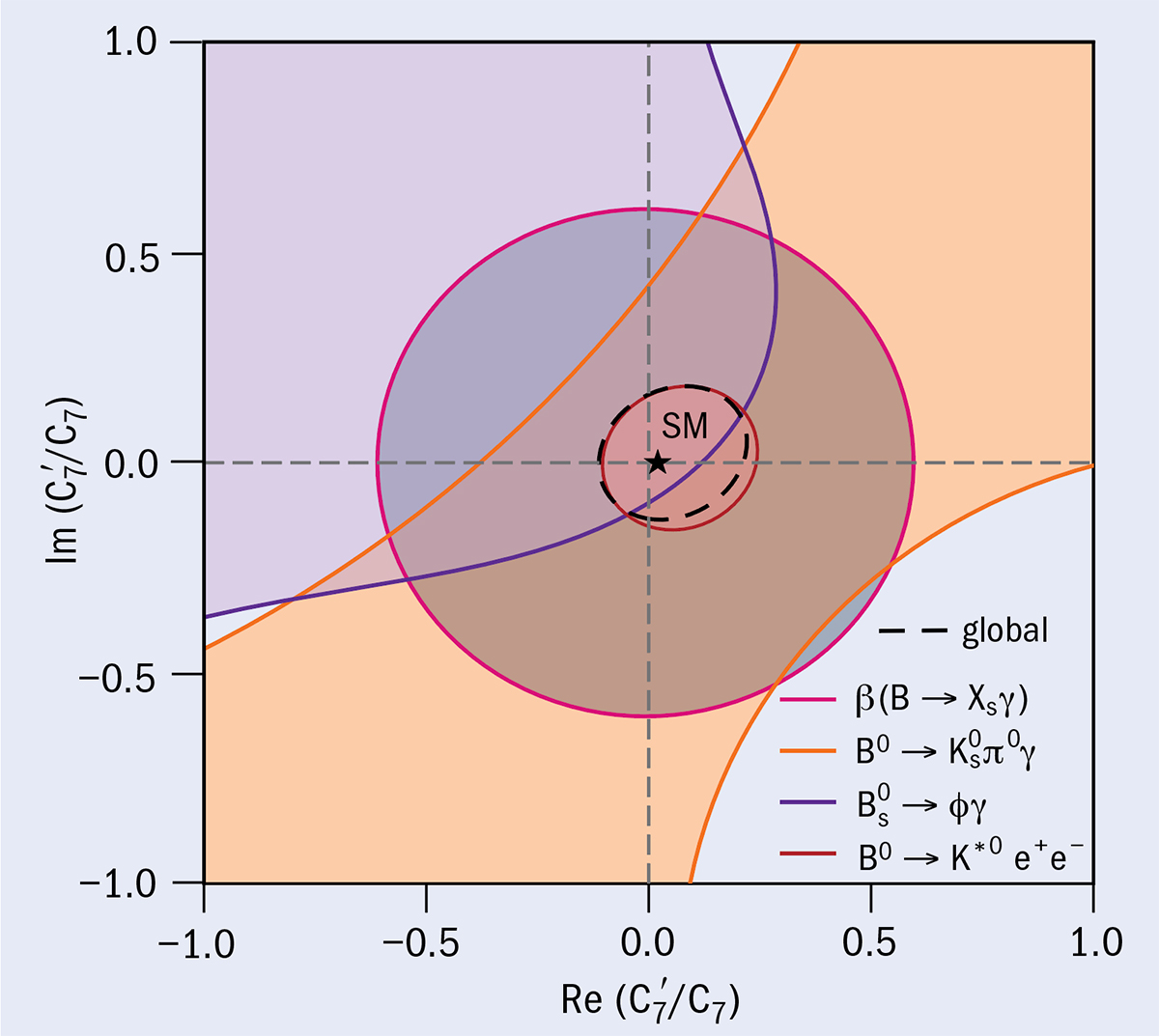
The size of the right-handed contribution to b → sγ is encoded in the magnitude of the complex parameter C′7/C7. This is a ratio of the right- and left-handed Wilson coefficients that are used in the effective description of b → s transitions. The new B0→ K*0e+e– analysis by the LHCb collaboration constrains the value of C′7/C7, and thus the photon polarisation, with unprecedented precision (figure 1). The measurement is compatible with the SM prediction.
This result showcases the exceptional capability of the LHCb experiment to study b → sγ transitions. The uncertainty is currently dominated by the data sample size, and thus more accurate studies are foreseen with the large data sample expected in Run 3 of the LHC. More precise measurements may yet unravel a small right-handed polarisation.
Ultra-relativistic heavy-ion collisions create a system of deconfined quarks and gluons known as the quark–gluon plasma (QGP). Among other particles, a large number of light nuclei such as the deuteron, triton, helium-3, helium-4 and their corresponding antinuclei are produced, and can be measured with very good precision by the ALICE experiment at the LHC thanks to its excellent tracking and particle-identification capabilities via specific energy loss and time-of-flight measurements. Considering that the binding energies of light (anti)nuclei do not exceed a few MeV, it is not clear how such fragile objects can survive the hadron gas phase created after the phase transition from the QGP to hadrons, where particles rescatter with a typical momentum transfer in excess of 100 MeV. The production mechanism of light (anti)nuclei in these collisions is still not understood and is under intense debate in the scientific community. Constraining models of light antinuclei production is also important for predicting the backgrounds to indirect dark-matter searches using cosmic rays, as performed by experiments in space and in hot-air balloons, for which light antinuclei are promising signals.
The measured elliptic flow of light nuclei is bracketed by the simple coalescence approach and the blast-wave model
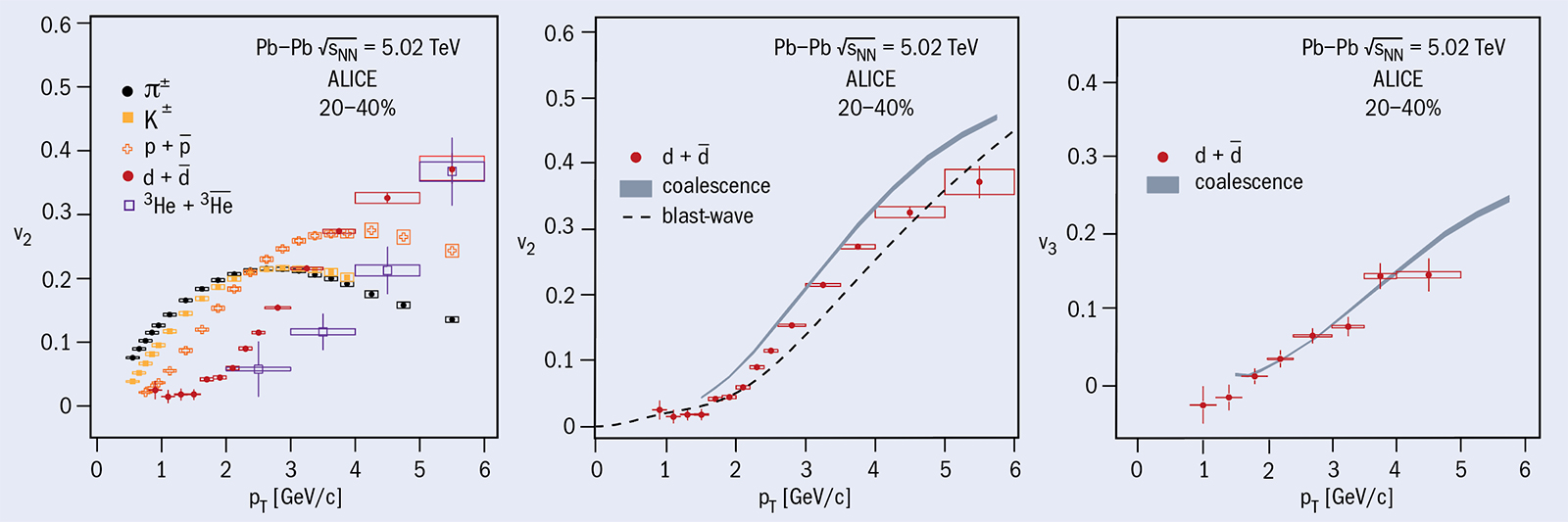
Azimuthal anisotropies of light (anti)nuclei production with respect to the symmetry plane of the collision are key observables to study interactions in the hadron-gas phase, and can shed light on the production mechanism of these fragile objects. The ALICE collaboration has recently reported the measurements of two harmonic coefficients (vn) in a Fourier decomposition of the azimuthal distribution of deuterons in Pb–Pb collisions at √sNN = 5.02 TeV: their elliptic flow, v2, and the first measurement of their triangular flow, v3. A clear mass ordering is observed in the elliptic flow of non-central Pb–Pb collisions at low pT when the deuteron results are compared with other particle species, as expected for an expanding hydrodynamic system (figure 1, left).
Blast wave is best
The results are often compared to three phenomenological models, namely the statistical hadronisation model, the coalescence model, and the blast-wave model. In the statistical hadronisation model, light (anti)nuclei are assumed to be emitted by a source of thermal and hydrochemical equilibrium, like other hadron species, and their abundances fixed at the chemical freeze-out – the time at which inelastic interactions cease. However, this model only describes their yields, and not their flow. On the other hand, the coalescence model predicts that light nuclei are formed by the coalescence of protons and neutrons that are close in phase space at the kinetic freeze-out – the time at which elastic interactions cease. The blast-wave model, which is based on a simplified version of relativistic hydrodynamics, describes their transverse momentum spectra with just a few parameters, such as the kinetic freeze-out temperatures and transverse velocity.
In the new ALICE results, the measured elliptic flow of light nuclei is bracketed by the simple coalescence approach and the blast-wave model, which describe the data in different multiplicity regimes (figure 1, middle). The deuteron triangular flow is consistent with the coalescence model predictions, but large uncertainties do not allow a conclusive statement (figure 1, right). This specific aspect will be addressed with the larger data sample that ALICE will record in Run 3, which will also allow measurement of the flow of heavier nuclei. These results will contribute to shed light on their production mechanism and to study the properties of the hadron gas phase.
The Standard Model (SM) groups quarks and leptons separately to account for their rather different observed properties, but might they be unified through a new particle that couples to both and turns one into the other? Such “leptoquarks” emerge quite naturally in several theories that extend the SM. Searches for leptoquarks have been an important part of the LHC’s research programme since the beginning, and have received additional attention recently in the light of hints of deviations from the principle of lepton universality – the so-called flavour anomalies.
In a recent CMS analysis, where the events collected in pp collisions during Run 2 (137 fb–1) are analysed, researchers have challenged the SM by investigating a previously unexplored leptoquark signature involving the third generation of fermions. The motivation for considering the third generation is to confront the principle of lepton universality, which asserts that the couplings of leptons with gauge bosons are flavour independent. This principle is built into the SM, but has recently been put under stress by a series of anomalies observed in precision measurements of certain B-meson decays by the LHCb, Belle and BaBar collaborations. A possible explanation for these anomalies, which are still under investigation and not yet confirmed, lies in the existence of leptoquarks that preferentially couple to the heaviest fermions.
These results are the most stringent limits to date on the presence of leptoquarks that couple preferentially to the third generation
The new CMS search looks for both single and pair production of leptoquarks. It considers leptoquarks that decay to a quark (top or bottom) and a lepton (tau or neutrino), targeting the signature with a top quark, a tau lepton, missing transverse momentum due to a neutrino, and, in the case of double production, an additional bottom-quark jet. This is the first search to simultaneously consider both production mechanisms by categorising events with one or two jets originating from a bottom quark. The analysis also includes a dedicated selection for the case of a large mass splitting between the leptoquark and the top quark, which would boost the top quark and could cause its decay products to be inseparable given the spatial resolution of jets.
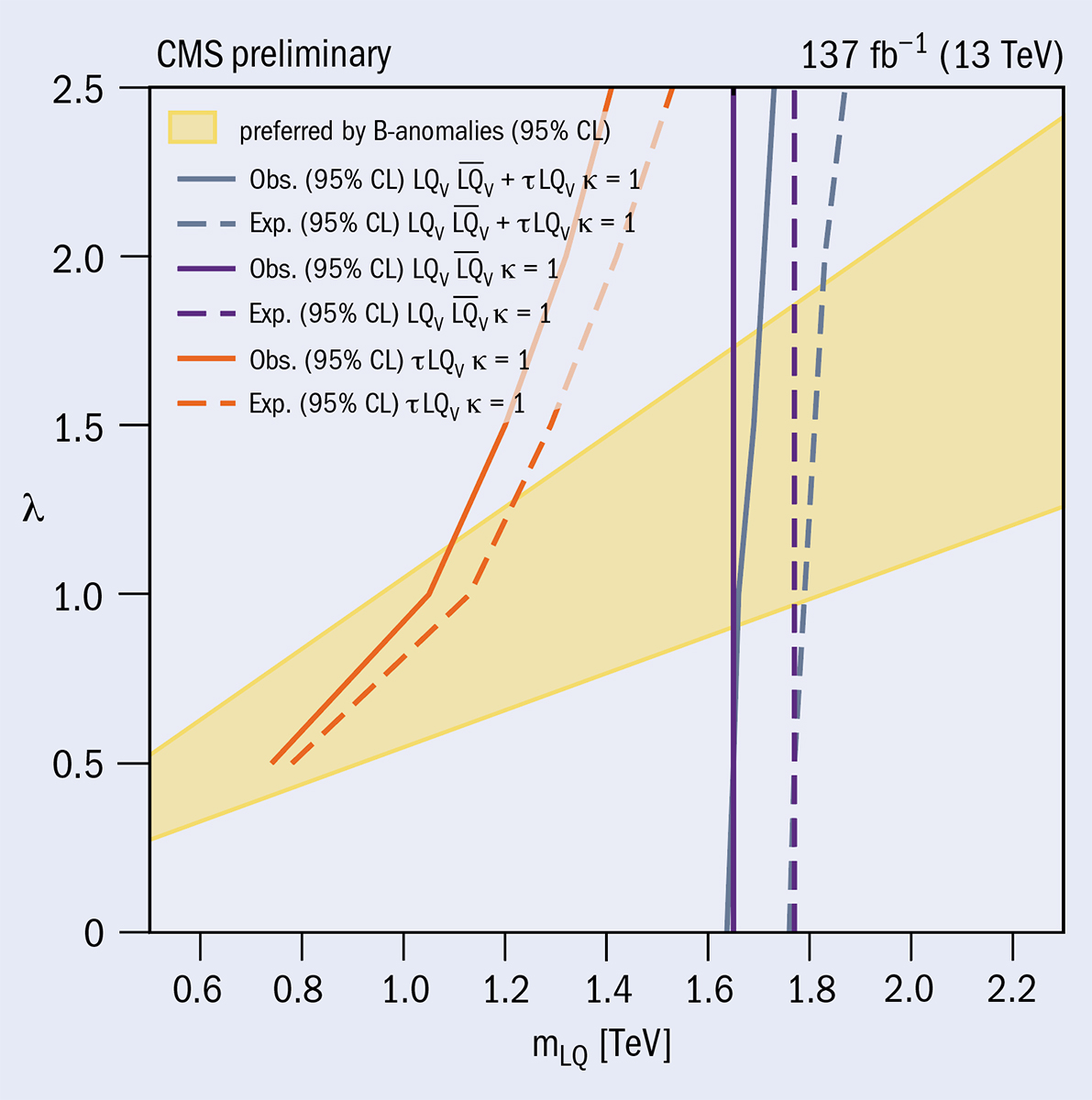
The observations are found to be in agreement with the SM prediction, and exclusion limits are derived in the plane of the leptoquark–lepton–quark vertex coupling λ and the leptoquark mass. The results are derived separately for hypothetical spin-0 and spin-1 (figure 1) leptoquarks, reflecting the two types allowed by theoretical models. The analysis assumes that the leptoquark decays half the time to each of the possible quark–lepton flavour pairs, for example, in the case of a spin-1 leptoquark, to a top quark and a neutrino, or to a bottom quark and a tau lepton. CMS finds a range of lower limits on the leptoquark mass between 0.98 and 1.73 TeV, at 95% confidence, depending on λ and the spin.
These results are the most stringent limits to date on the presence of leptoquarks that couple preferentially to the third generation of fermions. They also probe the parameter space preferred by the B-physics anomalies in several models, excluding relevant portions. As theories predict leptoquark masses as high as many tens of TeV, the pursuit of this promising solution for the unification of quarks and leptons must continue. The CMS collaboration has a broad programme for further investigations that will exploit the larger data samples from Run 3 and the high-luminosity LHC under different hypotheses. If leptoquarks exist, they may well be revealed in the coming data.
Dark matter is estimated to account for an unseen 85% of matter in the universe, but its nature is unknown. One possible explanation is weakly-interacting massive particles, or WIMPs, which could interact with ordinary matter through the exchange of a Higgs boson (“Higgs-portal” models) or a new mediator field yet to be discovered. The ATLAS collaboration has recently released two new investigations of WIMPs based on the full Run-2 data set.
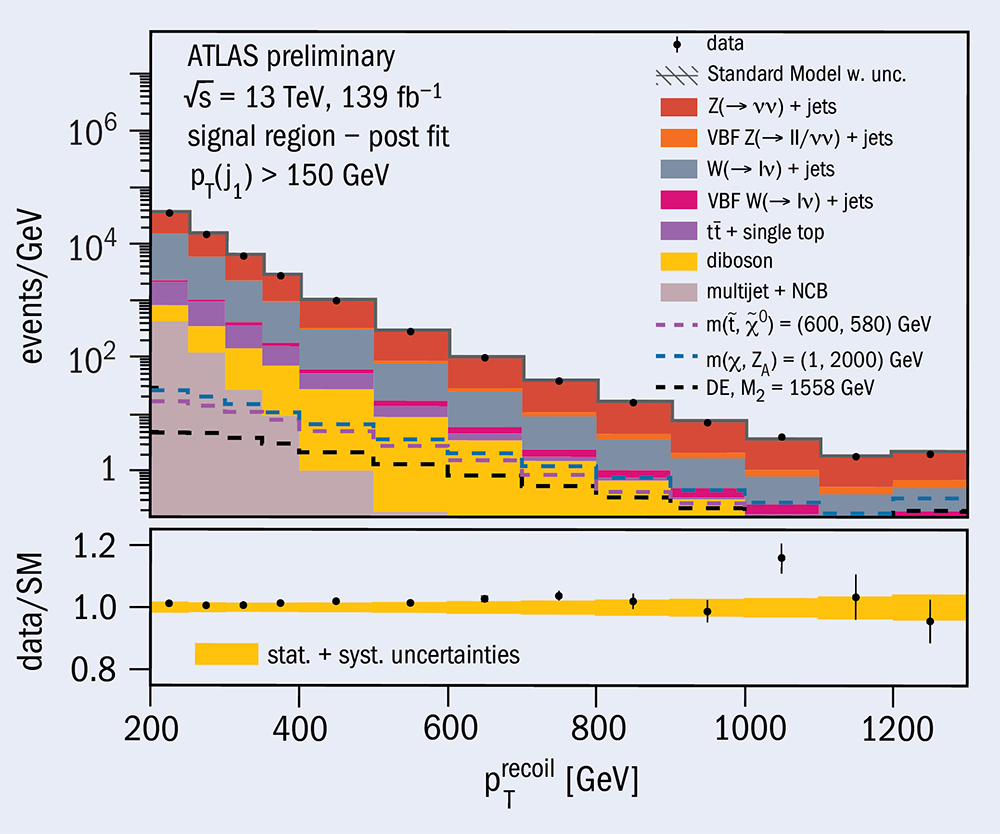
At the LHC, a mediator may be produced and decay into a pair of stable WIMPs, which then escape the detector unseen – an undetectable process, unless the mediator is produced, for example, in association with a high-pT gluon radiated from one of the incoming protons. This would provide a clear signature: a high-pT jet and significant missing transverse momentum (MET). A first “monojet” analysis sought events with MET in excess of 200 GeV, recoiling against a jet with pT > 150 GeV, with up to three additional jets and no leptons or photons. The leading background arises from events wherein a Z boson decays to neutrinos – a process experimentally indistinguishable from WIMP production. The predictions of this and other backgrounds benefitted from stateof- the-art theoretical calculations, detailed groundwork on particle reconstruction in ATLAS, and the use of data-control regions rich in W and Z boson decays. No significant excess was observed with respect to the Standard Model (SM) (figure 1).
As invisible Higgs-boson decays have a branching fraction of just 10–3, any signal would indicate new physics
Dijet analysis
A second “dijet” WIMP analysis searches for invisible decays of Higgs bosons produced via vector-boson fusion. Though accounting for just 10% as many Higgs bosons as the dominant gluon-fusion process at the LHC, the topology’s clear signature, with two widely separated jets in pseudorapidity, lends itself to searching for MET, as the jets tend to be close together in the transverse plane when recoiling against a Higgs boson with pT > 200 GeV. The art of this analysis is again in the precise modelling of SM backgrounds – a feat accomplished here with extrapolations from control regions and the use of jet kinematics to separate signal events from Z-boson decays to neutrinos, and W decays with an undetected charged lepton. As invisible Higgs-boson decays in the SM (chiefly H → ZZ* → 4ν) have a branching fraction of just 10–3, any significant signal would indicate new physics. No deviation from the SM was observed, allowing a 95% confidence upper limit to be placed on the branching fraction for invisible Higgs-boson decays of 13% – a factor two improvement in sensitivity compared to the previous analysis, despite the increase in pileup – or 9% when combining with other ATLAS Higgs-boson measurements. The results are complementary to direct-detection experiments looking for relic WIMPs with deep underground detectors, as they plumb lower WIMP masses than direct-detection experiments can currently access (figure 2).
These results also translate into limits on alternative dark-matter-related theories such as axion-like-particles (ALPs) and large extra-dimensions, and into model-independent limits on new phenomena. ATLAS will continue to explore the parameter space of dark-sector models such at ALPs, dark photons, dark scalars and heavy neutral leptons, complementing the results of dedicated smaller-scale experiments.
The nature of dark matter (DM) remains one of the most intriguing unsolved questions of modern physics. Astrophysical and cosmological observations suggest that DM accounts for roughly 27% of the mass-energy of the universe, with dark energy comprising 68% and ordinary baryonic matter as described by the Standard Model accounting for a paltry 5%. This massive hole in our understanding of the universe continues to drive multiple experimental searches for DM both in the laboratory and in space. No clear evidence for DM has yet been found, severely constraining the parameter space of the most popular “thermal” DM models.
Assuming DM is a material substance comprised of particles – not an illusion resulting from an imperfect understanding of gravity – there are three independent ways to search for it. One is to directly measure the production of DM particles in a high-energy collider such as the LHC. Another is to infer the presence of DM particles via their scattering off nuclei, as investigated by large underground detectors such as XENON1T and LUX. A third, similarly indirect, strategy is to search for the annihilation or decay of DM particles into ordinary (anti) particles such as positrons or antinuclei – as employed by the AMS experiment on board the International Space Station and in balloon-borne experiments such as GAPS. Low-energy light antinuclei, such as antideuterons and antihelium, are particularly promising signals for such indirect DM searches, since the background stemming from ordinary collisions between cosmic rays and the interstellar medium is expected to be low with respect to the DM signal.
ALICE is the only experiment at the LHC that is able to study the production and annihilation of low-energy antinuclei
The ability to interpret any future observation of antinuclei in our galaxy – especially when trying to identify their creation in exotic processes like DM annihilations – requires a quantitative understanding of light antinuclei production and annihilation mechanisms within the interstellar medium. However, the production of light antinuclei in hadronic collisions between cosmic rays and the interstellar medium is still not fully understood: different models compete to explain how these loosely bound objects can be formed in such high-energy collisions. Furthermore, the inelastic annihilation cross section of light antinuclei with matter is completely unknown in the kinematic region relevant for indirect DM searches, forcing current estimates to rely on extrapolations and modelling.
Fortunately, both the antinuclei production mechanism and the interactions between antinuclei and ordinary matter can be studied on Earth using large accelerators. The main contributions so far have come from the LHC at CERN and from the Relativistic Heavy Ion Collider (RHIC) at Brookhaven National Laboratory. Thanks to its unique low-material-budget tracker, which provides excellent tracking and particle-identification performance for low-momentum particles, ALICE is the only experiment at the LHC that is able to study the production and annihilation of low-energy antinuclei.
Antinucleosynthesis in the lab
While antinuclei can also be produced at lower collision energies, only at the LHC are matter and antimatter generated in equal abundances in the region transverse to the beam direction. The most abundant non-trivial antinucleus produced is the antideuteron, which consists of an antineutron and an antiproton. At low momentum, deuterons and antideuterons can be clearly identified thanks to their high energy loss in the ALICE detector’s time-projection chamber. At larger momenta, a clean identification of antideuterons is possible using the ALICE time-of-flight detector. This information, combined with the measured track length and the particle momentum, provide a precise determination of the particle mass. Using these and other techniques, the ALICE collaboration has recently measured the production of (anti)deuterons in proton–proton collisions, as well as in other colliding systems, and set tight constraints on the production models of (anti)nuclei.
There are two main ways to model the production mechanism of (anti)nuclei. Coalescence models assume that primary (anti)neutrons and (anti)protons can bind if they are close enough in phase space. Statistical hadronisation models, on the other hand, assume that hadrons and (anti) nuclei emerge when the collision system reaches thermodynamical equilibrium, making the temperature and the volume of the system the key parameters. Measurements of nuclei-to-proton ratios in various colliding systems have recently enabled the ALICE collaboration to compare the two model approaches in detail (see “Competing models” figure). As can be seen, the two models give different predictions for the evolution of the nuclei-to-proton ratio versus particle multiplicity, with the latest ALICE measurements slightly favouring the coalescence approach.
Similar conclusions about the two models can be drawn using heavier antinuclei, like 3He and 4He, which were already measured by ALICE in p–Pb and Pb–Pb collisions. The achievable precision of the measurement is limited by the available data: the antinuclei production rate in pp collisions goes down by a factor of about 1000 for every additional antinucleon in the antinucleus.
The precision of the measurements from proton–proton collisions places strong constraints on the production models, which can then be used to predict the antinuclei fluxes in space. Indeed, the ALICE measurements combined with different coalescence models have already been employed to estimate the antideuteron and antihelium flux from cosmic-ray interactions measurable by the AMS and GAPS experiments. These predictions will allow correct interpretations of the eventual antinuclei signal that might be observed in the future by the two collaborations.
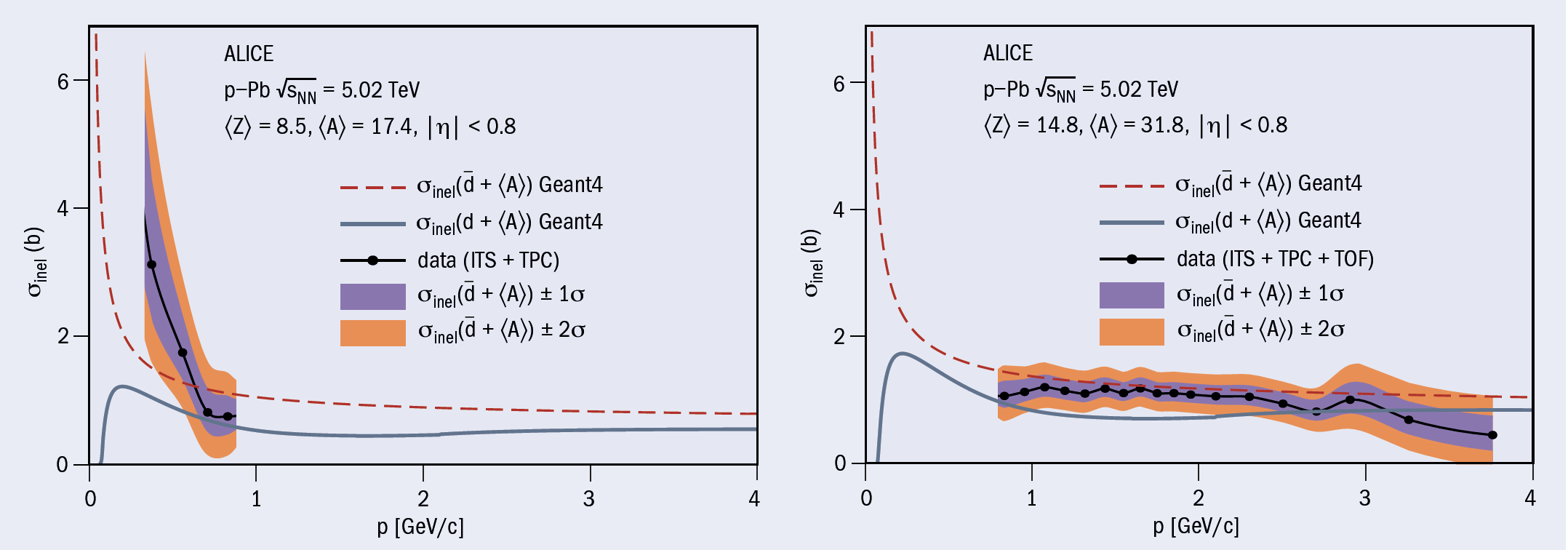
Further helping clarify the results of indirect DM searches, ALICE has recently performed the first measurement of the antideuteron inelastic cross section in the momentum range 0.3 < p < 4 GeV/c – significantly extending our knowledge about this cross section from previous measurements at momenta of 13 and 25 GeV/c at the Serpukhov accelerator complex in Russia in the early 1970s. The collaboration took advantage of the ability of antideuterons produced at the LHC to interact inelastically with the detector material. To quantify this process, ALICE has employed a novel approach based on the antideuteron- to-deuteron ratio reconstructed in collisions of protons and heavy ions at a centre-of-mass energy per nucleon–nucleon pair of 5.02 TeV. Such a ratio depends on both of the inelastic cross sections of deuterons and antideuterons. The former has been measured in various previous experiments at different momenta; the latter can be constrained from the ALICE data by comparing the measured ratio with detailed Monte Carlo simulations.
The resulting antideuteron inelastic cross section is shown (see “Interaction probability” figure), where the two panels correspond to the different sub-detectors employed in the analysis and therefore to different average material crossed by (anti)deuterons – corresponding to a difference of about a factor two in average mass number. The inelastic cross sections include all possible inelastic antideuteron processes such as break-up, annihilation or charge exchange, and the analysis procedure was validated by demonstrating consistency with existing antiproton results from traditional scattering experiments.
The momentum range covered is of particular importance to evaluate the signal predictions for indirect dark-matter searches
The momentum range covered in this latest analysis is of particular importance to evaluate the signal predictions for indirect dark-matter searches. Additionally, these measurements can help researchers to understand the low-energy antideuteron inelastic processes and to model better the inelastic antideuteron cross sections in widely-used toolkits such as Geant4. Together with the proper modelling of antinuclei formation, the obtained results will impact the antideuteron flux expectations at low momentum for ongoing and future satellite- and balloon-borne experiments.
The heavier, the better
ALICE is studying the full range of antinuclei physics with unprecedented precision. These results, which have started to emerge only since 2015, are contributing significantly to our understanding of antinuclei formation and annihilation processes, with important ramifications for DM searches. Both the statistical hadronisation and coalescence models can describe antideuteron production at the LHC, while the detector material can be used as an absorber to study the antinuclei inelastic cross section at low energies relevant for the astrophysical applications.
For the foreseeable future, ALICE will continue to provide an essential reference for the interpretation of astrophysics measurements of antinuclei in space. With the increased integrated luminosity that will be acquired by ALICE during LHC Run 3 from early 2022, it will be possible to extend the current analyses to heavier (anti)nuclei, such as 3He and 4He, with even better precision than the currently available measurements for (anti)deuterons. This will allow the collaboration to perform fundamental tests of the production and annihilation mechanisms with heavier, doubly-charged antinuclei, which are more easily identified by satellite-borne experiments and thus expected to provide an even clearer DM signature.
To provide the best experiences, we use technologies like cookies to store and/or access device information. Consenting to these technologies will allow us to process data such as browsing behavior or unique IDs on this site. Not consenting or withdrawing consent, may adversely affect certain features and functions.
Functional
Always active
The technical storage or access is strictly necessary for the legitimate purpose of enabling the use of a specific service explicitly requested by the subscriber or user, or for the sole purpose of carrying out the transmission of a communication over an electronic communications network.
Preferences
The technical storage or access is necessary for the legitimate purpose of storing preferences that are not requested by the subscriber or user.
Statistics
The technical storage or access that is used exclusively for statistical purposes.The technical storage or access that is used exclusively for anonymous statistical purposes. Without a subpoena, voluntary compliance on the part of your Internet Service Provider, or additional records from a third party, information stored or retrieved for this purpose alone cannot usually be used to identify you.
Marketing
The technical storage or access is required to create user profiles to send advertising, or to track the user on a website or across several websites for similar marketing purposes.