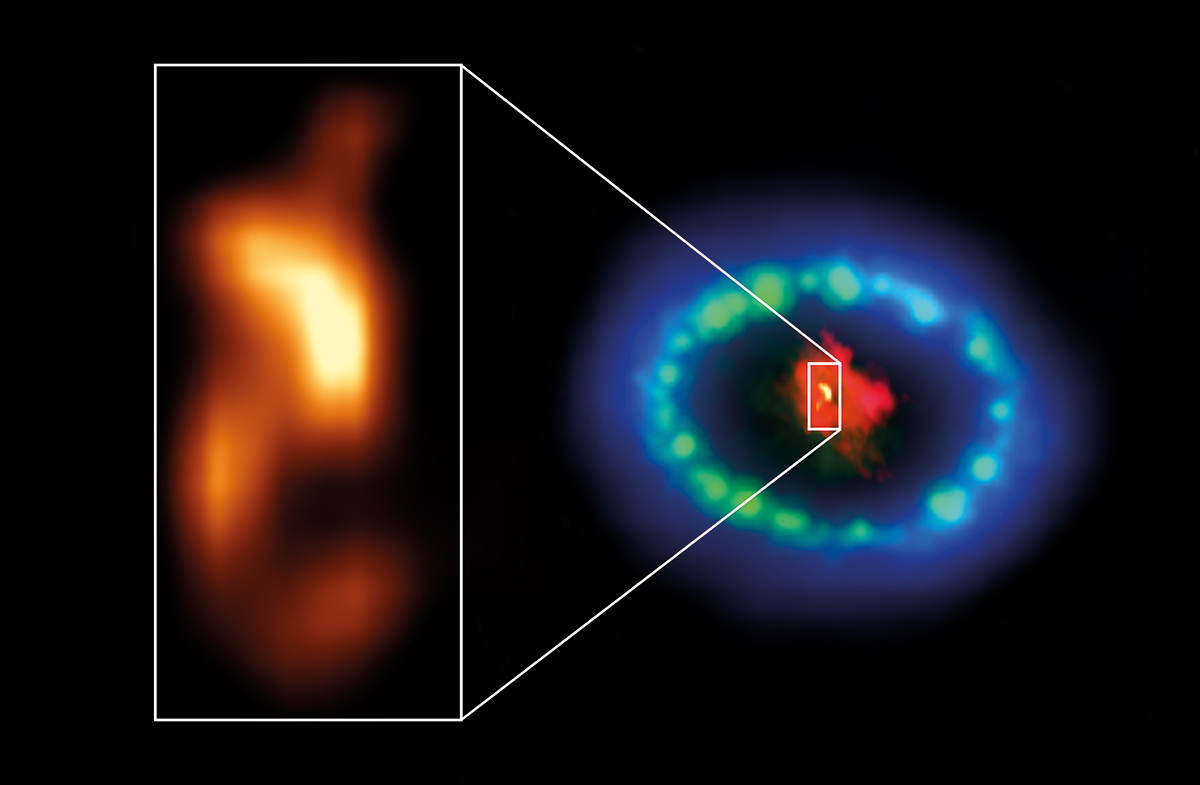
On 23 February 1987 astronomers around the world saw an extremely bright supernova, now called SN1987A. It was the closest supernova observed for over 300 years and was visible to the naked eye. The event was quickly confirmed to be the result of the collapse of “Sanduleak –69 202”, a blue supergiant star in the Large Magellanic Cloud. As the first nearby supernova in the era of modern astronomy, SN1987A remains one of the most monitored objects in the sky. Apart from confirming several important theories, such as radioactive decay being the source of the observed optical emission, the supernova also raised a number of questions that remain unanswered. The most important is: where is the remnant of the progenitor star?
Despite several false detection claims in the past, evidence is mounting that Sanduleak –69 202 collapsed into a neutron star
Despite several false detection claims in the past, evidence is mounting that Sanduleak –69 202 collapsed into a neutron star that is becoming more visible as the dust around it starts to settle. A new analysis by researchers in Italy and Japan based on high-energy X-ray data from the Chandra and NuSTAR space telescopes adds the latest support to this idea.
Even before the optical light from SN1987A was detected, several neutrino detectors around the world saw a burst of neutrinos. The brightest one was observed by Japan’s Kamiokande II detector, which detected a total of 12 antineutrinos approximately three hours before the first optical light reached Earth. The detection of antineutrinos seemed to confirm theoretical predictions for a star the size of Sanduleak –69 202: namely that it should collapse into a neutron star, and emit large numbers of neutrinos while doing so. The optical light arrives later because it is only produced when the shock waves from the collapse reach the surface of the star.
Since the newly formed neutron star would be expected to emit large amounts of energy at various wavelengths, one might assume it would be relatively easy to detect. However, no signs were found in follow-up searches over the past three decades, leading to much speculation about the fate of this star and its surrounding medium.
The first signs of the stellar remnants of SN1987A came from radio observations by the Atacama Large Millimeter/submillimeter Array (ALMA) in Chile in 2019. A group led by Phil Cigan from Cardiff University in the UK used ALMA data at various frequencies to study the core of SN1987A. Close to the centre, they found a bright “blob” structure, the emission from which appeared to be compatible with radio emission from particles accelerated by a neutron star, also called a pulsar wind nebula. Although the researchers could not exclude local heating from 44Ti produced during the supernova as the source, the results provided the first hint that the blob houses a young neutron star.
Wind power
Inspired by the ALMA results, Emanuele Greco from the University of Palermo and coworkers started to study the same region using X-ray data from Chandra and NuSTAR taken during 2012, 2013 and 2014. They found that the detected soft X-ray emission (0.5–8 keV) was compatible with thermal emission produced in the remnant shock waves of the supernova event with the circumstellar medium. However, at higher energies (10–20 keV) the emission was clearly non-thermal in nature. Describing their findings in a preprint posted in January, the group studied the two possible sources for such emission: synchrotron emission from a pulsar wind nebula and synchrotron emission produced in shock waves in the region. Whereas models for both ideas fit the spectral data, the pulsar wind nebula is favoured because the shock emission would not be expected to look like this for such a young remnant.
It appears that after 34 years of searching we will finally understand what happened in SN1987A
The reason why this neutron star has escaped previous observations in optical or soft X-ray energies is likely absorption by cold dust emitted during the supernova, which appears to still absorb a large part of the synchrotron emission observed in X-rays, especially at lower energies. But the dust is expected to start to heat up during the coming decades, thereby becoming transparent to lower energy emission. Greco and colleagues predict that, if the emission is indeed induced by a neutron star, it will become visible in the soft X-ray regime by 2030 with Chandra.
Although astronomers have just two observational hints that Sanduleak –69 202 did, as it should according to theory, collapse into a neutron star, it appears that after 34 years of searching we will finally understand what happened in SN1987A.
Supersymmetry is a popular extension of the Standard Model (SM) that has the potential to resolve several open questions in particle physics. As a result of a postulated new symmetry between fermions and bosons, the theory predicts a “superpartner” for each SM particle. The lightest of these new particles could be what makes up dark matter, while additional new superpartners could resolve the question of why the Higgs boson has a relatively low mass. Many searches for supersymmetry have already been performed by the ATLAS and CMS collaborations, but most have focused on strongly interacting superpartners that could be very heavy. It is possible, however, that electroweak production of supersymmetric particles is the dominant or only source of superpartners accessible at the LHC.
Supersymmetric events are expected to have an imbalance in transverse momentum
The unprecedented data volume of LHC Run 2 provides a unique opportunity to search for rare processes such as electroweak production of supersymmetric particles. A recent result from the CMS collaboration uses the Run-2 dataset to search for the superpartners of the electroweak bosons, called charginos and neutralinos. Events with three or more charged leptons, or two leptons of the same charge, were analysed. Such events are relatively rare in the SM, and, if they exist, charginos and neutralinos are predicted to create an excess of events with these topologies. Supersymmetric events are also expected to have an apparent imbalance in transverse momentum, because the lightest supersymmetric particle should evade detection. Correlations between the multiple leptons in the events, and between the leptons and the momentum imbalance, can be used to define a set of discriminating variables sensitive to chargino and neutralino production. These variables are used to assign the selected events into several search regions that address different possible signals of the production and decay of supersymmetric particles. Making such a multivariate binning optimal in every corner of phase-space, and for any possible manifestation of supersymmetry, is a challenging task.
Parametric machine learning
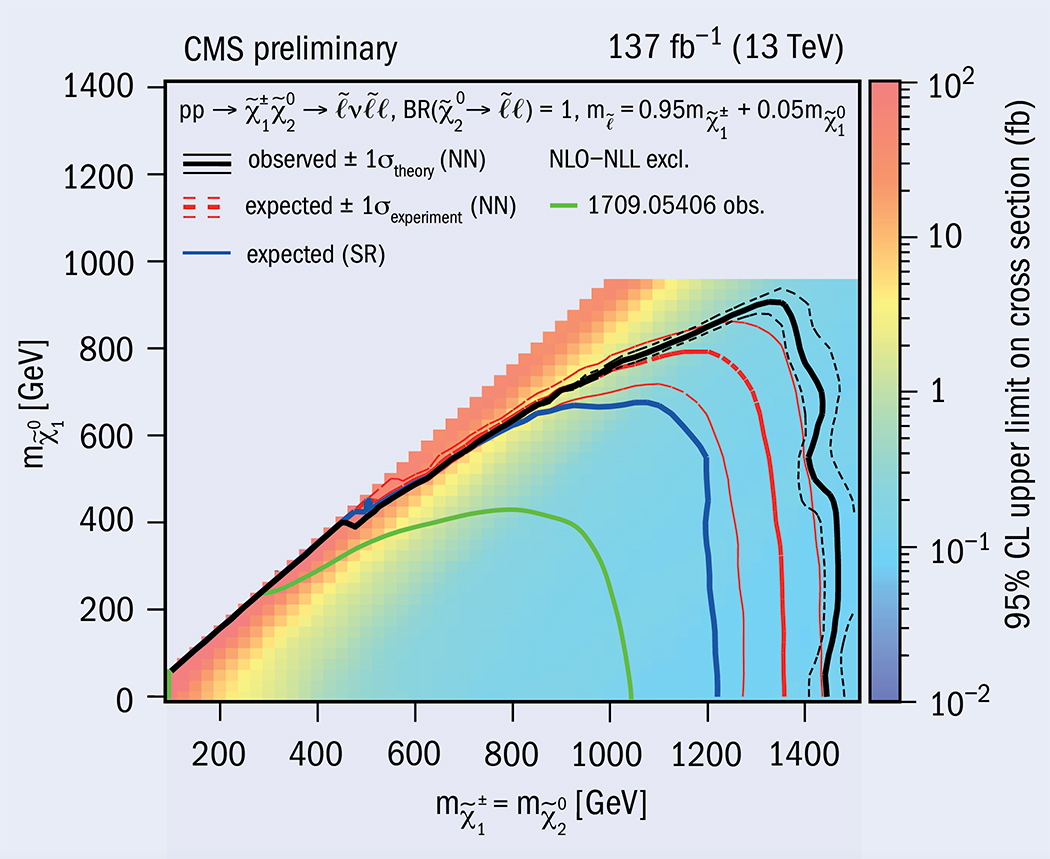
Events with three electrons and/or muons provide the bulk of the sensitivity by striking the best balance between signal purity and yields. A novel search approach is used that aims at better capturing the complexity of the events than is possible using predetermined search regions: parametric machine learning. The aim is to achieve the maximum sensitivity for any parameter choice nature might have made, as supersymmetry is not one model, but a class of models. Variations in the masses of the superpartners can substantially modify the observable signatures. Parametric neural networks were trained to find charginos and neutralinos with the unknown mass parameters added as input variables to the training. The network can evaluate the data at fixed values of the mass parameters, effectively performing a dedicated search for a signal with given masses in the data (figure 1).
The parametric neural network, together with a new optimised event binning of the other event categories, makes this analysis the most powerful search for charginos and neutralinos carried out by the CMS collaboration so far. The neural network alone results in a sensitivity boost that ranges from 30% to more than 100%. Substantial improvements occur for models where the decay of the charginos and neutralinos are mediated by the superpartners of leptons. The improvements become even larger when the mass splitting between sleptons and the chargino is relatively small. The data show no evidence for electroweak superpartner production, and chargino masses up to 1450 GeV, compared to 1150 GeV in earlier CMS searches for this scenario, are excluded at 95% confidence.
The Higgs boson discovered in 2012 by the ATLAS and CMS experiments is the pinnacle of the scientific results so far at the LHC. Measurements of its couplings to W and Z bosons and to heavy fermions have provided a strong indication that the mechanism of electroweak symmetry breaking is similar to that proposed by Brout, Englert and Higgs (BEH) more than 50 years ago. In this model, the BEH field exists throughout space with a non-zero field strength corresponding to the minimum of the BEH potential. The measurement of the shape of the BEH potential has become one of the main goals of experimental particle physics. It governs not only the nature of the electroweak phase transition in the early universe, when the BEH field gained its non-zero “vacuum expectation value” (VEV), but also the question of whether deeper minima than the present vacuum exist.
The measurement of the production of Higgs-boson pairs gives a direct way to measure λ
Interactions with the BEH VEV give mass not only to the W and Z bosons and the fermions, but also to the Higgs boson itself. If the mass of the Higgs boson is well known, the Standard Model (SM) can therefore predict the Higgs self-coupling, λ – the key unknown parameter in the shape of the BEH potential of the SM. The measurement of the production of Higgs-boson pairs (HH) gives a direct way to measure λ. Higgs-boson pair production is not yet established experimentally, as it is a thousand times less frequent than the production of a single Higgs boson. However, the presence of physics beyond the SM can substantially enhance the HH production rate. The search for HH production at the LHC is therefore an important test of the SM.
Best constraint
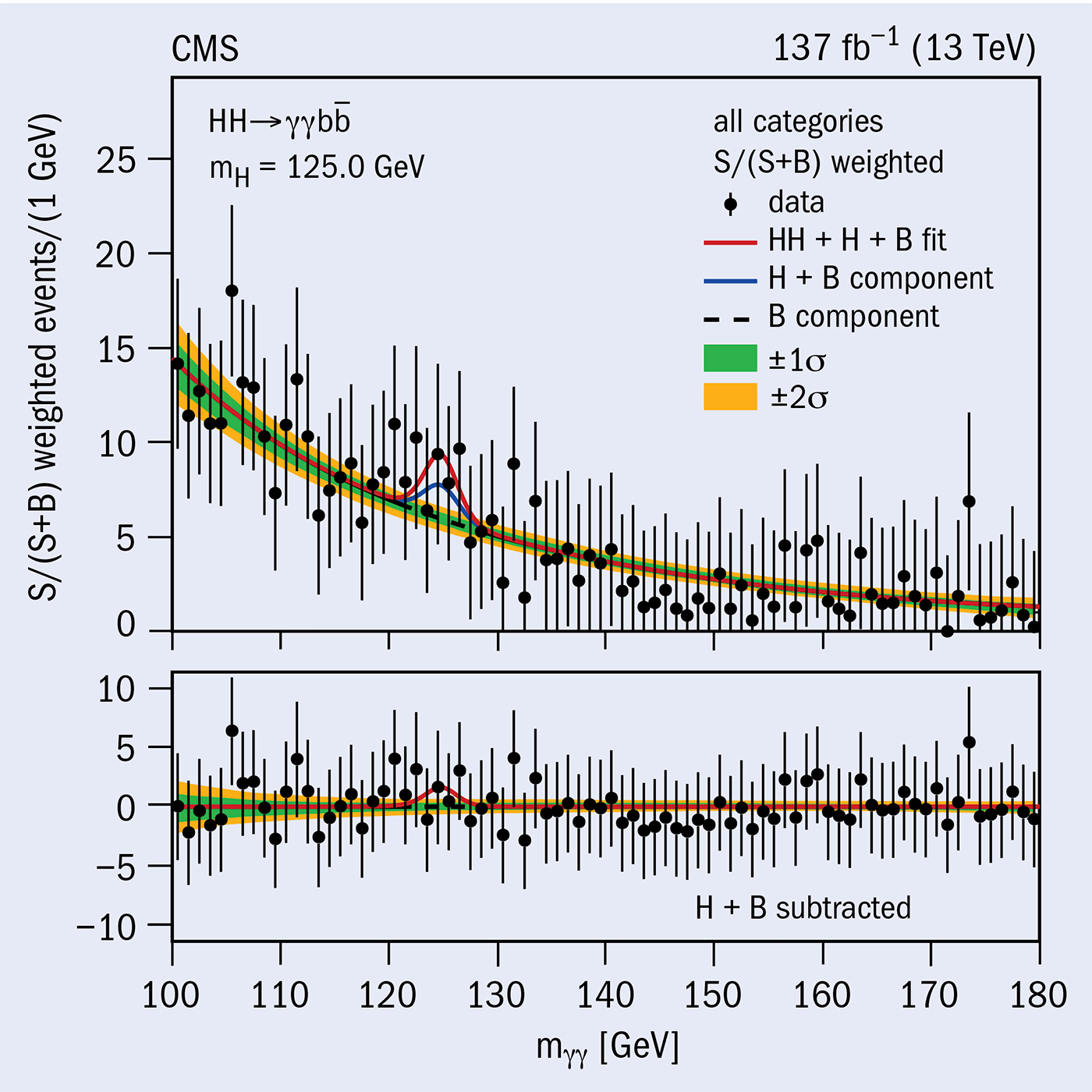
A recent result by the CMS collaboration describes a search for HH production in final states with two photons and two b-jets (figure 1). The large data sample collected during LHC Run 2 excludes a HH production rate larger than 7.7 times that predicted by the SM. CMS has set the best constraint to date on the ratio of the measured λ parameter to the SM prediction, κλ = 0.6+6.3–1.8.
The sensitivity of the analysis has been improved by about a factor four over the previous result that used the data collected in 2016, benefitting equally from the increase in luminosity and from a wealth of innovative analysis techniques. The electromagnetic calorimeter of the CMS experiment allows the measurement of H → γγ candidates with excellent resolution (about 1–2%). Advanced machine-learning techniques, including deep neural networks, were introduced to significantly improve the mass resolution of H → bb, from 15% down to 11%. The analysis combines information from the invariant mass of the HH system, reflecting the underlying physics processes, and a multivariate classifier exploring the kinematic properties as well as the identification of photons and b-jets.
Events were categorised to enhance the sensitivity to Higgs production via gluon fusion as well as, for the first time, vector-boson fusion. The latter constrains the quartic coupling between two vector bosons and two Higgs bosons, such as WWHH, which is an extremely rare interaction in the SM. In addition, dedicated categories from a previous analysis were added to account for the associated production of top quarks and a single Higgs boson, and to provide a simultaneous constraint on the top-quark Yukawa coupling and λ. Several hypotheses predicting new physics were also constrained. The results are an encouraging step forwards in the quest to measure the BEH potential and to further interrogate the SM.
The growing LHC dataset eight years after the discovery of the Higgs boson allows the experiments to study its properties more and more precisely, searching for hints of physics beyond the Standard Model (SM). New phenomena might occur at energy scales beyond the reach of the LHC, pointing to the existence of so-far undiscovered particles with masses too heavy to be directly produced in 13 TeV proton–proton collisions. Without knowing the exact nature of the new physics, LHC data can be analysed to systematically constrain new types of interactions in the framework of an effective field theory (EFT). One historical EFT example is Fermi’s effective interaction model for nuclear beta decay, which is valid as long as the probed energy scale is well below the mass of the W boson. The move to constrain EFTs rather than signal strengths for couplings marks a new, more comprehensive phase in SM tests at the LHC.
The move to constrain EFTs marks a new, more comprehensive phase in SM tests at the LHC
Almost all types of new physics would give rise to new interactions with SM particles, with different models leaving different EFT footprints. As the underlying dynamics is not known and effects can be subtle, it is important to combine as many measurements as possible across the full spectrum of the LHC research programme.
A new ATLAS analysis presented at the Higgs 2020 conference, held online from 26 to 30 October, takes a first step in this direction. The analysis combines measurements of production cross-sections and kinematic variables of Higgs-boson events in several decay channels (diphoton, four-lepton and di-b-quark decays) to constrain new phenomena within the so-called SMEFT framework. The combination of measurements allows multiple new interactions involving the Higgs boson to be constrained simultaneously. This approach requires fewer hypotheses on the other unconstrained interactions than studying the EFT terms one measurement at a time. The results are therefore more generic and easier to interpret in a broader context.
Predicted to vanish
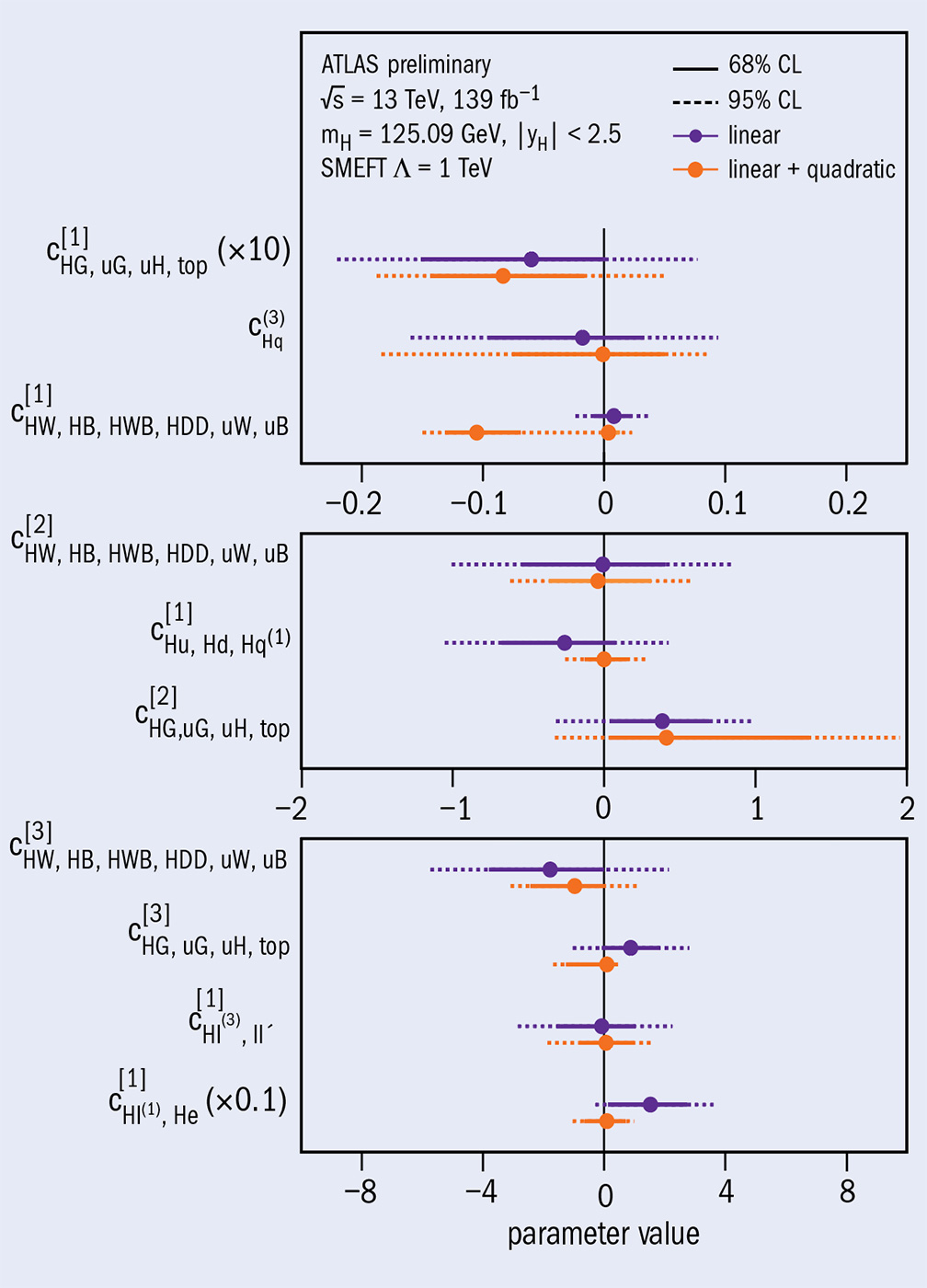
Figure 1 shows the allowed ranges for the coupling coefficients of new EFT interactions to which the ATLAS combined Higgs analysis is sensitive. The coefficient c(3)Hq, for example, describes the strength of an effective four-particle interaction between two quarks, a gauge boson and the Higgs boson. The SM predicts all these coefficients to vanish, as their corresponding interactions are not present. Significant positive or negative deviations would indicate new physics. For instance, a non-vanishing value of c(3)Hqwould cause deviations from the SM in the ZH and WH cross-sections at high transverse momentum of the Higgs boson, which are not observed in the measured channels.
All measurements are compatible with the SM, indicating that if new physics is present it either has a mass scale larger than 1 TeV (the reference scale for which these results are reported) – or it manifests itself in interactions to which the available measurements are not yet sensitive. In the meantime, thanks to the design of the analysis, the results can be added to wider EFT interpretations that combine measurements from different physics processes (e.g. electroweak- boson or top-quark production) studied by ATLAS and other experiments, providing a consistent and increasingly detailed mapping of the allowed new physics extensions of the SM.
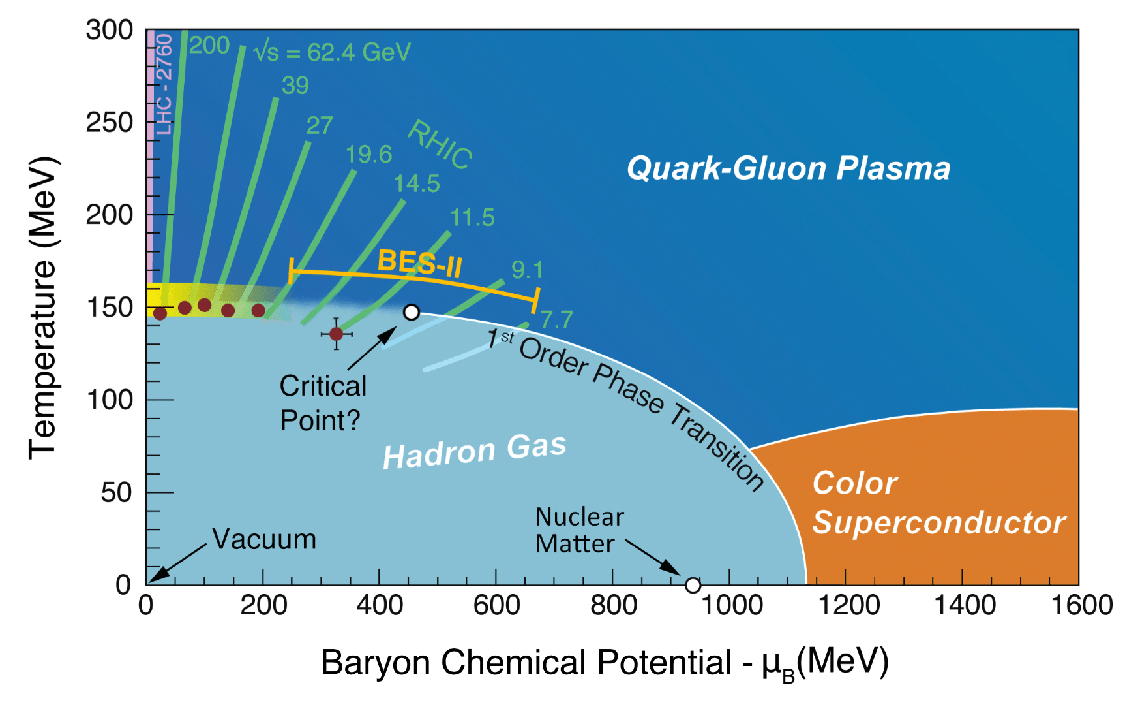
The XXXII international workshop of the Logunov Institute for High-Energy Physics of the NRC Kurchatov Institute in Protvino, near Moscow, brought more than 300 physicists together online from 9 to 13 November to discuss “hot problems in hot and cold quark matter”. The focus of the workshop was chiral theories and lattice simulations, which allow estimates beyond perturbation theory for studying the strongly coupled quark–gluon plasma (sQGP) – the hot and/or dense plasma of quarks and gluons that is created in heavy-ion collisions, and which may exist inside neutron stars.
Participants considered the QCD phase diagram (pictured) as a function of temperature, magnetic field (B), baryon and isospin chemical potentials (μB and μI), and varying quark masses. The crossover line (yellow strip), which marks a transition between hadronic matter and sQGP, has long attracted great interest. Vladimir Skokov (Brookhaven) employed recent progress in the Lee–Yang approach to phase transitions to derive from first principles that μB > 400 MeV at the critical end point (a possible termination of the first-order phase-transition boundary). Discussions of the phase diagram also included a decrease in the pseudocritical temperature with B, the possibility of a first-order phase transition at μB = 0 as B tends to infinity, the existence and location of a superconducting phase, the disagreement between measured and predicted collective flows of direct photons in heavy-ion collisions, and the diamagnetic and paramagnetic natures of the pion gas and deconfined matter, respectively. Evgeny Zabrodin (Oslo) explained that the rotating fireballs of strongly interacting matter that are produced in heavy-ion collisions are not only superfluids but also supervortical liquids.
Gravitational-wave astrophysics
Impressive work was also shared at the intersection of heavy-ion collisions and gravitational-wave astrophysics on the subject of the equation of state (EoS) of neutron-star cores. The EoS is the relationship between pressure and density, and can indicate whether hadronic or quark matter is inside. Theoretical bounds on the EoS come from chiral effective theories, perturbative QCD, and the bound on the speed of sound cs < 1/3. The quantities that can be extracted from experimental data are the mass–radius relation and the relationship between the tidal deformabilities of merging neutron stars and the peak frequency of the emitted gravitational waves. Several speakers observed that tidal deformabilities, which are measured in the inspiral phase, and the peak gravitational- wave frequency, which is measured in the post-merger phase, may together reveal the state of a neutron-star interior. Mergers observed since 2017 may already be able to shed light on the existence of a deconfined phase inside these ultra-compact objects.
Mariana Araújo offered a solution to the longstanding quarkonium polarisation puzzle
The Protvino workshop also revealed the enduring importance of studying heavy-quark physics. Since heavy quarks can be considered as approximately statically coloured sources, studies of quarkonia production are a step towards understanding hadron formation and the confinement mechanism. Peter Petreczky (Brookhaven) concluded from a lattice study of Bethe–Salpeter amplitudes that the potential model fails to describe bottomonium in terms of screened potential at high temperatures, with further investigations clearly needed in this field. Carlos Lourenço (CERN) showed that the lowering of quarkonia binding energies in the sQGP leads to nontrivial measured suppression patterns. Eric Braaten (Ohio) showed that the decrease with multiplicity of the ratio of the prompt production rates of X(3872) and Ψ(2S) in proton–proton collisions can be explained by the scattering of co-moving pions off X(3872) if it is a weakly bound charm-meson molecule. With equally impressively scrupulousness, Mariana Araújo (Innsbruck) offered a solution to the longstanding “quarkonium polarisation puzzle” by making use of a model-independent fitting procedure and taking into account correlations between cross sections and polarisations.
The next “hot problems” workshop will be held in November.
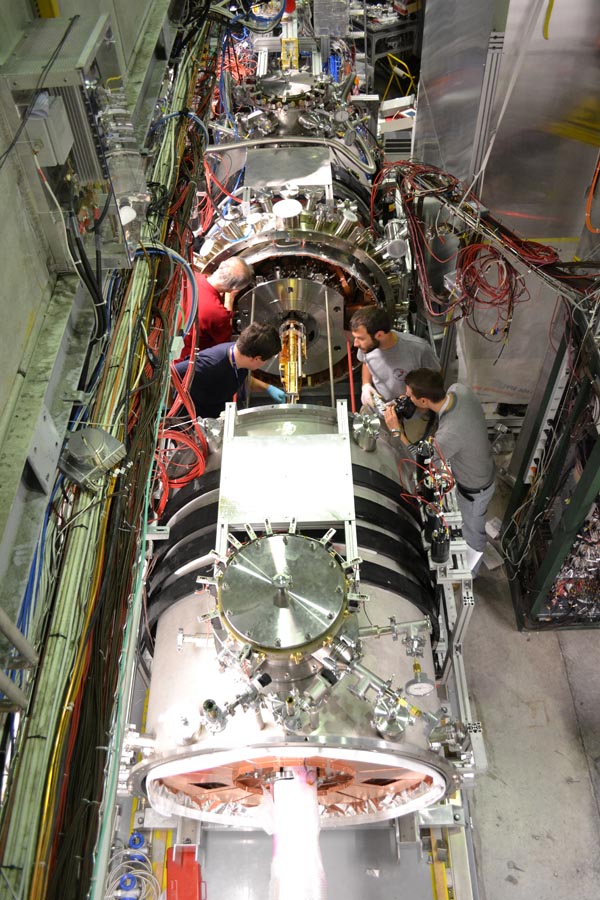
The AEgIS collaboration at CERN’s Antiproton Decelerator (AD) has reported a milestone in its bid to measure the gravitational free-fall of antimatter – a fundamental test of the weak equivalence principle. Using a series of techniques developed in 2018, the team demonstrated the first pulsed production of antihydrogen, which allows the time at which the antiatoms are formed to be known with high accuracy. This is a key step in determining “g” for antimatter.
“This is the first time that pulsed formation of antihydrogen has been established on timescales that open the door to simultaneous manipulation, by lasers or external fields, of the formed atoms, as well as to the possibility of applying the same method to pulsed formation of other antiprotonic atoms,” says AEgIS spokesperson Michael Doser of CERN. “Knowing the moment of antihydrogen formation is a powerful tool.”
General relativity’s weak equivalence principle holds that all particles with the same initial position and velocity should follow the same trajectories in a gravitational field. It has been verified for matter with an accuracy approaching 10–14. Since theories beyond the Standard Model such as supersymmetry, or the existence of Lorentz-symmetry violating terms, do not necessarily lead to an equivalent force on matter and antimatter, finding even the slightest difference in g would suggest the presence of quantum effects in the gravitational arena. Indirect arguments constrain possible differences to below 10–6g, but no direct measurement for antimatter has yet been performed due to the difficulty in producing and containing large quantities of it.
ALPHA, AEgIS and GBAR are all targeting a measurement of g at the 1% level in the coming years.
Antihydrogen’s neutrality and long lifetime make it an ideal system in which to test this and other fundamental laws, such as CPT invariance. The first production of low-energy antihydrogen, reported in 2002 by the ATHENA and ATRAP collaborations at the AD, involved a three-body recombination reaction (e++e++p → H+e+) involving clouds of antiprotons and positrons. Since then, steady progress by the AD’s ALPHA collaboration in producing, manipulating and trapping ever larger quantities of antihydrogen has enabled spectroscopic and other properties of antimatter to be determined in exquisite detail.
Whereas three-body recombination results in an almost continuous antihydrogen source, in which it is not possible to tag the time of the antiatom formation, AEgIS has employed an alternative charge-exchange process between trapped and cooled antiprotons and positronium (e+e– bound system). Bursts of positrons are accelerated and then implanted into a nano-channelled silicon target above an electromagnetic trap containing cold antiprotons, where, with the aid of laser pulses, they produce a cloud of excited positronium a few millimetres across. This can lead to the formation of antihydrogen within sub-μs timescales, the moment of production being defined by the wellknown laser firing time and the transit time of positronium toward the antiproton cloud. Since the antihydrogen is not trapped in the apparatus, it drifts in all directions until it annihilates on the surrounding material, producing pions and photons that are detected by a scintillating array read out by photomultipliers. The scheme allows the time at which 90% of the atoms are produced to be determined with an uncertainty of around 100 ns.
Further steps are required before the measurement of g can begin, explains Doser. These include the formation of a pulsed beam, greater quantities of antihydrogen, and the ability to make it colder. “With only three months of beam time this year, and lots of new equipment to commission, most likely 2022 will be the year in which we establish pulsed beam formation, which is a prerequisite for us to perform a gravity measurement.”
Targeted approach
Following a proof-of-principle measurement of g for antihydrogen by the ALPHA collaboration in 2013, ALPHA, AEgIS and a third AD experiment, GBAR, are all targeting a measurement of g at the 1% level in the coming years. In contrast to AEgIS’s approach, whereby the vertical deviation of a pulsed horizontal beam of cold antihydrogen atoms will be measured in an approximately 1 m-long flight tube, GBAR will take advantage of advances in ion-cooling techniques to measure ultraslow antihydrogen atoms as they fall from a height of 20 cm. ALPHA, meanwhile, will release antihydrogen atoms from a vertical magnetic trap and measure the distribution of annihilation positions when they hit the wall – ramping the trap down slowly so that the coldest atoms, which are most sensitive to gravity, come out last. All three experiments have recently been hooked up to the AD’s ELENA synchrotron, which enables the production of very low-energy antiprotons.
Given that most of the mass of antinuclei comes from massless gluons that bind their constituent quarks, physicists think it unlikely that antimatter experiences an opposite gravitational force to matter and therefore “falls up”. Nevertheless, precise measurements of the free fall of antiatoms could reveal subtle differences that would open an important crack in current understanding.
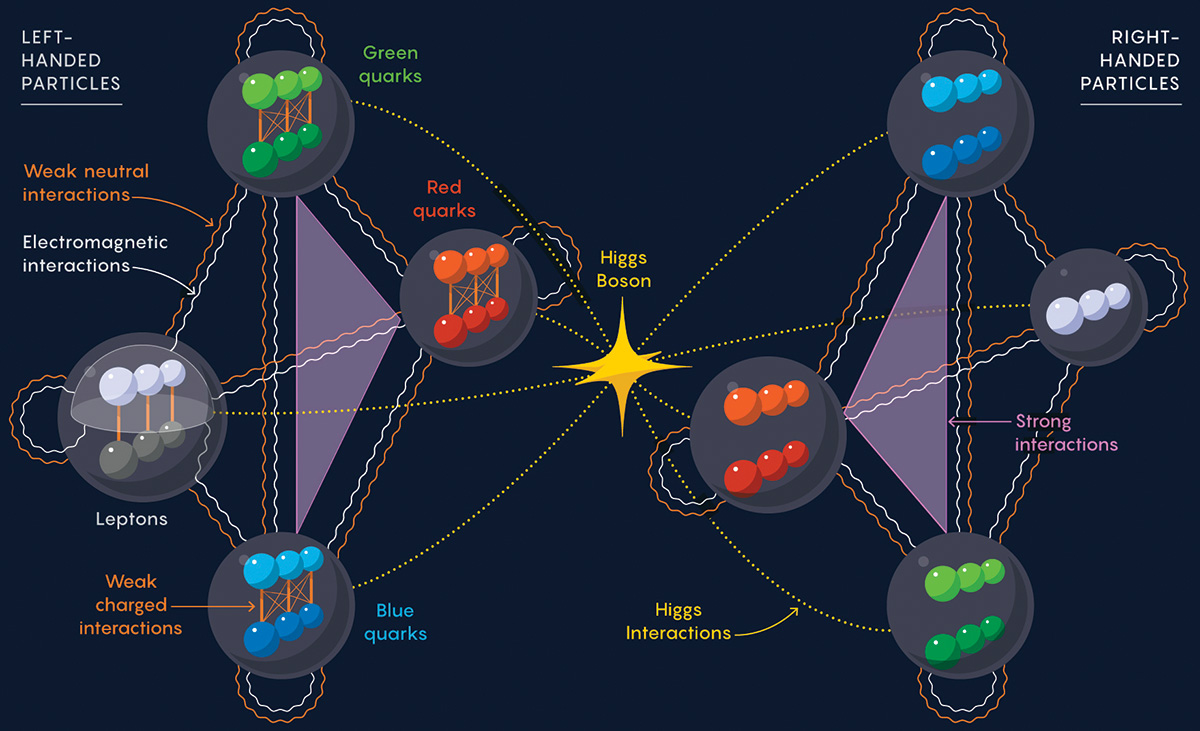
Popular representations of the Standard Model (SM) often hide its beautiful weirdness, for example slotting quarks and leptons into boxes and arranging them like a low-grade Mendeleev, or contriving a dartboard arrangement. The “double simplex” scheme invented in 2005 by US theorist Chris Quigg, which was recently given a flashy makeover by Quanta magazine (see image), is much richer (arXiv:hep-ph/0509037).
Jogesh Pati and Abdus Salam’s suggestion, in their 1974 shot at a grand unified theory, that lepton number be regarded as a fourth colour, inspired Quigg to place the leptons at the fourth point of an SU(4) tetrahedron. The additional edges therefore represent possible leptoquark transitions. Left-handed fermion doublets (left) are reflected in the broken mirror of parity to reveal right-handed fermion singlets (right), though Quanta, unlike Quigg perhaps favouring a purely left-handed Majorana mass term, omit possible right-handed neutrinos.
A final distinction is that Quigg chooses to superimpose the left and right simplexes – a term for a generalised triangle or tetrahedron in an arbitrary number of dimensions – while Quanta elects to separate the tetrahedra, and label couplings to the Higgs boson with sweeping loops. This obscures a beautiful feature of Quigg’s design, whereby the Yukawa couplings hypothesised by the SM, which couple the left- and right-handed incarnations of massive fermions in interactions with the Higgs field, link opposite corners of the superimposed double simplex, placing the Higgs boson at the centre of the picture. Quigg, who intended that the double simplex precipitate questions, also points out that the corners of the superimposed tetrahedra define a cube, whose edges suggest a possible new category of feeble interactions yet to be discovered.
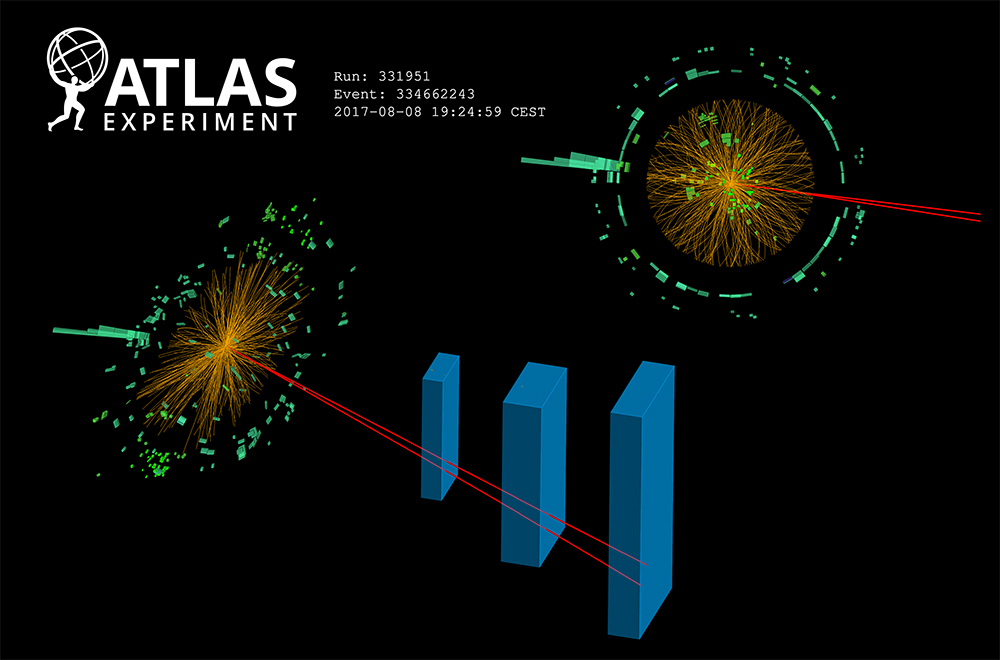
Evidence for the decay of the Higgs boson to a photon and a low-mass electron or muon pair, propagated predominantly by a virtual photon (γ*), H → γ*γ → ℓℓγ (where ℓ = e or μ), has been obtained at the LHC. At an LHC seminar today, the ATLAS collaboration reported a 3.2σ excess over background of H → ℓℓγ decay candidates with dilepton mass mℓℓ < 30 GeV.
The H → ℓℓγ decay is particularly interesting as it is a loop process
The measurement of rare decays of the Higgs boson is a crucial component of the Higgs-boson physics programme at the LHC, since they probe potential new interactions with the Higgs boson introduced by possible extensions of the Standard Model. The H → ℓℓγ decay is particularly interesting in this respect as it is a loop process and the three-body final state allows the CP structure of the Higgs boson to be probed. However, the small expected signal-to-background ratio and the typically low dilepton invariant mass make the search for H → ℓℓγ highly challenging.
The analysis performed by ATLAS searched for H → e+e–γ and H → μ+μ–γ decays. Special treatment was needed in particular for the electron channel: a dedicated electron trigger was developed as well as a specific identification algorithm. The predicted mℓℓ spectrum rises steeply towards lower values, with a kinematic cutoff at twice the final-state lepton mass. At such low electron–positron invariant masses, and given the large transverse momentum of their system, the electromagnetic showers induced by the electron and the positron in the ATLAS calorimeter can merge, requiring a specially developed reconstruction. Furthermore, a dedicated identification algorithm was developed for these topologies, and its efficiency was measured in data using photon detector-material conversions at low radius into an electron–positron pair from Z → ℓℓγ events.
The signal extraction is performed by searching in the ℓℓγ invariant mass (mℓℓγ) range between 110 and 160 GeV for a narrow signal peak over smooth background at the mass of the Higgs boson. The sensitivity to the H → ℓℓγ signal was increased by separating events in mutually exclusive categories based on lepton types and event topologies. ATLAS reports evidence in data for a H → ℓℓγ signal emerging over the background with a significance of 3.2σ (see figure). The Higgs boson production cross section times H → ℓℓγ branching fraction, measured for mℓℓ < 30 GeV, amounts to 8.7+2.8–2.7 fb. It corresponds to a signal strength – the ratio of the measured cross section times branching fraction to the Standard Model prediction – of 1.5 ± 0.5. With this, ATLAS has also extended the invariant-mass range of the lepton pair for the related Higgs-boson decay into a photon and a Z boson to lower masses, opening the door to future studies of three-body Higgs-boson decays and investigations of its underlying CP structure.
Looking back on the great discoveries in particle physics, one can see two classes. The discovery of the Ω– in 1964 and of the top quark in 1995 were the final pieces of a puzzle – they completed an existing mathematical structure. In contrast, the discovery of CP violation in 1964 and of the J/ψ in 1974 opened up new vistas on the microscopic world. Paradoxically, although the Higgs boson was slated for discovery for almost half a century following the papers of Brout, Englert, Higgs, Weinberg and others, its discovery belongs in the second class. It constitutes a novel departure in the same way as the J/ψ and the discovery of CP violation, rather than the completion of a paradigm as represented by the discoveries of the Ω– and the top quark.
The novelty of the Higgs boson derives largely from its apparently scalar nature. It is the only fundamental particle without spin. Additionally, it is the only fundamental particle with a self-coupling (gluons also couple to other gluons, but only to those with different colour combinations). Measurements of the couplings of the Higgs boson to the W and Z bosons at the LHC have confirmed its role in the generation of their masses, likewise for the charged third-generation fermions. Despite this great success, the Higgs boson is connected to many of the most troublesome aspects of the Standard Model (see “Connecting the Higgs to Standard Model enigmas” panel). It is for this reason that the recently concluded update of the European strategy for particle physics advocated an electron–positron Higgs factory as the highest priority collider after the LHC, to allow detailed study of this novel and unique particle.
Circular vs linear
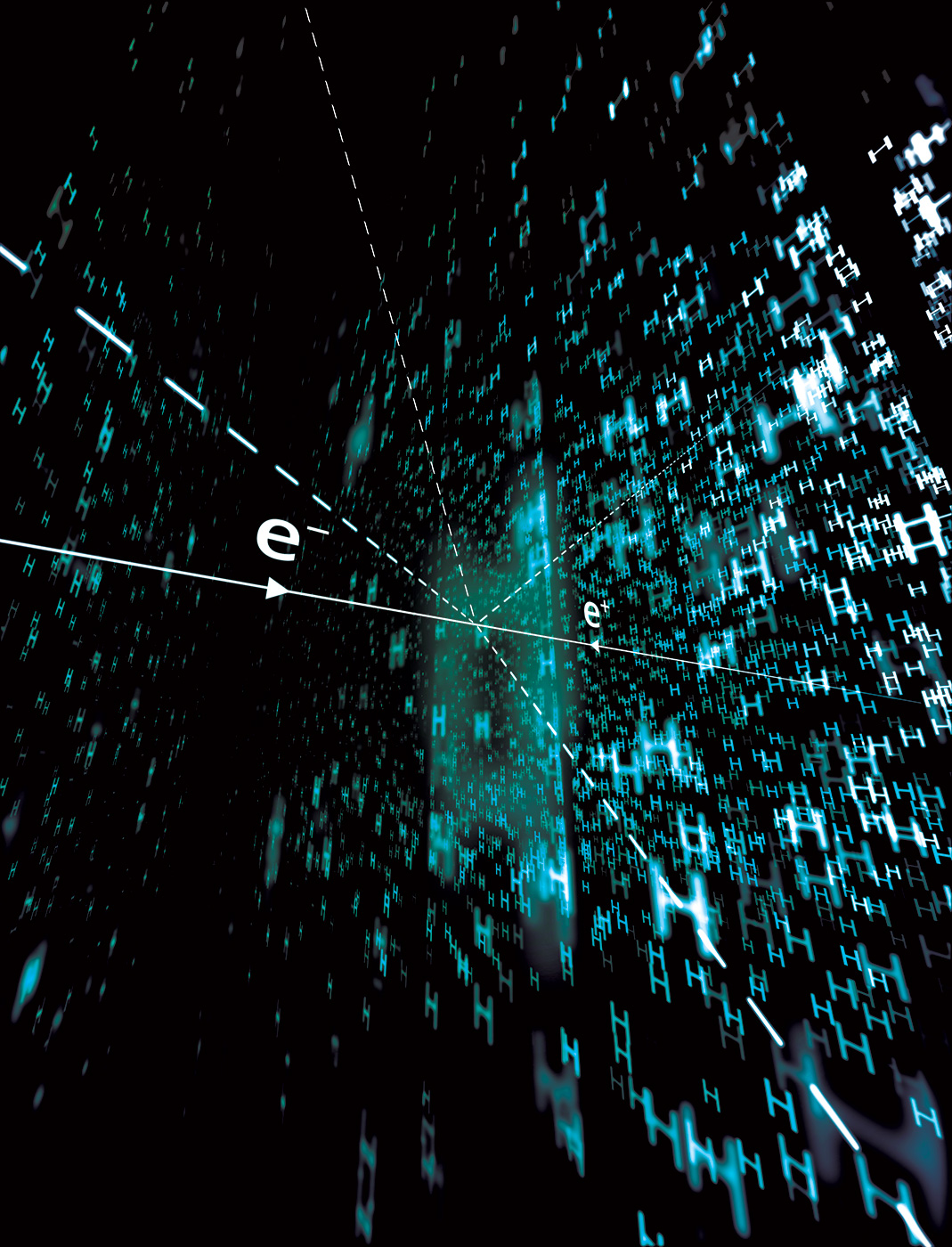
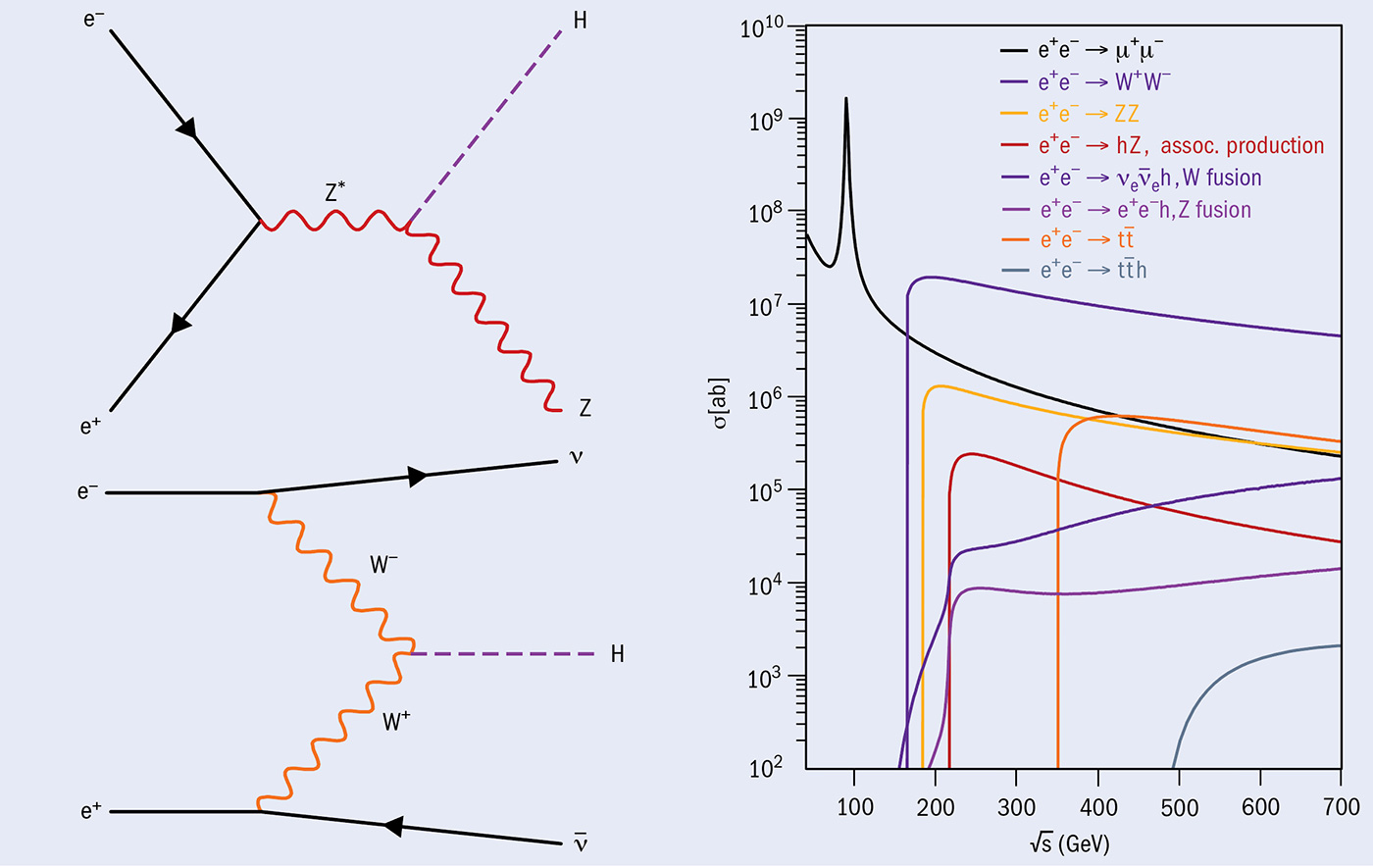
The discovery of the Higgs boson at the relatively light mass of 125 GeV, announced by the ATLAS and CMS collaborations in 2012, had two important consequences for experiment. The first was the large number of potentially observable branching fractions available. The second was that circular, as well as linear, e+e– machines could serve as Higgs factories. The two basic mechanisms for Higgs-boson production at such colliders are associated production, e+e–→ ZH, and vector-boson fusion. The former process is dominant at the low-energy first stage of the various Higgs factories under consideration, with vector-boson fusion becoming more important with increasing energy (see “Channeling the Higgs” figure). About a quarter of a million Higgs bosons would be produced per inverse attobarn of data, leading to substantial numbers of recorded events even after the branching ratios to observable modes are taken into account.
Four Higgs-factory designs are presently being considered. Two are linear accelerators, namely the International Linear Collider (ILC) under consideration in Japan and the Compact Linear Collider (CLIC) at CERN, while the other two are circular: the Future Circular Collider (FCC-ee) at CERN and the Circular Electron Positron Collider (CEPC) in China.
The beams in circular colliders continuously lose energy due to synchrotron radiation, causing the luminosity at circular colliders to decrease with beam energy roughly as Eb–3.5. The advantage of circular colliders is their high instantaneous luminosity, in particular at the centre-of-mass energy relevant for the Higgs-physics programme (250 GeV), but even more so at lower energies such as those corresponding to the Z-boson mass (91 GeV). Electron and positron beams in a circular machine naturally achieve transverse polarisation, which can be exploited to make precise measurements of the beam energy via the electron and positron spin-precession frequencies.
In contrast, for linear colliders the luminosity increases roughly linearly with the beam energy. The advantages of linear accelerators are that they can be extended to higher energies, and the beams can be polarised longitudinally. The ZH associated cross section can be increased by 40% with longitudinal polarisations of –80% and 30% for electrons and positrons, respectively. This increase, coupled with the ability to isolate certain components of Higgs-boson production by tuning the polarisation, enables a linear machine to achieve similar precisions on Higgs-boson measurements with half the integrated luminosity of a circular machine.
FCC-ee, CEPC and ILC are foreseen to run for several years at a centre-of-mass energy of around 250 GeV, where the ZH production cross section is largest. Instead, CLIC plans to run its first stage at 380 GeV where both WW fusion and ZH production contribute, and tt production is possible. The circular colliders FCC-ee and CEPC envisage running at the Z-pole and the WW production threshold for long enough to collect of the order 1012 Z bosons and 108 WW pairs, enabling powerful electroweak and flavour-physics programmes (see “Compare and contrast” table). To achieve design luminosity, all proposed e+e– colliders need beams focused to a very small size in one direction (30–70 nm for FCC-ee, 3–8 nm for ILC and 1–3 nm for CLIC), which are all below the values so far achieved at existing facilities.
Evolving designs
The proposed circular colliders are based on a combination of concepts that have been proven and used in previous and present colliders (LEP, SLC, PEP-II, KEKB, SuperKEKB, DAFNE). In Higgs-production mode the beam lifetime is limited by Bhabha scattering to about 30 minutes and therefore requires quasi-continuous injection or “top-up” as used by the B-factories. Each of the circular collider main concepts and parameters has been demonstrated in a previous machine, and thus the designs are considered mature. The total FCC-ee construction cost is estimated to be 10.5 billion CHF for energies up to 240 GeV, with an additional 1.1 billion CHF to go to the tt threshold. This includes 5.4 billion CHF for the tunnel, which could be reused later for a hadron collider. The CEPC cost has been estimated at $5 billion, including $1.3 billion for the tunnel. With the present design, the FCC-ee power consumption is 260–340 MW for the various energy stages (compared to 150 MW for the LHC).
The ILC was proposed in the late 1990s and a technical design report published in 2012. It uses superconducting RF cavities for the acceleration, as used in the currently operating European XFEL facility in Germany, to aim for gradients of 35 MV/m. The cost of the first energy stage (250 GeV) was estimated as $4.8–5.3 billion, with a power consumption of 130–200 MW, and an expression of interest to host the ILC as a global project is being considered in Japan. The CLIC accelerator uses a second beam, termed a drive-beam, to accelerate the primary beam, aiming for gradients in excess of 100 MV/m. This concept has been demonstrated with electron beams at the CLIC test facility, CTF3. The cost of the first energy stage of CLIC is estimated as 5.9 billion CHF with a power consumption of 170 MW, rising to 590 MW for final-stage operation at 3 TeV.
Another important difference between the proposed linear and circular colliders concerns the number of detectors they can host. Collisions at linear machines only occur at one interaction point, while in circular colliders at least two interaction points are proposed, doubling the luminosity available for analyses. Two detectors also offer the dual benefits of scientific competition and the cross-checking of results. At the ILC two detectors are proposed but they cannot run concurrently since they use the same interaction point.
FCC-ee and CLIC have both been proposed as CERN-hosted international projects, similar to the LHC or high-luminosity LHC (HL-LHC). At present, as recommended by the 2020 update of the European strategy for particle physics, a feasibility study for the FCC (including its post-FCC-ee hadron-collider stage, FCC-hh) is ongoing, with the goal of presenting an updated conceptual design report by the next strategy update in 2026. Among the e+e– colliders, CLIC has the greatest capacity to be extended to the multi-TeV energy range. In its low-energy incarnation it could be realised either with the drive-beam or conventional technology. CEPC is conceptually and technologically similar to FCC-ee and has also presented a conceptual design report. Nearly all statements about FCC-ee also hold for CEPC except that CEPC’s design luminosity is about a factor of two lower, and thus it takes longer to acquire the same integrated luminosity. At circular colliders, the multi-TeV regime (at least 100 TeV in the case of FCC-hh) would be reached by using proton beams, similar to what was done with LHC following LEP.
In addition to the vacuum expectation value of the Higgs field and the mass of the Higgs boson, the discovery of the Higgs boson introduces a large number of parameters into the Standard Model. Among them are the Yukawa couplings of the nine charged fermions (in contrast, the gauge sector of the SM has only three free parameters). The Yukawa forces, of which only three have been discovered corresponding to the couplings to the charged third-generation fermions, are completely new. They are of disparate strengths and, unlike the other forces, are not subject to the constraint of local gauge invariance. They provide a parameterisation of the theory of flavour, rather than an explanation. It is of primary importance to discover, bound and characterise the Yukawa forces. In particular, the discovery of CP violation in the Yukawa couplings would go beyond the confines of the Standard Model.
Famously, because of its scalar nature, the quantum corrections to the Higgs boson mass are only bounded by the cut-off on the theory, demanding large renormalisations to maintain the mass at 125 GeV as measured. This issue is not so much a problem for the Standard Model per se. However, in the context of a more complete theory that aims to supersede and encompass the Standard Model, it becomes much more troubling. In effect, the degree of cancellation necessary to maintain the Higgs mass at 125 GeV effectively sabotages the predictive power of any more complete theory. This sabotage becomes deadly as the scale of the new physics is pushed to higher and higher energies.
The electroweak potential is another area of importance in which our current knowledge is fragmentary. Within the confines of the Standard Model the potential is completely specified by the position of its minimum – the vacuum expectation value and the second derivative of the potential at the minimum, the mass of the Higgs boson (or equivalently its self-coupling). We have no direct knowledge of the behaviour of the potential at larger field values further from the minimum. In addition, extrapolation of the currently understood Higgs potential to higher energy reveals a world teetering between stability and instability. Further information about the behaviour of the potential could help us to interpret the meaning of this result. A modified electroweak potential might also give rise to a first-order phase transition at high temperature, rather than the smooth crossover expected for the Standard Model Higgs potential. This would fulfil one of the three Sakharov conditions necessary to generate an asymmetry between matter and antimatter in our universe.
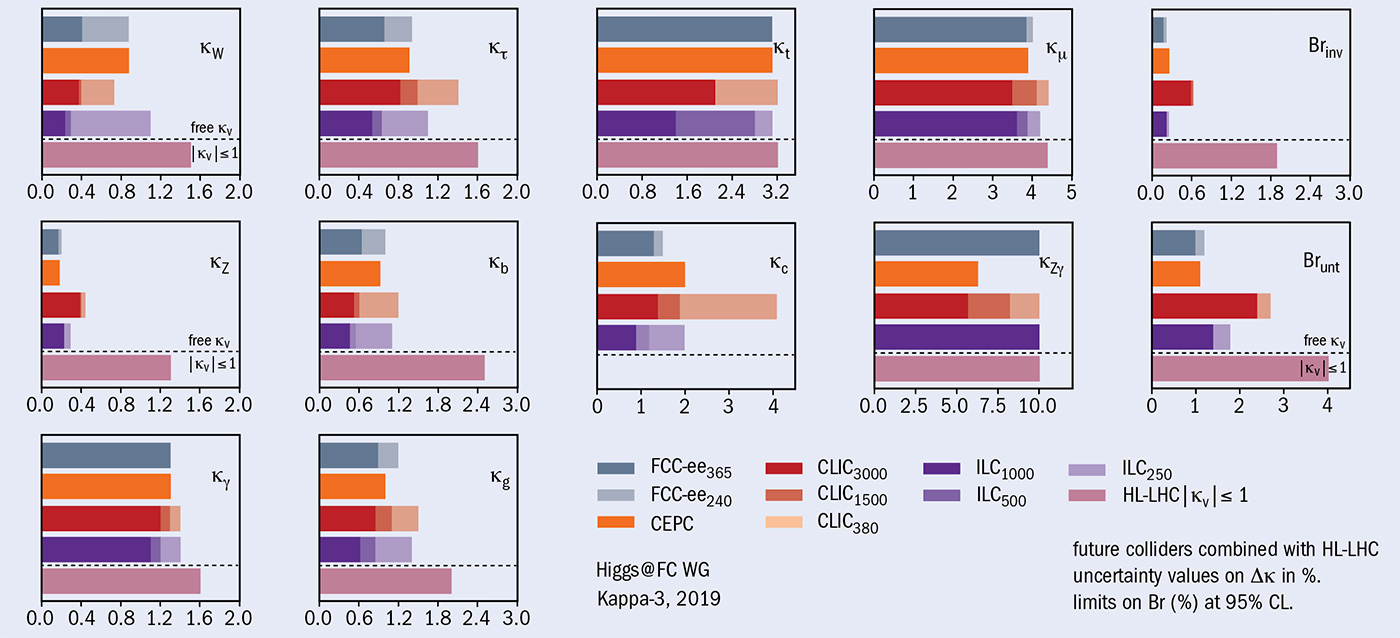
To quantify the scientific reach of the proposed colliders compared to current knowledge or the expectations for the HL-LHC, it is necessary to define figures-of-merit for the observables that will be measured. For the Higgs boson the focus is on the coupling strengths to the Standard Model bosons and fermions, as well as the couplings to any new particles. The strength with which the Higgs boson couples to the various particles, i, is denoted by κi, defined such that κi = 1 corresponds to the Standard Model. Non-standard phenomena are included in this “kappa” framework by introducing two new quantities: the branching ratio into invisible particles (determined by measuring the missing energy in identified Higgs events), and the branching ratio to untagged particles (determined by measuring the contributions to the total width accounted for by the observed modes, or by directly searching for anomalous decays).
Higgs-boson observables
At hadron colliders, only ratios of κi parameters can be measured, since a precise measurement of the total width of the Higgs boson is lacking (the expected total width of the Higgs boson in the Standard Model is 4.2 MeV, which is far too small to be resolved experimentally). To determine the absolute κi values at a hadron collider a further assumption needs to be made, either on decay rates of the Higgs boson to new particles or on one of the κi values. An assumption that is often made, and valid in many beyond-the-Standard-Model theories, is that κZ≤ 1.
The kappa framework, however, by construction, does not parameterise possible effects coming from different Lorentz structures and/or the energy dependence of the Higgs couplings. Such effects could generically arise from the existence of new physics at higher scales and could lead not only to changes in the predicted rates, but also in distributions. Deviations of κi from 1 indicate a departure from the Standard Model, but do not provide a tool to diagnose its cause. This shortcoming is remedied in so-called effective-operator formalisms by including operators of mass dimension greater than four.
At e+e– colliders a Higgs boson produced via e+e–→ ZH can be identified without observing its decay products. This measurement, of primary importance, is unique to e+e– colliders. By measuring the Z decay products and with the precise knowledge of the momenta of the incoming e– and e+ beams, the presence of the Higgs boson in ZH events can be inferred based on energy and momentum conservation alone, without actually tagging the Higgs boson. In this way one directly measures the coupling between the Higgs and Z bosons. In combination with the Higgs branching ratio to Z pairs it can be interpreted as a measurement of the Higgs-boson width. The first-stage e+e– Higgs factories all constrain the total width at about the 2% level.
LHC and HL-LHC
To assess the potential impact of the e+e– Higgs factories it is important to examine the point of departure provided by the LHC and HL-LHC. Since its startup in 2010 the LHC has made a monumental impact on our understanding of the Higgs sector. After the Higgs discovery in 2012, a measurement programme started and now, with nearly 150 fb–1 of data analysed by ATLAS and CMS, much has been learned. The Higgs-boson mass has been measured with a precision of < 0.2%, its spin and parity confirmed as expected in the Standard Model, and its coupling to bosons and to third-generation charged fermions established with a precision of 5–10%.
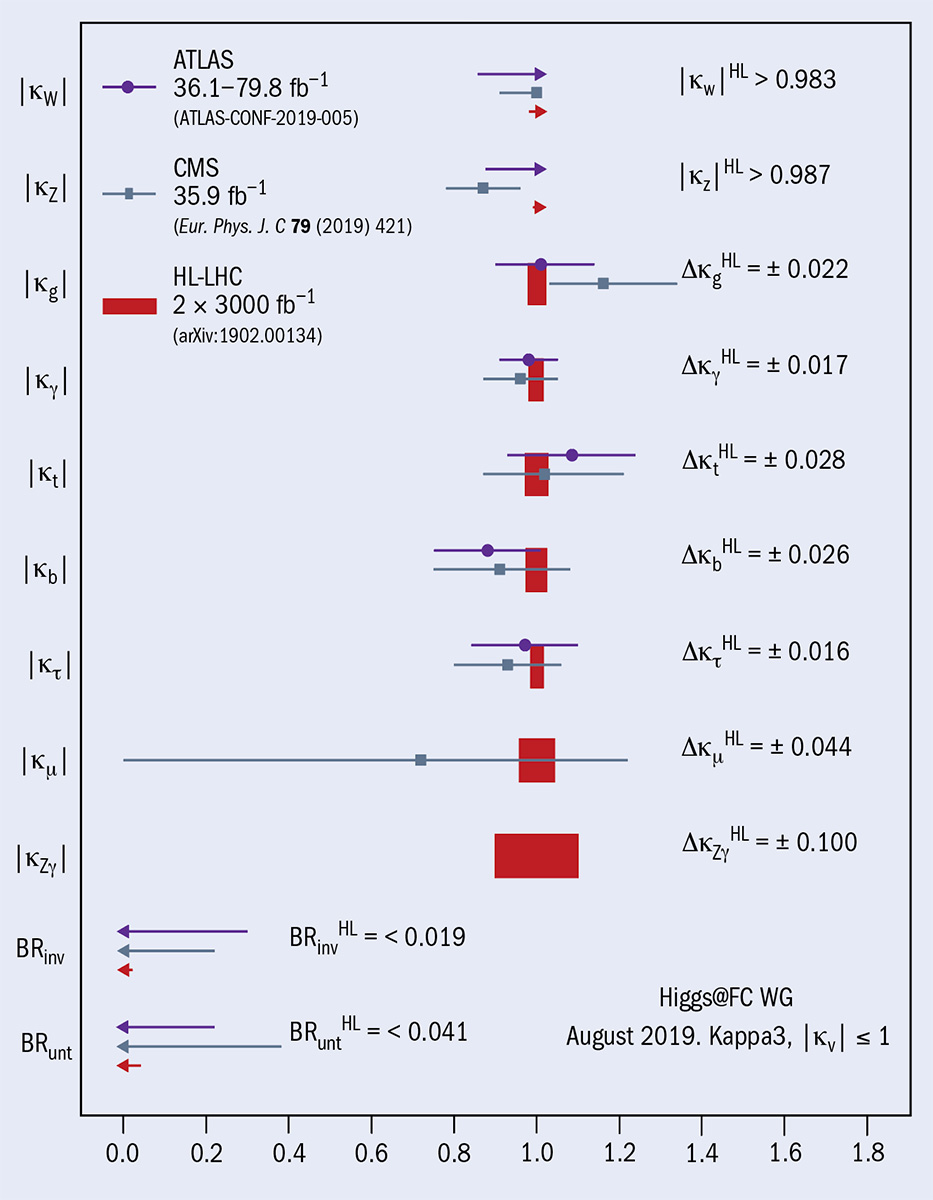
With the HL-LHC and its experiments planned to operate from 2027, the precision on the coupling parameters and the branching ratios to new particles will be increased by a factor of 5–10 in all cases, typically resulting in a sensitivity of a few % (see “Kappa couplings” figure). The HL-LHC will also enable measurements of the very rare μ+μ– decay, the first evidence for which was recently reported by CMS and ATLAS, and thus show whether the Higgs boson also generates the mass of a second-generation fermion. With the full HL-LHC dataset, corresponding to 3000 fb–1 for each of ATLAS and CMS, it is expected that di-Higgs production will be established with a significance of four standard deviations. This will allow a determination of the Higgs-boson’s coupling to itself with a precision of 50%.
About a quarter of a million Higgs bosons could be produced per inverse attobarn of data
The LHC has also made enormous progress in the direct searches for new particles at high energies. With more than 1000 papers published on this topic, hunting down particles predicted by dozens of theoretical ideas, and no firm sign of a new particle anywhere, it is clear that the new physics is either heavier, or more weakly coupled or has other features that hides it in the LHC data. The LHC is also a precision machine for electroweak physics, having measured the W-boson mass and the top-quark mass with uncertainties of 0.02% and 0.3%, respectively. In addition, a large number of relevant cross-section measurements of multi-boson production have been made, probing the trilinear and quartic interactions of the gauge bosons with each other.
Higgs-factory impact
In terms of the measurement precision on the Higgs-boson couplings, the proposed Higgs factories are expected to bring a major improvement with respect to HL-LHC in most cases (see “Relative precision” figure). Only for the rare decays to muons, photons and Zγ, and for the very massive top quark, is this not the case. The highest precision (0.2% in the case of FCC-ee) is achieved on κZ since the main Higgs production mode, ZH, depends directly on it, regardless of the decay mode. For other Standard Model particles, improvement factors of two to four are typical. For the invisible and untagged decays, the constraints are improved to around 0.2% and 1%, respectively, for some of the Higgs factories. A new measurement, not possible at the LHC, is that of the charm–quark coupling, κc.
None of the initial stages of the proposed Higgs factories will be able to directly probe the self-coupling of the Higgs boson beyond the 50% expected from the HL-LHC, since the cross-sections for the relevant processes (e+e–→ ZHH and e+e–→ HHνν) are negligible at centre-of-mass energies below 400 GeV. The Higgs self-coupling, however, enters through loops also in single-Higgs production and indirect effects might therefore be observable, for instance as a small (< 1%) deviation in measurements of the inclusive ZH cross section. Measurements of the Higgs self-coupling exploiting the di-Higgs production process can only be performed at higher energy colliders. The ILC and CLIC project uncertainties of around 30% at their intermediate energies and around 10% at their ultimate energies, while FCC-hh projects a precision of around 5%. Similarly, for the Higgs coupling to the top quark, the HL-LHC precision of 3.2% will not be improved by the initial stages of any of the Higgs factories.
The proposed Higgs factories also have a rich physics programme at lower energies, particularly at the Z pole. FCC-ee, for instance, plans to run for four years at the Z pole to accumulate a total of more than 1012 Z bosons – 100,000 times more than at LEP. This will enable a rich and unprecedented electroweak physics programme, constraining so-called oblique parameters (which are sensitive to violations of weak isospin) at the per-mille level, 100 times better than today. It will also enable a B-physics programme, complementary to that at Belle II and LHCb. At CEPC, a similar programme is possible, while at ILC and CLIC the luminosity when running at the Z pole is much lower: the typical number of Z-bosons that can be accumulated here is 109, 100 times more than LEP but not at the same level as the circular colliders. FCC-ee’s electroweak programme also foresees a run at the WW threshold to enable a high-precision measurement of the W mass.
Concerning the large top-quark mass, measurements at the LHC suffer from uncertainties associated with renormalisation schemes and it is unlikely to improve the precision significantly at the HL-LHC beyond the currently achieved value of 400 MeV. At an e+e– collider operating at the tt threshold (~350 GeV), a measurement of the top mass with total uncertainty of around 50 MeV and with full control of the issues associated with the renormalisation scheme is possible. In addition to its importance as a fundamental parameter of the Standard Model, the top mass is the dominant term in the evolution of the Higgs potential with energy to determine vacuum stability (see “Connecting the Higgs to Standard Model enigmas” panel).
To assess the potential impact of the e+e– Higgs factories it is important to examine the point of departure provided by the LHC and HL-LHC
In short, a Higgs factory promises to expand our knowledge of nature at the smallest scales. The ZH cross-section measurement alone will probe fine tuning at a level of a few permille, about 30 times better than what we know today. This provides indirect sensitivity to new particles with masses up to 10–30 TeV, depending on their coupling strength, and could point to a new energy scale in nature.
But most of all the Higgs boson has not exhausted its ability to surprise. The rest of the Standard Model is a compact structure, exquisitely tested, and ruled by local gauge invariance and other symmetries. Compared to this, the Lagrangian of the Higgs sector is the wild west, where the final laws have yet to be written. Does the Higgs boson have a significant rate of invisible decays, which could be a key component in understanding the nature of dark matter in our universe? Does the Higgs boson act as a portal to other scalar degrees of freedom? Does the Higgs boson provide a source of CP violation? An electron–positron Higgs factory provides a tool to address these questions with unique clarity, when deviations between the measured and predicted values of observables are detected. Building on the data from the HL-LHC, it will be the perfect tool to elucidate the underlying laws of physics.
To explore all our coverage marking the 10th anniversary of the discovery of the Higgs boson ...
The ability to accelerate charged particles using the “wakefields” of plasma density waves offers the promise of high-energy particle accelerators that are more compact than those based on radio-frequency cavities. Proposed in 1979, the idea is to create a wave inside a plasma upon which electrons can “surf” and gain energy over short distances. Although highly complex, wakefield acceleration (WFA) driven by laser pulses or electron beams has been successfully used to accelerate electron beams to tens of GeV within distances of less than a metre, and the AWAKE experiment at CERN is attempting to achieve higher energy gains by using protons as drive beams. Recent studies suggest that WFA may also occur naturally, potentially offering an explanation for some of the highest energy cosmic rays ever observed.
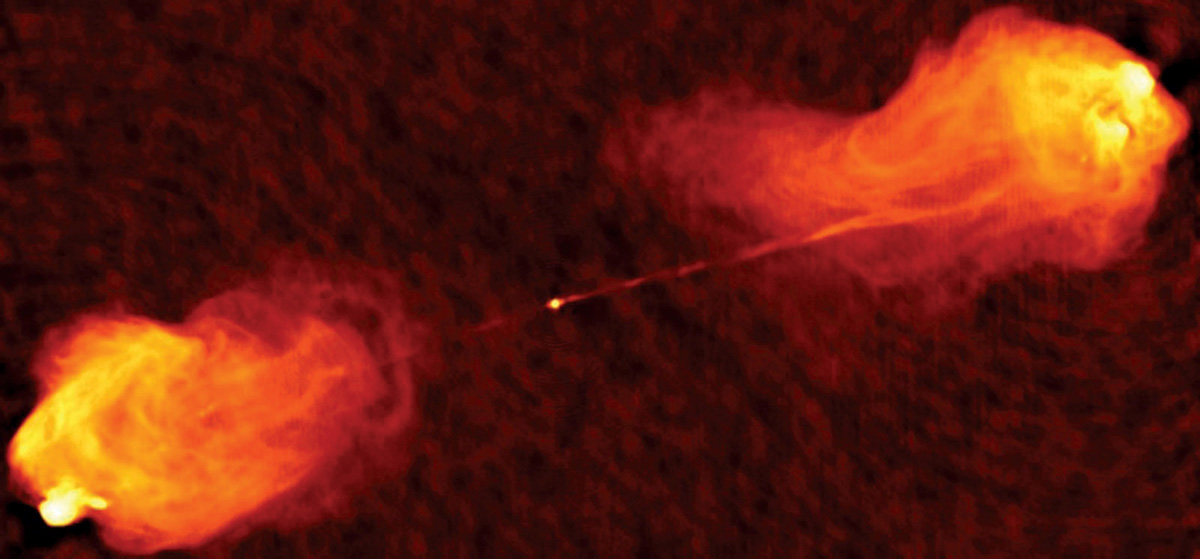
So-called Fermi acceleration, first conceived by the eponymous Italian in 1949, is considered to be the main mechanism responsible for high-energy cosmic rays. In this process, charged particles are accelerated due to relativistic shockwaves occurring within jets emitted by black-hole binaries, active galactic nuclei or gamma-ray bursts, to name just a few sources. As a charged particle travels within the jet it gets accelerated each time it passes through the shock wave, allowing it to gain energy until the magnetic field in the environment can no longer contain it. This process predicts the observed power-law spectrum of cosmic rays quite well, at least up to energies of around 1019 eV. Beyond this energy, however, Fermi acceleration becomes less efficient as the particles start to lose energy due to collisions and/or synchrotron radiation. The existence of ultra-high-energy cosmic rays (UHECRs), which have been observed up to energies of 1021 eV, indicates that a different acceleration mechanism could be at play in that energy domain. Thanks to its very high efficiency, WFA could provide such a mechanism.
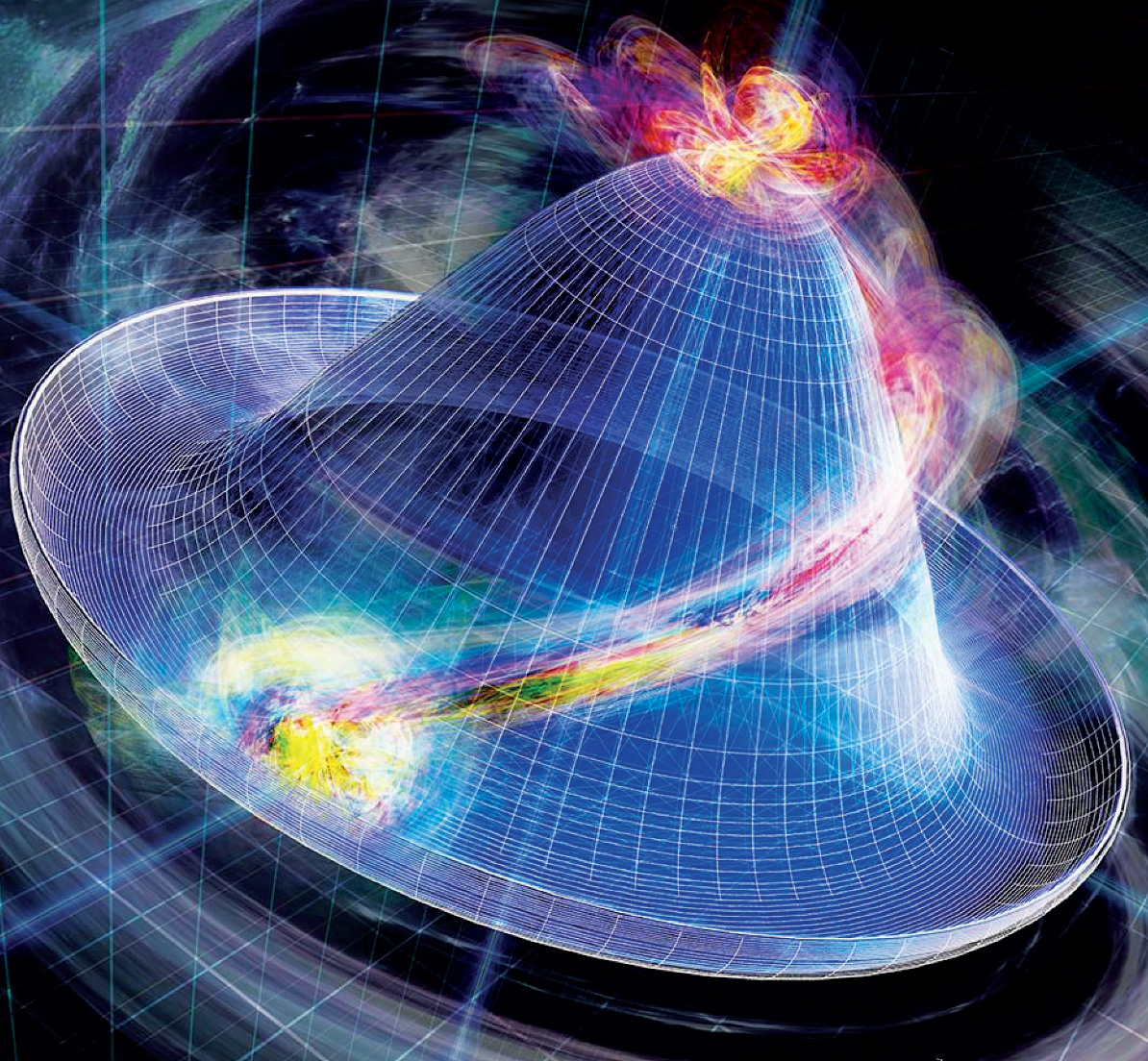
Although there are clearly no laser beams in astrophysical objects, plasma fields that can support waves can be found in many astrophysical settings. For example, in theories developed by Toshiki Tajima of the University of California at Irvine (UCI), one of the inventors of WFA technology, waves could be produced by instabilities in the accretion disks around compact objects such as black holes. These accretion disks can periodically transition from a highly magnetised to a little magnetised state, emitting electromagnetic waves that can propagate into the disk’s jets in the form of Alfven waves. As these waves continue to propagate along the jets they transform back into electromagnetic waves that can accelerate electrons on the front of the plasma’s “bow wake” and protons on the back of it.
Clear predictions
The energies that are theoretically achievable in cosmic-ray WFA depend on the mass of the compact object, as do the periodicities with which such waves can be produced. This allows clear predictions to be made for a range of different objects, which can be tested against observational data.
Groups based at UCI and at RIKEN in Japan recently tested these predictions on a range of astrophysical objects, spanning from 1 to 109 solar masses. Although not conclusive, these first comparisons between theory and observations indicate several interesting features that require further investigation. For example, WFA models predict periodic emission of both UHECRs – the protons on the back of the bow wake – in coincidence with electromagnetic radiation produced by the electrons from the front of the bow wake. Due to interactions with the intergalactic medium, UHECRs are also expected to produce secondary particles, including neutrinos. WFA could thereby also explain periodic outbursts of neutrinos in coincidence with gamma-rays from, for example, blazars, for which evidence was recently found by the IceCube experiment in collaboration with a range of electromagnetic instruments. Additionally, WFA could explain the non-uniformity of the UHECR sky such as that recently reported by the Pierre Auger Observatory (see CERN Courier December 2017 p15), as it allows for cosmic rays with energies up to 1024 eV to be produced within objects that lie within the location of the observed hot-spot.
In concert with future space-based UHECR detectors such as JEM-EUSO and POEMMA, further analysis of existing data should definitively answer the question of whether WFA does indeed occur in space. The clear predictions relating to periodicity, and the coincident emission of neutrinos, gamma-rays and other electromagnetic radiation, make it an ideal subject to study within the multi-messenger frameworks that are currently being set up.
To provide the best experiences, we use technologies like cookies to store and/or access device information. Consenting to these technologies will allow us to process data such as browsing behavior or unique IDs on this site. Not consenting or withdrawing consent, may adversely affect certain features and functions.
Functional
Always active
The technical storage or access is strictly necessary for the legitimate purpose of enabling the use of a specific service explicitly requested by the subscriber or user, or for the sole purpose of carrying out the transmission of a communication over an electronic communications network.
Preferences
The technical storage or access is necessary for the legitimate purpose of storing preferences that are not requested by the subscriber or user.
Statistics
The technical storage or access that is used exclusively for statistical purposes.The technical storage or access that is used exclusively for anonymous statistical purposes. Without a subpoena, voluntary compliance on the part of your Internet Service Provider, or additional records from a third party, information stored or retrieved for this purpose alone cannot usually be used to identify you.
Marketing
The technical storage or access is required to create user profiles to send advertising, or to track the user on a website or across several websites for similar marketing purposes.