Comsol -leaderboard other pages

Topics

New tetraquark a whisker away from stability

Jumbled together

All the exotic hadrons that have been observed so far decay rapidly via the strong interaction. The ccūd̄ tetraquark (Tcc+ ) just discovered by the LHCb collaboration is no exception. However, it is the longest-lived state yet, and reinforces expectations that its beautiful cousin, bbūd , will be stable with respect to the strong interaction when its peak emerges in future data.

“We have discovered a ccūd tetraquark with a mass just below the D*+D0 threshold which, according to most models, indicates that it is a bound state,” says LHCb analyst Ivan Polyakov (Syracuse University). “It still decays to D mesons via the strong interaction, but much less intensively than other exotic hadrons.”

Most of the exotic hadronic states discovered in the past 20 years or so are cc̄qq̄ tetraquarks or cc̄qqq pentaquarks, where q represents an up, down or strange quark. A year ago LHCb also discovered a hidden-double-charm cc̄cc̄ tetraquark, X(6900), and two open-charm csūd tetraquarks, X0(2900) and X1(2900). The new ccūd state, presented today at the European Physical Society conference on high-energy physics to have been observed with a significance substantially in excess of five standard deviations, is the first exotic hadronic state with so-called double open heavy flavour — in this case, two charm quarks unaccompanied by antiparticles of the same flavour.

Astoundingly, its observation by LHCb reveals that it is a mere 270 keV below the threshold

Prime Candidate

Tetraquark states with two heavy quarks and two light antiquarks have been the prime candidates for stable exotic hadronic states since the 1980s. LHCb’s discovery, four years ago, of the Ξcc++ (ccu) baryon allowed QCD phenomenologists to firmly predict the existence of a stable bbūd tetraquark, however the stability of a potential ccūd state remained unclear. Predictions of the mass of the ccūd state varied substantially, from 250 MeV below to 200 MeV above the D*+D0 mass threshold, say the team. Astoundingly, its observation by LHCb reveals that it is a mere 273 ± 61 keV below the threshold — a bound state, then, but with the threshold for strong decays to D*+D0 lying within the observed resonance’s narrow width of 410 ± 165 keV, prescribed by the uncertainty principle. The Tcc+ tetraquark can therefore decay via the strong interaction, but strikingly slowly. By contrast, most exotic hadronic states have widths from tens to several hundreds of MeV.

“Such closeness to the threshold is not very common in heavy-hadron spectroscopy,” says analyst Vanya Belyaev (Kurchatov Institute/ITEP). “Until now, the only similar closeness was observed for the enigmatic χc1(3872) state, whose mass coincides with the D*0D0 threshold with a precision of about 120 keV.” As it is wider, however, it is not yet known whether the χc1(3872) is below or above threshold.

I am fascinated by the idea that a strong coupling to a decay channel might attract the bare mass of the hadron

Mikhail Mikhasenko

“The surprising proximity of Tcc+ and χc1(3872) to the D*D thresholds must have deep reasoning,” adds analyst Mikhail Mikhasenko (ORIGINS, Munich). “I am fascinated by the idea that, roughly speaking, a strong coupling to a decay channel might attract the bare mass of the hadron. Tremendous progress in lattice QCD over the past 10 years gives us hope that we will discover the answer soon.”

The cause of this attraction, says Mikhasenko, could be linked to a “quantum admixture” of two models that vie to explain the structure of the new tetraquark: it could be a D*+ and a D0 meson, bound by the exchange of colourneutral objects such as light mesons, or a colour-charged cc “diquark” tightly bound via gluon exchange to up and down antiquarks (see “Jumbled together” figure). Diquarks are a frequently employed mathematical construct in low-energy quantum chromodynamics (QCD): if two heavy quarks are sufficiently close together, QCD becomes perturbative, and they may be shown to attract each other and exhibit effective anticolour charge. For example, a red-green cc diquark would have a wavefunction similar to an anti-blue anti-quark, and could pair up with a blue quark to form a baryon — or, hypothetically, a blue anti-diquark, to form a colour-neutral tetraquark.

“The question is if the D and D* are more or less separated, jumbled together to such a degree that all quarks are intertwined in a compact object, or something in between,” says Polyakov. “The first scenario resembles a relatively large ~4 fm deuteron, whereas the second can be compared to a relatively compact ~2 fm alpha particle.”

The new Tcc+ tetraquark is an enticing target for further study. Its narrow decay into a D0D0π+ final state — the virtual D*+ decays promptly into D0π+ — includes no particles that are difficult to detect, leading to a better precision on its mass than for existing measurements of charmed baryons. This, in turn, can provide a stringent test for existing theoretical models and could potentially probe previously unreachable QCD effects, says the team. And, if detected, its beautiful cousin would be an even bigger boon. “Observing a tightly bound exotic hadron that would be stable with respect to the strong interaction would be a cornerstone in understanding QCD at the scale of hadrons,” says Polyakov. “The bbūd , which is believed to satisfy this requirement, is produced rarely and is out of reach of the current luminosity of the LHC. However, it may become accessible in LHC Run 3 or at the High-Luminosity LHC.” In the meantime, there is no shortage of work in hadron spectroscopy, jokes Belyaev. “We definitely have more peaks than researchers!”
Charm breaks fragmentation universality

The study of heavy-flavour hadron production in proton–proton (pp) collisions provides an important test for quantum chromodynamics (QCD) calculations. Heavy-flavour hadron production is usually computed with perturbative–QCD (pQCD) calculations as the convolution of the parton distribution functions (PDFs) of the incoming protons, the partonic cross section and the fragmentation functions that describe the transition from charm quarks into charm hadrons. The latter are typically parametrised from measurements performed in e+e or ep collisions, under the assumption that the hadronisation of charm quarks into charm hadrons is a universal process that is independent of the colliding systems.

The assumption that charm-to-hadron fragmentation is universal is not valid

The large data samples collected during Run 2 of the LHC at √s = 5.02 TeV allowed the ALICE collaboration measure the vast majority of charm quarks produced in the pp collisions by reconstructing the decays of the ground-state charm hadrons, measuring all the charm-meson species and the most abundant charm baryons (Λc+, and Ξc0,+) down to very low transverse momenta. The result was presented today at the European Physical Society conference on high-energy physics (EPS-HEP 2021).

Charm–quark fragmentation fractions into charm hadrons

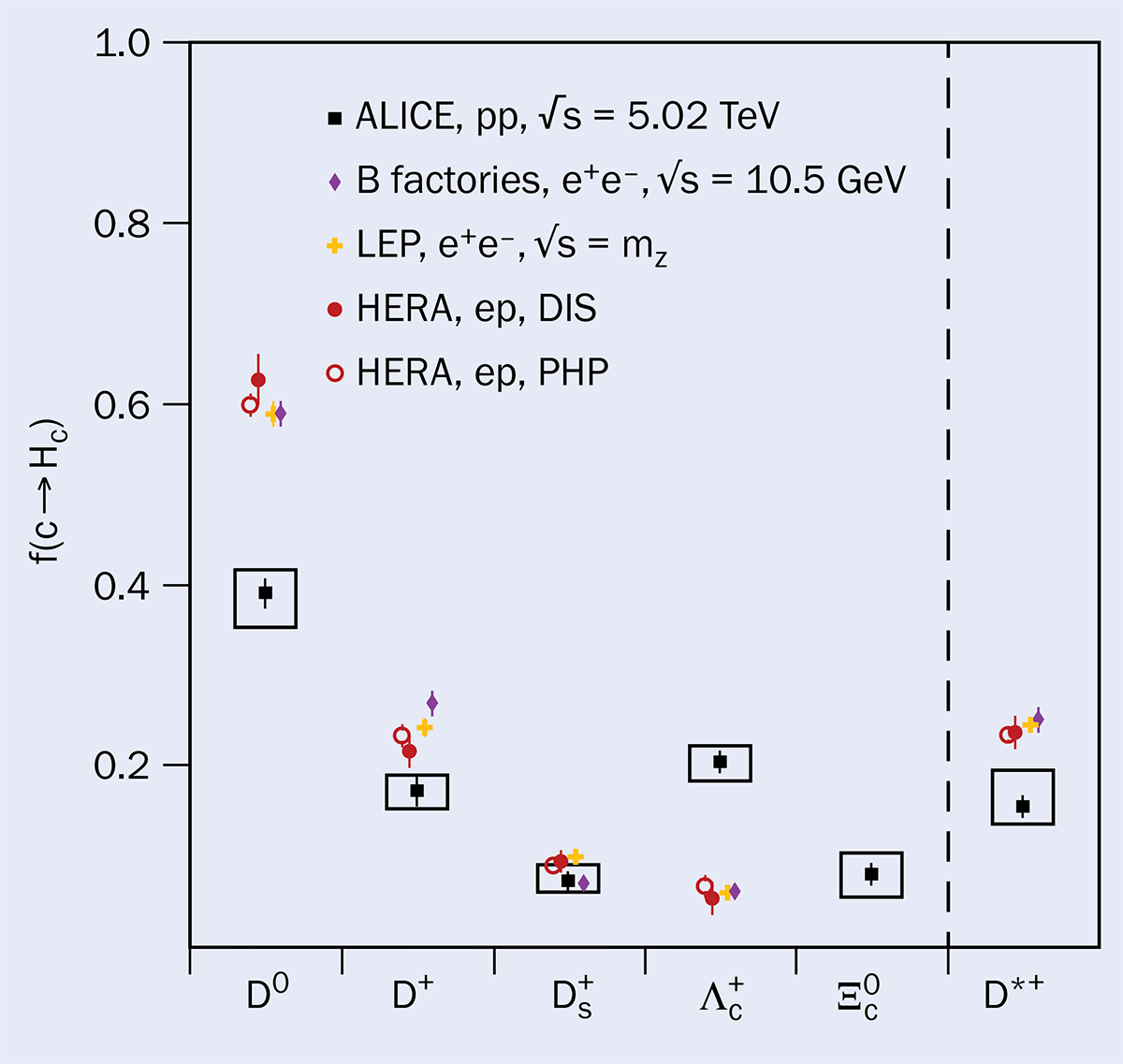
Charm fragmentation fractions, f(c → Hc), represent the probability for a charm quark to hadronise into a given charm hadron. These have now been measured for the first time at the LHC in pp collisions at midrapidity, and, in the case of the Ξc0 , for the first time in any collision system (figure 1). The measured f(c → Hc) are observed to be different from those measured in e+e and ep collisions – evidence that the assumption that charm-to-hadron fragmentation is universal is not valid.

Charm quarks were found to hadronise into baryons almost 40% of the time – four times more often than at colliders with electron beams. Several models have been proposed to explain this “baryon enhancement”. The explanations feature various different assumptions, such as including hadronisation via coalescence, considering a set of as-yet-unobserved higher-mass charm-baryon states, and including string formation beyond the leading-colour approximation.

The cc̄ production cross section per unit of rapidity at midrapidity (dσcc̄/dy||y|<0.5) was calculated by summing the cross sections of all measured ground-state charm hadrons (D0, D+, Ds+ , Λc+ , and Ξc0). The contribution of the Ξc0 was multiplied by a factor of two, in order to account for the contribution of the Ξc+. The resulting cc̄ cross section per unit of rapidity at midrapidity is dσcc̄/dy||y|<0.5 = 1165 ± 44(stat) +134 –101 (syst) μb. This measurement was obtained for the first time in hadronic collisions at the LHC including the charm-baryon states. The cc̄  cross section measured at the LHC lies at the upper edge of the theoretical pQCD calculations.

The measurements described above not only provide constraints to pQCD calculations, but also act as important references for investigating the interaction of charm quarks with the medium created in heavy-ion collisions. These measurements could be extended to include rarer baryons and studied as a function of the event multiplicity in pp and heavy-ion systems in future LHC runs.

Cosmic-ray anisotropy probed across 10 decades in energy

Spanning 13 decades in energy and more than 26 decades in intensity, cosmic rays are one of the hottest topics in astroparticle physics today. Spectral features such as a “knee” at a few PeV and an “ankle” at a few EeV give insights into their varying origins, but studies of their arrival direction can also provide valuable information. Though magnetic fields mean we cannot normally trace cosmic rays directly back to their point of origin, angular anisotropies provide important independent evidence towards probable sources at different energies. This week, at the 37th International Cosmic Ray Conference (ICRC), a range of space- and ground-based experiments greatly increased our knowledge of cosmic-ray anisotropies, with new results spanning 10 decades in energy, from GeV to tens of EeV.

Vela Supernova Remnant

At sub-TeV energies, spectral features seen by the AMS-02 and CALET detectors on the International Space Station and the Chinese–European DAMPE satellite could potentially be explained by a local galactic source such as a supernova remnant like Vela (see “Spectral” figure). If a nearby source is indeed responsible for a significant fraction of the cosmic rays observed at such energies, it could show up in the arrival direction of these cosmic rays in the form of a dipole feature, despite bending by galactic magnetic fields; however, results from AMS-02 at ICRC showed no evidence of a dipole in the arrival direction of protons or any other light nucleus. This was confirmed by DAMPE, which excluded dipole features with amplitudes above about 0.1% in the 100s of GeV energy range. The search continues, however, with DAMPE, AMS-02 and CALET all set to take further data over the coming years.

Close to the knee, the dipole has a maximum rather than a minimum close to the galactic centre

Moving to higher energies, clear anisotropic dipole excesses have been observed over the last decade by ground-based experiments such as the ARGO-YBJ observatory in China, the HAWC observatory in Mexico and the IceCube observatory at the South Pole – though with different “phases” at different energies. The anisotropy in the TeV to the 100s of TeV energy range could point towards a nearby source, though models proposing the structure of the interstellar magnetic field as the true origin for the anisotropy also exist. This feature was further confirmed this year by the LHAASO experiment in China, using a year of data that was taken while constructing the detector. The results from LHAASO also confirm a switch in the phase of the anisotropy when moving from 100s of TeV to PeV energies, as reported by IceCube and other experiments in recent years: at PeV energies, close to the knee, the dipole has a maximum rather than a minimum close to the galactic centre. This could indicate an excess of “pevatron” sources near the galactic centre.

Antennae Galaxies

Extragalactic sources

While results up to PeV energies give an insight into sources within our galaxy, it is theorised that the flux starts to be dominated by extragalactic sources somewhere between the knee and the ankle of the cosmic-ray spectrum. Evidence for this was increased by new results from the Pierre Auger Observatory in Argentina and the Telescope Array in the US. These two observatories, which observe different hemispheres, find strong evidence for excesses in the cosmic-ray flux in certain regions of the sky at energies exceeding EeV. At energies as high as these, cosmic rays point more clearly to their origin, and galactic cosmic rays should have very clear point-like sources that are not observed, providing evidence that they originate outside of our galaxy. A prime candidate for such sources are so-called starburst galaxies, wherein star formation happens unusually rapidly, during a short period of the galaxy’s evolution (see “Antennae galaxies” figure). As presented at ICRC 2021, the available data was fitted to models where starburst galaxies are the primary source of EeV cosmic rays. The model fits the anisotropy data with more than 4σ significance relative to the null hypothesis with normal galaxies, indicating starburst galaxies to likely be at least one source of EeV cosmic rays.

While some of the features will likely be fully confirmed within the coming years simply by accumulating statistics, new features are also likely to arise. One example is further constraints on the lack of any observed anisotropy at sub-TeV energies using data from space-based missions, while new data from ground-based experiments will start to bridge the measurement gap between PeV and EeV energies. The latter will be especially important in gaining an understanding of the energy scale at which extragalactic sources start to dominate. To fully exploit the data it will be necessary to compare complex cosmic-ray-propagation simulations with diverse data such as the pevatron sources discovered this year by LHAASO.

Long-lived particles gather interest

From 25 to 28 May, the long-lived particle (LLP) community marked five years of stretching the limits of searches for new physics with its ninth and best-attended workshop yet, with more than 300 registered participants.

LLP9 played host to six new results, three each from ATLAS and CMS. These included a remarkable new ATLAS paper searching for stopped particles – beyond-the-Standard Model (BSM) LLPs that can be produced in a proton–proton collision and then get stuck in the detector before decaying minutes, days or weeks later. Good hypothetical examples are the so-called gluino R-hadrons that occur in supersymmetric models. Also featured was a new CMS search for displaced di-muon resonances using “data scouting” – a unique method of increasing the number of potential signal events kept at the trigger level by reducing the event information that is retained. Both experiments presented new results searching for the Higgs boson decaying to LLPs (see “LLP candidate” figure).

Long-lived particles can also be produced in a collision inside ATLAS, CMS or LHCb and live long enough to drift entirely outside of the detector volume. To ensure that this discovery avenue is also covered for the future of the LHC’s operation, there is a rich set of dedicated LLP detectors either approved or proposed, and LLP9 featured updates from MoEDAL, FASER, MATHUSLA, CODEX-b, MilliQan, FACET and SND@LHC, as well as a presentation about the proposed forward physics facility for the High-Luminosity LHC (HL-LHC).

Reinterpreting machine learning

The liveliest parts of any LLP community workshop are the brainstorming and hands-on working-group sessions. LLP9 included multiple vibrant discussions and working sessions, including on heavy neutral leptons and the ability of physicists who are not members of experimental collaborations to be able to re-interpret LLP searches – a key issue for the LLP community. At LLP9, participants examined the challenges inherent in re-interpreting LLP results that use machine learning techniques, by now a common feature of particle-physics analyses. For example, boosted decision trees (BDTs) and neural networks (NNs) can be quite powerful for either object identification or event-level discrimination in LLP searches, but it’s not entirely clear how best to give theorists access to the full original BDT or NN used internally by the experiments.

LLP searches at the LHC often must also grapple with background sources that are negligible for the majority of searches for prompt objects. These backgrounds – such as cosmic muons, beam-induced backgrounds, beam-halo effects and cavern backgrounds – are reasonably well-understood for Run 2 and Run 3, but little study has been performed for the upcoming HL-LHC, and LLP9 featured a brainstorming session about what such non-standard backgrounds might look like in the future.

Also looking to the future, two very forward-thinking working-group sessions were held on LLPs at a potential future muon collider and at the proposed Future Circular Collider (FCC). Hadron collisions at ~100 TeV in FCC-hh would open up completely unprecedented discovery potential, including for LLPs, but it’s unclear how to optimise detector designs for both LLPs and the full slate of prompt searches.

Simulating dark showers is a longstanding challenge

Finally, LLP9 hosted an in-depth working-group session dedicated to the simulation of “dark showers”, in collaboration with the organisers of the dark-showers study group connected to the Snowmass process, which is currently shaping the future of US particle physics. Dark showers are a generic and poorly understood feature of a potential BSM dark sector with similarities to QCD, which could have its own “dark hadronisation” rules. Simulating dark showers is a longstanding challenge. More than 50 participants joined for a hands-on demonstration of simulation tools and a discussion of the dark-showers Pythia module, highlighting the growing interest in this subject in the LLP community.

LLP9 was raucous and stimulating, and identified multiple new avenues of research. LLPX, the tenth workshop in the series, will be held in November this year.

Experiment and theory trade blows at SQM 2021

The 19th international conference on strangeness in quark matter (SQM) was hosted virtually by Brookhaven National Laboratory from 17 to 22 May, attracting more than 300 participants. The series deals with the role of strange and heavy-flavour quarks in high-energy heavy-ion collisions and astrophysical phenomena.

sQM21

New results on the production of strangeness in heavy-ion collisions were presented for a variety of collision energies and systems. In an experimental highlight, the ALICE collaboration reported that the number of strange baryons depends more on the final-state multiplicity than the initial-state energy. On the theory side, it was shown that several models can explain the suppression of strange particles at low multiplicities. ALICE also presented new measurements of the charm cross section and fragmentation functions in proton–proton (pp) collisions. When compared to e+e collisions, these results suggest that the universality of parton-to-hadron fragmentation may be broken. 

Moving on to heavy flavours, the ATLAS collaboration presented results for the suppression of heavy-flavour production compared to pp collisions and the angular anisotropy of heavy mesons in heavy-ion collisions. These measurements are crucial for constraining models of in-medium energy loss. Interestingly, while charm seems to follow the flow of the quark–gluon plasma, beauty does not seem to flow. Better statistics are needed to constrain theoretical models. On the theory side, extremely interesting new calculations using open quantum systems coupled with potential non-relativistic QCD calculations were used to compute both the suppression and anisotropic flow of bottomonium states.

Hints of extrema

Another important goal of the field is to determine experimentally whether a critical point exists in the phase diagram of strongly interacting matter, and, if so, where it is located. The STAR experiment at the Relativistic Heavy Ion Collider (RHIC) presented results on higher order cumulants of net-proton fluctuations over a range of collision energies. Extrema as a function of beam energy are expected to indicate critical behaviour. New data from the Beam Energy Scan II programme at RHIC is expected to provide much-needed statistics to confirm hints of extrema in the data. On the theory side, new lattice QCD calculations of second-order net-baryon cumulants were presented, as well as new expansion schemes to extend the lattice-QCD equation of state to larger net baryon chemical potentials that are not computable directly, because of the fermion-sign problem. Another study included the lattice-QCD equation of state and susceptibilities in a hydrodynamic calculation to allow for a more direct comparison to experimental measurements of net-proton fluctuations. Significant differences between net-proton and net-baryon fluctuations were quantified. 

The study of the quark–gluon plasma’s vorticity via the measurement of the polarisation of hyperons was also a major topic. Theoretical calculations obtain the opposite sign to the data for the angular differential measurement. Attempts to solve this discrepancy presented at SQM 2021 featured shear-dependent terms and a stronger “memory” of the strange-quark spin.

Various new applications of machine learning and artificial intelligence were also discussed, for example, for determining the order of the phase transition and constraining the neutron-star equation of state. 

Overall, there were 41 plenary and 96 parallel talks at SQM 2021, poignantly including presentations in memory of Jean Cleymans, Jean Letessier, Dick Majka and Jack Sandweiss, who all made exceptional impacts on the field.

The next SQM conference will be held from 13 to 18 June 2022 in Busan, South Korea.

LHCP sees a host of new results

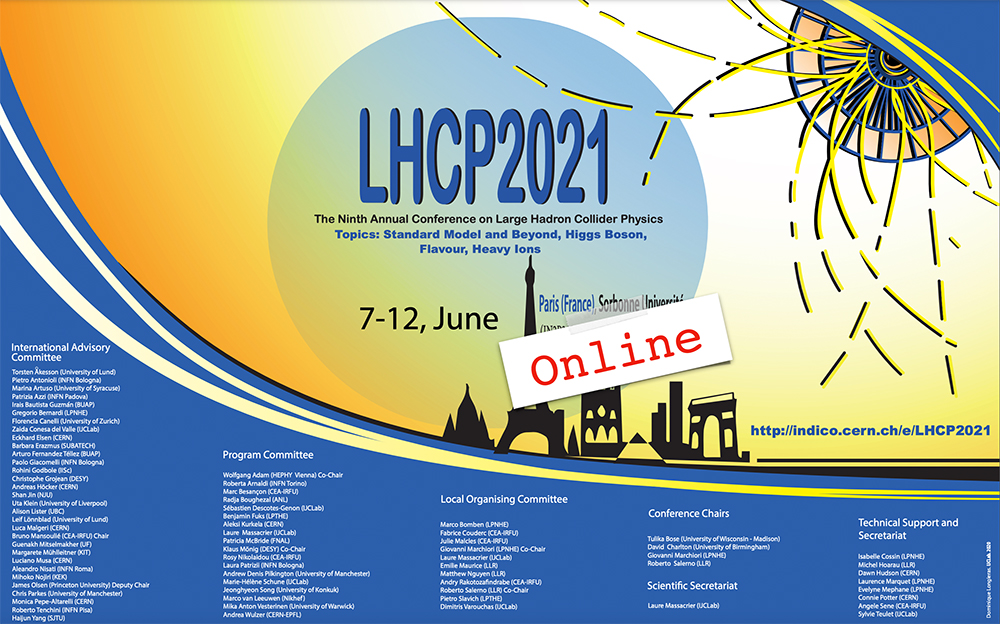
More than 1000 physicists took part in the ninth Large Hadron Collider Physics (LHCP) conference from 7 to 12 June. The in-person conference was to have been held in Paris: for the second year in a row, however, the organisers efficiently moved the meeting online, without a registration fee, thanks to the support of CERN and IUPAP. While the conference experience cannot be the same over a video link, the increased accessibility for people from all parts of the international community was evident, with LHCP21 participants hailing from institutes across 54 countries.

LHCP21 poster

The LHCP format traditionally has plenary sessions in the mornings and late afternoons, with parallel sessions in the middle of the day. This “shape” was kept for the online meeting, with a shorter day to improve the practicality of joining from distant time zones. This resulted in a dense format with seven-fold parallel sessions, allowing all parts of the LHC programme, both experimental and theoretical, to be explored in detail. The overall vitality of the programme is illustrated by the raw statistics: a grand total of 238 talks and 122 posters were presented.

Last year saw a strong focus on the couplings to the second generation

Nine years on from the discovery of the 125 GeV Higgs boson, measurements have progressed to a new level of precision with the full Run-2 data. Both ATLAS and CMS presented new results on Higgs production, helping constrain the dynamics of the production mechanisms via differential and “simplified template” cross-section measurements. While the couplings of the Higgs to third-generation fermions are now established, last year saw a strong focus on the couplings to the second generation. After first evidence for Higgs decays to muons was reported from CMS and ATLAS results earlier in the year, ATLAS presented a new search with the full Run-2 data for Higgs decays to charm quarks using powerful new charm-tagging techniques. Both CMS and ATLAS showed updated searches for Higgs-pair production, with ATLAS being able to exclude a production rate more than 4.1 times the Standard Model (SM) prediction at 95% confidence. This is a process that should be observable with High-Luminosity LHC statistics, if it is as predicted in the SM. A host of searches were also reported, some using the Higgs as a tool to probe for new physics.

Puzzling hints

The most puzzling hints from the LHC Run 1 seem to strengthen in Run 2. LHCb presented analyses relating to the “flavour anomalies” found most notably in b→sµ+µ decays, updated to the full data statistics, in multiple channels. While no result yet passes a 5σ difference from SM expectations, the significances continue to creep upwards. Searches by ATLAS and CMS for potential new particles or effects at high masses that could indicate an associated new-physics mechanism continue to draw a blank, however. This remains a dilemma to be studied with more precision and data in Run 3. Other results in the flavour sector from LHCb included a new measurement of the lifetime of the Ωc, four times longer than previous measurements (CERN Courier July/August 2021 p17) and the first observation of a mass difference between the mixed D0D0 meson mass eigenstates (CERN Courier July/August 2021 p8).

A wealth of results was presented from heavy-ion collisions. Measurements with heavy quarks were prominent here as well. ALICE reported various studies of the differences in heavy-flavour hadron production in proton–proton and heavy-ion collisions, for example using D mesons. CMS reported the first observation of Bc meson production in heavy-ion collisions, and also first evidence for top-quark pair production in lead–lead collisions. ATLAS used heavy-flavour decays to muons to compare suppression of b- and c-hadron production in lead–lead and proton–proton collisions. Beyond the ions, ALICE also showed intriguing new results demonstrating that the relative rates of different types of c-hadron production differ in proton–proton collisions compared to earlier experiments using e+e and ep collisions at LEP and HERA.

Looking forward, the experiments reported on their preparations for the coming LHC Run 3, including substantial upgrades. While some work has been slowed by the pandemic, recommissioning of the detectors has begun in preparation for physics data taking in spring 2022, with the brighter beams expected from the upgraded CERN accelerator chain. One constant to rely on, however, is that LHCP will continue to showcase the fantastic panoply of physics at the LHC.

New charmed-baryon lifetime hierarchy cast in stone

Figure 1

Which charmed baryon decays first? The LHCb collaboration recently challenged the received wisdom of fixed-target experiments by almost quadrupling the measured lifetime of the doubly strange Ωc0. Now, a follow-up measurement by the collaboration confirms the revised hierarchy, offering valuable input to theoretical models of the decays.

The situation changed dramatically in 2018

Ground-state baryons containing a charm quark (c), such as Λc+ (udc), Ξc+ (usc), Ξc0 (dsc) and Ωc0 (ssc), decay via the weak interaction. The ordering of their lifetimes has long been thought to be τ(Ξc+) > τ(Λc+) > τ(Ξc0) > τ(Ωc0), based on measurements from fixed-target experiments nearly 20 years ago. However, the situation changed dramatically in 2018 when LHCb joined the game using a sample of Ωc0 baryons obtained from bottom- baryon semileptonic decays. That LHCb study measured the Ωc0 lifetime to be nearly four times larger than previously measured, transforming the hierarchy into τ(Ξc+) > τ(Ωc0) > τ(Λc+) > τ(Ξc0). One year later, LHCb significantly improved the precisions of the lifetimes of the other three charmed baryons using the same method, also finding the lifetime of the Ξc0 baryon to be larger than the world-average value by about 3σ (figure 1).

Theoretically challenging

The corresponding theoretical calculations are challenging. In the charm sector, an effective theory of heavy-quark expansion is taken to calculate lifetimes of charmed baryons through an expansion in powers of 1/mc, where mc is the constituent charm–quark mass. Calculations up to order 1/mc3 imply a lifetime hierarchy consistent with the original fixed-target measurements, though only qualitatively. Attempts at higher-order calculations up to order 1/mc4, however, cannot accommodate the old hierarchy, but can explain the new one if a suppression factor to the constructive Pauli-interference and semileptonic terms is written in. The origin of the suppression factor is still unknown, but probably due to even higher order effects. An independent measurement was therefore needed to confirm the experimental situation.

The charmed-baryon lifetime puzzle has now been resolved by a new measurement from LHCb using a much larger sample of Ωc0 and Ξc0 baryons produced directly in proton–proton collisions. Both particles are detected in the final state pKKπ+. The measurement is made relative to the lifetime distribution of the charmed meson D0 via D0 K+Kπ+π decays, in order to control systematic uncertainties. Taking advantage of the performance and detailed understanding of the LHCb detector, the lifetimes of the Ωc0 and Ξc0 baryons are found to be τ(Ωc0) = 276.5 ± 13.4 (stat) ± 4.5 (syst) fs and τ(Ξc0) = 148.0 ± 2.3 (stat) ± 2.2 (syst) fs, respectively, where the precision of the Ωc0 lifetime is improved by a factor of two compared to the semileptonic measurement. The new results are consistent with the previous LHCb measurements, and hence establish the new lifetime hierarchy. Combining this measurement with the previous LHCb results gives τ(Ωc0) = 274.5 ± 12.4 fs and τ(Ξc0) = 152.0 ± 2.0 fs, the most precise charm-baryon lifetimes to date. The newly confirmed lifetime hierarchy will help improve our knowledge of QCD dynamics in charm hadrons, and provides a crucial input to calibrate theoretical calculations.

Four top quarks seen at once

Four-top candidate

The production of four top quarks is an extremely rare event at the LHC, with an expected cross section five orders of magnitude below the production of a top-quark pair. With the heaviest elementary particle in the Standard Model produced four times in the final state, it is also one of the most spectacular processes accessible at the LHC. By combining two analyses, the ATLAS collaboration has uncovered the first strong evidence to support the existence of this unique event topology with sensitivity to theo­ries beyond the Standard Model (BSM).

This is the only process that could probe potentially anomalous effective four-heavy-fermion operators

Figure 1

As a result of its large mass, the top quark plays a special role in numerous BSM theories, and many of these theories predict an increase in the four-top-quark production cross section. In particular, four-top-quark production is the only process that could probe potentially anomalous effective four-heavy-fermion operators. The cross section is also sensitive to the value of the top-quark Yukawa coupling, as a result of contributions mediated by Higgs bosons. However, until now, four-top-quark production has not been observed, in part because of its tiny production rate, and in part because the experimental signature of this process is very complex, requiring up to 12 particles to be reconstructed from the top-quark decays. The search is also affected by background sources in kinematic regions that are at the limit of the domain of validity of the simulations. 

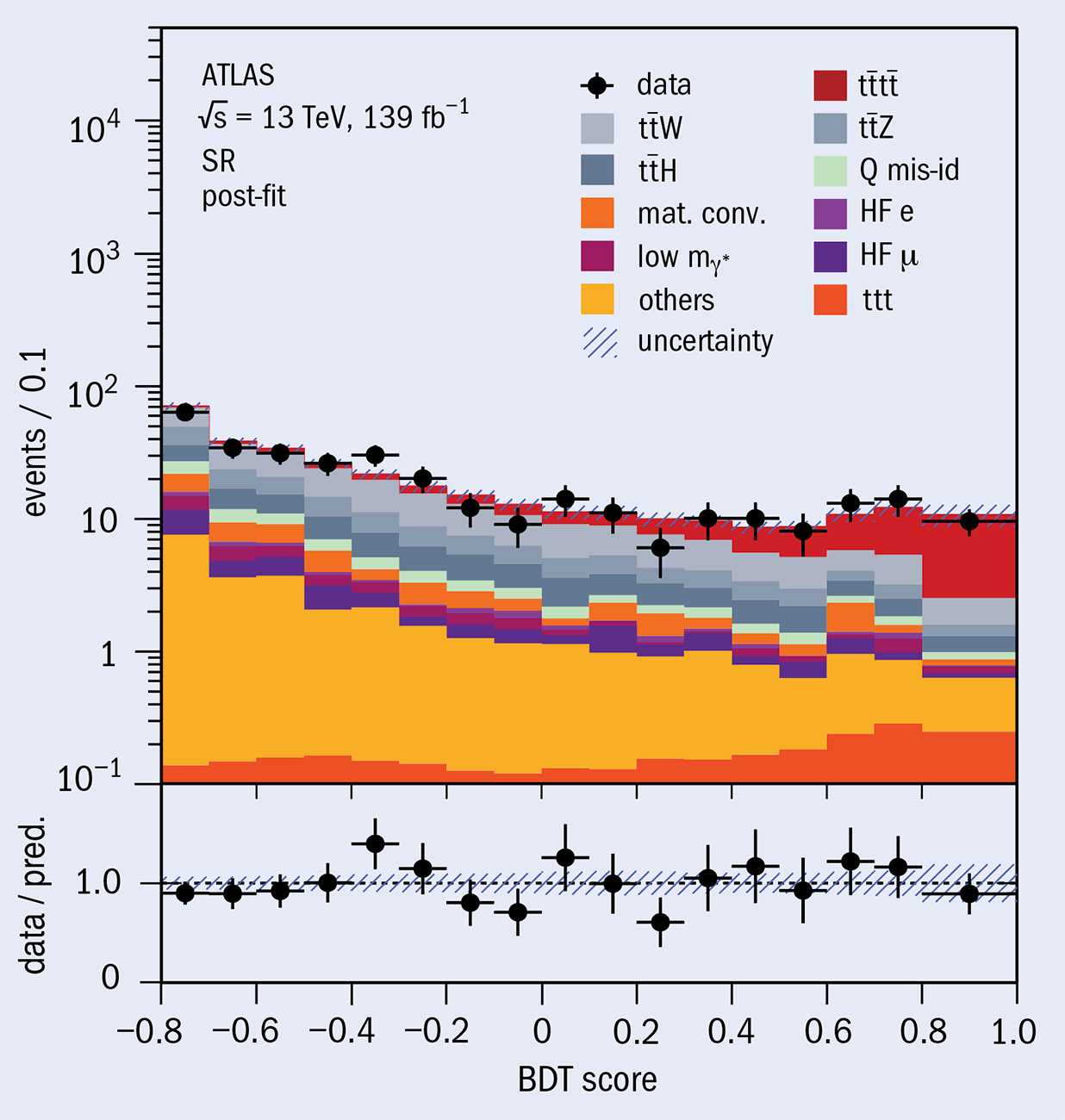
Despite these challenges, the ATLAS collaboration has recently released two studies of four-top-quark production using its full Run-2 data sample. The first study searches for events with two leptons (electrons or muons) with the same electric charge or with three leptons. This selection corresponds to only 13% of all possible four-top-quark final states, but is contaminated by only a small background, mainly from the production of a top-quark pair with a W, Z or Higgs boson and additional jets, or from events with one lepton with misidentified electric charge or a “fake” lepton that doesn’t correspond to a W or Z boson decay. Background processes were primarily simulated using the best available theoretical predictions; the rates of the most difficult ones were measured using control samples with similar properties to the signal events. The second study searches for events with one lepton or two oppositely-charged leptons. This selection retains 57% of the possible four-top-quark final states, but suffers from a large background from top-quark pairs produced in association with many jets, some of which are consistent with originating from b-quarks (b-jets). This background is difficult to model and was determined using data control samples. To better isolate the signal from the background, multivariate discriminants were trained in both analyses using distinct features of the signal, such as the number of b-jets and the kinematic properties of the reconstructed particles (see figure 1).

Figure 2

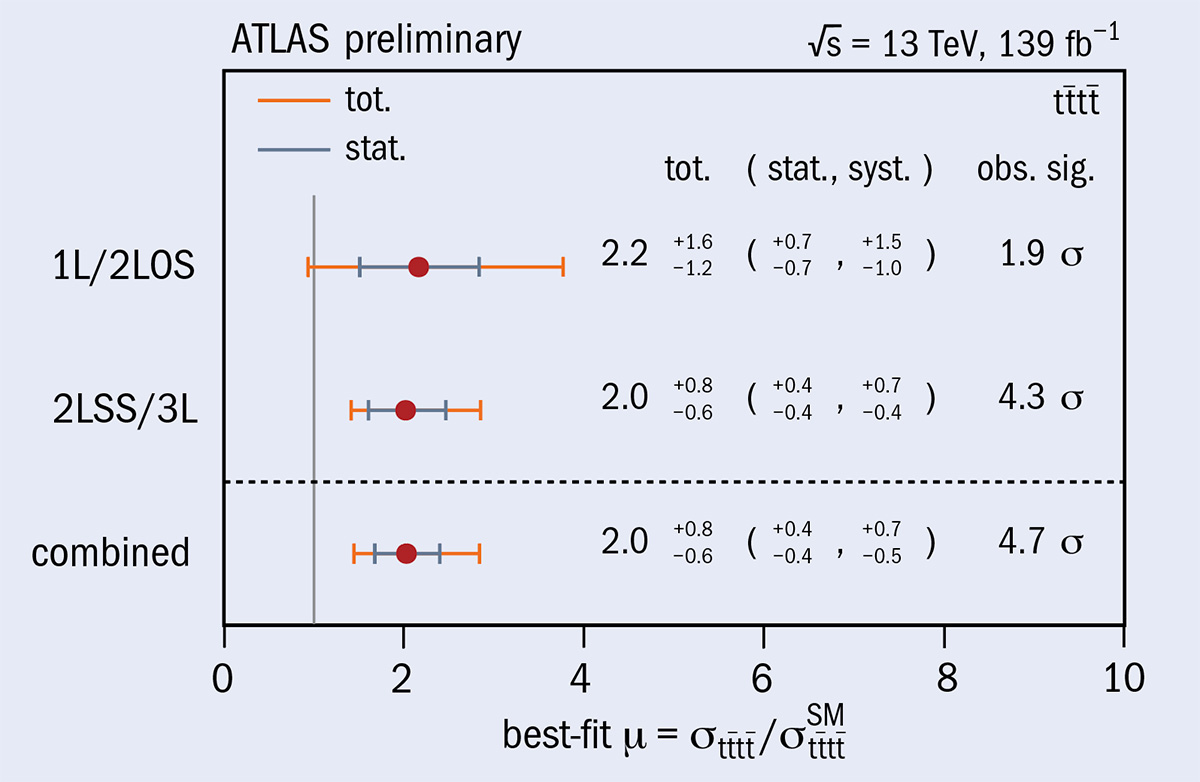
Results from the two studies were combined, leading to a four-top-quark cross-section measurement at 13 TeV of 25+7–6 fb, which is consistent with the Standard Model prediction of 12.0 ± 2.4 fb within 2.0σ (see figure 2). The statistical significance of the signal corresponds to 4.7σ, providing strong evidence for this process, close to the observation threshold of 5σ. LHC Run-3 data, possibly at a higher centre-of-mass energy, will allow ATLAS to verify whether the larger measured cross section relative to the prediction is confirmed or not. 

Astroparticle theory in rude health

The EuCAPT census

The European Consortium for Astroparticle theory (EuCAPT) held its first annual symposium from 5 to 7 May. Hundreds of theoretical physicists from Europe and beyond met online to discuss the present and future of astroparticle physics and cosmology, in a dense and exciting meeting that featured 29 invited presentations, 42 lightning talks by young researchers, and two community-wide brainstorming sessions.  

Participants discussed a wide array of topics at the interface between particle physics, astrophysics and cosmology, with particular emphasis on the challenges and opportunities for these fields in the next decade. Rather than focusing on experimental activities and the discoveries they might enable, the sessions were structured around thematic areas and explored the interdisciplinary multi-messenger aspects of each. 

Two sessions were dedicated to cosmology, exploring the early and late universe. As stressed by Geraldine Servant (Hamburg), several unresolved puzzles of particle physics – such as the origin of dark matter, the baryon asymmetry, and inflation – are directly linked to the early universe, and new observational probes may soon shed new light on them.

Julien Lesgourgues (Aachen) showed how the very same puzzles are also linked to the late universe, and cautiously elaborated on a series of possible inconsistencies between physical quantities inferred from early- and late-universe probes, for example the Hubble constant. Those inconsistencies represent both a challenge and an extraordinary opportunity for cosmology, as they might “break” the standard Lambda–cold-dark-matter model of cosmology, and allow us to gain insights into the physics of dark matter, dark energy and gravity.

We are witnessing a proliferation of theoretically well-motivated models

New strategies to go beyond the standard models of particle physics and cosmology were also discussed by Marco Cirelli (LPTHE) and Manfred Lindner (Heidelberg), in the framework of dark-matter searches and neutrino physics, respectively. Progress in both fields is currently not limited by a lack of ideas – we are actually witnessing a proliferation of theoretically well-motivated models – but by the difficulty of identifying experimental strategies to conclusively validate or rule them out. Much of the discussion here concerned prospects for detecting new physics with dedicated experiments and multi-messenger observations. 

Gravitational waves have added a new observational probe in astroparticle physics and cosmology. Alessandra Buonanno (Max Planck Institute for Gravitational Physics) illustrated the exciting prospects for this new field of research, whose potential for discovering new physics is attracting enormous interest from particle and astroparticle theorists. The connection between cosmic rays, gamma rays and high-energy neutrinos was explored in the final outlook by Elena Amato (Arcetri Astrophysical Observatory), who highlighted how progress in theory and observations is leading the community to reconsider some long-held beliefs – such as the idea that supernova remnants are the acceleration sites of cosmic rays up to the so-called “knee” – and stimulating new ideas.

In line with EuCAPT’s mission, the local organisers and the consortium’s steering committee organised a series of community-building activities. Participants stressed the importance of supporting diversity and inclusivity, a continuing high priority for EuCAPT, while a second brainstorming session was devoted to the discussion of the EuCAPT white paper currently being written, which should be published by September. Last but not least, Hannah Banks (Cambridge), Francesca Capel (TU Munich) and Charles Dalang (University of Geneva) received prizes for the best lightning talks, and Niko Sarcevic (Newcastle) was awarded an “outstanding contributor” prize for the help and support she provides for the analysis of the EuCAPT census (pictured).

The next symposium will take place in 2022, hopefully in person, at CERN. 

Mountain observatory nets PeV gamma rays

The universe seen with protons > 100TeV

Recent years have seen rapid growth in high-energy gamma-ray astronomy, with the first measurement of TeV photons from gamma-ray bursts by the MAGIC telescope and the first detection of gamma rays with energies above 100 TeV by the HAWC observatory.

Now, the Large High Altitude Air Shower Observatory (LHAASO) in China has increased the energy scale at which the universe has been observed by a further order of magnitude. The recent LHAASO detection provides the first clear evidence of the presence of galactic “pevatrons”: sources in the Milky Way capable of accelerating protons and electrons to PeV energies. Although PeV cosmic rays are known to exist, magnetic fields pervading the universe perturb their direction and therefore do not allow their origin to be traced. The gamma rays produced by such cosmic-rays, on the other hand, point directly to their source.

Wide field of view
LHAASO is located in the mountains of the Sichuan province of China and offers a wide field of view to study both high-energy cosmic and gamma rays. Once completed, the observatory will contain a water Cherenkov detector with a total area of about 78,000 m2, 18 widefield- of-view Cherenkov telescopes and a 1 km2 array of more than 5000 scintillator- based electromagnetic detectors (EDs). Finally, more than 1000 underground water Cherenkov tanks (the MDs) are placed over the grid to detect muons.

The latter two detectors, of which only half were finished during data-taking for this study, are used to directly detect the showers produced when high-energy particles interact with the Earth’s atmosphere. The EDs detect the shower profile and incoming angle, using charge and timing information of the detector array, while the MDs are used to distinguish hadronic showers from the electromagnetic showers produced by high-energy gamma rays. Thanks to both its large size and the MDs, LHAASO will ultimately be two orders of magnitude more sensitive at 100 TeV than the HAWC facility in Mexico, the previous most sensitive detector of this type.

The measurements reported by the Chinese-led international LHAASO collaboration reveal a total of 12 sources Astrowatch Mountain observatory nets PeV gamma rays located across the galactic plane (see image above). This distribution is expected, since gamma rays at such energies have a high cross-section for pair production with the cosmic microwave background and therefore the universe starts to become opaque at energies exceeding tens to hundreds of TeV, leaving only sources within our galaxy visible. Of the 12 presented sources, only the Crab nebula can be directly confirmed. This substantiates the pulsar-wind nebulae as a source in which electrons are accelerated beyond PeV energies, which in turn are responsible for the gamma rays through inverse Compton scattering.

Of specific interest is the source responsible for the photon with the highest energy, 1.4 PeV

The origin of the other photons remains unknown as the observed emission regions contain several possible sources within them. The sizes of the emission regions exceed the angular resolution of LHAASO, however, indicating that emission takes place over large scales. Of specific interest is the source responsible for the photon with the highest energy, 1.4 PeV. This came from a region containing both a supernova remnant as well as a star-forming cluster, both of which are prime theoretical candidates for hadronic pevatrons.

Tip of the iceberg
More detailed spectrometry as well as morphological measurements, in which the differences in emission intensity throughout the sources are measured, could allow the sources of > 100 TeV gamma rays to be identified in the next one or two years, say the authors. Furthermore, as the current 12 sources were visible using only one year of data from half the detector, it is clear that LHAASO is only seeing the tip of iceberg when it comes to high-energy gamma rays.

bright-rec iop pub iop-science physcis connect