Comsol -leaderboard other pages

Topics

Exotic hadrons brought into order by LHCb

LHCb’s latest tetraquarks

With so many new hadronic states being discovered at the LHC (67 and counting, with the vast majority seen by LHCb), it can be difficult to keep track of what’s what. While most are variations of known mesons and baryons, LHCb is uncovering an increasing number of exotic hadrons, namely tetraquarks and pentaquarks. A case in point is its recent discovery, announced at CERN on 5 July, of a new strange pentaquark (with quark content ccuds) and a new tetraquark pair: one constituting the first doubly charged open-charm tetraquark (csud) and the other a neutral isospin partner (csud). The situation has prompted the LHCb collaboration to introduce a new naming scheme. “We’re creating ‘particle zoo 2.0’,” says Niels Tuning, LHCb physics coordinator. “We’re witnessing a period of discovery similar to the 1950s, when a ‘zoo’ of hadrons ultimately led to the quark model of conventional hadrons in the 1960s.” 

While the quark model allows the existence of multiquark states beyond two- and three-quark mesons and baryons, the traditional naming scheme for hadrons doesn’t make much allowance for what these particles should be called. When the first tetraquark candidate was discovered at the Belle experiment in 2003, it was denoted by “X” because it didn’t seem to be a conventional charmonium state. Shortly afterwards, a similarly mysterious but different state turned up at BaBar and was denoted “Y”. Subsequent exotic states seen at Belle and BESIII were dubbed “Z”, and more recently tetraquarks discovered at LHCb were labelled “T”. 

Complicating matters further, the subscripts added to differentiate between the various states lack consistency. For example, the first known tetraquark states contained both charm and anticharm quarks, so a subscript “c” was added. But the recent discoveries of tetraquarks and pentaquarks containing a single strange quark require an extra subscript “s”. On top of all of that, explains LHCb’s Tim Gershon, who initiated the new naming scheme, tetraquarks discovered by LHCb in 2020 contain a single charm quark. “We couldn’t assign the subscript ‘c’ because we’ve always used that to denote states containing charm and anticharm, so we didn’t know what symbols to use,” he explains. “Things were starting to become a bit confusing, so we thought it was time to bring some kind of logic to the naming scheme. We have done this over an extended period, not only within LHCb but also involving other experiments and theorists in this field.”  

Helpfully, the new proposal labels all tetraquarks “T” and all pentaquarks “P”, with a set of rules regarding the necessary subscripts and superscripts. In this scheme, the two different spin states of the open-charm tetraquarks discovered by LHCb in 2020 become Tcs0(2900)0 and Tcs1(2900)0 instead of X0(2900)0 and X1(2900)0, for example, while the latest pentaquark is denoted PΛψs(4338)0. The collaboration hopes that the new scheme, which can be extended to six- or seven-quark hadrons, will make it easier for experts to communicate while also helping newcomers to the field. 

The new scheme could make it easier to spot patterns that might have been missed before

Importantly, it could make it easier to spot patterns that might have been missed before, perhaps shedding light on the central question of whether exotic hadrons are compact tightly bound multi-quark states or more loosely bound molecular-like states. The new LHCb scheme might even help researchers predict new exotic hadrons, just as the multiplets arising from the quark model made it possible to predict new mesons and baryons such as the Ω–. 

“Before this new scheme it was almost like a Tower of Babel situation where it was difficult to communicate,” says Gershon. “We have created a document that people can use as a kind of dictionary, in the hope that it will help the field to progress more rapidly.” 
Webb opens new era in observational astrophysics

JWST

The keenly awaited first science-grade images from the James Webb Space Telescope were released on 12 July – and they did not disappoint. Thanks to Webb’s unprecedented 6.5 m mirror, together with its four main instruments (NIRCam, NIRSpec, NIRISS and MIRI), the $10 billion probe marks a new dawn for observational astrophysics.

The past six months since Webb’s launch from French Guiana have been devoted to commissioning, including alignment and calibration of the mirrors and bringing temperatures to cyrogenic levels to minimise noise from heat radiated from the equipment (CERN Courier March/April 2022 p7). Unlike the Hubble Space Telescope, Webb does not look at ultraviolet or visible light but is primarily sensitive to near- and mid-infrared wavelengths. This enables it to look at the farthest galaxies and stars, as early as a few hundred million years after the Big Bang.

Wealth of information

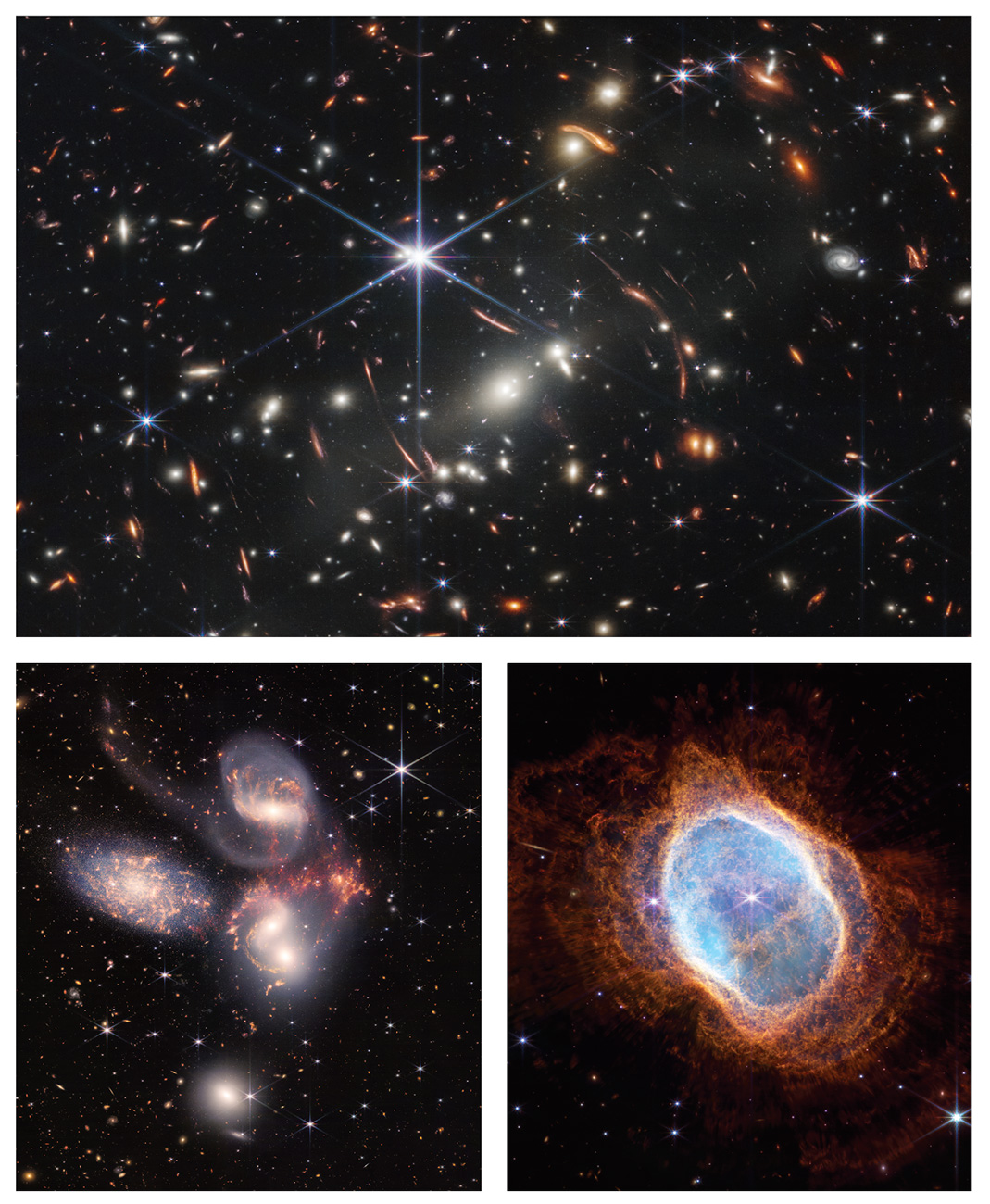
Pictured here are some of Webb’s early-release images. The first deep-field image (top) covers the same area of the sky as a grain of sand held at arm’s length, and is swarming with galaxies. At the centre is a cluster called SMACS 0723, whose combined mass is so high that its gravitational field bends the light of objects that lie behind it (resulting in arc-like features), revealing galaxies that existed when the universe was less than a billion years old. The image was taken using NIRCam and is a combination of images at different wavelengths. The spectrographs, NIRSpec and NIRISS, will provide a wealth of information on the composition of stars, galaxies and their clusters, offering a rare peak into the earliest stages of their formation and evolution. 

Stephan’s Quintet (bottom left) is a visual group of five galaxy clusters that was first discovered in 1877 and remains one of the most studied compact galaxy groups. The actual grouping involves only four galaxies, which are predicted to eventually merge. The non-member, NGC 7320, which lies about 40 million light years from Earth rather than 290 million for the actual group, is seen on the left, with vast regions of active star formation in its numerous spiral arms. 

A third stunning image, the Southern Ring nebula (bottom right), shows a dying star. With its reservoirs of light elements already exhausted, it starts using up any available heavier elements to sustain itself – a complex and violent process that results in large amounts of material being ejected from the star in intervals, visible as shells.

These images are just a taste, yet not all Webb data will be so visually spectacular. By extending Hubble’s observations of distant supernovae and other standard candles, for example, the telescope should enable the local rate of expansion to be determined more precisely, possibly shedding light on the nature of dark energy. By measuring the motion and gravitational lensing of early objects, it will also survey the distribution of dark matter, and might even hint at what it’s made of. Using transmission spectroscopy, Webb will also reveal exoplanets in unprecedented detail, learn about their chemical compositions and search for signatures of habitability. 

Determining the lifetime of the Bs

LHCb figure 1

As the LHCb experiment prepares for data taking with an upgraded detector for LHC Run 3, the rich harvest of results using data collected in Run 1 and Run 2 of the LHC continues.

A fascinating area of study is the quantum-mechanical oscillation of neutral mesons between their particle and antiparticle states, implying a coupled system of two mesons with different lifetimes. The phenomenology of the Bs system is particularly interesting as it provides a sensitive probe to physics beyond the Standard Model. A Bs meson oscillates with a frequency of about 3 × 1012 Hz, or on average about nine times during its lifetime, τ. In addition, a sizeable difference between the decay widths of the heavy (ΓH) and light (ΓL) mass eigenstates is expected. Measuring the lifetime of a CP-even Bs-decay mode determines τL = 1/ΓL. 

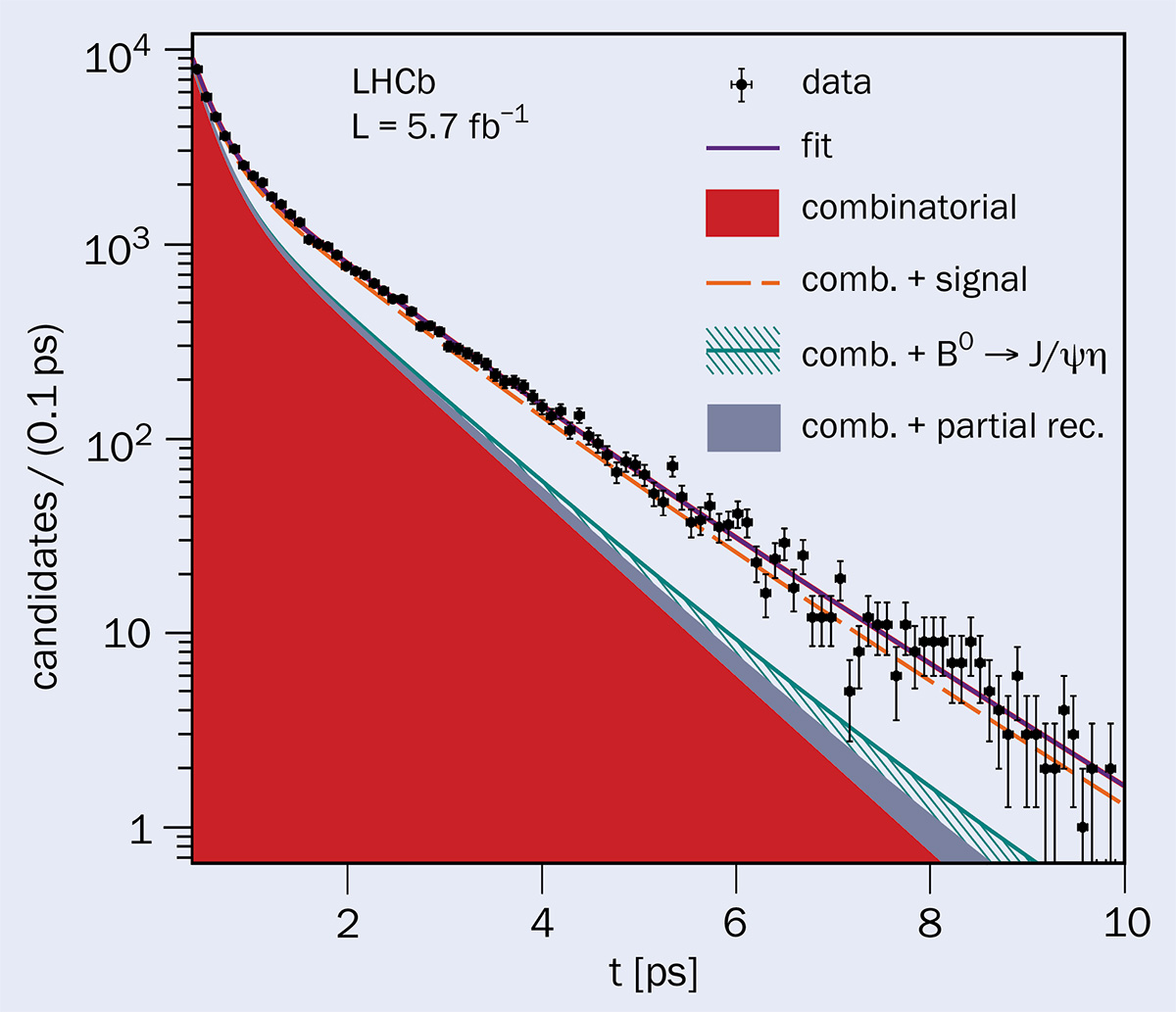
LHCb has recently released a new and precise measurement of this parameter, making use of Bs → J/ψη decays selected from 5.7 fb–1 of Run 2 data. The study improves the previous Run 1 precision by a factor of two. Due to the combinatorial background, the reconstruction of the η meson via its two-photon decay mode is a particular challenge for this analysis. Despite this, and even with the modest energy resolution of the calorimeter leading to a relatively broad mass peak overlapping partially with the signal from the B0 → J/ψη decay, a competitive accuracy has been achieved. By exploiting the latest machine-learning techniques to reduce the background and the well understood LHCb detector, the Bs → J/ψη decay is observed (figure 1), and τL is extracted from a two-dimensional fit to the mass and decay time.

LHCb figure 2

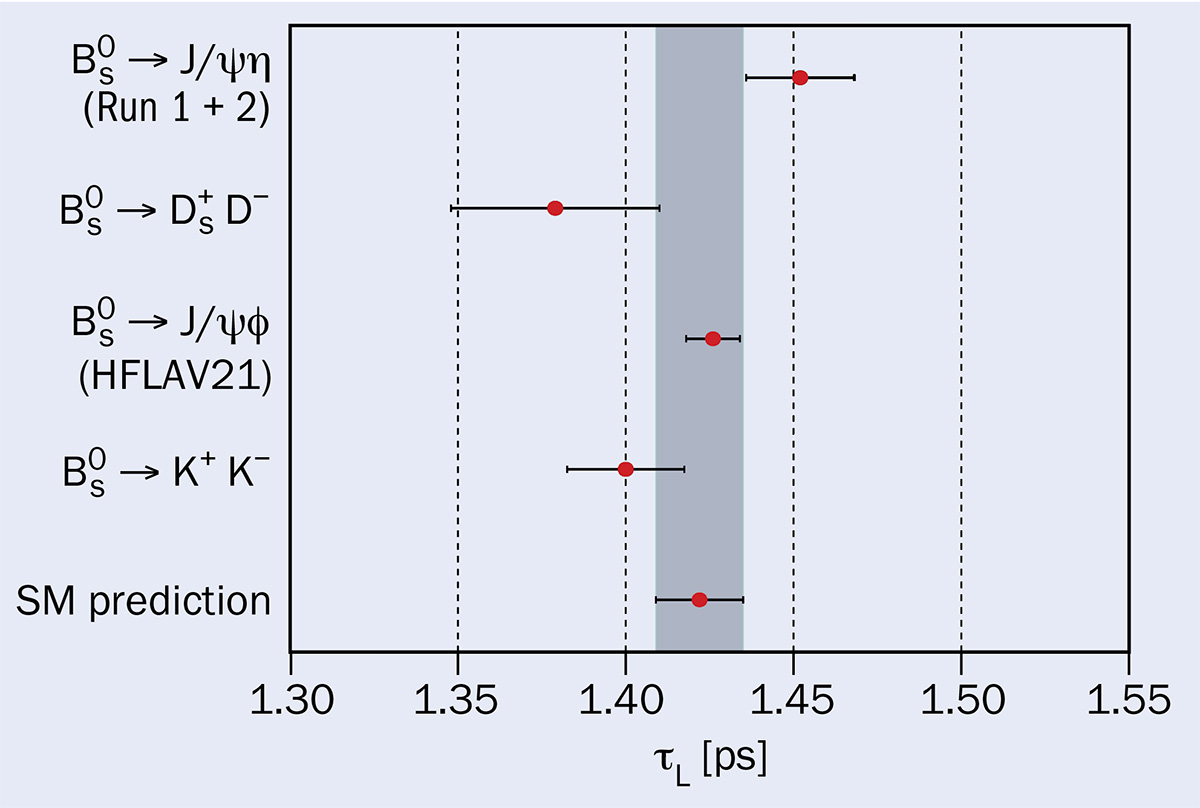
The analysis finds τL = 1.445 ± 0.016 (stat) ± 0.008 (syst) ps, which is the most precise measurement of this quantity. Combined with the LHCb Run 1 study of this and the Bs → Ds+ Ds– decay mode, τL = 1.437 ± 0.014 ps, which agrees well both with the Standard Model expectation (τL = 1.422 ± 0.013 ps) and the value inferred from measurements of Γs and ΔΓs in Bs → J/ψφ decays. Further improvement in the knowledge of τL is expected both by considering other CP-even Bs decays to final states containing η or η′ mesons, the Bs → Ds+ Ds– dataset collected during Run 2 and from the upcoming Run 3. 

Antinucleosynthesis beyond the average

ALICE figure 1

Despite two decades of extensive studies, the production of antinuclei in heavy-ion collisions is not yet fully understood. Antinuclei production is usually modelled by two conceptually different theoretical models, the statistical hadronisation model (SHM) and coalescence models. In the SHM, deuteron antinuclei are produced from a locally thermally equilibrated source, while antinuclei are formed from the binding of constituent nucleons, which are close in momentum and position phase space in the coalescence model. Both models predict very similar production yields of, for example, deuteron antinuclei, bound states of an antiproton and an antineutron. This calls for new experimental observables that discern different production models.

Measuring higher moments of the multiplicity distribution of antinuclei as well as the correlation with antinucleons produced in the collision have been recently proposed as sensitive variables to antinucleosynthesis processes in heavy-ion collisions. The first measurement of the variance to mean ratio of the multiplicity distribution of antideuterons is compared to the predictions of the SHM and coalescence models (figure 1). The coalescence model fails to describe the observed ratio of the variance and mean of the multiplicity distribution of antideuterons. The measurements are consistent with the statistical baseline, a Poissonian distribution, as well as with the SHM in the presence of baryon number conservation. However, this observable proves insensitive to the size of the correlation volume used in the SHM to conserve the baryon number.

The Pearson correlation coefficient between the number of produced antideuterons and antiprotons constrains the latter effectively. The small negative correlation reflects that there are less protons observed in events with at least one deuteron than in an average event (figure 1). The coalescence model does not reproduce the measurement, whereas it is possible to fit the measurement to extract the correlation volume out of the SHM. The obtained correlation volume is 1.6 times the volume of the fireball per unit of rapidity, which is smaller compared to those describing proton yields and a similar measurement of net-proton number fluctuations. These findings point to a later formation of the correlation among protons and deuterons compared to that among antiprotons and protons.

Overall, these results present a severe challenge to the current understanding of antinuclei production in heavy-ion collisions at the LHC energies. With the LHC Run 3 data it will be possible to extend these measurements to heavier antinuclei and to higher order correlation coefficients and moments of the antinuclei multiplicity distribution that are even more sensitive to details of the nucleosynthesis process in heavy-ion collisions.

23rd International Workshop on Neutrinos from Accelerators (NuFact2022)

NuFACT 2022 is the 23rd in the series of yearly international workshops which started in 1999 and which had previously been called the International Workshop on Neutrino Factories. The change of name to International Workshop on Neutrinos from Accelerators is related to the fact that the workshop program has, over the years, come to include all current and future accelerator and also reactor based neutrino projects, including also muon projects, not only the Neutrino Factory project.

The main goal of the workshop is to review the progress of current and future facilities able to improve on measurements of the properties of neutral and charged lepton flavor violation, as well as searches for new phenomena beyond the capabilities of presently planned experiments. The workshop is both interdisciplinary and interregional in that experimenters, theorists, and accelerator physicists from all over the world share expertise with the common goal of reviewing the results of currently operating experiments and designing the next generation of experiments. To allow for worldwide participation we plan to broadcast plenary sessions and make at least some selected parallel sessions available. Plenary sessions will be mostly held in the mornings in Utah, which translates into convenient times for international participants from the Americans and Europe/Africa regions.

Before and during the conference we will also have several mini-workshops and panel discussions. Currently we plan to have a mini-workshop on Multi-Messenger Tomography of Earth and a workshop on Muon Colliders, and plan to have a panel discussion on the Snowmass exercise.

We are currently envisioning a fully in-person event. Plenary and selected parallel sessions will be streamed for world-wide participation. NuFact will include some dedicated hybrid events  with opportunities for remote participants to give presentations and to discuss with the in-person participants.

The NuFact 2022 workshop is divided into seven Working Groups covering the following topics:

  1. Neutrino Oscillation Physics (Working Group 1),
  2. Neutrino Scattering Physics (Working Group 2),
  3. Accelerator Physics (Working Group 3),
  4. Muon Physics (Working Group 4), and
  5. Neutrinos Beyond PMNS (Working Group 5)
  6. Detectors (Working Group 6)
  7. Inclusion, Diversity, Equity, Education & Outreach (Working Group 7)

Amplitudes 2022

Amplitudes 2022, the 14th in a series of annual meetings, brings together a community of researchers in this fast-growing field of theoretical physics, interested in both formal and practical aspects of scattering amplitudes, and wide range of applications from pure mathematics to collider and gravitational wave physics.

Amplitudes Summer School will take place the week prior to the conference, August 1-6, 2022.

Scientific Advisory Committee

  • Nima Arkani-Hamed (IAS Princeton)
  • Zvi Bern (UCLA)
  • Jacob Bourjaily (Penn State U.)
  • Ruth Britto (Trinity College Dublin)
  • Freddy Cachazo (Perimeter)
  • Clifford Cheung (Caltech)
  • Lance Dixon (SLAC)
  • Henriette Elvang (University of Michigan)
  • Song He (CAS Beijing and Hangzhou)
  • Johannes Henn (Max Planck Inst., Munich)
  • David Kosower (IPhT, Saclay)
  • Michèle Levi (Oxford University)
  • Lionel Mason (Oxford University)
  • Anastasia Volovich (Brown University)

Local Organizers

Karol Kampf (Charles University), Jaroslav Trnka (UC Davis)
Christoph Bartsch, Jiří Novotný, Petr Vaško (Charles University Prague)
Klaus Bering, Michal Pazderka (Masaryk University Brno)
Constantinos Skordis, Renann Lipinski Jusinskas, Will Emond (Academy of Sciences Prague), Taro Brown (UC Davis)

Confirmed speakers

Agnese Bissi, Alessandra Buonanno, Alex Edison, Alexander Zhiboedov, Alfredo Guevara, Amit Sever, Andrew McLeod, Andrzej Pokraka, Callum Jones, Chia-Hsien Shen, Congkao Wen, Dalimil Mazac, David Kosower, Dimitry Chicherin, Fabrizio Caola, Gabriele Travaglini, Guilherme Pimentel, Gustav Mogull, Henriette Elvang, Hofie Hannesdottir, Johannes Henn, Julio Parra-Martinez, Lance Dixon, Livia Ferro, Lucia Cordova, Marc Spradlin, Mariana Carrillo-Gonzalez, Matthias Wilhelm, Michèle Levi, Monica Pate, Natalie Paquette, Nathaniel Craig, Nima Arkani-Hamed, Sabrina Pasterski, Sebastian Mizera, Shruti Paranjape, Song He, Tim Adamo, Xi Yin, Zohar Komargodski, Zvi Bern

Sponsors

This conference receives funding from the European Research Council (ERC) under the European Union’s Horizon 2020 research and innovation programme  (Novel structures in scattering amplitudes, grant agreement No 725110). We also acknowledge the support of Charles University, the Czech Science Foundation, the Czech Ministry of Education, the Czech Academy of Sciences and Masaryk University.

Back to the Swamp

The Swampland program gives general constraints on effective theories to be compatible with quantum gravity, therefore defining the Landscape of consistent theories. The program is quickly gaining command of the fundamental understanding of open questions in particle physics and cosmology, ranging from the hierarchy of fundamental scales in nature, to the origin and final fate of the universe.

The aim of this workshop is to gather leading experts in the field, to discuss the recent developments in our understanding of the Swampland and its implications for cosmology and particle physics.

This is the third edition of the previous very successful related workshops Vistas over the Swampland and Navigating the Swampland.

Rencontres du Vietnam: Flavour Physics Conference 2022

This meeting, normally held every three years, is intended to promote fruitful collaboration between experimentalists and theorists, between physicists in the areas of:

  • Searches for New Physics including the Dark Sector
  • Phenomenology of Physics Beyond the Standard Model
  • Beauty and Charm physics
  • Kaon physics
  • Tau and Muon physics
  • Neutrino physics
  • CP violation
  • Rare decays
  • Future facilities

from institutions across the world, by bringing together a limited number of particle physicists in beautiful and inspiring surroundings. A particular emphasis will be made on searches for new physics which complement direct studies at the LHC.

Expert speakers who will introduce the different areas include:

  • Jorge Camalich (Instituto de Astrofísica de Canarias)
  • Mu-Chun Chen (UC Irvine)
  • Giancarlo D’Ambrosio (INFN Naples)
  • Javier Fuentes (Universidad de Granada)
  • Stefania Gori (UC Santa Cruz)
  • Shoji Hashimoto (KEK)
  • Mikolaj Misiak (University of Warsaw)
  • Phillip Urquijo (University of Melbourne)
  • Roman Zwicky (University of Edinburgh)

In addition to having plenty of discussion, we will be producing a jointly-authored paper together during the conference which summarises these and the state of the field. We are looking forward to the participation of those who will be able to actively engage in the discussions and paper-writing sessions, and in turn believe that this will make for a rewarding and fruitful experience for all.


Physics of Fundamental Symmetries and Interactions (PSI2022)

The workshop focuses on the physics at the low energy, high precision frontier without neglecting complementary approaches. It aims at highlighting present activities and future developments.
Scientific Topics
  • Low energy precision tests of the Standard Model
  • Experiments with muons, pions, neutrons, antiprotons, other particles and atoms
  • Searches for permanent electric dipole moments
  • Searches for symmetry violations and new forces
  • Precision measurements of fundamental constants
  • Exotic atoms and molecules
  • New tools and facilities
The Paul Scherrer Institut (PSI) itself offers unique opportunities for experiments in this realm: it houses the world’s most powerful proton cyclotron and the highest intensity low momentum pion and muon beams and the new ultracold neutron source.

9th International Conference on Quarks and Nuclear Physics (QNP2022)

The 9th International Conference on Quarks and Nuclear Physics will be held at FSU in Tallahassee, FL, USA, on 5-9 September, 2022. This conference follows the series of meetings previously held in Adelaide, Julich, Bloomington, Madrid, Beijing, Palaiseau, Valparaiso, and Tsukuba. Experimentalists and theorists will discuss recent developments in the field of hadron and nuclear physics.
  • 9th conference in the QNP series
bright-rec iop pub iop-science physcis connect