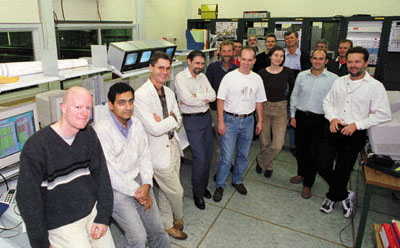
In normal beta decay, a nuclear neutron transforms into a proton by emitting a neutrino. A far more exotic possibility is two successive beta decays, in which the neutrino emitted in the first decay would be absorbed by the second decay. The resulting isotope would have two more protons, and no neutrinos would emerge. This can only happen if the neutrino and its antiparticle are indistinguishable from one another (a Majorana particle), as opposed to a conventional Dirac neutrino, whose particle and antiparticle are distinct.
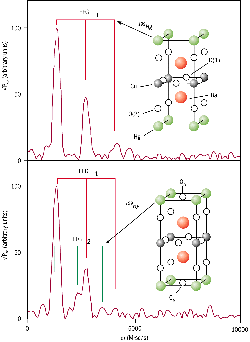
Using an 11.5 kg sample of germanium-76, in the Gran Sasso Laboratory, the Heidelberg-Moscow search has now established that neutrinoless double beta decay, if it happens at all, does so with a lifetime of at least 1025years: a world record. The corresponding effective Majorana neutrino mass (a superposition of the different neutrino mass eigenstates) has to be less than 0.2 eV.
This complements information obtained from solar and atmospheric neutrino oscillation experiments, which determine differences in neutrino mass eigenstates. The new mass limit has implications for the neutrino mass matrix, and for cosmology in the Majorana neutrino scenario. In addition to limits on the neutrino mass, the experiment places limits on other new physics effects.
A full report will appear in a forthcoming issue of CERN Courier.
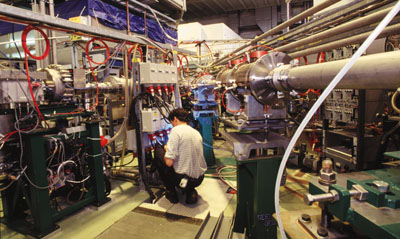
The proton is not strange. This is the conclusion drawn from the initial results of an experiment at the Jefferson Laboratory, Newport News, Virginia, which cast new light on the deep interior of nuclear particles.
Classically, the proton is understood to contain three “valence” quarks two “up” and one “down”. However, in 1987 the European Muon Collaboration experiment at CERN revealed that only about 30% of the intrinsic angular momentum (spin) of the nucleon is carried by the quarks. Ever since, physicists have been searching for the missing spin-carrying component.
All subnuclear particles contain a skeleton of valence quarks along with a fluid “sea” of transient quarks and antiquarks, and gluons, which transmit information between quarks.
In the case of the proton, the composition of this sea would not necessarily be limited to light up and down quarks but could also contain some of the heavier and more exotic quarks, particularly the “strange” quark, which makes up particles that are not normally found in our world.
One possibility is that this fluid sea contributes to the missing spin of the parent particle. To investigate this, the Hall A Proton Parity Experiment (HAPPEX) was commissioned at the Jefferson Laboratory CEBEF electron accelerator. The idea was to scatter a beam of high-energy polarized (spin-oriented) electrons and look at the spin distribution of the scattered electrons.
When electrons “bounce” off protons in this way, the bounce can be mediated either by an electromagnetic photon, or by the neutral Z carrier of the weak force. The delicate interference of these two effects depends on the way in which the electrons interact with the quarks in the proton. This produces a characteristic leftright asymmetry in the scattered beam. In particular, any strange quarks should contribute to this asymmetry in a different way from the more prominent up and down quarks.
HAPPEX used a 100 µA continuous beam of 3.356 GeV polarized electrons, which were derived from a laser-driven semiconductor photocathode. To measure the asymmetries expected to be at the level of parts per million any correlation between the beam’s spin alignment and intensity was avoided by using a sophisticated feedback system.
The asymmetry measured by HAPPEX is 14.5 ± 2.2 ppm, which does not indicate a significant contribution from strange quarks. However, to reach a definitive conclusion, more data are needed to isolate the charge and magnetic contributions to the asymmetry.
HAPPEX completed a new run last summer that will decrease the present experimental uncertainty by a factor of two. The experimenters say that the success of this experiment bodes well for the future use of these techniques as an incisive probe of subtle effects in nucleon and nuclear structure. The high intensity, together with the high polarization of the electron beam (up to 70%), is a major achievement.
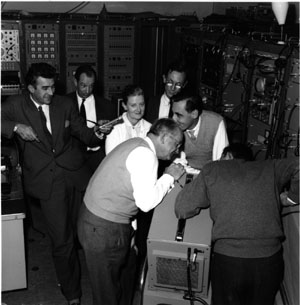
On 24 November 1959, CERN’s new Proton Synchrotron accelerated protons through the dreaded “transition energy” barrier and on to achieve the nominal energy of 24 GeV. Could any of those rejoicing on that historic day have thought that their machine would still be alive and well 40 years later, or that it would be the hub of the world’s largest complex of accelerators, at the centre of European high-energy physics? If such thoughts were on their minds, they certainly would not have extended so far in time or in performance.
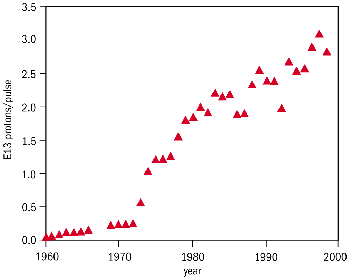
When operation for physics began in 1960, the Proton Synchrotron (PS) delivered 1010 protons per pulse. Since then, 40 years of relentless effort has improved the performance more than a thousandfold. Today the PS delivers 3 x 10¹³ protons per pulse.
The early history – the decision to build the PS, the courageous step from a weak-focusing to a strong-focusing synchrotron, its design, construction and legendary start-up – has been told before. Instead we look at the evolution that has led to today’s PS, the complex that has grown around it and the assured future that awaits it.
History 1959-1999: protons
The performance of the PS has increased, partly through patient optimization and partly owing to specific steps taken to cope with CERN’s evolving physics programme. In June 1960 the Parameter List showed a “best performance” of 6 x 10¹⁰ protons per pulse and further progress was rapid (figure 2).
Physics quickly benefited from Europe’s new high-energy proton source. In the first year of operation, internal targets supplied four experiments in the South Hall with secondary particles for more than 1000 h. More beamlines came into operation in 1961. From 1963, fast and slow extraction supplied primary protons to the East Area. Between 1972 and 1975 they were supplied to the West Area.
Although the intensity had increased a hundredfold by 1964, the many particle-hungry users, and the prospect of having to supply the new ISR proton collider, triggered an improvement programme.
A new main magnet power supply would double the repetition rate. A new Booster – four superimposed synchrotron rings, one quarter of the PS diameter, taking 50 MeV protons from the Linac up to 800 MeV – would raise the PS space-charge limit by a factor of 10, to 1013 protons. Construction of the Booster began in 1968 and was completed in 1972. With it came an increase in PS intensity, which was welcomed by the ISR and the Gargamelle bubble chamber. A further increase in intensity came in 1978, when the new Linac 2 replaced the original one. Today the Booster more than triples its design intensity, routinely delivering 3 x 10¹³ protons per pulse, to the delight of the ISOLDE radioactive-ion beam users.
In striving for higher intensities, several obstacles had to be overcome. One was passing the transition energy in the PS causing the dilution of longitudinal phase-space density. This was remedied in 1970 by the “Q-jump” and then the “gamma-transition jump”, in which pulsed quadrupoles make the protons traverse transition much faster. This trick came just in time for the much higher intensities generated by the Booster.
In 1976 the new SPS synchrotron became a welcome client. In 1970, in a deadlock over site selection for the new “300 GeV project”, John Adams had proposed attaching it to the existing CERN site and use the PS as the injector, thereby consolidating the future of the machine he had built and of CERN as a whole.
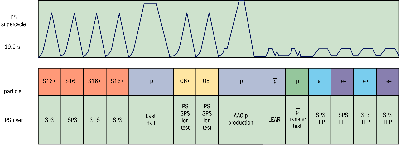
The variety of users and their demands generated a need for the PS to deliver different beams on successive cycles. This was called pulse-to-pulse modulation, with a number of different cycles grouped into a “supercycle” (figure 1). It was a great challenge for the long sequence of ever more powerful controls computers, the first having been a 1967 IBM 1800.
When, in December 1991, the council declared that the LHC was the “right next machine” for CERN, the PS had to prepare for yet another client – a very demanding one. The LHC would need proton beams of unprecedented density. For the Booster and the PS, this entailed a number of drastic changes, the validity of which was tested extensively at the end of 1993.
The radiofrequency systems in the Booster and PS were radically modified for acceleration on new harmonic numbers. Intricate radiofrequency gymnastics for splitting and merging bunches were also introduced (figure 3).
To obtain high transverse beam densities, the blow-up of emittances must be strictly limited. In 1999 the harmful effects of space charge in the PS were reduced by raising the Booster energy to 1.4 GeV. To preserve emittance tightly requires measuring it accurately. Existing diagnostic tools were sharpened and new ones added. Today, automatic beam steering alleviates the burden of optimization and will be an essential tool in meeting the LHC stringent emittance requirements.
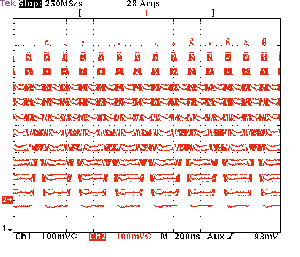
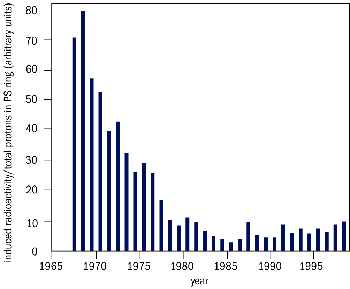
Acceleration of ever higher intensities brings higher radiation doses to the machine components. The first radiation damage was recorded as early as 1964, after a total of 1.1 x 10¹⁹ protons had been accelerated. Strict measures were taken to reduce losses – figure 4 shows how successful these measures were – otherwise the total of 1.56 x 10²¹ protons delivered so far would never have been reached. (The rest mass of all of the protons accelerated during 40 years of operation amounts to a mere 2.6 mg.)
Protons are not the only particles supplied. In 1964 the Linac produced deuterons of 12 MeV/nucleon and the PS accelerated them for a few milliseconds. In 1976 and 1977, deuterons were accelerated and transferred to the ISR for d–d collisions. When Linac 2 came into operation for protons, Linac 1 was left free for more ion studies.
In 1980, alpha particles were provided for the ISR. Heavier ions, oxygen and sulphur, were sent to the SPS. This whetted the physicists’ appetite for the really heavy stuff. In 1990, in collaboration with several other European laboratories, the construction of a new Linac 3 for the acceleration of lead ions began. It was completed and running in 1994. In the same year, lead ions were accelerated through the PS and SPS.
In the Low-Energy Antiproton Ring (LEAR), oxygen ions were stored and cooled, using both stochastic and electron cooling. Because, for lead–lead collisions, the LHC requires denser beams than the ion source and Linac 3 can provide, the use of LEAR was proposed. Between 1995 and 1997 extensive tests of a scheme for the accumulation and cooling of lead ions in LEAR gave convincing results.
For CERN’s antiproton programme, the PS became involved very early as a major contributor to the Initial Cooling Experiment to test stochastic and electron cooling. In 1978, the decision to go ahead with the Antiproton Project brought the Antiproton Accumulator (AA) to the PS. Apart from the construction of the AA, the PS had to prepare intense proton beams for antiproton production.
The AA started up in 1980, and in 1981 antiprotons were sent to the ISR and soon afterwards to the SPS (which was converted into a proton–antiproton collider) leading to the discovery of W and Z bosons. To increase antiproton production by an order of magnitude, an Antiproton Collector (AC) complemented the AA from 1987.
Once the AA was proven, LEAR was launched for completion in 1982. It received antiprotons from the AA via the PS, which were decelerated there to 600 MeV/c. This was a feat of beam handling. LEAR functioned as a “beam stretcher”. After storing, cooling, decelerating and then cooling again, its antiprotons were fed to the experiments via “ultraslow extraction”. Some 5 x 10⁹ antiprotons were served over periods lasting hours, on average at only one antiproton per revolution.
When antiproton physics finished at the SPS, AC–AA and LEAR continued to provide antiprotons to a rich field of physics until 1996. The AA was dismantled, but the AC is making a comeback as an Antiproton Decelerator (AD). It was first tested with protons in 1998. In 1999 the first antiprotons at 100 MeV/c (5 MeV kinetic energy) are scheduled for new experiments.
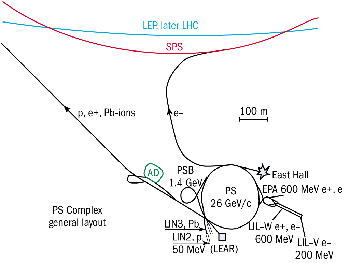
When CERN’s LEP electron–positron collider was conceived, history was repeated. Rather than building new injectors, the PS and SPS could take on the role. More machines had to be added to the PS Complex: a 200 MeV high-intensity electron Linac (to produce positrons from a converter target), a 600 MeV low-intensity electron–positron Linac and an Electron–Positron Accumulator (EPA), from which particles were passed to the PS, accelerated to 3.5 GeV, sent to the SPS for further acceleration and then on to LEP.
For the electron–positron linacs, expertise and help were sought from LAL, Orsay. Construction began in 1984. By 1987 electron and positron beams were ready. Routine LEP operation began in 1989.
Far-reaching modifications had to be made to the PS – the vacuum chamber was entirely changed, electron and positron transfer lines and injections were added, new 114 MHz cavities and three “wigglers” were added too.
As well as being a supplier of protons, antiprotons, electrons, positrons and ions to the SPS, the PS Complex has gathered a number of users of its own – protons supplied to the East Hall feed a major experiment (DIRAC) and a number of smaller ones, mostly to test detectors for the LHC experiments. This is also where key experiments for the Energy Amplifier were recently carried out.
ISOLDE moved to the Booster after the closure of the 600 MeV synchrocyclotron in 1990. It is enjoying the higher energy of 1 or 1.4 GeV and intensities of 3 x 10¹³ protons per pulse. Detector development profits from electrons in an experimental area connected to LIL and EPA. Experiments around the new AD are being readied for 100 MeV/c antiprotons. A new time-of-flight (TOF) facility, using intense proton beams from the PS to produce spallation neutrons, is nearing completion.
The future
For the future, the PS base-load will be the steady delivery of beams to the many clients and maintaining the machines in a good operational state. However, many other tasks are in the offing.
Once the TOF experiment is completed, others, which are using the intense beams from the PS, may follow. The preparation of proton beams to fulfil all of the demands of the LHC requires more effort. There is the conversion of LEAR, for the moment mothballed, to become the Low-Energy Ion Ring, in which lead ions will be accumulated and cooled to the levels required by the LHC. This is a demanding task, which will draw on all the expertise that the PS Division can muster.
The future also means looking beyond the LHC. The vast experience accumulated with a great variety of techniques, machines and beams in the PS Complex is fertile ground. The Compact Linear Collider study has found its home at the PS, with a succession of test facilities (CTF1, CTF2 and now CTF3 is under construction). This will be a major responsibility. A further long-term study has been launched on high-intensity proton accelerators for neutrino factories and, further ahead, a muon collider.
When celebrating a 40th anniversary, it is natural to recall successes and achievements and gloss over thunderstorms, fires, floods and sabotage. Some say that the good old PS should be replaced by something new and better. What is really left of the “good old PS” after all of these upheavals? The astonishing answer is: only the tunnel and 99 of its 100 magnets. Everything else is new, so it really is a “good young” PS. Reserve 24 November 2009 for the PS Golden Jubilee.
CERN’s isotope factory, ISOLDE, has a history stretching back over 30 years. ISOLDE’s unique ability to produce some 600 isotopes of 70 elements has ensured it a place at the forefront of low-energy radioactive-beam research and permits a programme that ranges from basic nuclear structure and weak interaction studies to applied fields like solid-state physics and the life sciences. ISOLDE owes its longevity to the ISOLDE team’s ability to develop new and more intense isotope beams and to the resourcefulness of the scientists, who design ever-more ingenious experiments for the facility.
The heart of ISOLDE is a target station where a 1 or 1.4 GeV proton beam from CERN’s booster accelerator strikes a target to produce a range of isotopes. Those of interest are then extracted, ionized and separated before being delivered to experiments. ISOLDE has always been able to produce extremely pure radioactive beams of a variety of species by combining a range of target materials with efficient and selective ion sources.
The Laser Ion Source
An important recent development, however, has allowed ISOLDE to improve efficiency and beam purity further. The Laser Ion Source (LIS) works by shining a combination of three laser beams into the cloud of nuclei released from the ISOLDE target. The combination acts like a key in a lock and selectively ionizes the isotopes of interest. This gives an unprecedented combination of both ionization efficiency and selectivity and has already allowed important measurements to be made on key processes that are believed to play a role in supernova nucleosynthesis.
More recently the LIS has been employed to produce isotopes of beryllium, which opens up a new range of possible experiments. Beryllium-7, for example, holds a key to the solar neutrino problem: the apparent deficit of neutrinos coming from the Sun that has been puzzling researchers for decades. One of the important reactions that gives rise to solar neutrinos is the capture of protons by beryllium-7. A precise knowledge of that isotope’s structure is important in understanding the expected flux of beryllium-7 related neutrinos from the Sun. An ISOLDE experiment has recently measured the quadrupole moment of the isotope. Furthermore, an experiment at Israel’s Weizmann Institute measures beryllium-7 proton capture using a beryllium-7 target made at ISOLDE.
Other, more esoteric, experiments use beryllium-11 and beryllium-14 to investigate a topic that has attracted much interest in recent years. In the 1980s, experiments on lithium-11 suggested that the nucleus might have a “halo” of two very loosely bound neutrons that surround a core lithium-9 nucleus. The proposed halo structure of lithium-11 has since been well established, both experimentally and theoretically, with much of the experimental work coming from ISOLDE.
Many similar neutron-rich nuclei have since been found and among them were beryllium-11 and beryllium-14. Beryllium-11, which has a single halo neutron, is the most simple halo nucleus. Its halo structure has recently been confirmed by the COLLAPS collaboration at ISOLDE, which has found that the magnetic dipole moment of beryllium-11 is consistent with a halo structure.
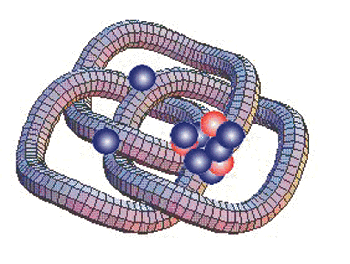
Berylium-14 is an altogether more complex object. Like lithium-11 it is a loosely bound three-body structure with two halo neutrons. Such nuclei have been dubbed Borromean because of a characteristic that they share with the heraldic Borromean rings symbol, which also features in mathematical knot theory. Just as a lithium-11 nucleus is a loosely bound state of three bodies, a Borromean ring system is an object composed of three intertwined rings. Whenever one ring is removed the remaining two are no longer bound to each other. The same is true of Borromean nuclei. These are three-body bound states in which any two-body subsystem would not be bound. The di-neutron is not bound, nor is lithium-9 plus a single neutron.
Producing beryllium-14 is particularly difficult because it has a half-life of only 4.3 ms, making it the shortest-lived isotope studied to date at ISOLDE. Few beryllium-14 nuclei survive long enough to escape the target, but a production rate of eight atoms per second has been achieved.
In lithium-11 a number of exotic decay modes involving the emission of tritons, deuterons, or up to three neutrons have been identified. These are associated with the halo structure, and the experimental goal of ISOLDE is to look for similar decay modes in beryllium-14. An early result shows that the probability of one-neutron emission is close to 100%. Further experiments are planned to search for other exotic decay modes.
Solid-state physics and life sciences
Radioactive nuclei are also used as powerful probes in solid-state physics (CERN Courier October 1998) and life sciences. One range of experiments studies the effect of hydrogen in semiconductors such as indium phosphide (InP), gallium arsenide (GaAs) and indium arsenide (InAs). Hydrogen can enter a semiconductor at many stages during production, causing passivation of intentionally introduced dopants by the formation of hydrogendopant complexes.
This is investigated at ISOLDE by implanting radioactive silver-117, which decays into cadmium-117. Cadmiumhydrogen pairs then form and, when the cadmium itself decays, the hydrogen is free to diffuse within the semiconductor. Information about the diffusion of hydrogen in the semiconductor can be gleaned by studying the gamma-ray distribution from the cadmium decay.
Another emerging area in which ISOLDE scientists are active is high-TC superconductors. Among the many that have been found, certain mercury-based materials achieve the highest critical temperature, of 135 K, at ambient pressure. These materials have a simple tetragonal lattice structure in which oxygen regulates the superconducting charge carriers and increases or decreases TC. ISOLDE researchers are able to extract information about the oxygen’s behaviour and concentration at the mercury lattice planes by measuring the electric field gradient that is caused by the charge distribution around implanted radioactive mercury probe nuclei.
In the life sciences, ISOLDE’s radionuclides are very suitable for use in biomedical research. One of the most interesting applications is cancer research. Certain modern techniques of systemic cancer therapy make use of “intelligent” molecules, which seek out specific binding sites in cancer cells with high selectivity. Such molecules can be used as vehicles to carry radioactive isotopes, produced at facilities such as ISOLDE, into the cancer tissue where they kill cancer cells. ISOLDE research into such novel forms of cancer therapy is guided by the Division of Nuclear Medicine at Geneva’s University Hospital.
Mass measurements
The mass of a nucleus is a fundamental quantity with importance in fields as diverse as nuclear physics and cosmology. This is particularly true of short-lived radioactive isotopes, for which ISOLDE has a long-standing tradition in high-precision mass measurements. The ISOLTRAP experiment, which is a combination of a recently added radiofrequency quadrupole cooler and two consecutive Penning traps, has mapped the nuclear mass surface over a sizable part of the nuclear chart with a resolution of 10-7.
ISOLTRAP will continue to be one of the major ISOLDE experiments for many years. However, it is limited to nuclei with half-lives of around 1 s and longer. This limitation is overcome in a complementary mass-measuring experiment called MISTRAL (CERN Courier September 1997), which has measured the masses of 15 radioactive isotopes, 3 of which have half-lives of less than 50 ms, with a mass resolution better than 10-5. These results are now providing valuable input to nuclear structure calculations.
Search for physics beyond the Standard Model
Radioactive nuclei are not only highly interesting systems in their own right but can also yield information regarding fundamental interactions, which is complementary to the results from high-energy physics. Nuclear beta decay, for example, is mediated by the exchange of W bosons having only certain (vector and axial-vector) couplings according to the Standard Model. However, theories beyond the Standard Model predict other weak couplings in nuclear beta decay. These could manifest themselves in electronneutrino correlations in super-allowed beta decays. The detection of the neutrino in the decay is practically impossible, so this correlation must be deduced from the velocity of the recoiling daughter nucleus.
This is an extremely delicate task because the velocities involved are very small and the movement of the daughter nucleus is affected by the surrounding material. In an experiment at ISOLDE, this last problem was partly circumvented by studying the decay of argon-32, which decays by beta-delayed proton emission. The energy peaks of the protons are then Doppler-broadened by the movement of the emitting daughter nucleus. Subsequently this broadening can be traced back to the electronneutrino correlation. The results were consistent with the Standard Model and have led to improved constraints on the scalar weak interaction.
Another quest for new physics is the search for right-handed currents in nuclear beta decay. This can be studied via the polarization of positrons that are emitted from a polarized radioactive source. Such an experiment has recently started taking data at ISOLDE.
REX-ISOLDE
In the past, ISOLDE has concentrated its efforts on the study of radioactive nuclei at very low energies less than 60 keV. The new REXISOLDE experiment is set to change this dramatically. A novel scheme for beam cooling, bunching, charge state breeding and subsequent acceleration will launch almost any isotope that is currently produced at ISOLDE into the 0.82.2 MeV per nucleon energy range. This opens up a completely new field of experiments with radioactive ion beams.
To convert a singly charged beam from the ISOLDE separator into a multiple-charged pulsed beam, which is suitable for acceleration, without losing too large a fraction of the painfully created radioactive nuclei, requires advanced techniques. Initially the ISOLDE beam is trapped, cooled and bunched in a linear Penning trap. The bunched beam is then transported to an electron beam ion source, where it is confined while being bombarded with a strong electron current in order to reach higher charge states. The ions are then re-accelerated and separated according to charge state before reaching a Linac. The overall efficiency is estimated to be 10%.
The REXISOLDE experiment aims to find out whether or not the magic numbers 20 and 28 are conserved when going to very neutron-rich nuclei. Other experiments have hinted at a weakening of the nuclear shell structure in the region of magnesium-32 (the most commonly occurring isotope is magnesium-24) and below calcium-48 (calcium-40 is the most commonly occurring isotope) with deduced sizable deformations.
The main detector system to be used for these experiments is the state-of-the-art gamma-detector array, MINIBALL, which is being constructed by a large European collaboration. Once REXISOLDE is ready, however, a large number of other experiments are also expected to make use of this powerful new instrument. Two more experiments are already approved. Both are concerned with investigating the unbound subsystems of halo nuclei like lithium-10. In the near future, other experiments that will take place concern the structure of unstable, medium-heavy (mass numbers between 50 and 100) nuclei with approximately the same number of neutrons and protons, proton radioactivity and nuclear astrophysics. The installation of the REX post-accelerator is well under way and the first post-accelerated radioactive beams are expected during 2000.
Outlook
With a well established physics programme, ISOLDE would be able to continue operation for many years to come with the current and foreseeable techniques, in particular with the REXISOLDE, including a possible energy upgrade to above 5 MeV per nucleon. However, the path towards new physics often relies on the availability of new or more intense radioactive beams, so the proton beam intensity delivered by the booster will become a limiting factor.
A number of new or upgraded facilities are currently being planned, built or commissioned worldwide. These will complement ISOLDE but they will still be first-generation facilities. There is considerable interest around the world in building a second-generation radioactive ion beam facility. In Europe this is spearheaded by the Nuclear Physics European Collaboration Committee (CERN Courier May p23) and in the US by the Department of Energy. Both have independently recommended the construction of a second-generation facility based on the ISOLDE principle, where radioactive beam intensities around 100 times higher than at the current facilities can be produced.
ISOLDE is well placed for further advances before such a facility comes along. ISOLDE currently uses about half of the number of protons delivered by the booster, but its target could easily withstand beam intensities more than an order of magnitude higher. ISOLDE physicists are currently studying the possibility of using a 2 GeV high-current proton Linac, which might form part of CERN’s LHC injector complex, to upgrade the facility further in years to come. A small part of the then available protons would be used by the driver beam, which would propel the ISOLDE to new scientific heights.
More than 10 years after the European Muon Collaboration at CERN discovered that the proton’s quarks account for only a fraction of the particle’s spin, physicists have been trying to find the “missing” component. This means exploring spin structure and content under higher-energy conditions.
The production of high-energy polarized proton beams and their subsequent long-term storage is one of the greatest challenges facing accelerator physicists. This was high on the agenda at a workshop on Polarized Protons at High Energies – Accelerator Challenges and Physics Opportunities, which was held at the DESY Laboratory in Hamburg earlier this year. Over 100 experts on the machine aspects of polarized proton beam acceleration and storage, spin physics and polarimetry were brought together.
Emphasis was placed on the polarized proton option for Brookhaven’s RHIC collider, which is expected to be commissioned next year, and the possible future storage of polarized protons in DESY’s HERA collider, in addition to the electrons and positrons that are already polarized.
The case for a fully polarized proton–electron HERA collider has been explored in two previous DESY workshops. Measurements at HERA include the structure functions g1 (the sum of the polarized quark and antiquark distributions) at low x (the quark momentum fraction) and g5 (the difference between the polarized quark and antiquark distributions), and polarized photoproduction measurements. The ability of HERA and RHIC to measure – for example, via jet or prompt photon production – the polarized gluon distribution, which is a likely source of spin, again underlined a measurement that is pivotal in understanding the spin structure of nucleons.
Previous studies have been updated, by using detailed detector simulation, for example, and several new channels have been proposed. New ideas were also presented for the HERA-N option in which the polarized proton beam would collide with a polarized, fixed target. The complementarity of the possible future physics programme at HERA and the programme at RHIC was emphasized.
Resonant depolarization during acceleration to high energy can be strongly suppressed using “Siberian snake” spin rotators. However, the snake schemes must be chosen carefully. High-intensity polarized sources, as well as high-quality polarization measurements, are needed at each step in the acceleration cycle.
Subjects for discussion included the necessary modifications to the HERA acceleration chain; the results of long-term spin-orbit tracking simulations for HERA and RHIC; progress on high-performance polarized sources; ideas for realistic snake layouts, which include plans for RHIC; experience at low-energy rings; various aspects of the theory of spin-orbit motion; and the description of helical magnetic fields. Significant advances were reported on all fronts. However, it remains clear that, to reach very high energy in HERA, a cooled beam would be desirable and that new means are needed to overcome the effects of closed-orbit distortion.
E Gabathuler, an opening plenary speaker, recalled the contribution of high-energy polarized scattering to our understanding of the structure of matter, and the surprises that emerged along the way. R Jaffe, A Deshpande and W Nowak reviewed the main aspects of the physics programme for polarized RHIC and HERA colliders. A Krisch recalled the efforts to achieve polarized proton beams at Brookhaven, and the commissioning of the Siberian snake at the IUCF ring in Indiana.
Siberian snakes for the polarized RHIC option are being constructed and will be commissioned in the near future for polarized proton collisions at an collision energy of 200 GeV. The experience that the Brookhaven Lab has in the acceleration and storage of polarized protons will be of vital use in the polarized HERA project.
The current position of the the RHIC spin option was detailed by T Roser. G Hoffstätter presented the status of the ongoing machine physics studies at DESY for HERA. The challenges in measuring the polarization of the high-energy proton beam were reviewed by G Bunce and K Kurita. Polarized ion sources, and the current spectacular developments in this field, were covered by L Anderson.
The future expectations of HERA, which has been running with polarized electron and positron beams for the HERMES experiment, were addressed by E Gianfelice-Wendt. Finally, the results, which will become available in the near future, from DESY (HERMES), CERN (COMPASS) and Jefferson (CEBAF) were reviewed by E Kinney.
A plenary session on polarimetry merited three summary talks. These were on machine aspects (A Chao), spin physics (T Gehrmann) and the general outlook (V Hughes).
A similar meeting, which will probably be held in the US, is planned for 2001, when the exciting results of RHIC will be available.
In 1974 the first protons were accelerated in the ring accelerator and the first pions were produced at, what was then known as the Swiss Institute for Nuclear Research. Some 25 years later, Switzerland’s National User Laboratory for Nuclear and Particle Physics has grown into the Paul Scherrer Institute a multipurpose facility.
In the beginning
The story of the first Swiss pions started in earnest on 17 January 1974. This was a few days after protons had been successfully extracted from the 72 MeV Philips Injector Cyclotron and accelerated via a few turns to 92 MeV in the in-house-designed 590 MeV Isochronous Ring Cyclotron.
Despite vacuum problems, which meant running on only three of the four accelerating cavities, on 18 January the beam dynamics group was able to accelerate protons from 100 to 540 MeV in just 30 min. Thus it created a new world record for the rate of gain of energy achieved by an isochronous cyclotron.
Acceleration to the extraction energy of 590 MeV took a bit more effort. However, shortly before the filament of the ion source burned out, 4 nA of protons were extracted and hit an external copper beam dump. This was the first time that any accelerator had reached truly relativistic energies with a 100% macroscopic duty cycle.
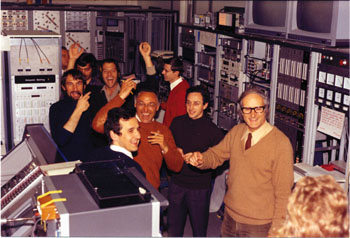
The then director, Jean-Pierre Blaser, and the late Hans Willax, the designer of the ring cyclotron concept, were seen with “silent glows” on their faces. Many years of considerable effort had finally been rewarded with success.
The “big run”, which was dedicated to the production of the first pions on the external target station, started in the early afternoon of 23 February 1974. Again, difficulties were encountered, which necessitated running on only three acceleration cavities in the main ring. However, the machine crew took up the challenge, and between 0.1 and 0.2 µA of protons soon reached the extraction radius.
The highlight came just after midnight on 24 February, when the first extracted protons were seen as a bright spot on a glass scintillation screen at the thin target station. A few minutes later the eagerly waiting physicists had their moment of truth: the first pions were detected at the end of the ¼M3 channel (which was tuned for positive particles of 300 ± 3 MeV/c).
The characteristic signature of protons and pions was seen on the oscilloscope and was confirmed via pulseheight spectra from a scintillatorCherenkov counter telescope. The first results yielded some 3000 positive pions per second for a proton current of 30 nA. It was a moment for celebration.
Today, 25 years later, the main Ring Accelerator is routinely running at more than 1.5 mA (15 times as great as the design current) with an increase to 2 mA planned. With the present 1 MW proton beam power, PSI has the most intense pion and muon beams in the world. This has yielded numerous first-class results over the years. These include:
the most precise values of the masses of the muon and the charged and neutral pion, in addition to the best “laboratory limit” on the mass of the muon neutrino;
in the rare and forbidden decay sector, which continues to be a specialist area of research at the facility, the most precise values have been established for the branching ratios of the pion into an electron and a neutrino; and into a muon a neutrino and a photon; and a muon into three electrons and two neutrinos;
the first observation of a pion decaying into three electrons and a neutrino, and hence the determination of the vector and the two axial-vector form factors of the pion;
in the search for lepton-flavoured violating processes, the most sensitive limits have been achieved for a muon decaying into three electrons (less than 10-12), for muon to electron conversion in nuclei (less than 6.1 x 10⁻¹³) and for muoniumantimuonium conversion (less than 8.2 x 10⁻¹¹);
other precision measurements, one of which is the measurement of the longitudinal polarization of positrons in muon decay, which together with the results from inverse muon decay, demonstrated that the VA structure of the weak interaction follows on as a natural consequence; also, the helicity of the muon neutrino was determined for the first time;
in the hadronic sector, the most accurate measurements of the delta (1232)** and delta (1232)0 masses and widths and the determination of the magnetic moment of the delta (1232)** have been made. Measurements in pionic hydrogen have yielded the strong interaction shift and width to unprecedented precision, from which the pionnucleon scattering lengths at threshold could be determined.
Special symposium
The anniversary was marked by a special symposium as part of the laboratory’s traditional half-yearly Accelerator Users Meeting.
The opening address was given by deputy director Ralph Eichler, who set the scene and outlined the present range of experiments at the Ring Accelerator, with the continuing trend towards larger and longer types of precision measurements.
Former director Blaser recounted the “Origins and Early Days of the Ring Cyclotron” with personal recollections and anecdotes. Then it was the turn of Claude Joseph (Lausanne), a long-standing experimenter at the facility, and Florian Scheck (Mainz), former head of the SIN Theory Group, to summarize physics milestones in the strong interaction and electroweak sectors respectively. This wealth of results is underlined by the number of corresponding entries in the Particle Data Booklet.
Finally, Jerzy Sromicki (ETHZ) gave a lively overview of the present tests of fundamental symmetries and future particle physics experiments that use neutrons from PSI’s spallation neutron source, SINQ, fed by the Ring Accelerator.
As one 25 year period closes, a new one will begin when the Swiss Light Source synchrotron radiation facility is commissioned.
In the beginning there were quarks and gluons the “quarkgluon plasma”. Density and temperature decreased as the universe expanded and cooled. The quarks and gluons began to freeze, forming subnuclear particles (protons and neutrons). These in turn stuck together to form nuclei. So goes the dogma.
To check whether or not this is true, experiments at CERN hurl beams of high-energy nuclei at targets to create hot, dense fireballs of protons and neutrons. These may be hot and dense enough for the protons and neutrons to melt and their component quarks and gluons to be released from their nuclear habitat.
Experiments using beams of lead ions at CERN’s SPS synchrotron have recently polished their results. Included is the NA50 study, which is looking at the production of J/psi particles. These particles are composed of a heavy (charmed) quark and an antiquark, which are bound together. They are more difficult to form when quarks and antiquarks are less likely to stick together. A clear signal of J/psi suppression was, therefore, greeted as the first resynthesis of the quarkgluon plasma since the Big Bang. However, some physicists are pointing out that this is not the whole story.
In any plasma (a gas of charged particles) the charge carried by any one particle is screened by those surrounding it. This is called Debye shielding. Quarks and gluons interact via the tripartite colour charge rather than the familiar dual (positive/negative) electrical charge.
It is this screening mechanism that prevents quarks from sticking together above a certain critical temperature, T0, and beyond a certain energy density, E0. Subnuclear particles melt under these conditions.
However, the J/psi, as the lightest particle containing charmed quarks, is very small and tightly bound. Therefore it melts at a slightly higher temperature, about 1.3T0. This apparently small temperature shift is amplified for the energy density, which behaves as the fourth power of temperature. Thus J/psis melt at energies of around 3E0, which is much later than most subnuclear particles.
Furthermore, J/psis are special because their constituent charm quarkantiquark pair will never recombine once the plasma fireball expands and cools. They lose contact with each other and adhere instead to other, lighter quarks to form D mesons. Light quarks in the plasma will recombine into protons, kaons, pions, etc.
NA50 sees the onset of J/psi disappearance in the most violent “head-on” collisions of lead ions (and only lead ions) at maximum SPS energy (158 GeV per nucleon). The energy density, therefore, must have reached about 3E0 in these collisions. Other experiments using lead ion beams, such as NA49, estimate from calorimetric measurements that the energy density achieved in these collisions is about 3 GeV per cubic fermi (1 fermi = 10-13 cm, which is the “diameter” of a proton). Tentatively combining these observations leads to the conclusion that the critical density, E0,is about 1 GeV per cubic fermi, which is in agreement with quarkgluon field theory calculations.
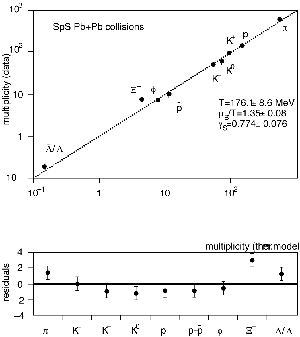
This can now be tested by the experiments using lead beams (NA44, NA49, WA89 and WA97). Reinhard Stock of Frankfurt points out that hadron production in these reactions can be reconciled with quarks and gluons combining at T0, which is near 180 MeV, and E0, which is near 1 GeV per cubic fermi.
Previous theoretical studies of the transition from a quarkgluon fireball to a subnuclear fireball by John Ellis of CERN and Klaus Kinder-Geiger (who died in last year’s Swissair plane crash) had set the stage. Their model set out to explain how different subnuclear particles containing quarks and gluons emerged from electronpositron annhilations.
They showed that the transition probability depends on statistical mechanics, so that the relative production levels of different subnuclear particles infers the temperature prevailing at their birth. This happens as the initial high-energy density quarkgluon fireball expands and cools towards the critical temperature at which the particles crystallize.
Thus, experiments with high-energy nuclear beams are recharting the Big Bang.
This month the first elements of the Very Small Array will be installed on Mount Teide in Tenerife. This is one of a number of new projects studying the cosmic microwave background.
Observations of the cosmic microwave background (CMB) are the closest that astronomers can get to the beginning of the universe. It dates from 300 000 years after the Big Bang, when radiation decoupled from matter. Fluctuations in the CMB are evidence for the first clumping of matter particles the seeds of the galaxies we see today.
The 14 antennae of the Very Small Array (VSA) will map small areas of the sky from 26 to 36 GHz with a sensitivity of 510 µK. The VSA will be capable of the two-dimensional mapping of real features and it is expected to be up and running by next summer.
By then, results from the Boomerang balloon experiment will be out. This experiment uses the polar wind to stay aloft and enables the balloon to circle the South Pole for more than 10 days. Thus it avoids the fate of other balloon experiments, which only have a short observation time. The VSA, with its greater resolution, will be able to follow up in more detail any areas of interest identified by the balloon. Balloon observations have different systematic errors than ground-based telescopes, so results are complementary.
Future projects include the US Cosmic Background Imager, to be installed in the Atacama desert, Chile, and the Degree Angular Scale Interferometer at the South Pole.
It is an interesting time for CMB observations. Following the great leap forward made by the COBE satellite in 1992, which measured the background fluctuations for the first time, years of data analysis and new ground-based experiments are providing fuller and more detailed results. A recent analysis of CMB data has even cast doubt on inflation the most stalwart theory of the early evolution of the universe. However, other investigations suggest that the discrepancy may be due to instrumental error. The VSA and Boomerang experiments will be in a position to find out.
The study of foreground microwave radiation has also progressed. New sources of microwave emission have been discovered, such as spinning dust grains in our galaxy. When this is better understood, it will make for more accurate CMB results. NASA’s Microwave Anisotropy Probe, which is scheduled for launch late next year, will perform the next all-sky survey as a follow up to COBE. At the other end of the spectrum, NASA’s X-ray satellite, Chandra, may provide crucial data with its observations of galaxy clusters, the largest scale clumping seen in the universe today. Cosmologists are hoping for some real advances. At worst, they will have to wait for the launch of ESA’s Planck satellite some time after 2007 .
The VSA is a collaboration between Cambridge University, Jodrell Bank and the Canary Islands Institute for Astrophysics. The Boomerang partners are the US and Italy, with contributions from the UK and CERN.
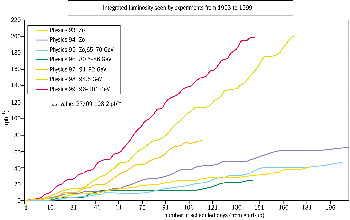
For the past two years, CERN’s LEP electronpositron collider has been performing better than ever. Each year sees new increases in collision energy and, just as important, new records in luminosity (a measure of the collision rate). Last year, LEP delivered about 200 inverse picobarns of luminosity to each of the four experiments and, as a result, almost quadrupled the collected data on W bosons (produced as oppositely charged pairs).
This year looks even more promising, with LEP reaching, and even slightly surpassing, the “magic” 200 GeV collision energy (100 GeV per beam). These new data have allowed the four LEP collaborations ALEPH, DELPHI, L3 and OPAL to extend and improve their studies at high energy. Of the many results presented recently at the EPS conference in Tampere, Finland, and the leptonphoton symposium at Stanford, the search for the Higgs boson and the measurement of the W mass were the highlights.
One of the first tasks in any new energy domain is to search for new particles. However, LEP is now exploring territory that could reveal the symmetry-breaking mechanism, at the heart of the Standard Model, that endows particles with mass (the “Higgs mechanism”). Although the Standard Model predicts that the Higgs particle should exist, unfortunately it says very little about its mass.
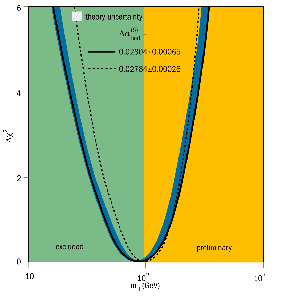
The Higgs should make its presence felt through delicate radiative corrections to the standard Z and W exchange mechanisms. These corrections have been studied in great detail by the LEP experiments, as well as by the SLD experiment at SLAC, Stanford, and the D0 and CDF experiments at Fermilab’s Tevatron protonantiproton collider. These studies indicate that the Higgs boson is relatively light. A fit to the LEP and SLC results on Z exchange, as well as the determinations of the W boson and top quark masses from LEP and the Tevatron, predict that the Higgs boson should be lighter than about 220 GeV, with a best fit at around 90 GeV. This is below the point where LEP is currently operating. A low-mass Higgs would be exciting. However, these suggestions are only indirect evidence.
The LEP experiments have been diligently searching for direct evidence of the Higgs since the beginning of LEP data taking. So far nothing has turned up. With no sign of a signal yet, the experiments express the non-observation as an upper limit on the Higgs production rate. At a given collision energy this depends on the Higgs mass and the upper limit on production rate can be converted into a lower limit on the Higgs mass.
Recently, following the example of the LEP Electroweak Working Group’s efforts to combine electroweak measurements, the LEP experiments have been combining their search results. The hope is that by combining the four experiments into a “meta-experiment”, with four times the luminosity, a signal might be detected that would be too small for an individual experiment to discover. Failing that, at least any mass limits could be increased.
Based on last year’s data, at a collision energy of 189 GeV, the combined lower limit on the Higgs mass from the four LEP experiments was 95.2 GeV. With the increased energy this year, the individual limits have also been increased to close to 100 GeV. It is too early to report on the combined limit. With the current limits so tantalizingly close to the value expected from the indirect evidence, the physicists at LEP are eagerly awaiting more data at even higher energies. The Higgs boson may be just round the corner.
W for weight
Compared with the lack of hard predictions on the Higgs boson, the Standard Model has somewhat more to say about the mass of the W boson. Via many of the same measurements that are used to constrain the Higgs boson indirectly, the experimenters (with a great deal of help from the theorists) have coaxed the Standard Model into predicting the mass of the W boson with an error of only 26 MeV (in 80 GeV). Now the challenge is to measure the W boson mass directly to the same accuracy, which will be a stringent test of the Standard Model.
This has been a major objective at LEP since 1996, when the energy was first raised above the threshold for producing pairs of W bosons. Since then the LEP experiments have been busy studying W bosons. Last year saw a fourfold increase in the LEP datasets, allowing the experiments to make dramatic improvements on the determination of the particle’s mass.
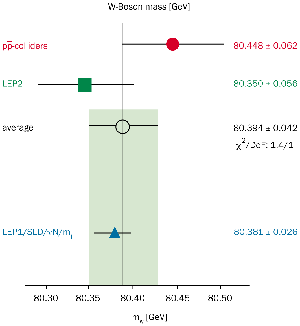
By now, each experiment has collected more than 4000 W pairs. With this amount of data the LEP experiments have been able to overtake their colleagues at protonantiproton colliders for the best direct W mass determination. The uncertainty on the LEP result is now 56 MeV, versus 62 MeV for the hadron collider result. Both measurements are in agreement with the indirect determination.
This year’s data will almost double the available statistics, and there are still more data to come next year. The LEP experimenters are hopeful that the final direct LEP W mass value will have an error of around 30 MeV, which is close to the error obtained indirectly.
The very first events were recorded by the LEP experiments on 13 August 1989. At that time the LEP energy was 91 GeV, which is right on the Z peak. Now, more than 10 years later and more than 100 GeV higher in energy, both the LEP machine and the LEP experiments are still going strong and the excitement is still mounting.
CERN is best known for pushing the high-energy frontier of physics, but, with its new Antiproton Decelerator, the low-energy frontier is about to resume its place at the heart of the laboratory’s experimental programme.
The Antiproton Decelerator (AD) is scheduled to switch on for physics this month, and an important milestone was reached this summer when, for the first time, the AD team decelerated a beam of protons to the AD’s target momentum of just 100 MeV/c.
It might seem strange that milestones for the AD are measured in terms of achievements with protons, but, as Flemming Pedersen of the AD team explained, “We already know how to make antiprotons. The real challenge is low fields.”
With an AD beam momentum of just 100 MeV/c, the magnetic bending fields, which hold the beam in orbit, are so low that even the magnetic field of the Earth must be taken into account. Protons are used instead of antiprotons in the setting-up phase because higher intensities can be achieved, which make for easier diagnostics.
Decelerating the beam
Beam particles enter the AD with a momentum of 3.5 GeV/c, which is about 35 times as high as when they leave it. The beam is rapidly decelerated to 2000 MeV/c before undergoing stochastic cooling. Reducing the energy further is a delicate task, owing to the origin of the AD’s components. The AD is not a purpose-built machine it has been assembled using components from the Antiproton Collector, the job of which was to collect antiprotons at 3.5 GeV for CERN’s historic protonantiproton collider project of the 1980s.
Bending magnets that are designed for constant 3.5 GeV operation are not ideal for the AD, where the field is constantly cycled. In particular,eddy currents, provoked by changing the magnetic field in the AD, can become large, and these can disturb the beam. To avoid this problem the momentum is reduced from 550 MeV very slowly.
When the beam reaches 300 MeV/c there is another pause. This time the technique of electron cooling, better adapted to very low-energy beams, is used. Like the magnets,the electron cooler is recycled. It came from CERN’s previous low-energy antiproton facility, LEAR, which was the world’s second application of the technique pioneered by Gersh Budker at Novosibirsk in the late 1960s.
For the final approach to 100 MeV/c, the beam is slowed down again. Here the Earth’s magnetic field has to be considered, along with remanent fields induced in the AD’s metallic components.
The main challenge in reaching 100 MeV/c was to produce very stable power supplies that would control eddy currents in the magnets. Soon after the 100 MeV/c challenge had been met, decelerating to 100 MeV/c had become routine and the AD was shut down to allow physicists to install the three experiments that will start taking data with the new machine.
When work resumed in September, the first task was to consolidate what had already been achieved with protons and to add a further electron-cooling stage at 100 MeV/c before the beams are extracted for delivery to experiments. Next on the agenda was reversing the polarity of the bending magnets to handle antiprotons. Some further setting up is expected because, as Pedersen pointed out, “We can’t reverse the polarity of the Earth’s magnetic field!”
To provide the best experiences, we use technologies like cookies to store and/or access device information. Consenting to these technologies will allow us to process data such as browsing behavior or unique IDs on this site. Not consenting or withdrawing consent, may adversely affect certain features and functions.
Functional
Always active
The technical storage or access is strictly necessary for the legitimate purpose of enabling the use of a specific service explicitly requested by the subscriber or user, or for the sole purpose of carrying out the transmission of a communication over an electronic communications network.
Preferences
The technical storage or access is necessary for the legitimate purpose of storing preferences that are not requested by the subscriber or user.
Statistics
The technical storage or access that is used exclusively for statistical purposes.The technical storage or access that is used exclusively for anonymous statistical purposes. Without a subpoena, voluntary compliance on the part of your Internet Service Provider, or additional records from a third party, information stored or retrieved for this purpose alone cannot usually be used to identify you.
Marketing
The technical storage or access is required to create user profiles to send advertising, or to track the user on a website or across several websites for similar marketing purposes.