Stars are formed from huge masses of gas and dust. From fluctuations, a centre forms and then, under gravity, more and more matter gradually accumulates until a core is formed, which attracts more gas and dust. This core a protostar will get hotter. Under the effect of gravity, the protostar will contract and, if the core is big enough, nuclear reactions (fusion) will cause it to ignite. Thus a star is born.
Multiple star systems
This is how I used to imagine that stars were formed. When I looked up at the sky, I saw our Sun as a solitary star and the sky full of single stars. The idea of binary star systems with two stars rotating round one another seemed quite unnecessary. It therefore came as a shock when I learned that only 15% of stars are single, while 65% are in binaries and the remaining 20% are in clusters of three or more. This seemed contrary to the concept of a big cloud of gas and dust condensing.
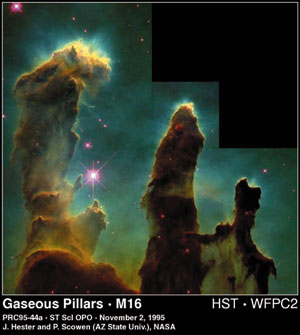
For me, the explanation came in an early photograph from the Hubble Space Telescope (figure 1). It showed a star-forming region of Freudian complexity that explains the birth of multiple star systems. We are fortunate that our star is a solitary one.
When the Sun was born, some 4600 million years ago, its gas was composed of 72% hydrogen, 24% helium and the remainder was a variety of elements, which had been formed almost entirely in supernova explosions and then blown out into space. The mass of the Sun is 2 x 1027 tons, or 2000 million million million million tons.
When a star is formed, its contraction makes it spin faster (like an ice skater pulling in his or her arms). Such a T Tauri star is distinctively bright for its mass. However, as it spins, it throws off mass, losing some 2000 million million million tons every year. It soon slows down, and today our Sun is losing some 20 million million tons per year (or 700 000 tons per second) as solar wind.
Solar flares
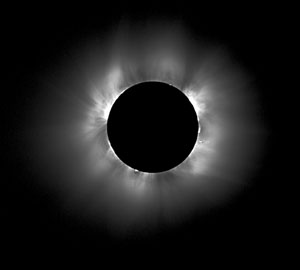
This stellar erosion can be seen during a total solar eclipse. The radius of the Sun is about 700 000 km, so the easily visible part of the solar wind, seen during an eclipse, extends out from the surface by more than a million kilometres. Occasionally a large flare will occur. An example of this is shown in figure 2.
The fate of a protostar core depends on its mass. If the protostar weighs less than 0.08 solar masses, the temperature of the core is not high enough to initiate nuclear fusion reactions and the protostar remains as an inert Brown Dwarf.
If the protostar weighs more than 8 solar masses, something new happens: the density of the core becomes so great that the inner 100 km or so of the star collapses within a few milliseconds, and the resulting ionized plasma is compressed into neutrons. Such a neutron star has an enormous density about 100 million tons/cm3.
The sudden collapse of the core generates a shock wave that compresses the neutron star even further. This rebounds, and the outward-moving shock wave then hits the remainder of the star, which, meanwhile, has hardly moved. The blast blows the shell apart and ignites it to produce the visible supernova.
If the star so formed is still massive about 20-30 solar masses then the neutron star can collapse further to give a black hole.
The basic reaction that initiates star formation is the fusion of two hydrogen nuclei (protons) to form deuterium, followed by the deuterium rapidly combining with another hydrogen nucleus to give helium-3. This happens very quickly the deuterium only exists for a second before fusing with a proton. One could say that the deuterium acts as a catalyst, which converts three nuclei of hydrogen into helium-3. The helium-3 is then converted into a stable helium-4 nucleus via several routes.
Helium-4 is very stable and is generally the end of the chain. To go further, an unusual fusion reaction needs to take place between three helium-4 nuclei to give carbon-12. This can further react to give nitrogen and oxygen. This is called the CNO cycle. The next element, fluorine, can then be formed in the NOF cycle.
The Sun, which is essentially a plasma with no rigid structure, is fuelled mainly by hydrogen in its core, which is at a temperature of 15 million degrees centigrade. Its density decreases rapidly with distance from the core, where it is about 150 g/cm3. At the surface, the density is only a millionth of a gram per cubic centimetre and the temperature is about 5500 °C.
Bright future
As the Sun continues to burn, the temperature will rise and the core will contract, which raises the temperature even higher and makes the envelope expand. Eventually the Sun will become a Red Giant, at which point most of the hydrogen in the core is burned.
Then the core will contract further and become steadily hotter and hotter until it reaches a hundred million degrees centigrade. At this point the helium-4 will ignite and carbon-12 will be formed in a thermonuclear explosion. For the following 100 million years, the star will continue to be very bright.
The carbon can provide extra nuclei of helium-4 to generate oxygen-16 and neon-20, etc (the CNO and NOF cycles will not occur because the necessary hydrogen has already been consumed). Next, the carbon and oxygen will burn, but the thermonuclear furnace will eventually cut out and the core will become inert.
However, outside the core, the remaining hydrogen and helium gas will continue to burn for some time. This will drive off much of the gas and eventually the star will become a White Dwarf with a remnant mass of about half that of the Sun. This hot star will be visible for billions of years, but will eventually cool and become an invisible Black Dwarf.
When our Sun becomes a Red Giant, its expansion will first swallow Mercury (58 million kilometres away), absorb Venus (108 million kilometres away), engulf the Earth (150 million kilometres away) and finally approach Mars (228 million kilometres away).
Fortunately for us this fate is about 5000 million years away. The Sun is a vigorous adult star that still has a brilliant future.
Heavy particles are hard to come by. As a result, precision measurements in this sector are widely admired and highly prized. This physics was a main focus at the International LeptonPhoton Symposium in Stanford. Existing experiments are homing in on the production of particles containing heavy quarks, and a series of major new experiments is being developed.
Spearheading this new generation of experiments are the B-factories at SLAC, Stanford and the Japanese KEK Laboratory. The electronpositron annihilations in these colliders PEP-II and KEKB respectively are a rich source of – particles that contain the fifth (“beauty”, “bottom” or simply “b”) quark. The decays of these B particles should reveal new insights into CP violation the subtle symmetry breaking assumed to be responsible for a matterantimatter symmetric Big Bang, which eventually produces a visible universe composed entirely of matter.
The other B physics players in the race include, notably, Cornell’s CESR electronpositron collider, which is equipped with the CLEO detector. CESR and CLEO have been working in tandem for some 20 years and have made a series of landmark contributions to B physics. Experiments at CERN’s LEP electronpositron collider have also made many valuable contributions to this work.
In the wings of the B stage is the HERA-B experiment at DESY, which uses the proton ring of the HERA collider. Fermilab’s Tevatron remains a source of a copious amount of heavy particles. Significant B physics potential is provided by the CDF and D0 detectors at Fermilab’s Tevatron protonantiproton collider, which is now fed by the new Main Injector. Detector upgrades and collision rate improvements will ensure that the Tevatron remains a focus of B physics.
For the future, the LHCb experiment at CERN’s LHC collider and the BTeV project at Fermilab are getting their acts together.
After a “Brief report from the B-factories”, an introduction to the leptonphoton symposium, attention was focused on heavy-quark physics. Ronald Poling of Minnesota showed how the experiments at CERN’s LEP electronpositron collider have charted semileptonic decays. The B physics scenarios, which have been explored at LEP at high energy and by CLEO at CESR via upsilon decays, are becoming increasingly reconciled with the LEP scenario, which is closer to theoretical predictions.
In measuring the parameters that describe the various interquark decays, CLEO has made charmless B decay (b quarks that decay directly into light quarks) its special hunting ground. In the more usual b decays (into charmed quarks) measurements from different experiments are converging.
While describing heavy-quark lifetimes and mixing, Guy Blaylock of Massachusetts highlighted valiant efforts to measure and understand why different charged states of heavy quarks have different lifetimes. In the present parametrization of quark decays, the mixing of B quarks is expected to be large, while that of D (charm) quarks is expected to be small. The former, says Blaylock, will lead to better measurements of the existing scheme, while the latter will provide a window for new physics effects.
And so to CP violation the subtle violation of a symmetry that, ideally, should reflect a particle into a mirror image of its antiparticle and vice versa. Two major experiments have recently announced new measurements of “direct” CP violation (CERN Courier September) brought about by quark transitions. Edward Blucher of Chicago spoke for the KTeV study at Fermilab and Giles Barr of CERN for the NA48 experiment. CERN experiments have had quantitative evidence of this effect since 1993, while a contemporary Fermilab experiment had published a result compatible with zero direct CP violation. After many years of anguished doubt, direct CP violation now looks here to stay. However, the years of dilemma underline the difficulty in making these measurements. With the objective of measuring direct CP violation to within 5%, both experiments have a lot more data to analyse. The CERN study continues.
Sergo Bertolucci described how the KLOE detector, at the new DAFNE phi factory at the Italian Frascati Laboratory, will explore additional aspects of neutral kaon physics via phi decays and could round off the kaon picture. Hopefully, B physics will soon open a new, and wider, window on CP violation, which has so far been confined to the strange world of the neutral kaon.
Complementary to the heavy quark is the heavy tau lepton, which is the only weakly interacting particle heavy enough to decay into strongly interacting particles. Tau specialist Antonio Pich of Valencia surveyed the tau scene at Stanford. Tau physics at electronpositron colliders, including spin effects, provides a valuable laboratory in which to explore the physics of weak interactions and the behaviour of heavy quarks.
“B decays, the unitarity triangle and the universe” was the challenging title assigned to Adam Falk of Johns Hopkins for his review of heavy-quark physics. The interrelation of the various possible quark decays has a self-consistent parametrization (the CabibboKobayashiMaskawa matrix), which gives some degree of predictive power but cannot be derived from first principles. What makes it work?
The imaginative title was a reference to the current dogma that CP violation, a mechanism that is much studied and well documented but still not entirely understood, is ultimately responsible for the disappearance of the antimatter half of the Big Bang.
The new B sector will subject this physics to much wider scrutiny and could reveal as yet unseen effects. Falk asked if the necessary formalism was ready to enable all of these processes to be analysed consistently.
At the turn of the millennium, heavy-quark physics is also poised to enter a new era.
In the late 1960s, when experimentalists using electron beams at SLAC, Stanford, discovered that the proton contained tiny scattering centres, a new type of physics opened up: deep inelastic scattering (DIS). Ever since, physicists have tried to peer deeper and deeper into the depths of the proton. The work of the HERA electronproton collider at DESY, Hamburg, was to probe this inner proton structure in more detail than had ever been done before.
This is one of the great success stories of HERA. However, to capitalize on this new window on the proton also calls for intense study and coordinated effort. After the advent of HERA, about seven years ago, a series of specialized workshops began.
Scattering involving the constituent “partons” hidden inside the proton is the natural scenario for quantum chromodynamics (QCD), which is the field theory of the constituent quarks and gluons. DIS99 (the seventh DIS conference) was hosted by DESY Zeuthen, south of Berlin, earlier this year.
New results from the HERA collider experiments were summarized by Bernd Löhr (DESY) for ZEUS and by Tancredi Carli (Munich) for H1. Cecilia Gerber (Fermilab) reported on the Tevatron experiments and Roland Windmolders (Mons) reviewed spin physics results. Recent developments in QCD were summarized by Willy van Neerven (Leiden). Two days of parallel sessions focused on structure functions, diffraction, final states and spin physics.
The working group on structure functions was conducted by Ursula Bassler (Paris), Eric Laenen (NIKHEF), Arnulf Quadt (CERN) and Heidi Schellman (Northwestern).
Structure functions
HERA probes low x, which is the momentum fraction carried by the struck quark, down to about 10-6. New precision is accompanied by impressive theoretical work on the gluon dynamics in this domain and on the transition between the deep inelastic and the photoproduction regimes.
Standard perturbative QCD field theory has no apparent difficulties in accounting for the behaviour of the proton structure down to surprisingly low values of x and of momentum transfers (Q2). Efforts are under way to extend QCD calculations, covering the “next to next to leading order”. This is a challenging task, which will substantially reduce the theoretical uncertainties.
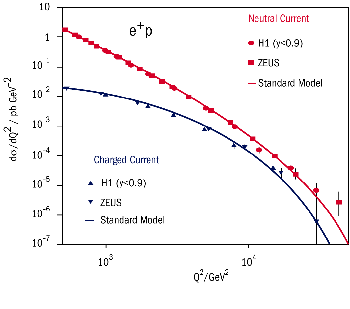
The emerging role of HERA as a machine for precision tests of QCD is comparable to that of CERN’s LEP electronpositron collider for testing the electroweak theory. With increasing HERA collision rates, the data at large Q2 approach the region where proton structure is probed by the W and Z weak bosons and the gluon and quark distributions become measurable even at large x, where uncertainties are currently still sizable.
The puzzling excess of high Q2 events at large x, which were first observed by H1 and ZEUS in 1997, was reported to be reduced after more data had been accumulated. The many new results from various sectors led Heidi Schellman to conclude that the “rest of the world keeps up with DESY”.
Diffractive interactions
The working group on diffractive interactions was organized by Mike Albrow (Fermilab), Riccardo Brugnera (Padova), Markus Diehl (DESY) and Douglas Jansen (Heidelberg). One early observation at HERA was that about 10% of electronproton events have little to show in the forward, proton direction. The electron interacts with something accompanying the proton rather than the proton itself. This stimulated the revival of interest in “diffractive” scattering.
Impressive new data should lead to a better understanding of this diffractive deep inelastic and photoproduction scattering. Theoretical work showed that the diffractive electronproton interaction, as for other hard-scattering processes, factorizes into a convolution of a parton distribution with an elementary scattering process. In hard hadronhadron processes, however, additional soft interactions between the two initial hadrons can occur. Such interactions are expected to suppress the diffractive effects. This may explain the apparent differences between the HERA and Tevatron (protonantiproton) measurements. Successful attempts were reported to implement diffractively produced string topologies into the simulation of the electronproton interaction final state.
The session on hadronic final states was another example of the fruitful collaboration between the HERA, LEP and Tevatron experiments. The session was coordinated by Marcello Cacciari (CERN), Frank Chlebana (Fermilab), Laurel Sinclair (Glasgow) and Mark Weber (Heidelberg). Deep inelastic processes producing two narrowly confined sprays of particles (“dijets”) were used to determine the gluon distribution at large x by the H1 experiment and the quarkgluon interaction coupling constant by the ZEUS experiment. Inclusive jet production at the Tevatron provided a new determination of this quantity, comparable to previous fits of deep inelastic scattering structure.
Dijet production also reflects the quarkgluon structure of the photon, and LEP and HERA data were presented on the gluon content of the photon. Some photon distribution parametrizations require revision owing to new measurements of the virtual photon structure. Isolated leptons with high transverse energy, observed by H1, so far have no conclusive interpretation. Theoretical and simulation work focused on the low x region and the description of gluon emission.
Spin physics
The parallel session on spin physics was organized by Michael Düren (Erlangen) and Werner Vogelsang (Stony Brook). Among new experimental results was the first indication of a positive gluon polarization, obtained from unlike charged pairs of hadrons produced at large momentum transfer, and the unexpected observation of a spin asymmetry in rho-meson production by the new HERMES experiment at HERA.
Data from SLAC (Stanford), CERN and DESY experiments determined the spin structure function. Its behaviour is in agreement with QCD. These measurements, as well as results from SMC and HERMES, allow the polarized up and down quark distributions to be determined accurately at larger x. However, the polarized gluon distribution is not yet known and the unaccountability of the proton spin in terms of its constituents the “spin crisis” remains. Its resolution will require data from the upgraded HERMES experiment and from the next generation of polarization experiments COMPASS at CERN and STAR/PHENIX at the polarized RHIC collider in order to disentangle the quark and the gluon contributions to the proton spin.
The future of DIS
A special session looked at the future of deep inelastic scattering. The first presentation, by Jorge Morfin (Fermilab), reported Fermilab’s plans for future neutrino experiments using the NuMI beam, and studies of neutrino beams from a muon collider. Dietrich von Harrach (Mainz) explained how spin physics could be extended to low x and high Q2 as well as to the polarized photon structure by accelerating polarized protons in HERA. Another future HERA option, as emphasized by Mark Strikman (DESY/Pennsylvania state), is the acceleration of nuclei in order to study electronneutron scattering in the HERA kinematic range, as well as other nuclear phenomena using heavy nuclei, which cannot be accessed with the currently attainable beam energies in electronproton collisions.
To mark DIS99, HERA ran at the record luminosity of two inverse picobarns per week. Albrecht Wagner (DESY) reported on the preparations to quadruple HERA’s luminosity during next year’s shutdown and presented DESY’s showcase TESLA, a superconducting linear electronpositron accelerator in the 500 GeV to 1 TeV range, which could be combined with an X-ray free-electron laser. Wagner and Yves Sirois (Paris) pointed out that TESLA could also be used to collide electrons of up to 500 GeV with protons in HERA of nearly 1 TeV, which would allow the inner structure to be explored down to 2 x 10-19 m. DESY has initiated a study of this option in the TESLA technical design report.
Erwin Gabathuler (Liverpool) summarized the workshop. The low x behaviour, which is measured with increasing precision by the HERA experiments, is essential in understanding what happens at high gluon densities, and also to predict reliably what will happen to CERN’s LHC interaction rates. Increasing precision leads to crucial tests of QCD, including unexplained events at extremely high Q2 and transverse energy. Machine and detector upgrades lead HERA into the next millennium with a challenging mid-term programme to use electroweak interactions for probing the nucleon structure. The next DIS conference will take place in Liverpool next April.
The proceedings of DIS99 are dedicated to the memory of DESY director Bjoern Wiik, who died in February. His outstanding personality and scientific achievements were recalled by Aharon Levy (Tel Aviv), chairman of the workshop’s international advisory committee, and Brandenburg minister of culture and research Steffen Reiche, who underlined the importance of realizing Bjoern Wiik’s vision, which led to the creation of HERA and has shaped, so decisively, the plans for TESLA.
The Z pairs are the latest addition to a physics gallery that was opened 21 years ago when an experiment using a polarized electron beam at SLAC, Stanford, provided the first firm evidence that nature included a synthesis of weak and electromagnetic interactions.
This landmark experiment succeeded in measuring the delicate interference effects between processes mediated by electromagnetic photons and those mediated by the Z (the electrically neutral carrier of the weak force). Soon after, Abdus Salam, one of the architects of the unified picture, coined the term “electroweak”.
Five years on, at CERN’s protonantiproton collider, the Z came out into the open. In 1989, CERN’s new LEP electronpositron collider and the SLC linear collider at SLAC were being commissioned and the stage was set for a new kind of physics precision studies of the electroweak interaction using Z particles.
At the 1989 LeptonPhoton Symposium at Stanford, SLC physicists reported finding 233 Zs. LEP reported 10 000 Zs in October.
A decade later, this year’s leptonphoton meeting returned to Stanford. Morris Swartz of Johns Hopkins, who reported on precision electroweak physics with Z particles, had 18 million Zs to draw on, amassed, mainly, by the four LEP experiments from 1989 to 1995, before LEP’s energy was increased. The SLC went out in a blaze of glory last year (CERN Courier October 1998) and, with LEP exploring pastures new, these 18 million events will probably remain the bulk of the world’s Z physics archive for some time.
From the Z discovery in 1983 until the advent of LEP and the SLC in 1989, colliders at CERN and Fermilab enjoyed a monopoly on Z physics. This monopoly continued for the W, the electrically charged counterpart of the Z, until 1996, when LEP’s energy was increased sufficiently for experiments to record their first W pairs.
At Stanford this year, David Charlton of Birmingham reported on electroweak physics from LEP2 (LEP operating at or beyond the threshold for producing W pairs). The W mass fix from LEP is 80.35 ± 0.056 GeV, which is now more accurate than the Fermilab Tevatron fix and reflects the shifting focus of W physics. Even greater accuracy is obtained via indirect measurements from the latest round of neutrino experiments at Fermilab.
Using this and other input, electroweak consistency arguments strongly hint that the mass of the Higgs particle, which is responsible for the subtle symmetry-breaking mechanism at the heart of the electroweak mechanism, is lighter than 300 GeV.
At its new energies, LEP is able to probe the interaction of electroweak carriers among themselves, for example via WWZ and WW-photon mechanisms. (A fuller report of LEP2 physics achievements will be published shortly.)
Fermilab’s Tevatron protonantiproton collider still enjoys exclusive coverage of the sixth top quark, which was discovered in 1995. The latest mass fix, reported at Stanford by Mark Lancaster of Berkeley, is centred at 174.3 GeV. Electronpositron machines cannot see the top quark directly, but can infer its presence indirectly. The LEP electroweak consistency fit gives a compatible top quark mass.
After 10 years of precision electroweak physics, the Higgs particle now looms large. However, with LEP’s radiofrequency powerhouse working at full stretch, there is still a chance that LEP could deliver the Higgs before the machine is finally switched off next autumn.
Neutrinos, which interact only via the weak force, may be the purest form of lepton and deserved to be in the spotlight at the International LeptonPhoton Symposium at Stanford. Neutrino physics questions are frequently unresolved and are even controversial, like Pauli’s prediction of a particle that hardly interacts at all. Neutrino physics has lived up to this reputation ever since.
Neutrinos can “oscillate” from one kind of neutrino to another
Last year, data on neutrinos generated by cosmic-ray collisions in the atmosphere ushered out the old orthodox view that neutrinos are massless particles. Endowed with mass, the three kinds of neutrinos electron, muon and tau are not immutable and can “oscillate” from one kind of neutrino to another. This year the neutrino results presented at the International LeptonPhoton Symposium showed that this view has now firmly taken root.
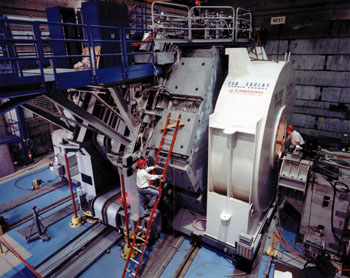
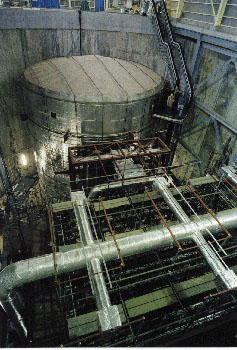
The 1998 paradigm shift was the outcome of the release of initial data from the 50 000 tonne Super-Kamiokande underground neutrino detector in Japan. The effect a deficit of muon neutrinos measured by the Super-Kamiokande detector had been known since the early 1980s from smaller experiments. However, the Super-K signal inspired physicists with new 50 000-tonne confidence. One year down the line this confidence seems complete.
Atmospheric neutrinos are not alone in oscillating. The dearth of neutrinos from the Sun an effect known for 30 years was initially attributed to the innate difficulties of neutrino experiments and of estimating the radiative neutrino power of the Sun rather than the neutrinos themselves.
In his presentation, Yoichiro Suzuki of Tokyo asked why solar neutrino experiments, which were the first to detect neutrino deficits, had not claimed the discovery of neutrino oscillations. The reasons, observed Suzuki, were the uncertainty of gauging the solar neutrino flux and the difficulty in providing a unique oscillation solution.
Flux-independent indicators, such as a systematic difference between the daytime and night-time signal and a spectrum revealing the way that neutrino behaviour changes with energy, would provide a more reliable indication. However, these were not forthcoming from the pioneer experiments.
Neutrino oscillation looks like it is here to stay
Super-K has amassed 825 days of logged solar neutrino data, and the daynight rates differ by 6.5% (albeit with an error of almost 50%) a possible indication of solar neutrino effects owing to neutrino transitions occurring while they pass through the Earth. The energy spectrum does not look flat.
The Sudbury Neutrino Observatory in Canada will soon provide valuable new data on additional reactions of solar neutrinos via the neutral as well as the charged current of weak interactions.
At Stanford, Tony Mann of Tufts covered the atmospheric neutrino sector centre stage since the Super-K results of 1998. As well as the Super-K water Cherenkov detector, the Soudan II sampling calorimeter in the US and the Macro muon detector in the Italian Gran Sasso laboratory are also adding their weight.
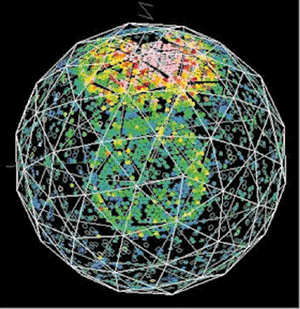
The angular distribution of Super-K signals, originally displayed in only five angular bins now extended to ten clearly show the sharp deficit of muon neutrinos travelling upwards, after having passed through the Earth before hitting the detector.
Neutrino oscillation looks likes it’s here to stay, but the nature and parameters of the oscillations have yet to be determined. Studies using neutrinos from reactors and from accelerators are playing a key role. At Stanford, Luigi Di Lella of CERN was the reviewer.
The Chooz (pronounced “Shaw”) reactor experiment in France provided key results that limited the possibilities for the disappearance of electron-type neutrinos over a 1 km flight path from the reactor to the detector. The Chooz experiment has now completed its mission but another, at Palo Verde in the US, continues to take data.
As for neutrino experiments at accelerators, a long-standing feature has been results from the LSND study at Los Alamos and the Karmen detector at the UK Rutherford Appleton Laboratory on the appearance, or otherwise, of (anti)electrons from a beam of muon (anti)neutrinos. The former “sees” a signal, the latter does not, but the two results are not entirely incompatible the regions accessed by the two experiments (and others) do not coincide totally. Thus, the oscillation signal suggested by LSND cannot be ruled out. Making this effect consistent with the rest of the neutrino data is highly constraining, according to Hamish Robertson of Washington in his subsequent review of neutrino mass and oscillations.
A feature of current neutrino dogma is that the bizarre “sterile” neutrinos, which do not react, could sap the power of other neutrino beams as their non-sterile particles oscillate out of sight. Some physicists are openly sceptical of the LSND result. Di Lella dutifully surveyed the experiment’s track record but found no cracks.
Chorus and Nomad at CERN had set out to see the production of tau neutrinos from an accelerator-produced beam mainly composed of muon neutrinos. Both studies have completed data taking, although Chorus has not yet analysed all of the interaction triggers in its emulsion target. With no tau production yet seen, the contours showing the limits on neutrino mass difference and mixing parameters can be extended substantially.
A major new player on the neutrino scene will be the MiniBoone experiment, which uses a beam derived from the Fermilab booster. This should definitively confirm or refute the LSND result.
To explore the remaining allowed oscillation territory, the emphasis also turns to “long baseline” experiments in which neutrino beams from accelerators travel over several hundred kilometres before reaching the main neutrino target.
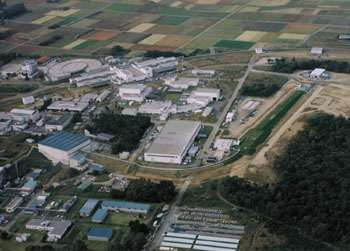
The K2K experiment using beams from the Japanese KEK laboratory and the Super-K detector has now started, while the MINOS study will cover a longer baseline and use higher-energy particles. The KAMLAND experiment in Japan (CERN Courier April) will look for interactions from neutrinos emitted by nuclear reactors more than 100 km away.
With questions unanswered and several projects under way, with more at proposal stage, and the fact that the implications of the results are of importance for our understanding of the universe, neutrino physics will maintain interest well into the next century.
Both SLAC in Stanford and the Japanese KEK Laboratory are beginning physics research with new B-factories. The electronpositron annihilations in these colliders are a copious source of B-particles, so called because they contain the fifth “beauty”, “bottom” or simply “b” quark. The decays of these B-particles are expected to reveal new information about CP violation the subtle symmetry breaking widely thought to be responsible for a Big Bang that was matterantimatter symmetric, which eventually produced a visible universe composed entirely of matter.
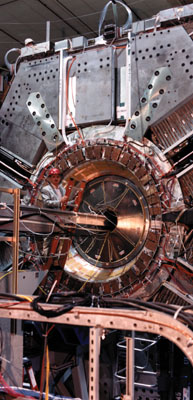
The factories PEP-II at SLAC and KEKB at KEK use the BaBar and BELLE detectors respectively to study the decays of B-particles.
This new effort for B physics was an overture for the International LeptonPhoton Symposium in Stanford (p6). Jonathan Dorfan, then SLAC director designate, described the PEP-II and BaBar programme. Fumihiko Takasaki of KEK described KEKB and BELLE.
However, there are other B-physics players. Klaus Honscheid of Ohio State covered the programme at Cornell’s CESR electronpositron collider equipped with the CLEO detector. CESR whose collision rate has continually been boosted and CLEO now undergoing its third major facelift have been working in tandem for some 20 years and have made pioneer contributions to B physics.
Warming up on the B touchline is the HERA-B experiment at DESY using the proton ring of the HERA collider. Michael Medinnis of DESY-Zeuthen outlined the detector effort under way en route to scheduled completion next year.
Manfred Paulini of Berkeley sketched the B physics potential of the big CDF and D0 detectors at Fermilab’s Tevatron protonantiproton collider, now fed by the new Main Injector. Also from next year, detector upgrades and collision rate improvements are set to ensure that the Tevatron remains a focus of B physics.
Major contributions also come from LEP at CERN. Not described in the LeptonPhoton Symposium presentations but gearing up for longer-term contributions are the LHCb experiment at CERN’s LHC collider and the BTeV project at Fermilab.
The visible universe is composed of matter particles protons, neutrons and electrons rather than their antimatter partners antiprotons, antineutrons and positrons. If the Moon were composed of antimatter, then lunar probes and astronauts would have vanished in a fireball of energy as soon as they touched the lunar surface. The solar wind and cosmic rays do not destroy us, implying that the Sun and the Milky Way are also made of matter.
If there were any region of antimatter within our local cluster of galaxies, we would be able to see radiation from matter-antimatter annihilations at the boundaries. Moreover, the cosmic microwave background radiation shows no signs of disturbance by subsequent annihilation radiation, suggesting that there are no large regions of antimatter within at least 10 billion light years and perhaps the whole visible universe.
The Big Bang should have created equal amounts of matter and antimatter. Why is there now so much of one and so little of the other? CP violation an obscure effect seen only with certain kinds of elementary particles could provide the answer.
Enter CP violation
A recent article by Gerry Bauer set the CP violation scene. In 1964, James Cronin, Val Fitch and collaborators discovered that the decays of neutral kaons did not respect the symmetry known as CP the combination of particle-antiparticle (charge conjugation C) and mirror (parity P) symmetry.
It had been known since 1957 that weak interactions violate both the C and P symmetries neutrinos spin left-handedly, whereas their antiparticles (antineutrinos) exist only in right-handed form. Despite this maximal violation of C and P, it had been thought that they were always violated together so as to respect the combination CP.
However, the Cronin-Fitch experiment showed that this could not be exactly true. What is the connection between this abtruse property of elementary particles and the matter dominance of the universe? A possible answer was provided by Andrei Sakharov in 1967. He laid out three conditions that would enable a universe containing initially equal amounts of matter and antimatter to evolve into a matter-dominated universe, which we see today.
Microphysics and macrophysics are now yoked together, pulling scientific explorers across the untracked expanses of the cosmos
The first requirement was that the proton - the bedrock particle of nuclear matter - should be unstable. The second was that there would be interactions violating C and CP, as shown by Cronin and Fitch, that would open up the possibility that the universe’s initial exact matter-antimatter symmetry could be upset. The third condition was that the universe would undergo a phase of extremely rapid expansion: otherwise, matter and antimatter particles, having equal masses, would be fated to pair up with equal densities.
If a cosmological matter-antimatter asymmetry could be built up in this way, all of the remaining antimatter particles would annihilate later in the history of the universe, leaving behind matter particles and radiation, as observed today.
Sakharov’s landmark paper provided the conceptual framework for generating a matter universe, but it has fallen to subsequent generations of physicists to explore specific mechanisms realizing his ideas, opening up some possibilities and excluding others. Key roles in this exploration are being played by recent experimental results from CERN and Fermilab, and new data from SLAC, KEK, Cornell, DESY and Frascati may soon be making important contributions.
The favoured theoretical framework for CP violation was provided in 1973 by Kobayashi and Maskawa, who pointed out that CP violation would follow automatically if there were at least six quark flavours. Measurements in the neutral-kaon system and elsewhere are all consistent with this being the only source of CP violation, although they leave room for other sources, which inventive theorists continually propose.
GUT feeling
Also in 1973, Pati and Salam, and Georgi and Glashow, proposed grand unified theories (GUTs) containing new interactions that allowed for proton decay. Such decay would violate the conservation of baryon number the total number of strongly interacting particles minus the number of antiparticles. So far, dedicated searches in such large underground detectors as Super-Kamiokande have not seen any evidence for this. However, the evidence that they have found for neutrino masses suggests that interactions that violate lepton number (the total number of weakly interacting particles minus the number of antiparticles) do exist. This is another key prediction of many GUTs, and may even play a role in generating the matter in the universe, as discussed later.
In 1978, CP violation and GUTs were combined by Yoshimura in a proposal for generating the matter asymmetry of the universe via the decays of massive particles. His idea was that, if they produced a CP-violating excess of quarks in their decays, this would evolve into the matter that we see in the universe today. Unfortunately, it was soon realized that the minimal GUTs originally proposed would yield too small an excess of quarks, so the GUT would need to be expanded to produce the amount of matter particles that are observed in the universe today: 10-9 of the number of photons.
It was suggested that the extra CP violation required might also generate a neutron electric dipole moment large enough to be detected. (Although a neutral particle, the neutron could contain an asymmetric distribution of equal and opposite positive and negative charge.) However, a long experimental campaign currently led by an experiment at ILL Grenoble limits this to less than 6 x 10-26 e cm, analogous to the Earth’s surface being smooth and symmetric to less than 1 µm.
By then, theorists had developed new ideas. One idea was that the strong interactions might also violate CP. The fact that this has not been seen led to the postulation of the axion, which might be a component of the universe’s dark matter.
Weak washout
The other surprise was that electroweak interactions could also change baryon number. This does not happen via the exchange of a specific particle. Instead it arises from coherent fields with non-trivial topological properties. These non-perturbative electroweak interactions provide both a challenge and an opportunity. The challenge is that they might “wash out” any matter density that is built up by GUT particles. The opportunity is that they might enable the matter density to be built up by the electroweak interactions alone.
One way to avoid the weak washout is to have the GUTs generate a net density of leptons, which the additional weak interactions would then recycle into baryons. One such scenario, proposed by Fukugita and Yanagida, relies on the decays of heavy right-handed neutrinos in the early universe. Some indirect support for this scenario comes from recent experimental hints that the known light neutrinos can mix (oscillate) and have masses, which could be due to mixing with such heavy neutrinos. At least some neutrino models that fit the neutrino data are also able to generate the matter in the universe. Another weighty implication of the new neutrino data?
As a GUTless alternative, perhaps the matter in the universe was generated when the cooling of the universe triggered a phase transition
As a GUTless alternative, perhaps the matter in the universe was generated when the cooling of the universe triggered a phase transition enabling quarks and the W and Z carriers of the weak force to acquire their masses from the Higgs boson? This electroweak mechanism would require the phase transition from a hot universe with massless particles to the present state with massive particles to have been abrupt, so as to meet Sakharov’s third requirement.
Unfortunately, the Higgs boson has not yet shown up at CERN’s LEP electron-positron collider, implying that it weighs more than about 100 GeV and that the electroweak phase transition was too weak to allow the matter of the universe to be generated this way.
However, the door is not yet closed. For example, a supersymmetric scenario, with new “sparticles” partnering the known particles, might provide a suitable abrupt transition, and also contain additional CP-violating effects that could generate a suitable matter density. These supersymmetric options suggest that LEP, which is now operating at higher energy, might produce a Higgs boson this year or the next. If LEP is lucky, this could also have weighty implications for the universe.
CP in the laboratory
One of the great attractions of such GUTless models is the possibility that they could be tested in laboratory experiments on CP violation. This exciting prospect has been underlined by the recent confirmation, by the KTeV experiment at Fermilab and by NA48 at CERN, of direct CP violation the decay of neutral kaons into two pions first measured by the NA31 experiment at CERN . The magnitude of the effect is surprisingly large.
Another possible observation of CP violation has recently been reported by the CDF collaboration at Fermilab in the decays of neutral B particles, each giving a J/psi and a neutral kaon. A large effect is expected in the Standard Model, and this is the most likely interpretation of the CDF data, although a null result cannot yet be excluded completely.
CP violation in the decays of B mesons is the primary objective of the experiments BaBar and BELLE at the B-factories, which are starting to take data at SLAC in Stanford and KEK in Japan. Their first task will be to seek confirmation of CP violation in the reaction probed by CDF and to search for CP violation in the decays of neutral Bs into pion pairs.
Also in the hunt will be HERA-B at DESY, the revamped CLEO detector at Cornell and experiments at Fermilab’s Tevatron collider. Even if these experiments turn out to agree with the orthodoxy of the Standard Model, there is scope for follow-on experiments that might be sensitive to subtle effects indicating new physics that might be related to a mechanism for generating the matter in the universe.
One such experiment is LHCb, which is scheduled to start taking data at CERN’s LHC collider in 2005. BTeV, another next-generation B experiment, is under consideration for the Tevatron. There are plenty of other opportunities for future experiments to probe CP violation and cast light on the origin of the matter in the universe. One is provided by rare neutral kaon decays, for example, producing a neutral pion together with a neutrino and an antineutrino or an electron-positron pair. The measurements of direct CP violation in decays into two pions leave room for large supersymmetric contributions to CP violation, which could cast light on supersymmetric scenarios for the origin of matter.
Another opportunity is the continued search for the neutron electric dipole moment, which might be able to reach the sensitivity required to test GUT models for the origin of matter.
Future violations
In the longer term, there are enticing opportunities to search for CP violation in neutrino oscillations, which could explore aspects of the models based on the decays of heavy neutrinos. Studies are under way on “neutrino factories” based on the decays of muons in storage rings (CERN Courier July). These provide well defined neutrino and antineutrino beams with both electron and muon flavours, which provide opportunities to search for CP-violating effects in the oscillations of neutrinos and antineutrinos. Looking further ahead, if the problems of controlling the muon beams can be solved, muon colliders could study Higgs bosons in unparalleled detail.
Supersymmetric models capable of generating matter in the universe raise the possibility that the decays of Higgs bosons might reveal novel violations of CP symmetry.
CP violation provides a uniquely subtle link between inner space, as explored by experiments in the laboratory, and outer space, as explored by telescopes measuring the density of matter in the universe.
I am sure that this dialogue between theory, experiment and cosmology will culminate in a theory of the origin of the matter in the universe, based on the far-reaching ideas proposed by Sakharov in 1967. This would be an achievement comparable in significance to the emerging theory of the formation of structure in the universe, based on inflation and dark matter. Microphysics and macrophysics are now yoked together, pulling scientific explorers across the untracked expanses of the cosmos.
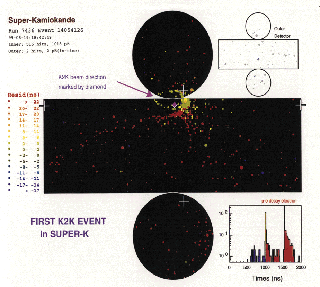
During 22 days of stable data-taking in June, the K2K Long Baseline Neutrino Oscillation experiment, connecting the Japanese KEK Laboratory with the detectors in the Kamioka mine 250 km away, observed four neutrino interactions in the inner Super-Kamiokande detector. This is the first step towards the verification of the neutrino oscillation results given by the Super-Kamiokande last year.
One event occurred inside the 22.5 kiloton “fiducial volume” (2 m from the inner photomultiplier tubes) and another three events occurred outside. The event characteristics are consistent with a neutrino interaction in water. More importantly, all four events happened within 1 µs of the time expected for neutrinos generated at KEK.
No further events were seen in the inner detector within 50 µs of the expected time. Before reaching the distant Super-Kamiokande detector, the neutrinos pass through a “near detector” on the KEK site. Both detectors have a clock synchronized by the Global Positioning System (GPS), which is accurate to 100 ns. The probability that each of the four events comes from an atmospheric neutrino interaction is estimated to be a few parts in 10 000.
The K2K experiment began tuning the beamline, beam monitors, magnetic horn system and the near detector on 5 March. All of the detector components worked as expected. During an engineering run from March to May, physicists ensured that neutrinos were being sent in the direction of Super-Kamiokande to an accuracy of 0.3 mrad and that the flux and the profile of the beam were as expected.
During the summer shutdown period, the KEK beamline group will be improving the transmission of the primary proton beamline and will increase the current of the magnetic horns. The KEK accelerator succeeded in circulating 6.5 x 10¹² protons in nine bunches in the main ring in June and will look for a further improvement in intensity. Thus, K2K hopes to have more neutrinos in the coming run, which will be starting in late October.
The K2K experiment is an international collaboration of institutes from Japan, Korea and the US.
The major international focus of high-energy physics in odd-numbered years is the International Symposium on LeptonPhoton Interactions at High Energies, which took place this year on 9-14 August at Stanford University, California. Several reports from the meeting feature in this issue.
The leptonphoton symposia alternate with the International Conference on HighEnergy Physics (ICHEP), often known as the “Rochester” series, after the founding venue.
Both of these interlocking biennial meetings are sponsored by the International Union of Pure and Applied Physics (IUPAP) and the venues follow a traditional pattern, rotating between Europe (Western and Eastern), North America and Asia.
Next year the ICHEP will be held in Osaka, Japan, from 27 July to 2 August. The 2001 LeptonPhoton Interaction Symposium will take place in Rome and the 2002 ICHEP in Amsterdam.
With a first result announced from a major experiment at CERN, 1999 looks like being a vintage year for the measurement of CP violation the effect that enables nature to differentiate between matter and antimatter.
Earlier this year, the KTeV experiment at Fermilab (CERN Courier April) confirmed that CP is violated “directly” in the way quarks decay and transform into each other. The new result from the NA48 experiment at CERN underlines this direct CP violation and provides a valuable new benchmark.
CP violation, which is vital to our understanding of particle interactions and of the evolution of the universe in the wake of the Big Bang, is difficult to understand, hard to study and awkward to measure.
In 1956, physicists were shocked to discover that the weak force can differentiate between right and left. To reimpose order on their theories, physicists introduced charge/parity (CP) symmetry, in which physics should remain the same if a left-handed particle changes into a right-handed antiparticle, and so on.
For CP, the neutral kaon plays a special role. For CP purposes, this particle has to come in two forms: long-lived, decaying into three pions; and short-lived, decaying into two pions. In 1964, physicists received another shock when Christenson, Cronin, Fitch and Turlay discovered at Brookhaven that long-lived kaons can also decay into two pions. CP symmetry is not exact.
There are two ways in which this can happen. In the first, the long-lived kaon is a mixture of quantum states, mainly CP-odd with just a small amount of CP-even. In addition, CP could also be violated in the actual quark reactions underlying the particle transformations. In the decay of the neutral kaon, a strange quark slips off the map, producing pions composed of only up and down quarks. CP violation via this route is called “direct”.
To establish whether such direct CP violation happens, physicists have to compare two ratios: that of long-lived kaons decaying into two neutral pions with those going into two charged pions and the equivalent ratio for short-lived kaons. If these two ratios do not tally exactly, direct CP violation happens. Quark effects contribute to CP violation.
For several years the results from two major experiments NA31 at CERN and E731 at Fermilab could not be reconciled. The former gave the difference of the ratio of ratios from unity (divided by a conventional numerical factor) of 2.3 ± 0.65 x 10⁻³. The latter gave a much smaller figure, compatible with zero.
Does direct CP violation happen or not? To resolve the dilemma, new studies were begun. The early CP violation experiment at CERN had made separate runs with long-lived and short-lived kaons, leaving the door open to possible changes creeping in from one run to the next. Both recent experiments overcame this by using simultaneous beams of long- and short-lived kaons and taking data on charged and neutral pion production by both kaon beams at the same time. Earlier this year, KTeV at Fermilab reported a value of 2.8 ± 0.41 x 10⁻³ in tune with the earlier CERN measurement, but a bit on the high side, which surprised some people. The new result from NA48 is 1.85 ± 0.73 x 10⁻³.
The NA48 flagship experiment providing the new measurement is a major research investment. Installed in CERN’s highest-intensity proton beamline it uses a large and sophisticated detector. Some of the CERN protons go to make long-lived kaons, and the remaining particles are bent by a crystal and used to make a parallel beam of short-lived kaons. In this way the protons giving birth to short-lived kaons are “tagged” and the two varieties of kaons are clearly differentiated, even though they eventually decay in the same way.
Decays into charged pions are measured by a magnetic spectrometer, while the pions from the neutral pions are pinpointed by the pride of the experiment a special liquid krypton calorimeter with better than 1% energy resolution and subnanosecond time resolution.
Handling NA48 data requires a major effort in dataprocessing power, with data from all detector modules being pipelined to CERN’s main computer centre via a dedicated fast link. The NA48 result comes from data taken in 1997 and will be about 10% of the total amount of data that the experiment expects to accumulate in three years of running. However, even this initial sample amounts to almost 5 million kaon decays into pairs of pions, more than1 million of them being decays of long-lived kaons into pairs of pions, the direct descendant of the handful of events seen in 1964 that established CP violation as a physics phenomenon.
CP violation has still only been seen in the decays of neutral kaons. However new experiments are setting out to measure CP violation via new routes.
To provide the best experiences, we use technologies like cookies to store and/or access device information. Consenting to these technologies will allow us to process data such as browsing behavior or unique IDs on this site. Not consenting or withdrawing consent, may adversely affect certain features and functions.
Functional
Always active
The technical storage or access is strictly necessary for the legitimate purpose of enabling the use of a specific service explicitly requested by the subscriber or user, or for the sole purpose of carrying out the transmission of a communication over an electronic communications network.
Preferences
The technical storage or access is necessary for the legitimate purpose of storing preferences that are not requested by the subscriber or user.
Statistics
The technical storage or access that is used exclusively for statistical purposes.The technical storage or access that is used exclusively for anonymous statistical purposes. Without a subpoena, voluntary compliance on the part of your Internet Service Provider, or additional records from a third party, information stored or retrieved for this purpose alone cannot usually be used to identify you.
Marketing
The technical storage or access is required to create user profiles to send advertising, or to track the user on a website or across several websites for similar marketing purposes.