Polarized solid targets have been used in nuclear and particle-physics experiments since the early 1960s, and with the development of superconducting magnets and 3He/4He dilution refrigerators in the early 1970s, proton-polarization values of 80-100% have been routinely achieved in various target materials at two standard magnetic field and temperature conditions (2.5 T; < 0.3 K and 5 T; 1 K). Due to the much lower magnetic moment of the deuteron compared with that of the proton, deuteron polarization values have been considerably lower, typically 30-50%. Now, however, research at the University of Bochum is yielding materials with deuteron polarizations as high as 80%.
During the past 10 years, polarized solid targets have been successfully used at CERN and SLAC to investigate the spin structure of the nucleon. For this purpose hydrogen- and deuterium-rich compounds such as butanol, deuterated butanol (D-butanol), ammonia (NH3 and ND3) and lithium deuteride (6LiD) have served as proton and neutron target materials, respectively. The basic technique used to obtain a high polarization of the nuclear spins in the solid targets is to transfer the almost complete polarization of electrons at high magnetic fields and low temperatures to the nuclei via a microwave field with a frequency close to the electron Larmor frequency. This process – called dynamic nuclear polarization (DNP) – works for any nucleus with spin. Because all the target materials used are diamagnetic compounds, some amount of paramagnetic impurities (radicals or crystalline defects with unpaired electron spins) have to be implanted into the host material (doping). However, the efficiency of DNP in achieving high polarizations depends strongly on the nature of the paramagnetic centre and on the interactions to which the respective unpaired electron is exposed.
According to spin temperature theory, a narrow electron paramagnetic resonance (EPR) line enables the creation of high inverse spin temperatures – and thus of high nuclear polarizations. Guided by this prediction, a team at the University of Bochum has therefore been performing a systematic study of target-material doping for several years, using EPR spectroscopy to study the characteristics of the different paramagnetic dopants.
In the search for radicals with a small EPR line width, any effects that tend to broaden the line have to be minimized. The anisotropic g-factor of the unpaired electron is a particular danger, because its influence on the line width increases with increasing magnetic field. Hyperfine interactions of the electron also cause broadening. Radiation doping of deuterated materials therefore appears useful because the resulting paramagnetic centres combine a small g-factor anisotropy with weak deuteron hyperfine splitting.
A good example of the useful paramagnetic centres discovered so far is the so-called F-centre in 6LiD, in which the EPR line width is almost entirely given by the magnetic interaction of the F-centre electron, with its six neighbouring 6Li nuclei. A maximum deuteron polarization of 56% at 2.5 T is already being achieved with the target for the COMPASS experiment (NA58) at CERN, which was developed and produced at Bochum. Measurements at Saclay are also showing that even higher polarization values can be obtained in this material at higher magnetic fields.
The research at Bochum has also concentrated on the improvement of deuterated alcohol targets. These play an important role in experiments at intermediate beam energies because all the nuclei in these materials (apart from deuterium) are spinless – unlike 6Li which has spin 1. The first breakthrough in this field came with the application of the radiation doping method to D-butanol. In this way, paramagnetic defects with characteristics very similar to those of the F-centres in 6LiD could be created. Although a systematic investigation concerning the optimum irradiation dose has not yet been performed for this material, deuteron polarizations of 54% at 2.5 T and 71% at 5 T have already been reached.
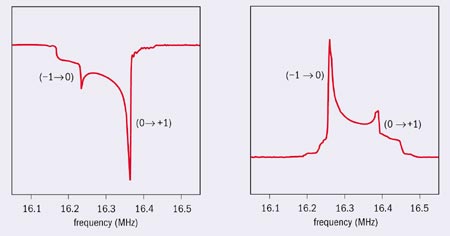
A further substantial increase of the deuteron polarization has been achieved in both D-butanol and D-propanediol, chemically doped with radicals of the trityl family (which was developed and delivered by Amersham Health, Malmö). Basically, the paramagnetic part of these molecules consists of a methyl-type radical with the three H-atoms replaced by larger but spinless complexes. They possess a very small EPR line width compared with those of the commonly used nitroxide radicals, porphyrexide and TEMPO. Both D-butanol and D-propanediol doped with radicals of the trityl family could be polarized up to around 80% at a magnetic field of 2.5 T. The nuclear magnetic resonance (NMR) signals for positively polarized butanol-d10 and negatively polarized 1,2-propanediol-d8 are shown in figure 1. They consist of two lines corresponding to the two transitions (m = +1→m = 0) and (m = 0→m = -1) of a spin-1 system, respectively. The resonances are separated by the so-called quadrupole splitting, which is a consequence of the interaction of the deuteron quadrupole moment with the lattice electrical field gradient at the site of the deuteron. The measurement of the intensity ratio of the two transitions provides a very accurate method for determining the polarization.
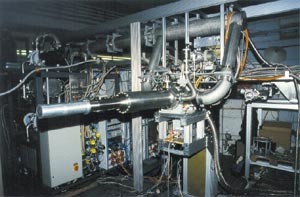
These new developments will allow polarization experiments to be performed on the deuteron and neutron with a much higher precision than was previously possible. Doubling the maximum polarization means doubling the statistical accuracy for the same measuring time. Alternatively, for a given accuracy, the measuring time required is reduced by a factor of four. For these reasons, trityl-doped D-butanol was recently successfully used for the neutron part of an experiment to study the Gerasimov-Drell-Hearn sum rule at the Mainz microtron, MAMI, using a polarized tagged photon beam. Figure 2 shows the horizontal dilution refrigerator developed by the Bonn Polarized Target Group for this particular experiment. For the first time, after more than 40 years of polarized solid targets, it is now possible to perform these kinds of experiments with low-intensity beams to the same precision and over the same time span, no matter whether the proton or the neutron is the subject of investigation.
The BES collaboration at the Beijing Electron Positron Collider (BEPC) has observed a clear signal for a narrow enhancement in the ppbar mass distribution near the 2mp threshold in the process J/Ψ→γppbar. The peak, which has a statistical significance of more than 16 σ, was found in the analysis of 58 million J/Ψ events. No corresponding enhancement has been seen in J/Ψ→ppbarπ0 decays.
The peak can be fit with either a S-wave (0-+) or a P-wave (0++) Breit-Wigner resonance function. For the S-wave fit, the mass is below 2mp at 1859+3-10 (stat)+5-25 (sys) MeV/c2 and the width is less than 30 MeV/c2 at 90% CL. For the P-wave fit, the mass is 1876.4±0.9 MeV/c2 with a width of 4.6±1.8(stat) MeV/c2. The acceptance-corrected photon angular distribution is consistent with that expected for a resonance with JPC= 0-+ or 0++.
Although there were indications of ppbar mass threshold enhancements in the J/Ψ→γppbar process from earlier experiments, including MARK-III at SLAC and DM2 at Orsay, the limited statistics in the data samples meant no firm conclusions could be drawn. The high statistics acquired with BES-II, however, has excluded the interpretation of the effect as being due to known particles, such as the η(1760). The high statistics also allow the mass and width of the state to be well determined, that is, below 2mp (S-wave) or at 2mp (P-wave). The mass and unexpectedly narrow width of the new resonance suggest it could be interpreted as a “deuteron-like” spin 0 proton-antiproton bound state (baryonium), with a zero baryon number.
Recent astrophysical measurements of distant quasar spectra indicate that the fundamental constants may be changing with time. The dimensionless fine structure constant α, which scales the energy in electromagnetic interactions, might have been smaller at early times in the universe: the difference compared with today’s value is a fraction of 10-5. Assuming that the drift is linear, this would be a change of around 10-15 per year.
In general, such astrophysical measurements probe a drift of constants over extremely long time periods. Laboratory experiments on the other hand are limited to short timescales of some years. However, this can be compensated for by a higher accuracy. The recent dramatic evolution of techniques for measuring the frequency of light with a precision of a few parts in 1015 means that laser spectroscopy of atoms and ions has now reached a level of accuracy where a search for a drift of constants is feasible.
In particular, there is an effective magnification between a drift of α and the drift of an atomic transition frequency compared with the SI second provided by a caesium clock, leading to a frequency drift at an estimated level of 10-14 per year. A remeasurement of atomic transition frequencies previously measured some time ago is therefore of great interest, and earlier this year researchers at MPQ in Munich carried out such an experiment, measuring the 1S-2S transition in atomic hydrogen.
In 1999 the absolute frequency of this transition had been phase coherently compared with a caesium fountain clock, as a primary frequency standard, using a novel frequency comb technique. The second harmonic of laser light from an ultrastable continuous-wave dye laser emitting near 486 nm was used to excite cold hydrogen atoms, Doppler-free, from the ground state to the metastable 2S state. A selection of slow atoms by time-resolved spectroscopy allowed the reduction of systematic effects, mainly the second-order Doppler shift (A Huber et al. 1999). This measurement has demonstrated a precision of 1.9 parts in 1014 (M Niering et al. 2000).
Since then, the techniques used for frequency measurement, as well as the hydrogen spectrometer, have been improved, and data gathered in 12 days of measurement in February this year are now being evaluated. So far, eight days of data have been analysed, and the preliminary result for the difference of the two measurements is -48(60) Hz. Assuming that the measurements performed in 1999 and 2003 are equivalent, this implies a possible drift of the 1S-2S frequency of -5.4(6.8) x 10-15 Hz per year.
“He who seeks finds.” After decades of speculation on the nature of gamma-ray bursts (GRBs), the very bright event known as GRB030329 is finally unveiling their origin. This burst is a “Rosetta stone” for scientists, revealing for the first time that a GRB and a supernova – the two most energetic explosions known in the universe – occur simultaneously. Thanks to this telling burst, a team of astronomers has pieced together the key elements of the so-called “collapsar” model of long-duration GRBs, from star death to the dramatic birth of a black hole.
NASA’s High-Energy Transient Explorer satellite (HETE-II) initially detected the burst on 29 March 2003 (at 11:37:14 UTC) in the constellation Leo. For more than 30 seconds the burst outshone the entire universe in gamma rays. Its unusual brightness triggered an unprecedented hunt for optical observations around the world. Within 24 hours a first, very detailed, spectrum of the burst’s optical afterglow was obtained by the Very Large Telescope (VLT) of the European Southern Observatory (ESO) at the Paranal Observatory in Chile. The spectrum displays a redshift of 0.1685, corresponding to a distance of 2650 million light-years. This is near for a GRB and explains why this burst is among the 0.2% brightest bursts ever recorded. It provides the long-awaited opportunity to test the many hypotheses and models proposed since the discovery of the first GRBs in the late 1960s.
The afterglow of GRB030329 lingered for weeks in lower energy X-ray and visible light, allowing continued spectral observations with the VLT over a period of one month. The results were published in Nature (J Hjorth et al. 2003) by members of the Gamma-Ray Burst Afterglow Collaboration (GRACE) at ESO. According to the group of 27 researchers from 17 institutes, the spectral changes of the fading source give irrefutable evidence of a direct connection between the GRB and “hypernova” explosion of a very massive, highly evolved star. This is based on the gradual emergence of a supernova-type spectrum, revealing the extremely violent explosion of a star. With velocities well in excess of 30,000 km/sec (10% the velocity of light), the ejected material is moving at record speed, testifying to the enormous power of the explosion.
Hypernovae are rare events and probably caused by the explosion of stars of the “Wolf-Rayet” type. These WR-stars were originally formed with a mass greater than 25 solar masses and consisted mostly of hydrogen. During their WR-phase, having stripped themselves of their outer layers, they consist almost purely of helium, oxygen and heavier elements, produced by intense nuclear burning during the preceding phase of their short life. Such a dense star of about 10 solar masses will rapidly deplete its fuel, triggering a Type Ic supernova/GRB event. The core collapses, without the star’s outer part “knowing”. A black hole forms inside, surrounded by a disc of accreting matter, and within a few seconds launches a jet of matter away from the black hole that ultimately makes the GRB. The jet passes through the outer shell of the star and, in conjunction with vigorous winds of newly forged radioactive nickel-56 blowing off the disc inside, shatters the star. The GRACE team say this “collapsar” model, introduced by Stan Woosley of the University of California in 1993, best explains the observation of GRB030329.
“We’ve been waiting for this for a long, long time,” said lead author Jens Hjorth. “This GRB gave us the missing information. From these detailed spectra we can now confirm that this burst, and probably other long GRBs, are created through the core collapse of massive stars. Most other leading theories are now unlikely.”
As Stan Woosley, one of the co-authors, points out, this does not mean the GRB mystery is completely solved because, “we cannot reach any conclusion yet on what causes short GRBs.” Many astronomers think these bursts, lasting less than two seconds, might be caused by neutron star mergers, but they are still waiting for their “Rosetta stone” burst.
In the mid-1990s a study of results from experiments at CERN (with a collision energy in the centre of mass of the nucleon pair of √sNN = < 20 GeV) and the Alternating Gradient Synchrotron (AGS) at Brookhaven (√sNN = 5.5 GeV) indicated some intriguing changes in the energy dependence of hadron production between top AGS and SPS energies (M Gazdzicki and D Röhrich 1996). Within a statistical model of the early stage of the collision process, these changes could be attributed to the onset of the deconfinement phase transition, where quarks and gluons are no longer confined within hadrons (M Gazdzicki and M Gorenstein 1999). The model predicted a sharp maximum in the multiplicity ratio of strange hadrons (hadrons that contain strange and anti-strange quarks) to pions (the lightest hadron) at the beginning of the transition region, at about √sNN ~ 7.5 GeV. This prediction triggered a new experimental programme at the SPS – the energy scan programme – in which the NA49 experiment recorded head-on (central) collisions of two lead nuclei (Pb+Pb) at several energies, √sNN = 6.3, 7.6, 8.7 and 12.3 GeV. Other heavy-ion experiments at the SPS (NA45, NA50, NA57 and NA60) participated in selected runs of the programme.
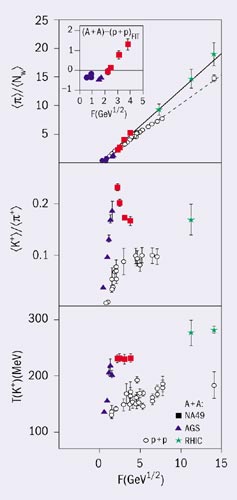
Recently published results from the energy scan, obtained mainly by the NA49 collaboration, have confirmed expectations. They indicate that rapid changes of hadron production properties occur within a narrow energy range of √sNN = 7-12 GeV (V Friese et al. 2003). The “Collision energy dependence” figure shows these latest results, together with earlier data from the SPS and the AGS, and data from the Relativistic Heavy-Ion Collider (RHIC). Data from proton_proton collisions are also included for comparison. The top panel of the figure shows that the number of pions produced per nucleon participating in the collision increases with energy as expected in both proton-proton and nucleus-nucleus reactions. However, the rate of increase in nucleus-nucleus collisions becomes larger within the SPS energy range and then stays constant up to the RHIC domain.
The most dramatic effect, shown in the middle panel of the figure, is seen in the energy dependence of the ratio <K+>/<π+> of the mean multiplicities of K+ and π+ produced in central Pb+Pb collisions. Following a fast threshold rise, the ratio passes through a sharp maximum in the SPS range and then seems to settle to a lower plateau value at higher energies. Kaons are the lightest strange hadrons and <K+> count for about half of all the anti-strange quarks produced in the collisions. Thus, the relative strangeness content of the produced matter passes through a sharp maximum at the SPS in nucleus-nucleus collisions. This feature is not observed for proton-proton reactions.
A third important result is the constant value of the apparent temperature of K+ mesons in central Pb+Pb collisions at SPS energies, as shown in the bottom panel of the figure. The plateau at SPS energies is preceeded by a steep rise of the apparent temperature measured at the AGS and followed by a further increase indicated by the RHIC data. Very different behaviour is measured in proton-proton interactions.
So far, only the statistical model of the early stage reproduces the sharp maximum and the following plateau in the energy dependence of the <K+>/<π+> ratio. In this model, the spike reflects the decrease in the number ratio of strange to non-strange degrees of freedom and changes in their masses when deconfinement sets in. Moreover, the observed steepening of the increase in pion production is consistent with the expected excitation of the quark and gluon degrees of freedom.
Finally, in the fireball of particles created in the collision, the apparent temperature is related to the thermal motion of the particles and their collective expansion velocity. Collective expansion effects are expected to be important only in heavy-ion collisions, as they result from the pressure generated in the dense interacting matter. The stationary value of the apparent temperature of K+ mesons may thus indicate an approximate constancy of the early stage temperature and pressure in the SPS energy range due to the coexistence of hadronic and deconfined phases.
These results suggest the deconfinement phase transition exists in nature (and thus the quark-gluon plasma) and that in Pb+Pb collisions it begins to occur in the SPS energy range. From the composition of hadrons resulting from the decay of the fireball, the temperature at which the transition takes place can be estimated to be T ≅ 2 x 10¹² K (170 MeV), coinciding with the limiting temperature of hadrons suggested at CERN many years ago by Rolf Hagedorn.
The observation of anomalies in the energy dependence of hadron production in Pb+Pb collisions in the SPS energy range requires further study. Analysis of data taken last year continues in search of further phenomena caused by the deconfinement phase transition, such as anomalies in the event-by-event fluctuations expected in the vicinity of the second-order critical end-point (M Stephanov, K Rajagopal and E Shuryak 1999). In future, it would be interesting to extend measurements of the energy dependence to central collisions of light nuclei as well as to proton-proton and proton-nucleus interactions. Such measurements should significantly constrain models of the collision process and, in particular, help us to understand the role played by the volume of the droplet of strongly interacting matter in determining the onset of the deconfinement phase transition.
Since it began operation three years ago, the US Department of Energy’s Relativistic Heavy-Ion Collider (RHIC) has produced an array of data that are rapidly shedding new light on unexplored territory in high-energy nuclear collisions. Results from the first gold-gold collisions at the new collider, recorded during the summer of 2000, immediately showed that the essential trend seen in fixed-target experiments at the Brookhaven AGS and CERN SPS continues as the collision energy is increased by an order of magnitude. Specifically, the concentration of energy deposited in the volume of space occupied by the colliding nuclei (the energy density) steadily increases with increasing collision energy. As a result, the multiplicity of particles produced in the most violent of the RHIC collisions is larger than any previously seen in subatomic interactions.
The early results have given clear indications that the origin of these particles involves extremes of density and temperature that are well into the range where the relevant degrees of freedom for nuclear interactions are expected to be those of quarks and gluons, not nucleons and mesons. Now it appears that measurements of high-energy phenomena due to the scattering of quarks and gluons in collisions of heavy nuclei have provided an important new means for probing the realm of the predicted quark-gluon plasma.
The RHIC collision energy is high enough to produce direct scattering of quarks and gluons from the incoming nuclei. In this “hard scattering” – in the parlance of quantum chromodynamics (QCD) – a single pair of partons (quark, anti-quark, gluon) from the incoming nuclei strike each other directly with such force that they scatter with high momentum away from the initial beam direction. These interactions, which are relatively rare even in the highest energy collisions, give rise to localized sprays of energetic particles called “jets”. These jets of hadrons are highly collimated along the axis of the initially scattered parton, and characteristically carry large components of momentum transverse to the axis of the colliding nuclei. Thus, while the average transverse momentum (pT) of hadrons produced in nuclear collisions is a few hundred MeV/c, hard-scattering processes in very high-energy collisions give rise to a small tail in the pT distribution that can extend out to tens of GeV/c.
Hard-scattering processes are well known in high-energy collisions of elementary particles, such as proton-proton collisions. Their observation was one of the early, compelling arguments for the existence of quark sub-structure in hadrons. By measuring the properties and momenta of the particles in a jet, one can reconstruct the kinematic and quantum properties of the initially scattered parton, and the measurements can be compared with readily calculable predictions of QCD.
These processes can now be seen at RHIC for the first time in nuclear collisions. They provide a direct signal of high-energy quarks or gluons emerging from the initial collision stage. Significantly, the early RHIC data from gold-gold collisions showed a deficit of high transverse-momentum particles from jets in collisions where the highest total number of particles is produced – that is, in the most violent collisions, where the evidence indicates that hot matter is formed. This effect, dubbed “jet quenching”, is one of the most striking indicators of possible new physics in these collisions.
It may be that the observed deficit of high-energy jets in these collisions is the result of a slowing down, or quenching, of the most energetic quarks as they propagate through a newly formed medium consisting of a dense quark-gluon plasma. If this is the case, then these measurements can provide a quantitative means of determining the properties of the primordial matter, in effect providing a direct probe of the plasma with beams of energetic partons.
First, however, it is important to verify this energy-loss interpretation of the observed jet quenching in gold-gold collisions. Recent theoretical work has conjectured that in very high-energy nuclear interactions the initial-state density of partons (mostly gluons) becomes so high that the effective number of interacting particles in the collision saturates, limiting the number of hard-scattering events. Thus, another possible interpretation of the paucity of jets might simply be that the wavefunction of a nucleus during a high-energy collision is significantly different from that of a superposition of nucleons.
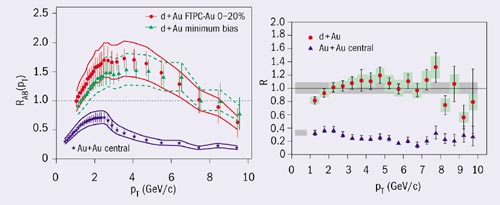
The question of whether the observed jet quenching is the result of initial-state saturation effects or energy loss due to a dense final-state medium, can be checked experimentally by colliding a nucleon with a nucleus and seeing if there is a difference relative to nucleon-nucleon collisions. Effects due to initial-state saturation effects, which are intrinsic to the properties of the nucleus, will appear in these collisions of a small probe with a heavy nucleus, whereas those due to energy loss in a dense medium, which should only be produced after the collision of two heavy nuclei, will not appear. To provide this comparison, RHIC carried out a two-month programme of deuteron-gold collisions, beginning in March 2003, with each beam accelerated to 100 GeV/ nucleon (as in the gold-gold collisions).
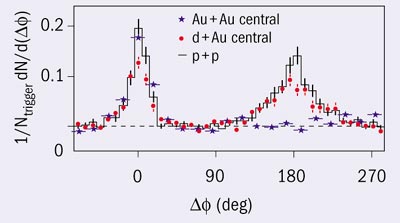
In the first results from this run, all four of the RHIC experiments (BRAHMS, PHENIX, PHOBOS and STAR) produced data showing no indication of suppression at large transverse momenta for deuteron-gold collisions, clearly indicating that the initial-state effects are small, and the suppression effect observed at large transverse momentum in gold-gold collisions is indeed due to jet energy loss. This result is strikingly illustrated by the back-to-back correlation data from STAR (see figure). A recoil jet peak is present in deuteron-gold collisions, as it is in proton-proton collisions, but is suppressed in the gold-gold data.
The data analysed so far at RHIC give convincing evidence that high-energy collisions of heavy nuclei do indeed trigger the production of a hot, dense medium of final-state particles that is characterized by strong collective interactions at very high-energy densities. More needs to be done to determine the essential properties of this matter, but these latest results provide a major step toward unveiling the long-sought quark-gluon plasma.
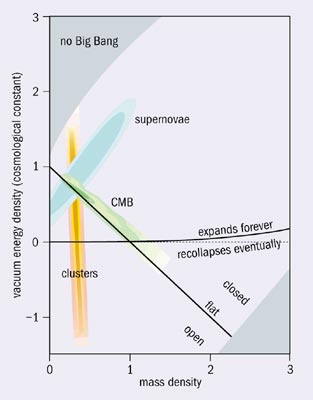
Cosmology has recently achieved its version of a standard model, called the “cosmic concordance”. This gives a broad picture of the components in the universe within the strongly tested framework of the hot Big Bang model. Of these components, only about 4% amount to the familiar baryons of the Standard Model of particle physics, and even some of these are “dark” or not evident directly from the light of distant objects. Another 20-25% is nonbaryonic dark matter, presumably either weakly interacting massive particles or axions, theorized elements of high-energy physics. But the majority of the energy density, some 70-75%, is detected only through its effect of accelerating the global expansion of the universe. This background energy, which is smooth out to scales larger than that of any matter structures such as clusters of galaxies, is named “dark energy”.
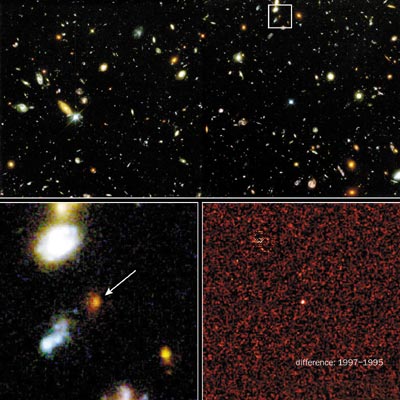
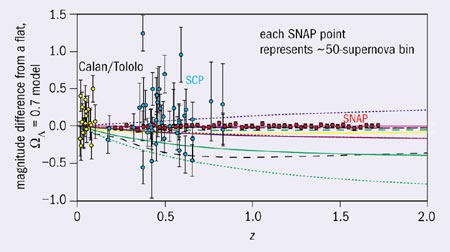
Dark energy was first discovered in 1998 by two groups using supernovae as markers of cosmological distance as a function of time – the Supernova Cosmology Project led by Saul Perlmutter at Lawrence Berkeley National Laboratory and the High-z Supernova Search Team led by Brian Schmidt at Australian National University. Measurements indicated that distant supernovae were dimmer than expected from the cosmological inverse square law in a universe dominated by matter (S Perlmutter et al. 1999, A Riess et al. 1998). That is, they appeared to be further away than expected from the expansion rate of the universe if gravitation due to the matter contents were the main force. Some form of dark energy was required at the 99% confidence level, and in amounts sufficient to counteract, on cosmic scales, the gravitational attraction from the clustered matter.
Since then, deeper and more precise supernova measurements and further lines of evidence confirm this conclusion (J Tonry et al. 2003, R Knop et al. 2003, D Spergel et al. 2003). Detailed measurements of the cosmic microwave background power spectrum, by the Wilkinson Microwave Anisotropy Probe satellite and by ground-based experiments, imply the presence of dark energy too. They also show that the spatial geometry of the universe is consistent with the flatness prediction of inflation. But observations of galaxy clusters tell us that the matter contribution to the total energy density can amount to only 20-30% of the needed critical density. Any two of the three lines of evidence imply that the dark energy composes roughly three-quarters of the energy density of the universe, while the third method provides a crosscheck. Such an amount of dark energy acts to accelerate the cosmic expansion.
The nature of dark energy
While gravitation due to matter or radiation is attractive, a sufficiently negative pressure p would offset a positive energy density ρ to give repulsive gravity under Einstein’s equations (the gravitating density depends on ρ+3p), pulling on space to accelerate the expansion of the universe. Researchers often discuss this in terms of the equation of state ratio of the pressure to energy density: w = p/ρ.
Negative pressures are not a wholly exotic phenomenon. After all, one of the equations of expansion of the universe, the Friedmann equation, looks remarkably similar to the first law of thermodynamics: d(ρV) = -pdV, where V is the volume considered. Negative pressure leads to an overall plus sign, turning this equation into something that looks like the tension in a spring or rubber band. Such a “springiness” of space was postulated soon after Einstein developed the general theory of relativity in his cosmological constant term, and Hermann Weyl attempted to link such a background energy to the quantum vacuum. If the vacuum is a true ground state then all observers must agree on its form. But the only Lorentz invariant energy-momentum tensor is the diagonal Minkowski tensor that has negative pressure equal and opposite to its energy density, that is, the cosmological constant has equation of state ratio w = -1. This would cause an accelerating universe.
So why are cosmologists not satisfied with identifying the cosmological constant with dark energy? In The Hunting of the Snark – the poem by Lewis Carroll, who was in fact Charles Dodgson, a mathematician at Oxford – when the explorers set sail to find the mysterious snark, the captain “had bought a large map representing the sea, without the least vestige of land: and the crew were much pleased when they found it to be a map they could all understand.” The cosmological constant term is such a featureless sea, but there are two problems with using it to describe our universe. The expected sea level for the quantum vacuum is much higher than we observe: naively one should indeed have a featureless universe, with matter drowned by 120 orders of magnitude below the energy density of the cosmological constant. But the cosmic concordance measures only a factor of a few difference. Furthermore, the matter and radiation we see in the universe evolves with the expansion of the universe, while the cosmological constant does not. Even an order of magnitude equality between them occurs in only one characteristic timescale (e-folding), out of the 23 in the expansion of the universe since the well-understood epoch of nuclei formation in the early universe. (See S Weinberg 1989 and S Carroll 2001 for more on these fine-tuning and coincidence puzzles.)
Hunting the dark energy
Researchers are thus driven to consider other explanations for the dark energy. Models with dynamical high-energy physics fields, often called “quintessence” when involving a simple scalar field, go some way toward alleviating the timing or coincidence puzzle, though there is still no clear underlying theory explaining the current effective energy density. Such a field would need an effective mass of 10-33 eV, that is, with a Compton wavelength of the order of the radius of the universe. However, there are rich attempts at phenomenology stretching back two decades (longer if scalar-tensor theories of gravitation are included). An early high-energy physics model was proposed by Andrei Linde in 1986, demonstrating how a linear potential could give rise to accelerating expansion. On the cosmology side, Robert Wagoner in 1986 examined how a general equation of state component would not only affect the expansion, but could be observationally probed with cosmological distance and age measurements.
Both the modelling of and the investigation of the observational consequences of dark energy are now active industries within research in cosmology, covering a wide variety of the physics of the early and late universe. In general, the dark-energy equation of state will vary with time and so needs to be probed with observations over a range of epochs, or astronomical redshifts z (the fractional difference in the scale of the universe today relative to an earlier time). The major challenge over the next few years in cosmology will be to characterize the equation of state function w (z ). On the phenomenology front, one might hope for a natural, robust model to emerge, but the theorists’ prolificness seems too great for this to settle the question. Indeed, models beyond scalar fields involving modifications of general relativity, extra dimensions, or quantum-phase transitions have also been proposed. Fortunately these can be written in terms of an effective w (z ) (E Linder and A Jenkins 2003) and subjected to cosmological measurements.
Three main routes to probing dark energy exist in cosmology. The first, and currently most favoured, involves mapping the expansion history of the universe. The second seeks to measure the growth rate of the formation of large-scale structures such as clusters of galaxies. The third involves the cosmic microwave background radiation – looking not for the time variation of the dark energy (since the cosmic microwave background photons effectively all come from the same redshift), but for the subtle spatial fluctuations in the dark-energy distribution on cosmic scales. Observations of Type Ia supernovae, which first discovered the dark energy in 1998, fall in the first category and seem the most promising. The second and third approaches are likely to run into limits imposed, respectively, by uncertainties involving entangled astrophysics and cosmic variance (intrinsic uncertainty due to observing only one universe). However, new methods and cross correlations between probes may eventually be practical.
In mapping the expansion history, cosmologists probe the deceleration due to the gravitation of matter and the acceleration due to dark energy at various epochs. Variations in the growth of distances reveal a picture of the cosmic environment, and hence the dynamic influence of dark energy, in the way that the width of tree rings indicates the Earth’s climatic environment over time. Type Ia supernovae can be seen to great distances and calibrated in luminosity (made “standard candles” through detailed observations). Thus the measurement of the received flux directly indicates their distance, and hence the time in the past they exploded, while the redshift of the photons is simply the ratio of the size of the universe now relative to then. Together these give the exact expansion history.
Future endeavours
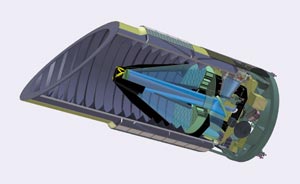
The best current supernova data extend out only to redshift z ≅ 1 (when the scale of the universe was 1/(1+z ) = 1/2 its current size) with any reasonable statistics, but they already constrain the averaged equation of state ratio to w = -1.05+0.15-0.20 (R Knop et al. 2003) or w = -1.0+0.14-0.24 (J Tonry et al. 2003). Clues to the underlying physical theory, however, reside in the dynamics, the time-varying function w (z ). A dedicated dark-energy mission, the Supernova/Acceleration Probe (SNAP) satellite, is being designed to determine the present value w0 to 7% and derivative w ‘ = dw/dz to ±0.15 (1 σ, including both statistical and systematic uncertainties). Led by Michael Levi and Saul Perlmutter of the Lawrence Berkeley National Laboratory, the project involves over 100 scientists and engineers from more than 15 institutions, including France and Sweden. Launch is proposed for 2010.
Meanwhile, an intense research effort continues. One example is the European Dark Energy Network (EDEN), a proposed European Union research training network of 13 nodes (including CERN, led by Gabriele Veneziano), coordinated by Pedro Ferreira of Oxford. Models attempt to link dark energy to dark matter, extra dimensions, modifications of gravity and a zoo of simple and non-minimally coupled scalar fields. These predict a range of values for the equation of state ratio w0, within the current constraints, and a wholly open variety of w ‘, both positive and negative. Some even lead to an eventual reversal of the acceleration and a collapse of the universe. It is amusing that the first dark-energy model, the linear potential, possesses this quality. Future data will constrain the allowed parameters of classes of high-energy physics models and the fate of the universe, including how long we have left until a cosmic doomsday! (See R Kallosh et al. 2003 for the linear potential case leading to a Big Crunch and R Caldwell et al. 2003 for a Big Rip.)
Can signs of the nature of dark energy be uncovered at particle accelerators? It is difficult to see how. The energy scale of the physics is presumably of the order 1016 GeV, and by its “dark” nature the coupling to matter is vanishingly small. On scales smaller than the universe, the dynamical effect of dark energy is negligible. The entire dark-energy content within the solar system equals that of three hours of solar luminosity. Perhaps if the physics involves the modification of gravity or extra dimensions, a precise laboratory test could see a signature (see E Adelberger et al. 2003 for a current experiment). But the true hunting grounds for the nature of dark energy and the physics causing the acceleration of the universe lie in cosmology. Just as advances have been made in the past two decades in theory and observations beyond the simplistic view of early universe inflation as a pure deSitter phase – “sea without the least vestige of land” – so too will dark-energy studies delve deeper into fundamental physics. Instruments now being designed could tell us within the next decade whether we must come to grips with a minuscule but finite cosmological constant or some exciting new dynamical physics.
The invention of minimal supergravity grand unification – mSUGRA – had a profound influence on the phenomenology of supersymmetry, and now mSUGRA is a leading candidate for yielding new physics beyond the Standard Model. A current assessment of mSUGRA in the search for unification and supersymmetry was the focus of the SUGRA20 conference held on 17-20 March at Northeastern University in Boston, where mSUGRA first evolved 20 years ago.
In supersymmetry, each particle has a superpartner – a sparticle – with a spin that differs by half a unit. The particles and sparticles should have the same mass, for example the mass of a quark should be equal to that of its superpartner, the squark, but this is contrary to observation. A mechanism for breaking supersymmetry is therefore crucial if theories that include supersymmetry are to confront experiment.
Models based on so-called global supersymmetry or rigid supersymmetry lead to a pattern of sparticle masses that are also in contradiction with experiment – for example, a squark mass may lie below the quark mass. They also yield a cosmological constant that is in gross violation of observation. However, both these obstacles are removed in supergravity grand unification and its minimal version, mSUGRA, which was first formulated by Ali Chamseddine, Richard Arnowitt and Pran Nath at Northeastern University in 1982 (Chamseddine et al. 1982).
The framework of supergravity grand unification is the so-called applied supergravity, where matter (quarks, leptons and Higgs particles) is coupled with supergravity and the potential of the theory is not positive definite. The breaking of supersymmetry in mSUGRA takes place through a “super Higgs” effect where the massless gravitino, which is the spin 3/2 partner of the graviton, becomes massive by “eating” the spin 1/2 component of a chiral super Higgs multiplet. This is a phenomenon akin to the Higgs_Kibble mechanism through which the W boson gains mass by absorbing the charged component of a Higgs doublet in the Glashow-Salam-Weinberg model.
mSUGRA has an ingenious mechanism to protect the electroweak scale from “pollution” by the high-energy scales of the Planck mass MPlanck (2.4 x 10¹⁸ GeV) and the grand unification mass MGUT (2 x 10¹⁶ GeV). In mSUGRA, supersymmetry breaking occurs in the hidden sector and is communicated by gravitational interactions to the physical sector, where physical fields such as leptons, quarks, Higgs and their superpartners reside (see figure 1). Since the vacuum energy of the theory is not positive definite, it is possible to fine-tune the vacuum energy to zero (or nearly zero) after the spontaneous breaking of supersymmetry, and so avoid any contradiction with experiment. Further, as a consequence of the communication between the hidden and physical sectors, soft breaking terms arise in the physical sector. These give masses to sparticles and generate non-vanishing trilinear couplings among scalar fields. Thus, for example, the squarks and selectons gain masses of the size of the electroweak scale and fall within reach of colliders such as the Tevatron at Fermilab and the Large Hadron Collider (LHC) at CERN.
A remarkable aspect of the hidden-sector/physical-sector mechanism is that the mass generation in the physical sector does not involve terms of the size of MPlanck – which is fortunate given the large size of MPlanck. A similar result was found by Riccardo Barbieri of Pisa, Sergio Ferrara of CERN and Carlos Savoy of Saclay, who also achieved soft breaking through the hidden-sector mechanism (Barbieri et al. 1982). Equally remarkable is the result found by Chamseddine, Arnowitt and Nath that the grand unification scale MGUT cancels in the computation of soft parameters (Chamseddine et al. 1982, Nath et al. 1983). The soft parameters are thus shielded effectively from the high-energy scales of MPlanck and MGUT. There are many later analyses where grand unification within supergravity has been discussed in further detail (Hall et al. 1983, Nilles 1984). In mSUGRA, universality of the soft parameters leads to a suppression of the flavour-changing neutral currents that is compatible with experiment. Furthermore, the mSUGRA model can be easily generalized to include non-universalities in certain sectors of the theory, maintaining consistency with experiment.
mSUGRA provides a dynamical explanation of the electroweak symmetry breaking that splits the weak nuclear force from electromagnetism and gives mass to the W and Z bosons. In the Standard Model this is done by giving a negative squared mass to the Higgs field, which can be considered contrived. In mSUGRA the breaking of supersymmetry naturally triggers the breaking of electroweak symmetry and leads to predictions of masses of sparticles lying in the 100 GeV-TeV energy range.
The SUGRA20 conference opened with talks that looked at the current and future prospects for experimental tests of mSUGRA. Xerxes Tata of Hawaii discussed the constraints on the sparticle masses from various experiments including the recent Brookhaven experiment on gµ-2. Speakers in several other talks pointed out that the most direct test of mSUGRA and other competing models will come in accelerator experiments at Run II of the Tevatron, at the LHC and at the Next Linear Collider (NLC). Such tests for the Tevatron were outlined by Michael Schmitt of Northwestern, while Frank Paige from Brookhaven National Laboratory and Stephno Villa of California, Irvine, discussed the possibilities for the ATLAS and CMS detectors at the LHC. Richard Arnowitt from Texas A&M discussed similar tests for the NLC.
mSUGRA also possesses the remarkable feature that it provides a natural candidate – the so-called neutralino – for cold dark matter in the universe. The talks by Howard Baer of Florida and Keith Olive of Minnesota revealed that the predictions of cold dark matter in mSUGRA and its extensions are consistent with the most recent data from the satellite experiment, the Wilkinson Microwave Anisotropy Probe. David Cline from UCLA later outlined future dark-matter experiments (GENIUS, ZEPLIN) to test mSUGRA and other competing models.
There were also talks in several areas complementary to the main theme of the conference. Mary K Gaillard of Berkeley discussed the connection of SUGRA models to strings, while the idea of conformal quiver gauge theories with a novel type of grand unification at about 4 TeV was explained by Paul Frampton of North Carolina. Other more theoretical ideas included talks on strong gravity by Ali Chamseddine from Beirut, on M theory by Michael Duff of Michigan, and on non-commutative geometry by Bruno Zumino from Berkeley.
Northeastern University, as a key player in the birth of mSUGRA 20 years ago, provided an ideal location for SUGRA20. While mSUGRA remains only a model, more than 100 participants at the conference expressed optimism that future experimental data may convert it from a theoretical model to an established theory.
Collisions of particles at very high energies generally result in the production of many secondary particles. When first observed in cosmic-ray interactions this effect was unexpected, but it led to the idea of applying the wide body of knowledge of statistical thermodynamics to multiparticle production processes. Prominent physicists such as Enrico Fermi, Lev Landau and Isaak Pomeranchuk made pioneering contributions to this approach, but because difficulties soon arose it did not initially become the mainstream for the study of particle production. However, it was natural for Rolf Hagedorn to turn to the problem.
Hagedorn, who died earlier this year, had an unusually varied educational and research background, which included thermal, solid-state, particle and nuclear physics. His initial work on statistical particle production led to his prediction, in the 1960s, of particle yields at the highest accelerator energies at the time at CERN’s proton synchrotron. Though there were few clues on how to proceed, he began by making the most of the “fireball” concept, which was then supported by cosmic-ray studies. In this approach all the energy of the collision was regarded to be contained within a small space-time volume from which particles were radiated, as in a burning fireball.
Several key ingredients brought from early experiments helped him to refine the approach. Among these observations, the most noticeable was the limited transverse momentum of the overwhelming majority of the secondary particles. Also, the elastic scattering cross-section at large angles was found to drop exponentially as a function of incident energy. Such behaviour strongly suggested an inherently thermal momentum distribution.
However, many objections were raised in these pioneering days of the early 1960s. What might actually be “thermalized” in a high-energy collision? Applying straightforward statistical mechanics gave too small a yield of pions. Moreover, even if there was a thermalized system in the first place, why was the apparent temperature constant? Should it not rise with incident beam energy?
It is to Hagedorn’s great credit that he stayed with his thermal interpretation, solving the problems one after the other. His particle-production models turned out to be remarkably accurate at predicting yields for the many different types of secondaries that originate in high-energy collisions. He understood that the temperature governing particle spectra does not increase, because as more and more energy is poured into the system new particles are produced. It is the entropy that increases with the collision energy. If the number of particles of a given mass (or mass spectrum) increases exponentially, the temperature becomes stuck at a limiting value. This is the Hagedorn temperature TH. It is nearly 160 MeV, about 15% above the mass of the lightest hadron, the pion.
Since the more massive resonances eventually fragment into less massive ones to yield the observed secondary particles as the “bottom line”, this solved the problem of the pion yield. The factor 1/n!, which originated in the quantum indistinguishability of identical particles, had plagued the statistical calculations that focussed on pions only. Now it had become unimportant as each one of the many states was unlikely to have a population, n, exceeding 1. At long last agreement between experiment and statistical calculations prevailed.
The statistical bootstrap model
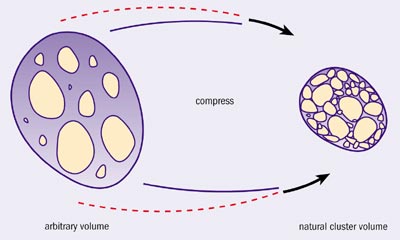
Once the physical facts had been assembled, Hagedorn turned his attention to improving their theoretical interpretation, and in considering the experimental finding that the formation of resonances dominates the scattering cross-section, he proposed the statistical bootstrap model (SBM). In a nutshell, in the SBM each of the many resonant states into which hadrons can be excited through a collision is itself a constituent of a still heavier resonance, whilst also being composed of lighter ones. In this way, when compressed to its natural volume, a matter cluster consisting of hadron resonances becomes a more massive resonance with lighter resonances as constituents, as shown in figure 1.
One day in 1964, one of us (TE) ran into Hagedorn, who was bubbling over to a degree we had not seen before. His eyes were lit up as he described all these fireballs: fireballs going into fireballs living on fireballs forever and all in a logically very consistent way. This must have been soon after he had invented the statistical bootstrap. He gave the impression of a man who had just found the famous philosophers’ stone, and that must have been exactly how he felt about it. Clearly Hagedorn immediately recognized the importance of the novel idea he had introduced. It was very interesting to observe how deeply he felt about it from the very beginning.
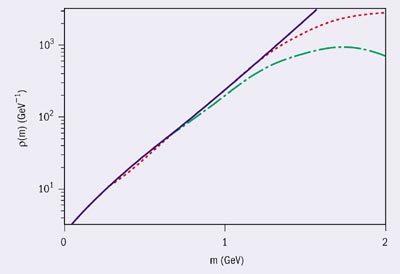
Using the SBM approach for a strongly interacting system, Hagedorn obtained an exponentially rising mass spectrum of resonant states. Today, experimental results on hadronic level counting reveal up to almost 5000 catalogued resonances. They agree beautifully with theoretical expectations from the SBM, and as our knowledge has increased, the observed mass spectrum has become a better exponential, as illustrated in figure 2. The solid blue line in figure 2 is the exponential fit to the smoothed hadron mass spectrum of the present day, which is represented by the short-dashed red line. Note that Hagedorn’s long-dashed green line of 1967 was already a remarkably good exponential. One can imagine that the remaining deviation at high mass in the top right corner of the figure originates in the experimental difficulties of discovering all these states.
The important physics message of figure 2 is that the rising slope in the mass spectrum is the same as the falling slope of the particle momentum spectra. The momentum spectra originate in the thermalization process and thus in reaction dynamics; the mass spectrum is an elementary property of strong interactions. The SBM provides an explanation of the relationship between these slopes, and explains why the temperature is bounded from above. Moreover, since the smallest building block of all hadronic resonances is the pion, within the SBM one can also understand why the limiting temperature is of the same magnitude as the smallest hadron mass TH ≈ mπ.
Today the Hagedorn temperature TH is like a brand name, and the concept of an exponentially rising mass spectrum is part of our understanding of hadron phenomena, which can be understood using approaches different from the SBM, such as that offered by dual models. However, when first proposed the SBM was looked upon with considerable scepticism, even within the CERN Theory Division where Hagedorn worked. As time has gone by, the understanding of the particle-production process that Hagedorn brought about has grown in significance, such is the sign of truly original work, of something that really had influence on our thinking. Hagedorn’s article (Hagedorn 1965), which introduced the statistical bootstrap model of particle production and placed the maximum temperature in the vocabulary of particle physics, has found a place among the most cited physics papers.
The accurate description of particle production, through the conversion of energy into matter, has numerous practical implications. Even in the very early days, Hagedorn’s insight into the yields and spectra of the produced secondaries showed that neutrino beams would have sufficient flux to allow a fruitful experimental program, and this gave a theoretical basis for the planning of the first neutrino beams constructed at CERN.
Quark-gluon plasma
At the same time that the SBM was being developed, the newly discovered quarks were gaining acceptance as the building blocks of hadrons. While Hagedorn saw a compressed gas of hadrons as another hadron, in the quark picture it became a drop of quark matter. In quark matter at high temperatures gluons should also be present and as the temperature is increased asymptotic freedom ensures that all constituents are interacting relatively weakly. There seems to be nothing to stop a dense assembly of hadrons from deconfining into a plasma of quarks and gluons. It also seems that this new state of matter could be heated to a very high temperature, with no limit in sight. So what is the meaning of the Hagedorn temperature in this context?
In the SBM as conceived before quarks, hadrons were point particles. A subtle modification is required when considering quarks as building blocks. Hadrons made of quarks need a finite volume that grows with hadron mass. One of us (JR) worked on this extension of the SBM with Hagedorn at the end of the 1970s and in the early 1980s. We discovered that at the Hagedorn temperature, finite-size hadrons dissolve into a quark-gluon liquid. Both a phase transition and a smoother transformation are possible, depending on the precise nature of the mass spectrum. The most physically attractive alternative was a first-order phase transition. In this case the latent heat is delivered to the hadron phase at a constant Hagedorn temperature TH. A new phase is then reached wherein the hadron constituents – the quarks and the gluons – are no longer confined. The system temperature can now rise again.
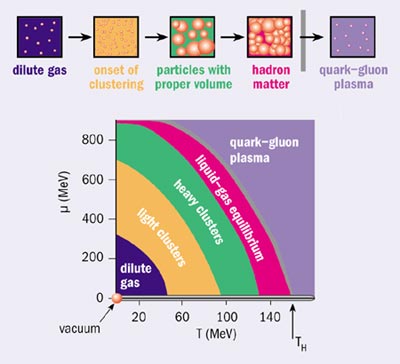
Within the study of hot hadronic matter today, the Hagedorn temperature is understood as the phase boundary temperature between the hadron gas phase and the deconfined state of mobile quarks and gluons (see figure 3). Several experiments involving high-energy nuclear collisions at CERN’s Super Proton Synchrotron (SPS) and at RHIC at the Brookhaven National Laboratory are testing these new concepts. Nuclei, rather than protons, are used in these experiments in order to maximize the volume of quark deconfinement. This allows a clearer study of the signature of the formation of a new phase of matter, the quark-gluon plasma (QGP).
The current experimental objective is the discovery of the deconfined QGP state in which the hadron constituents are dissolved. This requires the use of novel probes, which respond to a change in the nature of the state of matter within the short time available. More precisely, the heating of hadronic matter beyond the Hagedorn temperature is accompanied by a large collision compression pressure, which is the same in magnitude as the pressure in the very early universe. In the subsequent expansion, a collective flow velocity as large as 60% of the velocity of light is exceeded at RHIC. The expansion occurs on a timescale similar to that needed for light to transverse the interacting nuclei.
In the expansion-cooling process of QGP formed in nuclear collisions, the Hagedorn temperature is again reached after a time that corresponds to the lifespan of a short-lived hadron. A break up – that is, hadronization – then occurs and final-state hadrons emerge. Hagedorn was particularly interested in understanding the hadronic probes of QGP produced in hadronization. He participated in the initial exploration of the strangeness flavour as a signal of QGP formation.
In February 2000 the totality of intriguing experimental results obtained at the SPS over several years was folded into a public announcement stating that the formation of a new phase of matter was their best explanation. The key experimental results, including, in particular, strangeness and strange antibaryon enhancement, agreed with the theoretical expectations that were arrived at when one assumes that the QGP state was formed.
In mid-June 2003 the researchers at RHIC announced results that show that this new phase of matter is highly non-transparent to fast quarks, which is once more along the lines of what is expected for QGP. Many researchers believe that the deconfined phase has therefore been formed both at the SPS and at RHIC. The thrust of current research is to identify the conditions that are necessary for the onset of QGP, and to understand the initial reaction conditions in dense matter. In 2007 when a new domain of collision energy becomes accessible at CERN’s Large Hadron Collider, hot QGP in conditions similar to those present in the early universe will be studied.
In the next few years, the study of hadronic matter near the Hagedorn temperature will also dominate experimental efforts in the field of nuclear collisions, in particular at the new international experimental facility to be built at the GSI laboratory in Darmstadt, Germany. The richness of the physics at hand over the coming years is illustrated in the phase diagram in figure 3, which was obtained from the study of the SBM. Here, the domain is spanned by the temperature, T, and the baryochemical potential, µ, which regulates the baryon density.
In almost 50 years the understanding of the physics related to the Hagedorn temperature has changed. In the beginning it was merely the maximum temperature seen in proton-proton collisions. It then became the SBM inverse slope of the mass spectrum. Today, it denotes the phase boundary between hadron and quark matter. Moreover, as recent work in string theory has shown, Rolf Hagedorn will not only be remembered for the physics of hot hadronic matter: his name is already attached to a more general family of elementary phenomena that originate in the methods he developed in the study of strong interaction physics.
The CLEO collaboration has discovered a new particle, tentatively named the DsJ(2463), which decays to D*sπ0 with a decay width less than 7 MeV. The search that led to this discovery was motivated by BaBar’s discovery of an unexpected new narrow state called D*sJ(2317), which decays to Dsπ0. CLEO has also confirmed the existence of the D*sJ(2317).
In the simplest interpretation of these results both particles are excited bound states of a charm quark, c, and a strange antiquark, sbar. It was thought that such states would be massive enough to decay to a D or D* meson and a K meson. The biggest surprise of the D*sJ is that it is too light to decay via any of these modes. The decay of D*sJ to Dsπ0 is suppressed because it violates isospin symmetry, leading to the small decay width observed. Such suppressed isospin violating decays are not unknown in the c-sbar system – in 1995 CLEO found that about 6% of the decays of the D*s are to Dsπ0, instead of the dominant Dsγ mode. On the other hand, the DsJ is above the thresholds for decay to DK and Dsπ0, but apparently does not decay through either mode. If the spin parity of the DsJ is 1+, these modes would be forbidden and D*sπ0 would be allowed but also suppressed by isospin, again leading to a small decay width.
The analysis that determined the existence of the second state was complicated by an unusual kinematic property of the two states – the two new particles and the D* are narrow and the mass difference between the DsJ and D*s is essentially identical to the mass difference between the D*sJ and the Ds (see figure). Since the dominant decay mode of D*s is Dsγ, a real D*s decay can appear as a Ds if the photon from the D*s decay is lost, and a real Ds and random photon can appear as a D*s. This means that the two states can “feed into each other” as photons are missed or randomly acquired. The observed Dsπ0 signal thus has a background from real D*sπ0 events and vice-versa, so separating the two sources requires careful and subtle analysis. CLEO found that multiple analysis techniques applied to the Dsπ0 and D*sπ0 signals led to the conclusion that both states exist and resulted in consistent measurements of their masses and widths.
The preferred spin parity of the D*sJ is 0+ because it decays into Dsπ0 not D*sπ0. Predating the discovery of the D*sJ and DsJ, there were at least two theoretical models that coupled heavy quark effective theory with chiral symmetry and predicted light c-sbar states. In these models the mass difference between a 1+DsJ and the 1–D*s would be equal to the difference between a 0+D*sJ and the 0–Ds, in accord with CLEO’s observation.
To provide the best experiences, we use technologies like cookies to store and/or access device information. Consenting to these technologies will allow us to process data such as browsing behavior or unique IDs on this site. Not consenting or withdrawing consent, may adversely affect certain features and functions.
Functional
Always active
The technical storage or access is strictly necessary for the legitimate purpose of enabling the use of a specific service explicitly requested by the subscriber or user, or for the sole purpose of carrying out the transmission of a communication over an electronic communications network.
Preferences
The technical storage or access is necessary for the legitimate purpose of storing preferences that are not requested by the subscriber or user.
Statistics
The technical storage or access that is used exclusively for statistical purposes.The technical storage or access that is used exclusively for anonymous statistical purposes. Without a subpoena, voluntary compliance on the part of your Internet Service Provider, or additional records from a third party, information stored or retrieved for this purpose alone cannot usually be used to identify you.
Marketing
The technical storage or access is required to create user profiles to send advertising, or to track the user on a website or across several websites for similar marketing purposes.