The Kamioka liquid-scintillator antineutrino detector (KamLAND) has made the first observation of “geoneutrinos”. This comes just over 50 years since George Gamow, in a letter to Fred Reines in 1953, pointed out the possibility of detecting antineutrinos of terrestrial origin. KamLAND, which has already confirmed neutrino oscillations by detecting antineutrinos emitted from nuclear reactors, has opened up a new window of research, exploring the deep interior of the Earth by detecting geoneutrinos.
Geoneutrinos are created in the beta decays of radioactive isotopes in the Earth. The current geochemical and geophysical models suggest that the radiogenic power from the 238U and 232Th decay chains is 16 TW, approximately half the total measured heat-dissipation rate from the Earth. This heat helps to drive convective flows in the mantle and the outer core, resulting in plate tectonics, volcanism and terrestrial magnetism. Thus radiogenic heat is a key factor in understanding the Earth’s dynamics, formation and evolution. However, since geophysicists have never had a direct way to determine how uranium and thorium are distributed in the Earth’s interior, measuring their concentration inside the Earth sheds new light on geophysics.
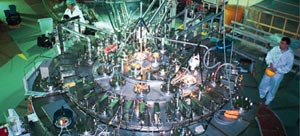
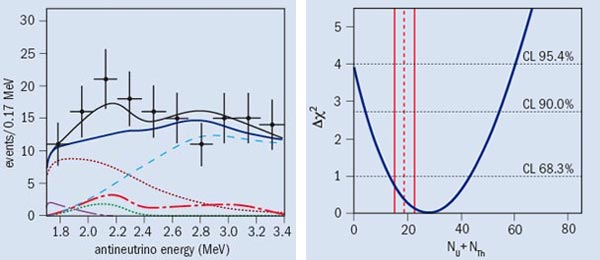
KamLAND consists of about 1 kt of liquid scintillator, located in the Kamioka mine in Japan. It can detect geoneutrinos from the 238U and 232Th decay chains through an inverse beta-decay process with a threshold energy of 1.8 MeV. Using data collected between 9 March 2002 and 30 October 2004 with a detector live-time of 749 days, 25 geoneutrino events were obtained after subtracting the number of expected background events, mostly from reactor antineutrinos. Combining the event rate and energy spectrum of candidates yields between 4.5 and 54.2 geoneutrinos, with a central value of 28 at the 90% confidence interval (see figures). This assumes a Th:U mass ratio of 3.9, the value derived from chondritic meteorites and commonly understood to be the same for all materials in the solar system.
The result is consistent with the central value of 19 predicted by a geological model, and constrains the flux of geoneutrinos from uranium and thorium to less than 1.62 × 107 cm−2 s−-1 at 99% confidence limits. Although the present data have limited statistical power, they nevertheless directly provide an upper limit of 60 TW for the radiogenic power of uranium and thorium in the Earth.
These investigations should pave the way to more accurate measurements, which may develop into a new field of neutrino geophysics. There is a programme currently under way to reduce the radioactive content of the KamLAND detector, but further background reduction will require a new detector location, far away from nuclear reactors. In the future, a worldwide network of geoneutrino detectors would allow the production of a tomographic image of the radiogenic heat distribution.
The Belle collaboration, with a detector operating at the KEKB facility, has recently reported that they have observed the rare b → d transitions. After analyzing 386 million B meson pairs, they have identified 35 events in which the B meson decays into either a ρ or an ω meson with an accompanying photon, implying a branching fraction
Br(B → (ρ, ω)γ) = 1.34 + 0.34 − 0.31 (stat) + 0.14 − 0.10 (syst) × 10−6 with a significance of 5.5σ. From this they derive the ratio of CKM matrix elements |Vtd⁄Vts| = 0.200 + 0.026 − 0.025 (exp) + 0.038 − 0.029 (theo). This is the first time that such B decays have been observed, due to the low branching fraction.
Belle has also reported evidence for signals in B+ → K0bar K+ and B0 → 0K0bar with significances of 3.0σ and 3.5σ respectively, albeit from a sample of 275 million BBbar pairs. These decay modes are examples of hadronic b → d transitions. The corresponding branching fractions are measured to be Br(B → K0bar K+) = 1.0 ± 0.4 ± 0.1 × 10⁻⁶ and Br(B0 → K0K0bar) = 0.8 ± 0.3 ± 0.1 × 10⁻⁶.
In the 50 years since Owen Chamberlain, Emilio Segrè, Clyde Wiegand and Tom Ypsilantis discovered the antiproton in October 1955, an extremely diverse range of research topics has developed that involve antiproton beams with kinetic energies of order kilo-electron-volts or less. This was the subject of the Workshop on Physics with Ultra Slow Antiproton Beams, held 14-16 March 2005 at RIKEN, Japan.
The workshop was motivated by the recent progress in manipulating large numbers of ultra-slow antiprotons that has been made by the antihydrogen and antiprotonic-helium collaborations working at CERN’s Antiproton Decelerator (AD). The latest of these developments was in summer 2004. That was when the Monoenergetic Ultra-Slow Antiproton Source for High-Precision Investigations (MUSASHI) group of the ASACUSA collaboration first slowed the 5.3 MeV pulsed AD beam in a radio-frequency quadrupole decelerator (RFQD) to some tens of kilo-electron-volts, then confined and cooled more than 1 million antiprotons in a large multi-ring Penning trap. The trapping efficiency of about 4% is approximately 100 times higher than any previously achieved. The group also succeeded in extracting antiprotons from the trap as an ultra-slow DC beam of 10-500 eV. The fact that this unique beam can, in principle, be transported for some distance without serious loss makes beam sharing for a variety of experiments a real possibility.
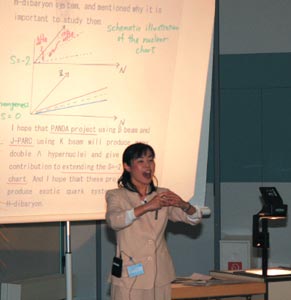
Although the workshop was announced only two months beforehand, it attracted some 70 participants from all the related fields, and covered subjects ranging from fundamental questions about charge-parity-time-reversal (CPT) symmetry and gravitation, to the structure of exotic nuclei, atomic collisions and atomic physics. This report relates just a few of these topics; a full account will soon be published in the Proceedings series of the American Institute of Physics.
The early days of antiproton research were reviewed by John Eades of the University of Tokyo. Eades turned back the pages of scientific history in a talk entitled “The Antiproton and How It Was Discovered”, quoting the thoughts and opinions of some of the main participants, made both at the time and in retrospect. He underlined the initial doubts and inconsistencies that surrounded Paul Dirac’s relativistic-wave equation of 1930, and its final triumph as the positron, antiproton and other antiparticles were discovered.
Klaus Jungmann of the Kernfysisch Versneller Instituut (KVI), Groningen, gave a comprehensive overview of the current status of low-energy antiprotons and other exotic particles, and the experimental opportunities they offer as windows on fundamental forces and symmetries in nature. On the theoretical side, Ralf Lehnert of Vanderbilt University pointed to the large gap that will remain in our understanding of nature at the smallest scales until a consistent quantum theory is developed that underlies both the Standard Model and general relativity. He discussed the so-called Standard Model Extension (SME) as a theoretical framework that may bridge this gap, and which incorporates all Lorentz- and CPT-violating corrections compatible with key principles of physics . The SME predicts diurnal variations in spectroscopic measurements of matter and antimatter atoms, and could therefore be a guiding principle in designing future antihydrogen experiments.
Antihydrogen atoms and antihydrogen ions
The past three years have seen important progress by both the ATHENA and the Antihydrogen Trap (ATRAP) collaborations in synthesizing and experimenting with antihydrogen atoms at the AD. Some of the main results concern the accumulation of large numbers of positrons and antiprotons in “nested” Penning traps of various geometrical designs, leading to the observation of high formation rates for antihydrogen atoms. An unexpected consequence is that these antihydrogen atoms seem to be created before their constituent antiprotons have been fully cooled, with the result that they are themselves too hot to be easily stored and manipulated with existing techniques. Moreover, they are primarily formed in highly excited Rydberg states, while it is the ground and first-excited states that are of most interest for testing CPT invariance.
These obstacles to preparing usable antihydrogen atoms for physics experiments demand new ideas in trap design, going beyond the configuration of the nested electrostatic potential well used so far. Thus, Jeff Hangst of Aarhus described the present status of the high-field-gradient magnetic multipole trap proposed by the newly formed Antihydrogen Laser Physics Apparatus (ALPHA) collaboration; and Dieter Grzonka of Jülich reported on tests made on long-term electron storage in the ATRAP collaboration’s quadrupole magnet, which has a more moderate field gradient.
The storage of neutral atoms of antihydrogen requires the presence of magnetic field gradients to drive the so-called low-field-seeking atomic-spin states towards field minima, and will be essential to carry out high-precision antihydrogen spectroscopy. Since it appears that the atoms are produced in highly excited Rydberg states, they must be stored for long enough to allow them to relax to the ground state. Discussions at the workshop centred on various multipole and quadrupole trap designs that are likely to be useful in preparing such ground-state antihydrogen atoms.
Further new designs involve the so-called “cusp trap”, consisting of a potential well formed by two oppositely directed Helmholtz-coil fields, and a high-Q RF trap resonating at two frequencies, which can store positively and negatively charged particles simultaneously.
Ryugo Hayano of the University of Tokyo summarized both the present status of precision spectroscopy of antiprotonic helium and the development of the two-frequency RF trap for antihydrogen synthesis. In the latter, positrons and antiprotons may recombine within a volume of around 1 mm3, and thus form a source for an antihydrogen atomic beam. Sextupole magnets installed in such a beam could select and analyse specific antihydrogen spin alignments to measure the hyperfine structure of the antihydrogen ground state, much as was done with ordinary hydrogen atoms several decades ago.
Because of their larger mass, muons probe CPT-violation effects at a distance 200 time closer to the antiproton nucleus than positrons and electrons do.
Akihiro Mohri of RIKEN, Japan, showed that stable long-term storage of an electron plasma has been achieved at finite temperature in a cusp trap and that this can also trap synthesized antihydrogen atoms in low-field-seeking states. When the temperature of antihydrogen atoms and the magnetic field of the cusp trap are properly set, antihydrogen atoms in the ground state are selectively guided and focused along the magnetic axis, enabling an intensity-enhanced spin-polarized antihydrogen beam to be prepared.
A new path towards gravitational experiments with antihydrogen was proposed by Patrice Perez of CEA/Saclay, who discussed synthesis of antihydrogen ions (Hbar+). These could be formed via two-step reactions (pbar →Hbar →Hbar +) when a 13 keV antiproton beam passes through a dense cloud of positronium atoms. The resulting Hbar+ ions would then be trapped, sympathetically cooled with laser-cooled alkali-earth ions, and finally ionized to the neutral state by a laser-detachment process to create the ultra-cold Hbar atoms necessary for detecting the extremely weak gravitational interaction.
Kanetada Nagamine of KEK proposed studying muonic antihydrogen (μ+pbar), the antimatter equivalent of muonic hydrogen (μ–p), as an alternative to antihydrogen. The advantage of comparisons between μ–p and μ+pbar is that because of their larger mass, muons probe CPT-violation effects at a distance 200 times closer to the antiproton nucleus than positrons and electrons do.
Further studies
Collision dynamics with antiprotons is also a potentially important subject, in which the antiproton behaves like a heavy electron. Although the Coulomb force is understood, its collision dynamics are not well known when more than three particles are involved. A familiar, puzzling example is the double ionization of helium by fast antiprotons, the cross-section for which is about twice as large as that for protons having the same velocity. Almost 20 years have passed since this observation, but it is not yet fully understood theoretically. This contrasts with the case of bound systems such as antiprotonic helium (pbarHe++), where the observed transition levels have been theoretically accounted for at the level of one part per billion.
Joachim Ullrich of the Max Planck Institute, Heidelberg, discussed the importance of studying collision dynamics with antiproton energies in the range of 100 keV for which the time required to traverse atoms or molecules is of the order of 100 attoseconds (as). Since this is comparable to the orbital period of outer-shell electrons in atoms or molecules, crucial information on collision dynamics involving electron-electron correlation can be extracted.
Antiprotonic atoms have long been used to probe neutron density distributions in stable nuclei through studies of antiprotonic X-ray spectra, radiochemistry of the residual nuclei, and the charged pions emitted when the antiprotons annihilate. An antiproton captured in an electronic orbit de-excites to successively lower atomic levels until its overlap with the nucleus becomes appreciable. At this point annihilation takes place with a proton or a neutron near the “surface” of the nucleus (atomic number A), the actual charge state being identifiable from the charge balance of emerging pions; a nucleus of atomic number A-1 results.
Michiharu Wada of RIKEN proposed extending the pion-detection method by storing antiprotons and unstable nuclei in a nested trap. The charge-balance method can be applied to various nuclei including those for which the A-1 nuclei have no bound states. Slawomir Wycech of the Soltan Institute, Warsaw, emphasized that all these measurements test neutron density distributions in different regions of nuclei and yield complementary information on the rms and higher moments of density profiles as low as 0.001 of the central neutron density.
Looking to future antiproton facilities Paul Kienle of the Technischen Universität München discussed the possibility of an antiproton-ion collider at GSI’s Facility for Antiproton and Ion Research (FAIR), with energies of 30 MeV and 740 AMeV for protons and ions respectively. Cross-sections for antiproton absorption on protons and neutrons would be measured by detecting residual nuclei with A-1, using Schottky and recoil detectors respectively. This would permit rms radii for protons and neutrons to be determined separately in stable and short-lived nuclei by means of antiproton absorption at medium energies. A general discussion around the subject of ultra-slow antiproton physics ended this extremely fruitful workshop.
The biennial International Conference on Low Energy Antiproton Physics, LEAP-05, took place in May at the Gustav-Stresemann-Institute in Bonn. Organized by the Jülich Research Centre, it brought together about 150 physicists, including experienced and active users of the former Low Energy Antiproton Ring (LEAR) at CERN and the existing Antiproton Decelerator (AD), as well as potential users of the future Facility of Antiproton and Ion Research (FAIR) at the Gesellschaft für Schwerionenforschung (GSI). The meeting enabled researchers who are interested in using the exciting tool of antiprotons to exchange knowledge about the physics and techniques. The programme covered the whole field of research with antiprotons, from atomic physics at low energies to hadronic reactions at high energies. The conference showed that the field is evolving, with new physics being studied at existing and planned facilities.
The AD began operating in 2000 and its experiments have reported spectacular production rates of antihydrogen atoms as well as topical observations of antiprotonic helium atoms. Though limited to low-energy antiproton research with only a pulsed extracted beam, the AD is regarded as the successor of LEAR after it closed down at the end of 1996, together with the Antiproton Accumulator (AA) and Antiproton Collector (AC). The AC machine was modified to become the AD – a decelerator to slow down the antiproton beam from a momentum of 3.57 GeV/c to 100 MeV/c. During deceleration, the beam undergoes stochastic and electron cooling. The extracted beam intensity is about 3 × 10⁷ antiprotons in a pulse of 90 ns, repeated every 86 s.
The AD delivers antiprotons only at the lowest energy that was available at LEAR, i.e. 5 MeV. For one experiment – ASACUSA – the antiproton beam is further slowed down to about 60 keV with a radio-frequency quadrupole decelerator (RFQD). A possible additional decelerator ring, ELENA, to serve all experiments, would have a cooled beam and would bring a major improvement if installed.
Plans are being realized for a new antiproton facility at GSI, where antiprotons with energy high enough for physics with strange and, especially, charm mesons will be available, in addition to very-low-energy antiprotons. An accelerator complex for research with both ion and antiproton beams is planned. This would provide an outstanding new experimental facility for studying matter at the level of atoms, protons and neutrons and their sub-nuclear constituents: quarks and gluons.
Research on fundamental symmetries was a very important part of the scientific programme at LEAP-05. Over the past 50 years, experimental tests have made physicists discard certain assumptions about symmetry: first, that physics is invariant under parity (P); and second, that it is invariant under the charge-parity (CP) transformation. Direct CP violation has been established in the decays of K-mesons and, recently, B-mesons. On the other hand, CP plus time-reversal (T) invariance, CPT, is believed to hold – and is partly experimentally verified – to a high degree of accuracy.
The symmetries under T, CP and CPT transformations are connected, and the CPT theorem demands that for each particle or element the equivalent antiparticle has the same mass, lifetime, spin and isospin – but an opposite value for all of the additive quantum numbers. The proof (or disproof) of the validity of this basic symmetry may be the key to such fundamental aspects as the universe’s matter-antimatter asymmetry. Physics is still in a phase where it is important to accumulate highly precise experimental data from different leptonic and/or hadronic systems. In this respect, the role of matter-antimatter asymmetry – especially baryonic proton-antiproton physics – is significant.
Probing how antiprotons interact with matter at very low energies is still a topical field for precise studies of the electromagnetic and strong forces and their interplay. High-precision spectroscopy of meta-stable antiprotonic atoms has produced very interesting and unique results. With the accuracy achieved in investigations of antiprotonic helium atoms, the CPT theorem can be tested to a level comparable to the existing bounds from other systems.
An alternative approach is the production and comparison of hydrogen and antihydrogen. A reasonable requirement for a new and unique CPT test of this kind is that it is eventually more stringent than existing tests with leptons and baryons. To make the required high-precision spectroscopic measurements, the hydrogen and antihydrogen atoms have to be at such low temperatures that laser cooling of trapped atoms, which is possible owing to the development of a continuous Lyman-alpha laser, appears to be necessary. Once all the basic technical requirements to produce antihydrogen atoms have been explored and optimized, tests of the gravitational force on antimatter will also be possible, free from the problems associated with charged particles.
When describing the nucleon-antinucleon (N-Nbar) interaction, it is implicitly assumed that the six-quark N-Nbar system can be regarded as a product of quark-antiquark nucleon wave functions with a complex potential that is dominated by the distance between the nucleons. Such a potential predicts a spectrum of many states, if the annihilation part is ignored. There is a rich dynamics of resonances or bound states around thresholds, where the annihilation effects are less dominant, since the phase space for the decay into meson resonances is more restricted. However, the transition from an N-Nbar system to a multiquark state, where quarks and antiquarks interact directly by gluon exchange, must be fully understood before invoking exotic mechanisms based on details of the interaction. New dedicated experiments could determine the energy and the quantum numbers of an N-Nbar system, clarifying the long-range interaction.
Probing the strong interaction
Antiproton beams are an excellent tool for addressing the regime of strong coupling. In antiproton-proton annihilations, particles with gluonic degrees of freedom as well as particle-antiparticle pairs are copiously produced, allowing spectroscopic studies with unprecedented statistics and precision. Phenomena arise that represent open problems in quantum chromodynamics (QCD) as they have their origin in the specific properties of the strong interaction and represent a major intellectual challenge. Quarks are confined within hadrons; the hadron mass does not balance with the summed mass of the quarks contained; and the characteristic self-interaction among gluons should allow for the existence of glue-balls and hybrids, consisting mainly of gluons and/or glue plus a quark-antiquark pair, respectively.
The charmonium system has turned out to be a powerful tool for understanding the strong interaction. The spectroscopy of the charm-anticharm system helped in tuning potential models of mesons in which the gluon condensate is determined. The gluon condensate is closely related to the charmonium masses since it is the gluon and quark-antiquark condensates that represent the energy density of the QCD vacuum. The QCD spectrum is much richer than in the simple quark model, as the gluons, which mediate the strong force between quarks, can also act as the principle components of entirely new types of hadronic matter: glueballs and hybrids.
The additional degrees of freedom carried by gluons allow glueballs and hybrids to have exotic quantum numbers that are forbidden for normal mesons and other fermion-antifermion systems. Such exotic systems can be identified by observing an overpopulation in the experimental meson spectrum, and by comparing their properties with predictions from models for lattice QCD considerations. Antiproton annihilation experiments have produced very promising results for gluonic hadrons.
A special session spiritedly discussed applications of antimatter, radiation and particle detection, covering well established medical treatments, diagnostic routines, plans for future developments and using nuclear physics to locate land-mines to reduce injuries, especially to children.
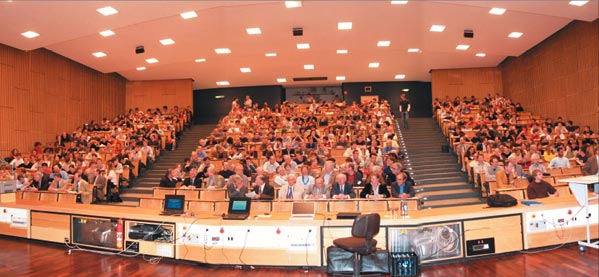
One highlight of the conference was a public presentation in the overcrowded Wolfgang Paul Lecture Hall at the University of Bonn, where more than 600 people listened to presentations on modern, high-quality physics and its excitements. At least some listeners were disappointed when these lectures stopped after four hours! The entire LEAP-05 was a brilliant preview of the physics to come from using antiprotons as a special and very effective tool.
• The conference was sponsored by Forschungszentrum Jülich; Deutsche Forschungsgemeinschaft; HiEnergy Technologies, Inc; Deutsche Telekom Stiftung; iseg Spezialelektronik GmbH; Bicron; W-IE-NER, Plein & Baus GmbH; and Pfeiffer Vacuum.
The DEAR (DAFNE Exotic Atoms Research) experiment at the DAFNE φ factory at Frascati has performed the most accurate determination of the effect of the strong interaction on the binding energy of kaonic hydrogen.
Kaonic hydrogen is an exotic atom where the electron is replaced by a K–, and it turns out to be an excellent laboratory for studies of quantum chromodynamics. Especially interesting is the determination of the strangeness content of the nucleon, which has traditionally been determined from low-energy kaon-nucleon scattering amplitudes. A significantly more accurate approach has now been discovered, which involves measuring the ground-state X-ray transitions in kaonic hydrogen atoms.
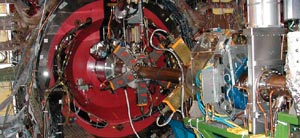
The DEAR collaboration took advantage of the low-energy monoenergetic kaons from the decay of φ mesons resonantly produced by e+e– collisions at one of the two interaction points at DAFNE. The kaons travelled through the thin beam pipe of DEAR and stopped in a gaseous hydrogen target. CCD detectors with a pixel size of 22.5 x 22.5 μm2 cooled to 165 K detected the X-rays emitted.
The DEAR experiment follows the steps of the KpX experiment at KEK in Japan, which first measured the ground-state X-ray peak of kaonic hydrogen. DEAR’s values are about a factor of two more accurate, and roughly 40% lower than those of the Japanese collaboration. The ground-state shift, ε1s, was measured to be -193 ± 37 (stat.) ± 6 (syst.) eV, with a 1s strong interaction width of Γ1s = 249 ± 111 (stat.) ± 30 (syst.) eV.
DEAR has also become the first experiment to observe transitions from different excited states, clearly identifying Kα, Kβ and Kγ lines.
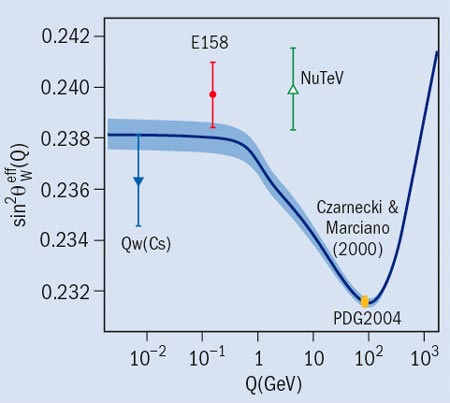
The E158 experiment at the Stanford Linear Accelerator Center has made a landmark observation: the strength of the weak force acting on two electrons lessens when the electrons are far apart. The results will be published in Physical Review Letters.
Because there is an asymmetry in how the weak force acts, there is a difference between how often left- and right-handed electrons scatter via a Z particle (the neutral carrier of the weak force). Two years ago, the team made the first observation of this parity-violation effect in electron-electron interactions.
For the new results, E185 used its improved precision asymmetry measurement to calculate the long-distance (low momentum transfer, Q) weak charge of the electron, which determines the strength of the weak force between two electrons. The result is the world’s best determination of the weak mixing angle at low energy: sin2θweff = 0.2397 ± 0.0010 (stat.) ± 0.0008 (syst.), evaluated at Q2 = 0.026 GeV2.
Previous experiments at SLAC and CERN measured the electron’s weak charge at high momentum transfer (short distances). E158’s long-distance measurement observes this weak charge to be half the size of the charge at short distances. Comparing the short-distance measurements with the long-distance results demonstrates (with 6σ significance) the variation of the strength of the weak force with distance, and confirms an important aspect of Standard Model theory. Using the result for sin2θweff, E158 finds the electron’s weak charge to be -0.041 ± 0.006 – half the value expected if there were no variation.
E158 was also sensitive to indirect signals from hypothetical Z’ particles, suggesting they are at least 10 times the mass of the Z.
Problems in theories such as quantum chromodynamics (QCD) that involve strong coupling are among the most intractable in physics. The difficulties of accurate calculations are particularly vexing when it comes to studying charge-parity (CP) violation – a necessary ingredient for explaining the absence of the antimatter produced in the Big Bang, and a vital topic in particle physics. Progress in making accurate QCD calculations in this sector of the Standard Model could have far-reaching consequences, because the larger theory in which the Standard Model is embedded, even if not strongly coupled ab initio, will almost certainly have strongly coupled sectors.
The amount of CP violation that is consistent with our current understanding of the Standard Model is not enough to account for the disappearance of the antimatter produced along with the matter. The decay of B mesons is the most promising arena in which to search for other sources of CP violation, and the B-factory experiments, BaBar and Belle, have been spectacularly successful in observing and studying CP violation in those decays.
However, the search for CP violation beyond the Standard Model involves comparison of the angles of the “unitarity triangle” measured in CP violation experiments, with the lengths of the sides determined from more conventional measurements. These lengths are determined from elements of the Cabibbo-Kobayashi-Maskawa (CKM) matrix, which describes the relative strengths of the weak decays of quarks. The problem is that quarks do not appear alone, but in strongly interacting combinations such as mesons and baryons. So, there is always a strong-interaction parameter that relates decay measurements to the underlying CKM matrix element. So far, the uncertainties in these parameters severely limit the precision of measurements of the CKM matrix elements.
One example of such a strong-interaction parameter, called fB, is required to extract the CKM matrix element called Vtd from measurements of B0B0bar mixing. This parameter is a measure of the separation of the b quark and the anti-d quark in a B meson, and could, in principle, be measured in B+ → μ+ν decay. However, this decay is so slow that an accurate measurement is impossible, even with the enormous data samples that the BaBar and Belle collaborations have accumulated. This is one of the parameters that lattice QCD (LQCD) theorists can calculate, but accuracy has been limited. Recent progress in LQCD holds the promise of precise calculations of the parameters, including fB, that are required to determine CKM matrix elements, but until now there has been no effective direct experimental test of the precision of these calculations.
Five years ago, some LQCD theorists and members of the CLEO collaboration at the Cornell Laboratory for Elementary-Particle Physics realized that comparing measurements of D meson decays with LQCD calculations could test the LQCD calculations needed for extracting CKM matrix elements. In particular, in the decay D+ → μ+ν there is a parameter called fD+ that is analogous to fB. The rate for D+ → μ+ν decay is larger than the corresponding B meson decay rate, so it can be measured accurately. If good agreement is found between the experimental and LQCD values for fD+, that would inspire confidence in LQCD calculations of fB. It is also generally believed that the ratio fB:fD+ can be calculated more accurately than either one, so fB could be determined from an experimental measurement of fD+ and a LQCD calculation of the ratio. This caused the CLEO collaboration and a group of LQCD theorists to embark on D meson decay experiments and the corresponding LQCD calculations, with goals of accuracies of a few per cent. However, they had technical difficulties to overcome.
Although there have been LQCD calculations since the 1970s, their accuracy has been limited to 20% because of a simplification – the “quenched approximation”. Predictions from “unquenched” LQCD calculations that match experimental results to a few per cent are needed to demonstrate that the calculations can be done at the desired level of accuracy. The LQCD theorists were the first to reach the goal of a few per cent in their calculations of important parameters (not fD+ or fB) in the b and c quark systems. However, their results were “postdictions” not predictions, because the corresponding experimental results had already been published. Still, this success motivated the group of LQCD theorists to embark on their calculations of the strong-interaction parameters needed to determine CKM matrix elements.
Measurement of fD+ is one of the main goals of the CLEO-c physics programme at the Cornell Electron Storage Ring (CESR). However, obtaining high luminosity was a major challenge for the CESR accelerator group. Although CESR had made progress in luminosity since its first operation in 1979, much of those gains would be lost in reducing the energy from the b quark threshold region, near 5 GeV per beam, to the c quark threshold region near 2 GeV per beam, where the measurement could be made most readily. As the energy of the beams is decreased, the synchrotron radiation “damping” required for high luminosity is substantially reduced. The solution was the installation of 12 “wiggler” magnets to increase the damping at the lower energies. These magnets were installed in 2003 and 2004 in CESR-c, and the CLEO-c programme then began in earnest, funded by a five-year grant from the National Science Foundation.
The first engineering run of CESR-c with six wigglers yielded an integrated luminosity of 60 pb-1 in e+e– collisions at a total energy of 3.77 GeV, the peak of the ψ (3770) resonance. This is substantially more than the luminosities available to either the MARK III or the BES II collaborations, at SLAC and the Institute of High Energy Physics in Beijing respectively, which previously took data at the same energy. Subsequent runs with 12 wigglers brought the total integrated luminosity to 281 pb-1. This is the most desirable energy for measuring D meson decays because the ψ (3770) decays only to D+D– or D0D0bar pairs, making very clean “tagged” measurements possible. In tagged measurements pioneered by the MARK III collaboration, if one D meson, D– for example, is reconstructed in an event, then the rest of the particles in that event must be from the decay of a D+ meson. Coupled with the excellent resolution and large acceptance of the CLEO-c detector, tagging provides a very clean sample of D+ meson decays, which is an ideal arena for searching for rare decays such as D+ → μ+ν.
The CLEO collaboration found eight D+ → μ+ν events (with an estimated background of one event) in the first 60 pb-1 of CLEO-c data. This provided a rough measurement of fD+ to an accuracy of 20%, which has now been published (Bonvicini 2004). The larger data sample and improvements in selection criteria produced a yield of 50 candidates for D+ → μ+ν decay with an estimated background of 2.9 ± 0.5, enough candidates to yield an error in fD+ below 10%.
While the CLEO collaboration, with the help of their CESR colleagues, was accumulating and analysing these data, a group of LQCD theorists was also hard at work calculating fD+. It became clear that both groups could have substantial results just in time for the Lepton-Photon Symposium in Uppsala at the end of June. Since both communities felt that it was very important for the LQCD result to be a real prediction, they agreed to embargo both of their results until the conference. On the second day of the symposium, Marina Artuso of Syracuse University reported the preliminary CLEO-c result fD+ = 223 ± 16-9+7 MeV (CLEO-c 2005), and Iain Stewart of MIT reported the LQCD result from the Fermilab, MIMD Lattice Calculation (MILC) and High Precision QCD (HPQCD) collaborations, fD+ = 201 ± 3 ± 17 MeV (Aubin et al. 2005). For both results the errors are statistical and systematic, respectively. The two results agree well within the errors of about 8% for each.
The agreement between the results motivates both communities to continue comparing LQCD calculations with experiments. On the LQCD side, important next steps include improvements in algorithms that can reduce systematic errors and precision calculations of the “form factors” involved in semileptonic decays of D and B mesons. The CLEO collaboration plans to utilize its data sample to measure form factors in semileptonic D decay and take more data to reduce errors. The LQCD theorists and the CLEO collaboration both aim to reduce errors to below 5%. The CLEO collaboration is also planning to explore the threshold region for DsDsbar production to search for an energy at which the tagging techniques can be applied to make the first accurate measurements of Ds meson decay, including fDs and Ds semileptonic decay form factors. The Fermilab, MILC and HPQCD group has already predicted the value of fDs.
Up to a few years ago, no significant measurement of the angle γ in the unitarity triangle of B-meson physics was expected to come out of the current B-factories. However, a recent proposal to measure γ in B → DK decays using a Dalitz plot analysis has revolutionized the field. Results are emerging from both the B-factories at KEK and at SLAC.
Determinations of the Cabibbo-Kobayashi-Maskawa (CKM) matrix elements provide important checks on the consistency of the Standard Model and ways to search for new physics. The CKM matrix parameterizes the mixing of different quarks as seen by the weak interaction and provides the Standard Model interpretation for charge-parity (CP) violation.
The nine complex elements of the matrix are related by unitarity constraints to a series of equations. One such relationship of specific interest to B-physics can be represented by a triangle, referred to as the “unitarity triangle”. The angles of the unitarity triangle are referred to as α, β and γ (ϕ2, ϕ1 and ϕ3 respectively in Japan). Although β has already been measured with an accuracy of a few degrees, it is more difficult to measure α and γ accurately.
.The new analysis uses three-body decay of the neutral D, D0 → Ksπ+π– from the channels B± → D0K±, B± → D*K± and B± → DK*±. In the Dalitz plot analysis on the three-body decay of the D the invariant mass of the Ksπ+ system is plotted versus the Ksπ– system in two dimensions, helping a measurement of an asymmetry when looking at B+ compared with B– decays. The method also utilizes more event information and is thus more sensitive compared with a 1D approach.
Using a data sample of 253 fb-1, the Belle collaboration at KEK obtains 276 signal candidates for B± → D0K±, 69 candidates for B± → D*K± and 56 candidates for B± → DK*± (Abe et al. 2004 and 2005). Combining the first two channels yields the result γ = 68° ± 14° ± 13° ± 11°. The first error is statistical, the second is experimental systematics and the third is model uncertainty. The statistical significance of CP violation is 98%. This is not quite enough to claim observation of direct CP violation just yet, but it is getting close.
The BaBar collaboration at SLAC is also working on a similar analysis and their preliminary result stands at γ = 70° ± 26° ± 10° ± 10° (Aubert et al. 2004). Such values of γ agree with what is expected by the Standard Model and global fits of other information; moreover, the Dalitz plot method is fast becoming an established tool for measuring γ.
Preliminary data on the hot topic of the search for pentaquarks were presented at the April Meeting of the American Physical Society by the Jefferson Laboratory’s CEBAF Large Acceptance Spectrometer (CLAS) collaboration. Quantum chromodynamics (QCD) does not forbid exotic, pentaquark states comprising four quarks and an antiquark, but the jury is still out as to whether such a state has been observed. Several experiments have published positive results while an equal number of different experiments have found nothing. The new result adds to the negative evidence.
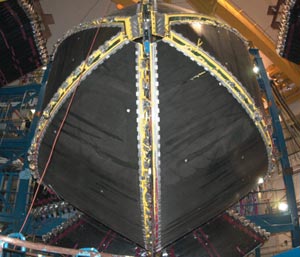
The g11 experiment at the CLAS detector is a fixed-target photoproduction experiment in which a tagged photon beam, with photon energies individually measured, at an energy of 1.6-3.8 GeV hits a proton target. Data-taking was completed in 2004 with 70 pb-1 of integrated luminosity. The collaboration searched for the Θ+(1540) produced together with a neutral kaon in the reaction γp → Θ+Kbar0, where the Kbar0 is detected via its K0s component decaying into π+π–.
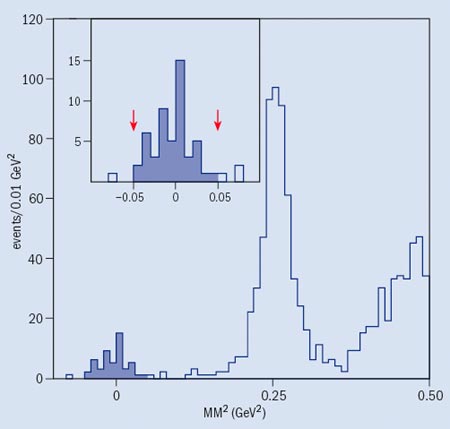
The Θ+ is expected to decay into a neutron and a K+, and the neutron is reconstructed from the missing mass in the reaction. No signal is seen in the nK+ mass spectrum, putting a limit on the production cross-section for γp → Θ+K0bar of less than 4 nb at a 95% confidence level.
This result is at odds with a published analysis of CLAS, where a Θ+ signal was seen with a 7.8 σ significance in the reaction γp → Θ+π+K–. The earlier study was performed on 5 pb-1 of data, where a couple of severe geometry cuts had to be applied to the original nK+ distribution to reveal the Θ+ signal. An experiment at higher energy to verify this result is planned.
“Table-top” experiments can still probe physics complementary to particle searches at high-energy accelerators. A beta-neutrino correlation experiment using TRIUMF’s Neutral Atom Trap (TRINAT) has now set the best limits on general scalar interactions contributing to nuclear beta decay.
TRINAT uses the radiation pressure of laser light to capture radioactive atoms in a 1 mm-sized cloud. Laser light of a frequency slightly below an atomic resonance is shone from all sides of the trap. Atoms moving away from the trap then “see” along their direction of motion light that is blueshifted closer to the resonance, while away from their direction of motion they see light redshifted further away from resonance. The net effect is of radiation pressure opposite to the direction of motion, as the atom absorbs more light that is closer to its resonance.
The trapped atomic nuclei undergo beta decay, which produces three decay products: a positron (β+), a neutrino (ν) and the recoiling daughter nucleus. The daughter nucleus has a kinetic energy of 0-430 eV; while it would stop in 1 nm of material, it can escape the trap. By measuring the momentum of the nucleus in coincidence with that of the β+, the TRINAT team can deduce the momentum of the neutrino more accurately than in previous experiments (which did not measure the recoil energy).
These techniques have been pioneered at TRIUMF using potassium isotopes with 1 s half-lives produced at the Isotope Separation and Acceleration (ISAC) facility with the main TRIUMF cyclotron – this “table-top” experiment admittedly is driven by the world’s largest cyclotron. Results are also becoming available from other experiments based on neutral-atom traps at Berkeley and Los Alamos.
In the Standard Model the weak interaction is mediated by spin-1 vector bosons, the W+, W– and Z. Measurements of the β-ν angular distribution in the decay of 38Km → 38Ar + β + ν where both parent and daughter have no nuclear spin allow the search for contributions from hypothetical spin-0 scalar bosons. The TRINAT result for the β-ν correlation parameter a is 0.9981 ± 0.0030 ± 0.0037, consistent with the Standard Model value a =1.
The previous best result, by a Seattle-Notre Dame collaboration using beta-delayed proton emission of 32Ar produced at the ISOLDE facility at CERN, is in the process of being re-evaluated after new measurements of the mass of parent and daughter. Such results constrain the existence of spin-0 bosons with mass:coupling ratios as great as four times the W+ mass, and are complementary to other measurements.
TRINAT can determine detector response functions in situ from the data itself. This is routinely done in high-energy experiments but never before for low-energy beta decay. The experiment has also used the equivalent of the missing-mass construction in high-energy physics to constrain the admixture of possible sterile neutrinos of million-electron-volt mass with the electron-neutrino.
TRINAT is also investigating other physics topics. These include measuring the neutrino asymmetry from polarized nuclei to search for evidence of non-Standard Model right-handed neutrinos (using a complementary measurement to the purely leptonic muon-decay studied at TRIUMF and PSI); measuring the spin asymmetry of the daughter nuclei in pure Gamow-Teller decays; and testing hints of a nonzero tensor interaction reported in π→νeγ by the PIBETA collaboration at PSI.
To provide the best experiences, we use technologies like cookies to store and/or access device information. Consenting to these technologies will allow us to process data such as browsing behavior or unique IDs on this site. Not consenting or withdrawing consent, may adversely affect certain features and functions.
Functional
Always active
The technical storage or access is strictly necessary for the legitimate purpose of enabling the use of a specific service explicitly requested by the subscriber or user, or for the sole purpose of carrying out the transmission of a communication over an electronic communications network.
Preferences
The technical storage or access is necessary for the legitimate purpose of storing preferences that are not requested by the subscriber or user.
Statistics
The technical storage or access that is used exclusively for statistical purposes.The technical storage or access that is used exclusively for anonymous statistical purposes. Without a subpoena, voluntary compliance on the part of your Internet Service Provider, or additional records from a third party, information stored or retrieved for this purpose alone cannot usually be used to identify you.
Marketing
The technical storage or access is required to create user profiles to send advertising, or to track the user on a website or across several websites for similar marketing purposes.