Most experiments at the Antiproton Decelerator (AD) at CERN involve laser or microwave studies of atoms such as antiprotonic helium (pbarαe–) and antihydrogen (pbare+). These may throw light on outstanding questions concerning, for example, the apparent absence of cosmic antimatter and possible limits to the validity of the charge–parity time-reversal (CPT) theorem. In this research, antiprotons are brought to rest in a container – a helium-gas target chamber in the first case, and a high-vacuum electromagnetic trap containing positrons in the second. In either case, interpretation of the results requires a full understanding of how the atoms are created, what their quantum states are and how they subsequently behave. However, it is rather like performing chemistry in a test tube where residues of impurity gases might also be present. Though unwanted these could have important effects and the studies at the AD have indeed led to some unexpected, serendipitous discoveries.
The ATHENA collaboration, whose primary is to study antihydrogen spectroscopically, has reported evidence that metastable protonium atoms (i.e. antiprotonic hydrogen, pbarp) can be created in binary antiproton reactions with H2+ ions. These ions were produced when the positrons in the trap collided with H2 molecules, inevitably present as “dirt in the test tube”. This serendipitous method of making protonium turns out to be interesting because it seems to produce it in states with principal quantum number (n) near 68 and angular momentum quantum number l < 10.
Ground-state n = 1, l = 0 protonium can be produced easily and has been known for many years. However, it annihilates almost instantaneously owing to the marked overlap of the p and pbar wave functions. In high-n protonium, however, there is little overlap, since the Bohr-model orbit radius is proportional to n2. The p and pbar can then come into contact only by de-exciting radiatively to l ∼ 0 via a chain of transitions that the ATHENA team estimates to take about 1 ms. This extreme longevity should enable detailed laser-spectroscopy experiments on the protonium atom, leading to values of the antiproton’s properties relative to those of the proton, and so to a new class of CPT-invariance tests (N Zurlo et al. 2006). Two-body atoms are especially valuable in this respect since their transition frequencies can be calculated analytically
Another experiment at the AD, ASACUSA, has been exploiting longevity against annihilation for some years with the (neutral) antiprotonic helium atom, pbarHe+. Although this is a three-body atom, its high-n, high-l, pbarHe states have microsecond annihilation lifetimes and are easily produced when antiprotons with electron-volt energies collide with ordinary helium atoms. As in the antihydrogen experiment, H2 impurities are always present in the “test tube” at some level and have long been known to reduce, or quench, the pbarHe+ lifetime, even at very low molecular concentrations, via binary collisions between H2 and pbarHe+.
To understand this fully, the ASACUSA team introduced H2 and D2 molecules into the helium target at various temperatures and concentrations and then deduced the quenching cross-section from the annihilation lifetime of the antiproton in the (n,l) = (37,34) and (n,l) = (39,35) states, as a function of these variables (B Juhász et al. 2006). Below 30 K the cross-section levelled off in the first case, revealing a tunnelling effect with a small activation barrier, while the (39,35) state had a 1/v “Wigner”-type dependence. Such results can perhaps serendipitously fill some gaps in our understanding of astrophysics, since the measured cross-sections should be similar to those for binary reactions of hydrogen and deuterium, which play an important role in cold interstellar and protostellar clouds, but have not been well studied at low temperatures.
A final unsought discovery has resulted from ASACUSA’s quest for ever lower systematic errors in the laser-spectroscopy experiments on antiprotonic helium. This forced the team to go to extremely low helium target pressures. At helium densities less than 3 × 1016 cm-3 they noticed a lengthening of the tail of the spectrum of time intervals between the formation of the pbarHe+ atom and the subsequent annihilation of the antiproton. This could only be explained by longevity of the pbarHe++ two-body, doubly charged ion, which in higher-pressure gas is a short-lived intermediate stage between the formation of the neutral pbarHe+ atom and the “contact” ppbar annihilation (Hori et al. 2005). Once again, a two-body atom promises to become serendipitously available as a test bench for CPT tests. Following up this possibility is an important part of the ASACUSA experimental programme.
Researchers at the Tevatron at Fermilab have found two new heavy particles and two of their excited states. The CDF collaboration has observed the first Σb particles, made up of quark combinations uub and ddb. Until now the Λb0 (udb) was the only baryon (three quark) state containing a b quark to have been observed.
The quark model predicts the existence of Σb particles, in which the spins of the light quarks (u or d) combine with spin-parity, JP = 1+ to give a ground-state baryon with JP = 1/2+, and excited state, Σb*, with JP = 3/2+. CDF is well placed to search for new particles like these, as the collaboration has the world’s largest data set of baryons containing the b quark, thanks to the displaced track trigger that the experiment uses and a total of proton–antiproton luminosity around 1 fb-1 from the Tevatron, collected between February 2002 and February 2006. As the ground states of Σb are expected to decay strongly to Λb0 states by emitting pions, the CDF team searched first for the Λ states via the decay chain, Λb0 → Λc+π, Λc+ → pK–π+. They then looked for narrow resonances in the mass difference m(Λb0pi;) – m(Λb0) – mπ, where they found signals corresponding to a hundred or so examples of positively charged states, and rather more with negative charge.
The states with positive charge correspond to uub and are consistent with being either Σb+ or Σb*-, while the negative states correspond to ddb, that is Σb+ or Σb*-, where the Σb* states have slightly higher masses. Working from CDF’s measurement of the Λb0, the four new states have masses in the region of 5800 MeV/c2.
The KEDR collaboration has precisely measured the τ lepton mass. This continues a series of high-precision measurements of masses of particles and resonances at the VEPP-4M collider at the Budker Institute of Nuclear Physics in Novosibirsk. In 2004 and 2005 masses of the J/Ψ and Ψ’ mesons were measured with a relative accuracy of 4 × 10⁻⁶ and 7 × 10⁻⁶, respectively.
The τ lepton mass is a fundamental parameter of the Standard Model. Its value can be used with the τ lifetime and the decay probability to eνbareντ to test the principle of lepton universality, one of the postulates of modern electroweak theory. Up to now the accuracy of the measurement of the Beijing Spectrometer (BES) has dominated the accuracy of the τ mass. Like BES, the KEDR experiment determines the τ mass by measuring the energy dependence of the τ+τ– cross-section near threshold, and the key factor in such experiments is the accuracy of the beam-energy determination.
While previous experiments relied on the extrapolation based on the J/Ψ and Ψ’ meson masses (measured in Novosibirsk) as reference points, the new KEDR-VEPP experiment uses two independent high-precision methods for the beam-energy measurement. During data-taking the beam energy was monitored through Compton backscattering of infrared laser light with a precision of 5 × 10⁻⁵. The beam energy was absolutely calibrated daily with a precision of 1 × 10⁻⁵ using the resonant depolarization method.
The preliminary result, presented at ICHEP’06, based on 6.7 pb-1 of data, is mτ = 1776.80-0.23+0.25 ±0.15 MeV. This value agrees well with the current world average mτ = 1776.99-0.26+0.29 MeV and has comparable accuracy. It is also in good agreement with the recent preliminary result from the Belle experiment at KEK of mτ = 1776.71±0.13±0.32 MeV, which was also reported in Moscow. Detector-related uncertainties currently dominate in the systematic error presented for KEDR, but they will be reduced with more detailed data analysis. The experiment started a new run of data-taking at the threshold for t production in October, with the aim of reducing the statistical error.
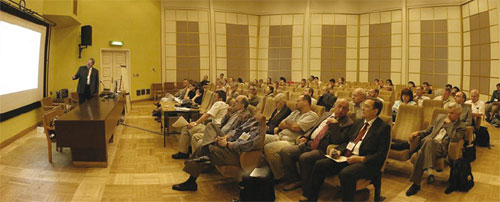
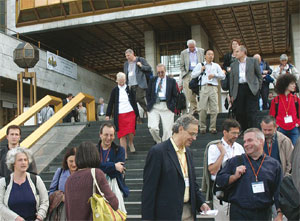
In summer 1976, the International Conference on High Energy Physics (ICHEP), known traditionally as the Rochester conference, was held in Tbilisi, the last time it would take place within the USSR. Thirty years later, the Rochester conference returned to Russia, when around a thousand physicists from 53 countries attended ICHEP’06, held on 26 July – 2 August in the Russian Academy of Sciences in Moscow. The extensive scientific programme contained the customary mixture of plenary reports, parallel sessions and poster presentations. For six days, participants discussed key issues in high-energy physics, ranging from astrophysics and cosmology, through the physics of heavy-ions, rare decays and hadron spectroscopy, to theoretical scenarios and experimental searches beyond the Standard Model. Topics also included Grid technology for data processing, new accelerators and particle detectors, and mathematical aspects of quantum field theory and string theory.
In his opening speech, the co-chair of the conference, Victor Matveev, emphasized that the entire community of Russian high-energy physicists was honoured to host the major international conference of 2006. The participants were also greeted by the director of the Budker Institute of Nuclear Physics (BINP) and co-chair of the conference, Alexander Skrinsky, and deputy rector of the Lomonosov Moscow State University, Vladimir Belokurov. The vice-chair of the organizing committee, and director of the Joint Institute for Nuclear Research (JINR), Alexei Sissakian then spoke about the structure of ICHEP’06 and its scientific programme.
Duality, QCD and heavy-ions
On the theory side, the progress in so-called “practical theory” is evident, primarily in the sophisticated calculations in quantum chromodynamics (QCD) presented by Giuseppe Marchesini of Milano-Bicocca University and Zvi Bern of the University of California, Los Angeles. Gerritt Schierholz from DESY, Adriano Di Giacomo of Pisa University and Valentin Zakharov of the Institute for Theoretical and Experimental Physics (ITEP), Moscow, explained the remarkable achievement of the splendid harmony between analytical calculations and the results obtained on the lattice using dynamical quarks.
The theoretical discussions emphasized the concept and use of gravity-gauge duality in a framework generalizing the anti-de Sitter space/conformal field theory correspondence. This duality is a conjectured relationship between confining gauge theories in four dimensions on the one hand, and gravity and string theory in five and more dimensions on the other. DESY’s Volker Schomerus described how, when applied to QCD, this approach reproduces numerous non-perturbative features of strong interactions, from the low-energy hadron spectrum through Regge trajectories and radial excitations to quark counting rules. On the experimental side, Pavel Pakhlov of ITEP Moscow, Antonio Vairo of Milano University and Alexandre Zaitsev of the Institute for High Energy Physics (IHEP) Protvino, reported on the numerous candidates for exotic hadronic states, both with light quarks only and with heavy quarks and/or gluons, that have been confirmed or newly reported by teams from the VES experiment in Protvino, BES II in Beijing, E852 at Brookhaven, CLEOc at Cornell, Belle at KEK, and BaBar at SLAC. These exotic states have still to be interpreted theoretically, within either gravity/gauge duality or more traditional approaches.
The Relativistic Heavy Ion Collider (RHIC) at the Brookhaven National Laboratory is intensively studying a relatively new area of QCD – the properties of matter at high temperatures and high particle densities. Timothy Hallman from Brookhaven, Larisa Bravina of the Skobeltsyn Institute of Nuclear Physics (SINP) Moscow University, Nu Xu of Lawrence Berkeley National Laboratory (LBNL), and Oleg Rogachevsky of JINR, among others, presented numerous experimental results, some of which were reported for the first time. These results suggest, quite surprisingly, as Xin-Nian Wang of LBNL explained, that collisions of highly energetic ions at RHIC result in the formation of strongly coupled quark–gluon matter, rather than weakly interacting quark–gluon “gas”. Here, too, gravity/gauge duality can reflect the most remarkable properties such as the low viscosity of quark–gluon “fluid”, jet quenching and so on.
Karel Safarik from CERN and Lyudmila Sarycheva of SINP described how QCD will be probed at even higher temperatures at the Large Hadron Collider (LHC) at CERN. Sissakian and Alexander Sorin of JINR reported on plans at the JINR Nuclotron for complementary studies of matter at lower temperatures but high baryon number densities; there are also plans at GSI, Darmstadt. Most likely, matter at these extreme conditions will exhibit new surprising properties in addition to those observed at RHIC.
Quarks and leptons
With the B-factories and Tevatron operating, this conference witnessed impressive progress in flavour physics, including B meson decays, processes with CP violation, b → s and b → d transitions and so on, which featured in the review talks by KEK’s Yasuhiro Okada and Masashi Hazumi and Robert Kowalewski from Victoria University. The discovery of Bs oscillations at the Tevatron was one of the highlights of the year. Doug Glenzinski of Fermilab reported on these results from the CDF collaboration, which reveal a mass difference between the mass eigenstates equal to 17.31 ps-1 (central value). All data on flavour physics, including CP violation and Bs oscillations, are now well described by the Standard Model and Cabibbo–Kobayashi–Maskawa theory. Thus, the Standard Model once again has passed a series of highly non-trivial tests, this time in the heavy-quark sector.
Dugan O’Neil of Simon Fraser University and Florencia Canelli from Fermilab were among those presenting precision measurements of the masses of the heaviest known particles, which are still an important aspect of experimental high-energy physics. New results presented at the conference were based mainly on data from the CDF and D0 collaborations at the Tevatron. The top quark became lighter than it had been at the Beijing Conference in 2004 (CERN Courier January/February 2005 p37): now its mass is 171.4±2.1 GeV. Measurements of the W-boson mass are also more accurate. Making use of these data, the Electroweak Working Group has produced a new fit for the mass of the Standard Model Higgs boson, mh = 85-28+39 GeV, which is somewhat lower than before. According to this fit, the upper limit on the Higgs boson mass is 166 GeV, as Darien Wood of Northeastern University explained. Yuri Tikhonov from BINP presented recent high-precision measurements of the mass of the τ lepton at Belle and at the KEDR detector at BINP, which have confirmed lepton universality in the Standard Model.
Beyond the Standard Model
The conference paid considerable attention to the search for new physics. Numerous possible properties beyond the Standard Model are even more strongly constrained than before, including supersymmetry; extra space–time dimensions; effective contact interactions in the quark and lepton sectors; additional heavy-gauge bosons; excited states of quarks and leptons; and leptoquarks. This was emphasized in various talks by Elisabetta Gallo of INFN Florence, Roger Barlow of Manchester University, Herbert Greenlee of Fermilab, Stephane Willocq of Massachusetts University and others. Yet most of the community is confident that new physics is within the reach of the LHC. Indeed, more theoretical scenarios for tera-electron-volt-scale physics beyond the Standard Model were presented at the conference, in talks for example by Rohini Godbole of the Indian Institute of Science, Alexander Belyaev of Michigan University, Pierre Savard of Toronto University and TRIUMF, Sergei Shmatov and Dmitri Kazakov of JINR, and Satya Nandi of Oklahoma University. Notable exceptions were Holger Bech Nielsen of the Niels Bohr Institute, who argued that even the Higgs boson might never be discovered (for a not necessarily scientific reason), and Mikhail Shaposhnikov of Lausanne University and the Institute for Nuclear Research (INR) Moscow, who defended his “nuMSM” model, which accounts for all existing data in particle physics and cosmology at the expense of extreme fine-tuning.
CERN’s Fabiola Gianotti raised much interest by discussing the tactics for early running at the LHC, reflecting the community’s thirst for new physics and the high expectations for the LHC. More generally, there was a sense of expectation as this was the last Rochester meeting before the start-up of the LHC.
The properties of neutrinos continue to be among the top issues in high-energy physics. Geoff Pearce of the Rutherford Appleton Laboratory presented the first data from a new player, the MINOS collaboration, which support the pattern of the oscillations of muon neutrinos observed by the Super-Kamiokande and KEK-to-Kamioka (K2K) experiments. Other collaborations presented refined analyses of their data in talks by Kiyoshi Nakamura of KamLAND and Tohoku University, Yasuo Takeuchi of Super-Kamiokande and Tokyo University, keVin Graham of the Sudbury Neutrino Observatory and Carleton University, Valery Gorbachev of the Russian American Gallium Experiment and INR Moscow, and Yuri Kudenko of K2K and INR. These agree overall on oscillations of both electron and muon neutrinos, with evidence for oscillations of muon neutrinos into tau neutrinos confirmed by the Super-Kamiokande experiment. Also, the KamLand experiment has confirmed and enhanced the case for geo-neutrinos. The dominating oscillation parameters are now measured with the precision of 10–20%, except for the smallest mixing angle θ13 and a possible CP-violating phase, as Regina Rameika of Fermilab, Ferruccio Feruglio of Padova University and Kunio Inoue of Tohoku University explained. Interestingly, the range of neutrino masses 0.01 eV < mν < 0.3 eV, suggested by neutrino oscillation experiments, as well as by cosmology and direct searches, is in the right ballpark for leptogenesis – a mechanism for the generation of the matter–antimatter asymmetry in the universe.
Astroparticle physics is another area of continuing interest. Anatoli Serebrov of Petersburg Nuclear Physics Institute presented a new measurement of the neutron lifetime, which makes a significant contribution to the calculation of the abundance of primordial helium-4 in the universe. Techniques for the direct and indirect detection of dark-matter particles are rapidly developing, with indications for positive signals from DAMA and EGRET still persisting, as described by Alessandro Bettini of INFN Padova and by Kazakov. In cosmic-ray physics, the Greisen–Zatsepin–Kuzmin cut-off in the spectrum of ultra-high-energy cosmic rays is still an issue. Giorgio Matthiae of Rome University “Tor Vergata” presented the first data from the Pierre Auger Observatory. Masahiro Teshima of the Max Planck Institute, Munich, and Gordon Thomson of Rutgers University presented the new analyses by the AGASA and HiRes collaborations, respectively. As a result, as Yoshiyuki Takahashi of Alabama University explained, the discrepancy between different experiments is now reduced.
Traditionally, the Rochester conferences discuss future accelerators for high-energy physics and new developments in particle detection, and receive reports from the International Committee for Future Accelerators (ICFA) and the Commission on Particles and Fields (C11) of the International Union of Pure and Applied Physics (IUPAP). This was particularly timely in Moscow in view of the upcoming start-up of the LHC. At present, the scientific community is discussing a new megaproject – the large linear electron–positron collider with an energy of 0.5–1.0 TeV, known as the International Linear Collider (ILC). Together with the LHC, the ILC will be a unique tool for studying fundamental properties of matter and the universe. The talks by Skrinsky, DESY’s Albrecht Wagner and Rolf Heuer, and CERN’s Lyn Evans discussed the prospects for the project, including the contribution from Russia. Gregor Herten of Freiburg University, who heads the IUPAP Commission (C11), said that fundamental science is very important in Russia, and that the research conducted by Russian scientists is highly esteemed around the world.
Valery Rubakov of INR Moscow closed the conference with a summary talk emphasizing both the current confusion of some theorists regarding new physics and the impact of the LHC on the entire field and beyond. The hope is that, with results from the LHC, at least some of the numerous questions raised in Moscow will be answered at the next Rochester conference, to be held in summer 2008 in Philadelphia.
The ICHEP’06 conference was jointly organized by the Russian Academy of Sciences, the Russian Federation (RF) Ministry of Education and Science, the RF Federal Agency on Science and Innovation, the RF Federal Agency on Atomic Energy, the Lomonosov Moscow State University and JINR, the main coordinator of the meeting. It was financially supported by IUPAP, the Russian Foundation for Basic Research, RAS, JINR and the RF Federal Agency on Science and Innovation.
• The authors are indebted to Valery Rubakov for his help in preparing this article.
The beautiful Asilomar resort, on the Pacific coast of the Monterey Peninsula in northern California, attracted 130 participants to the Second International Conference on Hard Probes of High Energy Nuclear Collisions, on 11–19 June 2006. The Hard Probes series brings together experimentalists and theorists to discuss perturbative quantum chromodynamics (pQCD) in the context of relativistic heavy-ion physics. Penetrating, hard probes provide essential tools for understanding the properties of the hot and dense QCD matter that is produced in nuclear collisions at the Super Proton Synchrotron (SPS), the Relativistic Heavy Ion Collider (RHIC) and, in the near future, at the Large Hadron Collider (LHC). The programme was divided into three areas: jets and high transverse-momentum (high pT) hadrons, heavy flavour and quarkonia, and photons and dileptons.
Jet quenching
Producing jets by the hard scattering of quarks and gluons from incoming projectile particles is the hard probe par excellence. One of the most striking early results at RHIC was the discovery that jets are quenched in hot QCD matter, providing a direct measurement of the parton number density and transport properties of the system that is produced. Since that initial discovery, RHIC experiments have extended their studies of jet quenching in many directions. The Pioneering High Energy Nuclear Interaction eXperiment (PHENIX) now measures strong suppression of pion production up to a pτ of 20 GeV, while observing that direct photons (which do not carry colour charge, in contrast to the jets generating the pions) are not suppressed, as Gabor David of Brookhaven National Laboratory (BNL) explained.
One of the highlights of the conference was the discussion of the unexpectedly large suppression of high-pτ D and B mesons, measured by PHENIX and by the Solenoidal Tracker At RHIC (STAR). These results challenge the robust QCD prediction that heavy quarks experience smaller radiative energy loss in matter than light quarks or gluons, as Carlos Salgado from the University of Rome “La Sapienza”, Magdalena Djordevic of Ohio State University, Che-Ming Ko of Texas A&M University and others described. Matteo Cacciari from the Université Pierre et Marie Curie reviewed the pQCD calculations of charm and bottom production at colliders and the implications for RHIC. In addition, in two exciting ad hoc night sessions, theorists debated vigorously the merits of various approaches to calculating radiative energy loss in QCD, while the experimentalists kept score.
New insights into jet quenching featured in the talk by Krishna Rajagopal of Massachusetts Institute of Technology (MIT). He presented a recent calculation of the jet quenching parameter q^ in string theory using the intriguing anti-de Sitter space/conformal field theory correspondence between strongly coupled QCD and weakly coupled gravity. Other non-static parameters of QCD-like hot matter can also be calculated in this approach, in particular the viscosity and heavy-quark diffusion coefficient, as discussed by Ed Shuryak of Stony Brook University (SUNY), Pavel Kovtun of the Kavli Institute for Theoretical Physics, and Urs Wiedemann from CERN. These new theoretical developments provide insight into dynamical properties of non-perturbative QCD that cannot be directly treated by either perturbative or lattice methods.
Another important focus of discussion was the modification of dijet azimuthal correlations in the medium. Thomas Peitzmann, of Utrecht University/NIKHEF, showed how STAR has put the back-to-back nature of dijets to good use, most recently reporting the measurement of the high-momentum “punch through” products of the recoiling jet. Given the large jet-energy loss, it is natural to ask where the lost energy goes and how the medium responds to it. Theorists have proposed that Mach cones or Cherenkov radiation might be produced in the process, as Abhijit Majumder of Duke University and Thorsten Renk of Jyvaskyla University discussed. Two-particle correlation measurements have shown previously that the recoiling jet is both softened and broadened in matter, but insight into the specific mechanisms at play requires higher-order correlations. Marco van Leeuwen of Lawrence Berkeley National Laboratory (LBNL) reviewed three-particle correlation techniques and their subtleties, and Jason Ulery of Purdue University and Nuggehalli Ajitanand of SUNY presented new, high-statistics three-particle correlation measurements from STAR and PHENIX, respectively. The data suggest the formation of a cone structure from shock waves or Cherenkov radiation. With improved statistical and systematic uncertainties in the near future, such a measurement could provide important information on the speed of sound or the dielectric constant in the strongly interacting quark–gluon plasma.
The STAR collaboration also reported “near side” correlations in which the jet structure is elongated owing to coupling with the longitudinally flowing medium, a theoretical prediction that Nestor Armesto of Santiago de Compostela reviewed. The jet-quenching results from RHIC have stimulated the reanalysis of high pτ heavy-ion data from the SPS, described by Christoph Blume and Mateusz Ploskon of Frankfurt University, which show surprisingly similar (albeit less spectacular) effects. Jet measurements will undoubtedly play an important role in the heavy-ion programme at the LHC, as CERN’s Andreas Morsch, MIT’s Gunther Roland, and BNL’s Helio Takai from the ALICE, cmS and ATLAS experiments, respectively, explained.
Heavy quarkonium and dimuouns
In 1986, Helmut Satz of Bielefeld University, together with Tetsuo Matsui, suggested that deconfinement would be signalled by the melting of heavy quarkonium states, and quarkonium suppression was well represented at the conference. Masayuki Asakawa of Osaka University, Takashi Umeda from BNL and Agnes Mocsy from RIKEN-BNL presented the latest lattice gauge calculations on heavy quarkonium at finite temperature which show that, in contrast to early calculations, the ground states (J/ψ, Y) survive at least up to twice the critical QCD temperature, whereas excited states such as the ψ’ and χc melt around Tcrit. At the conference Satz interpreted the similar J/ψ suppression pattern at RHIC and SPS, reported by Abigail Bickley of Colorado University/PHENIX and Roberta Arnaldi of INFN Torino/NA60, respectively, as resulting from the dissociation of ψ’ and χc, which contribute via feed-down decay to 40% of the J/Ψ yield. Robert Thews of Arizona University argued alternatively that direct J/ψ suppression is partially counterbalanced by heavy-quark recombination in the dense medium.
The venerable heavy-ion programme at the SPS continues to provide surprising and interesting results. Sanja Damjanovic from CERN presented the NA60 experiment’s new, high-statistics low-mass dimuon measurements, which address the important question of the restoration of chiral symmetry. The spectral shape of the ? meson in hot matter broadens but is not shifted in mass, in contrast to a long-standing prediction by Gerry Brown of SUNY and Mannque Rho of Saclay. Theorists were excited by these new data, which may provide a new window into the mechanisms underlying the breaking of chiral symmetry in the strong interaction.
All in all, the conference showed once again that hard processes are excellent probes of matter under extreme conditions of temperature and density. The large attendance, lively discussions, and marked experimental and theoretical progresses reported during the conference guarantee a strong future for the Hard Probes conference series. To maintain the now-traditional venue beside the sea, the next in the series will be held in 2008 at the spectacular thermal resort of A Toxa, on the Galician coast of the Iberian Peninsula.
About 200 physicists were in Cracow on 3–8 July to attend Physics at LHC 2006, organized by the Henryk Niewodniczanﳳki Institute of Nuclear Physics of the Polish Academy of Sciences and the University of Science and Technology, and hosted by the Polish Academy of Arts and Sciences. The third conference in the series, it should be the last to review only plans, expectations, hopes and nightmares related to the Large Hadron Collider (LHC). The next conference, in 2008, should summarize some first results.
Jos Engelen, CERN’s chief scientific officer, opened the 2006 conference with a review of the status of the LHC project: apart from small delays, it should run on schedule. The rest of the first day focused on the Higgs problem. Robert Harlander of the Bergische Universität Wuppertal presented a theoretical overview of Higgs particles in the Standard Model (SM) and its various extensions. Vanina Ruhlmann-Kleider from Dapnia and Guillaume Unal from CERN then reviewed LHC plans, and Oscar Gonzalez Lopez of the Centro de Investigaciones Energéticas, Medioambientales y Technológicas, Madrid, reviewed results from Fermilab’s Tevatron. Several further talks by experimentalists and theorists considered specific “Higgs discovery potentials” for LHC experiments in various decay channels.
The second day focused on supersymmetry (SUSY). CERN’s Peter Jenni and Ludwik Dobrzynﳳki of the Laboratoire Leprince-Ringuet presented the plans that the ATLAS and cmS collaborations have, respectively, for searching for SUSY particles. Jan Kalinowski of Warsaw University gave a theoretical overview of the subject both within and beyond the minimal supersymmetric SM (MSSM). He stressed that new physics at the tera-electon-volt scale is almost unavoidable, and that SUSY seems to be the best candidate. Elemer Nagy of the Centre de Physique des Particules de Marseille presented a summary of Tevatron results on SUSY, and CERN’s Maria Spiropulu gave a general review of the LHC’s potential in this field. Further talks followed on specific problems of SUSY particles and searches at the LHC, including astrophysical aspects.
A short session on the morning of the third day covered diffractive physics, and included a report on the HERA for LHC workshop by Albert de Roeck of CERN and a theoretical review by Joachim Bartels of the University of Hamburg. Valentina Avati from CERN described the TOTEM experiment, which will investigate diffractive physics at the LHC.
Fermilab’s Joseph Lykken began the fourth day with an overview of theoretical physics, Standard Model and Beyond. He appealed for so-called “negative results” of searches for SM violations to be treated as exciting discoveries that may bring new understanding in particle physics. Marek Zielinﳳki of Rochester University and Chris Hays of Oxford University reported on Tevatron results of SM tests, and Maarten Boonekamp of CEA/Saclay described the possibilities at the LHC. Stefan Pokorski of Warsaw University presented various theoretical routes beyond the SM (other than the MSSM). Sung-Won Lee of Texas Tech University reported on related searches at the Tevatron, and Reyes Alemany-Fernandez of the Laboratório de Instrumentação e Física Experimental de Partículas in Lisbon looked forward to the LHC. There were also more specific short talks.
Heavy flavours and heavy ions shared the fifth day. Ikaros Bigi of Notre Dame University gave an inspired theoretical review of heavy-flavour physics, and Jianming Qian of Michigan University and Rainer Bartoldus of SLAC reported on results from the Tevatron and B-factories, respectively. CERN’s Tatsuya Nakada presented the future LHCb experiment. In heavy-ion physics, Carlos Salgado of the University of Rome “La Sapienza” and Gunther Roland of MIT presented theoretical and experimental reports, respectively. In this session, Eugenio Nappi of INFN reported on the ALICE experiment and other perspectives of heavy-ion research at the LHC. In the afternoon, parallel sessions covered more specific problems in both subjects.
The last day looked further into the future. Brian Foster of Oxford University presented the status of the International Linear Collider study, and Masa Yamauchi of KEK described the plans for super B-factories. Peter Saulson of Syracuse University looked at present and future searches for gravitational waves, and Pierre Binetruy of APC-Collége de France discussed the plans that astroparticle physicists have for the LHC and elsewhere, in particular the Laser Interferometer Space Antenna project.
CERN’s John Ellis concluded the day and reflected on events beyond the conference by presenting past, recent and future events around the LHC as a World Cup football match: from the training camps, team selections and preparation, through the first and second half including injury time, and the extra time and penalty shooting. This corresponded to the early planning of the accelerator and experiments, forming the collaborations, detailed planning and construction, future early measurements, planned upgrades of detectors, possible necessary unexpected changes and plans for future accelerators. He stressed very strongly the role of the first LHC results in further planning. For example, it is quite possible that these results may prove that the energy range of a future electron linear collider must be far beyond present plans.
The conference was a success and showed the broad scope of problems to be dealt with at the LHC. It led to many new ties between existing members of the LHC community and others present, who may soon become involved in this great particle-physics adventure. The speakers, representing both the LHC management level and enthusiastic young physicists, allowed a better understanding of the unique role that this project will play in developing particle physics.
The organizing committee assured the smooth running of the conference and a pleasant atmosphere. All the participants are looking forward to the next conference in the series, in which the first LHC results should be presented.
The CERN Neutrinos to Gran Sasso (CNGS) facility was built to create a neutrino beam to search for oscillations between muon-neutrinos and tau-neutrinos. An intense, almost 100% pure beam of muon-neutrinos is produced at CERN in the direction of the Gran Sasso National Laboratory (LNGS), almost 732 km away in Italy . There, the OPERA experiment is being constructed to find interactions of tau-neutrinos among those of other neutrinos.
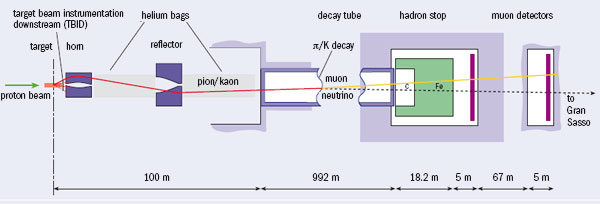
The production of the CNGS beam of muon-neutrinos follows the “classic” scheme that was first used in the 1960s at Brookhaven and CERN, and has been refined ever since. An intense proton beam from CERN’s Super Proton Synchrotron (SPS) is sent to strike a target, in this case graphite. Protons that interact with nuclei in the target produce many particles, mostly unwanted, but including positively charged pions and kaons – mesons that decay naturally into pairs of muons and muon-neutrinos. Two magnetic lenses – the horn and the reflector – collect these mesons within a selected momentum range and focus them into a parallel beam towards LNGS. After a decay tube nearly 1 km long, all the hadrons – i.e. protons that have not interacted in the target, pions and kaons that have not yet decayed, and so on – are absorbed in a hadron stopper; only neutrinos and muons can traverse this solid block of graphite and iron. The muons, which are ultimately absorbed downstream in around 500 m of rock, are measured first in two detector stations. Only the neutrinos are left to travel onwards through the top layer of the Earth’s crust towards LNGS.
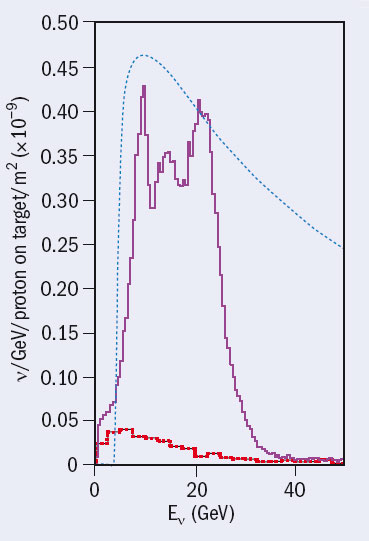
For the experimenters at LNGS, the beam’s key feature is the energy spectrum, as this determines the number of events that they can expect to measure. Two important energy-dependent ingredients have to be taken into account to maximize the number of tau-neutrino events that are anticipated: the probability for muon neutrino to tau-neutrino oscillation over the 732 km, and the probability for the tau-neutrino to leave a signal in a detector, i.e. the interaction cross-section for tau-neutrinos in matter, which is zero below a threshold of around 4 GeV. The product (convolution) of these two energy-dependent probabilities defines in effect an envelope in which the actual energy spectrum of the beam should fit. The graph below compares this convolution with the energy spectrum that was expected for the CNGS beam, as derived through Monte Carlo simulation, and shows how closely the match has been achieved. Note that the event rate at the OPERA detector at LNGS is very low. It will take many months of continuous CNGS running before the experiment can be expected to produce a neutrino energy spectrum like that in the graph below.
Six years in the making
CERN council approved the CNGS project in December 1999. Civil construction work began in September 2000 and was completed in June 2004. The underground work included the tunnel around 50–80 m below the surface for the 800 m proton beam line, as well as several caverns and access galleries. The facility uses protons from an extraction region at point 4 on the SPS, in common with the proton transfer line TI 8 for the Large Hadron Collider (LHC). A switch magnet at 100 m decides where the proton batches are sent: if the magnet is off, beam goes to the LHC, and if it is on, beam goes to the CNGS target. The beam line for CNGS then slopes down from the level of the SPS to a final slope of 5.6%, so that it points towards the LNGS.
While civil construction work continued, between July 2003 and April 2004 the beam dump (hadron stopper) and the 1 km decay tunnel were installed. Then in July 2004, with the construction work complete, an intense period of work began to install the electrical services, water-cooling and air-handling facilities. The overhead crane in the target chamber is an unusual feature that uses a rack-and-pinion system to cope with the slope of the tunnel. As well as being used in installation work, it will be needed for remote-handling in the harsh environment that is expected in the target chamber once the beam is operating at high intensity.
During the summer of 2005, installation of the services gradually gave way to the equipment installation in the proton beam tunnel as well as in the target chamber. By the end of November 2005, the proton beam was fully installed and the vacuum system closed, while work in the target chamber continued until spring 2006.
During February to April of 2006, large parts of the CNGS facility closed as detailed tests of all components in the facility began. In particular, all of the 119 dipole and quadrupole magnets in the proton beam line were tested at nominal power and their polarities checked, and the water-cooling and ventilation systems were operated under nominal conditions. The control-system experts artificially introduced magnet faults in all of the elements to test in detail how the beam interlock system responded to such errors.
At the same time technicians performed exercises in which they completely changed the target and horn under realistic conditions, performing a large fraction of the work remotely, using the crane in the target chamber. The exercises allowed detailed log-sheets of every step to be established, recording the crane co-ordinates for the approach, picking-up, lifting, translating and depositing for every shielding block as well as for the target and horn systems.
Once the equipment experts had tested all of the CNGS components, it was time for the commissioning team to move to the CERN Control Centre (CCC). Using a wealth of computers and display screens, the team tested every aspect of the CNGS facility under the most realistic conditions – as if there was beam, but without beam. This was a stressful period for the controls group and colleagues in the SPS operations team who were writing software. However, they responded to the challenge and, as commissioning with beam later demonstrated, these dry runs meant that the systems were working, saving much valuable beam time.
Large parts of the CNGS facility were closed on 19 May, in time for start-up with beam on 29 May. However, a last-minute schedule change, caused by a powering problem at the Proton Synchrotron, which feeds the SPS, implied that the first proton beam to CNGS could not be delivered until 10 July. This change of schedule allowed for another useful set of dry runs.
Beam commissioning begins
During the week of 10 July, the first of three CNGS beam commissioning weeks, the atmosphere in the SPS corner of the CCC was cheerful, but tension was nevertheless palpable. Initial tests of the extraction system with a CNGS-type beam had been done in autumn 2004, closely linked to the initial tests of the TI 8 beam. So it was no surprise to find that after only a few iterations, the kickers and septum magnets of the extraction channel from the SPS towards CNGS were well tuned, establishing a “golden trajectory”. On 11 July the first proton batch headed off to the CNGS target, and it was reassuring to see the proton beam well centred in all of the eight screens along the proton beam line.
The next step was to bring the beam position monitors (BPM) into operation. These important monitors were recuperated from the Large Electron–Positron collider, and equipped with sophisticated log-amp electronics, allowing them to measure the beam position rapidly and accurately. They revealed that the proton line was well tuned over its 800 m, with the maximum beam excursion far less than the permitted ±4 mm.
The CNGS commissioning also allows a valuable test for the Beam Interlock System that was developed for the LHC. The BPMs provide one of the crucial inputs to this system: any beam position that is more than 0.5 mm from the nominal trajectory creates an interlock to inhibit the next proton extraction and, in turn, provides an alarm to the SPS operations team. In addition, a series of beam loss monitors (BLMs) along the path of the protons measure tiny losses of protons, which would indicate that the beam is off course. Together, the BPMs and BLMs form a powerful means to protect the equipment in the CNGS proton beam line against damage from any losses larger than permitted by the very low thresholds in the system.
The beam size along the proton beam line was very close to the expectations from simulations. For a high-intensity beam – some 1013 protons for each extraction – the beam spot at the target was the expected 0.5 mm rms. The measured beam position stability is about 50 μm rms averaged over several days, and is much better than initially specified. Both the size and the stability of the beam are extremely important for protecting the target rods against rupture from the thermo-mechanical shock that is caused by the intense beam pulse: the beam size must not be too small (and hence concentrated) and the beam must hit the target close to the centre.
Much of the CNGS beam commissioning was done using a very low intensity proton beam – around a hundred times lower than the nominal value of 2.4 × 10¹³ protons for each extraction. This was necessary to protect the equipment from potential faults and other surprises. It was only during the last two days of commissioning that intensities reached the 1013 range. As a result of this economic use of the beam, less than 7 × 10¹⁵ protons were sent to CNGS during the entire commissioning phase, corresponding to about an hour of standard CNGS operation. In addition, while standard CNGS operation is foreseen with two 10.5 μs 400 GeV/c proton beam extractions for every SPS–CNGS magnet cycle, most of the commissioning work was done with one extraction only.
Lining up
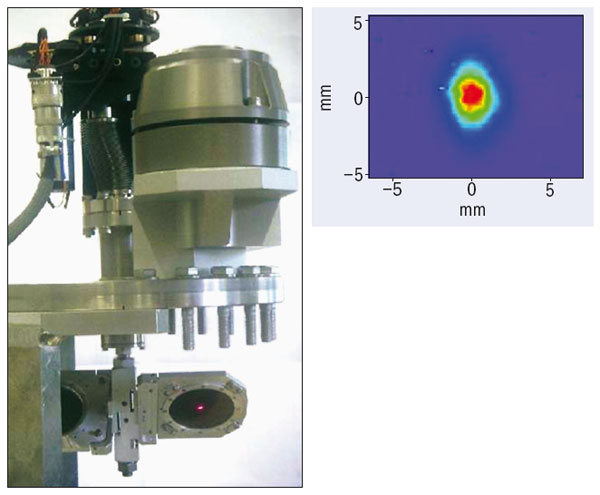
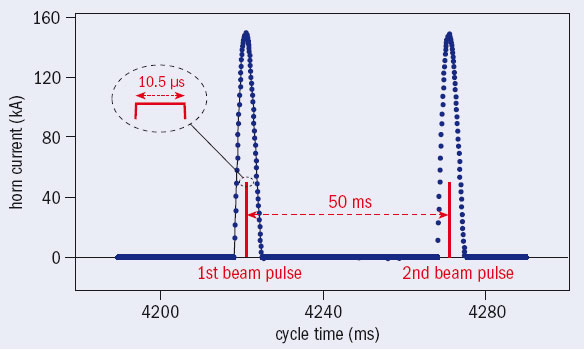
The CNGS proton beam is directed at a graphite target. The target consist of 13 graphite rods 10 cm long and 9 cm apart; the first two rods are 5 mm in diameter, while the others rods are 4 mm in diameter. The rods need to be thin and interspaced with air to let high-energy pions and kaons that are produced at smaller angles fly out of the target without interacting again. This is important for the relatively high-energy neutrino beam at CNGS, as pions of higher energies decay in flight into neutrinos of higher energies. Beyond the target lie the magnetic focusing system comprising the horn and reflector. The two focusing systems are operated with a pulsed current of 150 kA for the horn and 180 kA for the reflector. Both horn and reflector are pulsed twice for each SPS cycle; the two pulses are separated by 50 ms, in-time with the two beam pulses.
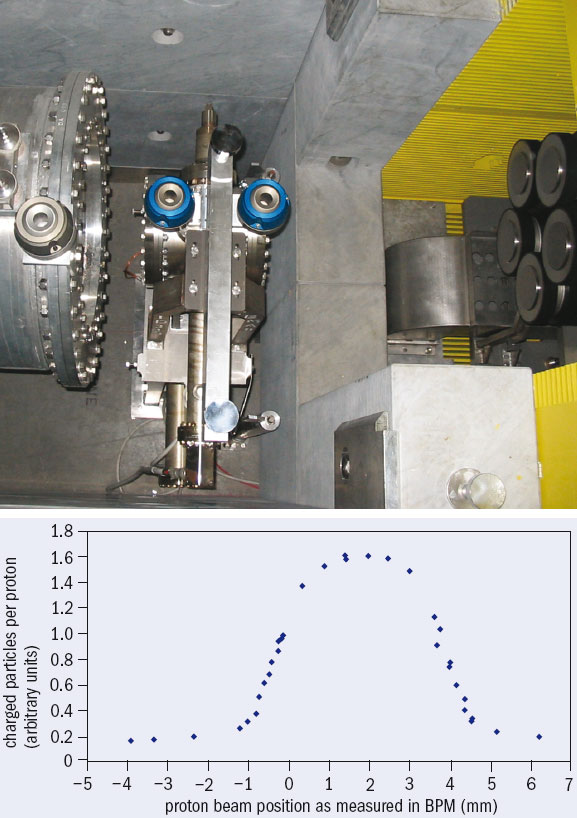
An important step during the beam commissioning was to cross-check the centring of the proton beam on the target. This is done by the Target Beam Instrumentation Downstream (TBID) monitor in which secondary electrons are produced by charged particles traversing a 145 mm diameter, 12 μm thick titanium sheet in a vacuum box. A beam scan across the target provides information on the maximum production of charged particles, in other words, on the best alignment of the proton beam with respect to the target.
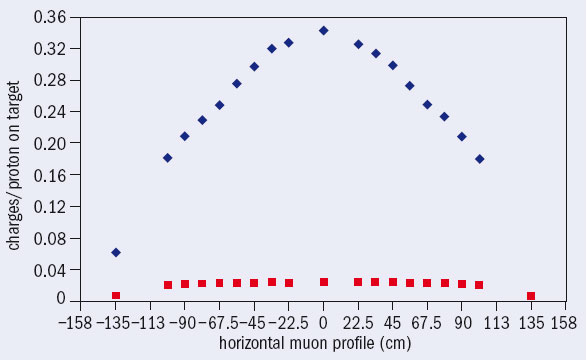
The last check that can be made along the neutrino beam line is on the production of muons that are created in association with the muon-neutrinos in the decay of the pions and kaons produced in the target. Unlike the neutrinos, the muons are charged and can be rather easily detected, so during beam commissioning muon detector stations provided online feedback for the quality control of the neutrino beam. In CNGS these detectors must register up to 108muons for each cm2 in a very short pulse of 10.5 μs. This implies that the muons cannot be counted individually. So to monitor the muons CNGS uses nitrogen-filled, sealed ionization chambers. Such detectors have been used for many years, for example as BLMs around the SPS. CNGS users could take advantage of the most recent development of ionization chambers, which will be used as BLMs at the LHC. The first 76 of more than 3000 of these BLMs are now in use at CNGS. There are 37 fixed muon detectors in each of the two muon detector chambers. The monitors are arranged in a cross-shaped array to record permanently the horizontal and vertical profile. An identical motorized monitor is installed downstream of the fixed ones to allow cross-calibration of the fixed monitors and to probe the muon profile where there is no fixed monitor.
Muons passing through the monitors produce electron–ion pairs, which are collected on sets of electrodes that are 5 mm apart at 800 V. Each muon monitor has 64 electrodes over an active length of 345 mm. The signal recorded is the integral number of charges for each beam pulse. The CNGS beam commissioning team used the muon detector stations as an online feedback for the quality control of the neutrino beam. The measurement is in reasonably good agreement with the preliminary expectations based on the FLUKA simulation package.
• CERN funded the CNGS project with special contributions from Belgium , France (in kind, via LAL/IN2P3), Germany , Italy (INFN and Compania di San Paolo), Spain and Switzerland . The CNGS proton-beam magnets were built in Novosibirsk , within a collaboration agreement between the Budker Institute for Nuclear Physics, DESY and CERN. The CNGS facility has been constructed and the beam commissioned on schedule and within budget. We would like to thank the many colleagues involved in CNGS, who have worked hard to help make this project a success.
Neutrino physics is a special field in which large-mass targets, which are needed to detect these elusive particles, are often combined with the ambitious goal of precision measurements, which are needed for firm conclusions. The Oscillation Project with Emulsion-tRacking Apparatus (OPERA) is a good example. It aims to directly observe the appearance of tau neutrinos (ντ) in oscillations from muon neutrinos (νμ→ντ) in the long-baseline beam of the CERN Neutrinos to Gran Sasso (CNGS) project. This would confirm the oscillation hypothesis for atmospheric neutrinos and unambiguously clarify its nature.
In 1998, the Super-Kamiokande collaboration announced that muon neutrinos change flavour (oscillate). The evidence came from detecting fewer muon neutrinos than expected in showers created by cosmic-ray interactions in the atmosphere. More recently, the KEK-to-Kamioka (K2K) experiment, using a man-made neutrino beam from KEK to the Super-Kamiokande detector, and the MINOS experiment, which uses a neutrino beam from Fermilab, have confirmed the oscillations that were observed in the atmospheric neutrinos. These experiments showed that muon neutrinos disappear, but there is no evidence of what they become. Only detecting the appearance of tau neutrinos from muon neutrinos will confirm the current theories underlying neutrino oscillation.
OPERA is searching for ντ by directly detecting the decay of the tau lepton that is produced in charged-current interactions of the ντ with nucleons in matter. To be sensitive to the oscillation parameters that are indicated by the deficit of muon neutrinos in the Super-Kamiokande data (Δm2 = 1.9–3.1 × 10⁻³ eV2, 90% CL, full mixing) and confirmed by the K2K and MINOS experiments, the experiment uses a 732 km baseline from the neutrino source to the detector – the distance from CERN to the Gran Sasso National Laboratory (LNGS) under the Gran Sasso massif in Italy. The νμ beam of CNGS has been optimized to obtain the maximum number of ντ charged-current interactions at OPERA and has an average νμ energy of about 17 GeV.
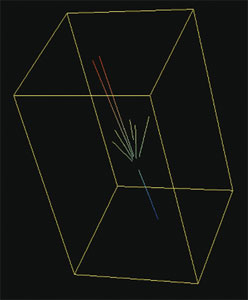
Detecting the ντ through the charged-current interaction is a challenging task. It demands not only a massive neutrino target (about 1.8 kilotonne), but also particle tracking at micrometre resolution to reconstruct the topology of the tau decay: either the kink – a sharp change (> 20 mrad) in direction occurring after about 1 mm – as the original tau lepton decays into a charged particle and one or more neutrinos, or the vertex for the decay mode into three charged particles plus a neutrino. For this purpose, the emulsion cloud chamber (ECC) – exploited by the DONUT collaboration at Fermilab for ντ detection in a beam-dump experiment in 2000 – combines in a sandwich-like cell the high-precision tracking capabilities of nuclear emulsions (two 40 μm layers on both sides of a 200 μm plastic base) and the large target mass provided by lead plates (1 mm thick).
Anatomy of the detector
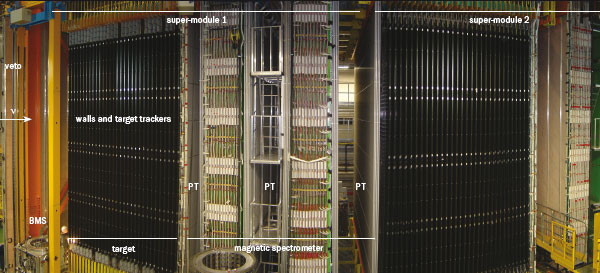
The design of OPERA is completely modular and allows real-time analysis of neutrino interactions. The target will eventually consist of 206,336 bricks, each comprising 56 consecutive ECC cells with transverse dimensions of 10.2 × 12.7 cm and weighing 8.3 kg. The bricks are being built underground at LNGS in the automated brick-assembly machine (BAM). They are then inserted into the experiment by two robots – the brick manipulator system (BMS) – into planar structures, or walls, which are interleaved with planes of scintillator tracker (5900 m2), built from vertical and horizontal strips of plastic scintillator 2.6 cm wide. The scintillators provide an electronic trigger for neutrino interactions, localize the particular brick in which the neutrino has interacted, and perform a first tracking of muons within the target. Localizing the brick is the first step in locating events in OPERA’s emulsions; the electronic trackers then provide predictions for the search for the particle tracks in the vertex brick with a position resolution of the order of 1 cm and an angular accuracy (on the muon tracks) of about 20 mrad.
The target sections are arranged in two independent super-modules, each with 31 walls and 64 layers of 52 bricks for each wall. Each super-module includes a muon spectrometer after the target section. The study of the muonic tau-decay channel needs muon identification and charge measurement. More generally, they are fundamental handles for suppressing the background from the decay of charmed particles, which are produced in ordinary_νμ charged-current interactions and decay similarly to the tau. The identification, with more than 95% efficiency, of the primary muon from the neutrino interaction that produces the charmed particle, allows this background to be effectively killed.
Each muon spectrometer comprises a dipolar magnet made of two iron arms (1 kilotonne of iron magnetized at 1.55 T), interleaved by pairs of 7 m long vertical drift-tube stations, 8064 tubes in total. These are the precision trackers (PTs) for precisely measuring the bending in the spectrometer. Twenty-two planes of resistive plate counters, 1525 m2 for each magnet, are inserted between the iron plates to provide coarser tracking in the magnet and a range measurement of stopping particles. An Ethernet-based data-acquisition system time-stamps and records asynchronously all detector hits in the target trackers and the spectrometers.
Selected bricks can be extracted daily from the target by the BMS for emulsion development and analysis. Each brick is equipped externally with a pair of emulsion sheets – the changeable sheets (CSs) – attached to its downstream face. Once a brick with an event has been localized, the CSs provide a first confirmation of the neutrino interaction and the initialization for the scanning analysis of the brick. Automatic fast microscopes scan large areas of emulsion and perform track reconstruction, searching for the tau-decay topologies and measuring the event kinematics. Track momenta are measured from their multiple scattering in the brick, while energies of electrons and photons are reconstructed from the development of electromagnetic showers.
Industrial production
When OPERA is fully operational, about 30 bricks a day will be extracted from the target with 1800 emulsion foils. The total emulsion surface to be measured corresponds to a few thousand square metres in five years. To cope with the real-time analysis of the neutrino interactions, high-speed automatic scanning microscopes were developed in Europe and Japan. These scan around 20 cm2 an hour – 20 times faster than in previous experiments.
As well as the special development of the microscopes, a large automation effort had to be put in to the brick production and handling, emulsion processing and chemical development, which together represent a small industry. Brick production has to be done underground to minimize the number of background tracks from cosmic rays and environmental radiation – LNGS has an average overburden of 1400 m of rock. Owing to space constraints the bricks must then be inserted immediately into the detector.
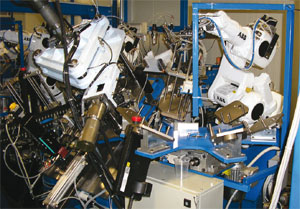
BAM specifications imply the production of about 1000 bricks a day, with 0.1 mm accuracy in each dimension. The BAM consists of an automated production line with several stations arranged in three different sections: input/output, BAM-in-light and BAM-in-dark. The input/output section manages the input of the lead containers (8 tonnes a day) and the output of bricks (1000 a day). In the BAM-in-light section (a class 10,000 clean room) the lead containers are automatically opened and pallets of lead are dispatched towards the dark room. In the BAM-in-dark room (class 10,000 and red light) the bricks, each comprising 57 emulsion sheets interleaved with 56 lead plates, are piled up under a pressure of 3 bar. This operation is performed in parallel by five piling/pressing stations, each using two anthropomorphic robots and a custom-built press machine. The brick pile has to be aligned within 50 μm precision, while its components must be handled in such a way as to guarantee 10 μm flatness. The bricks are then wrapped with aluminium adhesive tape by a large anthropomorphic robot. Once the bricks are light-tight they are sent back to the BAM-in-light section where their dimensions are checked, they are equipped with Teflon skates (to reduce friction during insertion into the detector) and a CS box, and labelled.
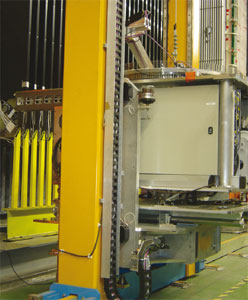
The bricks are stored in a transport cage – the drum – which brings them in groups of 234 to OPERA, where the BMS positions them in the walls. This must be done simultaneously on both sides of the detector to maintain a balance, and so requires two independent BMS units. Each BMS comprises a 10 m high portico that can slide along the side of the two super-modules. A platform on the portico moves vertically to reach the different parts of the walls, which it accesses with a lift bridge with micrometre accuracy. The platform has a rotating buffer disk (or carousel) hosting 32 bricks and with devices for inserting the bricks (the pusher) and extracting them. The latter is a small vehicle with a vacuum (VV) sucker on the front.
To place bricks into a wall, the drum is placed on a loading station, and bricks are loaded into the BMS. They are then pushed one at a time on the lift bridge with the pusher, until a row of 26 bricks has been inserted and aligned to its nominal position in the semi-wall. This operation is repeated for each wall layer until the 64 layers are complete. Each BMS can handle about 500 bricks a day, following the BAM speed. It will take a year to fill the detector.
During extraction, the VV approaches the bricks on the appropriate wall layer through the lift bridge. The bricks are extracted by suction one by one onto the carousel until the selected one is found. The remaining bricks are then pushed back into the wall together with a replacement brick from the periphery of the target, which becomes slowly smaller with time.
The analysis chain
The bricks with neutrino interactions are placed in the drums and transported to a brick-handling area where the CS is removed and processed while the bricks wait for the analysis to confirm an event. If an interaction is not confirmed, the brick is equipped with a new CS box and placed back in OPERA. However, if the analysis confirms an event, the brick is brought to the external LNGS laboratory, exposed for a day to cosmic rays for alignment and then disassembled. The films are stamped with an identifier and reference marks, developed with an automatic system with several parallel processing chains as in a big photographic laboratory, and dispatched to the scanning laboratories. (The scanning of the CS is performed locally to provide fast feedback.)
A charged particle crossing an emulsion layer ionizes the medium along its path, leaving a sequence of aligned silver grains, with a linear size of about 0.6 μm. Typically, a minimum ionizing particle leaves about 30 grains in 100 μm. Observing with a high-magnification optical microscope, silver grains appear as black spots on a bright field. To reconstruct particles’ trajectories, the computer-driven microscope adjusts the focal plane of the objective lens through the whole thickness of the emulsion, obtaining an optical tomography at different depths of each field of view with typically one image every 3 μm. Each image is filtered and digitized in real time to recognize track grains as clusters of dark pixels. A tracking algorithm reconstructs 3D sequences of aligned grains and extract a set of relevant parameters for each sequence. The position accuracy obtained for the reconstructed tracks is about 0.3 μm, with a resulting angular resolution of about 2 mrad – adequate for reconstructing the tau-decay topology.
Matching tracks in the two CSs are extrapolated in the most downstream foil of the brick and followed plate by plate until the interaction vertex is located. A plate-by-plate alignment procedure is applied so that tracks can be followed back with a precision of few micrometres and the search for each track can be performed in one field of view (about 300 μm × 300 μm). Once the vertex has been located, a volume scan (about 5 mm × 5 mm in several consecutive plates) around the interaction point is done. All track segments that are found in this volume are recorded. Vertex reconstruction algorithms are applied to classify the event and search for particle decay topologies. Taking advantage of cosmic-ray tracks, recorded during the deliberate exposure of the bricks after their extraction, sub-micrometre precision can be reached on the reconstructed vertex, as required for detecting kink topologies with angles of a few milliradians and for the kinematical analysis of the event.
Commissioning and running
OPERA was proposed in 2000, with installation starting in May 2003; it detected the first neutrinos from CNGS on 18 August 2006. This first run was of 11 days, with 5 days of equivalent beam time. It was devoted to the final commissioning of the electronic detectors (target trackers and spectrometers) with data-taking in global mode, to check the synchronization of the OPERA and CNGS clocks and to test the reconstruction algorithms. The detector collected more than 300 neutrino interactions, with a live-time greater than 95%. These interactions mainly occurred in the rock and in the iron of the two magnets.
The August run was conceived to tune the electronic detector performance with CNGS neutrino interactions without bricks. OPERA has now started the next phase, which aims to observe neutrino interactions in the bricks. Brick production and insertion started in the second half of September, ramping up to 1000 a day. A first test run of three weeks with some thousand bricks exposed to CNGS is scheduled to begin in mid-October. Then the full tau search will proceed with the run in 2007.
Researchers foresee the experiment running for five years, with an integrated fluence of 2.25 × 10²⁰ protons on the CNGS target. OPERA is sensitive to practically all of the tau-decay modes, with very low background levels: overall a total background of 1 event is expected. If νμ→ντ_oscillations occur, the average number of detected signal events will be 8.0–21.2 in the Super-Kamiokande 90% CL region and corresponds to 13.9 events for the best-fit value (Δm2 = 2.5 × 10⁻³ eV2, full mixing, Walter and Inoue 2006). OPERA can also search for_νμ→νe_oscillations with improved sensitivity on the still-unknown mixing angle θ13, compared with the best world limit obtained by the reactor experiment CHOOZ in 1998.
As particle physics heads towards tera-electron-volt energies with the Large Hadron Collider, it may be surprising to find that not all valuable research requires hadron beams of the highest energy available. Indeed, the opposite can be true. Experiments on processes that involve hadrons at kilo-electron-volt or even electron-volt energies can address some unresolved questions in quantum chromodynamics (QCD), its associated symmetries such as chiral symmetry, and CPT-invariance. This quickly developing field, which connects atomic, nuclear and particle physics, as well as astrophysics, was the subject of an international workshop, Exotic Hadronic Atoms, Deeply Bound Kaonic Nuclear States and Antihydrogen: Present Results, Future Challenges, which was held at the European Centre for Theoretical Nuclear Physics and Related Areas (ECT*) in Trento on 19–24 June. The workshop brought together some 50 experts in exotic atoms and nuclei to assess the current experimental and theoretical status of the field, and identify the most relevant topics to be addressed in the future. The rich programme extended from the pionic, kaonic and antiprotonic varieties of exotic atoms to antihydrogen, and exotic nuclear clusters, better known today as deeply bound kaonic nuclei. The workshop discussed the latest results from many experiments on these exotic atoms, and outlined future plans that are based on improved experimental techniques in detectors and/or hadronic beams.
Studies of exotic atoms in which a hadron such as a π–, K– or pbar replaces an electron can reveal important information about spontaneous chiral-symmetry breaking in QCD, which governs the low-energy interactions of the lightest pseudoscalar mesons (pions and kaons) with nucleons. Such experiments can access hadronic scattering lengths at zero energy by direct measurements of bound-state parameters, which is not possible through other experimental approaches. The Paul Scherrer Institut in Villigen has investigated pionic hydrogen (π––p) and deuterium (π––d), and DAFNE in Frascati has investigated their kaonic counterparts. Other no-less-important species include kaonic and antiprotonic helium, which have been studied at the Japanese High Energy Accelerator Research Organization (KEK) and CERN, and yet another exotic variety is formed by the non-baryonic π+– π–(pionium) and πK atoms. Finally, the antihydrogen atom, pbar–e+, which CERN has copiously produced, is in a class of its own owing to its importance for testing the CPT theorem to extremely high precision.
The latest kaonic hydrogen results from the DAFNE Exotic Atoms Research (DEAR) experiment, as presented by Johann Marton of SMI Vienna, gave rise to a lively discussion on the possibility of accommodating them with kaon–nucleon scattering data. More precise data and further theoretical calculations will evidently be needed in this domain. The SIDDHARTA experiment that is planned for DAFNE, which aims at 10 times higher precision on the kaonic hydrogen atom and the first measurement on kaonic deuterium, should contribute to a better understanding of the physics of the kaon–nucleon interaction at very low energies.
In the pion–pion scattering sector, the DIRAC experiment at CERN has measured pionium and yielded new values for the scattering lengths. However, the study of the kaon decaying to three pions provides a valid alternative for determining these quantities to an unprecedented accuracy. Gianmaria Collazuol, of INFN and Pisa, presented results from the NA48/2 experiment at CERN on the (a0–a2) difference of pion–pion scattering lengths with a precision of about 6%, equally shared between systematic and statistical uncertainties. This value is in agreement with various theoretical predictions that were discussed at the workshop. Further refinements in the precision of the results will need an interplay between experiment and theory, since most of the systematic error is caused by theoretical uncertainties.
Researchers at the Antiproton Decelerator (AD) at CERN are pursuing precision spectroscopy of antiprotonic helium, as Ryugo Hayano of Tokyo described. The study of the metastable three-body system pbar–e––He2+ has led to the most stringent tests of the equality of the charge and mass of the proton and antiproton at a relative precision of 2 ppb and, for the first time, produced a value of the antiproton-to-electron mass ratio.
Antihydrogen, the simplest atom of antimatter, offers even higher sensitivity to violations of CPT symmetry, because the properties of its conjugate system, hydrogen, are known to very high precision (10-12 for the ground-state hyperfine structure, and a few parts in 1014 for the 1S–2S two-photon transition). The ATRAP, ALPHA and ASACUSA collaborations at the AD are pursuing the formation of cold antihydrogen atoms for precision spectroscopy. Nikolaos Mavromatos of King’s College London and Ralf Lehnert of Massachusetts Institute of Technology discussed theoretical aspects of these interesting tests of CPT and Lorentz invariance, as well as the possibility of using antihydrogen to investigate the gravitational properties of antimatter.
Finally, an important part of the workshop programme discussed a new type of exotic nucleus – the antikaon (Kbar)-mediated bound nuclear system, with Kbar as constituents. Soon after the theoretical prediction of such states, both KEK and the Laboratori Nazionali di Frascati reported preliminary experimental evidence for their existence, and several experiments in Europe and Japan are currently searching for them. Attendees heard a critical review of the present experimental results, followed by an extended discussion on the foundations of the predictions. A lively discussion took place between those defending the existence of these deeply bound kaonic nuclear states and others who express doubts on their existence. There was also a critical analysis of the conditions under which such states might exist. New experiments, studying both the formation and the decay processes of the exotic nuclei, will play a key role in clarifying this interesting physics. These include a recently accepted proposal at the Japanese Proton Accelerator Research Complex (J-PARC), the AMADEUS experiment at DAFNE and the future possibility of investigating double Kbar systems at the Facility for Low-energy Antiproton and Ion Research (FLAIR) within the international Facility for Antiproton and Ion Research (FAIR) to be built at Darmstadt.
A round table on the deeply bound Kbar–nuclear systems, led by Wolfram Weise of Munich, concluded the workshop. He stressed the importance of new experimental studies and further theoretical efforts, showing that progress is expected on one side from next-generation experiments, and on the other by understanding of the Kbar–nucleon interaction (in the SIDDHARTA experiment) by realistic modelling of the nucleon–nucleon interaction and of the Kbar–nucleon–nucleon→hyperon–nucleon absorption. Weise also discussed the interesting connection with dense matter, namely kaon condensation in high-density media.
The workshop confirmed that many fundamental and still-open questions in low-energy QCD and related symmetries can be assessed and answered with experiments in the low-energy domain, by creating and measuring new forms of matter – exotic atoms, exotic nuclei and antihydrogen. An active and growing scientific community supports the great expectations of the field.
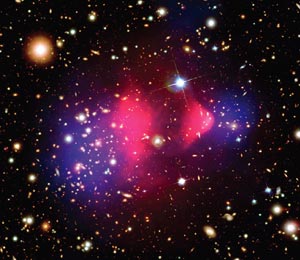
The idea of dark matter in the universe dates back to the 1930s, with the observation that the gravitational force on the visible matter in clusters of galaxies could not fully account for their behaviour, implying some alteration to gravity, or the existence of non-luminous, invisible matter. Now a team in the US has used a combination of astronomical images to analyse gravitational lensing in a region where two clusters are merging. The researchers find that their observations cannot be explained by modified gravity.
While dark matter has become the focus of a range of research, from cosmology to particle physics, it has proved difficult to rule out the alternative scenario in which gravity is slightly altered from the standard 1/r2 force law. The new study, however, has discovered a system in which the inferred dark matter is not coincident with the observable matter, and the difference in position is too great to be accounted for by modifying gravity. This, the team says, provides direct empirical proof for dark matter.
The team from the universities of Arizona and Florida, the Kavli Institute for Particle Astrophysics and Cosmology, and the Harvard-Smithsonian-Center for Astrophysics has combined observations from various telescopes to build a picture of what is happening in the galaxy cluster 1E0657-558. This cluster is particularly interesting because it shows evidence that a smaller cluster has at some stage ripped through a larger cluster, creating a bow-shaped shock wave.
Using images from the Hubble Space Telescope, the European Southern Observatory’s Very Large Telescope and the Magellan telescope to provide information on gravitational lensing of more-distant galaxies, the team has created a map of the gravitational potential across the cluster 1E0657-558. This reveals two regions in which the mass is concentrated.
The team has also observed the cluster with NASA’s Chandra X-ray Observatory to measure the positions of the two clouds of hot gas that are associated with the merging galaxies. It finds that these two clouds of X-ray emitting plasma of normal baryonic matter are not coincident with the two central locations of the gravitational mass, which in fact are further apart. This suggests that the plasma clouds have slowed as they passed through each other and interacted, while dark matter in the two clusters has not interacted.
To provide the best experiences, we use technologies like cookies to store and/or access device information. Consenting to these technologies will allow us to process data such as browsing behavior or unique IDs on this site. Not consenting or withdrawing consent, may adversely affect certain features and functions.
Functional
Always active
The technical storage or access is strictly necessary for the legitimate purpose of enabling the use of a specific service explicitly requested by the subscriber or user, or for the sole purpose of carrying out the transmission of a communication over an electronic communications network.
Preferences
The technical storage or access is necessary for the legitimate purpose of storing preferences that are not requested by the subscriber or user.
Statistics
The technical storage or access that is used exclusively for statistical purposes.The technical storage or access that is used exclusively for anonymous statistical purposes. Without a subpoena, voluntary compliance on the part of your Internet Service Provider, or additional records from a third party, information stored or retrieved for this purpose alone cannot usually be used to identify you.
Marketing
The technical storage or access is required to create user profiles to send advertising, or to track the user on a website or across several websites for similar marketing purposes.