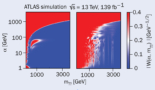
 Read article 'Probing for periodic signals'
Probing for periodic signals
ATLAS sees no significant deviation from the background-only hypothesis in its recent search for heavy gravitons predicted by "clockwork gravity".

 Read article 'Probing for periodic signals'
ATLAS sees no significant deviation from the background-only hypothesis in its recent search for heavy gravitons predicted by "clockwork gravity".
 Read article 'Inclusive photon production at forward rapidities'
Providing valuable input for theoretical models and event generators, ALICE has studied for the first time the dependence of the inclusive photon production on the number of nucleons participating in ...
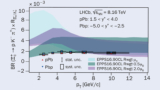 Read article 'Charm production in proton–lead collisions'
A new analysis of proton–lead collisions has allowed LHCb to investigate a crucial missing piece in our understanding of quantum chromodynamics.
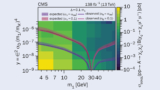 Read article 'A novel search for inelastic dark matter'
The CMS collaboration reports the first dedicated collider search for inelastic dark matter using the full Run 2 dataset.
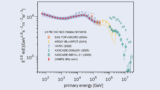 Read article 'DAMPE confirms cosmic-ray complexity'
The space-based Chinese–European Dark Matter Particle Explorer (DAMPE) reports detailed insights into the various spectral "breaks" in cosmic-ray spectra.
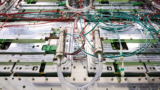 Read article 'A new TPC for T2K upgrade'
In the latest milestone for the CERN Neutrino Platform, a state-of-the-art time projection chamber for the near detector of the upgraded T2K experiment in Japan is now fully operational.
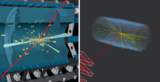 Read article 'ATLAS and CMS find first evidence for H → Zγ'
At this year's LHCP conference, ATLAS and CMS jointly announced their first results on a rare Higgs decay that is sensitive to new- physics effects.
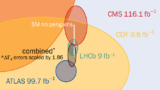 Read article 'LHCb sets record precision on CP violation'
LHCb has surpassed the precision of B-factory experiments on key CP-violation observables in charmonium decays.
 Read article 'EPS announces 2023 awards'
The EPS has announced the recipients of the 2023 High Energy and Particle Physics Awards.
 Read article 'Proton structure consists of three distinct regions'
Measurements of gluonic gravitational form factors at JLab have revealed three distinct regions in the proton's structure.