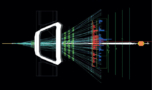
 Read article 'Successful test of proton–ion collisions in LHCb'
Successful test of proton–ion collisions in LHCb
Unlike the other three large experiments at the LHC, LHCb did not participate in heavy-ion runs in 2010 and 2011.

 Read article 'Successful test of proton–ion collisions in LHCb'
Unlike the other three large experiments at the LHC, LHCb did not participate in heavy-ion runs in 2010 and 2011.
 Read article 'Using the LHC as a photon collider'
The protons and nuclei accelerated by the LHC are surrounded by strong electric and magnetic fields. These fields can be treated as an equivalent flux of photons, making the LHC the world’s most pow...
 Read article 'ALICE takes a first look at diffraction'
Diffractive processes represent more than 25% of the cross-section for inelastic proton–proton collisions at the LHC. So, it is only natural that the ALICE collaboration is interested in a field...
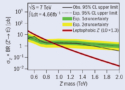 Read article 'Top-quark production gets a boost'
With the expected energy upgrade of the LHC the frequency of boosted final states will increase and even more sophisticated methods will be needed to search for physics beyond the Standard Model
Read article 'Updating the strategy for particle physics'
On 10–12 September, some 500 physicists attended an open symposium in Krakow for the purpose of updating the European Strategy for Particle Physics, which was adopted by CERN Council in 2006.
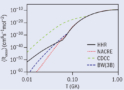 Read article 'Theorists calculate the route to carbon-12'
The triple-alpha reaction rate that produces carbon-12 in stars and other energetic astronomical phenomena has been a tricky subject for nuclear theorists for some time.
Read article 'Closer to the Milky Way’s supermassive black hole'
Astronomers have been tracking the motion of stars at the very centre of the Galaxy for the past 20 years. One star in particular has attracted a great deal of attention by completing a full orbi...
 Read article 'Deflector shields protect the lunar surface'
The origin of the enigmatic "lunar swirls" – patches of relatively pale lunar soil, some measuring several tens of kilometres across – has been an unresolved mystery since the mid-1960s, when NASA...
 Read article 'Baryon oscillation spectra for all'
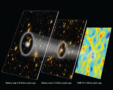
By professional astronomy standards, the 2.5 m telescope at Apache Point Observatory is quite small. More than 50 research telescopes are larger and many are located at much better sites.
Read article 'Summer running at the LHC'
The LHC has delivered more than twice as many collisions to the ATLAS and CMS experiments this year as it did in all of 2011.