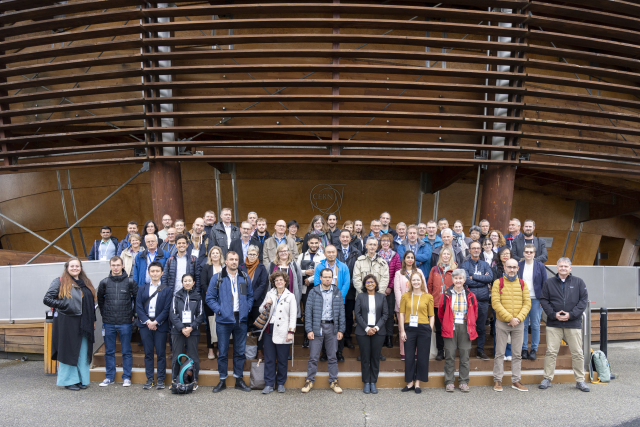
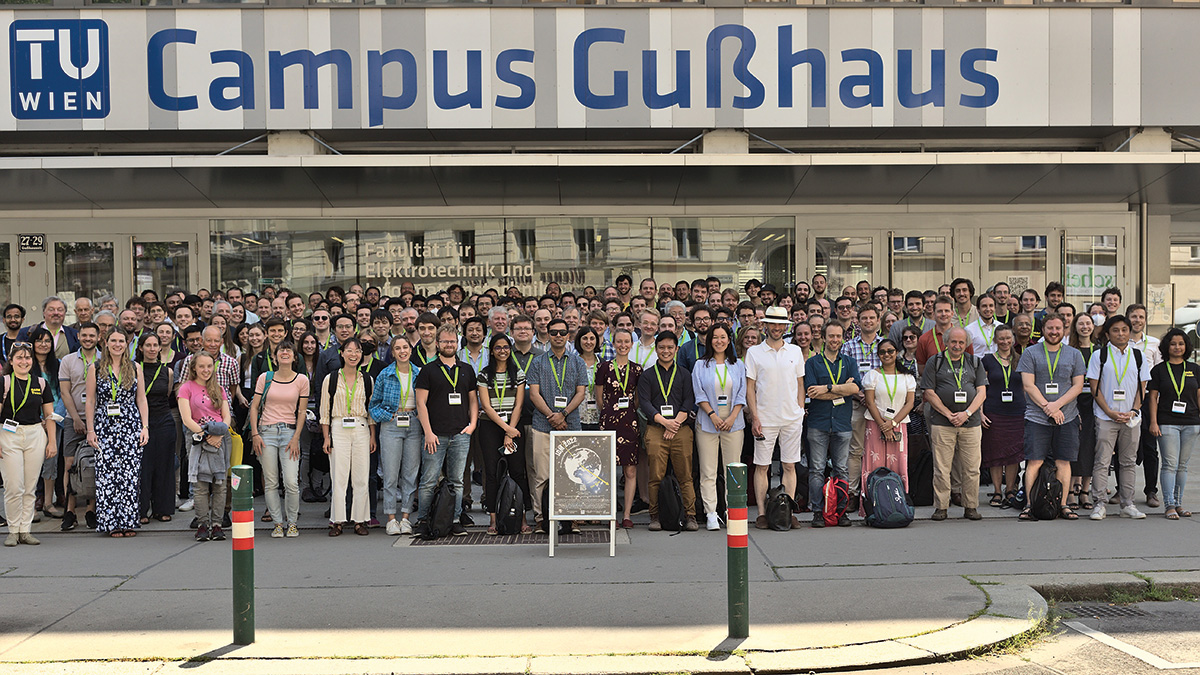
After two online editions during the Covid pandemic, this year the annual TOP conference returned to an in-person format. The 2022 edition took place in the historic city of Durham in the UK from 4 to 9 September and attracted more than 100 participants.
The LHC collaborations that study the top quark presented a wealth of recent results based on Run 2 data, many of which were shown for the first time, and even included a measurement with the very first data collected in Run 3. CMS and ATLAS presented new top-quark mass results, new measurements of top-quark production asymmetries, new cross-section measurements as well as searches for new production and decay modes, both within and beyond the Standard Model (SM). These included ttW and four top-quark production, and processes involving flavour-changing-neutral-current interactions that could produce sizable rates beyond the SM prediction.
Earlier this year, CMS released a preliminary mass measurement that profiles all uncertainties, including a finely split set of signal-modelling uncertainties based on variations of Monte Carlo generators. To account for the limited statistical power for some of these variations, this precision analysis implements a fully consistent treatment of the resulting fluctuations leading to a 380 MeV uncertainty. ATLAS presented a top-quark mass measurement of 172.63 ± 0.20 (stat) ± 0.67 (syst) ± 0.37 (recoil) GeV. The last uncertainty represents the ambiguity in assigning the recoil of gluon emissions in the top-quark decay chain that was neither considered in Run 1 analyses nor in the CMS measurement and requires further studies. The large difference in the modelling uncertainties assigned by both collaborations underlines the importance to overcome the limitations of Monte Carlo generators for these precision measurements.
Run 2 of the LHC opens up new production processes that could not be probed at the Tevatron or in Run 1. Recently, ATLAS announced the observation of the rare production process of a single top quark and a photon, thus completing the list of associated top-quark production processes with SM gauge bosons. CMS followed with a brand-new analysis of the four top-quark production process, the rarest process accessible by the LHC to date. Together with combined ATLAS analyses, there is now very strong evidence that this elusive process exists. While most results in the classical top-quark pair and single-top production modes agree very well with the SM predictions, slight excesses are seen in several rare production modes, such as ttW and four-top production. None of these excesses are statistically significant, but they form an interesting pattern that requires experimental results and theory predictions to be considered extra carefully, while keeping an eye open for more exotic explanations.
Theory ahead
Theory contributions at TOP 2022 revolved around two major themes: precision calculations and beyond-SM models. For the former, several groups presented new calculations that enable a more precise comparison of measurements with SM predictions. These calculations provide an integrated treatment of the top-quark and boson decays, including off-shell effects, which are small in the total cross section, but which can be significantly enhanced locally in some corners of phase space. Including these effects is therefore relevant for the highest-precision differential measurements at the LHC. For the second theme, the most popular approach is to expand around the SM with minimal model dependence using effective field theory. This is complemented by more focussed efforts in concrete new-physics scenarios, including composite Higgs (and top) models as well as leptoquarks. A dedicated theory mini-workshop discussed the interplay of top-quark measurements with results in flavour physics.
Perhaps the most exciting result, the first at Run 3, was presented by CMS. On 5 July, just two months before the conference, the LHC switched back on after a three-year shutdown and started to produce the first proton-proton collisions at a record centre-of-mass energy of 13.6 TeV. Stretching over the next few years, Run 3 will increase the size of available datasets involving top quarks by a factor of three to four. Both ATLAS and CMS made a tremendous effort to prepare the detectors, to collect and check the quality of the data, and to provide preliminary calibrations for leptons and jets. In a race against the clock, CMS isolated the top-quark pair production process in the data collected in July and August in time for the conference. Even at this very early stage, the data are understood well enough that a cross-section measurement with a total uncertainty below 8% was possible by making use of the top-quark events themselves to calibrate most of the relevant experimental uncertainties in situ.
With these first results showing that the LHC and the experiments are smoothly operating, TOP22 kicks off the Run 3 top-quark physics programme. We can look back on a very exciting edition of the TOP conference and look forward to meeting again in Michigan in 2023.
Safety is a priority for CERN. It spans all areas of occupational health and safety, including the protection of the environment and the safe operation of facilities. Continuous exchanges with similar research infrastructures on best practices and techniques ensures that CERN maintains the highest standards. From 25 to 28 October, more than 100 people from CERN and research institutes worldwide gathered in the Globe of Science and Innovation at CERN for the International Technical Safety Forum (ITSF). This key conference in matters of health and safety is a forum for exchanging new ideas, processes, procedures and technologies in personnel, environmental and equipment safety among a variety of high-energy physics, synchrotron and other research infrastructures.
It is a pleasure to share new ways of thinking and acting in matters of occupational health & safety and environmental protection
Yves Loertscher
“In its 25-year existence, the Forum has evolved with the times, all the while increasing its attractiveness for experts to share their knowledge, experience and challenges,” says Ralf Trant of the CERN technology department. “The scope has broadened from high-energy physics to a wider range of disciplines and participating institutes, in Europe and beyond with Asian labs joining in addition to American institutes, who have been involved since the beginning.”
Opening the event, Benoît Delille, head of the CERN Health, Safety & Environment (HSE) unit, noted: “For colleagues from different institutes who visit CERN for the first time, it is an occasion for us to share the values on which this Organization is built, that we are proud of, and also how we make them come to life through the prism of Safety.” A first session on environmental protection and sustainability saw CERN share its approach to minimise its environmental footprint in key domains, alongside a presentation from the European Spallation Source (ESS) on environmental management during its post-construction phase. Sessions including continuous improvements in health & safety, fire safety, equipment certification, incidents and lessons learned, risk assessment and technical risks unfolded during the week, ending with new projects and challenges, safety culture and behaviour and safety training.
“Listening to your colleagues from other research institutes informing about occurred events, lessons learned and recent developments in safety assessment is the pure essence of ITSF,” said Peter Jakobsson, head of environment, safety, health & quality at ESS and member of the ITSF organising committee, who chaired the “Incidents and lessons learned” session. “We openly share information in different subject safety areas such as fire hazards, handling of chemicals and inspection of pressurised equipment. In doing so, we all learn from each other to create a safe work environment for our staff and scientific users: a true sign of the safety culture that we all strive for.”
In addition to a rich programme of presentations, the event featured an interactive fire workshop in which participants shared ongoing projects and challenges related to fire safety in accelerator facilities. CERN also shared its experiences of the fire-induced radiological integrated assessment (FIRIA) project whose objective is to develop a general methodology for assessing the fire-related risks present in CERN’s facilities and provide a forum to keep experts connected and updated. Participants also enjoyed visits of the installations, complemented with a tour of the CERN safety training centre in Prévessin on the final day.
“This event gave us the possibility to share our knowledge through presentations but also through networking breaks, visits and social events,” said Yves Loertscher, head of the CERN HSE occupational health & safety group and organiser of this year’s ITSF event. “After a break of almost three years owing to the pandemic, it is a pleasure to interact directly with peers again and share new ways of thinking and acting in matters of occupational health & safety and environmental protection”.
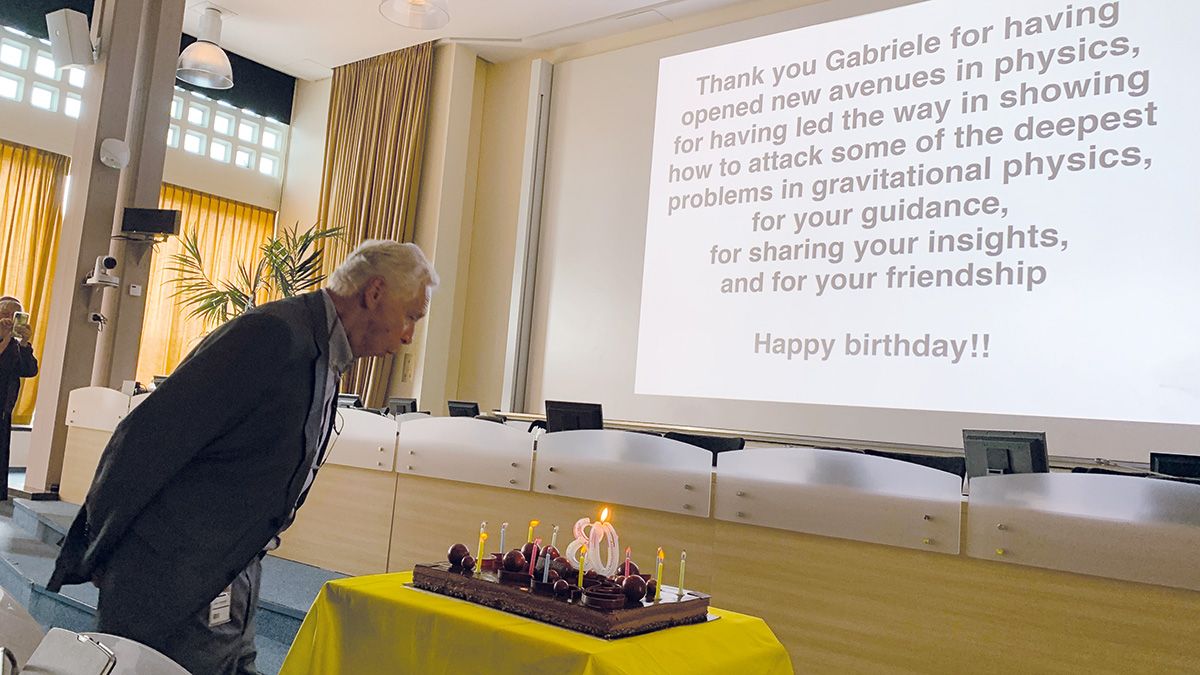
On 7 September colleagues and friends of Gabriele Veneziano gathered at CERN for an informal celebration of the renowned theorist’s 80th birthday. While a visitor in the CERN theory division (TH) in 1968, Veneziano wrote a paper “Construction of a crossing-simmetric, Regge-behaved amplitude for linearly rising trajectories”. It was an attempt to explain the strong interaction, but ended up marking the beginning of string theory. During the special TH colloquium, talks by Paolo Di Vecchia (NBI&Nordita), Thibault Damour (IHES) and others explored this and numerous other aspects of Veneziano’s work, much of which was undertaken during his 30 year-long career at CERN. Concluding the day’s proceedings, Veneziano thanked his mentors, CERN TH and chance – “the chance of having lived through one of most interesting periods in the history of physics… during which, through a wonderful cooperation between theory and experiment, enormous progress has been made in our understanding of nature at its deepest level.”
The second joint ECFA (European Committee for Future Accelerators), NuPECC (Nuclear Physics European Collaboration Committee) and APPEC (AstroParticle Physics European Consortium) symposium, JENAS, was held from 3 to 6 May in Madrid, Spain. Senior and junior members of the astroparticle, nuclear and particle-physics communities presented their challenges and discussed common issues with the goal of achieving a more comprehensive assessment of overlapping research topics. For many of the more than 160 participants, it was their first in-person attendance at a conference after more than two years due to the COVID-19 pandemic.
Focal point
The symposium began with the research highlights and strategies of the three research fields. A major part of this concerned the progress and plans of the six joint projects that have emerged since the first JENAS event in 2019: dark matter (iDMEu initiative); gravitational waves for fundamental physics; machine-learning optimised design of experiments; nuclear physics at the LHC; storage rings to search for charged-particle electric dipole moments; and synergies between the LHC and future electron–ion collider experiments. The discussions on the joint projects were complemented by a poster session where young scientists presented the details of many of these activities.
The goal was achieving a more comprehensive assessment of overlapping research topics
Detector R&D, software and computing, as well as the application of artificial intelligence, are important examples where large synergies between the three fields can be exploited. On detector R&D there is interest in collaborating on important research topics such as those identified in the 2021 ECFA roadmap on detector R&D. In this roadmap, colleagues from the astroparticle and nuclear-physics communities were involved. Likewise, the challenges of processing and handling large datasets, distributed computing, as well as developing modern analysis methods for complex data analyses involving machine learning, can be addressed together.
Overview talks and round-table discussions related to education, outreach, open science and knowledge transfer allowed participants to emphasise and exchange best practices. In addition, the first results of surveys on diversity and the recognition of individual achievements in large collaborations were presented and discussed. For the latter, a joint APPEC–ECFA–NuPECC working group has presented an aggregation of best practices already in place. A major finding is that many collaborations have already addressed this topic thoroughly. However, they are encouraged to further monitor progress and consider introducing more of the best practices that were identified.
Synergy
One day was dedicated to presentations and closed-session discussions with representatives from both European funding agencies and the European Commission. The aim was to evaluate whether appropriate funding schemes and organisational structures can be established to better exploit the synergies between astroparticle, nuclear and particle physics, and thus enable a more efficient use of resources. The positive and constructive feedback will be taken into account when carrying out the common projects and towards the preparation of the third JENAS event, which is planned to take place in about three years’ time.
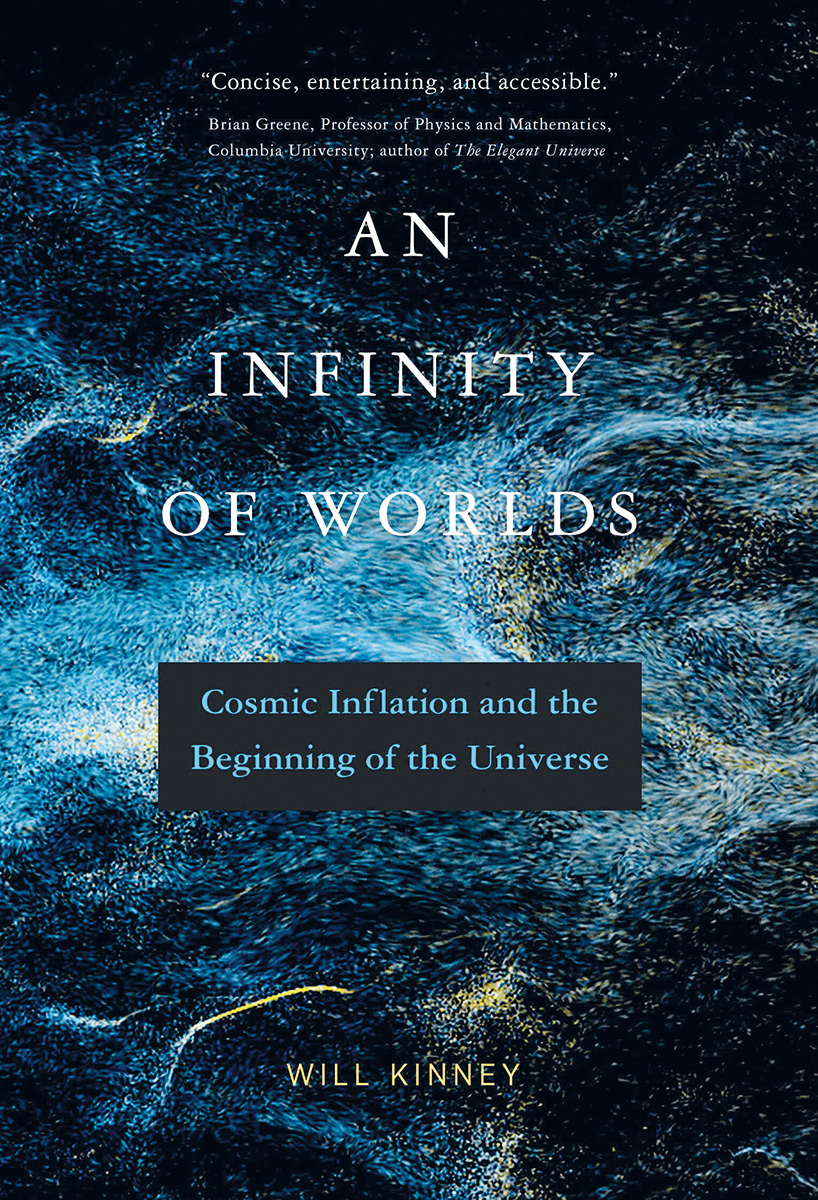
Cosmology, along with quantum mechanics, is probably among the most misunderstood physics topics for the layperson. Many misconceptions exist, for instance whether the universe had a beginning or not, what the cosmic expansion is, or even what exactly is meant by the term “Big Bang”. Will Kinney’s book An Infinity of Worlds: Cosmic Inflation and the Beginning of the Universe clarifies and corrects these misconceptions in the most accessible way.
Kinney’s main aim is to introduce cosmic inflation – a period of exponential expansion conjectured to have taken place in the very early universe – to a general audience. He starts by discussing the Standard Model of cosmology and how we know that it is correct. This is done most successfully and in a very succinct way. In only 24 pages, the book clarifies all the relevant concepts about what it means for the universe to expand, its thermal history and what a modern cosmologist means by the term Big Bang.
The book continues with an accessible discussion about the motivation for inflation. There are plenty of comments about the current evidence for the theory, its testability and future directions, along with discussions about the multiverse, quantum gravity, the anthropic principle and how all these combine together.
A clear understanding
There are two main points that the author manages to successfully induce the reader to reflect on. The first is the extreme success of the cosmic microwave background (CMB) as a tool to understand cosmology: its black-body spectrum established the Big Bang; its analysis demonstrated the flatness of the universe and its dark contents and motivated inflation; its fluctuations play a large part in our understanding of structure formation in the universe; and, along with the polarisation of the CMB, photons provide a window into the dynamics of inflation. Kinney notes that there are also plenty of features that have not been measured, which are especially important for inflation, such as the B-modes of the CMB and primordial gravitational waves, meaning that CMB-related observations have a long way to go.
The second main point is the importance of a clear understanding of what we know and what we do not know in cosmology. The Big Bang, which is essentially the statement that the universe started as a hot plasma of particles and cooled as it expanded, is a fact. The evidence, which goes well beyond the observation of cosmic expansion, is explained very well in Kinney’s book. Beyond that there are many unknowns. Despite the excellent motivation for and the significant observational successes of inflationary models, they are yet to be experimentally verified. It is probably safe to assume, along with the author, that we will know in the future whether inflation happened or not. Even if we establish that it did and understand its mechanism, it is not clear what we can learn beyond that. Most inflationary models make statements about elements, such as the inflationary multiverse, that in principle cannot be observed.
Steven Weinberg once commented that we did not have to wait to see the dark side of the moon to conclude that it exists. Whether this analogy can be extended successfully to include inflation or string theory is definitely debatable. What is certain, however, is that there will be no shortage of interesting topics and discussions in the years to come about cosmology and fundamental physics in general. Kinney’s book can serve as a useful introduction for the general public, but also for physics students and even physicists working in different fields. As such, this book is a valuable contribution to both science education and dissemination.
The use of deep learning in particle physics has exploded in recent years. Based on INSPIRE HEP’s database, the number of papers in high-energy physics and related fields referring to deep learning and similar topics has grown 10-fold over the last decade. A textbook introducing these concepts to physics students is therefore timely and valuable.
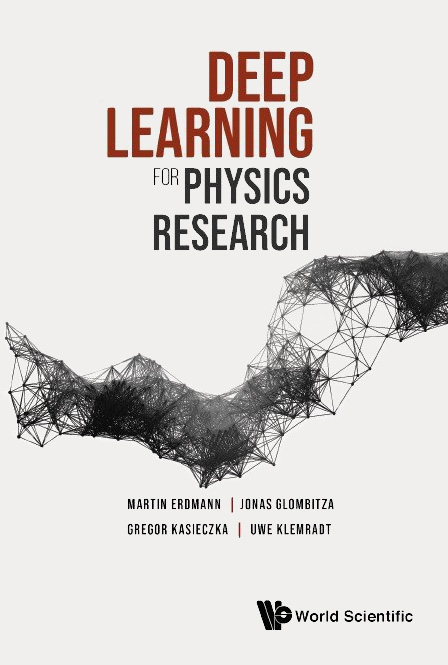
When teaching deep learning to physicists, it can be difficult to strike a balance between theory and practice, physics and programming, and foundations and state-of-the-art. Born out of a lecture series at RWTH Aachen and Hamburg universities, Deep Learning for Physics Research by Martin Erdmann, Jonas Glombitza, Gregor Kasieczka and Uwe Klemradt does an admiral job of striking this balance.
The book contains 21 chapters split across four parts: deep-learning basics, standard deep neural-networks, interpretability and uncertainty quantification, and advanced concepts.
In part one, the authors cover introductory topics including physics data, neural-network building blocks, training and model building. Part two surveys and applies different neural-network structures, including fully connected, convolutional, recurrent and graph neural-networks, while also reviewing multi-task learning. Part three covers introspection, interpretability, uncertainty quantification, and revisits different objective functions for a variety of learning tasks. Finally, part four touches on weakly supervised and unsupervised learning methods, generative models, domain adaptation and anomaly detection. Helping to lower the barrier to entry for physics students to use deep learning in their work, the authors contextualise these methods in real physics-research studies, which is an added benefit compared to similar textbooks.
Deep learning borrows many concepts from physics, which can provide a way of connecting similar ideas in the two fields. A nice example explained in the book is the cross-entropy loss function, which has its origins in the definition of entropy according to Gibbs and Boltzmann. Another example that crops up, although rather late in part three, is the connection between the mean-squared-error loss function and the log-likelihood function for a Gaussian probability distribution, which may be more familiar to physics students accustomed to performing maximum likelihood fits.
Hands-on
Accompanying the textbook is a breadth of free, online Jupyter notebooks (executable Python code in an interactive format), which are available at http://deeplearningphysics.org. These curated notebooks are paired with different chapters and immerse students in hands-on exercises. Both the problem and corresponding solution notebooks are available online,and are accessible to students even without expensive computing hardware as they can be launched on free cloud services such as Google Colab or Binder. In addition, students who have a CERN account can launch the notebooks on CERN’s service for web-based analysis (SWAN) platform.
Advanced exercises include the training and evaluation of a denoising autoencoder for speckle removal in X-ray images and a Wasserstein generative adversarial network for the generation of cosmic-ray-induced air-shower footprints. What is truly exciting about these exercises is their use of physics research examples, many taken from recent publications. Students can see how close their homework exercises and solutions are to cutting-edge research, which can be highly motivating.
In a book spanning less than 300 pages (excluding references), it is impossible to cover everything, especially as new deep-learning methods are developed almost daily. For a more theoretical understanding of the fundamentals of deep learning, readers are advised to consult the classic Deep Learning by Ian Goodfellow, Yoshua Bengio and Aaron Courville, while for more recent deep-learning developments in particle physics they are directed to the article “A Living Review of Machine Learning for Particle Physics” by Matthew Feickert and Benjamin Nachman.
With continued interest in deep learning, coverage of a variety of real physics-research examples and a breadth of accessible, online exercises, Deep Learning in Physics Research is poised to be a standard textbook on the bookshelf of physics students for years to come.
The international conference series on the identification of dark matter (IDM) was brought to life in 1996 with the motto that “it is of critical importance now not just to pursue further evidence for its existence but rather to identify what the dark matter is.” Despite earnest attempts to identify what dark matter comprises, the answer to this question remains elusive. Today, the evidence for dark matter is overwhelming; its amount is known to be around 27% of the universe’s energy-density budget. IDM2022 illuminated the dark-matter mystery from all angles, ranging from cosmological evidence via astrophysics to possible dark-matter particle candidates and their detection via indirect searches, direct searches and colliders.
The 14th edition of IDM took place in Vienna, Austria, from 18 to 22 July, attracting about 250 physicists and more than 200 contributions. The conference was initially scheduled for 2020 but changed to an online format due to the pandemic, while the in-person IDM was delayed until 2022. Many young scientists were able to meet the dark-matter community for the first time “in real life”. The Strings 2022 conference took place in Vienna simultaneously, with complementary presentations.
One focus of IDM2022 was the direct detection of dark matter. Tremendous progress in the sensitivity of direct detection experiments has been achieved in the past few decades over a wide dark-matter particle mass range. All major experiments presented their latest results. While in the past, direct searches focused on the classical WIMP region in a mass between a few GeV and several TeV, the search region is now enlarged towards even lighter dark-matter particles down to the keV region. Different mass regions require different technologies and new ideas were presented to increase the sensitivities towards these unexplored mass regions. For GeV WIMP dark-matter searches, the XENON collaboration displayed the first results from their latest setup, XENONnT, which has a significantly lower background level and recently eliminated a previously seen excess in XENON1T. The XENON, Darwin and LZ collaborations recently formed the XLZD collaboration with the aim of building a next-generation liquid-xenon experiment.
While the XENON1T excess is gone, direct-detection experiments exploring the sub-GeV mass regime still face unknown background contributions, especially in solid-state detectors. This is currently one of the biggest obstacles to increasing the sensitivity to even smaller cross-sections. No complete understanding has been achieved so far, but combining the results, knowledge and expertise of the experiments points to stress relaxations in crystals as one primary underlying source. To tackle this tricky problem, a subset of the IDM2022 participants held a dedicated satellite meeting. This EXCESS workshop was the third event of its kind, and the first to take place in person.
The direct detection experiment DAMA has observed a statistically significant signal of an annual modulated event rate for several years. This observation is consistent with Earth moving through the dark-matter halo, but has not been confirmed by any other experiment. DAMA recently reduced the energy threshold to 0.5 keV electron equivalent by upgrading their readout electronics to further increase sensitivity. Several new dark-matter experiments based on the same target material – NaI – are running or being commissioned to provide more information on the long-standing DAMA observation: ANAIS, COSINE, COSINUS and SABRE. Even lighter forms of dark matter, such as axions and axion-like particles, were discussed, as well as the possibility that dark matter comprises bound states.
Primordial black holes are also attractive potential dark-matter candidates. Astronomical data from, for example,microlensing, structure formation and gravitational waves hint at their existence. However, current data gives no handle on whether primordial black holes could be responsible for all the universe’s dark-matter content, or only correspond to part of the overall dark-matter density. Besides black-hole mergers, gravitational-wave signals can provide additional information to understand the origin of dark matter. In particular, processes in the early universe detected via gravitational waves could provide new insights into the particle nature of dark matter. With the increased sensitivity of operating and future gravitational-wave detectors, new players will provide additional data to unravel the dark-matter problem.
With a plethora of new ideas and experiments presented at this year’s IDM, the path is prepared for the next edition in L’Aquila, Italy, in 2024.
Neutrinos are the least understood of all elementary particles, and the fact that they have mass is a firm indication of physics beyond the Standard Model. Decades of effort have been devoted to exploring the properties of neutrinos. However, there are still many important questions to address. For example, little is known about the absolute mass scale and neutrino-mass ordering. Also, we have not achieved a decent measurement of the CP phase in the neutrino mixing “PMNS” matrix. Furthermore, the nature of neutrino masses, i.e. whether they are Dirac or Majorana, remains unknown.
From 30 July to 6 August the 23rd NuFACT workshop hosted by the University of Utah reviewed recent developments in neutrino physics, particle physics and astroparticle physics. The workshop brought together experts from all leading neutrino experiments and discussed theoretical aspects, with the aim of facilitating new connections between different disciplines and theorists and experimentalists.
Talking points
NuFACT2022 topics were spread into seven working groups: neutrino oscillations; neutrino scattering physics; accelerator physics; muon physics; neutrinos beyond PMNS; detectors; and inclusion, diversity, equity, education and outreach. The latter was newly established at this year’s workshop to become an integral part of the series.
Three mini-workshops took place. One explored plans for the second phase of the European Spallation Source neutrino Super Beam (ESSνSB) project, for which the European Union has recently decided to continue its support for another four years. This second phase will study new components that open additional physics opportunities including muon studies, precise neutrino cross-section measurements and sterile-neutrino searches.
The two-day mini-workshop “Multi- messenger Tomography of the Earth”, involving 22 talks, saw leading neutrino physicists and geoscientists exchange ideas on how Earth’s interior models may impact high-precision measurements of neutrino oscillation parameters. Participants also addressed the potential of using neutrino absorption at high energies (PeV–TeV) and neutrino oscillation at low energies (~GeV) inside Earth to locate the core–mantle boundary, determine the density of the core and mantle, and measure the chemical composition of the core. A third workshop targeted career development, with the aim of improving communication and negotiation skills among early-career scientists.
Progress in using neutrino-oscillation measurements to search for hints of new physics and symmetries in nature was discussed extensively. Central questions to be addressed include: is the neutrino-mixing angle θ23 exactly 45°, which might hint at a new symmetry in nature? Is the PMNS matrix unitary or could it indicate there are additional neutrinos or something fundamentally wrong with our understanding of the neutrino sector? Are there more than the three active neutrinos? Do we see indications for CP violation in the neutrino sector or is it even maximal? Do neutrino-mass eigenstates follow the same “normal” ordering as observed for quarks, for which there is currently a slight preference in the global fit data ?
The latest results from leading experiments including IceCube, KM3NeT/ORCA, NOvA,Super-K and T2K were presented. T2K presented a new analysis using the same data runs as last year, but using more data from the near and far detector samples combined with upgraded cross-section and flux models. T2K and NOvA data preferences on δCP and sin2θ23 are broadly compatible and joint fit results can be expected for late 2022. For the normal-mass ordering case, the most probable regions are distinct, and the significant contour overlap of 1σ, while no preference on CP violation can be inferred. For the inverted mass ordering case, T2K and NOvA contours overlap and are consistent with maximal CP violation in the neutrino sector.
Particularly competitive results of neutrino oscillation-parameter measurements with neutrino telescopes are available from IceCube–DeepCore and ORCA, and are now approaching the precision of accelerator-based neutrino experiments.
Various theoretical aspects of neutrino physics were covered. The nature of the neutrino mass, either Dirac or Majorana, remains a key focus. Different see-saw mechanism types and their experimental consequences were intensively discussed. In particular, recent progress in Majorana neutrino tests using both neutrinoless double-beta decay experiments as well as LHC measurements by the new FASER experiment were reported. Connecting neutrino and muon experiments, such as charged-lepton-flavour violation and the application of a possible muon collider to neutrino physics, were extensively addressed. The existence of sterile neutrinos and their properties remain of high importance to the field and future experimental results are highly anticipated, such as the short-baseline program at Fermilab and JSNS2 at J-PARC. Alternative explanations for various neutrino anomalies were also discussed, including more general dark-sector searches using neutrino experiments. The electron low-energy excess at MicroBooNE in particular draws attention. The focus is on improved event reconstructions, which may unveil the nature of this anomalous excess. Assuming the existence of one species of sterile neutrino, 3+1 oscillation analyses have been carried out to interpret the anomaly and compare with results from other experiments. Although inconclusive, this anomaly triggers many interesting ideas that will motivate follow-up studies.
Taking place shortly after the Snowmass Summer Meeting in Seattle (see Charting the future of US particle physics), NuFACT2022 also offered an opportunity to summarise the scientific vision for the future of neutrino physics in the US. The neutrino frontier in Snowmass has 10 topical groups, with physics beyond the Standard Model and neutrinos as messengers emerging as major focuses. Many possible synergies between neutrino physics and other branches of physics were also highlighted.
The International Union of Pure and Applied Physics (IUPAP) is an offspring of the International Research Council, a temporary body created after the First World War to rebuild and promote research across the sciences. IUPAP was established in 1922 with 13 member countries and held its first general assembly in Paris the following year. Originally, neither the International Research Council nor IUPAP included any of the countries of the Central Powers (Germany, Austria–Hungary, Bulgaria and the Ottoman Empire). Many lessons in science diplomacy had to be learned before IUPAP and the other scientific unions became truly international and physicists from all countries could apply to join. Today, with 60 member countries, the union strongly advocates that no scientist shall be excluded from the scientific community as long as their work is based on ethics and the principles of science in its highest ideals – an aspect that certainly will be further elaborated by the working group on ethics established by IUPAP in October last year.
Information exchange
Among IUPAP’s commissions covering all the different disciplines of physicsis the Commission on Symbols, Units, Nomenclature, Atomic Masses and Fundamental Constants (C2), formed in 1931. The task of this commission is to promote the exchange of information and views among the members of the international scientific community in the general field of fundamental constants. As an example, the international system of units (SI) was originally recommended by IUPAP in 1960, and C2 has maintained its role in recommending further improvements, including resolutions supporting the choice of constants to define the new SI as well as the decision to proceed with the redefinition of four of the seven units made in May 2019.
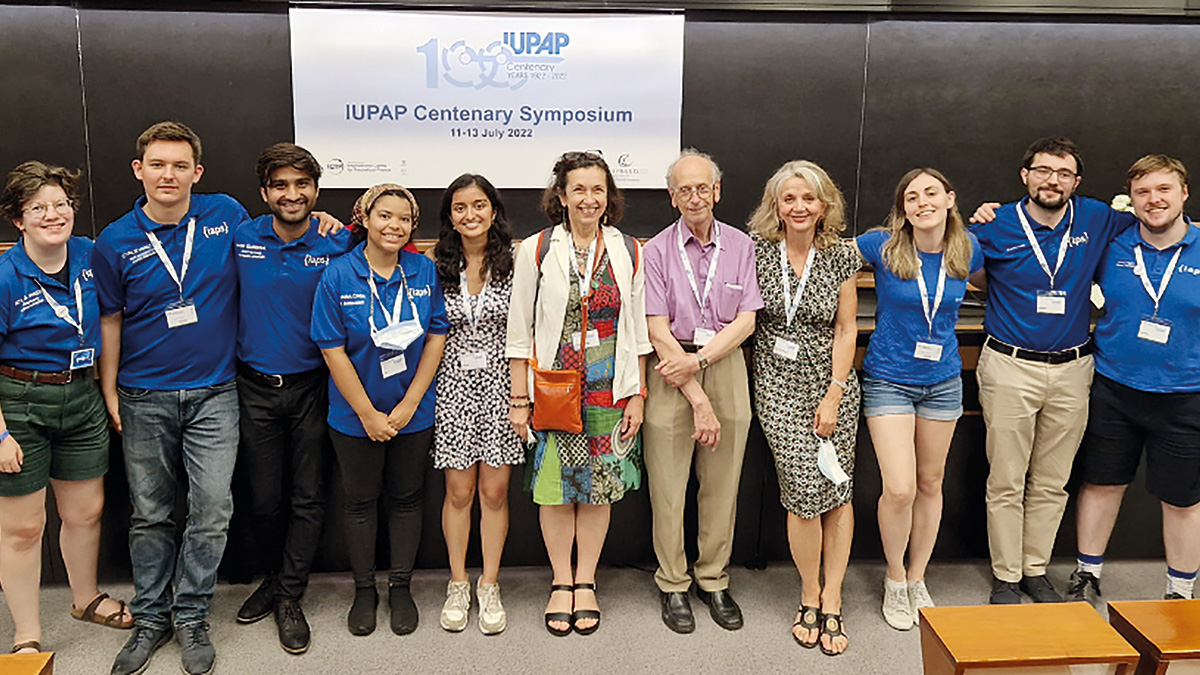
From 11 to 13 July, around 250 physicists from some 70 countries gathered to celebrate the 100th birthday of IUPAP at a symposium held at the Abdus Salam International Centre for Theoretical Physics (ICTP) in Trieste, Italy. The symposium was one of the official events of the International Year of Basic Sciences for Sustainable Development, which was officially inaugurated only a few days earlier at the UNESCO headquarters in Paris. About 40% of the participants were physically present, while the rest connected online. Various panels composed of international experts discussed important issues in alignment with the IUPAP’s core aims, including: how to support and encourage early-career physicists, how to improve diversity in physics, how to strengthen the ties to physicists working in industry, how to improve the quality of physics education, and how to promote physics in less developed countries.
IUPAP continues to promote physics as an essential tool for development and sustainability in the next century
A number of influential scientists, including Giorgio Parisi (La Sapienza) and Laura Greene (Florida State University), described their roles in providing evidence-based advice to their respective governments on science and shared best practices that could be useful across borders. Other prominent speakers included William Phillips (Maryland), who covered the quantum reform of modern metric systems; Donna Strickland (Waterloo), who discussed the physics of high-intensity lasers; and Takaaki Kajita (Tokyo), who presented 100 years of neutrino physics via an online connection with the International Conference on High Energy Physics (ICHEP) in Bologna. Climate scientist Tim Palmer (Oxford) argued that a supercomputing facility modelled on the organisation of CERN would enable a step-change in quantifying climate change, while Stewart Prager (Princeton) outlined a new project sponsored by the American Physical Society to engage physicists in reducing nuclear threat. Dedicated panels discussed the development of physics in Africa and the Middle East, Asia and the Pacific, and Latin America. It is clear that in these regions IUPAP has a large potential to foster further international collaboration.
IUPAP enhances the vital role of young physicists, among others, through the award of early-career scientist prizes. In Trieste, several recent recipients of the prize were invited to present their research. The talks were all striking and left the audience with high hopes for the future of physics. Furthermore, the logistics in the auditorium and the handling of all the questions that came in from online participants were smoothly taken care of by members of the International Association of Physics Students.
The centennial symposium was an opportunity to reflect on IUPAP’s role in promoting international cooperation and to welcome Ukraine as a new member. The decision to admit Ukraine was expedited to send a strong signal of support for the war-torn country – a war that has not spared its scientific institutions and the people who work there, as expressed by the president of the Ukrainian Academy of Sciences Anatoly Zagorodny in a powerful online presentation. IUPAP has issued a statement strongly condemning the Russian aggression in Ukraine, while also expressing the principle that no scientist should be excluded from union-sponsored conferences, as long as he or she carries out work not contributing to weapons development. To overcome difficulties related to conferences, IUPAP has put in place that excluded scientists can participate using the Union as their affiliation – similar to the model applied for the Olympic Games.
IUPAP has served the physics community for 100 years and has strong ambitions to continue to assist in the worldwide development of physics and to promote physics as an essential tool for development and sustainability in the next century.
In the dark abysses of the Mediterranean Sea, what promises to be the world’s largest neutrino telescope, KM3NeT, is rapidly taking shape. Using transparent seawater as the detection medium, its large three-dimensional arrays of photosensors will instrument a volume of more than one cubic kilometre and detect the faint Cherenkov light induced by the passage of charged particles produced in nearby neutrino interactions. The main physics goals of KM3NeT are to detect high-energy cosmic neutrinos and identify their astrophysical origins, as well as to study the fundamental properties of the neutrino itself.
KM3NeT (the Cubic Kilometre Neutrino Telescope) is the successor to the ANTARES neutrino telescope, which operated continuously from 2008 and has recently been decommissioned (see “The ANTARES legacy” panel). KM3NeT comprises two detectors: ARCA (Astroparticle Research with Cosmics in the Abyss), located at a depth of 3500 m offshore from Sicily, and ORCA (Oscillation Research with Cosmics in the Abyss), located at a depth of 2450 m offshore from southern France. ARCA is a sparse detector of about 1 km3 that is optimised for the detection of TeV–PeV neutrinos, while ORCA is a 7 Mt-dense detector optimised for sub-TeV neutrinos. The KM3NeT collaboration comprises more than 250 scientists from 16 countries.
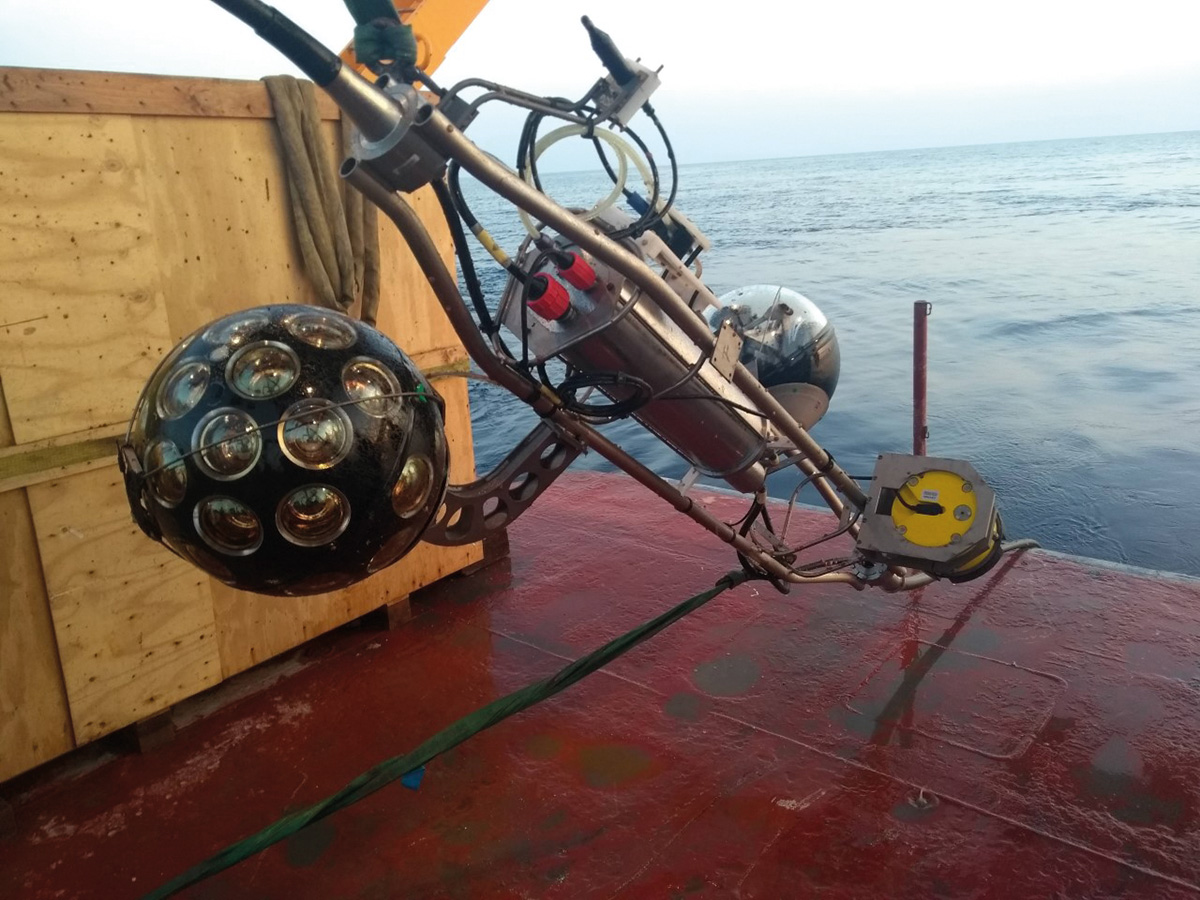
The key technology is the digital optical module (DOM) – a pressure-resistant glass sphere hosting 31 three-inch photomutiplier tubes, various calibration devices and the readout electronics (see “Modular” image). A total of 18 DOMs are hosted on a single detection line, and the lines are anchored to the seafloor and held taut by a submerged buoy. The ORCA detector will comprise around 100 lines and the ARCA detector will have twice as many. The bases of the lines are connected via cables on the seafloor to junction boxes, from which electro-opticalcables many tens of kilometres long bring the data to shore along optical fibres. Information on every single photon is transmitted to the shore stations, where trigger algorithms are applied to select interesting events for offline analysis.
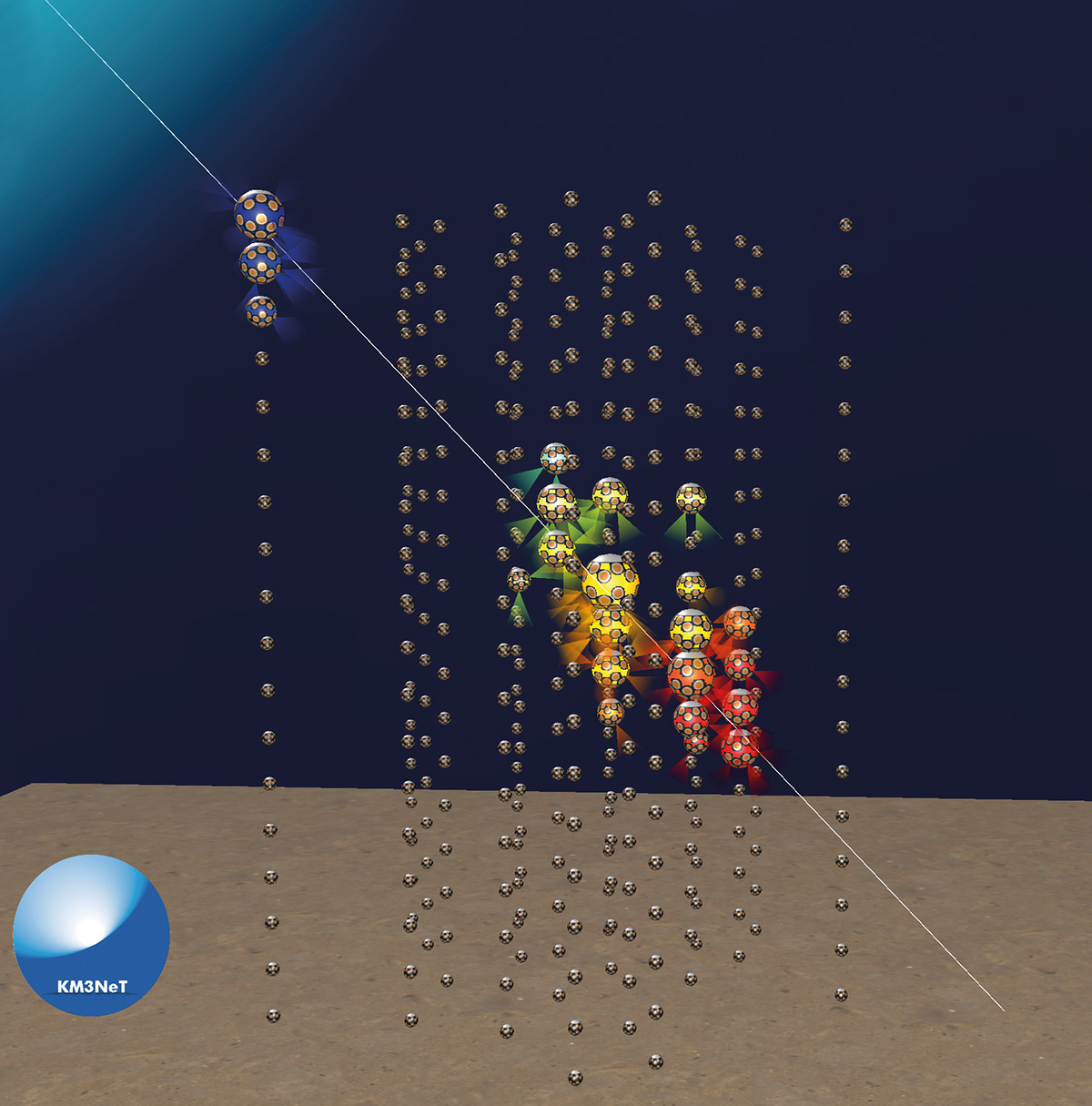
From the light pattern recorded by the DOMs, the energy and the direction of a neutrino can be estimated. Furthermore, the neutrino flavour can also be distinguished; muon neutrino charged–current (CC) interactions produce an extended track-like signature (see “Subsea shower” image) whereas electron– and tau–neutrino CC interactions, as well as neutral-current interactions, produce more compact shower-like events. By selecting up-going neutrinos, i.e. those that have travelled from the other side of Earth, the large background from down-going atmospheric muons can be rejected and a clean sample of neutrinos obtained.
The first KM3NeT detection line was connected in 2016 and currently a total of 32 lines are operating at the two sites. The first science results with these partial detectors have already been obtained.
Fundamental neutrino properties
Sixty-six years after their discovery, neutrinos remain the most mysterious of the fermions. As they whiz through the universe, barely interacting with any other particles, they have the unique ability to oscillate between their three different types or flavours (electron, muon and tau). The observation of neutrino oscillations in the late 1990s implies that neutrinos have a non-zero mass, contrary to the Standard Model expectation. Understanding the origin and order of the neutrino masses could therefore unlock a path to new physics. Numerous neutrino experiments around the world are closing in on the neutrino’s properties, using both artificial (accelerator and reactor) and natural (atmospheric and extraterrestrial) neutrino sources.
The KM3NeT/ORCA array is optimised for the detection of atmospheric neutrinos, produced when cosmic rays strike atomic nuclei at an altitude of around 15 km. Such interactions produce a cascade of particles on Earth’s surface, mostly pions and kaons, which decay to neutrinos capable of traversing the entire planet. About two thirds of these are muon neutrinos and antineutrinos, and the remainder are electron neutrinos and antineutrinos.
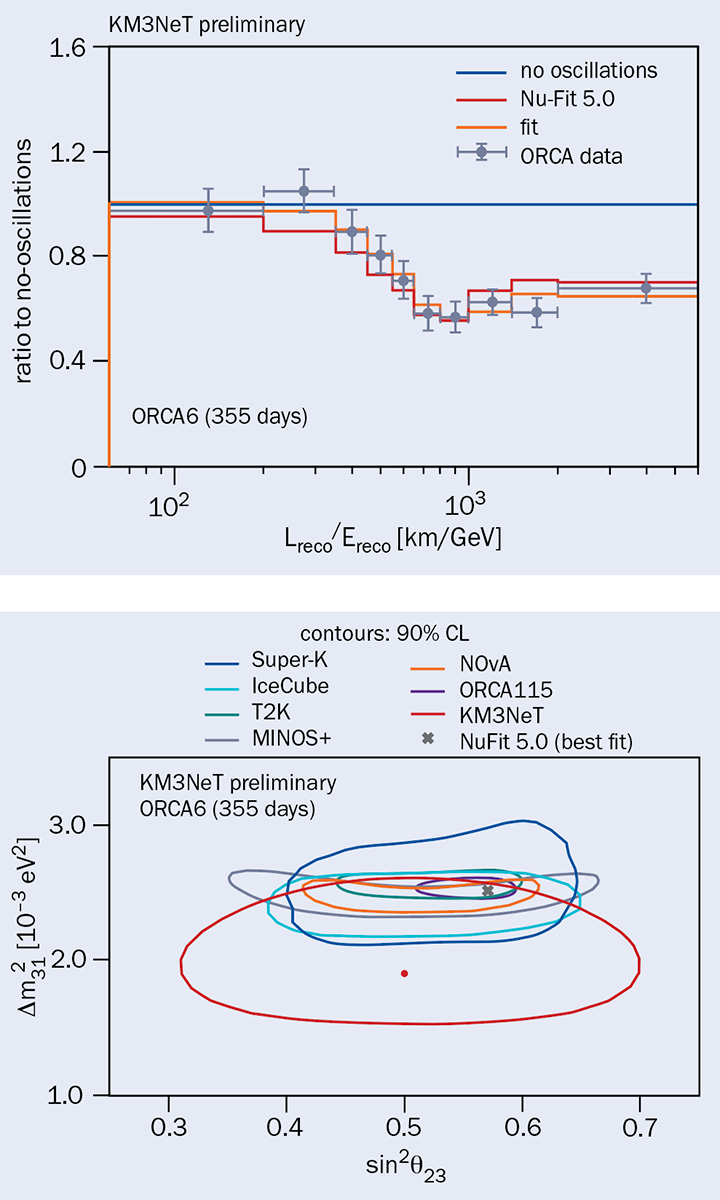
Measuring the directions and energies of the detected atmospheric neutrinos allows the oscillatory behaviour of neutrinos to be studied, and thus elements of the leptonic “PMNS” mixing matrix to be determined. The measured direction is used as a proxy for the distance the atmospheric neutrino has travelled through Earth between its points of production and detection. First preliminary results with six ORCA lines and one year of data clearly show the expected disappearance of muon neutrinos with increasing baseline/energy. The corresponding constraints on θ23 (the mixing angle between the m2 and m3 states) and Δm232 (the mass difference of the squared masses) already start to be competitive with multi-year results from the current long-baseline accelerator experiments (see “Physics debut” figure).
Building a telescope anchored deep at the bottom of the sea requires skill, patience and expertise. KM3NeT would not be on its way without the invaluable experience gained from its older sibling, the ANTARES telescope. ANTARES operated continuously for more than 15 years, and pioneered solutions to construct and operate a neutrino detector in the challenging environment of the deep sea. Despite ANTARES containing only 12 detector lines compared to 86 in IceCube, its superior angular resolution (due to the intrinsic water properties) and its Northern Hemisphere location provided competitive results and valuable insights and constraints in various domains.
Following IceCube’s discovery of a diffuse flux of cosmic neutrinos, the ANTARES all-flavour neutrino data sample revealed a mild (1.8σ) excess of high-energy events consistent with the neutrino signal detected by IceCube. ANTARES also contributed strongly to the multi-messenger endeavour, participating in the search for a neutrino counterpart to major alerts from the LIGO/Virgo gravitational-wave interferometers, IceCube, ground-based imaging air Cherenkov telescopes, as well as X- and gamma-ray satellites. For instance, the TXS0506+056 blazar is the second most significant point source, with a local significance of 2.8σ, strengthening its case as the first high-energy neutrino source. ANTARES also distributed its own neutrino alerts with an unprecedented low latency for a neutrino telescope.
Its energy threshold of a few tens of GeV allowed the study of atmospheric muon neutrino disappearance due to neutrino oscillations and to constrain the “3+1” neutrino model. In this domain, results consistent with world best-fit values were obtained, as well as competitive limits on non-standard interactions. The data were also used to search for dark-matter particles that would have accumulated in astrophysical bodies like the Sun or the galactic centre before annihilating or decaying into neutrinos. Since no excesses were found, competitive limits were set that reduce the parameter space to be explored by direct, indirect (including KM3NeT) and collider dark-matter experiments.
Recently superseded in sensitivity by KM3NeT, ANTARES was finally decommissioned in February 2022.
A longer-term physics goal of KM3NeT is to determine the neutrino mass ordering, i.e. whether the third neutrino mass eigenstate is heavier or lighter than the first two. This is important to help constrain the plethora of theoretical models proposed to explain the neutrino masses. Due to the large distances travelled by atmospheric neutrinos as they pass through Earth’s mantle and core, subtle matter effects come into play and distort the expected oscillation pattern in the zenith angle/energy plane. By comparing the observed distortions to those expected for either “normal” or “inverted” mass ordering, and thanks to the large neutrino sample collected, the neutrino mass ordering can be determined.
A 115-line configuration of ORCA operating for three years is expected to provide a three-sigma sensitivity for most θ23 values. KM3NeT could therefore be the first detector to unambiguously determine the neutrino mass ordering, on a time scale in advance of the planned long-baseline accelerator experiments. New-physics scenarios (for example, non-standard interactions, neutrino decays and sterile neutrinos) that modify the oscillation patterns recorded in both ORCA and ARCA have already been explored. While no significant deviations from the Standard Model have been observed, the enhanced sensitivity as the detectors grow will push the existing limits and probe uncharted territories.
Neutrino astronomy
At the beginning of the 1960s, it was realised that the neutrino could play a special role in the study of the universe at large. Weakly interacting with matter and electrically neutral, it enables exploration at greater distances and higher energies than is possible with conventional electromagnetic probes. In addition, neutrinos are the unambiguous smoking gun of hadronic acceleration processes occurring at their source.
Since the observation of a significant flux of cosmic high-energy neutrinos in the TeV–PeV range by the IceCube Neutrino Observatory at the South Pole in 2013, the focus of neutrino astronomers has been to identify the astrophysical origins of these neutrinos. Amongst the diverse possible sources, a multi-messenger approach has identified the first: the flaring blazar TXS0506+056. While other source candidates have appeared, such as tidal disruption events and radio-bright blazars, the currently identified source population(s) cannot fully explain the detected flux. Having a neutrino telescope with a sensitivity similar to that of IceCube and with a complementary field of view allows the full neutrino sky to be continuously monitored. KM3NeT’s location in the Northern Hemisphere provides an optimal view of the galactic plane and makes it the ideal instrument to detect, characterise and resolve sources that may emit galactic neutrinos.
Soon, KM3NeT will start sending alerts to its multi- messenger partners – including conventional electromagnetic telescopes but also other neutrino telescopes such as IceCube and Baikal/GVD – when a neutrino candidate with a high probability of astrophysical origin is detected. This is right on time for the fourth observing run of the LIGO, Virgo and KAGRA gravitational-wave interferometers. While so far no neutrinos have been observed from binary compact systems detected through gravitational waves, a joint detection would reveal unique information on the high-energy processes in the environment of the mergers. Furthermore, the exceptional pointing resolution of KM3NeT would significantly reduce the region of interest where electromagnetic partners should search for a counterpart. The ARCA detector, for example, will benefit from the low optical scattering of deep seawater to reconstruct the direction of muon-neutrino events to less than 0.1 degrees at 100 TeV and around 1 degree for the electron/tau neutrino flavours.
Last but not least, KM3NeT is already waiting for the next close-by core-collapse supernova. Such astrophysical events are rare: the first and only one ever detected in neutrinos, SN1987a, occurred 35 years ago. The KM3NeT DOMs are continuously monitoring for a short-duration increase in counting rates on many DOMs simultaneously – the signature of a flash of MeV supernova neutrinos passing through the detectors – and the detector is networked with other neutrino telescopes via the SuperNova Early Warning System (SNEWS). If a galactic supernova would happen today, the number of neutrinos detected by SNEWS would be four orders of magnitude more than for SN1987a!
Whether the cosmic-neutrino sources are point-like, extended, transient or variable, the KM3NeT collaboration has developed reconstruction techniques, event selections and statistical frameworks to identify them and determine their characteristics. Disentangling the galactic from the extragalactic components, the steady from the transient and the electromagnetically bright from the obscure are on KM3NeT’s to-do list for the coming decade.
Marine science
KM3NeT is important not only for particle physics, but is also a powerful tool for marine sciences. The acquisition of long-term oceanographic data helps researchers understand and eventually mitigate the harmful effects of global processes, such as climate change and anthropogenic impact, as well as study episodic events such as earthquakes, tsunamis, biodiversity changes and pollution – all of which are difficult to study with short-term conventional marine expeditions. To this end, the seafloor infrastructures of first the ANTARES and now the KM3NeT sites are unique cabled marine observatories. They are open to all scientific communities, and as such are important nodes of the European Multidisciplinary Seafloor and water-column Observatory, EMSO.
Sixty-six years after their discovery, neutrinos remain the most mysterious of the fermions
Furthermore, the KM3NeT optical sensors and the acoustics sensors (used for the positioning of the DOMs) themselves provide unique information on deep-sea bioluminescence and bioacoustics. The ANTARES collaboration has several publications studying deep-sea bioluminescence and acoustic detection of cetaceans, and recently KM3NeT invited citizen scientists to analyse its optical and acoustic data via the Zooniverse platform in the context of the EU project REINFORCE.
The KM3NeT detectors will continue to grow in size and sensitivity as additional new lines are installed over the next five years. With three major neutrino telescope facilities now online – Baikal/GVD, IceCube and KM3NeT – neutrino astronomy is truly entering its golden era.
To provide the best experiences, we use technologies like cookies to store and/or access device information. Consenting to these technologies will allow us to process data such as browsing behavior or unique IDs on this site. Not consenting or withdrawing consent, may adversely affect certain features and functions.
Functional
Always active
The technical storage or access is strictly necessary for the legitimate purpose of enabling the use of a specific service explicitly requested by the subscriber or user, or for the sole purpose of carrying out the transmission of a communication over an electronic communications network.
Preferences
The technical storage or access is necessary for the legitimate purpose of storing preferences that are not requested by the subscriber or user.
Statistics
The technical storage or access that is used exclusively for statistical purposes.The technical storage or access that is used exclusively for anonymous statistical purposes. Without a subpoena, voluntary compliance on the part of your Internet Service Provider, or additional records from a third party, information stored or retrieved for this purpose alone cannot usually be used to identify you.
Marketing
The technical storage or access is required to create user profiles to send advertising, or to track the user on a website or across several websites for similar marketing purposes.