Within the naturally lit expanse of the Exploring the Unknown exhibition at CERN Science Gateway, an artwork both intrigues and challenges: Julius von Bismarck’s Round About Four Dimensions, commonly referred to as the “tesseract”. As light interacts with its surfaces, the tesseract – a 3D representation of a 4D cube – unfolds and refolds, turning inside out in a hypnotic sequence that draws viewers into its rhythm (see “Round About Four Dimensions” image). This kinetic piece not only captivates with movement but also signifies the deep-rooted relationship between art and science.
Organised around themes of space and time, dark matter, and the quantum vacuum, the Exploring the Unknown exhibition becomes a meeting point, inviting spectators to dive into the collective curiosity of both artists and scientists. In particular it channels the imaginative spirit of CERN’s theoretical physicists, including Joachim Kopp, who remarked during an encounter with a visiting artist: “I try to visualise the maths. So, whenever I work on something, I need to have some pictures in my head, even when it’s mathematical concepts.” This sentiment illuminates the profound visual connection artists and scientists alike experience when confronted with complex ideas.
Rich dialogue
Born from the collaborative efforts between the Arts at CERN programme and the CERN exhibitions section, this display vividly encapsulates the synergy between art and science. By championing artist residencies, commissioning distinct art pieces and curating exhibitions, a rich dialogue is fostered between two seemingly distinct worlds. For the first time, Science Gateway will spotlight works born from residencies and commissions, proudly featuring creations from celebrated resident artists including Yunchul Kim, Chloé Delarue, Ryoji Ikeda and Julius von Bismarck.
Within CERN’s corridors, serendipitous dialogues emerge. An artist might gain fresh inspiration from a casual chat about the universe, looking at their work through a new lens. On the other hand, physicists can discover a fresh perspective on their familiar theories through the artist’s interpretation. As former CERN theorist Tevong You insightfully shared during one such discussion, “In the quantum world of particles and waves, there’s a beauty that artists instinctively grasp. They bring to life the equations we scribble on paper.”
The dialogue between diverse minds takes centre-stage at Science Gateway. Yunchul Kim harnesses the intricacies of fluid dynamics (see “Chroma VII” image), capturing space and time and the elusive nature of dark matter in his sculptures. Chloé Delarue crafts tangible experiences around the mystery and the uncertainty of the unknown (see “TAFAA” image), while the avant-garde audiovisual installations of Ryoji Ikeda breathe life into the elusive quantum vacuum (see “data.gram [n°4]” image). As artists immerse in these scientific domains, they unearth fresh inspiration and, in return, challenge scientists to see their own work through a different prism. This unconventional collaboration amplifies both fields: artists distill vast, abstract concepts into evocative forms, and scientists, inspired by this artistic partnership, discover enriched avenues through which to communicate their research.
Navigating the confluence of art and science is no straightforward journey. For every moment of synergy, there are hurdles to clear – terminology gaps, differing methodologies and the occasional skepticism from both sides. However, through the many interactions we’ve experienced between scientists and artists, it’s clear that these challenges can be overcome. Artists, through their residencies at CERN, have cultivated an understanding of complex scientific narratives. Conversely, CERN scientists have come to appreciate the evocative power of art, expanding beyond their traditional vocabulary. This endeavour is about building bridges, recognising the need for compromise, and ultimately celebrating the beauty that emerges when diverse worlds collide.
Finding equilibrium between artistic liberty and scientific truthfulness is also a delicate dance. In the vast realm of creativity, an artist might sometimes venture far from the core scientific concepts in their pursuit of artistic expression. In Exploring the Unknown, such balances are impressively maintained by von Bismarck’s tesseract and Ikeda’s audiovisual installation data.gram [n°4]. The exhibition shows that neither art’s freedom nor science’s precision need to be sacrificed; when approached with mutual respect, they can coexist, each enhancing the other’s message.
The 2020 update of the European strategy for particle physics couldn’t have put it better: “The particle-physics community should work with educators and relevant authorities to explore the adoption of basic knowledge of elementary particles and their interactions in the regular school curriculum”. The past decades have witnessed a heightened interest in introducing particle physics to high-school students. On top of the growing number of educational activities proposed in physics-education research literature, more and more high-school curricula explicitly include particle-physics topics. Yet, a big question lingers: what is the true extent of particle-physics representation in current high-school curricula?
In 2021, CERN physics-education researchers undertook a review encompassing 27 high-school physics curricula, spanning both CERN member and non-member states, to address this question. Each curriculum was analysed by at least two teachers from the CERN teacher programmes alumni network who are well acquainted with their respective curricula and the 28 particle-physics concepts on which the review was based (see “Standard Model” image). The review sought to identify existing trends and chart a roadmap for future curricular developments while also providing a benchmark for CERN’s outreach and educational initiatives.
Two types
The curricula included in the review can be split into two types depending on whether they contain any chapters that explicitly focus on particle-physics content. For the curricula with an explicit emphasis on particle physics (International Baccalaureate, Austria, Australia [Queensland], Croatia, Germany [Brandenburg], Israel, Russia, Switzerland [Nidwalden], Serbia, South Africa, Spain and the UK), the results show that more than half contain the following 10 particle-physics concepts (out of 28 included in the review): the Standard Model, electromagnetic interaction, strong interaction, weak interaction, quarks, leptons, interaction particles, antimatter research, general particle accelerators and open questions in particle physics.
For the curricula without any focus on particle physics (Brazil [São Paolo], Canada [Manitoba], Germany [Baden-Württemberg; Saxony], France, Ghana, Greece, Italy, Lebanon, the Netherlands, Poland, Slovakia, Slovenia, Sweden and the US), only four particle-physics concepts (out of 28 included in the review) were found in more than half of them: the Big Bang, electromagnetic interaction, electric charge and leptons.
The great majority of the concepts that appeared in more than half of the reviewed curricula were classified as theoretical particle-physics concepts. On the other hand, experimental concepts were generally lacking. Indeed, only particle accelerators appeared in a notable number of curricula with a dedicated particle-physics chapter. Even then, particle accelerators mostly appeared as context within electromagnetism without being explicitly connected to particle physics. Particle detectors appeared even less often in the curricula. Some historical particle detectors, such as the Geiger–Müller counter, were occasionally featured within the context of radiation. However, state-of-the-art detectors such as the LHC experiments were conspicuously absent from all reviewed curricula.
Emphasising real-world experimental contexts, such as modern particle detectors and their applications across domains such as medicine and art, could enrich student learning and interest
This lack of the experimental aspects of physics in high-school physics curricula is not limited to particle physics. Excplicit examples of the importance and value of experiments in science is often absent in high-school curricula, showing physics as a set of solidified facts. Ultimately, this can lead to gaps in students’ understanding of the role of experiments in science. Indeed, the contemporary relevance and the blend of theory and experiments within particle physics can offer students a unique opportunity to learn about how real modern science is done and what is the nature of science. Furthermore, emphasising real-world experimental contexts, such as modern particle detectors and their applications across domains such as medicine and art, could enrich student learning and interest.
The connection between particle interactions and the charges that govern them represents another noticeable gap. While the idea of an electric charge is relatively common within discussions on electromagnetism, concepts such as strong and weak charge are conspicuously absent. This is intriguing, especially since the strong and weak interactions are mentioned in several curricula either within the particle-physics or the nuclear-physics chapters. Moreover, electric charge remains referred to merely as charge, which can lead to difficulties in understanding different types of charge down the line. Hence, introducing strong and weak charge can provide a more rounded understanding, even without delving into unnecessary mathematical interpretations. Such introductions could form foundational pillars for students aiming to move further into particle physics and its related domains.
What next?
Particle physics has unequivocally made its mark in high-school education. The consistent presence of certain foundational concepts – electromagnetic interaction, leptons and electric charge – across curricula signals a universal baseline. However, the road to a meaningful introduction of particle-physics concepts in high-school classrooms is still long.
The glaring gap in experimental particle physics underscores that there is an immediate area of focus for our outreach efforts. Bridging this gap will ensure that students gain a more well-rounded understanding, synergising theoretical knowledge with cutting-edge experimental practices.
In addition, a review of particle-physics vocabulary, both in the context of charges and beyond, could improve students’ overall understanding of particle physics. By using clear and consistent language, communicators and educators can help reduce possible misunderstandings in the future.
Finally, the narrative around particle physics can serve as more than just a lesson on subatomic particles. It can be a lens, magnifying the very process of science: its challenges, its dynamism and its unparalleled ability to shape and reshape our understanding of the universe. As curricula designers ponder the next iteration, one hopes that particle physics finds a more holistic representation. The next generation of physicists, scientists and curious minds deserve nothing less
Alongside a hands-on education laboratory and large auditorium, Science Gateway houses three permanent exhibitions: Discover CERN, Our Universe and Quantum World. As they come through the doors, visitors discover a rich mixture of exhibition elements: authentic objects, contemporary artworks, audiovisual content, immersive spaces – and, of course, an abundance of interactive exhibits. The latter go through many carefully considered steps to present a spot-on experience to visitors, and must meet a number of criteria (see “Criteria that a good interactive exhibit should meet” panel).
Irrespective of the topic, there is a basic recipe for making an interactive exhibit. Once the clear message the exhibit aims to convey has been identified, developers write a draft that sets up a scenario of visitor interaction and sketches how the exhibit may look. What will visitors see when they approach the exhibit? What can they do? Are there several ways in which it is possible to interact with the exhibit?
Model making
The next step is to make a prototype. Depending on the nature of the exhibit, it may be a “quick and dirty” mockup, a simple 3D model, a paper prototype, or even just a verbal description. Then, the prototype is tested with at least several members of the target audience. What do they conclude from their interaction with the exhibit and why? How enjoyable and interesting do they find it? How well does the exhibit convey its key message? Afterwards comes the design and building of the exhibit. This stage often involves a lot of technical testing – for example, when choosing the materials or trying to keep within the available budget. In addition, texts that accompany the exhibit need to be written and translated. When the (nearly) final version of the exhibit is ready, it is evaluated again with the target audience. How clear are the instructions and the gameplay? What needs to be changed in the exhibit and how exactly? The final step, if necessary, is to reiterate.
Visitors discover the phenomenon by going through the stages of the scientific method
In reality, however, the development process rarely turns out to be simply moving from one step to the next. Sometimes, the results of testing a prototype with the public show that the scenario needs to be rewritten completely, bringing developers back to where they started. In other cases, time or budgetary constraints force the team to merge some steps or even skip them entirely. Two Science Gateway exhibits illustrate the twists and turns of developing a state-of-the-art science exhibit.
Criteria that a good interactive exhibit should (or at least should try to) meet
• Focus The exhibit should aim to convey only one, clearly defined message. For example: “In the LHC, particles are accelerated with the help of an electric field.”
• Edutainment Visitors can/should have fun when interacting with the exhibit and at the same time learn something new.
• Responsiveness Visitors should immediately receive a reaction from the exhibit when they do something. Simple encouragement like “Good job!” or “Keep going!” is helpful.
• Multi-sensory experience Interaction with the exhibit should involve as many senses as possible.
• Self-sufficiency People should understand how to use the exhibit, as well as the key ideas of the exhibit, without the help of a guide.
• Zero position After visitors leave the exhibit, it should self-restore to the state where it is ready to be used by the next person.
• Safety The exhibit should be safe for everyone to use, including children.
• Maintenance The technical team needs to have easy access to the exhibit and be able to use standard components to fix it if necessary.
• Physical accessibility The exhibit must be usable by – and feel welcoming for – diverse groups of visitors, for example, wheelchair users.
• Content accessibility Target audiences need to understand the language, key messages, ideas.
3 Social interactions Co-operation between visitors should be encouraged, for example through gameplay.
The starting point for the antimatter-trap exhibit (see “Trial and error” image) was a real antimatter trap – an eye-catching piece of scientific equipment that is well suited to an interactive exhibit. Following several brainstorms with antimatter scientists, a PhD student who specialised in the design of interactive science-communication experiences, and who developed the exhibit scenario further, made a paper prototype. In this version of the exhibit, visitors first had to slow an antiproton down in a decelerator, and only after that shoot the antiproton into the trap. The trap had several parameters (for example, a magnetic field that could be switched on and off) that visitors could play with before injecting the antiproton into the decelerator. Depending on how the parameters had been set, the antiproton would fly through the trap, annihilate or become captured.
We then tested this prototype with six small groups of visitors at the CERN Microcosm exhibition and six groups of CERN members of personnel who did not have a background in science or technology. Results from the testing led to many changes. For example, we learnt that many people were confused about deceleration. We therefore removed this stage from the gameplay but kept the speed of the antiproton coming into the trap as one of the parameters. A bigger problem was the fact that visitors, most of whom had heard nothing about antimatter prior to their interaction with the exhibit, still did not understand anything about it after successfully trapping the antiproton. We were faced with a dilemma: should the main message of the exhibit be about the antimatter itself, or should the exhibit still focus on how the antimatter trap works? After a difficult consideration, we decided to stick to the latter, whilst ensuring the former is included elsewhere in the exhibition.
An updated version of the exhibit scenario was handed over to the multimedia company that had been contracted to develop the exhibit, and further tests were conducted with two classes of Italian middle-school students. Apart from some minor usability issues, the exhibit proved to be challenging yet engaging: students yelled proudly and happily high-fived their team members after managing to trap the antiproton. The exhibit was then improved further, eventually taking its current shape in Science Gateway’s “Back to the Big Bang” exhibition. This was also the moment to come back to the antimatter scientists who helped ensure that all the texts and drawings in the exhibit were correct.
Keep the heat out
The goal here was to come up with a hands-on exhibit that would allow Science Gateway visitors to discover what keeps the LHC superconducting magnets cold. Similar to the experience with the antimatter exhibit, we again worked side-by-side with a CERN scientist. The original plan was to recreate a real situation: place a cold source at the centre and cover it with layers of different insulation materials. Visitors would be able to open and close these layers, as well as create a vacuum. They would observe that when the cold source was shielded from the environment, it required less power consumption to stay cool. This idea looked very promising on paper, especially given that the exhibit would be integrated into a full-scale mockup of the LHC.
However, calculations showed that the effect would only become visible after approximately half an hour. While this may not seem like a deal-breaker, in this context it certainly is: visitors at science exhibitions expect immediate feedback and typically do not spend more than just a few minutes at each exhibit. Moreover, having a surface that is sufficiently colder that the environment leads to condensation, which would create difficulties for the technical maintenance of the exhibit.
Alternative ideas were needed. To avoid reinventing the wheel, we explored which exhibits on the topic already existed in other science centres and museums. Eventually we decided to focus on a very basic idea: certain materials block heat, other materials conduct it. Communicating this message required a plate heated to 45 °C (not so hot that visitors risk burning themselves, but still warm enough to see the effect), a bunch of conducting and insulating materials that come in different shapes and thicknesses, and an infrared camera. Lots of technical prototyping and testing allowed us to determine how thick the materials should be to ensure that the effect was both visible and revealed itself quickly enough for the exhibit to be interesting. As the reflective metallic surfaces produce incorrect readings on the infrared camera, all metal materials were painted black. Finally, to keep the link between the exhibit and the actual LHC insulation, key elements such as mylar, vacuum and minimal surface contact were incorporated.
In its final form, the exhibit enables open-ended exploration, such that visitors discover the phenomenon by going through the stages of the scientific method. First, visitors face a challenge: in the instructions accompanying the exhibit, they are invited to try shielding the heated plate from the infrared camera. Then, by picking a certain type of material, visitors form a hypothesis – “maybe this piece made of copper will do the job?” – and test it by placing the material on the plate. As the copper piece quickly reaches the same temperature as the heated plate, visitors observe it with the help of the infrared camera and conclude that copper is not a good choice. This leads to a new hypothesis, another material… and so on. Visitors are free to explore the exhibit as long as they want, and we hope that for many Science Gateway visitors this open exploration will culminate in the magical “aha!” moment – the reason why we developed all these interactive exhibits in the first place.
When CERN was founded in 1954, four missions were given to the new organisation: performing fundamental research at the frontier of knowledge; development of innovative technologies to pursue fundamental research; international collaboration for the good of humanity; and education and inspiration for future generations of scientists, engineers and the public at large. The latter mission has been given a powerful new platform in the form of the CERN Science Gateway.
CERN is well known for outreach, most recently via the switch-on of the LHC and the search for and discovery of the Higgs boson. It also trains thousands of people through a variety of student and graduate programmes, ranging from internships, studentships and fellowships to professional training, such as at the CERN Accelerator School, the CERN School of Computing, and several physics and instrumentation Schools. Less well known, perhaps, is CERN’s influential work in science education.
Growth initiatives
CERN offers many professional-development programmes for teachers (see Inspiring the inspirers), as well as dedicated experiment sessions at the former “S’Cool LAB” (reincarnated in the Science Gateway educational labs, see Hands on, minds on, goggles on!) and the highly popular Beamline for Schools competition. These efforts are also underpinned by an education-research programme that has seen seven PhD theses produced during the past five years as well as 82 published articles since the programme began in 2009. This is made possible by the significant contributions of doctoral students, who make up much of the team, and cooperation with their almae matres in CERN’s member states. In addition, CERN is the publisher of the multilingual international journal Progress in Science Education.
The question “what is science education?” probably has more answers than the number of science educators in Europe. Nevertheless, the nature of science – the scientific method itself, without which we could not formulate science correctly, reproducibly and understandably – is a basic principle. Teaching the nature of science as the basis and conveying scientific results as examples is widely regarded as the best way to inspire learners young and old, although methods vary. A frequently asked question in this respect is: what to educate?
The traditional answer, which will be familiar to people who went to school in the 1970s or earlier, is “pure knowledge”. Later, it was realised that “skills” were important, too. While both remain core to science curricula, “competencies” are now seen as an effective way to advance society. In terms of physics, key topics in this regard are education for sustainable development, quantum physics and its applications, radiation and artificial intelligence.
Fulfilling its mission, CERN strives to reach everyone with its education programmes. The CERN Science Gateway offers exhibitions, large education labs, as well as educational science shows for audiences aged five and above. Education is key to sustainability, and thus to society, so let’s all work together. The CERN team is open to your proposals!
“The reason I want to talk to you today is that I myself had a very good physics teacher, which is why I’m now here at CERN. So, thank you for the important work you are all doing. You really make a difference!” This heartfelt sentiment, echoing the gratitude often expressed by CERN scientists when addressing visiting high-school teachers, encapsulates the essence of CERN’s teacher programmes.
Over the past quarter-century, CERN’s teacher programmes have played a vital role in bridging the gap between particle physics and educators from across the globe. What started originally in 1998, when the first International High School Teacher Programme took place with a small group of teachers, has grown into one of CERN’s many success stories. Today, CERN’s teacher programmes run on an almost weekly basis, welcoming about 1000 teachers from more than 60 countries every year, which makes them one of the largest and most successful professional development offers for in-service high-school science teachers worldwide.
The vast bulk are week-long programmes for teachers from one country or from one language group, predominantly targeting teachers from CERN’s member states, associate member states and the occasional non-member state. In addition, two international teacher programmes take place every year in the summer, significantly broadening the reach. Each international teacher programme lasts two weeks and hosts up to 48 teachers from around the world. So far, about 14,500 teachers from 106 countries have participated in CERN’s national and international teacher programmes, and every year another 1000 teachers travel to CERN to attend lectures, on-site visits, hands-on workshops, discussions and Q&A sessions.
Multifaceted
Teacher programmes at CERN serve multiple purposes. First and foremost, they are professional development programmes that enable high-school teachers to keep up to date with the latest developments in particle physics and related areas, and to experience a dynamic, international research environment. As such, they answer the call to bring more modern science into the classroom, which goes hand in hand with a slow yet steadily increasing change in curriculum development (see Particle physics in school curricula). Second, teacher programmes are an acknowledgement of the critical role that teachers play in preparing the future of humanity. They inspire and empower teachers and, through them, their students. Last but not least, teacher programmes showcase the importance of science diplomacy – colloquially referred to as a soft power in the world of international relations. For instance, before joining CERN as associate member states, several countries already brought high-school teachers to CERN for dedicated national teacher programmes; these, in turn served as door-openers in the respective ministries and supported the country’s application to join CERN. The same is true for distant countries, with which CERN has no other connections than teachers who took part in one of the international teacher programmes.
High impact
But what about the impact of CERN’s teacher programmes? Is it possible to measure the effectiveness of such a variety of programmes and perform an evaluation that goes beyond documenting teachers’ feedback? Combined with anecdotal data from alumni teachers, who frequently return to CERN with their students or take part in other education activities such as the Beamline for Schools (BL4S) competition, and the fact that CERN’s teacher programmes are heavily overbooked, the overall picture is clear: teachers’ satisfaction with CERN’s teacher programmes is extremely high.
The overall picture is clear: teachers’ satisfaction with CERN’s teacher programmes is extremely high
To deepen the level of evaluation of CERN’s teacher programmes and to allow for further development in the future, in 2021 a multi-stakeholder study was performed to document and illustrate the goals of professional development programmes at particle-physics laboratories. This study led to a hierarchical list of the 10 most important learning goals, such as enhancing teachers’ knowledge of scientific concepts and models, and enhancing their knowledge of curricula, which now represent the baseline for future evaluations of teachers’ learning. Here, a large-scale study is currently ongoing to assess their knowledge in a pre-post setting by using concept maps. The aim of this approach is not only to study the learning progression throughout a teacher programme but also to support teachers in constructing meaningful mental models and knowledge structures, which are key indicators of successful educators. Indeed, CERN’s teacher programmes continue to serve as a prime testbed for the Organization’s physics-education research efforts, with one doctoral research project already successfully completed and a second on its way. Future research projects will aim to evaluate teachers’ use of their new knowledge and skills after their participation in CERN’s teacher programmes and consequently their students’ learning outcomes.
The most important dimension of CERN’s teacher programmes, however, is the social one. Over the past 25 years, teachers from different parts of the world have met at CERN, became friends and remained in touch with one another. This has led to several cross-border Erasmus projects, combined school events and even tri-national proposals for the BL4S competition.
Today, CERN’s teacher programmes are more popular than ever, with teachers from all around the world being more than eager to apply for one of the limited spots. One participant of this year’s International High School Teacher Programme even had to move his wedding date, which originally coincided with the programme dates. Luckily, his fiancée was understanding and not only agreed to the postponed date but also smiled when he put on his CERN helmet for the wedding picture.
Ever since the discovery of antimatter 90 years ago, physicists have striven to measure its properties in new and more precise ways. Experiments at CERN’s Antimatter Factory represent the state of the art. In addition to enabling measurements of properties such as the antiproton charge-to-mass ratio with exquisite precision (recently shown by the BASE experiment to be equal to that of the proton within a remarkable 16 parts per trillion), the ability to trap and store large numbers of antihydrogen atoms for long periods by the ALPHA experiment has opened the era of antihydrogen spectroscopy. Such studies allow precise tests of fundamental symmetries such as CPT. Until now, however, the gravitational behaviour of antimatter has remained largely unknown.
Equivalence principle
Using a modified setup, the ALPHA collaboration recently clocked the freefall of antihydrogen, paving the way for precision studies of the magnitude of the gravitational acceleration between antiatoms and Earth. The goal is to test the weak equivalence principle of general relativity, which requires that all test masses must react identically to Earth’s gravity. While models have been built that suggest differences could exist between the freefall rates of matter and antimatter (for example due to the existence of new, long-range forces), the theoretical consensus is clear: they should fall to Earth at the same rate. In physics, however, you don’t really know something until you observe it, emphasises ALPHA spokesperson Jeffrey Hangst: “This is the first direct experiment to actually observe a gravitational effect on the motion of antimatter. It’s a milestone in the study of antimatter, which still mystifies us due to its apparent absence in the universe.”
The ALPHA collaboration creates antihydrogen by binding antiprotons produced and slowed down in the Antiproton Decelerator and ELENA rings with positrons accumulated from a sodium-22 source. It then confines the neutral, but slightly magnetic, antimatter atoms in a magnetic trap to prevent them from coming into contact with matter and annihilating. Until now, the team has concentrated on spectroscopic studies with the ALPHA-2 device. But it has also built an apparatus called ALPHA-g, which makes it possible to measure the vertical positions at which antihydrogen atoms annihilate with matter once the trap’s magnetic field is switched off, allowing the antiatoms to escape.
The ALPHA team trapped groups of about 100 antihydrogen atoms and then slowly released them over a period of 20 seconds by gradually ramping down the top and bottom magnets of the trap. Numerical simulations indicate that, for matter, this operation would result in about 20% of the atoms exiting through the top of the trap and 80% through the bottom – a difference caused by the downward force of gravity. By averaging the results of seven release trials, the ALPHA team found that the fractions of antiatoms exiting through the top and bottom were in line with simulations. Since vertical gradients in the magnetic field magnitude can mimic the effect of gravity, the team repeated the experiment several times for different values of an additional bias magnetic field, which could either enhance or counteract the force of gravity. By analysing the data from this bias scan, the team found that the local gravitational acceleration of antihydrogen is directed towards Earth and has magnitude ag = [0.75 ± 0.13 (stat. + syst.) ± 0.16 (sim.)]g, which is consistent with the attractive gravitational force between matter and Earth.
This is the start of a new avenue of experimental exploration that pushes the development of trapping and other techniques
The next step, says Hangst, is to increase the precision of the measurements via laser-cooling of the antiatoms, which was first demonstrated in ALPHA-2 and will be implemented in ALPHA-g in 2024. Two other experiments at CERN’s Antimatter Factory, AEgIS and GBAR, are poised to measure ag using complementary methods. AEgIS will measure the vertical deviation of a pulsed horizontal beam of cold antihydrogen atoms in an approximately 1 m-long flight tube, while GBAR will take advantage of new ion-cooling techniques to measure ultra-slow antihydrogen atoms as they fall from a height of 20 cm. All three experiments are targeting a measurement of ag at the 1% level in the coming years.
Even higher levels of precision will be needed to test models of new physics, say theorists. “The role of antimatter in the ‘weight’ of antihydrogen is very little, since practically all the mass of a nucleon or antinucleon comes from binding gluons, not antiquarks,” says Diego Blas of Institut de Física d’Altes Energies and Universitat Autònoma de Barcelona. “Any new force that couples differently to matter and antimatter would therefore need to have a huge effect in antiquarks, which makes it difficult to build models that are consistent with existing observations and where the current measurements by ALPHA-g would be different.” Things start to get interesting when the precision reaches about one part in 10 million, he says. “This is the start of a new avenue of experimental exploration that pushes the development of trapping and other techniques. If you compare the situation with the sensitivity of the first prototypes of gravitational-wave detectors 50 years ago, which had to be improved by six or seven orders of magnitude before a detection could be made, anything is possible in principle.”
On 7 October, CERN Science Gateway – a new emblematic centre for science education and outreach targeting all ages – was inaugurated in the presence of 500 invited guests, including the president of the Swiss Confederation, ministers and other high-level authorities from CERN’s member and associate member states, the project’s donors, and other partners. The following day the centre opened to the public, welcoming about 1400 visitors.
Opening the inauguration ceremony in the new 900-seat auditorium, CERN Director-General Fabiola Gianotti stressed the value of education and outreach: “Sharing CERN’s research and the beauty and utility of science with the public has always been a key objective and activity of CERN, and with Science Gateway we can expand significantly this component of our mission. We want to show the importance of fundamental research and its applications to society, infuse everyone who comes here with curiosity and a passion for science, and inspire young people to take up careers in science, technology, engineering and mathematics. Science Gateway will be a place where scientists and the public can interact daily. For me, personally, it is a dream that has become a reality and I am deeply grateful to all the people who have contributed, starting with our generous donors.”
The overall cost of Science Gateway, about CHF 100 million, was funded exclusively through donations. Contributing CHF 45 million, the Stellantis Foundation is the largest single donor. The Fondation Hans Wilsdorf is also a major donor. The other donors are the LEGO Foundation, Loterie Romande, Ernst Göhner Stiftung, Rolex, Carla Fendi Foundation, Fondation Gelbert, Solvay, Fondation Meyrinoise du Casino and the town of Meyrin.
In his address, president of the Swiss Confederation Alain Berset said: “Those familiar with Venn diagrams will agree that this invisible circle puts CERN at the intersection between Switzerland, France and Europe, thus symbolising its commitment to shared scientific and political values. CERN truly is an exceptional facility and one that enables Switzerland and Geneva to shine on the world stage.”
Throughout the day, guided by CERN scientists and children of CERN personnel, visitors were able to experience first-hand the range of Science Gateway’s opportunities, from interactive exhibitions to laboratories for educational experiments and immersive spaces (see Education and outreach in particle physics). The new centre, which is free of charge and open six days a week (it is closed on Mondays), is expected to host up to 500,000 visitors a year from across the world. While the full project was launched in 2018, construction of the Science Gateway campus – designed by renowned architect Renzo Piano – took just over two years, with the first stone of the building being laid on 21 June 2021.
Speaking on behalf of CERN’s member and associate-member states, president of the CERN Council Eliezer Rabinovici said: “Today we celebrate the courage and passion to innovate that CERN has always demonstrated and the commitment to share the fruits of its research with people from all countries and of all ages. May the science leaders of tomorrow come from among the curious children who will fill this wonderful place with joy in the coming years.”
September saw another important inauguration at CERN: that of the refurbished CERN library. Following 12 months of renovation work, on 28 September the library and bookshop welcomed users of the new spaces with a two-day event packed with activities and entertainment.
The library renovation project had two main goals. One was to lower the library’s carbon footprint using state-of-the-art cooling and ventilation, LED lights, the replacement of all windows and the renovation of the roof. The second aim was to improve the comfort of library users thanks to an optimised layout of the reading room, which is fitted out with modern, high-quality furniture and ergonomic workspaces. A first-stone ceremony was held in March during which a time capsule containing photos of the library through the years, personal messages from users and librarians, and a key holder that opened the old library desk, was sealed into the walls.
Designed by UK architects Bisset Adams, the new CERN library is accessible 24 hours a day, seven days a week. Sixty new workplaces await users, and more than 16,000 books are available in open stacks with many more available upon request or as e-books. The library desk and bookshop are open from 09:00 to 18:00 during weekdays, and books can be borrowed outside these hours by emailing library.desk@cern.ch.
Towards the end of the lifetime of a very massive (>8 M☉) star, the nuclear fusion processes in its core are no longer sufficient to balance the constantly increasing pull of gravitational forces. This eventually causes the core to collapse, with the release of an enormous amount of matter and energy via shockwaves. Nearly 99% of such a core-collapse supernova’s energy is released in the form of neutrinos, usually leaving behind a compact proto-neutron star with a mass of about 1.5 M☉ and a radius of about 10 km. For more massive remnant cores (>3 M☉), a black hole is formed instead. The near-zero mass and electrical neutrality of neutrinos make their detection particularly challenging: when the famous 1987 supernova SN1987a occurred 168,000 light-years from Earth, the IMB observatory in the US detected just eight neutrinos, BNO in Russia detected 13 and Kamiokande II in Japan detected 11 (CERN Courier March/April 2021 p12).
Besides telling us about the astrophysical processes inside a core-collapse supernova, such neutrino detections might also tell us more about the particles themselves. The Standard Model (SM) predicts feeble self-interactions among neutrinos (νSI), but probing them remains beyond the reach of present-day laboratories on Earth. As outlined in a white paper published earlier this year by Jeffrey Berryman and co-workers, νSI (mediated, for example, by a new scalar or vector boson) enter many beyond-the-SM theories that attempt to explain the generation of neutrino masses and the origin of dark matter. One of the probes that can be used to explore such interactions are core-collapse supernovae, since the extreme conditions in these catastrophic events make it more likely for νSI to occur and therefore affect the behaviour of the emitted neutrinos.
Recently, Po-Wen Chang and colleagues at Ohio State University explored this possibility by considering the formation of a tightly coupled neutrino fluid that expands under relativistic hydrodynamics, thereby having an effect on neutrino pulses detected on Earth. The team derives solutions to relativistic hydrodynamic equations for two cases: a “burst outflow” and a “wind outflow”. A burst outflow of a uniform neutrino fluid occurs when it undergoes free expansion in vacuum, while a wind outflow occurs when steady-state solutions to the hydrodynamics equations are looked for. In their current work, the authors focus on the former.
In a scenario without νSI, the neutrinos escape and form a shell of thickness about 105 times the radius of the proto-neutron star that freely travels away at the speed of light. On the other hand, in a scenario with νSI, the neutrinos don’t move freely immediately after escaping the proto-neutron star and instead undergo increased neutrino elastic scattering. As a result, the neutrino shell continues expanding radially until it reaches the point where the density becomes low enough for the neutrinos to decouple and begin free-flowing. The thickness of the shell at this instant depends on the strength of the νSI interactions and is expected to be much larger than that in the no-νSI case. This, in turn, would translate to longer neutrino signals in detectors on Earth.
The effects of neutrino self interactions on SN1987a are starting to become clearer
Data from SN1987a, where the neutrino signal lasted for about 10 s, broadly agree with the no-νSI scenario and were used to set limits on very strong νSI interactions. On the other hand, if νSI were to exist as a burst-outflow, the proposed model gives very robust results, with an estimated sensitivity of 3 s. Additionally, the authors argue that the steady-state wind-outflow case might be more likely to occur, a dedicated treatment of which has been left for future work.
For the first time since its observation 36 years ago, the effects of νSI on SN1987a are starting to become clearer. Further advances in this direction are much anticipated so that when the next supernovae occurs it could help clear the fog that surrounds our current understanding of neutrinos.
Following the successful repair in August of a small leak in the insulation vacuum of the LHC inner triplet assembly near Point 8, beams returned on 30 August for the first long heavy-ion run of Run 3. Stable beams were declared on 27 September with an energy of 5.36 TeV per nucleon pair (compared to 5.02 TeV during Run 2) and a collision rate increased by a factor of 10 since the last heavy-ion run in 2018.
The primary goal of the five-week-long run was to advance understanding of quark–gluon plasma, in which quarks and gluons move around freely for a split-second before the system expands and cools down, turning back into hadrons. In addition to the improved beam parameters, significant upgrades have taken place in the LHC experiments to maximise their physics harvest. ALICE is now using an entirely new mode of data processing, storing all collisions without selection, resulting in up to 100 times more collisions being recorded per second (CERN Courier September/October 2023 p39). In addition, its track reconstruction efficiency and precision have increased due to the installation of new subsystems and upgrades of existing ones. CMS and ATLAS have also upgraded their data acquisition, reconstruction and selection infrastructures to take advantage of the increased collision rates, while LHCb is preparing a unique programme of fixed-target collisions between lead nuclei and other types of nuclei using its SMOG2 apparatus.
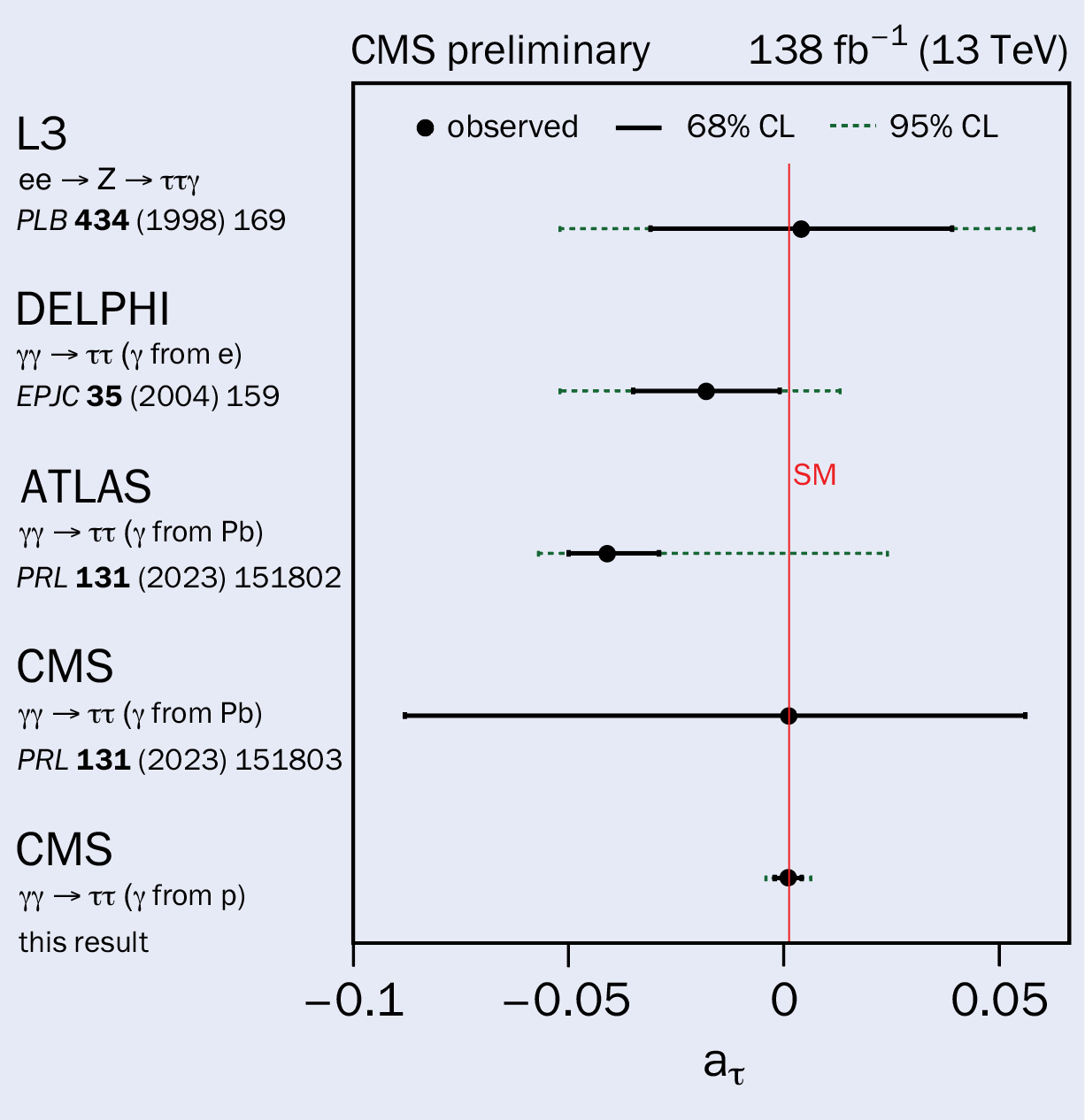
The increased number of collisions is expected to allow measurements of the temperature of the quark–gluon plasma using thermal radiation in the form of photons and electron-positron pairs. Hydrodynamic properties of this near-perfect liquid state will also be measured in greater detail. In addition, the experiments will probe ultra-peripheral collisions of heavy ions in which one beam emits a high-energy photon that strikes the other beam. These collisions will be used to probe gluonic matter inside nuclei and to study rare phenomena such as light-by-light scattering and τ-lepton photoproduction.
To provide the best experiences, we use technologies like cookies to store and/or access device information. Consenting to these technologies will allow us to process data such as browsing behavior or unique IDs on this site. Not consenting or withdrawing consent, may adversely affect certain features and functions.
Functional
Always active
The technical storage or access is strictly necessary for the legitimate purpose of enabling the use of a specific service explicitly requested by the subscriber or user, or for the sole purpose of carrying out the transmission of a communication over an electronic communications network.
Preferences
The technical storage or access is necessary for the legitimate purpose of storing preferences that are not requested by the subscriber or user.
Statistics
The technical storage or access that is used exclusively for statistical purposes.The technical storage or access that is used exclusively for anonymous statistical purposes. Without a subpoena, voluntary compliance on the part of your Internet Service Provider, or additional records from a third party, information stored or retrieved for this purpose alone cannot usually be used to identify you.
Marketing
The technical storage or access is required to create user profiles to send advertising, or to track the user on a website or across several websites for similar marketing purposes.