Comsol -leaderboard other pages

Topics

Hans Bethe and his Physics

By Gerald E Brown and Chang-Hwan Lee (eds), World Scientific. Hardback ISBN 9789812566096 £56 ($98). Paperback ISBN 9789812566102 £22 ($38).
CCboo1_04_07

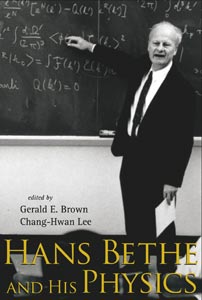
This book is the result of a request that Hans Bethe made at the age of 97 to his long-term collaborator Gerry Brown to explain “his physics” to the world. This is no easy feat considering that the published scientific papers, books and reports span the best part of eight decades, and include some of the most important contributions to 20th-century physics. Brown and Lee have risen to the challenge and produced a book of which Bethe himself would be proud. It even goes beyond Bethe’s initial request to explain his physics and provides a portrait of the great man in all aspects of his life, which Brown and Lee have accomplished by enlisting the help of experts, collaborators and friends.

In part one of this four-part book, we catch a personal glimpse of the man and his science through the eyes of close collaborators and friends. Brown summarizes and evaluates Bethe’s long career as a teacher and researcher, starting with a brief history of his early years in Germany and England, with a short stay in Italy. He describes how Bethe developed mathematical rigor working with Arnold Sommerfeld and gained physical intuition from Enrico Fermi.

However, Bethe found that the British had a much healthier attitude towards life than the Germans, and with the rise of Adolf Hitler and the new laws he could not hold a university position as two of his grandparents were Jewish. So in 1933 he moved to Manchester University where he was reunited with his old friend Rudi Peierls. Bethe regarded 1933–34 as his most productive time, although he had already published the famous “Bethe ansatz”. Brown ends his article by describing his own long collaborative research with Bethe in astrophysics.

Bethe’s own article, “My life in astrophysics”, highlights his strengths and the application of nuclear physics in stellar energy production, for which he won the Nobel prize in 1967. The article describes in detail the whole Nobel experience; his enjoyment is obvious. He concludes by describing his return to astrophysics after retiring from Cornell University.

“Three weeks with Hans Bethe” by Chris Adami is a transcript of conversations with Bethe and Brown over a three-week period at the Kellogg Radiation Laboratory at Caltech. Here Adami provides a unique insight into the mind of Bethe, his thoughts on science, people and politics. Adami quizzed Bethe on almost every aspect of his life, keeping a record of each day’s discussion, a real Bridget Jones’s Diary of physics. Here we learn that Bethe was an expert on shock waves and explosions, which he had ample opportunity to develop during his time at Los Alamos, and Adami was sometimes met with silence if the questioning came too close to classified work.

Bethe’s commitment to nuclear energy is highlighted in the short article by Jeremy Bernstein, who had written a piece about Bethe for the New Yorker, highlighting his enthusiasm for nuclear energy. At the time, Bethe debated the nuclear option with Barry Commoner, a committed environmentalist and the magazine’s energy guru. Such debates are again increasingly relevant, but without a Bethe, explaining the nuclear option is more difficult. Part one concludes with a well crafted piece by Ed Salpeter who interacted with Bethe over a 60 year period.

Kurt Gottfried introduces part two, followed by Silvan Schweber who gives an account of Bethe’s education, swift rise to international prominence and immense impact on American physics. The other four papers in this section deal with distinct aspects of his research. Salpeter and the late John Bahcall expand on Bethe’s work on energy production in stars, nuclear astrophysics and neutrino physics. Bethe wrote an important and influential paper in 1986 on the missing solar neutrinos, explaining the Mikheyev–Smirnov–Wolfenstein effect. This is the best explanation of matter effects on neutrino oscillations that I have come across. Freeman Dyson traces Bethe’s influence on the development of quantum electrodynamics and the story of how he solved the Lamb shift problem, claiming that “Hans Bethe was the supreme problem solver of the past century”. John Negele describes Bethe’s work on the theory of nuclear matter and the post-war contribution he made to the nuclear many-body problem. Brown concludes this section by providing an intimate look at his remarkable collaboration with Bethe on supernovae and mergers between neutron stars and black holes as possible sources of gravitational waves.

Part three contains papers by Chen Ning Yang and Mo-Lin Ge on the impact of what Yang had termed the “Bethe ansatz”, which extended to many systems beyond the 1D problem in quantum mechanics that Bethe originally considered. David Mermin and Neil Ashcroft describe how influential Bethe was in solid-state physics. However, although he played a major role in developing the quantum theory of solids, he realized by 1933 that his real interest was in nuclear physics. Jeremy Holt and Brown provide a historical summary of nuclear physics where they put Bethe’s major contributions into context. Sometimes in physics the exact details of discovery are not well documented, but not in this case I am pleased to say. This section ends with the paper “And don’t forget the black holes”, which Bethe co-authored with Brown and Chang-Hwan Lee shortly before his death.

The last part of the book concludes with a set of papers discussing Bethe’s contribution to science policy at all levels. Sydney Dell recounts the various ways in which Bethe’s integrity, together with his incredible scientific knowledge, made him an admirable adviser to policy makers. Bethe’s panel helped shape the Limited Test Ban Treaty of 1963. He was deeply concerned with new threats posed by nuclear weapons and was deeply involved in all aspects of the global-energy problem. The article by Boris Ioffe on “Hans Bethe and the global energy problem” outlines Bethe’s commitment to the peaceful use of nuclear energy. He also advocated strategies to police and limit the amount of weapons-grade material, a very real threat in today’s global political scene. The book concludes with obituaries by Richard Garwin, Frank von Hippel and Gottfried.

This book does an admirable task in drawing a portrait of a great scientist and a great man. Bethe’s power, in my experience, was that he could always easily get to the heart of a problem in any field and solve it in the most economical way, and this comes through clearly. The book is a “must read” for every researcher and teacher of science.

ICFA releases ILC design report

The International Committee for Future Accelerators (ICFA) has released the Reference Design Report (RDR) for a future International Linear Collider (ILC). The report provides the first detailed technical description of the machine, including a cost estimate, and is a major step towards the engineering design report that would underlie a formal project proposal.

CCnew1_04_07

The concept behind the ILC is a high-luminosity electron–positron collider, operating at centre-of-mass energies of 200–500 GeV, with a possible upgrade to 1 TeV. The first map of physics at the tera-electron-volt scale will come from CERN’s LHC; the ILC would expand on the discoveries made in this new energy region, investigating it with high precision.

ICFA established the basis for the design in August 2004 when it accepted the advice of the International Technology Recommendation Panel to opt for superconducting radio-frequency (SCRF) accelerating cavities operating at 1.3 GHz. A year later the Global Design Effort (GDE), a team of more than 60 scientists, was officially formed to define the basic parameters and layout and develop the reference design.

The RDR defines the technical specifications for a 31 km long machine, which would deliver a peak luminosity of about 2 × 1034 cm–2s–1, at a top centre-of-mass energy of 500 GeV. The basic design achieves this high luminosity through a combination of small emittance beams and high beam power, facilitated by the use of 1.3 GHz SCRF. The design also allows for an upgrade to a 50 km, 1 TeV machine during the second stage of the project.

The major components start with a polarized electron source based on a photocathode DC gun and an undulator-based positron source, driven by a 150 GeV electron beam. The particles produced will then pass to 5 GeV electron and positron damping rings at the centre of the ILC complex, before being transported to the main linacs, where each beam will enter a bunch-compressor system prior to injection. The two 11 km long main linacs will use the 1.3 GHz SCRF cavities operating at an average gradient of 31.5 MV/m, with a pulse length of 1.6 ms and a cycle rate of 5 Hz. Finally, a 4.5 km long beam-delivery system will bring the two beams into collision at a 14 mrad crossing angle. Two detectors in a “push–pull” configuration will share the luminosity at the single interaction point.

As part of the RDR, the GDE members also produced a preliminary value estimate of the cost for the ILC. This estimate contains three elements: €1480 million ($1800 million) for site-related costs, such as for tunnelling in a specific region; €4040 million ($4900 million) for the value of the high technology and conventional components; and approximately 2000 people a year, or 13,000 person years, for the supporting manpower. Some 43% of the total costs come from the SCRF technology for the main linacs.

The value cost estimate provides guidance for optimization of both the design and the R&D to be done during the engineering design phase, which will formally start in the autumn. The global R&D effort will continue to focus on the performance of the high-gradient accelerating cavities. These are key components as the gradient governs the lengths of the linacs. The goal of an average operational gradient of 31.5 MV/m translates to a minimum of 35 MV/m in acceptance tests during mass production of the cavities. The next major milestone for the GDE will then be to produce the engineering design report – the detailed blueprints for building the machine – by 2010.

• To download a summary or the full report see www.linearcollider.org.

SLAC demonstrates plasma ‘afterburner’

A team of researchers at SLAC has shown that plasma acceleration can dramatically boost the energy of particles over a short distance. The breakthrough is the culmination of almost a decade of work, led by Chan Joshi from University of California, Los Angeles, Thomas Katsouleas from the University of Southern California and Robert Siemann from SLAC.

The technique uses the plasma-wakefield effect – the high electric fields generated in the wake of an intense beam of either photons or charged particles passing through a plasma. In 2006, Wim Leemans and colleagues from the Lawrence Berkeley National Laboratory and Oxford University accelerated electrons to 1 GeV in laser-driven wakefields over 3.3 cm. Now Ian Blumenfeld and colleagues have used the intense, ultrarelativistic electron beam from the 3 km linac at SLAC to create the wakefields.

CCnew2_04_07

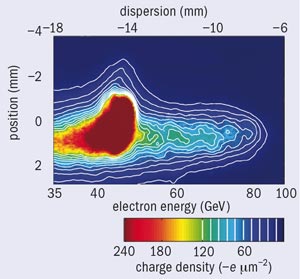
In the experiment at SLAC, the team directed the 42 GeV beam from the linac into lithium gas in an 85 cm long plasma chamber. The electrons ionize the gas at the front of the beam pulse, creating a plasma, and also push out the plasma electrons to leave a column of ions. The plasma electrons are attracted back to the ions, but overshoot, setting up space–charge oscillations at the rear of the pulse, forming the wake. While most of the electrons in the beam pulse lose energy as they create the wakefield, those near the back of each pulse are accelerated in the high field created there. The measurements showed that some electrons more than doubled their energy, up to a maximum of 85 ± 7 GeV (see figure), implying a peak accelerating field of around 53 GV/m. In 800 events, 30% showed an energy gain of more than 30 GeV.

In tests with a 113 cm lithium-gas column, the team measured a maximum energy of just 71 ±11 GeV, and only 3% of 8000 consecutive events showed an energy gain of more than 30 GeV. This apparent saturation in the energy gain appears to be due to an expansion of the front of the beam, which could be reduced with a lower-emittance beam.

New BMBF funding for LHC experiments

In February the German Federal Ministry of Education and Research, BMBF, set up new funding for the German universities and institutions involved in ALICE, ATLAS and CMS.

Besides financing the institutes individually, the BMBF approved additional funding for three BMBF-Forschungsschwerpunkte (FSP), or BMBF strategic research clusters. These comprise a large number of university groups and other research institutions working closely within a national research network. The scheme aims to promote co-operation between the institutes to create wider networks of scientific excellence and enhanced international visibility.

FSP 201 – ALICE, FSP 101 – ATLAS and FSP 102 – CMS won the first funding round. In total, the institutes in these clusters will receive more than €32 million for the next funding period, which runs until 2009. The research centres Karlsruhe, DESY and GSI will assist the clusters in their work.

CMS solenoid makes successful descent

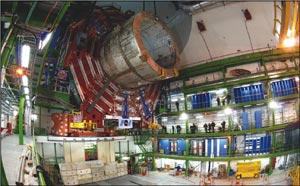
At 6.00 a.m. on 28 February the heaviest section of the Compact Muon Solenoid (CMS) detector began its momentous journey into the experiment’s cavern, 100 m below ground. Using a huge gantry crane, custom-built by the Vorspann System Losinger Group, the pre-assembled central piece, weighing 1920 tonnes – or as much as five jumbo jets – was gently lowered into place, descending at a rate of about 10 m an hour. It finally touched down smoothly at 6.00 p.m., under the eyes and cameras of assembled press, hundreds of CMS collaboration sightseers and TV viewers around the world.

CCnew3_04_07

The giant element, 16 m tall, 17 m wide and 13 m long, consisted of the complete superconducting solenoid, together with the central section of the magnet return yoke. Its descent was a challenging feat of engineering, as there was only 20 cm leeway between the detector and the walls of the shaft. To make the journey, the piece was suspended by four massive cables, each with 55 strands and attached to a step-by-step hydraulic jacking system. Sophisticated monitoring and control ensured that it did not sway or tilt.

CCnew4_04_07

The CMS collaboration broke with tradition by starting assembly of the detector before completion of the underground cavern, taking advantage of a spacious surface assembly hall to pre-assemble and pre-test the solenoid magnet and the various detectors. There are 15 pieces altogether, and the descent of the central section marks the halfway point in the lowering process, with the last piece scheduled to go underground in the summer.

Diamond welcomes its first scientific users

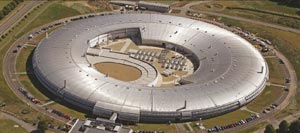
The Diamond Light Source, the UK’s new synchrotron facility in Oxfordshire, has welcomed its first scientific users after opening its doors for business in February. The projects, selected from 127 proposals received last year, cover a broad range of research, from cancer studies, to advancing data-storage techniques, to unravelling the mysteries of the solar system. They will provide the teams at Diamond with real projects to assist in the six-month period of fine-tuning the first experimental stations.

CCnew5_04_07

These first research projects will be carried out in beamlines that are part of Phase I of Diamond’s development – comprising the buildings, the synchrotron itself and the first seven beamlines. Phase I investment of £260 million from the UK government (86%) via the Council for the Central Laboratory of the Research Councils and the Wellcome Trust (14%), was used to deliver the facility on time, on budget and to specification. Funding for Phase II of the project – a further £120 million – was confirmed in October 2004 and will be used to build 15 additional beamlines to expand the available range of research applications. Construction has already started on the Phase II beamlines and beyond this, on average four to five new beamlines will be available each year until 2011.

Galaxy centre may harbour super accelerator

Although the super-massive black hole at the centre of our galaxy seems very quiet compared with those seen as quasars in remote galaxies, it might be a giant proton accelerator more powerful than CERN’s Large Hadron Collider. This at least is what a group of theorists at the University of Arizona suggests to explain the very high-energy gamma-ray source at the centre of the Milky Way.

CCast1_04_07

The galactic centre is a complex region with a large density of both compact and diffuse energetic sources. At the very heart of the galaxy individual stars have been observed to orbit an invisible object with an inferred mass about 3 million times that of the Sun. There is almost no doubt now that this object is a super-massive black hole. It remains a mystery, however, why the output of this black hole is so dim compared with the tremendous energy released by black holes of comparable mass in active galactic nuclei.

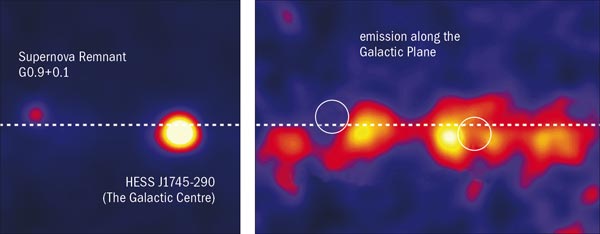
Another puzzle is that this quiet object is apparently a strong source of gamma rays at tera-electron-volt energies. The HESS (High-Energy Stereoscopic System) array of Cherenkov telescopes in Namibia finds the position of the gamma-ray source to be coincident with that of the black hole to a relatively high accuracy. If the gamma rays – as suggested by the data – do indeed originate from the black hole rather than from the nearby supernova remnant Sagittarius A East, understanding their production mechanism is a theoretical challenge.

Direct generation of tera-electron-volt photons around the black hole seems unrealistic, so theorists have explored indirect processes. The most likely scenario is that relativistic protons are accelerated in the vicinity of the black hole, diffuse along magnetic field lines and eventually collide with ambient hydrogen nuclei. Such proton–proton scatterings would produce pions, which would rapidly decay into pairs of photons. Several recent studies attempted to explain how these protons could be accelerated to energies of up to hundreds of tera-electron-volts close to the black hole’s event horizon.

To address this question further, one group of theorists has now tried instead to figure out whether such relativistic protons could be at the origin of the gamma-ray emission observed by HESS. David Ballantyne and colleagues from the University of Arizona, Los Alamos National Laboratory and the University of Adelaide, model the diffusion of relativistic protons in a cube with sides 20 light-years long centred on the Milky Way’s super-massive black hole. Using a realistic density distribution, they study the random-walk trajectories of 222,000 simulated protons as they interact with the turbulent magnetic field in the volume.

Assuming the magnetic field intensity to be proportional to the gas density, the team finds that about a third of the protons will produce gamma rays in the circumnuclear torus around the black hole. These scatterings at only several light-years from the galactic centre could be responsible for the point-like gamma-ray source found by HESS, but only if the initial proton spectrum is very hard, with a power-law index of 0.75. The majority of relativistic protons would travel much longer distances before interacting with interstellar gas and could be responsible for the diffuse glow of the central galactic ridge that HESS also sees. That these two sources of tera-electon-volt photons with very different spatial distributions could have the same origin gives strength to this model.

Further reading

D R Ballantyne et al. 2007 Astroph. Journal 657 L13.

US looks to new rare-isotope science facility

Nuclear science is one of many branches of physics that daily disprove the musings of Lord Kelvin. Sometime around 1900, before quantum mechanics and special relativity, the pioneer of thermo-dynamics and the creator of the absolute-temperature scale reportedly declared, “There is nothing new to be discovered in physics now.” More than a century later, nuclear physicists remain energized by a host of pursuits, including exploring the science of atomic nuclei, understanding processes in nature’s most powerful explosion, the supernova, and addressing open questions about fundamental symmetries of nature. The compelling questions that drive this research are creating a push for new facilities in various parts of the world, including a rare-isotope science facility for the US.

CCrar1_04_07

Rare-isotope research today explores the limits of nuclear stability and determines nuclear properties in the uncharted domain of nuclides with very unusual proton-to-neutron composition. The nuclei farthest from stability are especially important and provide the best vehicle for understanding the interplay of internal structure, reactions with other objects of a similar nature, and decays to the continuum. Such nuclei enable myriad experimental possibilities that collectively will advance and possibly even transform nuclear theory. Some of the most likely experiments will address wide-ranging themes in nuclear physics, ranging from magic numbers to dynamical symmetries to the limits of stability. Others will home in on specific measurements of nuclear-shell structure aimed at elucidating the most important degrees of freedom.

Attempts at fine-grained analysis of nuclear structure invariably lead to innovation in the tools that underpin the workaday world of nuclear physics. One contemporary example is intermediate-energy Coulomb excitation, which allows critical information to be extracted from experiments with beam intensities of only a few tens of thousands of atoms a day. Another example is the precision determination of nuclear binding energies with Penning traps. Current experimental frontiers include studies of nuclear sizes, wave functions, half-lives and decay modes of exotic nuclei.

Beyond the relevance to basic nuclear-structure physics, rare-isotope research is increasingly vibrant at its edges, where the field connects to other intellectual pursuits such as mesoscopic quantum systems – which can be averaged over many atomic-scale systems – and astrophysics. To a very good approximation, we can describe nuclei as self-sustaining finite droplets of a two-component – neutron and proton – Fermi-liquid, the detailed properties of which depend on the delicate interplay of the strong, electromagnetic and weak interactions.

Advances in computation techniques have allowed accurate microscopic calculations of the properties of very light (A < 16) nuclei. For heavier nuclei, full microscopic treatments rapidly become unfeasible and additional approximations must be introduced to solve the underlying many-body quantum problem. This is mesoscopic study, between microscopic and macroscopic. Many exotic nuclei are systems of marginal stability for which coupling to the continuum is important. They are “open” mesoscopic quantum systems in which interactions among finite numbers of particles can be described by effective forces. Describing the interplay of internal structure and external interactions is relevant to other research areas in physics, including information processing, quantum chaos, decoherence and phase transformations.

Understanding mesoscopic quantum systems is important to progress in nanotechnology and quantum computing, which are areas of high interest in condensed-matter physics and quantum optics. In nanotechnology, the basic quantum many-body problem raises fundamental issues about the design and engineering of artificial mesoscopic systems in which complexity emerges from the elementary interactions of a relatively small number of constituents. Nuclear science addresses similar questions, though at femtometre rather than nanometre scale.

Nuclear processes shape much of the visible universe – one reason why astrophysics and nuclear physics have long been closely connected. This link will strengthen in the future. Research with rare isotopes together with progress in observational astronomy will help address several areas of inquiry in astrophysics, including the chemical history of the universe, the conditions and sites where the elements were created, and the nature of exotic objects such as neutron stars, and explosive events such as novae and supernovae.

CCrar2_04_07

With more than 2000 active scientists worldwide, rare-isotope research is vibrant and international. New and planned facilities at RIKEN in Japan, GSI in Germany and GANIL in France complement existing facilities such as Louvain-la-Neuve in Belgium, HRIBF in Tennessee and the TRIUMF ISAC facility in Canada.
Inspired by such promise in this field, the US National Academies have recently published a report justifying the case for a new isotope science facility in the US. The report, nearly a year in the making and released online in unedited prepublication form on 8 December, concluded that the science goals were compelling and that “the science addressed by a rare-isotope science facility… should be a high priority for the United States”. The report adds that, provided the new facility is based on a heavy-ion linac, it will complement existing and planned nuclear-science activities worldwide.

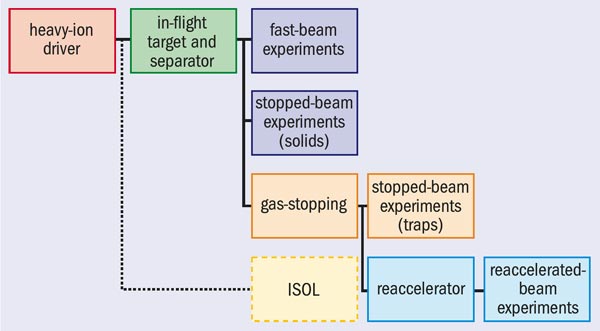
A January town meeting in Chicago provided additional momentum. The aim of the meeting, part of the US nuclear-science community’s current five-year strategic planning exercise, was to identify top priorities in nuclear-structure and nuclear-astrophysics research. Attendees at the meeting concluded that one such priority is a more powerful means for producing rare isotopes for research with stopped, reaccelerated and in-flight (or fast) beams.

The scientific questions and a set of possible options for the technical implementation of such a new facility are laid out in some detail in a recent whitepaper released by the National Super-conducting Cyclotron Laboratory (NSCL) at Michigan State University (MSU). This document proposes building a high-power superconducting heavy-ion linac at MSU. The new Isotope Science Facility (ISF), the working name of the proposed MSU facility, would be based on a linac able to deliver beams of all stable elements with variable energies up to at least 200 MeV/nucleon and beam power up to 400 kW. A team at Argonne National Laboratory has presented similar ideas.

The ISF would combine the possibility of measurements with post-accelerated radioactive beams with the ability to conduct experiments using fast radioactive beams. In many cases, fast beams would provide 10,000 times higher sensitivity than is possible with reaccelerated beams, and make possible experiments with single ions of the rarest isotopes. This is an important consideration, the NSCL whitepaper points out, given that many interesting isotopes that are potential objects of study are produced at levels below a hundred or so per second, where the reaccelerated beam technique starts to become difficult. For example, fast beams would allow researchers to probe how nuclear structure evolves in nickel isotopes moving from atomic numbers 48 to 83. In addition fast beams would enable the study of key benchmark nuclei near 48Ni, 60Ca, 78Ni and 100Sn.

CCrar3_04_07

Complementary to the fast-beam approach, the proposed facility will allow isotope separation online (ISOL) techniques, in which isotopes are produced at rest in a thick target. CERN’s ISOLDE facility pioneered the field, and the forefront research using reaccelerated beam produced from ISOL continues in Geneva. Stopped beams are important for precision measurements with ion or atom traps or for collinear laser spectroscopy. Reaccelerated beams provide the opportunity to measure important nuclear-reaction rates relevant to nuclear astrophysics and to employ the well-proven techniques of nuclear-structure physics to a host of new nuclei. In addition, reaccelerated beams allow the investigation of fusion reactions, which will lead to the production of new neutron-rich isotopes of very heavy elements.

The use of a heavy-ion linac allows in-flight separation of ions and provides a path to reaccelerated beams that overcomes some of the chemical limitations of traditional ISOL techniques. Stopping, extracting and reaccelerating rare-isotope beams leads to intensity losses, the full extent of which is not yet known, although NSCL, Argonne National Laboratory, GSI and RIKEN are making significant progress. The time has come, however, for full performance tests of the concept. NSCL is building a project to test comprehensively the production, gas-stopping and reacceleration sequence.

A new US facility would complement international efforts in this field and would be relevant far beyond basic nuclear-structure research, especially given the links to other physics-related disciplines, such as astrophysics and mesoscopic science. However, the most important reason to proceed with rare-isotope research is to address questions at the core of nuclear physics. What are the limits of nuclear existence? How do we develop a predictive theory of nuclei? What is the origin of simple patterns in complex nuclei? What is the nature of neutron stars?

Such big questions represent the barest fraction of the unknown in nuclear science, which demonstrates that there is much compelling knowledge to be generated in a next-generation isotope-science facility – and also that Lord Kelvin is as wrong today as he was more than a century ago.

George Smoot: the Indiana Jones of the universe

CCsmo1_04_07

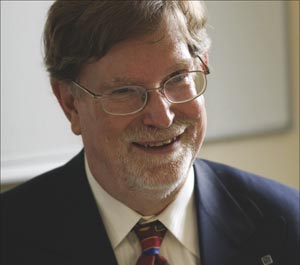
George Smoot feels at home when he is at CERN: as he walks through the corridors he always meets colleagues waving to him. This is not surprising as he has often visited the laboratory during the past 20 years. And even if he is now considered one of the great cosmologists, he remembers that his work began in particle physics when he was a PhD student.

As Smoot himself says, he was destined to be a scientist: he is cut out to do it. He remembers that as a child he asked his parents how the Moon could appear to follow their car and at the same time all the cars in the world. When they explained about the Earth and the Moon, it was a revelation for him and perhaps the beginning of his career. So, while still very young, Smoot read about Galileo, who became his hero. Was he not one of the first experimental physicists and the first astronomer to turn a telescope to the sky?

CCsmo3_04_07

Later, Smoot joined the Massachusetts Institute of Technology where he thought first of studying medicine. But physics and mathematics finally called him and he majored in these subjects in 1966 before focusing on particle physics, in which he obtained his doctorate in 1970. Soon he switched to cosmology, moving to the Lawrence Berkeley National Laboratory (LBNL) where he has worked and taught for more than three decades.

From the rainforests of Brazil to the bleak plains of Antarctica, Smoot has covered the whole world looking for what he likes to call “the holy grail of cosmology” – evidence for the Big Bang. This Indiana Jones of cosmology also likes playing with the big toys of technology and has used all he can to penetrate the mysteries of the early universe: high-altitude experimental balloons, U2 spy planes, satellites and so on. At LBNL he began work on the High-Altitude Particle Physics Experiment (HAPPE), aiming to find antimatter in the upper atmosphere, and cast light on the theory of the Big Bang. While he did not find antimatter with HAPPE, he did go on to discover the long-sought hard evidence for the Big Bang. In 1974 he had begun work on a proposal to map the cosmic microwave background (CMB) radiation. This later blossomed into NASA’s Cosmic Background Explorer (COBE), with which he discovered small fluctuations in the CMB in 1992.

CCsmo4_04_07

In 2006 Smoot won the Nobel Prize in Physics for this major milestone in our knowledge about the origin of the universe (see box 1). It is as if he had taken a photograph of the baby universe, succeeding where others had failed for so long. To achieve this breakthrough, he invented precision cosmology, managing to measure very tiny differences in the temperature of the cosmological background radiation at the level of a hundred-thousandth of a degree. His discovery is really a revolution, perhaps the greatest since the confirmation of the theory of general relativity. What Smoot calls the “wrinkles in time” gives us a new view of the very early universe, prefiguring the formation of large structures such as galaxies. And what is most exciting for him, is that in his opinion we now have one clear picture for the origin of the universe, which transcends cultures, religions and other differences the world over.

The discovery was by no means easy. Smoot and his team had to analyse and clean a large amount of data, verifying them again and again before being sure of the results. (This is more or less what physicists at CERN will have to do soon with the experiments at the LHC.) At the end of this meticulous work, however, he felt so confident about his results that he said he would offer a plane ticket to any destination to anyone who could find a mistake.

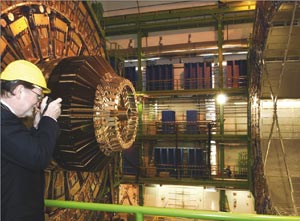
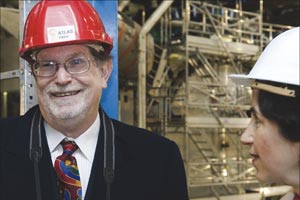
Smoot has now been tracking fluctuations in cosmological background radiation for more than 30 years, but he is not yet ready to step down. Now he is working on the Planck mission, the European successor to the Wilkinson Microwave Anisotropy Probe, which will give a higher precision than ever before. It is due to launch in 2008, when the LHC will be collecting its first data. “In the following three or four years, the most exciting physics experiments will be Planck and the LHC,” says Smoot. He is expecting much from the LHC experiments, so it is no coincidence that he went to see ATLAS and CMS during his visit to CERN. He says that “CERN is the place to be,” adding that if he was a PhD student now he would want to work there.

CCsmo2_04_07

With Planck, Smoot hopes to answer new questions about the shape of the universe and the inflationary model, so he thinks it would be very exciting to find something unusual at the LHC, such as extra dimensions or supersymmetry – something really revolutionary that would be exciting for the next generation. Whatever is found, it will open new windows on the universe and give new lines of research for physics. For Smoot, even though they have followed different paths, cosmology and particle physics are now asking the same questions – they are merging. He explained in the talk he gave at CERN how cosmological data could be used to test fundamental-physics models, providing frameworks and constraints. “We are living in the golden age of cosmology,” he says. Now he is waiting for the next cliffhanger in our exploration of the universe and is certain to be one of the main players in this next scientific crusade.

MEGAPIE leads the way to waste transmutation

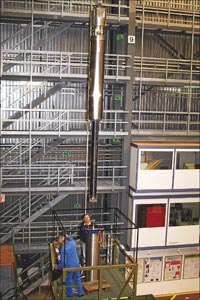
Megawatt-class beam targets are nowadays attracting attention from a wide variety of users, for investigations that span the spectrum from the transmutation of long-lived radioactive waste, through material research, to radioactive beams and neutrino factories. At the Paul Scherrer Institute (PSI), the Megawatt Pilot Experiment (MEGAPIE) has recently demonstrated the feasibility of safely running a liquid heavy-metal target in the world’s most powerful DC proton beam. The experiment is particularly important for the development of an accelerator driven system (ADS) for the transmutation of long-lived radioactive waste. It serves to demonstrate the feasibility, potential for licensing, and long-term operation under realistic conditions, of a high-power spallation target, which could later provide the high-energy neutrons required to induce fission in waste atoms.

CCmeg1_04_07

Spallation neutrons are produced efficiently by firing a proton beam at a heavy-metal target such as lead where the reactions of the protons with nuclei literally knock out or “spallate” neutrons, while further neutrons are evaporated. On average each proton produces about 11 neutrons. Up until now spallation targets have always been solid, but MEGAPIE has demonstrated the advantages of a liquid target, namely an increase in neutron flux and convectional cooling of the target window. The second advantage gives the liquid target potential for higher power, in contrast to a solid target, which cannot be cooled sufficiently. In MEGAPIE, the use of a liquid target with the 1 MW beam at the Swiss Spallation Neutron Source (SINQ) increased the neutron flux by about 80% compared with the previous solid-lead target.

A powerful alliance

MEGAPIE is a collaboration of nine research institutes in Europe, Japan, Korea and the US, which have agreed to design and build a liquid-metal spallation target suitable for 1 MW beam power, and to license and operate it at PSI, where SINQ is the world’s only spallation neutron facility with a sufficiently powerful proton driver. The present 1.1 MW proton beam from PSI’s 590 MeV ring cyclotron delivers, after passing two secondary-beam production targets, a continuous proton-beam current of up to 1.4 mA (about 800 kW) at an energy of 575 MeV to the SINQ spallation source. For MEGAPIE, the collaboration decided that the liquid-metal target must be irradiated for a minimum of three months, both to achieve a sufficiently high irradiation dose on the component materials and to demonstrate that the system could operate reliably. During its operation, the target served as the source for the neutron-scattering programme at PSI, which involves some 260 experiments.

The MEGAPIE target consists of 920 kg of liquid lead-bismuth eutectic (LBE), contained in a steel casing. On impact, the 800 kW proton beam deposits about 580 kW of heat in the target material. The heat is removed by circulating the lead-bismuth in forced convection through a heat exchanger. The proton beam penetrates the lead-bismuth to a depth of 27 cm and generates an integrated flux of 1017 neutrons a second.

During the four months of operation, the target operated very satisfactorily and according to predictions. It triggered only a small number of unscheduled beam shutdowns and experienced more than 8000 beam interrupts of different durations without damage. Its availability reached 95%, with an accumulated proton charge amounting to 2.8 Ah.

CCmeg2_04_07

Earlier Monte Carlo simulations had indicated that the liquid-metal target should provide a 40% increase in neutron flux (at identical current) compared with a solid target. However, initial measurements at selected instruments confirmed an increase in neutron flux, which the collaboration met at first glance with some scepticism: instruments at the cold guide gave a flux increase as high as 70–80%. However, gold-foil activation measurements have confirmed flux increases of 80–90% at both a thermal and a cold beam port. New calculations with more detailed target and moderator geometry now reproduce these results.

The higher flux means that it will be possible to carry out more experiments within the same time frame, a definite benefit for the over-booked beam lines. With a flux gain of this magnitude, operation with a permanent liquid-metal target at SINQ has become a priority and PSI has launched a new project to pursue this goal.

From nuclear waste to beta-beams

The success of MEGAPIE is particularly important for research into ADS transmutation of radioactive waste. The long-lived minor actinides (neptunium, americium and curium) are the main contributors to the long-term radio-toxicity of nuclear wastes. However, it should be possible to transmute them into short-lived or stable elements using a sub-critical ADS equipped with an internal neutron source and driven by a high-energy proton beam. CERN has made major contributions to this concept with the experiments FEAT and TARC (CERN Courier April 1997 p8). In 1998, a technical working group headed by Carlo Rubbia established a roadmap to achieve ADS transmutation. The group considered the development of a high-power spallation target and the demonstration of its reliable operation to be vital steps en route.

Researchers are now also considering ADS scenarios based on megawatt spallation neutron targets for the next-generation European Radioactive Ion Beam Facility, EURISOL. Here a 1 GeV superconducting linear proton driver with separate post-acceleration capabilities will allow low-, intermediate- and high-energy, very intense radioactive ion-beams to probe fundamental questions in nuclear structure, nuclear astrophysics and fundamental symmetries and interactions. Another use of an ADS based on a spallation source would be the production of a neutrino beam in a “beta beam”. In this case, radioactive ions circulating in a storage ring beta-decay to produce a pure beam of electron-neutrinos/antineutrinos; the ions themselves are produced in a two-step process from the interaction of spallation neutrons in a suitable secondary target.

The pie is opened

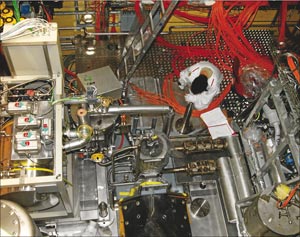
The accelerator shutdown at the end of 2006 marked the end of the irradiation phase for MEGAPIE. The final phase of the experiment – the post-irradiation examination of the target components – will start after the target, which is now solidified, has been stored for two years. The analysis will provide information about corrosion effects on structural materials and allow the validation of various models. The state of the beam window will allow the combined effect of LBE and proton irradiation to be assessed and provide information on the potential lifetime of such a beam window. The analysis of the LBE will also furnish information on the spallation products and their chemistry, so validating neutronic and radiochemical models. This information will feed back into the design and operation of new spallation sources. New versions of ADS will also benefit enormously from the experience gained from MEGAPIE, which has also proved to be a key experiment for future industrial projects involving the transmutation of nuclear waste.

bright-rec iop pub iop-science physcis connect