Comsol -leaderboard other pages

Topics

The stop-start approach to rare isotope beams

The study of rare isotopes with proton and neutron compositions far outside the “valley of stability” provides critical tests of nuclear models. Several facilities around the world produce such isotopes by directing energetic beams of nuclei into solid targets. Now researchers are exploring ways to extend their investigations by collecting the rare isotopes and forming them into new reaccelerated beams.

CCEiso1_07-08

There are two basic approaches to producing rare isotopes, which differ in the thickness of the target employed. Isotope separation on line (ISOL), developed some 40 years ago at CERN’s ISOLDE facility, uses a target that is thick enough for the nuclei to come to a stop within it. The isotopes can then be extracted, but this is a slow process – a problem for short-lived isotopes. In addition, each new element requires dedicated development work and some elements, such as refractory metals, are difficult or impossible to obtain.

Nonetheless, facilities such as ISOLDE, the Isotope Separator and Accelerator (ISAC) at TRIUMF and the Holifield Radioactive Beam Facility at the Oak Ridge National Laboratory have made important scientific advances using ISOL sources. They have extended the ISOL method further by accelerating the isotopes produced. At ISOLDE, the Radioactive Beam Experiment (REX) post-accelerator has pioneered the technique of increasing the charge state of low-energy, singly charged ions in an electron-beam ion source (EBIS) before reaccelerating them. TRIUMF recently stepped up its own production of radioactive beams with a superconducting linear accelerator to push the energies of rare isotopes above the Coulomb barrier.

The second approach to producing beams of rare isotopes is through projectile fragmentation, which separates the desired isotopes from the fragments that emerge when a fast heavy-ion beam impinges on a thin foil target. GANIL in France, RIKEN in Japan, GSI in Germany and the National Superconducting Cyclotron Laboratory (NSCL) at Michigan State University (MSU) in the US all use this technique, which is less sensitive to the chemistry of the elements than ISOL. Projectile fragmentation makes it easier to produce and isolate rare isotopes, and it has made available thousands of different isotopes. The rate of generation tends to be smaller than for ISOL, however, and for experiments requiring slow beams the isotopes are not easy (or may even be impossible) to use because they emerge at a large fraction of the speed of light, with an energy in the region of 100 MeV per nucleon.

The obvious way to create low-energy beams is to slow down high-energy ones, but this severely degrades their quality. A better technical approach is to stop the beams, extract them and then reaccelerate them or use them at low energies. This is the path that MSU has opted for in upgrading its NSCL facility. To provide isotope beams with lower and more tightly distributed energies, it will combine new and established technology to stop the beams, increase the charge on the ions and then reaccelerate them. The resulting beams will enable users at NSCL to explore the excitations of rare isotopes – by either nucleon transfer or Coulomb excitation – to reveal their internal structure. In particular, their excited states provide stringent tests of nuclear models. “NSCL will be the first facility in the world to offer fast (about 50–150 MeV per nucleon), stopped and reaccelerated (up to 3 MeV per nucleon, for now) beams of rare isotopes, providing its users with an unusually broad arsenal of beams and experimental tools for their research,” says Konrad Gelbke, the director of NSCL.
CCEiso2_07-08

The particles in the beams will have energies similar to those encountered in astrophysical environments, such as stellar explosions. “With these reaccelerated beams you can measure reactions at the actual astrophysical energies,” says MSU professor of nuclear astrophysics Hendrik Schatz. “That’s the big step.” Schatz and colleagues, including many among NSCL’s community of 700 researchers, hope to use the reaccelerated beams to explore reactions of unstable nuclei with protons in fixed targets or helium nuclei. These are the same reactions that occur in the astrophysical rapid-proton (rp) process and are believed to be important in X-ray bursts – the most abundant thermonuclear explosions in the universe. Future advances in the technology may help to probe the rapid-neutron (r) process reactions of neutron-rich nuclei, which occur in supernovae and are thought to give rise to many heavier chemical elements. The upgrade will help to test, refine and improve technological approaches that could be used for exploring rare isotopes at future facilities.

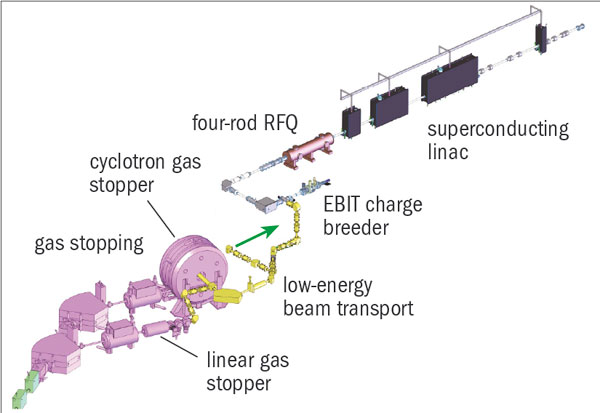
The approach taken towards reacceleration at NSCL involves slowing a high-energy beam by passing it through a solid degrader and bringing the ions to a stop, decreasing their initial spread of energy. The best-established stopping technology is the linear gas stopper – a tube of helium gas at pressures up to 1 bar. One important challenge, however, is to separate the desired isotopes from the many helium ions created during the stopping process. NSCL has already pioneered the use of these techniques to slow down isotopes produced by projectile fragmentation, allowing them to capture the isotopes in Penning traps for precision measurements.

In parallel, Georg Bollen and colleagues at NSCL are developing a cyclotron stopper, which should be quite effective for lighter isotopes. Instead of travelling along a tube of helium several metres long, the ions tangentially enter a gas tube where a magnetic field diverts them into a circular orbit. As they travel multiple times around the circumference, they lose energy and spiral toward the axis, where they can be collected. The compact geometry allows this to be done effectively in the tens of milliseconds needed to use short-lived isotopes. The NSCL team plans to explore both an advanced version of linear gas stopping and cyclotron gas stopping in the reacceleration project to evaluate how these steps contribute to the overall system.

Another enabling technology used for reacceleration is the breeding of high charges on the ions to get the maximum energy from limited acceleration voltage. The “classic” approach first accelerates singly charged ions, then passes them through foils to strip off electrons before further accelerating the multiply charged ions. This method – used, for example, in ISAC at TRIUMF – is robust and established, but creates a variety of charge states. Electron-cyclotron resonance plasmas, which are used in Japan and elsewhere for charge breeding, also create multiple charge states. Since only a single state can be selected, both of these techniques have an inherently limited efficiency in using precious rare isotopes.

NSCL will use a different breeder to increase the charges – namely the electron-beam ion trap, pioneered (as the EBIS) at REX-ISOLDE. Here, ions are electrostatically attracted to an intense electron beam as well as ionized by it. One advantage is that, by targeting stable electronic shells and selectively extracting charge states from the trap, the system can produce isotopes with a single high-charge state. “You can make use of noble-gas configuration – you get a nice enhancement in a single charge state,” explains Bollen.

Once the isotopes have high charges, they are reaccelerated using a standard superconducting linear accelerator. The initial plans at NSCL call for relatively modest energies (around 3 MeV per nucleon) but more cavities can be added as needed to boost the energy. The system is designed for efficient processing of rare isotopes at each stage, as well as for the efficient transfer between successive stages.

The technologies developed for this upgrade will provide important technical experience for the Facility for Rare Isotope Beams (FRIB), for which the US Department of Energy (DOE) has invited proposals. This machine would use a linear accelerator for the primary beam and provide higher initial isotope fluxes than the current cyclotron source at NSCL, which could make more experiments (including on the neutron-rich side) possible. Researchers at NSCL, who will explore how well the various components of the reacceleration project can scale to higher beam currents, have already laid the groundwork for FRIB. In autumn 2007, the laboratory published a detailed white paper describing a next-generation facility based on a superconducting 200 MeV, 400 kW heavy-ion driver with the possibility of experiments using fast, stopped and reaccelerated beams. These are all elements required for FRIB.

Karsten Riisager of CERN acknowledges that the NSCL upgrade will complement existing capabilities, noting that no single technical approach is superior. Although ISOL-based facilities like CERN’s REX-ISOLDE usually supply higher beam current, “for some of the exotic beams, such as short-lived isotopes, NSCL may have an advantage”, he says. Some elements are not available at all using ISOL techniques. He notes, however, that NSCL provides only nuclei lighter than about the mass of tin. “We [ISOLDE] are the only place right now where you have the very heavy nuclei reaccelerated.”

Bollen, who served as ISOLDE group leader in the late-1990s, and who plays a leading role at NSCL, is optimistic about the technology and science that the upgrade will enable. “We will produce reaccelerated beams which are not accessible at other facilities anywhere in the world now,” he says. Adds Gelbke: “History has taught us that new and unique tools often go hand in hand with new discoveries – and lead to further refinements based on the unique experience gained.”

A supernova is caught in the act of exploding

Astronomers have, for the first time, observed a star in the act of exploding. The event happened in January while NASA’s Swift satellite was observing another supernova in the same galaxy. The supernova explosion was preceded by an X-ray outburst of about seven minutes. This new milestone in the study of supernova explosions was published just a week after the announcement of the discovery of the remains of the most recent supernova in our galaxy.

Supernova explosions occur about twice a century in spiral galaxies. This is also the case in our galaxy as derived from the rate of radioactive aluminium decay observed by ESA’s INTEGRAL satellite (CERN Courier January/February 2006 p10). It is therefore surprising that since the supernova observed by Johannes Kepler in 1604 (CERN Courier December 2004 p15), no other exploding star has been seen in the Milky Way. It was long suspected that some supernovae could have been missed due to dust absorption along the line of sight. The first evidence of a recent, unnoticed explosion comes from the dating of the supernova remnant Cassiopeia A (CERN Courier October 2004 p19), which is only about 330 years old. A team led by Stephen Reynolds from the North Carolina State University has now identified another remnant, G1.9+0.3, precisely dated to be only 140 years old, located close to the galactic centre. The remnant was observed to be rapidly expanding between 1985 and 2008 in radio images obtained by the Very Large Array (VLA) in New Mexico.

Because of the rate of only two supernovae per century, it is unlikely that two exploding stars can be seen simultaneously in the same galaxy, but it happened in the spiral galaxy NGC 2770. On 9 January 2008, while the Swift satellite performed on going observations of a first, one-month-old supernova, a second stellar explosion occurred. This time, Swift did not even have to use its rapid repointing ability – as it had for the supernova SN 2006aj following an X-ray flash (CERN Courier October 2006 p13). It was already pointing its optical, ultraviolet and X-ray telescopes towards the dying star.

The surprise was to observe a strong X-ray outburst lasting about 400 s and preceding the supernova detection in visible light by 1.4 h. Although very luminous, the X-ray outburst was not detected in gamma-rays and is about thousand times less energetic than typical gamma-ray bursts.

The analysis of the multi-wavelength observations of SN 2008D has been published in Nature by an international group led by Alicia Soderberg from Princeton University. They show that the supernova is of type Ibc, the kind of stellar explosions associated with long gamma-ray bursts and X-ray flashes. However, they have no evidence of relativistic motion, and suggest that the X-ray outburst is not from a highly relativistic jet but is radiation associated with any normal supernova. The origin of the X-ray outburst would be the "shock break-out", when the ejected material, having bounced off the collapsed stellar core, crosses the surface of the dying star. But other astronomers interpret the outburst as a weak X-ray flash, the low-energy cousin of gamma-ray bursts.

…and time flies for the ALICE detector

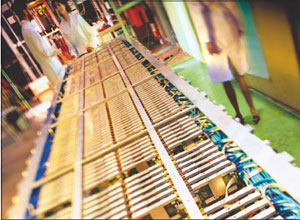
During the last week of April, the ALICE experiment’s time-of-flight (TOF) detector was completed and installed in the experimental cavern. The TOF lies inside the huge magnet of ALICE, 3.7 m from the beamline. It will operate together with the time projection chamber, which lies inside the cylinder formed by the TOF, in identifying charged particles, such as pions, kaons and protons produced in collisions in ALICE.

CCEnew6_07-08

The TOF detector has a total surface area of 150 m2. and is divided into 18 supermodules, each of which is further subdivided into five modules. It consists of 1638 strips of multigap resistive plate chambers, which were made at the INFN Laboratory in Bologna. Each module has been carefully checked for performance with cosmic rays before being assembled in the supermodules. Now that these modules are installed in the ALICE detector, all that remains for the team is to retest them to ensure that no damage occurred during installation and to connect and commission the electronics in the experimental cavern in preparation for start-up of the LHC.

CMS completes milestone installation of beam pipe…

On 10 June the CMS collaboration reached another major milestone when the heart of the detector, the beam pipe, was fully installed after 15 years of complex design and manufacture. This fragile, 44 m long component is one of the last elements of the CMS experiment to be installed.

CCEnew5_07-08

The design of the beam pipe required compromising on numerous needs of the experiment, with the physicists calling for no material, no support and virtually nothing at the collision point, while the engineers wanted a thicker pipe for greater stability of the vacuum and better electrical conductivity. The compromise is a complex beam pipe made of changing thickness and materials. For 2 m on either side of the interaction point the pipe is of 0.8 mm thick beryllium, weighing less than 1.5 kg. Beyond that for 18 m on either side, and widening towards the ends, are sections of stainless steel, which is good for welding, assembly and precision alignment.

It is very important for both the LHC machine and the detector to have a good vacuum, and a recent “bake-out” should have cleaned out stray particles to ensure that this happens. During this process the beam pipe is heated to 200–250 °C for 48 hours. The length of the pipe is coated with non-evaporable getter material, made of titanium, zirconium and vanadium, which acts as a pump, constantly absorbing residual particles even at the interaction point where no pump would fit.

High-energy physics labs become INSPIREd

CERN, DESY, Fermilab and SLAC have announced that they will join forces to build INSPIRE, the next-generation, high-energy physics (HEP) information system. The announcement came at the second annual Summit of Information Specialists in Particle Physics and Astrophysics, which was held at DESY on 20–21 May. Representatives from the four laboratories attended the event, together with leading publishers and information providers, including Cornell’s http://arXiv.org and the SAO/NASA Astrophysics Data System.

The libraries of CERN, DESY, Fermilab and SLAC recently analysed the status of HEP information systems. A subsequent poll revealed that community-based services are overwhelmingly dominant in the research workflow of HEP scholars, whose needs are not met by existing commercial services. The poll found that HEP researchers attach paramount importance to three axes of excellence: access to full-text, depth of coverage and quality of content, possibly extended to connecting fields outside HEP.

Based on these results, the management of the laboratories seized the opportunity to build INSPIRE, a community-based and user-driven, next-generation information system, fully exploiting a new technological environment. It is being built by combining the successful SPIRES database, curated at DESY, Fermilab and SLAC, with the Invenio digital library technology developed at CERN. INSPIRE will offer the functionalities and quality of service that the HEP user community has grown to expect from SPIRES, an indispensable tool in their daily research workflow. It will develop long-awaited features, providing access to the entire body of HEP literature with full-text, Google-like search capabilities and enabling innovative text- and data-mining applications.

Protons and neutrons certainly prefer each other’s company

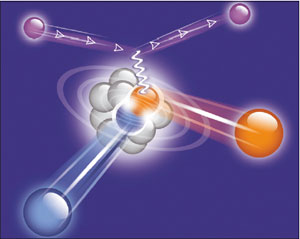
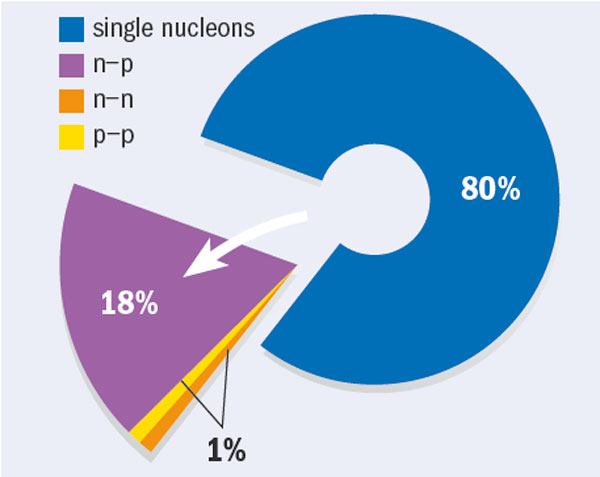
Researchers at the Jefferson Lab have found that neutron–proton pairs in the ground state carbon-12 nucleus are far more common than proton–proton pairs and neutron–neutron pairs. As many as 18% of the nucleons are involved in proton–neutron short-range correlations (SRCs), a result that could have implications for neutron stars.

In a typical nucleus, nucleons maintain an average distance of 1.7 fm. However, roughly one-fifth of nucleons are involved in short-range correlations, where two nucleons come to within a femtometre of each other. These pairs can create local densities five times that of average nuclear matter, thus providing a glimpse of dense nuclear matter as found in neutron stars.

CCEnew3_07-08

Now a team working in Jefferson Lab’s Hall A has made the first simultaneous measurement of SRCs and their constituents. The experiment used an incident electron beam of 4.627 GeV and a carbon-12 target. Proton-knockout events were defined by the two High-Resolution Spectrometers (HRS) in Hall A. The left HRS detected scattered electrons and the right HRS detected knock-out protons. A large acceptance spectrometer (BigBite) and a neutron array detected correlated high-momentum recoiling protons and neutrons, respectively.

The experiment selected (e,e’p) events with high missing momentum, greater than 300 MeV/c, and revealed that the missing momentum was balanced almost entirely by a single recoiling nucleon. This nucleon was initially back to back with the knock-out proton. The team found that 90% of these SRCs involved proton–neutron pairs. The remaining 10% were split between proton–proton and neutron–neutron pairs (Subedi et al. 2008). Calculations of this effect in recent theoretical work indicate that the large prevalence of neutron–proton pairs over proton–proton and neutron–neutron pairs is a result of the nucleon–nucleon tensor force (Sargsian et al. 2005 and Schiavilla et al. 2007).

CCEnew4_07-08

Together with previous work, including cross-section ratio measurements at Jefferson Lab and proton-knockout experiments at Brookhaven National Laboratory, the new result yields a consistent picture of the short-distance structure of nuclear systems, from light nuclei to neutron stars. Most accepted models of neutron stars assume a make-up of 95% neutrons and 5% protons at the core. The presence of strong short-range, neutron–proton pairing could alter assumptions about the protons’ momenta, thus affecting calculations of the density and/or lifetime of neutron stars.

GLAST in orbit to explore extreme universe

The Gamma-Ray Large Area Space Telescope (GLAST) was launched by NASA on 11 June from the Cape Canaveral Air Force Station in Florida. GLAST is a next-generation, high-energy, gamma-ray observatory, designed to explore some of the most energetic phenomena in the universe and enhance knowledge of fundamental physics, astronomy and cosmology. It is an international, multi-agency mission with important contributions from research institutions in France, Germany, Italy, Japan, Sweden and the US.

GLAST will capture high-energy gamma rays (from 20 MeV to greater than 300 GeV) from a wealth of cosmic sources that are sites of very-high-energy particle acceleration. These include the supermassive black hole systems of active galactic nuclei, supernova remnants, neutron stars, galactic and solar system sources, and gamma-ray bursts (GRBs). The GLAST collaboration expects to discover thousands of new sources of different classes, which will shed light on many unresolved questions about the nature of dark matter, the origin of cosmic rays, the engines of GRBs, and acceleration mechanisms of high-energy cosmic particles. The discoveries may also provide tests of fundamental physical principles, such as Lorentz invariance.

CCEnew2_07-08

The Large Area Telescope (LAT) is the main instrument on board (Michelson 2008). It is accompanied by the Gamma-Burst Monitor (GBM), an instrument primarily dedicated to the detection of GRBs between 8 keV and 30 MeV (von Kienlin et al. 2001). Together the GBM and LAT will cover a remarkable seven decades in energy.

The LAT is a pair-conversion telescope that measures the direction, energy and arrival time of incoming photons from the entire sky with unprecedented resolution and sensitivity. It will collect more than two orders of magnitude more gamma rays than its predecessor, EGRET (Thompson et al. 1993), and the current gamma-ray mission AGILE (Tavani et al. 2008). This leap in capabilities is made possible by combining information from three detector subsystems, all based on major developments in experimental particle physics. These are a silicon-strip tracker-converter, the largest of its class with its 70 m2. of active surface and 900,000 digital channels; an 8.5 radiation-length CsI imaging calorimeter, capable of a very large dynamic range to ensure better than 15% energy resolution over the entire acceptance; and an outer, segmented plastic scintillator anticoincidence shield, which is used to reject charged particle background.

Teams in the participating institutes built and qualified the LAT subsystems for space before they were integrated at SLAC. The Max Planck Institute for Extraterrestrial Physics in Garching produced the GBM detectors, and these were integrated at the Marshall Space Flight Center in Huntsville. Both instruments were then integrated with the spacecraft at General Dynamics, in Phoenix, Arizona, to form the GLAST observatory. Environmental testing took place both at General Dynamics and at the Naval Research Laboratory in Washington DC. The calibration of the LAT relies on a combination of charge injection, ground and in-orbit cosmic-ray data, an advanced Monte Carlo simulation based on the Geant4 toolkit, and data from particle test beams collected from a calibration unit at CERN and GSI (Baldini et al. 2007).

Protons knock on the LHC’s door

CCEnew1_07-08

On 24 May, a proton beam arrived on the threshold of the LHC, passing down transfer line TI 8 to the LHC, which runs from the SPS towards the LHC, where it intersects just before point 8. The TI 8 line became operational in October 2004. Now a beam has passed along it for only the second time, on this occasion in preparation for the full LHC start-up. The beam was extracted from the SPS, sent down the 2.8 km transfer line and stopped just 15 m or so from the LHC tunnel.

CERN Council looks forward to imminent start-up of the LHC

At its 147th meeting on 20 June, CERN Council heard news on progress towards start-up of the LHC later this summer. In addition, the latest in a series of audits covering all aspects of safety and environmental was presented to Council at the meeting. It addressed the question of whether there is any danger related to the production of new particles at the LHC.

Commissioning of the 27 km LHC started in 2007 with the first cool down of one of the machine’s eight sectors. Once successfully cooled, each sector has to pass through hardware commissioning, which involves intensive electrical tests, before being handed over to the operations team. By the time of the Council meeting, five of the eight sectors were at or close to the operating temperature of 1.9 K and the remaining three were at various stages of being cooled down. Moreover, sector 5-6 had passed through all steps of the hardware commissioning and was in the hands of the operations team.

When the LHC starts up this summer, its proton beams will collide at higher energies than have ever been produced in a particle accelerator, although nature routinely produces higher energies in cosmic-ray collisions. Nevertheless, concerns about the safety of whatever might be created in such high-energy particle collisions have been addressed for many years.

The latest review of the safety of the LHC’s collisions was prepared by the LHC Safety Assessment Group (LSAG), which comprises scientists at CERN, the University of California, Santa Barbara, and the Institute for Nuclear Research of the Russian Academy of Sciences. The LSAG report updates a 2003 paper by the LHC Safety Study Group and incorporates recent experimental and observational data. It confirms and strengthens the conclusion of the 2003 report that there is no cause for concern. Whatever the LHC will do, nature has already done many times over during the lifetime of the Earth and other astronomical bodies.

The new report has been reviewed by the Scientific Policy Committee (SPC), which advises Council on scientific matters. A panel of five independent scientists, including one Nobel Laureate, reviewed and endorsed the authors’ approach of basing their arguments on irrefutable observational evidence to conclude that new particles produced at the LHC will pose no danger. The panel presented its conclusions to a meeting of the full 20 members of the SPC, who unanimously approved this conclusion, prior to the Council meeting.

• The LSAG report is accompanied by a summary in non-technical language. It is available together with other documents relating to the safety and environmental impact of the LHC at http://public.web.cern.ch/public/en/LHC/Safety-en.html.

I Am a Strange Loop

By Douglas Hofstadter, Basic Books. Hardback ISBN 9780465030781, £15.99 ($26.95).

Douglas Hofstadter is a truly exceptional person. His remarkable academic life followed a path that reflected his evolving interests in mathematics (graduation in 1965), physics (PhD in 1975), and cognitive sciences (his main field of research ever since). He is also captivated by literature, music, philosophy and other forms of high-level human creativity – probably because they are particularly beautiful expressions of consciousness, a more elusive activity that somehow emerges from within our “thinking machine”, the brain.

CCboo1_06_08

Hofstadter is best known for having written Gödel, Escher, Bach: an Eternal Golden Braid (GEB), undoubtedly an inspired masterwork that was immediately recognized as a breakthrough in scientific literature. Despite being a brilliant and original work, most readers of GEB might feel uneasy when asked to summarize in a few sentences the main message of this unusual “metaphorical fugue on minds and machines in the spirit of Lewis Carroll”, which lasts for 777 (plus 22) pages. This is not a criticism. Many works of art can be appreciated, enjoyed and admired, even if we fail to grasp the main idea inspiring the artist. Maybe revolutionary breakthroughs – in art and certain areas of science – are naturally difficult to master at first and remain somewhat foggy in the minds of the “amateur”. In any case, GEB is certainly at the top of the list of books that I would take with me to a desert island. It has enough content and structure – not to mention depth and broadness – to provide thought-provoking reading for a very long time, and being alone on a desert island is an ideal setting for asking what we mean when we say “I”. Frankly, I’ve never read GEB in its full extent, from cover to cover. I prefer to see it as a collection of great wonders that visitors can enjoy in several possible sequences, even skipping a few of them. It’s impossible to visit all “great wonders of the world” in a single lifetime.

This browsing attitude (jumping back and forth between chapters and sections) or even opening the book at a random page and enjoying a few pages, is probably a good indication that I am one of the many readers who Hofstadter had in mind when he grumbled that GEB has been misperceived as “a hodgepodge of neat things with no central theme”. Apparently, this was one of the factors that triggered him to embark on the braiding of I Am a Strange Loop – 432 pages devoted to the “I” theme, 28 years after the eternal golden braid of GEB. I presume he would have finished much earlier had he not become a victim of his own (recursive) Hofstadter’s Law: It always takes longer than you expect, even when you take into account Hofstadter’s Law. I would also have written this review long ago, if I were not an enthusiast of this law…

In this more recent work, Hofstadter revisits several of GEB’s topics, such as Gö:del’s inspiring work on self-referential systems and “self-engulfing TV screens”, now magnificently represented in colour and with higher resolution than before, which provide a striking illustration of a self-referential loop (despite the absence of the “black hole” seen in the original screenings). However, the new book focuses on the scientific, philosophic and spiritual issues related to the ever-elusive nature of mind and consciousness. The author recognizes this as a daunting task: “our very nature is such as to prevent us from fully understanding its very nature.”

GEB’s emblematic actors (Achilles, Tortoise and other mythical characters who had metaphorical dialogues interspacing the main chapters) are absent in I Am a Strange Loop, giving it a seemingly more relaxed fluidity and somewhat reducing the “hodgepodge” feeling. The feeling is not entirely gone, however, and we can use another of Hofstadter’s pictorial expressions to qualify it as “a random-looking swirl of pockmarked, bluish-white globs that reminded me a bit of some kind of exotic cheese…”.

Like the topic it addresses, I Am a Strange Loop has elusive parts and hard-to-follow concepts, but it retains a surely poetic (even beautiful) literary exquisiteness, providing delightful reading that I do not remember experiencing with any other scientific book. I wholeheartedly recommend it to anyone interested in “the mind’s I” and to those looking for a scientific book written at the highest literary level. A warning, though: you may want to have a good English dictionary within arm’s reach. I should also recommend reading The Mind’s I by Hofstadter and Daniel Dennett, another delightful selection of “fantasies and reflections on self and soul”, which will trigger your mind into wondering “what is the mind, who am I, can machines think?”, through extraordinary stories and disturbing commentaries.

bright-rec iop pub iop-science physcis connect