Comsol -leaderboard other pages

Topics

CMS: A study in compactness (archive)

CCCMS1_10_08

The milestone workshops on LHC experiments in Aachen in 1990 and at Evian in 1992 provided the first sketches of how LHC detectors might look. The concept of a compact general-purpose LHC experiment based on a solenoid to provide the magnetic field was first discussed at Aachen, and the formal expression of interest was aired at Evian. It was here that the Compact Muon Solenoid (CMS) name first became public.

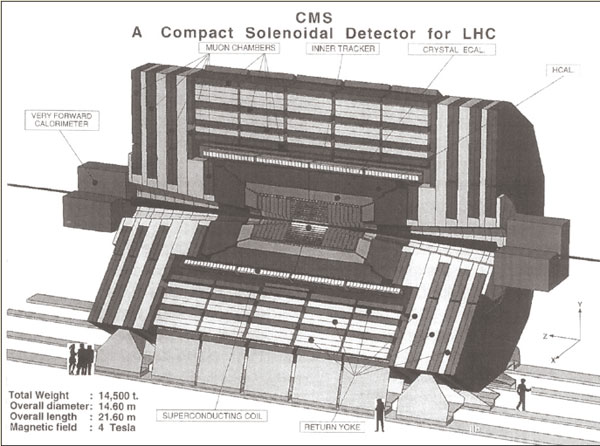
Optimizing first the muon-detection system is a natural starting point for a high-luminosity (interaction rate) proton–proton collider experiment. The compact CMS design called for a strong magnetic field, of some 4 T, using a superconducting solenoid, originally about 14 m long and 6 m bore. (By LHC standards, this warrants the adjective “compact”.)

The main design goals of CMS are: 1) a very good muon system providing many possibilities for momentum measurement; 2) the best possible electromagnetic calorimeter consistent with the above; 3) high-quality central tracking to achieve both the above; and 4) an affordable detector.

Overall, CMS aims to detect cleanly the diverse signatures of new physics by identifying and precisely measuring muons, electrons and photons over a large energy range at very high collision rates, while also exploiting the lower luminosity initial running. As well as proton–proton collisions, CMS will also be able to look at the muons emerging from LHC heavy-ion beam collisions.

The Evian CMS conceptual design foresaw the full calorimetry inside the solenoid, with emphasis on precision electromagnetic calorimetry for picking up photons. (A light Higgs particle will probably be seen via its decay into photon pairs.) The muon system now foresaw four stations. Inner tracking would use silicon microstrips and microstrip gas chambers, with over 107 channels offering high track-finding efficiency. In the central CMS barrel, the tracking elements are mounted on spirals, providing space for cabling and cooling.

Following Evian, a letter of intent signed by 443 scientists from 62 institutes was presented to the then new LHC Experiments Committee. Two electromagnetic-calorimetry routes were proposed, a preferred one based on homogeneous media, and the other on a less expensive sampling solution using a lead/scintillator sandwich read out by wavelength-shifting fibres, named shashlik.

Due to limited resources in the collaboration at the time, the shashlik solution was adopted as baseline. However, R&D continued on cerium fluoride (CeF3) and two other candidate media, lead-tungstate crystals (PbWO4) and hafnium-fluoride glasses. The collaboration had doubled in size by the summer of 1994 and in September of that year lead tungstate was chosen after extensive beam tests of matrices of shashlik, cerium fluoride and tungstate towers. The radiation length of PbWO4 is only 0.9 cm and the required volume (approximately 12.5 m3) is only half that for CeF3, leading to a substantial reduction in cost. In addition, lead tungstate is a relatively easy crystal to grow from readily available raw materials and significant production capacity already exists.

Following the November 1993 decision to foreclose the SSC project, US physicists were looking for new possibilities and many knocked at the CMS door. A letter of intent submitted to the US Department of Energy in September 1994 covered a 270-strong US contingent in CMS, where the main responsibility would be for the endcap muon system and barrel hadronic calorimeter.

Meanwhile, interest continued to grow so that CMS now involves some 1250 scientists from 132 institutions in 28 countries. Some 600 scientists are from CERN member states, the remainder hail from further afield: some 300 from 37 institutes in the US, and 250 from research institutes in Russia and member states of the international Joint Institute for Nuclear Research, Dubna, near Moscow.

The choice of magnet was the starting point for the whole CMS design. Although the solenoid has been cut from 14 to 13 m in length, its radius (2.95 m) and magnetic field (4 T) remain unaltered. This long and high field solenoid removes the need for additional forward magnets for muon coverage, while accommodating easily the tracking and calorimetry.

The 12-sided structure, designed at CERN, is subdivided along the beam axis into five rings, each some 2.6 m long, with the central one supporting the inner superconducting coil. Endcaps complete the magnetic volume. The coil itself, designed at Saclay, is split into four sections, each 6.8 m in diameter, the maximum girth compatible with transport by road. The conductor is 40-strand niobium-titanium enclosed in an aluminium stabilizer. With 900 W of cooling power at 4.5 K and 3400 W at 60 K, cooldown will take 32 days.

In order to deal with high track multiplicities in the inner tracking cavity, detectors with small cell sizes are needed. Solid-state and gas-microstrip detectors provide the required granularity and precision. Two layers of pixel detectors have been added to improve the measurement of the track-impact parameter and secondary vertices. The silicon-pixel and microstrip detectors will be kept at 0° to slow down damage by irradiation. High track finding efficiencies are achieved for isolated high transverse-momentum tracks. It is also fairly high for such tracks in jets. All high transverse-momentum tracks produced in the central region are reconstructed with high-momentum precision (5 per mil), a direct consequence of the high magnetic field. The responsibility for the inner tracker extends to institutes in Belgium, Finland, France, Germany, Greece, India, Italy, Switzerland, the UK, the US and CERN.

Centrally produced muons are identified and measured in four muon stations inserted in the magnet-return yoke. The chambers are judiciously arranged to maximize the geometric acceptance. Each muon station consists of 12 planes of aluminium drift tubes designed to give a muon vector in space, with 100 μm precision in position and better than 1 mrad in direction.

The four muon stations also include resistive-plate chamber-triggering planes that identify the bunch crossing and enable a cut on the muon transverse momentum at the first trigger level. The endcap muon system also consists of four muon stations. Each station consists of six planes of Cathode Strip Chambers. The final muon stations come after a substantial amount of absorber so that only muons can reach them. The large bending power is the key to very good momentum resolution even in the so-called “stand alone” mode, especially at high transverse momenta. The muon-system team includes scientists from Austria, China, Germany, Hungary, Italy, Poland and Spain with large contingents from the US and Dubna member states.

As the coil radius is large enough to install essentially all the calorimetry inside, a high-precision electromagnetic calorimeter can be envisaged. The lead-tungstate (PbWO4) crystal calorimeter leads to a di-photon mass resolution twice as good as that anticipated from the shashlik. The electromagnetic calorimeter groups scientists with large experience of total absorption calorimeters from China, Dubna member states, France, Italy, Germany, Switzerland, the UK, the US and CERN.

The hadron calorimeter, benefiting from US involvement, will use interleaved copper plates and plastic scintillator tiles read out by wavelength-shifting fibres. As well as the US, the CMS hadron calorimetry squad includes institutes from China, Hungary, India, Spain and Dubna member states.

For LHC’s design luminosity of 1034 cm–2 s–1, CMS will have to digest 20 highly complex collisions every 25 ns. This input rate of 109 interactions per second has to be reduced to just 100 for off-line analysis. This will be accomplished by a two-level trigger. The first-level trigger uses pipelined information from the muon detectors and the calorimeters to reach a decision after a fixed time period of 3 μs. The data from a maximum of 10s interactions per second, from the muon detectors and the calorimeters only, is forwarded to an online processor farm. This “virtual” Level 2 uses the full granularity to reject almost 90% of the events. The entire data from the remaining events is then passed to the farm for further processing. The trigger- and data-acquisition systems are the responsibility of a team from Austria, Finland, France, Germany, Hungary, Italy, Portugal, Poland, Dubna Member States, Spain, Switzerland, the UK, the US and CERN. Software and computing, for monitoring and control as well as data handling and analysis, will take on a new dimension at the LHC.

• June 1995 pp5–8 (abridged).


CMS changes to silicon track
CCCMS2_10_08

The collaboration for the CMS experiment will base its tracker entirely on silicon sensor technology using fine-feature-size electronics. The decision to go all-silicon follows unexpectedly rapid recent advances in read-out for microstrip detectors, in the fabrication of sensors on 6 inch diameter silicon wafers, and automated assembly techniques for an all-silicon detector. It is a significant departure from the CMS baseline-tracker proposal, which foresaw a central region of silicon devices surrounded by microstrip gas chambers (MSGCs).

In the mid-1990s, MSGCs seemed to offer an economical alternative to silicon. In early implementations, however, their performance was found to deteriorate significantly with increased exposure to ionizing particles. Nevertheless, solutions to these teething problems seemed to be available and CMS chose MSGCs as their baseline proposal – on the condition that certain milestones were reached. These were successfully achieved, but silicon-related technology was advancing in parallel, reducing the cost advantage that MSGCs offered.

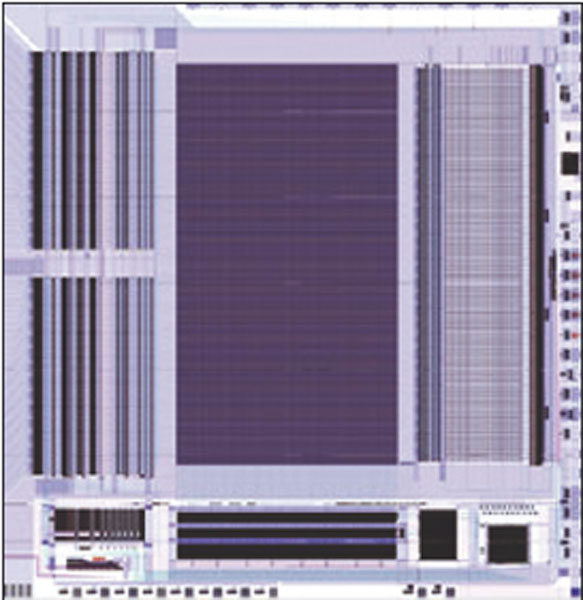
A decisive factor in reducing the tracker’s price tag, by almost SFr6.5 million, was the development by CMS of a CMOS read-out chip using low-cost technology, originally aimed at increasing the compactness of computer chips. With a feature size of 0.25 μm compared with the 1 μm of conventional CMOS chips, the new APV25 chip is certainly compact. It is also extremely radiation-hard, with lower noise and power consumption than a conventional CMOS chip. The other decisive factor is that silicon detectors are already widely available from industry in large quantities and their price has been falling.

May 2000 p5 (abridged).
ATLAS: The making of a giant

CCAtl3_10_08

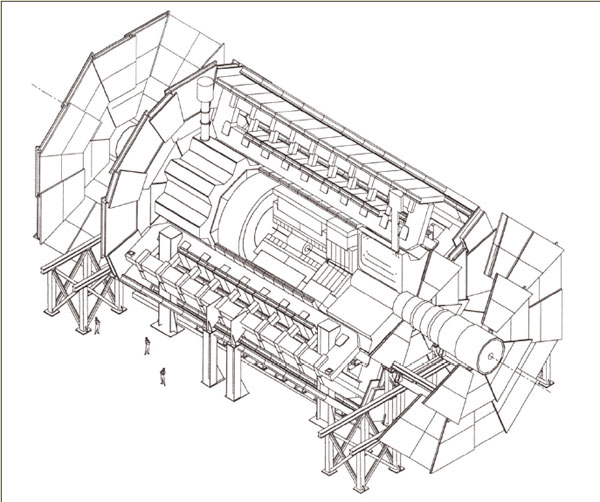
ATLAS is the well deserved name for the largest-volume detector ever constructed at a particle collider. It sits about 100 m underground in a cavern that could accommodate the Arc de Triomphe in Paris. A multipurpose detector, its physics goals range from the search for the Higgs boson and supersymmetric particles to the exploration of extra dimensions and other alternative scenarios.

The ATLAS collaboration was born in the autumn of 1992 from the merging of two existing groups, ASCOT and EAGLE, that had presented different expressions of interest at the meeting in Evian the previous March. By the end of 1994, the ATLAS collaboration had taken shape and submitted the technical proposal. “In summer 1995 the detector was pretty much the same as it is today with the exception of the inner detector, whose technical design report was presented later, in 1997,” says Peter Jenni, (co-)spokesperson of the ATLAS collaboration since the beginning. “When, we submitted the technical proposal in December 1994, all the big decisions, such as which type of calorimeter or magnetic field to use, had already been taken.”

So, after about 15 years in the making, not much has changed from the original design for ATLAS. There were only ever two main turning points. “Until 1997, the design of the precision chambers in the inner detector was not established,” explains Jenni. “The collaboration was hesitating between using microstrip gas chambers and silicon strips in the outer layer. It finally decided to adopt the silicon solution. In 2002, the ATLAS detector underwent an internal financial audit and the resources review board accepted a completion plan with a reduced budget. As a result, the development of some parts of the detector had to be postponed. The impact of such financial cuts was particularly significant on the high-level trigger and data acquisition, but some features of the inner detector, the muon system, the electronics of the calorimeter and the shielding system had to be reviewed as well.” Since then, not all these projects have been completed, and some of them never will be. “However,” says Jenni, “this does not affect the main design or performance of the detector.”

The detector was designed from the beginning to study a range of phenomena. “The initial design requirements of ATLAS were optimized for the search for the Higgs boson and supersymmetric particles,” confirms Jenni. “The Higgs boson always featured strongly because, depending on the mass, the decays to deal with experimentally are very different. Therefore it is an excellent benchmark for making sure you have built a detector with many capabilities.”

If the ATLAS detector has not changed much since 1995, the physics panorama has. New particles have come onto the scene, as well as new scenarios that attempt to describe the first moments of the universe. “ATLAS will be able to study the signature of still-to-be discovered heavy objects decaying into electron pairs or muon pairs, such as the Z’,” explains Jenni. “The superconducting toroid system allows us to measure muons with great precision, even with the highest luminosity, independently from the inner detector.” Jenni also expects an excellent performance for studying signatures from particles coming from possible supersymmetry (SUSY). “Our detector has a particularly good hadronic calorimeter, which will allow us to measure accurately the missing energy associated with the possible existence of SUSY or extra dimensions. Moreover, if there is a graviton-like resonance from extra-dimension scenarios we will have to measure the angular distribution. In this case, toroids have the advantage that the field is optimal also in the forward direction.” In Jenni’s opinion: “The performance of detectors with high luminosity will make the difference in the race for discovery in the long run.”

However, according to the most recent schedules, such high luminosity will not be available at the LHC until 2011 or 2012. In particular, the first protons will collide in the LHC at 5 TeV, rather than at 7 TeV. Instead of being disappointed, Jenni is pragmatic. “We will use the first two-month run to get to know and test the detector with known signatures, such as the W boson and the top quark – 10 TeV at low luminosity will already give us a lot of data to calibrate, as well as understand all the subdetectors and the chain of data preparation and analysis. Before any discovery can be claimed we first have to show that the known physics is reproduced and that the detector performs well.”

After this first learning phase, the collaboration will be ready for 2009, when the accelerator will run at full energy and increasing luminosity. If the expected Higgs boson really exists, ATLAS will start to record its signatures. “An estimate for finding the Higgs is not before 2010, but this seems rather optimistic,” says Jenni. “For SUSY or extra dimensions, the time needed to study the signatures depends on the different theoretical models. We could cast light on some of them before the Higgs can be confirmed”.

When it comes to discoveries, an important aspect for the collaboration and for CERN will be how they will be disseminated. “The first thing we will take care of is to publish our results in a scientific review, not in the New York Times,” declares Jenni. “Then will come the sharing of the excitement of the results with the public and this is a very important aspect. For an experiment like ATLAS, outreach is an important activity. I think that it is crucial to involve active scientists, although scientists do not necessarily know how to deal with it. We will all have to learn how to do it together with CERN.”

ATLAS has been a pioneer in this field, with an attractive website that features video material, interactive games, press kits, regular news etc. “Inside ATLAS we have some communication plans to deal with the publication of the first results. There is already quite a lot of preparation of educational resources to be used to explain how things work. An EU co-funded project has recently received a first approval from the Commission,” continues Jenni. “All this, however, seems rather theoretical for the moment. I feel that we will have to learn how to do things for real.”

In the race for discovery at the LHC, ATLAS is not alone. The collaborations are competitors, but they are also allied because what one detector sees will have to be confirmed by the others. “Different detectors have made different choices, giving priority to different features (calorimetry, particle identification systems etc). Physics will tell us who made the right choice,” confirms Jenni. “Having invested so much in this powerful multipurpose detector, it is clear that the ambition and duty of ATLAS is to exploit the LHC potential to the maximum”.

ATLAS: A titan fit for the LHC (archive)

CCAtl1_10_08

In Greek mythology, Atlas was a Titan who had to hold up the heavens with his hands as a punishment for having taken part in a revolt against the Olympians. For LHC, the ATLAS detector will also have an onerous physics burden to bear, but this is seen as a golden opportunity rather than a punishment.

The major physics goal of CERN’s LHC proton–proton collider is the quest for the long-awaited “Higgs” mechanism, which drives the spontaneous symmetry breaking of the electroweak Standard Model picture. The large ATLAS collaboration proposes a large general-purpose detector to exploit the full discovery potential of LHC’s proton collisions. LHC will provide proton–proton collision luminosities at the awe inspiring level of 1034 cm–2 s–1, with initial running in at 1033. The ATLAS philosophy is to handle as many signatures as possible at all luminosity levels, with the initial running providing more complex possibilities.

The ATLAS concept was first presented as a letter of intent to the LHC Committee in November 1992. Following initial presentations at the Evian meeting in March of that year, two ideas for general-purpose detectors, the ASCOT and EAGLE schemes, merged, with Friedrich Dydak (MPl Munich) and Peter Jenni (CERN) as ATLAS co-spokesmen.

Since the initial letter of intent presentation, the ATLAS design has been optimized and developed, guided by physics performance studies and the LHC-oriented detector R&D programme. The overall detector concept is characterized by an inner superconducting solenoid (for inner tracking) and large superconducting air-core toroids outside the calorimetry. This solution avoids constraining the calorimetry while providing a high-resolution, large acceptance and robust detector.

The outer magnet will extend over a length of 26 m with an outer diameter of almost 20 m. The total weight of the detector is 7000 tonnes. Fitted with its endcap toroids, the outer magnet alone will weigh 1400 tonnes.

Designs on calorimetry

To achieve its basic aims, the ATLAS design has gone for very good electromagnetic calorimetry for electron and photon identification and measurements, complemented by complete (hermetic) jet and missing energy calorimetry; efficient tracking at high luminosity for lepton momentum measurements, for heavy quark tagging, and for good electron and photon identification, as well as heavy-flavour vertexing and reconstruction capability; precision muon-momentum measurements up to the highest luminosities and very low transverse-momentum triggering at lower luminosities. Other overall design aims include large angular coverage together with triggering and particle-momentum capabilities at low transverse momenta.

The inner detector is contained in a cylinder 6.8 m long (with a solenoid of length 5.3 m) and diameter 2.3 m, providing a magnetic field of 2 T. Design of the coil is being developed by the Japanese KEK Laboratory. Reflecting LHC’s bold physics aims and the pace of detector R&D, this inner detector is packed with innovative tracking technology (compared with existing major detectors), including high-resolution pixel and strip detectors inside and straw tubes with transition radiation capability farther away from the beam pipe. Finest granularity will be provided by semiconductor pixel detectors immediately around the beam pipe, providing about a hundred million pixels. With this technology moving rapidly, the final solution will benefit from ongoing R&D work.

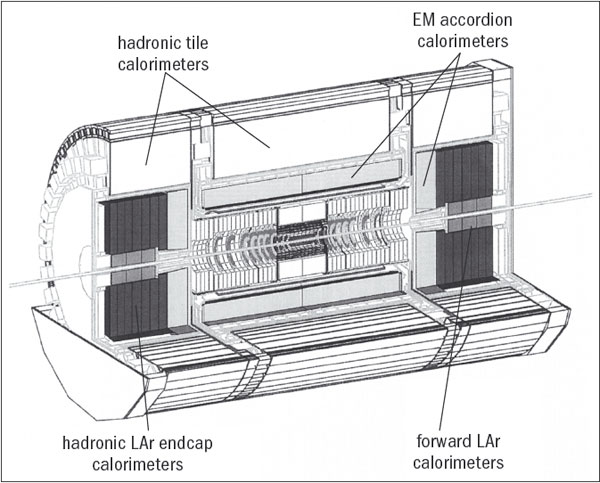
Surrounding the tracking region will be highly granular electromagnetic-sampling calorimetry, probably based on liquid argon (however, studies on an alternative liquid-krypton scheme are still in progress), contained in an “accordion” absorber structure in a cylinder 7 m long and 4.5 m across, plus two endcaps. The inner solenoid coil is integrated into the vacuum vessel of the calorimeter cryogenics, reducing the amount of material that emerging particles have to cross.

Liquid argon is used for both electromagnetic and hadronic calorimetry in the endcaps of the calorimeter, the former arranged in a “Spanish fan” geometry to cover all azimuthal angles without cracks, the latter in a wheel-like structure using copper absorber. Integrated into the endcaps is the forward calorimetry based on an array of rods and tubes embedded in a tungsten absorber some 5 m from the interaction point.

The bulk of the hadronic calorimetry is provided by three large barrels of a novel tile scintillator with plastic scintillator plates embedded in iron absorber and read out by wavelength-shifting fibres. The tiles, laid perpendicular to the beam direction, are staggered in depth to simplify construction and fibre routing. The total weight of the calorimetry system is 4000 tonnes (the entire UA1 detector that ran at CERN’s proton–antiproton collider for a decade and was considered a big detector in its time, weighed 2000 tonnes).

The air-core toroid magnet, with its long barrel and inserted endcaps, generates a substantial field over a large volume but with a light and open structure that minimizes troublesome multiple scattering. The toroid route was chosen because this geometry features the magnetic field perpendicular to the particle, and avoids large volumes of iron flux return. The French Saclay Laboratory is responsible for the barrel and the British Rutherford Appleton Laboratory for the endcaps.

lnterleaved with the main air-toroid magnet will be the muon chambers, the last outposts of ATLAS. These chambers, arranged in projective towers in the barrel region, are diametrically 22 m apart, with the central muon barrel extending 26 m and forward muon chambers 42 m apart, along the beam direction. Cathode-strip chambers will be used in the highest-rate environment close to the beam direction, supplemented farther out by “monitored” drift tubes – pressurized thin-wall tubes arranged in several layers.

Overall, ATLAS so far involves some 1500 scientists and engineers representing 140 institutions in 31 countries (including 17 CERN member states). The participation of non-member state groups is still subject to the satisfactory establishment of bilateral agreements between CERN and the appropriate funding agencies. However, their potential involvement in ATLAS is already woven deeply into the fabric of the collaboration.

For example, semiconductor strips for the inner detector could involve teams from institutes in Australia, Canada, the Czech Republic, Finland, Germany, Japan, Norway, Poland, Russia, Sweden, Switzerland, the UK and the US, while the scintillator tiles could involve Armenia, Brazil, the Czech Republic, France, ltaly, Portugal, Romania, Russia, Spain, Sweden, CERN and the US.

In addition to the 7000 tonnes of ATLAS hardware, a major effort is also required for software and data acquisition. To handle ATLAS data, the first-level trigger, which identify unambiguously which event crossing is responsible for the event, operates at the full-bunch crossing rate of 40 MHz (one bunch every 25 ns). It takes about 2 μs for the first-level trigger information to take shape and be distributed. During level-1 trigger-processing time, all data is held in pipelines prior to output at 100 kHz for subsequent processing at level 2. During these 10 ms, the level-2 processors look at subsets of detector data before passing it on for final processing (at about 1 kHz) at level 3, where complete event reconstruction becomes possible. Trigger processors at all three levels will be programmable.

• June 1995 p9 (abridged).

Tiles and accordions

CCAtl2_10_08

Design work and prototyping is well under way for the modules that will make up the ATLAS detector. One feature of the design stresses very good electromagnetic calorimetry for electron and photon identification and measurements, complemented by accurate measurements of hadronic jets and missing energy.

Arranged as a conventional central barrel with two endcaps, the inner part (including endcaps) uses the very-radiation-resistant liquid argon technique for electromagnetic measurements, contained in a 13 m long cylinder with outer radius 2.25 m, surrounded by less expensive iron-scintillator tiles sampling calorimetry for the hadronic part, extending to a radius of 4.25 m.

In the inner part of the endcaps, liquid argon is also used for the hadronic calorimeter. Special requirements are needed for the forward calorimeter around the beam pipe, about 5 m from the collision point. Fully integrated with the endcaps, liquid argon is again the sampling medium of choice.

For the electromagnetic liquid-argon part, the 1024 lead–stainless steel converters of the sampling calorimeter are arranged in a novel corrugated “accordion” structure, with plates following the direction of the emerging secondary particles.

The barrel hadronic calorimetry is provided by an active medium of 3 mm-thick scintillator tiles, interleaved with absorber in the form of 14 mm steel sheets, and fashioned as a large 2500-tonne cylinder to surround the liquid argon barrel and endcaps. Full-scale prototypes under test show promising energy resolution.

• April 1997 pp5–6 (abridged).

Collaboration: A machine for the world (archive)

The LHC has attracted significant contributions from several major nations outside the CERN member-state community, making it truly a world machine.

In addition to these important contributions from Canada, India, Japan, Russia and the US, CERN host-states France and Switzerland also contribute significant additional resources to the LHC above and beyond their natural involvement as part of the 20-nation European CERN community.

Canada

The contribution to the LHC from Canada is valued at C$40 m, much of which is used for hardware to help to upgrade the injector chain, particularly the Booster and the PS synchrotron. This involvement goes back to 1995 and is coordinated by the Canadian TRIUMF laboratory.

Equipment includes ferrite rings, and the tuning and high-voltage power supplies for four new radiofrequency cavities for the Booster, which was upgraded from 1 to 1.4 GeV specifically for its new role in the LHC injector chain.

Canadian contributions also include most of the magnets and power supplies for the transfer line between the Booster and the PS, major equipment for the Booster main magnet power supply, and a reactive power compensator to reduce Booster-induced transients on CERN’s electrical supply system.

A second wave of Canadian contribution is mainly for the LHC ring, including 52 twin-aperture quadrupole magnets for “beam cleaning” insertions, together with power supplies for kicker magnets, pulse-forming networks and switches. Canada will also develop beam-position-monitor electronics and carry out some beam optics studies.

India

The initial CERN–India cooperation agreement was signed in 1991 and is renewed every five years. The value of equipment covered is $25 m, of which half is transferred by CERN into a special fund to underwrite further joint ventures.

The main Indian hardware contribution is superconducting sextupole and decapole spool pieces amounting to half of the total LHC requirement for such corrector magnet equipment. In addition, India will supply LHC magnet support jacks and quench heater power supplies.

Circuit breakers are being supplied by Russia, but India remains responsible for the necessary electronics. In addition, India is carrying out several programming and documentation projects.

Japan

CCcol5_10_08

Japan’s early entry into the LHC arena in 1995 provided a memorable boost for the project. Japanese contributions currently total approximately ¥13 850 m (some SFr160 m). Of this sum, some SFr25 m was earmarked for construction of the solenoid magnet for the ATLAS experiment.

The KEK national laboratory acts as a major coordinator for all of this work. Japan is the source of much of the basic material (steel and superconducting cable) for the LHC.

A further significant Japanese contribution to the LHC is the 16 quadrupoles used to squeeze the colliding beams and boost the interaction rate. Also on the list of equipment are compressors for cooling superfluid helium.

Russia

CCcol6_10_08

The contribution of the Russian Federation to the LHC machine is valued at SFr100 m. One-third is channelled into a special fund for CERN–Russian collaboration.

The largest and most visible part of this contribution is the thousands of tonnes of magnets and equipment for the beamlines to link the SPS synchrotron to the LHC. The supply of this equipment from Novosibirsk will soon be complete. Novosibirsk is also supplying insertion magnets for the LHC ring.

The Protvino laboratory is responsible for 18 extraction magnets and the circuit breakers that will receive the electronics from India. The Joint Institute for Nuclear Research, Dubna, is contributing a damping system, and a number of other Russian research centres will furnish a range of items and equipment, including design work, radiation studies, survey targets, ceramic components, busbars and shielding.

USA

Work in the US for the LHC centres on interaction regions 1, 2, 5 and 8, together with some radiofrequency equipment for Point 4. The work is shared between the Brookhaven, Fermilab and Lawrence Berkeley National laboratories.

The impressive list of contributed hardware includes superconducting quadrupoles and their cryostats for beam intersections (Fermilab), superconducting dipoles for beam separation (Brookhaven) and cryogenic feed boxes (Berkeley).

The beam insertion hardware overlaps with that from Japan, and there has been excellent co-operation on LHC contributions between these two industrial giant nations.

Host nations

CCcol7_10_08

France and Switzerland, as CERN host nations, make special contributions to the LHC. For France, this includes 218 person-years of work, spread over four major technical agreements, covering the cold mass for LHC short straight sections (handled by the CEA Atomic Energy Commission), the short straight section cryostats and assembly (by the CNRS national research agency), calibration of 8000 thermometers for the LHC (by the Orsay laboratory), and design and series fabrication work for the superfluid helium refrigeration system (CEA).

In addition to this national involvement, the local Rhone-Alpes regional government and the départements of Ain and Haute-Savoie also contribute.

Under the regional government plan, about 90 person-years of assistance will be supplied by young graduates of technical and engineering universities. Haute-Savoie contributes design work on the integration of microelectronics for the LHC cryogenic system.

In addition, the LAPP laboratory at Annecy is developing ultrasonic equipment to monitor superconducting dipole interconnections, and it is doing design work for the vacuum chambers of the major LHC experiments. Ain has contributed the land to build a major new construction and assembly hall next to the CERN site.

The Swiss contribution comes from the federal government and the canton of Geneva, and it covers the cost of a 2.5 km tunnel through which protons will be fed from the SPS to the LHC in the anticlockwise direction.

September 2001 pp15–17 (abridged).


Testing times

CCcol8_10_08

The first testing of series production LHC magnets began in 2001, with two test benches and a limited cryogenic infrastructure. The first sets of dipoles had to be thoroughly tested, with full magnetic and other measurements. This extensive testing, together with the limited operational experience and support tools, meant that some 20–30 days were required to test a magnet during 2001–2002, and only 21 magnets were tested in this period.

To increase throughput, the test facility began to operate round the clock early in 2003. With a final set-up of 12 test benches and a minimum of 4 people per shift, this required a minimum team of 24. The initial plan had been to outsource, but by early 2002 it was clear that this was no longer an option. It was at this time that the Department of Atomic Energy (DAE), India, offered technical human resources for SM18. A collaboration agreement between India and CERN had been in place since the 1990s, including a 10 man-year arrangement for tests and measurements during the magnet prototyping phase. This eventually allowed more than 90 qualified personnel from four different Indian establishments to participate in the magnet tests on a one-year rotational basis (a condition requested by India) starting around 2002.

June 2007 pp19–22 (extract).

Collaboration (archive)

Going global: Japan helps LHC construction (archive)

CCcol1_10_08

As CERN’s major project for the future, the LHC sets a new scale in world-wide scientific collaboration. As well as researchers and engineers from CERN’s European Member States, preparations for the LHC now include scientists from several continents. Some 50% of the researchers involved in one way or another with preparations for the LHC experimental programme now come from countries that are not CERN Member States.

Underlining this enlarged international involvement is the recent decision by the Japanese Ministry of Education, Science and Culture to accord CERN a generous contribution of ¥5 bn (about Sfr65 m) to help finance the construction of the LHC. This money will be held in a special fund earmarked for construction of specific LHC components and related activities.

At the June Council session, Japan was unanimously elected as a CERN Observer State, giving them the right to attend Council meetings. Speaking at the Council meeting in his new capacity as Observer State spokesman, Kaoru Yosano, Japan’s Minister of Education, Science and Culture, pointed to his country’s wish to contribute to the LHC project at an early stage. He said that large scientific projects like the LHC “captivated the imagination of citizens”.

September 1995 p1 (extract).

CERN and Russia step up cooperation

CCcol2_10_08

September 1999 p11.

The signing of a new protocol between CERN and Russia marks a considerable increase in joint collaboration and a further consolidation of ties dating back 30 years. As well as directly assisting construction of CERN’s new LHC proton collider, the protocol, within the framework of the 1993 CERN–Russia Cooperation Agreement, and with Russia as a CERN Observer State, will provide valuable further stimulus for Russian high technology.

Covering Russian participation in LHC construction and the preparations for its research programme over a 10 year period, the protocol includes two separate in-kind contributions, each with net value to CERN of Sfr67 m, for LHC construction and for the LHC detectors. In addition, a generous contribution from the Joint Institute for Nuclear Research at Dubna, near Moscow, will be invested in LHC preparations.

This latest two-way development in CERN/Russian collaboration will be to the mutual advantage of both parties. It will boost the LHC effort en route to completion of the machine at its full design collision energy of 14 TeV. In addition, the increased scope and scale of this challenging work, together with its inherent complexity and sophistication, will provide impetus to Russian science and industry, and provide vital transfer of front-line technology and skills.

As well as the new protocol, additional contributions to LHC experiments could come through the International Science Technology Centre programme funded by the European Union, Japan, Russia and the US to promote the integration of former Soviet Union weapons scientists into fresh projects, and where six particle physics projects have already been approved.

September 1996 p32–33 (extract).

After the SSC

In the wake of the demise of the US Superconducting Supercollider (SSC) project, which impoverished both US and world science, some rapid scene shifting is going on. The SSC may be dead, but the underlying physics quest lives on.

To nurture the natural enthusiasm to continue this physics, contacts have been developing at several levels. In December 1993, informal exploratory talks were held at CERN between spokesmen of the LHC experiments and their counterparts from the major SDC and GEM projects which were being readied for the SSC, and with CERN management. The object was the common interest in multi-TeV physics at the LHC, and, once this is in place, to exploit valuable R&D already accomplished and the high level of expertise achieved in the SSC framework. A substantial number of US physicists involved in SDC and GEM could be interested in joining LHC experiments, together with Japanese researchers involved in SDC. Many of the SDC Canadian contingent could also turn their sights towards Geneva.

April 1994 pp1–2 (extract).

LHC milestones (archive)

What next after LEP?

CCmil1_10_08

Work for the LEP electron–positron collider continues to drive ahead, however LEP is far from being the last word in CERN’s long term plans. A clue was already in the LEP Design Study ” …by the adoption of a beam height of only 80 cm, there is enough room left (in the tunnel) for the installation of a second machine at a later stage…”.

A workshop, organized by ECFA and CERN in March 1984, examined the feasibility of a hadron collider in the LEP tunnel (Lausanne LHC workshop). There the idea emerged for a ring of superconducting magnets, installed above the LEP ring, to collide protons together (or protons with antiprotons) at as high an energy as possible. Since this meeting, considerably more work has been done to firm up ideas.

Using 10 Tesla dipole bending magnets, collision energies of 17 TeV (8500 GeV per beam) could be achieved with a respectable collision rate (luminosity 1033 cm–2 s–1). A ‘two-in-one’ aperture solution for the superconducting magnets is recommended for economy and compactness.

It is the relative ease of colliding proton beams (as compared to the difficulties of first making and then handling antiprotons) which promise high collision rates and make the proton–proton option the preferred solution. Despite the need to provide a large number of bunches (a figure of 3564 has been quoted), the two proton rings in the LEP tunnel could be filled using CERN’s existing 450 GeV SPS machine and its proton supply in only a few minutes. Of course new injection lines would have to be built.

• July/August 1986 pp5–4 (abridged).


Elsewhere

In Europe the news of the initial approval for the US Superconducting Supercollider was received enthusiastically as it showed that the future of high-energy physics is regarded as being of paramount importance at the highest levels. While the US plans gather momentum, the possibility of a hadron ring in the LEP tunnel at CERN is still attractive. Although restricted in energy by the ‘modest’ dimensions of the LEP tunnel compared to the SSC (27 km circumference against 84), the LHC scheme scores points for the magnificent beam injection systems already in place at CERN, a complete tunnel, and several collision options.

• March 1987 p2 (abridged).


Superconducting magnet success

Technical preparations for a possible proton–proton collider (LHC) in the LEP tunnel have made substantial progress with the successful testing of the first LHC superconducting high-field 1 m long model magnet. The single aperture niobium-titanium wound dipole was designed by R Perin and his LHC magnet study team, and manufactured by Ansaldo Componenti, Genova.

Operating at 2 K, it reached and passed its 8 Tesla nominal field without any quench, the first three quenches occurring at central fields of 8.55, 8.9 and 9 Tesla respectively. It then attained 9.1 Tesla without quenching and operated at this level for some time.

This is the first time a high field ‘accelerator quality’ superconducting dipole model has been designed and built as a joint venture between a scientific laboratory and industry. CERN provided most of the know-how and the superconductor, while manufacture was taken over by Ansaldo.

• June 1988 p13 (abridged).


Magnets: beyond niobium-titantium

CCmil2_10_08

The superconducting proton ring being built for the HERA electron–proton collider at DESY has already demonstrated that niobium-titanium technology is mature, even on an industrial scale. The HERA-type design (coils around the beam-pipe, mechanical support collars and cold iron return) has gone on to become widely adopted, but reaches its natural limit for dipole construction using niobium-titanium near 10 Tesla.

This is now well understood and has been demonstrated with several test magnets developed in a collaboration between CERN and Italian supplier Ansaldo. A similar geometry was used with niobium-tin in a collaboration between CERN and Elin (Austria) which reached a record field for this kind of magnet of 9.45 Tesla in September 1989.

CERN’s proposed LHC collider in the LEP tunnel envisages 10 T fields with a double aperture carrying the two beam pipes for the proton beams inside a single cryostat. Four contracts have been placed with European firms for the development of one-metre, double-aperture niobium-titanium magnets with a view to placing further orders for full-scale, 10 m prototype units. Using superfluid helium at 1.8 K instead of conventional 4.2 K cryogenics provides the necessary additional potential.

• Sept/October 1990 pp17–18 (extract).

Early days: The challenges of the LHC (archive)

CCcha2_10_08

It is generally considered that the starting point for the Large Hadron Collider (LHC) was an ECFA meeting in Lausanne in March 1984,although many of us had begun work on the design of the machine in 1981. It took a very long time – 10 years – from this starting point for the project to be approved. During most of this time Giorgio Brianti led the LHC project study. However, we should not forget the enormous debt we owe to Carlo Rubbia in the second half of that decade for holding the community together behind the LHC against all the odds.

The first project approval came in December 1994, although under such severe financial constraints that we were obliged to make a proposal for building the machine in two stages. This would have been a terrible thing to do, but at that point we had no alternative. However, after a major crisis in 1996, when CERN had a rather severe budget cut, at least the constraints on borrowing were relaxed and a single-stage machine was approved.

It is clear that building the LHC is a very challenging project. It is based on 1232 double-aperture superconducting dipole magnets – equivalent to 2664 single dipoles – which have to be capable of operating at up to 9 T. We were doing R&D on these magnets in parallel with constructing the machine and the experimental areas. This was not just a question of building a 1 m scale model with the very skilled people here at CERN, but of being able to build the magnets by mass production, in an industrial environment, at an acceptable price. This is something we believe we have achieved.

The machine also incorporates more than 500 “two-in-one” superconducting quadrupole magnets operating at more than 250 T/m. Here, our colleagues at Saclay have taken on a big role in designing and prototyping the quadrupoles very successfully. There are also more than 4000 superconducting corrector magnets of many types. Moreover, operating the machine will involve cooling 40,000 tonnes of material to 1.9 K, when helium becomes superfluid. An additional challenge has been to build the machine in an international collaboration. Although usual for detectors, this was a first for the accelerator community, and it has proved to be an enriching experience.

CCcha1_10_08

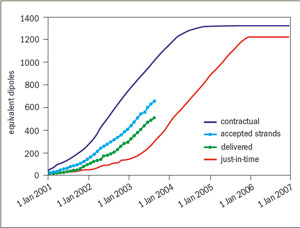
The production of the superconducting cable for the dipoles has driven the final schedule for the LHC, because we have to supply the cable to the magnet manufacturers. We could not risk starting magnet production too early when we were not sure that we could follow it with cable production. Figure 1 shows the ramp-up of cable production in 2002–2003.

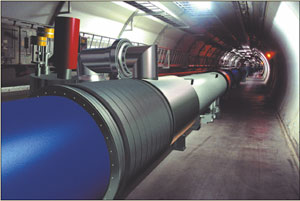
The next step is the series production of the dipoles, with installation in the tunnel starting in January 2004 and finishing in summer/autumn 2006. The “collared coils” – more than half the work on the dipoles – are now being made at the rate we need. These are assembled into the cold masses, which are delivered to CERN where they are installed in their cryostats, tested and stored.

At the same time the infrastructure of the tunnel is being prepared for the installation of the superconducting magnets. Sector 7-8, the first sector to be instrumented, now has its piping and cabling installed. The next step is the installation of the cryoline, to provide the liquid-helium refrigeration. We are now looking forward to as smooth a passage as possible from installation into commissioning.

The LHC is a very complicated machine, and its operation presents many challenges. The most fundamental concern is the beam–beam interaction and collimation. In designing a particle accelerator, we try to make sure that the magnets have as little nonlinearity as possible: that is, they have pure dipole and quadrupole fields. We then introduce controlled non-linearities – sextupoles to control chromatic aberrations and octupoles to give beam stability (Landau damping). We want smooth, distributed non-linearity, not a “lumped” linearity at one point in the ring. So we take a great deal of care, but then we are stuck with what we absolutely do not want – the beam–beam interaction itself. When the beams are brought into collision, a particle in one beam sees the Coulomb field of the other beam, which is strongly non-linear and is lumped – in every revolution the particle sees the beam–beam interaction at the same place. This produces very important effects, which I shall describe.

First, however, I should mention that the conversion of the Super Proton Synchrotron (SPS) into a proton–antiproton collider was a vital step in understanding this phenomenon. Indeed, it is not generally known what a step into the unknown we took with the collider. In this machine the strength of the beam–beam interaction, which we call the beam–beam “tune shift”, was very large, much larger than at the Intersecting Storage Rings (ISR). The collider was to operate in a domain where only electron–positron machines had worked, and these machines have the enormous advantage of strong synchrotron-radiation damping: particles that go through large amplitudes are “damped” into the core of the beam again. So we were going to operate a machine with no damping and a strong beam–beam effect. (Indeed, tests at SPEAR at lower and lower energies with reduced damping showed catastrophic effects, which when extrapolated indicated that the proton–antiproton collider could never work!)

CCcha3_10_08

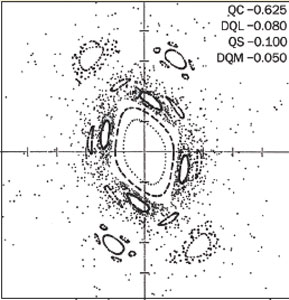
Figure 2 shows the effects in a simulation of the transverse phase space (the position–velocity space) of a particle in a perfect machine, apart from the beam–beam interaction. Because of the strong nonlinearity of the beam–beam interaction, particle motion can become chaotic and unstable at large amplitude. This was a real worry at the proton–antiproton collider, which proved to be an absolutely essential prototype for defining the parameters of the LHC. We have designed the LHC to beat this effect by sitting in a very small corner of “tune space” with very precise control in order to stay away from high-order resonances, although the beam–beam interaction will always be a fundamental limit.

A second major challenge of operating the LHC concerns collimation, which is needed to remove halo particles from the beams to avoid their touching the superconducting magnets, and to control the background in the detectors. We also need collimation to protect against fault conditions – the stored energy in the nominal LHC beam is equivalent to 60 kg of TNT! If there is a fault the beam will be kicked out, and for that there is a 3 μs hole in the bunch spacing to allow the field in the kicker magnets to rise. If there is a misfiring particles will be lost as the kickers rise, and the collimators can melt, so they have to be very carefully designed.

CCcha4_10_08

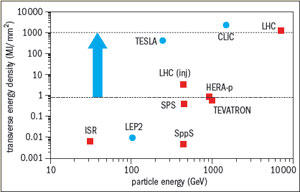
Already, at less than 1% of its nominal intensity, the LHC will enter new territory in terms of stored energy. It is two orders of magnitude more in stored beam energy, but the beam-energy density is three orders of magnitude higher (figure 3) because as the beam is accelerated it becomes very small. To cope with this we have designed a very sophisticated collimation system. At injection the beam will be big, so we will open up the collimators to an aperture of about 12 mm, while in physics conditions the aperture of the beam will be 3 mm – the size of the Iberian Peninsula on a €1 coin. The beam will be physically close to the collimator material and the collimators themselves are up to 1.2 m long.

We are now on the final stretch of this very long project. Although there are three and a half years to go, they will be very exciting years as we install the machine and the detectors. It is going to be a big challenge both to reach the design luminosity and for the detectors to swallow it. However, we have a competent and experienced team, and we have put into the design 30 years of accumulated knowledge from previous projects at CERN, through the ISR and proton–antiproton collider. We are now looking forward to the challenge of commissioning the LHC.

January/February 2004 p27 (abridged).

Based on a talk given at a symposium at CERN, published in Prestigious Discoveries at CERN. 1973 Neutral Currents 1983 W & Z Bosons (Springer 2003).

Early days: The Evian experiment meeting (archive)

CCcon3_10_08

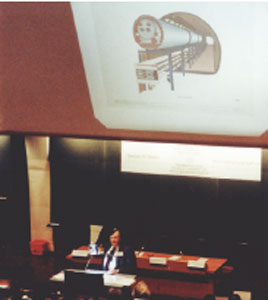
As plans for the LHC proton collider to be built in CERN’s 27 km LEP tunnel take shape, interest widens to bring in the experiments exploiting the big machine. The first public presentations of ‘expressions of interest’ for LHC experiments featured on 5–8 March at Evian-les-Bains on the shore of Lake Geneva, some 50 km from CERN, at the special ‘Towards the LHC Experimental Programme’ meeting.

This event followed soon after CERN Council’s unanimous December 1991 vote that the LHC machine, to be installed in the existing 27 km LEP tunnel, is ‘the right machine for the advance of the subject and for the future of CERN’. With detailed information on costs, feasibility and prospective delivery schedules to be drawn up before the end of next year, and now with plans for experiments under discussion, the preparations for LHC move into higher gear. The Evian meeting was a public forum for a full range of expressions of interest in LHC experiments, setting the stage for the submission of Letters of Intent later this year and cementing the proto-collaboration arrangements.

Participants at the meeting also heard the latest news on LHC machine studies, and the thinking on preparations for experimental areas and LHC physics potential. As well as its main objective of proton–proton collisions, LHC also opens up possibilities for ion–ion collisions, for fixed-target studies and eventually for electron–proton collisions as well. Most of these areas were covered at Evian.

LHC beams can in principle collide at eight points. Four of these coincide with the four big experiments at the LEP electron–positron collider. Of the remaining four points, one, deep under the Jura mountains, will have to be used for an LHC ‘beam-cleaning’ system to ensure high performance by reducing troublesome beam halo. Another will be reserved for the beam dump where the LHC protons will be absorbed once the circulating beams are no longer required. This leaves room for two big new LHC-collider detectors, plus the potential of the existing LEP experimental areas, using either adapted LEP experiments or new apparatus mounted in push–pull to alternate with LEP running.

At Evian, four major detectors for studying proton–proton collisions were being tabled, three of which are new, and one a development from an existing LEP experiment. The ASCOT (Apparatus with SuperCOnducting Toroids) general purpose detector is proposed by a team from CERN, the UK (Edinburgh and Rutherford Appleton Laboratory), Germany (Wuppertal and Munich MPI and University), France (Saclay) and Russia (Moscow, Dubna and Protvino). It is based on a 24 m long superconducting toroid instrumented with drift tubes for precision muon detection.

Inside the magnet, the emphasis is on electrons, with a lead/liquid argon electromagnetic calorimeter, and tracking through interleaved layers of scintillators and transition radiation detectors, with semiconductor pads close to the beam pipe. A 1.5 T superconducting solenoid in front of the electromagnetic calorimeter distinguishes electrons and positrons. Hadron calorimetry uses iron and liquid argon.

The EAGLE (Experiment for Accurate Gamma, Lepton and Energy measurements) collaboration proposes a comprehensive detector to cover a wide range of physics, and already involves physicists from 14 CERN member states, plus Canada, Russia, Australia, Brazil and lsrael. EAGLE foresees a powerful inner-electron detector inside a 2 T central superconducting solenoid. The design features high-quality electromagnetic sampling calorimetry combined with fine-grained electron and photon preshower detection, a high-precision vertex detector for lower collision rates, hadron calorimetry and a conventional toroid muon spectrometer.

The Compact Muon Solenoid (CMS) LHC detector is designed to be compatible with the highest LHC collision rates, and is built around a 15 m long superconducting solenoid providing a 4 T field. The strong field gives relatively compact muon measurement. R&D work for the muon detectors is looking at resistive-plate chambers and parallel plate chambers for timing information and honeycomb-strip chambers and wall-less drift chambers for spatial information. The central tracker will use small cells, based on silicon (or gallium arsenide) strip detectors and microstrip gas chambers, to ensure good pattern recognition under the stringent LHC conditions. Also inside the coil is a high-resolution electromagnetic calorimeter and a hadron calorimeter. CMS involves a team from 12 CERN member states, plus Byelorussia, Bulgaria, Estonia, Georgia, Hungary, Russia and the US.

The L3 experiment at LEP was originally designed for use at both LEP and LHC, with a large experimental hall and magnet. Upgrade for LHC would involve improving the muon resolution, adding a fine-grain hadron calorimeter, increasing the magnetic field, and being able to lift the detector 120 cm from the LEP position to the LHC beams above. For the work, 39 institutes from the L3 LEP line-up have been joined by 20 more, mainly from China and the former Soviet bloc.

Supplementing the main proton–proton LHC programme are a range of other experiments, including fixed-target studies. Expressions of interest received so far include ideas for two neutrino experiments and three studies concentrating on CP violation in B-particle decays, one using a gas-jet target, one using extracted beams and one a colliding-beam setup.

Although not the spearhead of LHC physics, ion–ion collisions will still play a major role, continuing a CERN tradition in this field. For ion collisions, three teams are interested – one using CMS, another using the (suitably modified) Delphi experiment at LEP and a third using a new dedicated detector.

More than 600 members of the potential LHC user community met at Evian. Introducing the event, Organizing Committee chairman Gunter Flügge of Aachen traced the previous history of major international get-togethers and other milestones which have delineated LHC progress: from the 1984 Lausanne workshop where the LHC idea was launched, through the valuable 1987 recommendations of the CERN Long Range Planning Committee under the chairmanship of Carlo Rubbia, to the 1989 Barcelona meeting on Instrumentation Technology and the 1990 Aachen workshop to study the physics objectives. Wrapping up at Evian, CERN director-general Carlo Rubbia proposed an ongoing schedule for the selection of LHC experiments, with Letters of Intent to be submitted after the summer for selection at the end of the year. The selected experiments would then proceed with a full design report. Whatever the outcome of this selection, Evian will always be remembered as the stage where these ideas made their public debut.

• Compiled from April 1992 pp1–3 and May 1992 pp1–3.

Early days: Aachen: the case for LHC (archive)

CCcon2_10_08

It was a workshop on a scale to match the ultimate goal. When some 500 physicists met in Aachen, Germany, in October to put the research case for the proposed Large Hadron Collider (LHC) at CERN, the turnout was among the biggest attendances of the year.

Organized by ECFA, the European Committee for Future Accelerators, the meeting, by its attendance and by the depth of its scientific content, clearly displayed the enthusiasm for LHC in the research community, and provided valuable additional impetus for the already-compelling idea of a proton collider using superconducting magnets in the 27 km tunnel built for LEP.

Introducing the plenary sessions at Aachen, CERN director-general Carlo Rubbia underlined the complementarity of a dual LEP–LHC complex with its electron and proton beams, providing a balanced two-pronged attack on the physics-research frontier while at the same time making the most of CERN’s versatile beam-handling systems, both existing and potential. With CERN already serving a varied menu of particles, LHC physics would be well-endowed with beam options. As well as providing proton–proton collisions at about 8 TeV per beam, LHC could follow the tradition of CERN’s other proton machines and handle heavy ions as well.

With basic (dimensional) arguments saying that reaction rates have to decrease with collision energy, then high luminosity (related to the collision rate) is a basic collider requirement which is expected to become even more important at higher energies. Thus a main aim of the LHC design is to attain the highest-possible luminosities.

The Aachen meeting mirrored on one hand the physics potential opened up by such a high-luminosity approach, and on the other the challenges for the detector systems which will have to handle bunches of 1011 protons crossing every 15 ns or so, resulting in billions of secondary particles each second. In addition to coping with this flood of data, the potentially delicate detector components will have to withstand long exposure to this harsh radiation environment.

The presentations at Aachen summarized the work of the hundreds of physicists in LHC working groups set up by ECFA earlier this year. Three groups looked at the physics potential of the three collision options (proton–proton, electron–proton, and ion–ion), while others studied detector aspects.

For proton–proton collision physics, Daniel Denegri of Saclay looked at the implications of the current Standard Model, while Felicitas Pauss of CERN attempted to look at the uncharted territory beyond. Putting the physics case for LHC proton–proton studies, Guido Altarelli of CERN was confident that new physics would turn up at the mass scales covered by this machine and provide a natural explanation for some of the apparently arbitrary numbers of today’s Standard Model (the unification of the weak nuclear force and electromagnetism loosely tied to the quark–gluon field theory of strong nuclear forces). While no cracks have yet appeared in this structure, Altarelli thought that with LHC the betting would be against the Standard Model, and its continued survival would be a turnup for the book.

Major goals include the clarification of the electroweak symmetry breaking mechanism (Higgs Particle), where Altarelli remarked there was room for contributions from LEP a well as from the proton–proton sector. However with its proposed high luminosity of 1034/cm2 per s, LHC has the discovery potential to attack the main outstanding questions of particle physics. Subsequent talks outlined the additional potential opened up by LHC’s electron–proton and ion–ion collision options.

Summarizing the work on the interaction regions where LHC experiments would be housed, Lars Leistam of CERN pointed out that if construction work on big new underground caverns is to begin in 1993, then the plans for the experimental areas should be ready by the end of next year. Although ideas for individual experiments have not yet been tabled, the sessions on muon identification at least gave some idea of what an LHC detector might look like. Contenders included toroids, solenoids, and their variants, and an idea to convert the L3 setup currently used at LEP.

• December 1990 pp3–5 (abridged).

“The LHC project now exists”

Sir William Mitchell

1991: The right machine

At the December meeting of CERN’s Council, the Organization’s Governing Body, the delegates from the 16 member states unanimously agreed that the LHC proton–proton collider proposed for the 27 km LEP tunnel is the ‘right machine for the advance of the subject and of the future of CERN’. Detailed information on costs, technical feasibility and prospective delivery schedules, and involvement of CERN Member States and other countries, together with an outline of the LHC experimental programme, its goals and its implications, including funding, will be provided before the end of 1993 so that Council can move towards an LHC decision. Following the vote, Council President Sir William Mitchell said “this is a historic occasion”. “The LHC project now exists,” he added.

The vote followed a special extended Council session on the LHC project on 19 December before extended delegations from CERN Member States and invited guests from other nations. They heard presentations from Scientific Policy Committee chairman Chris Llewellyn Smith on the physics potential for LHC, from ECFA Chairman J-E Augustin on the LHC user aspects, and from CERN director-general Carlo Rubbia on the LHC project and the future of CERN. This special meeting helped prepare the ground for Council’s vote the following day.

• January/February 1992 pp23–24 (extract).

Early days: Lausanne LHC workshop (archive)

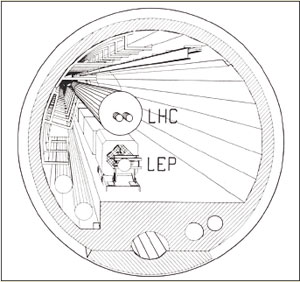
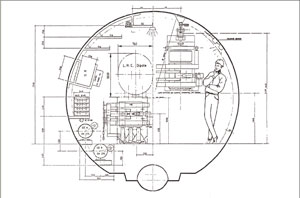
LEP Tunnel sketch

The installation of a hadron collider in the LEP tunnel, using superconducting magnets, has always been foreseen by ECFA and CERN as the natural long term extension of the CERN facilities beyond LEP. Indeed such considerations were kept in mind when the radius and size of the LEP tunnel were decided. The recent successes of the CERN proton–antiproton collider now give confidence that a hadron collider would be an ideal machine to explore physics in the few TeV range at the particle constituent (quarks and gluons) level. The present enthusiasm for the Superconducting Super Collider (SSC) in the US reflects the impressive potential of such machines.

Although the installation of such a hadron collider in the LEP tunnel might appear still a long way off (LEP is scheduled for initial operation in 1988), it was still an opportune moment for ECFA, in collaboration with CERN, to organize a ‘Workshop on the Feasibility of a Hadron Collider in the LEP Tunnel’ from 21–27 March. The first four days of detailed work were held in Lausanne, at the kind invitation of the University, and were followed by two days of summary talks and discussion at CERN.

The workshop was initiated particularly by the then ECFA Chairman, John Mulvey, in keeping with ECFA’s role in stimulating and coordinating plans for future particle-physics facilities in Europe. The workshop was timed to enable CERN to communicate present ideas on long-term prospects to an ICFA (International Committee for Future Accelerators) seminar held in Tokyo on 15–19 May and entitled ‘Perspectives in High-Energy Physics’.

To be competitive, the LHC has to push for the highest-possible energies given its fixed tunnel circumference

In his opening address at the workshop summary session, CERN director-general Herwig Schopper emphasized that CERN’s top priorities remain the completion of LEP Phase I (to achieve electron–positron collisions up to 50 GeV per beam), followed by Phase II (taking the beam energies to around 100 GeV). Thus the Large Hadron Collider (LHC) means looking as far ahead as the middle of the next decade.

Nevertheless, LHC would have to use the infrastructure permitted by LEP. Present ECFA Chairman Jean Sacton emphasized what LEP and CERN would offer. Besides the LEP tunnel itself, the PS and SPS provide excellent proton (and antiproton) injectors. In particular, with the experience of the Intersecting Storage Rings (ISR) and the proton–antiproton Collider under its belt, CERN can claim unique experience and expertise with bunched-beam hadron colliders. The European particle-physics community is also well aware of the competition from the SSC in the US breathing down its neck.

Giorgio Brianti summed up the outcome of the LHC machine studies so far. After confirming that the LEP tunnel would indeed be suitable for such a machine, the next conclusion was that construction moreover need not interfere significantly with LEP operation, given the foreseen LEP operating schedule. Four excavated colliding beam regions are still vacant, although this may not still be the case by the time of LEP Phase II.

To be competitive, the LHC has to push for the highest-possible energies given its fixed tunnel circumference. Thus the competitivity lives or dies with the development of high field superconducting magnets. The long gestation period of LHC fits in with the research and development required for 10 T magnets (probably niobium-tin), which would permit 10 TeV colliding beams. The keen interest in having such magnets extends into the thermonuclear fusion field, and development collaborations in the US, Japan and Europe look feasible.

There are two main options – either to build a single ring and have proton–antiproton colliding beams, as in the CERN SPS Super Proton Synchrotron and scheduled for Fermilab’s Tevatron, or to build two rings and have colliding proton beams. Two considerations turned the thinking firmly towards the second option. The first is the advantage of the higher luminosity (up to 1033/cm2 per s) of proton–proton collisions. The second is the complications in separating the multi-bunch proton and antiproton beams outside the collision regions, which would require cumbersome separators. These considerations outweigh the intrinsic economy of having protons and antiprotons circulating in the same ring. At the workshop, designs were presented of two-in-one magnets in single cryostats with the two proton-beam channels less than 20 cm apart.

At such high energies, there are aspects of machine operation which need special attention. For example – the enormous stored energy in the beams means that the beam-abort system would have to cope with 60 MJ, the vacuum chamber design has to take account of synchrotron radiation heating, the refrigeration system has to distribute liquid helium over tens of kilometres and be able to cope with several superconducting magnet quenches at a time. The growing experience at the Fermilab Tevatron, where the world’s first superconducting synchrotron has come so impressively into operation, would provide important input into design decisions.

Preceding the workshop, studies of machine design, magnets and cryogenics had been (and continue to be) underway at CERN, with periodic meetings to review progress. This work was summarized at Lausanne, including a panel discussion on superconducting magnet design and technology.

The key point is to have at least 10 TeV collision energy in order to have typically at least one TeV at the hadron constituent level

On the experimental side, eight working groups had been set up: Jets (convener P Jenni), Electron and photon detection (P Bloch), Muon detection (W Bartel), Tracking chambers (A Wagner), Vertex detection (G Bellini), Triggering (J Garvey), Data acquisition (D Linglin) and Forward physics (G Matthiae). There was also a great deal of input from theorists, and the Lausanne theory talks were also attended by many experimentalists.

The reports of these working groups provided much valuable input, and several general conclusions emerged. The highest energy would be a valuable asset but there is no actual threshold known now. The key point is to have at least 10 TeV collision energy in order to have typically at least one TeV at the hadron constituent level. There is also a trade-off between energy and luminosity, a gain in luminosity for a loss in energy and vice versa. According to present wisdom, differences between proton–proton and proton–antiproton reactions would be in most cases too small to be detectable. Information from proton collisions should hence be adequate.

Production rates for hitherto unknown objects are ‘expected’ to decrease quickly with the mass of these objects, so that here high luminosity would be an advantage. Multi-bunched beams were envisaged with 3564 bunches per ring, giving 25 ns between bunches and an average of one interaction per bunch crossing. Much thought is going into particle detector performance and there is confidence that the high luminosities could be handled.

Another attractive possibility with both proton and electron rings in the same LEP tunnel is the provision of high-energy electron–proton collisions ‘for free’.

No attempt was made at the workshop to arrive at even a tentative cost estimate for LHC in the LEP tunnel. The project has only been under consideration for a few months and a great deal of further study is needed. However, as Carlo Rubbia emphasized in his concluding remarks, the feasibility of the LHC has been demonstrated, a good physics case has been outlined and CERN is able to promise a great deal when future perspectives in high-energy physics are discussed.

• June 1984 pp185–187 (abridged).

bright-rec iop pub iop-science physcis connect