During the last weekend of October, particles once again entered the LHC after the one-year interruption following the incident of September 2008, travelling through one sector in each direction – clockwise and anticlockwise. ALICE and LHCb, the two experiments sitting along the portion of the beam lines in question, were able to observe the effects of beams in the machine. A week later, at around 8 p.m. on 7 November, protons travelling anticlockwise arrived at the doorstep of the CMS experiment, thus completing half of the journey around the LHC.
On 23 October, a first beam of ions entered the clockwise beam pipe of the LHC. Previous tests, on 25–26 September, had involved injecting lead-ion beams through the whole injection chain right up to the threshold of the LHC. This time, the lead ions entered the LHC just before point 2, where the ALICE experiment is installed, and were dumped before point 3. These tests enabled the machine experts to test the operation of the whole injection chain and an entire sector (sector 1-2) of the LHC.
Several sub-detectors of the ALICE experiment were switched on and saw their first beam. This helped them synchronize with the LHC clock and test the capability of the sub-detectors to measure high particle multiplicities.
During the afternoon on the following day, the first proton beam made its way through the TI8 transfer line up to the anticlockwise beam pipe of the LHC. Protons passed through the LHCb experiment and were dumped just before point 7.
Most of the LHCb sub-detectors were switched off to keep the experiment safe during these delicate operations. Only the beam and background monitors remained switched on, allowing an opportunity for commissioning of the beam-monitoring software. A highlight of the weekend was the switching on of the LHCb magnet, with operators able to measure its effect on the LHC beam and adjust the magnetic compensators around LHCb accordingly to bring the beam back into orbit.
The first weekend of November saw protons complete their journey anticlockwise through three octants before being dumped in collimators just prior to entry to the cavern of the CMS experiment. The particles produced by the impact of the protons on the tertiary collimators (used to stop the beam) left their tracks in the calorimeters and the muon chambers of the experiment. The more delicate inner detectors remained switched off for protection reasons.
During the same weekend, bunches of protons were also sent in the clockwise direction, passing through the ALICE detector before being dumped at point 3.
Hardware commissioning and magnet-powering tests have also continued in the LHC. By the first week in November, six of the eight sectors had been commissioned up to 2 kA, sufficient to guide a beam at an energy of about 1.2 TeV. Furthermore, the qualification of the new quench-protection system is progressing well, with the measured values complying with the stringent standards.
The first experiments are now under way using the world’s most powerful X-ray laser, the Linac Coherent Light Source (LCLS), located at the SLAC National Accelerator Laboratory. With 10,000 million times the brightness of any other man-made X-ray source, the light from the LCLS can resolve detail the size of atoms, enabling the facility to break new ground in research in many fields including physics, structural biology, energy science and chemistry.
The LCLS takes short pulses of electrons accelerated in SLAC’s linac and directs them through a 100 m stretch of alternating magnets that force the electrons to slalom back and forth. This motion makes the electrons emit X-rays, which become synchronized as they interact with the electron pulses, thus creating the world’s brightest X-ray laser pulse. Each of these laser pulses has 1012 X-ray photons in a bunch only 100 fs long.
Commissioning assisted by users is currently under way, with experiments taking place using the Atomic, Molecular and Optical (AMO) science instrument, the first of six instruments planned for the LCLS. In these first experiments, the researchers are using X-rays from the LCLS to gain an in-depth understanding of how the ultrabright beam interacts with matter.
Early studies are revealing new insights into the fundamentals of atomic physics and have successfully proved the machine’s capabilities to control and manipulate the underlying properties of atoms and molecules. Researchers have used the pulses from the LCLS to strip neon atoms completely of all of their electrons. They have also watched for two-photon ionization. This is normally difficult to observe at X-ray facilities, but the extreme brightness of the laser beam at the LCLS makes the study of these events possible.
Future AMO experiments will create stop-action movies of molecules in motion. The quick, short, repetitive X-ray bursts from the LCLS enable experiments to form images as molecules move and interact. By stringing together many such images to make a movie, researchers will be able to watch the molecules of life in action, view chemical bonds forming and breaking in real time and see how materials work on the quantum level.
The LCLS is a testament to SLAC’s leadership in accelerator technology. Four decades ago, the laboratory’s 3 km-long linear accelerator began to reveal the inner structure of the proton. Now, this same machine has been revitalized for pioneering research at the LCLS. By 2013, all six LCLS scientific instruments will be on-line and operational, providing unprecedented tools for a range of research in material science, medicine, chemistry, energy science, physics, biology and environmental science.
The National High Magnetic Field Laboratory at Florida State University has been awarded nearly $3 million to build a high-temperature superconducting magnet that will break records for magnetic field strength by aiming to reach 32 T. Around 8 km of cable formed from the high-temperature superconductor yttrium barium copper oxide, or YBCO, will go into the construction of the new magnet.
Superconducting magnets are well known in the world of particle accelerators (reaching a field of more than 8 T in the LHC, for example) and in magnetic-resonance imaging in hospitals (with fields of 1–3 T). They are also commonly used in high-field research, where one benefit is that they create more stable fields than do resistive magnets.
While superconducting magnets use a lot less electricity than their resistive counterparts, they traditionally operate at low temperatures that require costly cryogens. The high-temperature superconductor YBCO produces magnets that are not only cheaper to operate, but ones that do so at magnetic fields above about 23 T, where low-temperature superconducting magnets cease to work.
The construction of the 32 T magnet is funded by a grant of $2 million from the National Science Foundation and $1 million from Florida State University. The aim is to develop and demonstrate that technology will allow superconducting magnets to replace the resistive magnets in the National High Magnetic Field Laboratory.
Construction is beginning on the second-generation Neutralized Drift Compression eXperiment (NDCX-II), a new high-current, modest-kinetic-energy accelerator at Lawrence Berkeley National Laboratory (LBNL). The machine’s ion beams will enable studies of the poorly understood “warm dense matter” regime of temperatures around 10,000 K and densities near solid (as in the cores of giant planets). NDCX-II will also allow exploration of important issues in inertial-fusion target physics.
These studies support the ultimate goal of using ion beams to heat deuterium/tritium fuel to ignition in a future inertial fusion power reactor (a role for which accelerators appear well suited). NDCX-II has received $11 million of funding from the American Recovery and Reinvestment Act. Construction began in July with completion of the initial 15-cell configuration anticipated in March 2012.
NDCX-II will accelerate a beam of 30–50 nC of Li+ ions to 1.5–4 MeV and compress it into a pulse around 1 ns long. The short, high-current pulse is important for applications requiring efficient stopping of ions for rapid heating of a small amount of matter. As with the existing NDCX-I, the new machine uses neutralized drift compression. In this process, the beam’s tail is given a higher velocity than its head, so that it shortens while it drifts in a plasma that provides electrons to cancel space–charge forces.
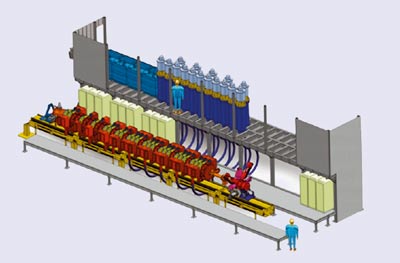
The figure shows the layout of the machine. It will make extensive use of induction cells (accelerating elements) and other parts from the decommissioned Advanced Test Accelerator (ATA) at Lawrence Livermore National Laboratory (LLNL). It will be extensible and reconfigurable. In the configuration that has received the most emphasis, each pulse will deliver Li+ ions at 3 MeV into a millimetre-diameter spot onto a thin-foil target. Pulse compression to around 1 ns begins in the accelerator and finishes in the drift compression line.
NDCX-II employs novel beam dynamics to achieve unprecedented rapid pulse compression in a short ion accelerator. The 200 kV charged transmission-line pulsed-power voltage sources from ATA, known as “Blumleins”, can provide voltage pulses that are not longer than 70 ns. These are shown as blue cylinders in the figure. For them to be usable, it is necessary to reduce the ion bunch duration from its original 500 ns. This shortening is accomplished in an initial stage of non-neutral drift compression, downstream of the injector and the first few induction cells (note the spaces between induction cells at the left end of the figure). Long-pulse voltage generators are used at the front end; Blumleins power the rest of the acceleration.
Extensive particle-in-cell computer simulation studies have enabled an attractive physics design that meets the stringent cost goal. Snapshots from a simulation video are shown in the figure. Studies on a dedicated test stand are examining the ATA hardware and supporting the development of new pulsed solenoids that will provide transverse beam confinement.
Applications of this facility will include studies of warm dense matter using uniform, volumetric ion-heating of thin foil targets, and studies of ion energy coupling into an expanding plasma (such as occurs in an inertial fusion target). NDCX-II will also enable a better understanding of space-charge-dominated ion-beam dynamics and of beam behaviour in plasmas. The machine will complement facilities at GSI in Darmstadt, but will employ lower ion kinetic energies and commensurately shorter stopping ranges in matter.
NDCX-II will contribute to the long-term goal of electric power production via heavy-ion inertial fusion. In inertial fusion, a target containing fusion fuel is heated by energetic driver beams and undergoes a miniature thermonuclear explosion. The largest inertial confinement facility is Livermore’s National Ignition Facility (NIF). NIF is expected to establish the fundamental feasibility of fusion ignition on the laboratory scale. Heavy-ion accelerators offer efficient conversion of input power into beam energy, are long-lived, and can use magnetic fields for final focusing onto a target. These attributes make them attractive candidates for a power plant. The beams in such a system will require manipulations similar to those being pioneered on NDCX-II.
• NDCX-II is sponsored by the US Department of Energy’s Office of Fusion Energy Sciences. It is being developed by a collaboration known as the Virtual National Laboratory for Heavy Ion Fusion Science, including LBNL, LLNL and the Princeton Plasma Physics Laboratory.
The Heidelberg Ion Therapy Centre (HIT) celebrated its opening at the Heidelberg University Hospital on 2 November. Developed with scientists and engineers at GSI in Darmstadt, the novel ion-beam cancer therapy facility is now ready to treat large numbers of patients, some 1300 a year.
HIT uses beams of ions, i.e. positively charged carbon or hydrogen atoms, which penetrate the body and exert their full impact deep within the tissue. To reach the tumour tissue, the ion beams are accelerated and then steered with such precision that they can irradiate a tumour the size of a tennis ball with millimetre accuracy, point by point. The surrounding healthy tissue remains mostly unaffected, so the method is particularly suited for treating deep-seated tumours that are close to vital or important organs such as the brain stem or the optic nerve.
The new facility has grown out of pioneering work at GSI, which has conducted fundamental research in radiobiology, nuclear physics and accelerator technology for therapeutic uses since 1980. The construction of a pilot ion-therapy project at GSI began in 1993 in a collaboration between GSI, the Heidelberg University Hospital, the Deutsches Krebsforschungszentrum in Heidelberg and the Forschungszentrum Dresden-Rossendorf.
At the same time, plans were made to introduce ion-beam therapy as a regular component of patient care with a new clinical facility at Heidelberg. HIT thus represents a direct transfer of technology from the GSI pilot project, which introduced several innovative techniques. These included: the raster scan method, which allowed tailored tumour irradiation with a carbon-ion beam; an accelerator that permits rapid variation in the energy of the ion beam in order to adjust the penetration depth inside a tumour; a fast control system to steer the ion beam safely inside the patient at millisecond intervals; and monitoring of the irradiation through a positron emission tomography (PET) camera, to make sure the beam hits the tumour.
Since 1997, 440 patients, most of them with tumours at the base of the skull, have been treated with carbon ion beams at the GSI facility. Clinical studies proved the success of the treatment, documenting a cure rate of up to 90%. Ion-beam treatment is now an accepted therapy, with health-insurance providers refunding the costs.
The new treatment centre is operated by the Heidelberg University Hospital, where a special building with a floor space of 60 m × 80 m was constructed to host it. The facility has a 5 m long linear accelerator and a synchrotron with a diameter of 20 m. Three treatment spaces are located adjacent to the accelerators, two of which are a development of technology used at GSI. The third treatment space features a gantry – a rotating ion-beam guidance system – that is a direct advance on the prototype developed at GSI. The gantry allows the ion beam to be aimed at a patient’s tumour at any angle, thus greatly enhancing the treatment options.
The ion-beam cancer treatment available at HIT is the first of its kind. Japan is currently the only other country offering ion-beam cancer therapy, but with a less effective irradiation technique. In the scope of a licence agreement between the GSI and Siemens AG, two more facilities modelled on HIT are under construction in Marburg and Kiel.
The detection of very-high energy (VHE, E> 100 GeV) gamma-rays from the starburst galaxy Messier 82 (M82) by the Very Energetic Radiation Imaging Telescope Array System (VERITAS) may help solve a 100-year-old mystery on the origin of cosmic rays. It provides new evidence for cosmic rays being powered by exploding stars and stellar winds.
The sensitivity to VHE gamma-rays of the current generation of Cherenkov telescope arrays has opened a new era in the study of cosmic rays. The gamma-rays are produced by the interaction of cosmic rays – particles that zip through space at nearly the speed of light – with interstellar matter and ambient radiation. As the induced gamma-rays are not deflected by magnetic fields in the galaxy, they have the advantage of pointing back to their production sites.
The detection of VHE gamma-rays from the rim of the supernova remnant RX J1713.7-3946 by the High Energy Stereoscopic System (HESS) was already strong evidence for cosmic-ray acceleration in the shock wave launched by the supernova explosion (CERN Courier January/February 2005 p30). Another piece of evidence now comes from VERITAS, the northern hemisphere analogue to HESS. The array of four 12-m Cherenkov telescopes located in Arizona was pointed towards the “Cigar Galaxy” M82 for 137 hours between January 2008 and April 2009. This exceptional observation effort finally paid off with a firm detection (4.8σ) of this galaxy located 12 million light-years away in the direction of the constellation Ursa Major, near the well known Big Dipper or Plough. M82 was a prime target for VERITAS because it was predicted to be the brightest starburst galaxy in terms of gamma-ray emission and was out of reach for HESS, located too far south in Namibia.
VERITAS observed less than one gamma-ray photon from M82 an hour. With only 91 events, the spectrum of the VHE emission is quite poorly determined. It was, however, found that both the intensity and the photon index (Γ = 2.5±0.8) in the 0.9–5 TeV range are consistent with a recent model prediction for M82. In this energy range, the dominant contributors to the VHE gamma-ray emission are supposed to be inverse-Compton scattering from cosmic-ray electrons and the decay of neutral pions originating from the interaction of ions (mostly protons) with atoms in the interstellar medium. The inferred density of cosmic rays in the central core of M82 is about 500 times that on average in the Milky Way. The Hubble telescope revealed that this region of about 1000 light-years in diameter contains hundreds of young, massive star clusters. The wind of the most massive stars and a supernova rate 30 times higher than in our galaxy are supposed to accelerate enough cosmic-ray particles to produce the VHE gamma-ray radiation observed in M82.
Until now, the only sources of VHE gamma-rays detected outside the Milky Way were active galactic nuclei, where the observed radiation is supposed to be emitted by a relativistic jet launched by a super-massive black hole. The detection of the non-active galaxy M82 – as well as that of NGC 253 reported in September by the HESS collaboration – is a new breakthrough for Cherenkov telescope arrays.
The founding father of DESY, Willibald Jentschke, was a Viennese nuclear physicist who had built a successful career in the US by the time he accepted a professorship at Hamburg University in 1955. He arrived with a plan to build a substantial laboratory for which he managed to secure unprecedented start-up funding worth about €25 million in today’s money. Jentschke discussed his ideas with leading German nuclear physicists, including Wolfgang Gentner, Wolfgang Paul and Wilhelm Walcher, at the 1956 Conference on High-Energy Particle Accelerators at CERN. Together they conceived the idea to create a laboratory serving all German universities, thus making good use of Jentschke’s “seed money”. This would enable German physicists to participate in the emerging field of high-energy physics where similar laboratories were planned or already in existence in other European countries. With the backing of influential personalities such as Werner Heisenberg and the firm support of the authorities of the City of Hamburg, the plan eventually materialized and Jentschke became the first director of the Deutsches Elektronen-Synchrotron, DESY, which came into being in December 1959.
DESY’s founders wisely opted for a 6 GeV electron synchrotron – the highest electron energy they could expect to reach with contemporary technology. In this way the machine would be complementary to CERN’s proton accelerators, the Synchrocyclotron and the Proton Synchrotron. The DESY synchrotron started operations in 1964. At the time, physics with electron and photon beams was considered a niche activity, but under Jentschke’s direction DESY managed to perform new and beautiful measurements of the nucleon form factors and the photoproduction of hadrons. It also earned renown for having “saved QED”, with an experiment led by Sam Ting that corrected earlier results from the US on wide-angle electron-pair production.
In the early 1960s, the laboratory developed plans to build a large electron–positron storage ring. The motivation was to try something new, but the physics prospects did not appear exciting. Few people at the time took quarks seriously, so the physics community expected hadron production to be dominated by time-like form factors and to decrease dramatically with energy. It was a bold move to base the future of DESY on electron storage rings as the main facility to follow the synchrotron. After controversial discussions, the laboratory nevertheless took the step towards an uncertain future: the construction of DORIS, a two-ring electron–positron collider with 3 GeV beam energy, began in 1969.
Exciting times
Good news followed with the discovery at the storage rings Adone in Frascati and the low-beta bypass of the Cambridge Electron Accelerator in Massachusetts that cross-sections for electron–positron collisions decrease only mildly with increasing energy. This was finally interpreted as evidence for quark–antiquark pair production and went a long way in establishing the quark model. The bad news was that beam instabilities, in particular in two-ring storage machines, were much stronger than expected; moreover, SPEAR, the simpler one-ring machine at Stanford, had started up some years before DORIS. So the J/Ψ and the τ-lepton were found at SPEAR. The experiments at DORIS were nevertheless able to contribute substantially towards charm spectroscopy, for example by discovering the P-wave states of charmonium and finding evidence for leptonic charm decays. The real opportunity for DORIS came later, however, after the discovery of the b quark in 1977. DESY made a big effort to upgrade DORIS in energy so that B mesons could be pair produced. The experimenters were able to perform a rich programme on the physics of the B particles, culminating in 1987 in the discovery of the mixing of neutral B mesons.
Plans for a bigger ring surrounding the whole DESY site were already under discussion during the construction of DORIS, and the discovery of the J/ψ in November 1974 provided the final impetus. Under the guidance of the director at the time, Herwig Schopper, and an energetic accelerator division leader, Gustav-Adolf Voss, PETRA – an electron–positron collider with an initial centre-of-mass energy of 30 GeV – was completed in 1978, far ahead of schedule and below budget. PETRA was later upgraded to 46 GeV and, for the eight years of its lifetime, was the highest-energy electron–positron collider in the world. The year 1979 saw the first observation of three-jet events at PETRA, leading to the discovery of the gluon and a measurement of its spin. Other important results concerned the comparison of the production of quark and gluon jets with the predictions of QCD perturbation theory to second order, leading to a measurement of the strong coupling constant αS and the first measurements of electroweak interference in muon- and τ-pair production.
An event recorded by the ARGUS detector at the DORIS storage ring shows the decay of the Υ(4S) resonance into a pair of B mesons, identified by their decay. This is evidence of B–B̅ mixing.
Image credit: DESY.
It was an exciting time in which experimenters and theorists worked together closely on the new fields that PETRA had opened up. By the time the experiments were completed in 1986, they had contributed greatly to establishing the Standard Model as a generally accepted theory. With PETRA, DESY had grown into a leading centre for particle physics, reflected by the international nature of its user community, with as many as 50% of the visiting scientists coming from outside Germany.
A three-jet event, registered at the PETRA storage ring; such events were a direct evidence for the existence of gluons.
Image credit: DESY.
So what was to come after PETRA? As a guiding principle, complementarity with the programme at CERN had always been central to DESY’s strategy. So, when CERN opted for the Large Electron–Positron (LEP) collider, the next big project for DESY became HERA – the world’s only electron–proton collider. Bjørn Wiik had been pursuing plans for such a machine for years and these gathered full momentum when Volker Soergel became DESY’s director in 1981. Together, Wiik and Soergel succeeded in convincing colleagues and funding agencies in Canada, France, Israel, Italy and the Netherlands to contribute to HERA as a joint project through the provision of machine components to be manufactured by the respective home industries or laboratories. In addition, physicists and technicians from universities and institutes not only in Germany but in many other countries, foremost China and Poland, came to DESY to participate in the construction of the machine. Eventually almost half of the manpower used to build HERA was from outside DESY. This “HERA model” of how to realize a big accelerator facility became an outstanding success. HERA was also unique in being situated underground in a residential area, but it took little more than six years from the start of construction to obtain the first electron–proton collisions at the full centre-of-mass energy of 300 GeV, in 1991. Two big detectors, H1 and ZEUS, started taking data immediately; HERMES and HERA-B followed a few years later.
Further expansion
A deep inelastic electron–proton scattering event, recorded by the H1 detector at HERA. The proton beam comes from the right, the electron beam from the left. The electron is back-scattered off a quark inside the proton and emerges to the left upwards. The quark is knocked out of the proton and produces a shower at the lower left.
Image credit: H1/DESY.
HERA was operated successfully until 2007. While spectacular “new physics” failed to appear, the experiments revealed the structure of the proton with unprecedented beauty. Their results will define our knowledge of the nucleon for the foreseeable future and will be invaluable for interpreting the data from the LHC experiments (CERN Courier January/February 2008 p30 and CERN Courier p34); they also offer some of the most precise tests yet of QCD and of the electroweak interaction.
A view inside the 6.3-km tunnel of HERA shows the superconducting magnets – used to guide the proton beam – installed above the normally conducting magnets of the electron ring.
Image credit: DESY.
Wiik succeeded Soergel as DESY’s director in 1993 and he soon initiated another vision: TESLA, a linear electron–positron collider of 500 GeV centre-of-mass energy employing superconducting accelerating cavities. It would, at the same time, provide the beam for an X-ray free-electron laser. An international collaboration was formed to develop the project and it had made substantial progress when, in 2003, a decision by the German government forced a drastic change of plan. While the government agreed to the realization of the X-ray free-electron laser part of the project within an international framework, it did not at the time support building the high-energy collider in Hamburg and decided to await the course of international developments before recommending a site for the collider. The German government did, however, renew its support for R&D work for a linear collider, which enabled DESY to proceed with this and maintain its involvement in the international co-ordination and decision process. By endorsing the realization of one of the world’s most powerful X-ray lasers in the Hamburg area, this decision in effect contributed to strengthening the second “pillar” of DESY’s research: photon science.
Measuring station in the experimental hall of the new PETRA III synchrotron radiation source at DESY – one of the most brilliant storage-ring-based X-ray sources in the world.
Image credit: Dominik Reipka, Hamburg.
Photon science – a modern term for research with synchrotron and free-electron laser radiation – was not new to DESY. On the initiative of research director Peter Stähelin, DESY had already built laboratories and instruments for utilizing synchrotron radiation at the original synchrotron and had made them available to a wide community of users in the 1960s. Later, the storage ring DORIS offered a continuous beam with much improved conditions, in particular for X-rays. The quality was enhanced further by insertion devices such as wigglers and undulators. In 1980 DESY created HASYLAB, a big laboratory to provide the growing community of users with all of the facilities they required. The research spanned a wide area, from materials science, physics, chemistry and geology to molecular biology and medical applications. Among the most active users were the European Molecular Biology Laboratory (EMBL) – which operated its own outstation at DESY – and special groups that the Max Planck Society established for applying the synchrotron radiation at DESY to research in structural biology. One prominent Max Planck group was led by Ada Yonath from the Weizmann Institute in Israel, who won the 2009 Nobel Prize in Chemistry for unravelling the structure of the ribosome. Part of this work was done with the help of synchrotron radiation from DORIS.
In 1993, after an upgrade with additional insertion devices, DORIS became entirely dedicated to the generation of synchrotron radiation and, with more than 40 beamlines, became a leading X-ray facility. By 1995 PETRA’s performance as a pre-accelerator for HERA was so smooth that this machine could also be used as a source for hard X-rays. The rising demand for such beams led to the rebuilding of PETRA as a dedicated synchrotron-radiation source, once the operation of HERA ceased in 2007. PETRA III was completed in 2009 together with a large new experimental hall (CERN Courier September 2008 p19). As one of the most brilliant light sources of its kind, it will be a world-leading facility for research with hard X-rays and provide high intensity for very small probes.
The big challenge for the DESY accelerator experts in the forthcoming years will be the construction of the X-ray free-electron laser, the European XFEL. Having grown out of the TESLA project, this 3 km-long facility will be equipped with superconducting accelerating cavities and precision undulators. It will allow users to study dynamic processes with atomic-scale resolution in space and time, opening exciting research opportunities. A similar but smaller self-amplifying spontaneous-emission laser, FLASH, has already been operating at DESY for a few years. It generates ultrashort laser pulses of vacuum-ultraviolet and soft X-ray radiation and is in high demand by experimenters because of its unique properties (CERN Courier January/February 2007 p8).
With around 2000 users, photon science is now a major activity at DESY. No longer having a high-energy accelerator on site, DESY’s particle physicists have turned to the LHC and become partners in the ATLAS and CMS collaborations. This revives a tradition, as in past decades, of DESY physicists participating strongly in experiments at CERN, such as with bubble chambers and muon beams. DESY is also setting up a National Analysis Facility – a computing and analysis platform for LHC experiments. Studies relating to a possible International Linear Collider (ILC), which will make use of superconducting cavities as developed for TESLA, also remain on the agenda. DESY has formed a close relationship with the German universities and institutes that are involved in the LHC or the ILC studies within the national Helmholtz Association alliance, “Physics at the Terascale”, which extends to theoretical particle physics and cosmology (CERN Courier May 2008 p11). The DESY theory group is also strongly engaged in lattice calculations.
In 1992 the Institute of High-Energy Physics of former East Germany, in Zeuthen near Berlin, became part of DESY. Besides its involvement in high-energy-physics experiments, particle theory and the development of electron guns for free-electron lasers, the institute brought astroparticle physics into DESY’s programme. DESY Zeuthen is currently a strong partner in the construction of the 1 km3 IceCube neutrino telescope at the South Pole, which should soon deliver results (CERN Courier March 2008 p9).
In its 50th year, with the prospect of photon sources of unprecedented quality, an active role in particle and astroparticle physics and the involvement of a wide international scientist community, DESY is looking forward to a continuing bright future.
DESY came to my attention for the first time in 1963 through a poster advertising its new summer student programme. Although I did not go to Hamburg that summer, this triggered my awareness of the laboratory. It took 11 more years before I finally went there, as a member of a group from Heidelberg, to work on the electron–positron storage rings, DORIS and then PETRA. It was 1974, the year of the discovery of the J/Ψ and it was in the midst of the related “November revolution” that DORIS started to provide its first collisions. The contributions that this machine was able to make in the understanding of the properties of the bound states of the charm and anti-charm quarks, as well as in the mass measurement of the τ-lepton, created a very stimulating atmosphere – which became the springboard for the next DESY project, the 2.3 km-circumference storage ring, PETRA.
PETRA, originally proposed as a proton–electron collider, was quickly converted into a positron–electron collider. Approved in 1976, it was built in the record time of two years and eight months, while staying 20% under the original budget. With the PETRA experiments being realized in international co-operation, DESY for the first time became a truly international laboratory and laid the foundation for its future development. The main drivers at DESY at that time were Herwig Schopper, Gustav-Adolf Voss, Erich Lohrmann and the many scientists, engineers and technicians from DESY, Germany and the partners abroad. For DESY, this international flavour was new and stimulating. The scientific programme for PETRA was broad, but interestingly enough did not contain what was to become the machine’s major highlight – the discovery of the gluon.
It was while working on JADE, one of the four experiments at PETRA, that I lived through the worst moment of my professional career, when early in 1979 the beams were lost in the middle of the detector, breaking many wires of the “jet” chamber on which I was working. But I also experienced extremely exciting, hard-working and very rewarding moments while trying to establish the true nature of the 3-jet events that proved to be the gluon’s signature. The scientific success of PETRA, and with it JADE, was paradoxically the reason for me to leave DESY in around 1980 – to work on the next electron–positron collider, the 27 km LEP at CERN. There I joined the OPAL experiment, the big brother of JADE.
I was called back to Hamburg, the university and DESY just as the hadron–electron storage ring, HERA, was getting ready to operate in 1991. HERA was built by three great personalities: Volker Soergel, Bjørn Wiik and (again) Gustav-Adolf Voss. This time not only the experiments but also the accelerator had been built through international collaboration, in a very successful way that became known as the “HERA model”. Although I had moved from working on an experiment to science management, I kept close contact with the experiments and the physics at HERA. When HERA operations came to a close in 2007, we could look back on an impressive and unique harvest of scientific results, from the structure of the proton to the properties of the fundamental forces. Only one wish had not come true, the discovery of the unforeseen.
New technology
Around 1990, work on linear colliders started around the globe inspired by the continuing success of electron–positron colliders. It had become clear that circular machines would no longer be feasible and that a new concept with many challenges had to be tackled. By the mid-1990s DESY decided to concentrate on superconducting accelerator technology and the TESLA collaboration was formed with many international partners. Combining the world know-how in this area, the collaboration made major progress in raising acceleration gradients and also solved many other problems. To put the technology to the test under realistic conditions, the collaboration built the TESLA Test Facility (TTF) at DESY, which demonstrated the feasibility of the technology and its reliable operation.
At a major meeting in 2001, the collaboration presented a proposal for a 500 GeV linear collider with an integrated X-ray laser (XFEL), to be realized as an international project at DESY. Two years later, the German government decided to approve the XFEL, together with the conversion of PETRA into a synchrotron light source, and to fund continuing R&D for a linear collider. At the same time the TTF was turned into FLASH, a soft X-ray laser facility for science and a test-bed for future linear-collider work. In the same year the International Committee for Future Accelerators unanimously decided that the technology for the linear collider, now called the International Linear Collider, should be based on superconductivity. Together with its partners from the TESLA Collaboration, DESY thus continues to be one of the main players in the R&D work for the next major project of particle physics.
I have focused mainly on the particle physics aspect of DESY. At the same time, however, the lab has been a pioneer in the generation and use of synchrotron radiation. First experiments started in 1964 and the Hamburg Synchrotron Radiation Laboratory (HASYLAB) was founded in 1977 around DORIS – still the work horse, serving more than 2000 scientists a year. Today, with the new light sources PETRA III and FLASH, and as host for the European XFEL, DESY is building and operating a remarkable suite of new tools for photon science.
As a former director of DESY, I am delighted that the laboratory, despite its age, has remained young, flexible, ambitious and successful on a world scale. I hope for DESY, my former colleagues, and all of the guest scientists, that the same can be said in another 50 years.
The fundamental questions about the origins and the future of the universe motivated me to choose physics as a course of study when I was 18 years old. My career as a scientist then led me to do research in solid-state physics and finally to investigate solid-state boundaries and nanomaterials using synchrotron radiation and neutrons. As a result, I have more or less closed a circle through my work at DESY. Here, both focuses of my research are united under one roof: particle physics with its fundamental questions, and structural research using cutting-edge light sources – both are fields that provide us with the knowledge base for technological and medical progress.
In an anniversary year, it is time not only to cast a backward glance but also to look forward at a clear objective: working together with all of the people at DESY to strengthen further the lab’s world-class international position. Now that HERA has been decommissioned, the focus for our facilities in Hamburg and Zeuthen clearly lies on the new and innovative light sources that are being realized in the Hamburg metropolitan region. “Insight starts here” is the slogan that we have chosen for DESY’s research – insight based on top-quality accelerator facilities and an important role as a partner in international projects.
With PETRA III, we have built a synchrotron-radiation source that will outperform all other competitors that use storage-ring technology. As the most brilliant light source of its kind, PETRA III will offer outstanding opportunities for experimentation. It will be of particular benefit to scientists who need strongly focused, very short-wave X-ray radiation to gain high-resolution insights at the atomic level into biological specimens or new high-performance materials. There is a tremendous demand from researchers aiming to develop new materials in the area of nanotechnology or new medicines based on molecular biology. A new interdisciplinary centre for structural systems biology is being set up in the direct vicinity of PETRA III.
This equips us perfectly to deal with the challenges of today and tomorrow. But the DESY tradition is also to keep in mind the challenges of the day after tomorrow – in other words, to build the light sources of the future. With the free-electron lasers, DESY has again assured itself a place in the world’s leading ranks when it comes to the development of a new key technology. On the basis of the superconducting TESLA technology, we have created light sources that are entering completely new territory by generating high-intensity, ultrashort, pulsed X-ray radiation with genuine laser properties. With this kind of radiation, scientists can for the first time observe processes in the nano-cosmos in real time. They can, for instance, view “live broadcasts” of the formation and dissolution of chemical bonds. That is why there is such a great demand for the FLASH free-electron laser at DESY. The expectations concerning the European X-ray laser, the European XFEL, which is now being built in the Hamburg area, are correspondingly high. DESY is playing a key role regarding this new beacon for science. Among other things, it is building the heart of the facility: the accelerator, which is approximately 2 km long.
International scope
In the fields of high-energy and astroparticle physics, DESY is facing the challenges of the future, which are becoming increasingly global; the era of national accelerator facilities is now a thing of the past. The field is dominated by internationally oriented “world machines” such as the LHC at CERN. So it is quite appropriate that the laboratory already has a long tradition of international co-operation across cultural and political boundaries. At its two locations in Hamburg and Zeuthen, DESY is involved in a number of major facilities that are no longer supported by one country alone, but are implemented as international projects. For example, DESY is participating in the experiments at the LHC and computer centres are being built on the DESY campus to monitor the data-taking and analysis. DESY is also playing a major role in the next future-oriented project in particle physics, the design study for the International Linear Collider.
DESY researchers are also active in astroparticle physics, in projects that include the neutrino telescope IceCube at the South Pole and the development work for a future gamma-ray telescope facility, the Cherenkov Telescope Array. With these two projects, the researchers are taking advantage of the fastest and most reliable messengers from the far reaches of the cosmos – high-energy neutrinos and gamma radiation – to investigate the early stages of the universe.
This broad international orientation is one element of the base that will continue to support DESY in the future. We will go on systematically developing the three main research pillars of DESY: accelerator development, photon science and particle physics. Another important element is the promotion of young scientists, an activity in which DESY engages intensely in co-operation with universities. Our goal is to be a magnet for the best and most creative brains and to co-operate with them in the future to do what we do best: ensuring that insight starts here.
The invention of micropattern gaseous detectors (MPGDs), in particular the gas electron multiplier (GEM) by Fabio Sauli and the micromesh gaseous structure (Micromegas) by Ioannis Giomataris, has triggered a range of active research and development on a new generation of gaseous detectors. These technologies, together with other new micropattern detector schemes that have arisen from these initial ideas, are now enabling the development of detectors with unprecedented spatial resolution and high-rate capability, which also have large sensitive areas and exhibit operational stability and increased radiation hardness. Many groups worldwide are developing MPGD devices for future experiments, not only at particle accelerators but also in nuclear and astroparticle physics, as well as for applications such as medical imaging, material science and security inspection.
This range of activity was the subject of the first international conference on MPGDs, which was organized at the Orthodox Academy of Crete, in Kolymbari, Greece, on 12–15 June 2009. The RD51 collaboration, which was established to advance the technological development and application of MPGDs, actively participated in the conference and held its collaboration meeting immediately afterwards on 16–17 June. The Orthodox Academy conference centre offered an ideal environment for the detailed examination of MPGD issues, together with the exchange of ideas and lively discussions that took place in both meetings. Crete is after all where, according to the myths of Daedalus and Talos, technology emerged during the Minoan civilization.
From COMPASS to the ILC
The history of MPGDs is much shorter, but nevertheless it is already rich in results and prospects. In 1999 COMPASS at CERN became the first high-energy physics experiment to use large-area Micromegas and GEM detectors in high-rate hadron beams. Micromegas produced with the new “microbulk” technology have backgrounds of a few 10–7 counts/s/keV/cm2. They might allow big improvements in the research potential of experiments that are searching for rare events (such as CAST, MIMAC and NEXT). Three time-projection chambers (TPCs) developed for the Tokai to Kamioka (T2K) project are using large pixellized Micromegas made using bulk technology to read out data from some 80,000 channels. This promising neutrino oscillation experiment reported impressive technological progress and results. Meanwhile, GEMs are about to be used in the TOTEM experiment at the LHC.
Review talks on future accelerators and upgrades, in particular the sLHC and the International Linear Collider (ILC) projects, covered the physics potential and set the requirements for detectors. MPGDs are in a favourable position thanks to their excellent properties. Research and development has already begun on a pixellized tracker (namely GridPix, or the Gas On Slimmed Silicon Pixels [GOSSIP] detector) for the upgrades of the LHC experiments, aiming for a spatial precision of around 20 μm. MPGDs are also good candidates for upgrading end-cap muon detection (with a precision of around 25 μm). Detectors with large surface areas pose a serious problem, however, owing to the huge number of read-out channels. A modified MPGD with controlled charge dispersion on a resistive anode-film laminated above the read-out plane would allow wide pads (about 2.7 mm), thus reducing significantly the number of channels.
GEMs and variations of Micromegas are being designed for digital hadron calorimetry and for TPCs and their read-out electronics at the ILC. The spatial resolution, which is not affected by a magnetic field, is reaching a record 50 μm for this application. The ion feedback suppression offered by the MPGDs is particularly important for operation at high rates. The new development of an integrated Micromegas (INGRID) on top of silicon micropixel anodes offers a novel and challenging read-out solution, and is under study both for a TPC at the ILC and for a vertex detector for ATLAS. Recent results using a triple-GEM structure combined with either Medipix or Timepix read-out electronics were also presented at the conference.
Multiple applications
Moving away from applications in particle physics, the strip-resistive-electrode thick GEM (S-RETGEM) could be used as flame/smoke detectors for the detection of forest fires at distances up to 1 km, compared with a range of about 200 m for commercially available UV-flame detectors. A detector structure inspired by the Micromegas concept, the Parallel Ionization Multiplier (PIM-MPGD), is being developed in collaboration with medical researchers for use in radio-pharmaceutical β-imaging, with a spatial resolution of 30 μm.
X-ray polarimetry for astrophysical applications now has a powerful tool, with intense development work on GEMs and thick GEMs (THGEMs) based on the pure noble gases xenon, argon, and neon. Interesting developments on GEMs and micropixel (μPIC) detectors operating as large-area VUV gas photomultiplier tubes were also presented at the conference. THGEMs are being assessed for applications in ring-imaging Cherenkov detectors and are also being used in a novel nuclear-imaging technique (3γ imaging) for medical purposes.
The construction of MPGDs is now moving away from planar geometry, but not without difficulties. Cylindrical Micromegas, as used in the CLAS12 detector at Jefferson Lab, and the triple-GEM structure developed for the KLOE experiment at Frascati, do not lose their performance compared with planar ones. Spherical GEMs are also being tested to fight parallax effects that pose limitations in many applications.
Rui De Oliveira of CERN presented the excellent research, development and innovation taking place at CERN in close collaboration with the GEM and Micromegas groups. He presented new photolithography and etching techniques that aim to improve several aspects of the performance of MPGDs, e.g. in robustness, homogeneity, sparking and electronics integration. MPGDs are now being manufactured with areas larger than around 0.5 m2, but further developments are needed for detectors for the sLHC and ILC. Industry has quickly become involved in MPGDs; several companies in Europe, Japan and the US are already manufacturing MPGD elements.
The conference proved the ideal occasion for discussions about the common aspects of all of the variations of MPGDs: field mapping, simulations, gases, electronics etc. All of the groups involved, and the two communities, GEM and Micromegas, came together in a fruitful collaboration. In addition, they were able to sample some of the beauty of Crete, present and past, with two special lectures, one on the history of Crete and the city of Chania, and one on Cretan flora. Participants also enjoyed walking excursions in the gorge of Samaria or visiting the archaeological site of Knossos. The conference dinner featured local delicacies, traditional Greek and Cretan music as well as dancing.
To provide the best experiences, we use technologies like cookies to store and/or access device information. Consenting to these technologies will allow us to process data such as browsing behavior or unique IDs on this site. Not consenting or withdrawing consent, may adversely affect certain features and functions.
Functional
Always active
The technical storage or access is strictly necessary for the legitimate purpose of enabling the use of a specific service explicitly requested by the subscriber or user, or for the sole purpose of carrying out the transmission of a communication over an electronic communications network.
Preferences
The technical storage or access is necessary for the legitimate purpose of storing preferences that are not requested by the subscriber or user.
Statistics
The technical storage or access that is used exclusively for statistical purposes.The technical storage or access that is used exclusively for anonymous statistical purposes. Without a subpoena, voluntary compliance on the part of your Internet Service Provider, or additional records from a third party, information stored or retrieved for this purpose alone cannot usually be used to identify you.
Marketing
The technical storage or access is required to create user profiles to send advertising, or to track the user on a website or across several websites for similar marketing purposes.