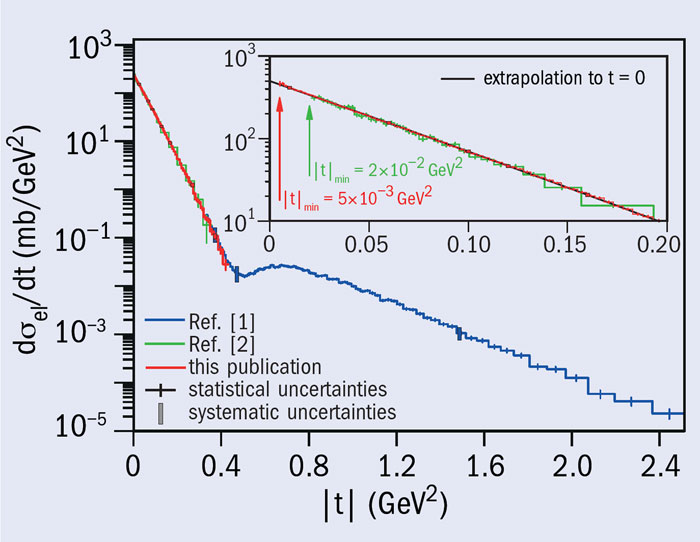
A year after publishing first results on proton–proton elastic scattering at a centre-of-mass energy of 7 TeV at the LHC, the TOTEM collaboration now has new measurements based on the analysis of data collected in October 2011. These latest results extend the measurement of the differential elastic cross-section to smaller values of |t|, the four-momentum transfer squared. They also allow a new determination of the elastic and total proton–proton (pp) cross-sections.
TOTEM, which stands for “TOTal cross-section, Elastic scattering and diffraction dissociation Measurement”, is optimized for making precise measurements of particles that emerge from collisions in the forward direction, close to the direction of the LHC beams. This allows it to probe physics that is not easily accessed by other LHC experiments, in particular elastic pp scattering down to small values of |t|. It detects protons scattered at small angles by using silicon detectors in Roman Pots – movable insertions in the beam pipe that allow the detectors to be brought closer to the beam.
The first measurement of the differential elastic cross-section dσ/dt by TOTEM covered a range 0.36 < |t| < 2.5 GeV2, revealing features similar to those first observed at CERN’s Intersecting Storage Rings in the 1970s: a peak at low |t| with an exponential decrease leading to a pronounced dip, followed by a rounded peak that falls away as a power law. With the data taken in 2011, the collaboration has now extended the measurements down to 0.005 GeV2 – corresponding to scattering angles of some 20 µrad – enabling the observation of 91% of the elastic cross-section and further exploration of the exponential slope of dσ/dt at small |t|.
For these measurements, the Roman Pot detectors had to approach close to the beam centre – to a distance of around five times the transverse size of the beam – during a dedicated run in which the LHC beams were deliberately left relatively wide and straight as they collided, rather than being “squeezed” for maximum luminosity. This involved running the LHC with magnet settings such that the β function, which describes the envelope of the beam oscillations, had a value of β* – the distance to the point where the beam is twice as wide as at the interaction point – of 90 m.
The results show that the slope of dσ/dt remains constant down to 0.005 GeV2, so that an exponential fit with only one constant B = (19.9±0.3) GeV–2 describes all of the range 0.005 < |t| < 0.2 GeV2 (TOTEM collaboration 2012). The small error on B – a result of the high precision of the measurement and the large range of the fit – allows a precise extrapolation over the non-visible cross-section (the remaining 9%) to t = 0. Taken with the luminosity measured by the CMS experiment at the same interaction point, this gives an elastic pp cross-section of 25.4±1.1 mb at a centre-of-mass energy of 7 TeV and, using the optical theorem, yields a value for the total pp cross-section of 98.6±2.2 mb. In addition, the difference between the total and elastic cross-sections gives a precise indirect measurement of the fully inclusive inelastic cross-section, with no dependence on Monte Carlo models, notably in the low-mass extrapolation region.
The measurements are being repeated this year at a centre-of-mass energy of 8 TeV. In addition, the machine optics for a still larger β* of 500–1000 m is being developed, which will enable TOTEM to reach a value of |t| as small as 0.0005 GeV2. This is where the Coulomb and hadronic contributions to the differential cross-sections are about equal, allowing the study of Coulomb-hadronic interference and the determination of the ρ parameter (the ratio of the real to imaginary part of the forward hadronic scattering amplitude). The collaboration is also studying the possibilities for measurements of pp elastic scattering at high values of |t| because these could reveal further diffractive minima, as predicted by some models.
One of the interesting ways to search for CP violation in B-meson decays is by using three-body decays of charged B mesons, i.e. B+ →K+K–K+, K+π–π+, K+K–π+ and π+π–π+ (and the charge-conjugated modes). In the 1.0 fb–1 of data accumulated in 2011, LHCb already recorded samples of these decays that are an order of magnitude larger than those available to previous experiments. The first studies of the K+K–K+ and K+π–π+ decays were presented by the collaboration at the 2012 International Conference on High-Energy Physics in July, revealing evidence of large CP-violation effects (LHCb 2012a). Now, at the 7th International Workshop on the CKM Unitarity Triangle, held at the end of September, LHCb has complemented these with results from the rarer decays to K+K–π+ and π+π–π+, finding evidence of even larger CP violation (LHCb 2012b).
While the inclusive CP asymmetries (which are integrated over the entire phase space, or the Dalitz plots, of the three-body decays) show evidence of CP violation, more pronounced effects are visible when looking at the variation of the effect in different regions. The LHCb analyses have used model-independent approaches – based on binning the Dalitz plot – to explore the local asymmetries.
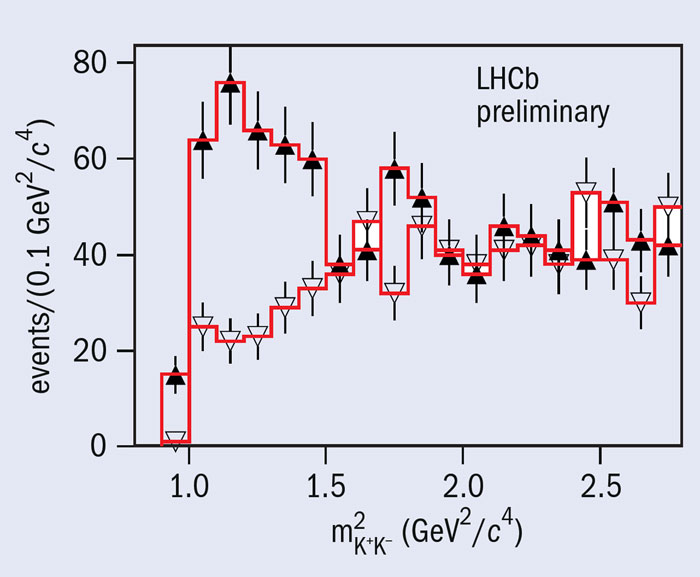
A remarkable feature of the new results is that the CP-violation effects appear to arise in regions of the Dalitz plots that are not dominated by contributions from narrow resonances. For example, previously the BaBar collaboration observed a broad feature at low values of the K+K– invariant mass in B±→K+K–π± decays (Aubert et al. 2007); in the LHCb data, this appears to be present only in B+ decays, as the figure shows, indicating direct CP violation in these decays. This points to some interesting hadronic dynamics that must generate the strong (CP conserving) phase difference that is necessary for direct CP violation to emerge.
To understand these effects further, the LHCb collaboration is now starting detailed studies of these channels and will also exploit the larger data sample that will be available after the 2012 running. The results from these analyses will also establish whether the observed CP violation is consistent with the expectations of the Standard Model or whether it has a more exotic origin.
Unlike the other three large experiments at the LHC, LHCb did not participate in heavy-ion runs in 2010 and 2011. This was because the forward region covered by the experiment, which corresponds to angles below 20° with respect to the beam axis, has been optimized for the study of heavy quarks in the proton–proton (pp) collisions that the LHC provides for most of the year. In the usual heavy-ion environment, i.e. the collisions of two lead-ion beams (PbPb), the density of tracks in this region would be so high that LHCb’s tracking detectors would be saturated with hits. However, the decision to run with proton–lead-ion (pPb) collisions for the next heavy-ion run opened the door for LHCb to participate, as the track occupancies would to be more similar to the usual pp running.
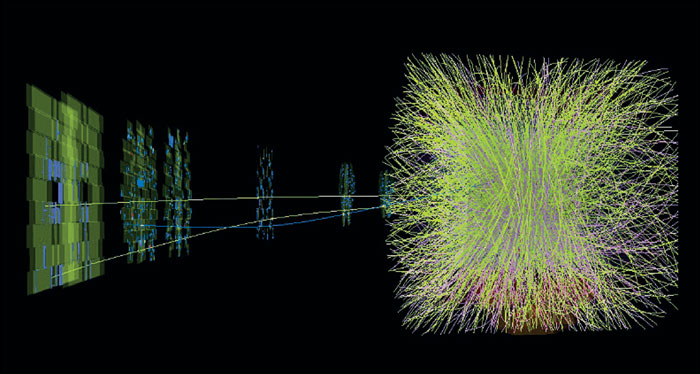
In the recent test of this mode of operating the LHC, collisions were provided for a few hours in the early morning of 13 September (Celebrations, challenges and business as usual). The LHCb detector worked perfectly during the test, as the figure shows, and it was exciting for the LHCb team to see this new category of events being recorded. The data were analysed quickly and clean signals were reconstructed for decays of KS and Λ decays (long-lived particles containing the strange quark). The signals were found to be even cleaner than equivalent ones extracted from pp data. This was to some extent expected, because the luminosity was low during the test run, so there were only single primary pPb interactions, whereas in pp running there may be four or more primary interactions in the same event in LHCb. However, once the signals had been normalized to the number of primary vertices, there still remained a factor of three or so enhancement in the pPb data compared with pp.
This is a first indication of the interesting physics that can be studied in the full pPb run, currently scheduled for early in 2013. With its high-precision vertex reconstruction and powerful particle-identification capabilities, the LHCb experiment should provide extra information to complement the measurements from the other experiments. In particular, the production rates of heavy-flavour states such as the J/ψ and Υ, or charmed particles, will be of interest in the forward region.
The protons and nuclei accelerated by the LHC are surrounded by strong electric and magnetic fields. These fields can be treated as an equivalent flux of photons, making the LHC the world’s most powerful collider not only for protons and lead ions but also for photon–photon and photon–hadron collisions. This is particularly so for beams of multiply charged heavy-ions, where the number of photons is enhanced by almost four orders of magnitude compared with the singly charged protons (the photon flux is proportional to the square of the ion charge).
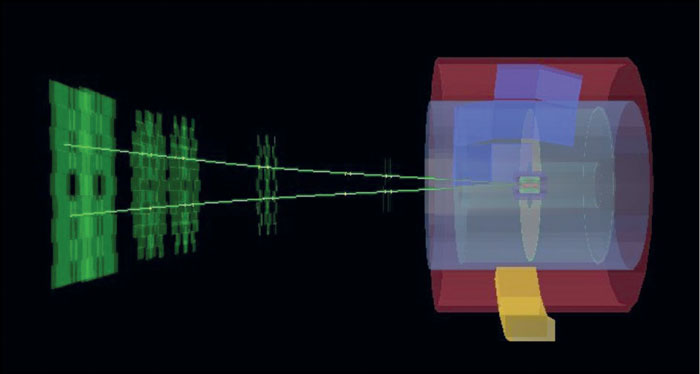
The ALICE collaboration has recently taken advantage of this effect in a study of coherent photoproduction of J/ψ mesons in lead–lead (PbPb) collisions. The J/ψ is detected through its dimuon decay in the muon arm of the ALICE detector, which also provides the trigger for these events. The relevant collisions typically occur at impact parameters of several tens of femtometres, which is well beyond the range of the strong force, so the nuclei usually remain intact and continue down the beam pipe. The photonuclear origin of the J/ψ is therefore ensured by requiring that the detector is void of other particles, that there is only one positive and one negative muon candidate, and that the J/ψ has very low transverse momentum, etc. The appearance of these events (see figure) stands in sharp contrast to central heavy-ion collisions, where thousands of particles are produced.
These interactions carry an interesting message about the partonic substructure of heavy nuclei. Exclusive photoproduction of heavy vector mesons is believed to be a good probe of the nuclear gluon distribution. The cross-section measured in a heavy-ion collision Pb+Pb → Pb+Pb+J/ψ is a convolution of the equivalent photon spectrum with the photonuclear cross-section for γ+Pb → J/ψ+Pb. The latter process can be modelled as the colourless exchange of two gluons.
At the rapidities (y around 3) studied in ALICE, J/ψ photoproduction is sensitive mainly to the gluon distribution at values of Bjorken-x of about 10–2. Although the experimental error is rather large, the conclusion from ALICE is that the data favour models that include strong modifications to the nuclear gluon distribution, known as nuclear shadowing.
Diffractive processes represent more than 25% of the cross-section for inelastic proton–proton collisions at the LHC. So, it is only natural that the ALICE collaboration is interested in a field that started with optical phenomena but which today provides access to non-perturbative QCD processes, at the heart of ALICE’s scientific programme. There are also practical reasons that diffraction cannot be ignored, for instance, when normalizing data to specific event classes such as non-single diffractive (NSD) or inelastic (INEL), or when measuring precisely the proton–proton inelastic cross-section, which is used by ALICE as input for model calculations to determine the number of nucleon–nucleon binary collisions in heavy-ion collisions.
Diffractive reactions in particle physics are characterized by an exchange that has the quantum numbers of the vacuum – the pomeron – and leaves a “rapidity gap”, devoid of particles. Experimentally, there is no possibility to distinguish large rapidity gaps caused by pomeron exchange from those caused by other colour-neutral exchanges (e.g. secondary Reggeons). The ALICE collaboration therefore used the occurrence of large rapidity gaps as definition of diffraction (figure 1). Single Diffraction (SD) processes are those that have a large gap in rapidity from the leading proton, limited by the value of the diffracted mass MX < 200 GeV/c2 on the other side; other inelastic events are considered NSD events. Double diffraction (DD) processes are defined as NSD events with a gap in pseudorapidity, Δη > 3.
ALICE profited from particularly favourable circumstances in its study of diffraction: a detector sensitive to particles with low transverse-momentum, down to about 20 MeV/c; data taken with low luminosity so that corrections for event overlap in the same proton bunch-crossing are small; and above all, the presence in the collaboration of Martin Poghosyan, a developer of diffraction models and a former co-worker of the late Aleksei Kaidalov, which gave ALICE privileged access to the details of the Kaidalov-Poghosyan (KP) model.
The challenge was to study diffraction while being unable to observe either the non-diffracted proton or events in which the diffracted system escapes the acceptance of the detector. Nevertheless, the ALICE detectors cover a sufficient range in pseudorapidity (8.8 units, from –3.7 to 5.1, for collisions at the origin of the co-ordinate system) to have ample sensitivity to the SD and DD processes. Two independent observables were identified that are sensitive to diffraction: the ratio of the numbers of SD-like (activity on one side of the detector only) to NSD-like (activity on both sides of the detector) events; and the width distribution of the pseudorapidity gap for events of NSD type.
Obtaining the relative rates of diffractive processes from these two observables required the use of a model, so ALICE chose the KP model to estimate the fraction of unseen events. In practice, the diffracted-mass distribution is the sole relatively unknown parameter – the kinematics of diffractive collisions and the fragmentation of the diffracted system are known with sufficient precision. Experimental data and recent models that include higher-order pomeron terms show that the variation of the diffracted-mass distribution with centre-of-mass energy is slow, which gives confidence that extrapolation to LHC energies does not add a large uncertainty.
The sensitivity to models was studied by considering different models for the diffracted-mass distribution. The systematic error was obtained from extreme cases, varying the KP model by a factor of ±50% at the low-mass threshold and using the Donnachie-Landshoff model as the other limit. A van der Meer scan of the transverse profiles of the beams provided the luminosity L. The simulation needed to be adjusted using the KP model and the observed relative rate of diffraction to determine the acceptance and efficiency factor, A, in the measurement of the trigger rate, R(t), so that the inelastic cross-section, σINEL, could be determined, using R(t) = A × σINEL × L. Combining the relative rates of diffractive processes with inelastic cross-sections, ALICE obtained the SD and DD cross-sections at three centre-of-mass energies, √s = 0.9, 2.76 and 7 TeV, as shown in figure 2. (σINEL at √s = 0.9 TeV was not measured by ALICE, instead, σINEL = 52.5+2.0/–3.3 was used.)
This first measurement of SD and DD cross-sections at the LHC confirms that these processes evolve only slowly from the centre-of-mass energies of the Intersecting Storage Rings to 7 TeV at the LHC. The analysis by ALICE also shows the importance of including diffraction correctly to describe precisely the acceptance and efficiency of the detector for minimum bias triggers.
Top quarks are especially interesting at the LHC because they are the most massive fundamental particle known, suggesting an intimate association with electroweak symmetry breaking and possible new-physics scenarios.
The top quark decays via two channels: t → Wb → lνb or t → Wb → qqb. When a tt pair is created in an experiment with energy roughly equal to the quark–antiquark rest mass, the decay products appear well separated in the detector. With the higher energies at the LHC, however, particles are often given a “boost” in momentum when produced so the decay products of a tt pair have extra momentum along the directions of the top and antitop, and are found in opposite hemispheres of the detector.
While higher energies allow the experiments at the LHC to probe for new physics as never before, they also bring new challenges. For example, what if the top quark is so boosted that the three jets from the decay t → Wb → qqb merge to a point where they are indistinguishable from each other and appear as one large jet? With the high energy at the LHC, this boosted situation happens quite often and must be accounted for when reconstructing top-quark decays. Analyses involving top quarks or other “boosted objects” at the LHC, now include approaches that allow for these effects.
The special techniques for measuring boosted top quarks are particularly important when searching for new resonances, where a new heavy particle decaying primarily into tt pairs could be observed as a bump in the relevant invariant mass spectrum. The higher the mass of the new particle, the more likely it is that the top-quark decay products will merge in the detector.
ATLAS recently performed searches for tt resonances in final states with one or no leptons. In the former case, the lepton is allowed to be much closer to the b quark than in non-boosted analyses. In the other hemisphere of the detector, a wide massive jet with underlying structure is required. Using these boosted techniques, the sensitivity to a new heavy-gauge boson increased by nearly 700 GeV.
With the expected energy upgrade of the LHC the frequency of boosted final states will increase and even more sophisticated methods will be needed to search for physics beyond the Standard Model. The future, is certainly boosted.
On 10–12 September, some 500 physicists attended an open symposium in Krakow for the purpose of updating the European Strategy for Particle Physics, which was adopted by CERN Council in 2006. The meeting provided an opportunity for the global particle-physics community to express views on the scientific objectives of the strategy in light of developments over the past six years. With the aid of a local organizing committee, it was arranged by a preparatory group chaired by Tatsuya Nakada (see Viewpoint Charting the future of European particle physics).
The triple-alpha reaction rate that produces carbon-12 in stars and other energetic astronomical phenomena has been a tricky subject for nuclear theorists for some time. Initially, Fred Hoyle proposed that there should be a 0+ resonance close to the 3α threshold to justify the observed abundances of carbon-12 in stars, a theory that was later confirmed experimentally. However, if there is not enough energy in the stellar environment to reach the narrow resonances involved, then a direct three-body capture becomes the favoured path.
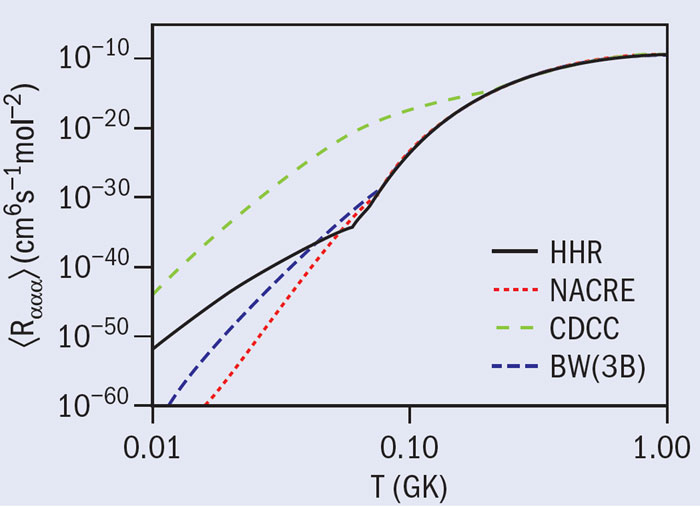
In the Nuclear Astrophysics Compilation of Reaction Rates (NACRE), the direct triple-alpha capture rate has been extrapolated from the two-step resonant capture to temperatures well below 108 K, where the resonant capture dominates (C Angulo et al. 1999). However, this estimation has proved inadequate and nuclear theorists began trying to solve the problem more directly.
Recently, a team at Kyushu University in Japan made use of the continuum-discretized coupled-channel (CDCC) method, which expands the full three-body wave function in terms of the continuum states of the two-body subsystem – in this case beryllium-8 (Ogata et al. 2009). This method is challenging in the case of the triple-alpha reaction problem because the charged-particle reaction occurs at large distances and is dominated by Coulomb interactions. The results reflected these challenges, as the predicted rates showed an increase of 20 orders of magnitude when compared with NACRE, and caused the red-giant phase in low- and intermediate-mass stars to disappear in theoretical models of stellar evolution. Additionally, studies of helium ignition in accreting white dwarfs and accreting neutron stars showed that the CDCC rate is barely consistent with observations of Type Ia supernovae and type I X-ray bursts, respectively.
To skirt some of these difficulties, the nuclear theory group at the National Superconducting Cyclotron Laboratory at Michigan State University combined the Faddeev hyperspherical harmonics and the R-matrix method (HHR) to obtain a full solution to the three-body triple-alpha continuum (Nguyen et al. 2012). The researchers find that the HHR method agrees well with NACRE above 7 × 10⁷ K. However, below that temperature the calculations revealed a pronounced increase of the rate accompanied by a completely different temperature dependence. Though the results do show a strong enhancement at these low energies, it is not as strong as that seen in the CDCC result.
This finding turns out to have crucial repercussions for astrophysics. When the new results are used in stellar evolution simulations within the MESA (Modules for Experiments in Stellar Astrophysics) code, the red-giant phase in the stellar evolution of low- and intermediate-mass stars survives. The team plans to carry out further astrophysical studies to understand the implications of the new rate in explosive scenarios in the near future.
Astronomers have been tracking the motion of stars at the very centre of the Galaxy for the past 20 years. One star in particular has attracted a great deal of attention by completing a full orbit round the supermassive black hole at the centre with a period of about 16 years. Now a team using the two Keck telescopes in Hawaii has detected another much fainter star with an even shorter period of only 11.5 years. This second star will help test Albert Einstein’s theory of general relativity in the strong gravitational field of the back hole.
The Sun is located at the periphery of a disc-shaped spiral galaxy, commonly known as the Galaxy. Seen from Earth, the lights from thousands of millions of stars in this galaxy form a bright stripe across the night sky. This is the Milky Way. However, most of the stars remain hidden behind an inhomogeneous web of gas and dust, forming the interstellar medium. While this absorbing material obscures the view of the galactic centre in visible light, at infrared wavelengths, dust becomes much more transparent. The advent of infrared cameras in the 1990s therefore allowed the detection of the Galaxy’s most centrally located stars for the first time.
Europeans and Americans competed to follow the motion of these stars with the goal of ascertaining the existence of a supermassive black hole in the Galaxy. The Europeans started in 1992 by using the New Technology Telescope and then the Very Large Telescope of the European Southern Observatory (ESO) in Chile, and since 1995 the Americans have used the Keck Observatory in Hawaii. Both groups used a star, S0-2, that orbits the radio source Sagittarius A* in 15.9 years to derive the mass and the distance of the black hole coinciding with this source. Around four years ago, they obtained a result of about 4 million solar masses located some 27,000 light-years away.
Now a group of astronomers, led by Leo Meyer and Andrea Ghez from the University of California, Los Angeles, has found a second star that is even closer to the supermassive black hole, with a period of only 11.5 years. Being 16 times fainter than S0-2, this new source, S0-102, was difficult to detect by the twin Keck telescopes in the crowded central region of the Galaxy. It is mainly thanks to adaptive optics that this star could be identified and tracked. Adaptive optics, first employed in 2004 at the Keck Observatory, is a technique used to correct in real time the deformation of the image induced by turbulence in the atmosphere. The wave-front deformation is measured by observing a bright star or an artificial “guide star”, generated in the upper atmosphere by a powerful sodium laser. The correction is implemented by changing the inclination and the shape of the deformable secondary mirror on time scales of a few milliseconds.
The detection of a second star orbiting closely the supermassive black hole of the Galaxy will enable tests of general relativity in a gravitational potential that is two orders of magnitude stronger than at the surface of the Sun. The effect of curved space–time manifests itself by a deviation from the Keplerian orbit of the stars and a relativistic red shift of their emission. The gravitational red shift could become measurable at the next closest approach to the black hole, in 2018 for S0-2 and three years later for S0-102. The deformation of the elliptical orbits induced by curved space–time will be more difficult to identify and might await the next generation of 30-m class telescopes. The presence of the second star will anyway be instrumental in breaking the degeneracy inherent in the measurement of curved space–time with a single star.
The Quark Matter conferences, held roughly every 18 months, form the most important series of meetings in relativistic heavy-ion physics. The latest and 23rd in the series took place on 13–18 August at the Omni Shoreham hotel, a historic landmark in downtown Washington, DC. The meeting attracted around 700 participants from all around the world who discussed an unprecedented amount of new heavy-ion data from experiments at both Brookhaven National Laboratory (BNL) and CERN. This rich harvest of high-quality experimental results from the PHENIX and STAR collaborations at BNL’s Relativistic Heavy-Ion Collider (RHIC) and the ALICE, ATLAS and CMS collaborations at CERN’s LHC is providing a deep insight into the behaviour of quarks and gluons under the extreme conditions of high temperature and density.
The opening ceremony included presentations by Bart Gordon, former chair of the US House of Representatives Committee on Science and Technology, Timothy Hallman, associate director of Science for Nuclear Physics of the US Department of Energy, and Samuel Aronson, director of BNL. Urs Wiedemann of CERN provided an overview of the current status of relativistic heavy-ion physics, followed by highlights from the experiments presented by Takao Sakaguchi of PHENIX, Xin Dong of STAR, Karel Safarik of ALICE, Barbara Wosiek of ATLAS and Gunther Roland of CMS. The welcome reception was held at the spectacular Smithsonian Institute’s National Portrait Gallery.
Understanding the quark–gluon plasma
Quantum chromodynamics (QCD) – the theory describing the interactions of quarks and gluons – is believed to be responsible for 99% of the mass of the visible universe, with the Higgs boson responsible for the remaining 1%. It has become clear that this mass originates mainly from the self-interaction of gluons, which at short distances is governed by asymptotic freedom. Yet the dynamics of gluon interactions in the large-distance, strong-coupling regime, which is responsible for quark confinement and the existence of atomic nuclei, remains mysterious. It is intimately linked to the complicated and poorly understood structure of the QCD vacuum.
QCD is believed to be responsible for 99% of the mass of the visible universe
The understanding of matter is often advanced by the study of phase transitions in macroscopic systems; thus heavy-ion physics aims towards a better understanding of QCD by creating a “macroscopic” domain of excited vacuum populated by a hot quark–gluon fireball. Advancing the understanding of the quark–gluon plasma also helps in better understanding the origins of the universe – this is because the conditions created in heavy-ion collisions, albeit fleetingly, are similar to the conditions that existed a few microseconds after the Big Bang. In addition, because both QCD and the electroweak sector of the Standard Model are described by non-Abelian gauge theories, understanding the QCD plasma will therefore provide valuable insight into the dynamics of matter at temperatures above the electroweak phase transition that are not accessible in the laboratory. This is important because, for example, the topological “sphaleron” transitions in the electroweak plasma could be responsible for the baryon asymmetry of the present-day universe.
A major advance in the physics of the QCD plasma made possible by the data from RHIC – and now also from the LHC – was the realization that at experimentally accessible temperatures the plasma behaves as a liquid with small dissipation, quantified by small values of shear and bulk viscosities. This implies that there exists a range of temperatures above the deconfinement phase transition in which the plasma does not at all resemble the quasi-ideal gas of quarks and gluons that is expected at high temperatures as a result of asymptotic freedom. At strong coupling, the non-Abelian plasma possesses small shear viscosity as exemplified by the supersymmetric plasma that is amenable to the studies by holographic methods based on string theory. In the latter case, the ratio of shear viscosity to entropy at strong coupling reaches the value of 1/(4π), a value that was conjectured to be the universal lower bound for any fluid. The physics underlying this bound is of a quantum nature because at strong coupling the mean free path approaches the de Broglie wavelength of the constituents, making the quasi-particle picture inapplicable.
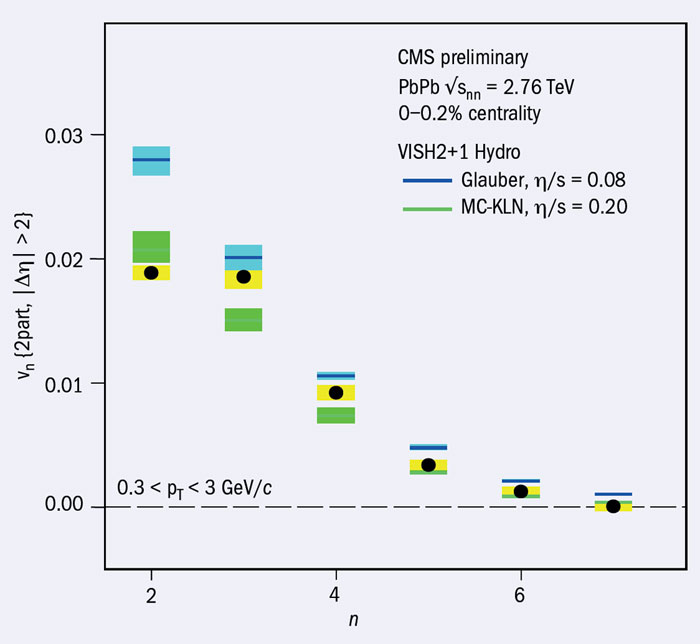
The new data presented at Quark Matter 2012 have strengthened the case for the “perfect liquid” and made the physical picture more detailed. The data on hadron spectra and azimuthal correlations from RHIC and the LHC point towards the presence of well localized quantum fluctuations at the early stage of the collision that induce excitations in the quark–gluon liquid. The azimuthal distributions of hadrons are conveniently parameterized by their Fourier coefficients vn. For large n, these coefficients signal the presence of localized fluctuations at the early stage of the collision; their values should be sensitive to the shear viscosity of the liquid.
Ordinarily, the “elliptic flow” v2 dominates over higher harmonics because it reflects decompression of the elliptical shape of the produced fireball. However, all harmonics in the most-central heavy-ion collisions become similar, as illustrated in figure 1 by data from the CMS collaboration in the 0.2% most-central lead–lead (PbPb) collisions at the LHC. A comparison of the data with hydrodynamical calculations shows that the shear viscosity of the liquid is quite close to the conjectured quantum bound, although its precise value depends on the choice of initial conditions.
The initial conditions in heavy-ion collisions are determined by the structure of nuclear wave-functions at small Bjorken-x and the dynamics of their interaction. Significant progress in the understanding of QCD at small x has been made in recent years, triggered by the data from RHIC and the LHC. The quantum evolution in QCD and the high density of partons in Lorentz-contracted nuclei (which can be described as the “colour glass condensate”) lead to the emergence of strong colour fields that dominate the early moments of heavy-ion collisions. The data on the collective flow and other observables suggest that thermalization occurs very early on – within 1 fm/c of the beginning of the collision. The dynamics of this “early thermalization” is not yet entirely understood but several promising theoretical developments were reported at the conference.
One of the proposed signatures of the colour glass condensate is the disappearance of quantum back-to-back di-jet correlations in the forward rapidity region of deuterium–gold collisions at RHIC, owing to the emergence of a semi-classical gluon field at small Bjorken-x. Both the PHENIX and STAR collaborations reported on observations of this effect at RHIC.
The QCD medium can be studied using hard probes to investigate its response to external localized perturbations. The RHIC experiments observed the strong quenching of high-transverse-momentum hadrons and jets that had been proposed as a signature of hot and dense quark–gluon matter. The LHC has significantly extended the kinematic reach in the studies of jets. All LHC experiments found that the strong suppression of jets persists up to high jet energies.
There is no clear sign of the dependence of jet-energy loss on the colour charge of the parton
The mechanism behind the jet-energy loss is still not clear: does it depend on the colour charge of the leading parton (quark or gluon)? Is it suppressed for heavy quark jets, as expected for the medium-induced gluon radiation as a result of the “dead cone” effect? Are the dynamics of energy loss adequately described by perturbative QCD, or does it call for new strong-coupling methods? These questions can be answered only after more detailed data are acquired on jet shapes and flavour-tagged jets.
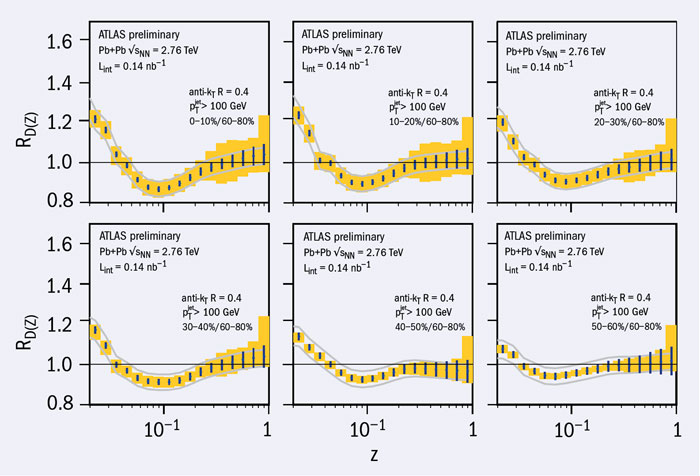
An interesting effect of the modification of the jet-fragmentation function in PbPb collisions was reported at the conference by the ATLAS and CMS collaborations. Figure 2 shows the ATLAS result. In addition to the enhancement of hadron production at a small fraction of the jet energy z, there is also a sizable dip for the intermediate values of z, which has yet to be understood.
As for the flavour-tagged jets, high-energy b- and c-tagged jets are seen by the LHC experiments to be quenched similarly to the inclusive jets, which are dominated by gluons. At present there is no clear sign of the dependence of jet-energy loss on the colour charge of the parton. At transverse momenta below 8 GeV, there is a hint of weaker quenching for D mesons than for light hadrons, as reported by the ALICE collaboration. The electrons from heavy-flavour decays that receive a significant contribution from beauty decays at high transverse momenta have been found by ALICE to be quenched less than the charm decays of D mesons, as figure 3 shows. This suggests that the quenching of bottom quarks is weaker than that of charm quarks.
The PHENIX collaboration presented the first data on heavy-meson quenching from decay electrons obtained by using their new silicon vertex detector. In accord with the expectations from theory, D mesons are observed to be suppressed less than light hadrons. However, the PHENIX collaboration found surprising hints of a significantly stronger suppression of B-mesons.
An important baseline for jet quenching is provided by the colourless probes – the photons, Z and W bosons. Indeed, the ATLAS and CMS collaborations reported the production of Z bosons with no sign of suppression up to transverse momenta of about 100 GeV. This implies that the observed suppression of jets is, indeed, a result of the colour dynamics.
Heavy quarkonium has been proposed as a probe of deconfinement – the Debye screening in the quark–gluon plasma (QGP) is expected to make quarkonium formation impossible. Strong suppression of J/ψ production was observed at CERN’s Super Proton Synchrotron – and then at RHIC and at the LHC. Studies of heavy quarkonium have now been extended to the bottomonium family, with the expected hierarchy of suppression, as shown in figure 4a from the CMS collaboration: it is more difficult to dissolve states with larger binding energies and smaller radii.
Nevertheless, the observed suppression stems from a complicated interplay of final- and initial-state effects, as suggested by the recent PHENIX data on J/ψ production in asymmetrical copper–gold (CuAu) collisions presented at the conference (figure 4b). The J/ψ suppression at rapidities in the Cu fragmentation region is found to be stronger than in the Au-fragmentation region. This is inconsistent with a final-state effect alone because the density of produced particles is larger in the Au-fragmentation region. On the other hand, J/ψ production in central CuAu collisions in the Cu-fragmentation region selects a high-density region in the wave function at small x of the Au nucleus. The rescattering of heavy quarks in this dense gluon system before the formation of the QGP is expected to reduce the probability for J/ψ formation.
Fluctuations, broken symmetries and the critical point
An important goal of heavy-ion physics is to map the QCD phase diagram. A prominent feature of this phase diagram is the possible existence of a critical point at finite baryon density at the end of the first-order phase-transition curve. The signature of the critical point is the enhancement of fluctuations, including the fluctuations of net baryon number. Experimental access to the high baryon-density in heavy-ion collisions requires decreasing the energy of the collisions at RHIC. The search for the critical point, and thus for the disappearance of signatures of deconfined matter, was the goal of the recent scan of the beam energy at RHIC.
Both the STAR and PHENIX collaborations reported results from the RHIC Beam Energy Scan at the conference. The STAR experiment sees an intriguing deviation of the higher moments of net proton-fluctuations from the Poisson baseline and from the expectations based on Monte-Carlo models at centre-of-mass energies below 20 GeV. A measurement at higher statistics with a finer step in collision energy will be needed to tell whether this observation does point to the existence of the critical point. As the energy of the collision was decreased, several signatures of the plasma phase were found to disappear, as reported by STAR. These include the suppression of the high-transverse momentum hadrons, the scaling in constituent number of the elliptic flow and the fluctuations of charge separation, which is a consequence of the chiral magnetic effect.
Theoreticians have proposed the existence of quantum fluctuations of topological origin in the early stage of heavy-ion collisions, which generate chirality similarly to the electroweak sphalerons that generate baryon number at much higher temperatures. In the presence of the strong magnetic field generated by the colliding heavy ions, the fluctuations in net chirality can lead to fluctuations in the electric-charge separation because of the “chiral magnetic effect”. The resulting observable is the event-by-event fluctuation in the electric-charge separation relative to the reaction plane, signalling the fluctuating electric dipole moment of the plasma. The effect can be accessed experimentally by measuring the difference in the fluctuations of the parity-odd harmonics of azimuthal distributions for hadrons of the same and opposite charge. The effect has been seen at RHIC by the STAR and PHENIX experiments; an effect of similar strength was also reported by the ALICE collaboration.
However, because the observable is parity-even it can receive contributions from more mundane effects. An alternative conventional explanation has been put forward based on the combination of correlations between opposite electric charges and the elliptic flow. Usually, the elliptic flow is correlated with the magnetic field by the geometry of the collision and both vanish in central collisions. However, the new RHIC data on uranium–uranium (UU) collisions allow separation of the two effects. Because of the deformed shape of the uranium nucleus, the central collisions produce a deformed fireball leading to a sizeable elliptic flow; yet, the number of spectators detected by the Zero Degree Calorimeter is small, so the magnetic field must be greatly suppressed. Thus, it should be possible to establish whether the observed fluctuations in charge asymmetries are driven by the elliptic flow or by the magnetic field.
Preliminary data from STAR presented at the conference indicate that the difference in the fluctuations of the asymmetry for the same- and opposite-charge hadrons vanishes in central UU collisions (figure 5), suggesting that these fluctuations are driven by the magnetic field. Another important result on this topic reported by STAR was the difference between the elliptic flows of positive and negative pions in AuAu collisions at 200 GeV, which is found to be linearly dependent on the charge asymmetry in the event, as expected on the basis of the chiral magnetic effect. New refined data are necessary to reach a definitive conclusion on this issue. Topological transitions in QCD generating chirality are analogous to the electroweak sphaleron transitions that generated the baryon asymmetry of the universe shortly after the Big Bang. Therefore, understanding them better is important.
Broad connections
The conference highlighted the broad connections of relativistic heavy-ion physics to condensed-matter physics, string theory, cosmology and astrophysics. For example, the small viscosity of the QGP makes it similar to such seemingly distant objects as ultracold atoms and graphene, where the charge carriers are chiral and the effective coupling is large. The non-dissipative chiral magnetic current appears to exist also in Weyl semimetals and opens possibilities for the creation of a new generation of electronic devices.
The conference made clear the need for dedicated future facilities, several of which were discussed, including: the Electron–Ion Collider needed for a precision study of small-x gluon wave-functions of nuclei and of the spin structure of the proton; the Large Hadron–Electron Collider at CERN, which would advance the high-energy, high-momentum-transfer frontier of deep-inelastic scattering; the Facility for Antiproton and Ion Research under construction at GSI in Darmstadt; and the Nuclotron-based Ion Collider facility, currently under construction in Dubna. The case for the latter two facilities was advanced by the first results from the beam-energy scan at RHIC that were reported at the conference.
Summaries of the results presented were provided by three pairs of rapporteurs, each pair composed of a theorist and experimentalist: Boris Hippolyte of the Institut Pluridisciplinaire Hubert Curien and Dirk Rischke of the University of Frankfurt on global variables and correlations; Jorge Casalderrey-Solana of the University of Barcelona and Alexander Milov of the Weizmann Institute of Science on high-transverse-momenta and jets; and Charles Gale of McGill University and Lijuan Ruan of BNL on heavy flavours, quarkonia and electroweak probes. The wealth of new data and the resulting leap in the theoretical understanding of QCD matter were possible only because of the successes of the two complementary experimental programmes at RHIC and the LHC.
To provide the best experiences, we use technologies like cookies to store and/or access device information. Consenting to these technologies will allow us to process data such as browsing behavior or unique IDs on this site. Not consenting or withdrawing consent, may adversely affect certain features and functions.
Functional
Always active
The technical storage or access is strictly necessary for the legitimate purpose of enabling the use of a specific service explicitly requested by the subscriber or user, or for the sole purpose of carrying out the transmission of a communication over an electronic communications network.
Preferences
The technical storage or access is necessary for the legitimate purpose of storing preferences that are not requested by the subscriber or user.
Statistics
The technical storage or access that is used exclusively for statistical purposes.The technical storage or access that is used exclusively for anonymous statistical purposes. Without a subpoena, voluntary compliance on the part of your Internet Service Provider, or additional records from a third party, information stored or retrieved for this purpose alone cannot usually be used to identify you.
Marketing
The technical storage or access is required to create user profiles to send advertising, or to track the user on a website or across several websites for similar marketing purposes.