Comsol -leaderboard other pages

Topics

On the Topology and Future Stability of the Universe

By Hans Ringström
Oxford University Press
Hardback: £80 $125
Also available as an e-book

41Rn0DaRnjL._SX328_BO1,204,203,200_

This volume in the series of Oxford Mathematical Monographs contains a general introduction to the Cauchy problem for the Einstein–Vlasov system, a proof of future stability spatially of locally homogeneous solutions, and a demonstration that there are models of the universe that are consistent with the observations but have arbitrary compact spatial topology. It includes a general description of results in the area, relevant to mathematicians and physicists with knowledge of general relativity.

Advanced General Relativity: Gravity Waves, Spinning Particles, and Black Holes

By Claude Barrabès and Peter A Hogan

Oxford University Press
Hardback: £55 $89.95
Also available as an e-book

41V6dQvOKrL._SX343_BO1,204,203,200_

This book is aimed at students making the transition from a first course on general relativity to a specialized subfield. It presents a variety of topics under the general headings of gravitational waves in vacuo and in a cosmological setting, equations of motion, and black holes, all having clear physical relevance and a strong emphasis on space–time geometry. Each chapter could be used as the basis for an early postgraduate project for those who are exploring avenues into research in general relativity, and who have already accumulated the technical knowledge required.

Geometric and Topological Methods for Quantum Field Theory: Proceedings of the 2009 Villa de Leyva Summer School

By Alexander Cardona, Iván Contreras and Andrés F Reyes-Lega (eds.)
Cambridge University Press
Hardback: £75 $125
Also available as an e-book

51FtqsvZvcL._SX348_BO1,204,203,200_

Based on lectures given at the Villa de Leyva Summer School, this book presents modern geometric methods in quantum field theory. Covering areas in geometry, topology, algebra, number-theory methods and their applications to quantum field theory, the book covers topics such as Dirac structures, holomorphic bundles and stability, Feynman integrals, geometric aspects of quantum field theory and the Standard Model, spectral and Riemannian geometry and index theory. It is a valuable guide for graduate students and researchers in physics and mathematics wanting to enter this interesting research field at the border between mathematics and physics.

Introduction to the Statistical Physics of Integrable Many-body Systems

By Ladislav Šamaj and Zoltán Bajnok
Cambridge University Press
Hardback: £80 $130
Also available as an e-book

9781107030435

Beginning with a treatise of non-relativistic 1D continuum Fermi and Bose quantum gases of identical spinless particles, this book describes the quantum inverse-scattering method and analysis of the related Yang–Baxter equation and integrable quantum Heisenberg models. It also discusses systems within condensed-matter physics, the complete solution of the sine-Gordon model and modern trends in the thermodynamic Bethe ansatz. Each chapter concludes with problems and solutions to help consolidate the reader’s understanding of the theory and its applications.

Gottes unsichtbare Würfel: Die Physik an den Grenzen des Erforschbaren

By Helmut Satz
C H Beck
Hardback: €19.95
Also available as an e-book

Also published as:

Ultimate Horizons: Probing the Limits of the Universe
Springer

Hardback: £44.99 €53.49
E-book: £35.99 €41.65

CCboo2_03_14

This book is one of the most interesting introductions to today’s problems and advances in the fields of cosmology, particle and nuclear physics that I have seen. The author’s talent in explaining complex problems with “simple” language is certainly the fruit of his life-long teaching experience at the University of Bielefeld and other places. There are numerous examples where the reader is given easy “visualizations” of scientific findings. For instance, if our eyes were sensitive to photons with a wavelength of about 7 cm, then we would see the sky illuminated even at night, thanks to the cosmic microwave background – the afterglow of the Big Bang. Another example is the Casimir effect – a curious demonstration that “the vacuum is not empty” – while Paul Dirac’s sea is revisited to define empty space as a “sea of unborn particles”.

It is worth emphasizing that this book does not simply present a collection of facts. The author deliberately discusses implications of certain findings and manages to connect ideas and concepts from different branches of physics extremely well. For example, the term “horizon” is transported from general relativity to the field of particle physics, in the context of quark confinement, in introducing the concept of the “colour horizon” – the distance beyond which the quarks no longer interact with each other.

Each of the different topics is introduced properly from a historical perspective, always quoting the originator of the idea carefully, which sometimes goes back to the Ancient Greeks. It is interesting to depict the historical evolution of the concept of elementary particles as the “Matryoshka doll” of physics: atoms, thought at first to be indivisible, are actually composed of electrons and nuclei, the latter being themselves composed of protons and neutrons, which are composed of quarks.

A part of the book is dedicated to the studies of quark–gluon plasma, an area where the author has done pioneering work, including a seminal paper that is currently one of the most cited publications in particle physics. Also of interest is the collection of carefully inserted historical anecdotes. Even writers and poets, such as Michael Ende, Lewis Carroll, Edgar Allan Poe and Italo Calvino, find their words in the book.

From reading the book it transpires that, often, formulating a new problem is even more important than solving it. Scientific progress is mostly made through abstract thinking. Helmut is interested in understanding old and new problems of physics and, building on many years of studies and deep reflection, successfully transmits this enthusiasm to the reader. It certainly triggers further thinking.

Handbook of Accelerator Physics and Engineering (2nd edition)

By Alexander Wu Chao, Karl Hubert Mess, Maury Tigner and Frank Zimmermann (eds.)
World Scientific
Hardback: £91
Paperback: £51
E-book: £38
Also available at the CERN bookshop

51sxu02YmdL._AC_SY780_

Edited by internationally recognized authorities in the field, this expanded and updated second edition contains more than 100 new articles. With more than 2000 equations, 300 illustrations and 500 graphs and tables, it is intended as a vade mecum for professional engineers and physicists engaged in the design and operation of modern accelerators. In addition to the common formulae of previous compilations, it includes hard-to-find, specialized formulae, as well as material pooled from the lifetime experience of many of the world’s experts. The eight chapters include both theoretical and practical matters, as well as an extensive glossary of accelerator types. A detailed name and subject index is provided, with reliable references to the literature where the most detailed information available on all of the topics can be found.

The Mass Gap and its Applications

By Vakhtang Gogokhia and Gergely Gabor Barnaföldi
World Scientific
Hardback: £65
E-book: £49

41dlWZsFuRL._SX312_BO1,204,203,200_

QCD is the most up-to-date theory of strong interactions. However, standard perturbative procedures fail if applied to low-energy QCD. Even the discovery of a Higgs boson will not solve the problem of masses originating from the non-perturbative behaviour of QCD. This book presents a new method – the introduction of the “mass gap” – first suggested by Arthur Jaffe and Edward Witten at the turn of the millennium. As the energy difference between the lowest order and the vacuum state in Yang–Mills quantum-field theory, the mass gap is – in principle – responsible for the large-scale structure of the QCD ground state, and therefore for its non-perturbative phenomena at low energies. The book also presents the applications and outlook of the mass-gap method and includes problems for students.

From the Web to the Grid and Beyond: Computing Paradigms Driven by High-Energy Physics

By René Brun, Federico Carminati and Giuliana Galli Carminati (eds.)
Springer
Hardback: £62.99 €74.85 $99.00
E-book: £49.99 €59.49 $69.95
Also available at the CERN bookshop

CCboo1_03_14

To tell the story behind the title, the editors of this book have brought together chapters written by many well-known people in the field of computing in high-energy physics.

It starts with enlightening accounts by René Brun and Ben Segal of how things that I have been familiar with since being a postdoc came to be. I was intrigued to discover how we alighted on so much of what we now take for granted, such as C++, TCP/IP, Unix, code-management systems and ROOT. There is a nice – and at times frightening – account of the environment in which the World Wide Web was born, describing the conditions that needed to be present for it to happen as it did, and which nearly might not have been the case. The reader is reminded that ground-breaking developments in high-energy physics do not, in general, come about from hierarchical management plans, but from giving space to visionaries.

There are several chapters on the Grid (Les Robertson, Patricia Méndez Lorenzo and Jamie Shiers) and the evolution from grids to clouds (Pedrag Buncic and Federico Carminati). These will be of interest to those who, like me, were involved in a series of EU Grid projects that absorbed many of us completely during the era of “e-science”. The Worldwide LHC Computing Grid was built and is of course now taken for granted by all of us. The discussion of virtualization and the evolution from grids to clouds presents an interesting take on what is a change of name and what is a change of technology.

In another chapter, Carminati gives his candid take on software development – and I found myself smiling and agreeing. Many of us will remember when some sort of religion sprang up around OO design methods, UML, OMT, software reviews and so on. He gives his view of where this helped and where it hindered in our environment, where requirements change, users are developers, and forward motion is made by common consent not by top-down design.

Distributed data and its access is discussed in depth by Fabrizio Furano and Andrew Hanushevsky, who remind us that this is one of the most demanding sectors in computing for high-energy physics. A history of parallel computing by Fons Rademakers is interesting because this has become topical recently, as we struggle to deal with many-core devices. Lawrence Pinsky’s chapter on software legal issues delves into how instruments such as copyright and patents are applied in an area for which they were never designed. It makes for engrossing reading, in the same way that technical issues become captivating when watching legal drama on television.

It is not clear – to me at least – whether Giuliana Galli Carminati’s final chapter on “the planetary brain” is a speculation too far and should be politely passed over, as the author invites the reader to do, or whether there is something significant there that the reader should be concerned about. The speculation is whether the web and grid form something that could be considered as a brain on a planetary scale. I leave you to judge.

It is a highly interesting book, and I plan to read many of the chapters again.


LS1: on the home straight

CCnew1_03_14

When the shift crew in the CERN Control Centre extracted the beams from the LHC on 14 February last year, it marked the beginning of the first long shutdown, LS1, not only for the LHC but for all of CERN’s accelerator complex, after an unprecedented three years of almost continuous running. By the end of last summer, the programme for LS1 had already reached some key milestones. Now, with the cooling of the LHC to begin in May and the restart of the Proton Synchrotron (PS) and Super Proton Synchrotron (SPS) planned for later this year, LS1 is well on schedule.

Throughout LS1, the Superconducting Magnets and Circuits Consolidation (SMACC) project has been responsible for opening interconnections between the LHC magnets for the series of operations needed for magnet-circuit consolidation. A major objective has been to install a shunt on each splice, straddling the main electrical connection and the busbars of the neighbouring magnets. This is to avoid the serious consequences of electric arcs that could arise from discontinuities in the splices.

Despite the complexity of the work on the 27-km-long LHC, there has been excellent progress, with SMACC teams working on different sectors of the accelerator in parallel. By October, the outer “W” sleeves had been removed from the equivalent of seven of the eight sectors, and leak tests were in progress in several sub-sectors. A month later, the first SMACC team had arrived in sector 4-5 and with the opening of the “W” bellows had completed the full tour of the LHC. One-third of the shunts were by then in place and the closure of internal sleeves had begun in sector 7-8. On 28 November, CERN’s director-general, Rolf Heuer, was present for the welding of the last W sleeve in sector 6-7, and expressed his appreciation to the teams involved in the LS1 work. By mid-February, 80% of the interconnections had been consolidated and 85% of the 27,000 shunts had been installed.

CCnew2_03_14

On 15 January, the first pressure tests began in sector 6-7, after all of its vacuum subsectors had been closed and tested. The objective was to check the mechanical integrity and overall leak-tightness of the sector by injecting it with pressurized helium. The tests were a success. Next, the cryogenic teams prepared the sector for new electrical quality-assurance tests at ambient temperature, which were also successful. Two weeks of intensive cleaning followed to flush out any dust and dirt from the repair and consolidation work.

Elsewhere around the LHC, X-ray testing has been used to look for any faults in the machine’s cryogenic distribution system, and 1,344 DN200 safety valves have been installed to release helium in the event of pressure build-up. Compensators on the LHC’s cryogenic distribution lines have been replaced, as has a faulty RF cryomodule. Tests on the back-up electrical supply have also been completed.

Meanwhile, at the PS Booster, a new beam dump and its shielding blocks were installed from October onwards. At the PS itself, the cooling and ventilation system – dating back to 1957 – was replaced with a new ventilation system to aerate radioactive areas more efficiently. At the same time, testing of the newly installed access system was underway. By late October, consolidation of the seven main PS magnets had begun, with magnets being removed from the beam line and delivered to the magnet workshop, to be worked on by a specialized team from Russia.

Thanks to the know-how, motivation and commitment of hundreds of professionals at CERN – as well as teams from member states and beyond – the LHC, its experiments and its injectors are on course to be ready to start the next LHC run in January 2015.

• See cds.cern.ch/journal/CERNBulletin/.

Tevatron experiments find missing piece in top-quark puzzle

CCnew4_03_14

Data from the CDF and D0 experiments at the Tevatron have revealed one of the rarest methods of producing a top quark. The two collaborations announced jointly on 21 February that they have observed s-channel production of single top quarks.

The top quark, t, which was discovered in proton–antiproton collisions at the Tevatron in 1995, is the heaviest elementary particle of the Standard Model, with a mass of 173 GeV. Only the Tevatron and the LHC colliders have so far been capable of making t quarks. In s-channel production, a quark from a proton and an antiquark from an antiproton create a W boson, which decays to a t quark and a b quark. The t quark in turn decays to a new W boson and a b, leading to a final state of Wbb. The production of single t quarks in the s-channel is among the rarest decays of the W boson, given that one of the final state particles (t) has a rest mass more than twice that of the parent W boson.

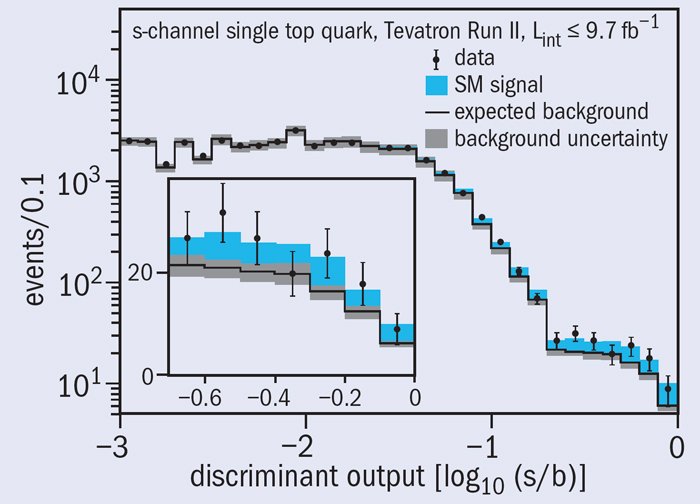
Selecting a region of high signal-to-background, as shown in the figure, required the development of sophisticated analysis methods. These included identifying jets from the hadronization of the b quarks efficiently and with low background. Between them, the CDF and D0 collaborations analysed more than 2 × 1010 events recorded to tape during operation of the Tevatron as a collider between 2001 and 2011.

Each experiment saw a substantial excess of events – about 40 in total – that could be attributed to single s-channel production of the t quark (CDF 2014 and D0 2013). However, only by combining the results from both experiments to make full use of the Tevatron data set, could the teams push the significance of the observation to 6.3σ, consistent with the discovery of a new process (CDF and D0 2014). The measured production cross-section in the s-channel of 1.29 pb agrees with the Standard Model prediction and so excludes the possibility of a particle other than the W boson, not predicted by the Standard Model, as a source of single t quarks.

Detection of this extremely rare process was one of the final goals of the Tevatron programme to be achieved. However, it is not the end of the story for the top quark because many more studies will continue, both with Tevatron data and at the LHC, to understand fully the heaviest known elementary particle.

bright-rec iop pub iop-science physcis connect