Comsol -leaderboard other pages

Topics

Relativistic Hydrodynamics

By Luciano Rezzolla and Olindo Zanotti
Oxford University Press
Hardback: £55

Also available as an e-book

814CjoRuYML

This book provides an up-to-date, lively and approachable introduction to the mathematical formalism, numerical techniques, and applications of relativistic hydrodynamics. It presents a well-organized description of the subject, from the basic principles of statistical kinetic theory, through the technical aspects of numerical methods devised for the solution of the equations, to applications in modern physics and astrophysics. There are numerous figures and diagrams, as well as a variety of exercises, which support the material in the book.

100 Years of Subatomic Physics

By Ernest M Henley and Stephen D Ellis (eds.)
World Scientific
Hardback: £58
Paperback: £32
E-book: £24
Also available at the CERN bookshop

41IDLnrCbvL._SX346_BO1,204,203,200_

By 1911, radioactivity had been discovered for more than a decade but its origin remained a mystery. Ernest Rutherford’s discovery of the nucleus and the subsequent discovery of the neutron by James Chadwick started the field of subatomic physics – a quest to understand the fundamental constituents of matter. This book reviews the important achievements in subatomic physics in the past century. The chapters are divided into two parts – nuclear physics and particle physics – with contributions by many eminent researchers, from Steven Weinberg’s overview of the subject to John Schwarz on string theory and M-theory.

Selected Papers II: With Commentaries

By Chen Ning Yang
World Scientific
Hardback: £65
Paperback: £32
E-book: £24

4135fuWrl+L

Since receiving his PhD from the University of Chicago in 1948, Chen Ning Yang has had great impact in both abstract theory and phenomenological analysis in modern physics. In 1983 he published Selected Papers (1945–1980), With Commentary. Freeman Dyson considered it to be one of his favourite books. This sequel to that previous volume is a collection of Yang’s personally selected papers (1971–2012), supplemented by his insightful commentaries. Its contents reflect his changing interests after he reached the age of 30. It also includes commentaries that he wrote in 2011 when he was 89. The papers and commentaries in this collection comprise a remarkable personal and professional chronicle, shedding light on both the intellectual development of a great physicist and on the nature of scientific inquiry.

Space–Time Symmetry and Quantum Yang–Mills Gravity: How Space–Time Translational Gauge Symmetry Enables the Unification of Gravity with Other Forces

By Jong-Ping Hsu and Leonardo Hsu
World Scientific
Hardback: £65

E-book: £49

61GX2lTKkGL

Yang–Mills gravity is a new theory, consistent with experiments, that brings gravity back to the arena of gauge field theory and quantum mechanics in flat space–time. It provides solutions to long-standing difficulties in physics, such as the incompatibility between Einstein’s principle of general co-ordinate invariance and modern schemes for a quantum mechanical description of nature. The book aims to provide a treatment of quantum Yang–Mills gravity with an emphasis on the ideas and evidence that the gravitational field is the manifestation of space–time translational symmetry in flat space-time, and that there exists a fundamental space–time symmetry framework that can encompass all of physics, including gravity, for all inertial and non-inertial frames of reference.

A Course in Field Theory

By Pierre Van Baal
CRC Press
Also available as an e-book

CCboo2_04_14

Quantum field theory is a mature discipline. One of the key questions today is how to teach and organize this large body of information, which spans several decades and encompasses diverse physical applications that range from condensed-matter to nuclear and high-energy physics. Since the turn of the millennium, interested readers have witnessed progressive growth in publications on the subject. More often than not, the authors choose to edit their own notes extensively, with the purpose of presenting a whole series of lectures as a treatise.

Indeed, it is common to see books on quantum field theory of around 500 pages. Most of these publications give slightly different perspectives on the same subjects, but their treatments are often synoptic because they all refer to some of the classic presentations on field theory of the 20th century. The proliferation of books is at odds with the current practice where students are obliged to summarize a large number of different subjects through shorter texts, or even by systematic searches through various databases.

In this respect, A Course in Field Theory is a pleasant novelty that manages the impossible: a full course in field theory from a derivation of the Dirac equation to the standard electroweak theory in less than 200 pages. Moreover, the final chapter consists of a careful selection of assorted problems, which are original and either anticipate or detail some of the topics discussed in the bulk of the chapters.

Instead of building a treatise out of a collection of lecture notes, the author took the complementary approach and constructed a course out of a number of well-known and classic treatises. The result is fresh and useful. The essential parts of the 22 short chapters – each covering approximately one or two blackboard lectures – are cleverly set out: the more thorough calculations are simply quoted by spelling out, in great detail, the chapters and sections of the various classic books on field theory, where students can appreciate the real source of the various treatments that have propagated through the current scientific literature. Despite the book’s conciseness the mathematical approach is rigorous, and readers are never spoon-fed but encouraged to focus on the few essential themes of each lecture. The purpose is to induce specific reflections on many important applications that are often mentioned but not pedantically scrutinized. The ability to prioritize the various topics is wisely married with constant stimulus for the reader’s curiosity.

This book will be useful not only for masters-level students but will, I hope, be well received by teachers and practitioners in the field. At a time when PowerPoint dictates the rules of scientific communication between students and teachers (and vice versa), this course – including some minor typos – smells pleasantly of chalk and blackboard.

Hans Christian Ørsted: Reading Nature’s Mind

By Dan Ch Christensen
Oxford University Press
Hardback: £39.99 $69.95
Also available as an e-book, and at the CERN bookshop

51N97-zGgfL

Hans Christian Ørsted (1777–1851) is of great importance as a scientist and philosopher, far beyond the borders of Denmark and his own time. His discovery of electromagnetism revolutionized the course of physical research, and in time prompted technological inventions that changed the life of modern societies. He was also remarkable in unifying two cultures – the sciences and the arts. This first comprehensive and contextual biography of Ørsted offers cultural and sociological insights into the European network of scientists in the 19th century, when divergent national paradigms prevailed. It also illuminates Danish cultural and intellectual circles in the so-called Golden Age.

Fun in Fusion Research

By John Sheffield
Elsevier
Hardback: €50.95
E-book: €50.95

CCboo1_04_14

One thing the reader learns from this book is that the path towards achieving controlled nuclear fusion is not smooth or free from the vagaries of funding agencies. You also realize how incredibly difficult the problem is.

The fusion process is well understood and a number of experiments around the world have verified the principles. However, it still has to be demonstrated that a gain in energy can be achieved. There are two main approaches to accomplishing this. One is the magnetic confinement of deuterium–tritium plasma and the other is laser compression of a cryogenic layer of deuterium and tritium in a pellet. Sheffield takes the reader on a personal journey in the quest for a fusion device capable of producing net energy gain, recounting some amusing moments from his career as he oscillated between Europe and the US. Interspersed between the many stories, there is an historical account of modern fusion activity, covering both science and politics.

His research career in fusion started when he joined the United Kingdom Atomic Energy Authority laboratory at Harwell, close to Oxford, in 1958. There he began working on shock-wave experiments to reach the temperatures necessary for fusion. In these early shock experiments, as in all fusion experiments, high-voltage systems were the norm – and where large amounts of electrical energy are stored, sparks and explosions can occur. Sheffield recounts several stories of such explosions, sparks and fires. He was always amazed that no one was seriously injured – this was not a result of stringent safety precautions, but sheer luck. Today, safety officers reading these stories of capacitors accidentally discharging megajoules of energy would swiftly close down the site. Sheffield’s early experiments on shock waves were indeed shut down, but because they were a dead end in terms of fusion. Nevertheless, by the end they had amassed a wealth of data on collisionless shock waves. This science of collisionless shocks is now an active research area in space physics and astrophysics.

The imagination of fusion scientists shows no bounds when it comes to thinking of new magnetic-field topologies to contain plasma with a temperature of 100 million degrees. However, the closing down of machines is a major problem in fusion research, which has resulted in there being today only a few major facilities, such as the Joint European Torus in the UK, the ITER international tokamak device being built in France, and the National Ignition Facility in the US, where a laser-fusion machine is operating and producing interesting results. Sheffield describes the “dinosaur chart” he created when accused by a congressional staffer that fusion scientists never wanted to close any line of research or a machine. The chart shows how projects are closed or cancelled. A parallel in accelerator physics is the Superconducting Super Collider (SSC) in the US, but most of the machines described in the dinosaur chart were being used for science, unlike the SSC, which was never completed.

The book is, in a sense, a short history of the quest for fusion, mainly through magnetic confinement, and the various stories paint an interesting picture of some of the characters in the field. A number of them are well known in fusion circles, but little known outside, so this will interest readers who are already working in fusion or plasma physics, where the stories and characters will be familiar. A few exceptions include Edward Teller, Andrei Sakharov, Lev Artsimovich and Marshall Rosenbluth.

There is some useful information about the various fusion processes and while the book is not comprehensive, it gives the main ideas – even if briefly – behind magnetic and inertial fusion. It conveys a strong message that fusion is well worth the effort, even though it is likely to be decades before energy is delivered to the Grid. It will appeal to those who have an interest in fusion and in the psychology behind scientific activity.

LHC and Tevatron teams announce first joint result

CCnew1_04_14

The collaborations working on the world’s leading particle-collider experiments have joined forces, combined their data and produced the first joint result from Fermilab’s Tevatron collider and CERN’s Large Hadron Collider. Scientists from the four experiments involved – ATLAS, CDF, CMS and D0 – announced their joint findings on the mass of the top quark at the 2014 Rencontres de Moriond international physics conference on 19 March. The four collaborations pooled their data-analysis power to arrive at a world’s best value for the mass of the top quark of 173.34±0.76 GeV/c2.

Experiments at the LHC and the Tevatron collider are the only ones that have observed the top quark – the heaviest-known elementary particle. Its large mass makes it one of the most important tools in the quest to understand the nature of the universe.

The CDF and D0 experiments discovered the top quark in 1995, and the Tevatron produced some 300,000 top-quark events during its 25-year lifetime, before it finally shut down in 2011. Now the LHC is the world’s leading top-quark factory, having produced close to 18-million events with top quarks since it started collider physics operations in 2009.

Each of the four collaborations had previously released their individual measurements of the top-quark mass. Combining them together required close collaboration between the four large groups of researchers, and a detailed understanding of each other’s techniques and uncertainties. Each experiment measured the mass of the top quark using several different methods. The analyses involved a variety of top-quark decay channels, employing sophisticated techniques that have been developed and improved over more than 20 years of top-quark research, beginning at the Tevatron and continuing at the LHC.

More than 6000 researchers from more than 50 countries participated in the four experimental collaborations.

While this article was in preparation, the CMS Collaboration released the world’s most precise single measurement of the top-quark mass in the semileptonic decay channel, using the experiment’s full sample of data at 8 TeV. Combined with the previous CMS results, this gives a mass of 172.22±0.73 GeV/c2. More details will appear in the next edition of CERN Courier.

CERN and ESA sign co-operation agreement

CCnew2_04_14

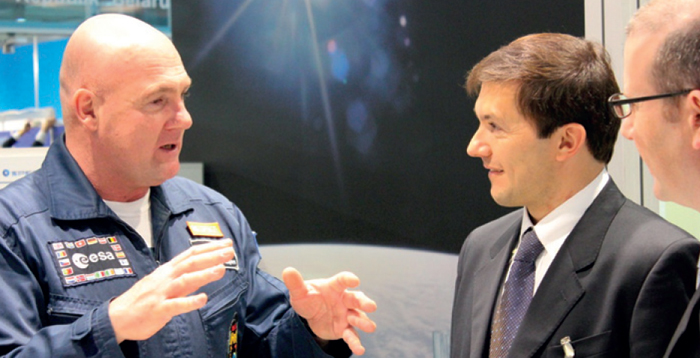
On 28 March, CERN and the European Space Agency (ESA) signed a framework agreement for future co-operation on research and technology in areas of mutual interest. Future areas might include the development and characterization of innovative materials for applications in extreme conditions and for cutting-edge scientific performances, the development of new micro-technologies to be applied in miniaturized distributed sensor systems, and the development and testing of high-performance detectors for high-energy physics experiments and space payloads.

This year is CERN’s 60th anniversary and ESA’s 50th, making the signature an opportunity to celebrate the memory of a scientist who was a founding father of both organizations: the Italian, Edoardo Amaldi. During the ceremony, ESA’s director-general Jean-Jacques Dordain presented CERN’s director-general, Rolf Heuer, with copies of letters by Amaldi in which he lays out his concern for peace and the role science should play in fostering it. These letters were flown aboard ESA’s Automated Transfer Vehicle 3 – a spacecraft named in Amaldi’s honour.

CMS sets new constraints on the width of the Higgs boson

After the discovery of a Higgs boson at the LHC in 2012, all of the measurements of its properties and tests of its spin-parity have proved to be consistent with the predictions of the Standard Model. One important property is its natural width, which is expected to be small in the Standard Model – approximately 4 MeV. A larger width could indicate, for example, additional non-standard Higgs decays into known or unknown particles.

CCnew4_04_14

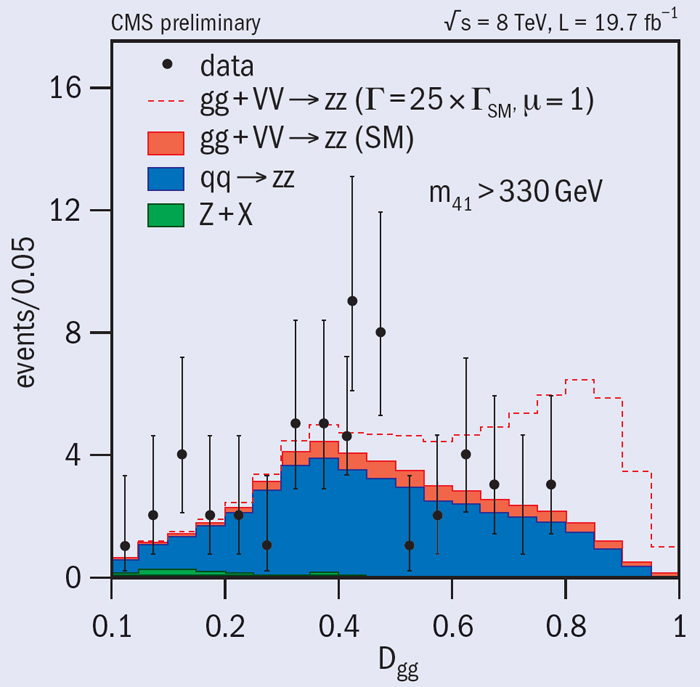
At the 2014 Rencontres de Moriond in March, the CMS collaboration presented new and stronger constraints on the total width of the 125 GeV Higgs boson by applying a novel technique on the data collected at the LHC at a centre-of-mass energy of 8 TeV. Following suggestions from several theorists to measure the ratio of the production rate for Higgs-mediated ZZ events with a mass considerably above the mass of the resonance (larger than approximately 200 GeV) to that on the peak, it is possible to derive precise indications on the maximal size of the Higgs boson’s natural width. For this analysis, CMS exploited two ZZ decay channels of the Higgs boson: H → ZZ → 4 leptons, where the four leptons can be electrons or muons, and H → ZZ → 2 leptons + 2 neutrinos.

To maximize the sensitivity of this analysis, in the 4-lepton channel, CMS took advantage of the kinematic differences between 4-lepton production occurring through gluon–gluon fusion (as for Higgs production) and through quark–antiquark scattering, which constitutes a large background to this analysis. The collaboration employed a matrix-element likelihood discriminant Dgg similar to that used for the standard Higgs analysis to help separate signal from background, and carried out a simultaneous fit of this discriminant versus the 4-lepton mass to measure the cross-section for off-peak production. The figure shows the distribution of the discriminant Dgg for events with high mass.

The 2 lepton + 2 neutrino channel has the advantage of a larger branching ratio, but it comes at the price of more background: owing to the presence of neutrinos, the final state is not fully reconstructed. This channel is based on the presence of large missing transverse energy (MET), and therefore is only sensitive to the off-shell part of the cross-section. In the case of on-peak production, the Z decaying into neutrinos does not have large transverse momentum and does not generate a significant MET. The on-peak cross-section measured from H → ZZ → 4 leptons is used for both channels.

The final result of the analysis is that the two channels have very similar sensitivities. In the Standard Model scenario, each of them is expected to exclude at the 95% confidence level (CL) a Higgs-boson width about 10 times larger than the natural width predicted by the model. The combined result is an exclusion of 17 MeV (35 expected) at 95% CL, which corresponds to 4.2 (8.5 expected) times the width in the Standard Model. Previous direct limits obtained from the measured width of the H → ZZ and H → γγ peaks, which are dominated by the detector resolution, are much weaker (of the order of a few giga-electron-volts).

bright-rec iop pub iop-science physcis connect