The Standard Model of particle physics has been extremely successful in predicting a vast variety of phenomena – so successful, that it is easy to forget that some of its predictions have not yet been verified. A very important one, related intimately to electroweak symmetry breaking, is that the gauge bosons (γ, W and Z) can interact with each other through quartic interactions. Four such interactions are allowed in the Standard Model: WWWW, WWZZ, WWZγ and WWγγ. The other boson combinations are forbidden on symmetry grounds. Now the ATLAS collaboration has found evidence for a process involving the first of these three – the WWWW interaction.
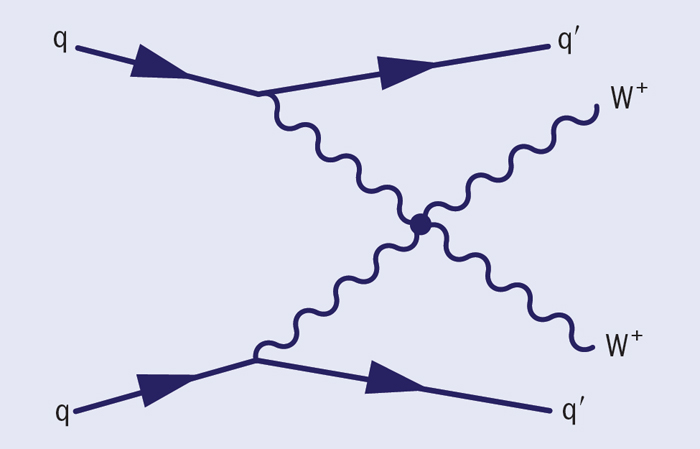
The WWWW and WWZZ interactions, in particular, are of great theoretical interest. If there were no Higgs boson, the rate of these processes would become unphysically large. With the discovery of a Higgs boson, they have remained interesting as a way to study electroweak symmetry breaking and even to probe for new heavier Higgs bosons. At the LHC, the WWWW interactions can be studied through the radiation of W bosons from quarks (see figure). This is a rare process, making the interaction of W bosons particularly rare and difficult to detect.
The ATLAS collaboration has presented the first evidence of this rare process involving a quartic WWWW interaction in a paper submitted to Physical Review Letters. The ATLAS analysis selected events with two same-charge W bosons (reconstructed through their leptonic decays to electron or muon and their respective (anti)neutrinos) and two jets. The background from other Standard Model processes is reduced by using the fact that these processes rarely produce two leptons with the same electric charge, together with the knowledge that the quarks that recoil off the radiated W bosons will produce jets that are separated widely and have a particularly large invariant mass.
Data collected by the ATLAS experiment show an excess of these events across the predicted background, with a statistical significance of 3.6σ. The measured fiducial cross-section is 1.3±0.4 fb, in agreement with the Standard Model expectation of 0.95±0.06 fb, and provides the first step into a previously untouched segment of the Standard Model.
At the Quark Matter 2014 conference, held in Darmstadt on 19–25 May, ATLAS presented a variety of new results based on lead–lead (PbPb) and proton–lead (pPb) data collected during Run 1 of the LHC. The PbPb results included new measurements of event-by-event correlations and fluctuations of collective flow, high-statistics measurements of photon and W production, and studies of jet quenching using charged particles, single jets, nearby jet pairs and jet-fragmentation functions. The results from pPb data included precision measurements of long-range pseudorapidity correlation and associated azimuthal structures, and high-pT production of charged particles, Z bosons and jets. Here are some of the highlights.
Following the first observation of highly asymmetric dijets in PbPb collisions, the study of jet quenching has been an essential part of the heavy-ion physics programme at the LHC. Measurements of the production of electroweak bosons provide important control data for the study of jet quenching, as well as for investigating nuclear modifications to parton distribution functions. ATLAS presented new results on the measurement of W-boson production via the electron and muon decay modes in PbPb collisions at √sNN = 2.76 TeV, with yields of W bosons obtained as a function of centrality and pseudorapidity. A good agreement was found between the two decay channels. The yields are in agreement with the predictions based on modified next-to-leading-order calculations, while leading-order calculations underestimate the yield.
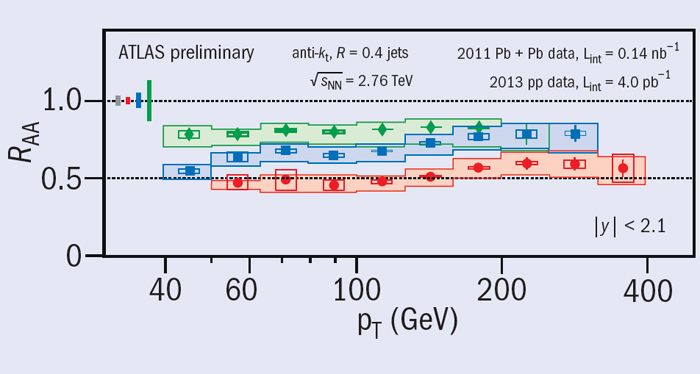
Jets produced in heavy-ion collisions can interact with the medium that is produced in the collisions and lose energy through the phenomenon of jet quenching. This energy loss suppresses the rate of jets produced in these collisions, relative to proton–proton collisions, where no such effects are present. Using the high-statistics proton–proton data set from 2013 as the new reference, ATLAS presented the most precise measurement of jet suppression to date. In central collisions, the jet yields are suppressed by more than a factor of two below a jet transverse momentum, pT, of around 150 GeV (see figure 1), but the suppression is found to be reduced at higher pT.
ATLAS presented first results on direct correlations between the elliptic flow coefficient, v2, and higher-order flow harmonics, v3, v4 and v5, in PbPb collisions. This correlation is obtained via an event-shape engineering technique, in which events within the same centrality interval are divided into different classes according to the observed ellipticity in the forward pseudorapidity. The correlation in v2 for two different ranges in pT (figure 2(a)) shows non-trivial centrality dependence but is linear within a narrow centrality interval. This linearity indicates that viscous effects are controlled by the size of the system, and not its overall shape. The v3–v2 correlations, shown in figure 2(b), reveal a surprising anticorrelation between the ellipticity and triangularity of the initial geometry, which is not accessible via the traditional measurements. The v4–v2 and v5–v2 correlations provide the most direct and detailed picture of the interplay between the linear and nonlinear collective dynamics in the final state of the PbPb collisions.
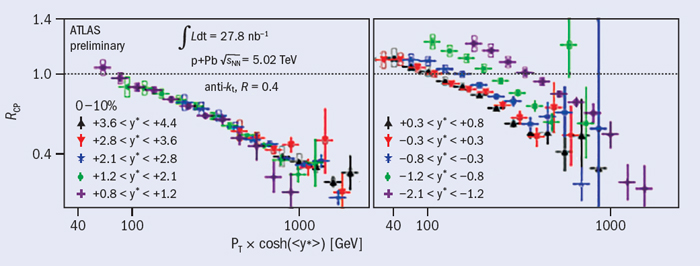
Turning to the pPb runs, the large data sample collected at √sNN = 5.02 TeV in 2013 allowed ATLAS to measure the jet production over the widest kinematic range ever probed in proton–nucleus collisions. This measurement has the potential to reveal how the hard partonic content inside matter is modified deep inside the high-density nucleus, and explores the interplay between hard processes and collision geometry – a major topic at the conference. When considering collisions of all impact parameters, the rate of jets was found to be slightly above what would be expected just from the proton’s collisions with individual nucleons in the lead nucleus. This slight excess is generally consistent with models of the modified parton densities in nuclei. However, when pPb collisions are selected by “centrality”, unexpected effects appear (figure 3). The rate of jets is suppressed strongly in apparently central events (with small impact parameter) and enhanced in those that appear peripheral (large impact parameter). Furthermore, the modifications of the jet rate have a striking pattern as a function of the energy and rapidity, implying that the modifications might originate in the proton, rather than the nuclear, wave function.
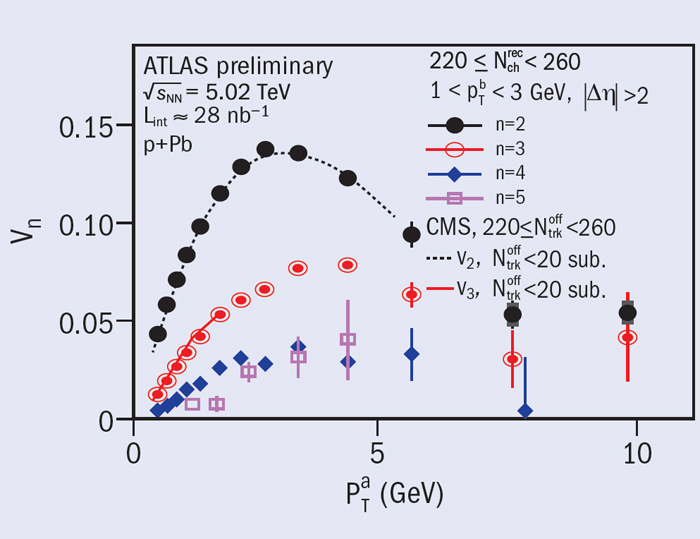
Using the same pPb data set, ATLAS also performed a detailed study of the long-range pseudorapidity correlation and its azimuthal structure, as characterized by the first five Fourier harmonics, v1–v5. The study extended the previous measurements at the LHC of v2 and v3 to higher pT and events with higher charged-particle multiplicities. Moreover, the measurements of v1, v4 and v5 were presented in this context for the first time. As figure 4 shows, the pT dependences of vn are found to be similar to PbPb collisions with comparable multiplicities, suggesting that the collective flow – the main attribute of the dense system created in PbPb collisions – might also be present in pPb interactions.
In May, an advisory panel to federal funding agencies in the US approved a proposed plan for the future of the country’s particle physics. Top priorities in the plan – written by the Particle Physics Prioritization Panel (P5) – include continuing to play a major role at the LHC in Europe; building a world-leading neutrino programme hosted in the US; and participating in the development of a proposed future linear collider, if a decision is made in Japan to go forward with construction.
The P5 report culminates a process open to all members of the US particle-physics community that lasted more than a year. It was presented to the High Energy Physics Advisory Panel (HEPAP), a body that formally advises the US Department of Energy Office of Science and the National Science Foundation.
The plan recommends a US particle-physics programme that will pursue research related to the Higgs boson, neutrinos, dark matter, dark energy and inflation, and as-yet-undiscovered particles, interactions and physical principles. It advises increasing investment in the construction of new experimental facilities.
The P5 panel envisions the US as the host of an international programme of neutrino research that will operate the world’s most powerful neutrino beam and, with international partners, build a major long-baseline neutrino facility complemented by multiple small, short-baseline neutrino experiments. Launching this programme will involve a change in direction, because the panel recommends reformulating the currently planned Long-Baseline Neutrino Experiment as an internationally designed, co-ordinated and funded programme called the Long-Baseline Neutrino Facility, or LBNF. The facility would use a neutrino beam at Fermilab, upgraded through the proposed project called the Proton Improvement Plan II, together with a massive liquid-argon neutrino detector placed underground, probably at the Sanford Underground Research Facility in South Dakota, and a smaller detector placed nearer to the source of the beam.
The plan emphasizes the need for the US to begin several planned second-generation dark-matter experiments immediately, with a vision to build at least one large, third-generation experiment in the US near the beginning of the next decade. It also recommends increasing funding for the particle-physics components of cosmic surveys.
In early June, the Organisation for Economic Co-operation and Development (OECD) published their Global Science Forum (GSF) report, “The Impacts of Large Research Infrastructures on Economic Innovation and on Society: Case studies at CERN”. The report praises the culture of innovation at CERN, and finds that the laboratory has “evident links to economic, political, educational and social advances of the past half-century”.
Through in-depth, confidential interviews with the people involved directly, the report focuses on two of CERN’s projects: the development of superconducting dipole magnets for the LHC and the organization’s contribution to hadron therapy.
As many as 1232 superconducting dipoles – each 14 m long and weighing 35 tonnes – steer the particle beams in the LHC. Following the R&D phase in the years 1985–2001, a call to tender was issued for the series production of the dipoles. R&D had included building a proof-of-concept prototype, meeting the considerable challenge of designing superconducting cables made of niobium-titanium (NbTi), and designing a complex cryostat system to keep the magnets cold enough to operate under superconducting conditions (CERN Courier October 2006 p28).
The report notes that although innovation at the cutting edge of technology is “inherently difficult, costly, time consuming and risky”, CERN mitigated those risks by keeping direct responsibility, decision-making and control for the project. While almost all of the “intellectual added value” from the project stemmed from CERN, contractors interviewed for the study reported their experience with the organization to be positive. CERN’s flexibility and ability to innovate attracts creative, ambitious individuals, such that “success breeds success in innovation”, note the report’s authors.
The second case study covered CERN’s contribution to hadron therapy using beams of protons, or heavier nuclei such as carbon, to kill tumours. The authors attribute CERN’s success in pushing through medical research to its relatively “flat” hierarchy, where students and junior members of staff can share ideas freely with heads of department or management. A key project was the three-year Proton Ion Medical Machine Study, which started in 1996 and submitted a complete accelerator-system design in 1999 (CERN CourierOctober 1998 p20). CERN’s involvement in hadron therapy is also a story of collaboration – the laboratory retains close links with CNAO, the National Centre for Oncological Hadron Therapy in Italy, and the MedAustron centre in Austria and others (CERN Courier December 2011 p37).
The report also praises the longevity of CERN, which allows it to “recyle” its infrastructure for new projects, and the CERN staff. This manpower is described as a “great asset” for the organization, which can be deployed in response to strategic “top down” decisions or in response to initiatives that arise in a “bottom up” mode.
A detailed study of galaxy clusters using NASA’s Chandra X-ray Observatory and ESA’s XMM-Newton has found a mysterious X-ray signal. One intriguing possibility is that the X-rays are produced by the decay of sterile neutrinos – a candidate particle for dark matter – although there is doubt that this is the correct interpretation.
The mystery surrounds an unidentified X-ray emission line at energy E = 3.56±0.03 keV, found in the Perseus galaxy cluster, during a study of data from both the Chandra and XMM-Newton missions led by Esra Bulbul from the Harvard-Smithsonian Center for Astrophysics. The team also found the line in a combined study of 73 other galaxy clusters observed with XMM-Newton. As these clusters have different redshifts, this finding excludes, a priori, the possibility that the line is an instrumental artifact. The authors of the study admit, however, that the detection is at the limit of the current instrumental capabilities.
The researchers argue that there should be no atomic transitions in thermal plasma at this energy. They therefore suggest that this emission line could be a signature from the decay of a sterile neutrino with a mass of ms = 2E = 7.1 keV. Sterile neutrinos are a hypothetical type of neutrino predicted to interact with normal matter via gravity only. They have been put forward as candidates to explain dark matter, at least partially.
The paper on these findings was submitted to The Astrophysical Journal in February and posted on the arXiv preprint server, igniting a flurry of activity, with 60 new papers having cited this work in the four months from March to June. Some of these papers explore the sterile neutrino interpretation, while others suggest that other types of candidate dark-matter particles, such as axions, might have been detected.
What makes many researchers doubt the results, is that the intensity of the emission line is significantly different from one cluster to the other. While the detection in the full sample of clusters corresponds to a mixing angle for the decay that is below previously determined upper limits, the line in Perseus is much brighter than expected for this mixing angle (based on the cluster’s mass and distance), deviating significantly from other subsamples. The fact that the detected signal is very weak (with an equivalent width in the full sample of about 1 eV only) and located within 50–110 eV of several known faint lines is also suspicious. However, the authors recognize that “the dark matter explanation is a long shot” and that they “have a lot of work to do before they can claim, with any confidence, that they have found sterile neutrinos”.
This study on a possible dark-matter signal follows the report on the excess of gamma-ray emission from the Galactic Centre observed with Fermi, which strengthened the case for a signal from annihilating dark matter (CERN Courier April 2014 p13). In this case, it is still early days. Have the researchers stumbled on something really interesting? Future studies and better instrumentation are needed to settle the issue.
In the summer of 1964, at the International Conference on High-Energy Physics (ICHEP) in Dubna, Jim Cronin presented the results of an experiment studying neutral kaons at Brookhaven National Laboratory. In particular, it had shown that the long-lived neutral kaon can decay into two pions, which implied the violation of CP symmetry – a discovery that took the physics community by surprise. The news was greeted with some scepticism and met a barrage of questions. Everyone wanted to be satisfied that nothing had been overlooked, and that all other possibilities had been considered carefully and ruled out. People need not have worried. Cronin, together with Val Fitch, visiting French physicist René Turlay and graduate student Jim Christenson, had spent months asking themselves the same questions, testing and cross-checking their results thoroughly. There was, in the end, only one conclusion that they could draw from their observations: CP symmetry was not a perfect symmetry of nature. Only when the researchers were completely satisfied did they make their findings known to the physics community. It is testament to their patience and the quality of their work that the result was so robust to scrutiny. It was 15 years later that Cronin and Fitch received the 1980 Nobel Prize in Physics for the discovery.
The announcement of a broken symmetry was not new to the physics community, having first occurred only a few years previously, when the maximal non-conservation of parity (P) in the weak interaction was discovered by Chien-Shiung Wu and her colleagues in 1957, following the proposal by Tsung-Dao Lee and Chen-Ning Yang that parity violation might explain puzzles in the decays of charged kaons. The disturbing conclusion that the laws of physics depend on the frame of reference was evaded, however, because experiments soon showed that symmetry under charge-conjugation (C) was also maximally violated. Therefore, as long as the combined operation, CP, was a good symmetry, the possibility of an absolute distinction between left-handed and right-handed co-ordinate systems would be prevented, being compensated exactly by the asymmetry between particles and antiparticles. CP invariance had already been suggested as the means to restore symmetry conservation by Lev Landau, and by Lee and Yang, so the situation seemed to be resolved neatly.
No elegant alternative was available to replace CP invariance
When the news came in 1964 that CP was also a broken symmetry, it was harder to accept, because no elegant alternative was available to replace CP invariance. There was also the issue of the treasured CPT theorem: if CPT holds, then CP violation implies violation of time-reversal (T) symmetry. The discovery of CP violation led to the unsettling conclusion that the microscopic laws of physics do indeed allow absolute distinctions between left- and right-handed co-ordinate systems, between particles and antiparticles, and between time running forwards and backwards.
By the early 1960s, the neutral kaon system had already proved to be a rich testing ground for new physics. Its “strange” behaviour had been a matter for scrutiny since its discovery in cosmic rays in 1946. Neutral kaons were found to be produced copiously through the strong interaction, while their long lifetimes suggested decays via the weak interaction. In 1953, Murray Gell-Mann assigned the K0 a “strangeness” quantum number, S = 1, which was conserved by the strong force but not by the weak force. This implied that there must exist a distinct anti-K0, K0, with S = –1. However, because both the K0 and K0 appeared to decay to two pions, the distinction between the particles was blurred somewhat. The situation prompted Gell-Mann and Abraham Pais to propose, in 1955, that the states of definite mass and lifetime, labelled K1 and K2, were instead an admixture of the two particles, and were even and odd, respectively, under the CP transformation. Under the assumption of CP invariance, the K2 was forbidden to decay to two pions. This gave it a much longer lifetime than the K1, as observed.
The primary motivation for the experiment at Brookhaven was to study a phenomenon peculiar to the kaon system called regeneration (see box). Fitch, an expert on kaons, had approached Cronin, who with Christenson and Turlay had built a state-of-the-art spectrometer based on spark chambers, which could be operated with an electronic trigger to select rare events. It was just what was needed for further tests of regeneration. Finding a “new upper limit” for K2 decaying to 2π was a secondary consideration, listed under “other results to be obtained”. The experiment was approved for 200 hours of run-time, and about half of this was devoted to the “CP invariance run”, across five days towards the end of June 1963. Turlay began the analysis of the CP run in the autumn. By the time it was complete, early in 1964, it was clear that 2π decays were present, with 45±10 events, corresponding to about one in 500 of K2 decays to charged modes. In the conclusion of their seminal paper, published in July 1964, the team stated: “The presence of a two-pion decay mode implies that the K2 meson is not a pure eigenstate of CP” (Christenson et al. 1964).
During the year that followed, there was feverish activity in both the experimental and theoretical communities. The discovery of CP violation raised many questions about its origins, and the size of the effect. In particular, it was unclear from experiment whether the effect was occurring in the kaon decays (direct CP violation) or in neutral kaon mixing (indirect CP violation). Indeed, the results could be explained solely by invoking indirect CP violation, which was achieved by the simple, but ad hoc, addition of a small admixture of the CP = +1 eigenstate to the mass eigenstate of the long-lived neutral kaon. This was parameterized by the small complex parameter ε, which had a magnitude of about 2 × 10⁻³. The two states of distinct (short and long) lifetime were then KS = K1 + εK2 and KL = K2 + εK1 (to order ε2).
Among the many theoretical papers that followed in the wake of the discovery of CP violation was that by Lincoln Wolfenstein in August 1964, which proposed the “superweak” model. This was the minimal model, which accounted for the observed effect by adding a single CP-violating contribution to the ΔS = 2 mixing-matrix element between the K0 and the K0. There was no CP-violating contribution to the kaon decays themselves, hence the model offered a prediction that the phenomenon would be seen only as a feature of neutral kaon mixing. Alternatively, a “milliweak” theory would include direct CP-violating contributions to neutral kaon decays (ΔS = 1), as well as to the kaon mixing-matrix element. Another proposal was that the action of an all-pervading long-range vector field of cosmological origin could cause the observed decay to 2π without invoking CP violation. This was a relatively easy option to test experimentally, because it predicted that the decay rate would depend on the energy of the kaons.
The experimental confirmation of the π+π– decay of the long-lived kaon came early in 1965, from groups at the Rutherford Laboratory in the UK and at CERN. These experiments also dispensed swiftly with the vector-field proposal. There was no evidence for the variation of the decay rate with energy. Experiments were now needed to determine the CP-violating parameters η+– and η00 – the ratios of the amplitudes for the KL and KS decays into π+π– or π0π0, respectively (see box in“NA31/48: the pursuit of direct CP violation”) – the measurable quantities being the related magnitudes (|η+–|, |η00|) and phases (φ+–, φ00).
In 1964, Jack Steinberger had realized that the interference between KS and KL decaying to the same final state (π+π–) could provide a valuable way to study CP violation. Results published in 1966 from two such experiments at CERN’s Proton Synchrotron provided measurements of |η+–| and φ+–. The more difficult challenge of measuring decays to π0π0 was taken up by spark-chamber experiments at CERN, Brookhaven and Berkeley. In another experiment at CERN, a beam of KL passed along a pipe through the Heavy-Liquid Bubble Chamber (HLBC), in which the photons from the π0 decays would convert. First results from the spark-chamber experiments seemed to indicate that |η00| was much larger than |η+–|. However, in late 1968 the HLBC collaboration presented a result that was compatible with |η00| = |η+–|. After some confusion, the spark-chamber experiments confirmed this result and also measured φ00.
More refined experiments were to follow, giving more precise measurements for the different decay modes. By the time of the 13th ICHEP in London in 1974 – 10 years after the announcement in Dubna – all results agreed perfectly with the predictions of the superweak model, with no need for direct CP violation. However, a new theory that accounted for CP violation was already in the air – and with it new challenges for a new generation of experiments.
Neutral kaon mixing, oscillations and regeneration
Because the weak interaction does not conserve strangeness, second-order weak-interaction processes mediate transitions between the strangeness eigenstates K0 and K0 . Therefore, the physical particles (eigenstates of mass and lifetime) are linear combinations of K0 and K0 , and states born as one or the other “oscillate” between these two eigenstates before decaying. The two physical eigenstates are called KS and KL – short and long – reflecting their different lifetimes. Allowed to propagate for long enough, a mixed beam of neutral kaons will evolve into a pure beam of KL. Because K0 and K0 have different interactions with matter, if an initially pure KL beam enters matter, the K0 component will interact preferentially, forming a different admixture of K0 and K0 . This admixture must be different from the pure KL that entered the matter, which means that a component of KS is “regenerated” in the beam. Regeneration is not an effect of CP violation, but it is used extensively in “regenerators” in kaon experiments.
In 1973 – almost 10 years after the surprising discovery of CP violation – Makoto Kobayashi and Toshihide Maskawa produced the first theory of the phenomenon in the context of the Standard Model. They proposed a bold generalization of a mechanism that Sheldon Glashow, John Iliopoulos and Luciano Maiani had put forward in 1970. The “GIM mechanism” suppressed strangeness-changing weak neutral currents through the introduction of a fourth quark – charm – and was, in turn, an extension of ideas that began with Nicola Cabibbo. Kobayashi and Maskawa introduced a third generation of quarks (b and t), and a full 3 × 3 unitary matrix parameterizing complex couplings between the quark-mass eigenstates and the charged weak gauge bosons (W±). In this model, a single complex phase in the matrix accounted for all observed CP-violating effects in the kaon system, and provided for CP violation in matrix elements, both for mixing and for decays – that is, for both indirect and direct CP violation.
The discovery of the b quark in 1977 brought the theory of Kobayashi and Maskawa well and truly into the spotlight, and the hunt began to search for the predicted CP violation in the b-quark system (“What’s next for CP violation?”). In kaon physics, the crucial experimental question now was to disprove the superweak model for CP violation (“CP violation’s early days”), which had no need for direct CP violation. In contrast, in the Kobayashi-Maskawa model, the parameter describing direct CP violation, ε´, was nonzero. However, considerable theoretical uncertainty remained concerning its value, which was potentially too small to be measured by the existing experimental techniques. This provided fresh impetus to the search for direct CP violation, and prompted renewed efforts at CERN and at Fermilab to meet the experimental challenges involved.
At CERN, the NA31 experiment was proposed in 1982 with the explicit goal of establishing whether the ratio ε´/ε was nonzero. This required measuring all four decay rates of KS and KL to the charged and neutral 2π final states (see box). The concept behind NA31 was to measure KS and KL decays at the same locations (binned in momentum) to provide essentially the same acceptance for each set of events, and so reduce the dependence on Monte Carlo simulation. The experiment employed a mobile KS target, able to move along a 50-m track, with data-taking stations every 1.2 m. Additionally, beam and detector fluctuations were limited by rapidly alternating the data-taking between KS and KL. The experimental limitations were determined by statistics and background suppression. In both cases, a liquid argon calorimeter was used to achieve the stable, high-quality energy and position resolution that was crucial for reconstructing the π0π0 decays. The calorimeter was developed by exploiting the expertise acquired by the group of Bill Willis at CERN with the first liquid-argon calorimeter at the Intersecting Storage Rings.
In 1988, NA31 found the first evidence for direct CP violation, with a result that was about three standard deviations from zero. However, shortly after this the E731 experiment at Fermilab reported a measurement that was consistent with zero. These conflicting results increased the importance of answering the question on the existence of direct CP violation, and prompted the design of a new generation of detectors, both at CERN (NA48) and at Fermilab (KTeV).
The NA48 experiment was designed to handle a 10-fold increase in beam intensity and event rates compared with NA31. It incorporated a magnetic spectrometer to reduce background in the charged-pion mode and a new calorimeter to replace the liquid-argon original. The novel liquid-krypton calorimeter was fully longitudinally integrating, and had fine granularity in two dimensions to provide faster detection with superior resolution for neutral-pion decays. Systematic effects were also greatly reduced in NA48 by observing all four decay modes concurrently.
In 1999, both the KTeV and NA48 experiments were successful in measuring direct CP violation in the decay of neutral kaons, clearly establishing that CP violation was not just confined to kaon mixing (CERN Courier September 1999 p32). The discovery was later recognized by honours in both Europe and the US. In 2005, the European Physical Society’s High-Energy Physics Prize was awarded jointly to CERN’s Heinrich Wahl, for his “outstanding leadership of challenging experiments on CP violation”, and to the NA31 collaboration as a whole, for having shown, for the first time, direct CP violation in the decays of neutral K mesons. Wahl, who was spokesman of NA31, had a long association with CP-violation experiments since his arrival at CERN in 1969, and was also a major proponent of NA48. Two years later, Italo Mannelli, Wahl and Bruce Winstein, leader of the KTeV collaboration, were awarded the W K H Panofsky prize of the American Physical Society, in recognition of their “leadership in the series of experiments that resulted in a multitude of precision measurements of properties of neutral K mesons, most notably the discovery of direct CP violation”.
During the past 50 years, the study of the neutral-kaon system has gone hand-in-hand with the development of the Standard Model
During the past 50 years, the study of the neutral-kaon system has gone hand-in-hand with the development of the Standard Model. In particular, CP violation in neutral kaons provided the experimental stimulus for Kobayashi and Maskawa to propose the third generation of quarks. That boosted the motivation to search for direct CP violation, which in turn motivated improvements in experimental techniques. The search for direct CP violation across several generations of experiments led to the tantalizing hint of a result in NA31, before the effect was eventually nailed down by KTeV and NA48.
Victor Hugo wrote in Les Misérables: “La symétrie, c’est l’ennui”. A less succinct but more poetic sentiment was expressed by Wolfenstein at the conference on CP violation at Chateau de Blois in 1989, which celebrated the 25th anniversary of the discovery of the unexpected effect. He described broken symmetry as “something more intriguing and perhaps more beautiful than perfect symmetry”. Another 25 years on, that sentiment is stronger than ever.
Measuring direct CP violation in the neutral-kaon system
CP violation in general manifests itself as a difference between the behaviours of particles and antiparticles (apart from the obvious charge inversion). In the original experiment at Brookhaven, the observation of the decay of a KL to two pions could be explained by one effect or by a combination of two effects:
• The KL is an exact eigenstate of CP with eigenvalue –1. Its decay is mediated by an interaction that violates CP, allowing it to decay to a CP = +1 final state (e.g. two pions). Such direct CP violation is parameterized by a complex quantity, ε´.
• The KL eigenstate is an admixture of CP = –1 and CP = +1 components, the CP = +1 part being a (complex) fraction ε of the total. This is the case if the mixing amplitude (which causes transitions between K0 and K0) violates CP. This is called indirect CP violation.
The parameter ε measures the admixture of the CP = +1 eigenstate in the KL mass eigenstate, so if this were the only source of CP violation, the fraction of KL decays with a two-pion final state normalized to Kswould be independent of whether the two pions were π+π–or a π0π0. Any observed difference between the amplitude ratios η+– and η00would be evidence for direct CP violation, and the deviation from unity of their squared-ratio (which depends on the respective event rates) can be shown to be six times the real part of ε´/ε. This is given experimentally by the ratio-of-ratios of event rates. Therefore, to make a measurement of the direct CP violation parameter, the four rates must be measured. Because ε´/ε is of the order of 10–3, the measurements are particularly difficult.
The observation of CP violation was first revealed to an unsuspecting physics community in July 1964 (“CP violation’s early days”). Since then, as figure 1 shows, interest in this puzzling phenomenon has grown significantly. So what is driving this interest and what remains to be studied?
One reason that the field remains so vibrant is the connection with the existence of our matter-dominated universe. As Andrei Sakharov showed in 1967, the absolute distinction between matter and antimatter provided by C and CP violation is – together with baryon number violation and a period of thermal inequilibrium – one of the necessary conditions to generate a net baryon asymmetry from an initially symmetrical state (Sakharov 1967). Moreover, because the Standard Model provides only a small amount of CP violation, and also constrains strongly the amount of baryon number violation and the phase transitions that cause inequilibrium, it cannot account for the amount of matter surviving the almost total annihilation that must have occurred in the early universe. This mystery strikes a chord among scientists and the general public alike, because it points to a way to search for physics beyond the Standard Model and hints at a connection to one of the biggest questions in science: why is there something rather than nothing?
The model introduced by Makoto Kobayashi and Toshihide Maskawa predicted that CP-violation effects should occur also in the B sector
Although answers to such grandiose questions are by their nature elusive, there has been significant progress in understanding CP violation during the past 50 years, and there are excellent prospects for further advances. Perhaps the two most important experimental results in the field, since the discovery, occurred around the turn of the millenium, corresponding to the peak in figure 1. The first was the long-sought observation of direct CP violation through the measurement of a nonzero value of the parameter Re(ε’/εK) of the neutral kaon system (see “NA31/48: the pursuit of direct CP violation”). The second was the discovery of CP violation in the B system.
The model introduced by Makoto Kobayashi and Toshihide Maskawa predicted that CP-violation effects should occur also in the B sector (Kobayashi and Maskawa 1973). Specifically, as Ikaros Bigi, Ashton Carter and Tony Sanda showed, a potentially large asymmetry could be expected between the decay rates of B0 and B0 mesons to the J/ψ KS final state, as a function of time after production (Carter and Sanda 1981, Bigi and Sanda 1981).
To make the observation, however, would require much larger numbers of B mesons than had been produced in previous experiments. Moreover, it would be necessary to have a precise measurement of the decay time, together with knowledge of the flavour of the B meson at production – that is, “flavour tagging”. To meet these challenges, several different designs were put forward, with the preferred solution being a high-luminosity asymmetrical e+e– collider, with a detector equipped with a silicon vertex detector and particle-identification capability. By colliding electrons and positrons at the centre-of-mass energy of the ϒ(4S) meson, the facilities could exploit the resonant production of quantum entangled B–B meson pairs, while the decay vertices of the two particles could be separated owing to the beam-energy asymmetry. Two such “B factories” were built – the PEP-II and KEKB accelerators, with their associated detectors BaBar and Belle, at SLAC in California and KEK in Japan, respectively. In 2001, the first results from the two experiments were enough to establish that CP is indeed violated in the B system (CERN Courier April 2001 p5).
By the time that the research programmes at the B factories had been completed, the accelerators had broken records for the highest instantaneous and integrated luminosities of any particle collider, allowing the measurement of the CP-violation parameter in B0 →J/ψ KS decays to be improved to a precision of better than 3%. This parameter is referred to as sin(2β), because it is sensitive to the angle β of the Cabibbo-Kobayashi-Maskawa (CKM) unitarity triangle, which represents in the complex plane the relation VudVub* + VcdVcb* + VtdVtb* = 0 between elements of the CKM quark-mixing matrix. Other measurements of the properties (angles and sides) of this triangle are all consistent, as figure 2 shows, where the constraints all overlap at the apex of the triangle. This astonishing agreement between data and theory led to the award of the 2008 Nobel Prize in Physics to Kobayashi and Maskawa.
The data represented in figure 2 are the result of enormous effort from experimentalists and theorists alike. Indeed, because the properties of quarks can be studied only through final states containing hadrons, detailed knowledge of the properties of the strong interaction specific to each interaction is necessary to obtain quantitative information about CP violation. In a few “golden modes”, such as the measurement of sin(2β), the associated uncertainties are negligible. But for others such as εK, input from, for example, lattice QCD calculations, is essential.
The large samples of B mesons available at BaBar and Belle allowed several further milestones in CP-violation studies to be achieved. One notable result is the observation of direct CP violation in B0 →Kπ decays (CERN Courier September 2004 p5). Further advances have become possible more recently because an even more copious source of b hadrons has become available – the LHC at CERN. In particular, the LHCb experiment is designed to exploit the potential for heavy-flavour physics at the LHC by instrumenting the forward region of proton–proton collisions, and therefore optimizing the acceptance of the b quark–antiquark pairs produced.
As with BaBar and Belle, LHCb is equipped with excellent vertexing and particle-identification capabilities. An additional challenge for an experiment at a hadron collider is the efficient rejection of minimum-bias events that occur at a high rate. This is achieved in LHCb by exploiting signatures of the decay products of heavy flavoured particles, such as muons with comparatively high transverse momentum and a secondary vertex that is significantly displaced from the proton–proton interaction point. Unlike the B factories, LHCb can study all types of b hadron – a feature that allowed it to make the first observation of direct CP violation in B0s meson decays (CERN Courier June 2013 p7). LHCb has also discovered very large – and rather puzzling – CP-violation effects in decays of B mesons to three particles (pions or kaons) (CERN Courier November 2012 p7), which need to be understood with further experimental and theoretical investigations.
Future prospects
What, then, remains for studies of CP violation? One important point is that the measurements shown in figure 2 are, on the whole, not limited by theoretical uncertainties. Because the consistency of the measurements provides strong constraints on theories of physics beyond the Standard Model, there is good motivation to continue to improve them. For example, the measurement of the angle γ achieved by studying CP-violation effects in B → DK decays has negligible theoretical uncertainty. The current constraint, combining results from BaBar, Belle and LHCb, gives an uncertainty of about ±10°. Reducing this uncertainty by an order of magnitude will either further constrain models that contain new sources of CP violation or, perhaps, reveal the presence of new physics. This is one of the main objectives of the next generation of B-physics experiments: the upgraded SuperKEKB accelerator and Belle2 detector at KEK, and the LHCb upgrade at CERN.
There are several other important CP-violating observables in the B system, where the Standard Model predicts small effects, but new physics could result in much larger values being measured in experiments. One good example is the decay mode B0s →J/ψ φ, which is the B0s sector equivalent of B0 →J/ψ KS, and probes a parameter labelled βs. In the Standard Model, βs is expected to be around 1°, whereas the latest results from LHCb and other experiments limit its value to less than about 4°. Similarly, the parameters describing CP violation in the B0– B0 (and B0s–B0S) mixing amplitudes, which are the B-system equivalents of εK, are expected to be vanishingly small. This has been a topic of considerable interest during the past few years, because the D0 experiment based at Fermilab’s Tevatron reported an anomalous charge asymmetry in events with two same-sign muons (CERN Courier July/August 2010 p6). These same-sign muons occur in events where both particles resulting from the hadronization of a b quark–antiquark pair decay semileptonically, but one of them decays only after oscillating into its antipartner. The inclusive asymmetry could, therefore, be caused by CP violation in either or both of the B0– B0 and B0s–B0S mixing amplitudes. However, measurements of the parameters describing CP violation in each of the two amplitudes individually do not reveal any discrepancy with the Standard Model, as figure 3 shows. Improved measurements are needed to resolve the situation and are eagerly anticipated.
Contemporary CP-violation searches are not confined to B mesons. Heavy-flavour experiments are abundant sources of charm hadrons, which can be used to investigate matter–antimatter asymmetries. Indeed, D0–D0 oscillations provide a particularly interesting “laboratory” for such searches, because this is the only system involving up quarks in which phenomena similar to those measured in the K0–K0 and B0–B0 systems can be probed. Within the Standard Model, the CP-violating effects are tiny, which provides a potential opportunity for new physics signatures to appear. The small mixing rates make these measurements extremely challenging, but experiments have now been able to establish the mixing phenomena at a high level of significance (CERN Courier November 2012 p7). Consequently, charm-physics experiments are becoming more focused on CP violation, and further progress can be foreseen as the accumulated data samples increase.
Because the top quark does not hadronize, it must be studied in different ways from the lighter heavy quarks. It is also, of course, an excellent tool for probing beyond the Standard Model. Among the many tests of the top sector being performed with the unprecedented samples collected by the ATLAS and CMS experiments are studies of CP violation in both the production and decays of top quarks. The discovery of a Higgs boson also provides the opportunity for ATLAS and CMS to search for CP violation in the Higgs sector, which is absent in the Standard Model.
Indeed, the description of CP violation within the context of the Standard Model is highly restrictive: it appears only among the flavour-changing interactions of the quarks. As a consequence, tests of CP violation in other sectors can be carried out with zero Standard Model background, and are therefore particularly sensitive to new sources of asymmetry. In addition to the examples given above, searches for nonzero electric dipole-moments of fundamental particles such as the electron are sensitive to flavour-conserving CP-violation effects. Owing to the amazingly high precision that is achieved in experiments, the measurements are sensitive to the small effects that are expected to be induced by new physics at the tera-electron-volt scale (Baron et al. 2014). As yet, however, there are no hints of a nonzero electric dipole-moment.
Perhaps the best chance of a discovery of a new source of CP violation in the medium-term future is in the lepton sector. Neutrino oscillations can be described by the Pontecorvo-Maki-Nakagawa-Sakata mixing matrix in an analogous way to the CKM matrix of the quark sector. (However, because the leptons do not couple to the strong interaction, the phenomenology of quark and lepton mixing is, in essentially all other respects, completely different.) The recent measurement of a nonzero value of the mixing angle θ13 by Daya Bay (CERN Courier April 2012 p8) and other experiments shows that all three flavours of neutrino mix with each other to give the physical eigenstates, which is a prerequisite for CP violation to be observable.
The parameter that describes CP violation in neutrino mixing, δCP, can be measured by comparing the probabilities for electron (anti)neutrino appearance in a muon (anti)neutrino beam. The MINOS experiment, which detects neutrino beams from Fermilab with a far detector at a baseline of 735 km in the Soudan mine in Minnesota, and the T2K experiment, which uses neutrinos from the Japan Proton Accelerator Complex (J-PARC) and a far detector 295 km away in the Kamioka mine, have already made first steps in this direction. Now the NOvA experiment is also under way in the US, using the upgraded beam at Fermilab with a baseline of 810 km (“NOvA takes a new look at neutrino oscillations”). However, far better sensitivity will be needed. For this reason, new and upgraded experiments have been proposed. These include the Long Baseline Neutrino Facility (“US particle-physics community sets research priorities”) in the US and Hyper-Kamkiokande (Hyper-K) in Japan, as well as possible projects in Europe and elsewhere. Example sensitivities to δCP in these experiments are shown in figure 4. Because the observation of CP violation in the lepton sector would give the possibility to explain the baryon asymmetry of the universe, through a mechanism known as leptogenesis, these projects are among the highest-priority science goals in the international particle-physics community. The construction and operation of such projects might take 20 years, but if CP violation is discovered in the lepton sector, it will be worth the wait.
Nonetheless, no one knows currently in which, if any, of these sectors the new sources of CP violation that must exist will appear first. It is therefore essential to continue to explore on as many fronts as possible. In this regard, it might be that the next big breakthrough in the field comes from the same particle that started the whole field off 50 years ago. Decays of kaons to final states containing a pion and a neutrino–antineutrino pair can provide a theoretically clean measurement of the height of the unitarity triangle, and therefore of the amount of CP violation described by the CKM matrix. Moreover, because these decays are highly suppressed, they are highly sensitive to physics beyond the Standard Model. Within the next few years, the NA62 experiment at CERN and the KOTO experiment at J-PARC will improve significantly on previous measurements of these decays, and might, therefore, start to provide hints of CP violation beyond the Standard Model. Such a discovery would provide fertile ground for investigations for the next 50 years.
NOvA, Fermilab’s new flagship neutrino-oscillation experiment, has recorded its first neutrinos and is now poised to make precision measurements of electron-neutrino (νe) appearance and muon-neutrino (νμ) disappearance. These data will help to unravel remaining unknowns in understanding neutrino masses and mixing. In the now standard picture of neutrinos, the three electroweak flavour states (νe, νμ and ντ) are mixtures of the mass eigenstates (ν1, ν2 and ν3) related by a unitary matrix that is parameterized by three mixing angles and a charge-parity (CP) violating phase. Neutrinos are produced and detected in flavour eigenstates but propagate in mass eigenstates. Interference among the mass states means that a neutrino created in a definite flavour state can later be detected in a different flavour state. This oscillation probability is determined by the sizes of the mixing angles, the splittings in the neutrino masses, the energy of the neutrino and the distance it has travelled. Measurements of the oscillation probabilities of neutrinos of known energy that travel a known distance reveal the underlying mass-splittings and mixings.
Thanks to experiments using neutrinos produced in the Sun, in the atmosphere, at particle accelerators and in nuclear reactors, researchers have found out a great deal about neutrino masses and mixing. We know that two neutrinos are relatively close in mass and that the third is relatively far away in mass. We know that the mixing angles are all relatively large, in contrast to mixing angles in the quark sector, which are small. We also know that the two neutrinos that are relatively close in mass contain most of the electron-neutrino flavour, and that the third is a nearly equal combination of muon and tau flavour. However, we do not know if the third mass eigenstate is composed of more νμ or ντ, or if a new symmetry keeps these two contributions equal. We do not know if neutrinos violate CP symmetry, and we do not know the ordering of the neutrino masses.
Neutrinos could follow a normal hierarchy, with most of the νe content contained in the lightest two states, or they could follow an inverted hierarchy with the νe content predominantly in the heaviest two states. The neutrino-mass hierarchy is one specific prediction of different grand-unification theories, with implications for cosmological measurements of the absolute scale of neutrino mass. The hierarchy, in combination with results from neutrinoless double-beta decay experiments, plays an important role in determining the Dirac or Majorana nature of the neutrino.
NOvA will use two detectors to measure oscillation probabilities in Fermilab’s NuMI (Neutrinos at the Main Injector) muon-neutrino beam. When neutrinos travel the 810 km between Fermilab and Ash River, Minnesota, through the crust of the Earth, scattering of νe on atomic electrons can either enhance or suppress the oscillation probability, depending on the mass hierarchy. The effect is opposite in neutrinos compared with antineutrinos, so by comparing the oscillation probability measured in neutrinos with that measured with antineutrinos, NOvA can determine the mass hierarchy, resolve the nature of ν3, and begin the study of CP violation in neutrinos.
To achieve these goals, NOvA requires an intense neutrino and antineutrino source. NuMI had routinely delivered 320 kW of beam power to the MINOS and MINERvA experiments during operation of the Tevatron. However, with Tevatron operations now ended, the accelerator complex has been reconfigured to provide twice the beam power to the NuMI beamline. During a shutdown of a year and a half starting in the spring of 2012, a major RF upgrade in the Main Injector was accomplished, reducing its cycle time from 2.2 s to 1.67 s. Additionally, the Recycler ring, which was key to antiproton generation for the Tevatron, was converted to a proton accumulator so that protons can be integrated and stored during the Main Injector ramp from 8 GeV at injection to 120 GeV.
At the same time, the NuMI beamline underwent a transformation to accommodate the higher proton intensities required for NOvA. The neutrino target and focusing horns were replaced and repositioned. The new beam provides higher-energy neutrinos on-axis, but at 14 mrad off the beam axis – where the NOvA detectors are located – the neutrino energy spectrum is peaked narrowly at 2 GeV, the perfect energy for the long-baseline oscillations that NOvA will study.
Beam began circulating again in the Main Injector in September 2013 and work started on commissioning the new accelerator in the Recycler ring. The Recycler is now normally included in operations, and work is underway to “slip stack” routinely in this new machine – a delicate manoeuvre where one bunch is injected then shifted to a different orbit to make room for a second bunch in the same RF bucket. Once the two bunches are merged, they are accelerated together. This work is expected to bring the NuMI intensity to 450 kW by the end of the year, and ongoing upgrades to the Booster ring that feeds this complex are expected to bring the intensity to 700 kW within another year. Since coming back up from the shutdown, the complex has achieved a peak beam power of more than 300 kW and delivered almost 2.5 × 10²⁰ protons to NOvA and the other two neutrino experiments sharing the beam, MINOS+ and MINERvA.
The NOvA detector must be big to overcome the small size of the neutrino-interaction cross-section and the 810 km distance from the neutrino source
In addition to an intense beam, NOvA also requires a massive far detector and a functionally identical near detector. Like all neutrino detectors, the NOvA detector must be big to overcome the small size of the neutrino-interaction cross-section and the 810 km distance from the neutrino source. Being big, however, is not enough. The detector must also be highly segmented to prevent the numerous cosmic rays that cross the detector from interfering with neutrino events from Fermilab. Furthermore, to separate electromagnetic showers from electron-neutrino events from similar showers from other sources, especially the decays of π0 mesons, heavy materials of high atomic number (Z) such as steel – which are normally used to build large structures – have not been employed.
The NOvA detectors (figures 1 and 2) are a unique solution to the particular challenges of observing νe appearance using the NuMI neutrino beamline. The NOvA far detector is a 14,000 tonne detector, using 9000 tonnes of liquid scintillator – the largest quantity of liquid scintillator ever produced for a physics experiment – to record the tracks of charged particles. The scintillator is contained in a 15.6 × 15.6 × 60 m3, 5000-tonne PVC structure constructed from modules assembled at a factory operated by collaborators at the University of Minnesota. A crew of more than 700 undergraduate students directed by 10 full-time staff members ran the factory. These pieces were shipped to the Ash River Laboratory in Northern Minnesota, where another 45 full-time staff members built the 28 free-standing blocks that make up the detector. The 190-tonne blocks were constructed horizontally on an enormous table, which later pivoted them into a vertical position and placed them in the experimental hall.
In addition to containing the scintillator, the PVC structure segments the detector into 4 cm × 6 cm × 15.6 m channels. Light produced in these channels by the charged particles that traverse them bounces 10 times, on average, before it is captured in a wavelength-shifting fibre. To ensure that enough light is captured in the fibre, a special PVC formulation with enhanced reflectivity had to be developed. The large size of the detector and the large number of channels required more than 10,000 km of wavelength-shifting fibre – enough to stretch from the supplier in Japan to the Ash River Laboratory in a single unbroken thread.
This large-scale assembly project is now finished. The last detector block was put in place in February of this year and the last of the 11 million litres of scintillator made for the experiment was delivered in April. While the task of outfitting the detector with electronics is continuing through the summer, the experiment recorded its first neutrino event in November last year, and has analysed millions of cosmic-ray tracks. This analysis has verified that the scintillator, PVC, fibre and electronics work together as designed to move the scintillation light from the far end of the detection channels to where it can be recorded. As figure 3 shows, the efficiency for detecting a minimum-ionizing particle crossing a cell at the furthest end from the read-out is above 90%, which is key to the tracking and particle-identification performance of the detector.
First events
Cosmic-ray interactions are an excellent source for detector calibration, but they are also a potential background to the neutrino selection. While the NuMI beam is delivered in regular bursts, 10 μs in duration, the high cosmic rate on the surface means that about 1.5 cosmic interactions are expected in the detector during the spill. On the other hand, after oscillations, a NuMI neutrino interacts in the far detector once every 12,000 spills, or only about once every four hours. Containment and directional cuts suppress the cosmic rate by about a factor of 105, with only minimal loss of neutrino events. Figure 4 shows a charged-current νμ interaction identified in the NOvA far detector, along with two cosmic-ray muons zipping through during the beam spill. Figure 5 shows the same event, reconstructed, as well as a timing distribution of other neutrino candidates found in the far detector. The neutrino candidates pile up at the arrival time measured in the NOvA prototype detector delayed by the neutrino flight time between the two sites, confirming that NOvA can identify neutrinos among the cosmic-ray backgrounds.
In May, one sixth of the full near detector was turned on for the first time, and neutrinos were seen in the first spills
While relatively simple cuts can be used to separate beam neutrino events from cosmogenic events, further suppression of cosmic rays is required to achieve the oscillation physics goals. Multivariate event-selection algorithms tuned to recognize the differing topologies of νμ and νe charged-current and and neutral-current interactions suppress the cosmic-ray background rate by a further two orders of magnitude. Data collected when the beam is known to be off confirm that the necessary level of rejection can be achieved: the cosmic-ray background in a one-year exposure is predicted to be one event in the νμ sample and 0.5 events in the νe sample, well below the expected signal rates of 75 and 15 neutrinos in these samples.
The NOvA collaboration is now eagerly awaiting data from the near detector, which are needed to measure the beam composition and energy spectrum before oscillations have developed. The near-detector data will set the background expectation in the far detector for the νe appearance channel, and determine the unoscillated event rate as a function of energy for the νμ disappearance channel. In May, one sixth of the full near detector was turned on for the first time, and neutrinos were seen in the first spills. NOvA researchers are looking forward to an exciting summer.
The enthusiasm and motivation to explore particle physics at the high-energy frontier knows no borders between the nations and regions of the planet. It is shared between physicists of widely different cultures and origins. This is evident today when looking around the large but still overcrowded auditoria where the latest results from the LHC are presented, as with the announcements of the Higgs-boson discovery. Such results are, in turn, presented by speakers on behalf of LHC collaborations that span the globe, with physicists from all inhabited continents.
Today we take this for granted, but it is worth remembering that it took about two decades to grow and consolidate these worldwide scientific and human projects into the peaceful, creative and efficient networks that are now exploring LHC physics. This process of collaboration building is of course not finished yet, and many challenges remain. CERN and its experiment collaborations at the LHC’s predecessors – the Large Electron–Positron collider and the Super Proton Synchrotron pp collider – have long been a fertile cradle for physicists teaming up from different regions, but with the LHC collaborations, globalization for the experiments has reached a new scale. Roughly speaking, about half of the participants in ATLAS and CMS are from non-member states of CERN.
I consider it a big privilege to have witnessed this evolution from inside CERN and actively from inside the ATLAS collaboration – and to have been able, humbly, to contribute to it a little. For me, the first contacts with far-away countries started with several visits as a junior member of CERN delegations in the late 1980s and early 1990s, presenting the LHC dream to colleagues and decision makers in places such as Russia (still the Soviet Union in the beginning), Eastern Europe and Japan, and later across the world. My “hat” changed quickly from predominantly CERN to ATLAS from the early 1990s, and the focus moved from generic LHC detectors and physics to a concrete experiment project.
A formidable evolution took place during the past 25 years, which was a pleasure to see. Presenting the LHC and ATLAS in the early years could be quite an adventure. There were places where electricity for the slides was not always guaranteed, many colleagues from potential new collaboration partners barely spoke any English, and the local custom could be that only the most senior professor would be expected to speak up. Today one may find, at the same places, the most modern conference installations and – even more enjoyable to see – confident, clever young students and postdocs expressing their curiosity and opinions.
What was also striking in the early times was the great motivation to be part of the experiment collaborations and to contribute – sometimes under difficult conditions – to the building up of the experiments. I often had the impression that colleagues in less privileged countries made extraordinary efforts, with many personal sacrifices, to fulfil their promises for the construction of the detectors. Those of us from richer countries should not forget that!
Of course an experiment like ATLAS could not have been built without the massive and leading contributions from CERN’s member states and other large, highly industrialized countries, and we experimentalists must be grateful for their support in the first place. They are the backbone that made it possible to be open to other countries that have great human talent but little in the way of material resources.
The years immediately following the ATLAS and CMS Letters of Intent in October 1992 were a time when the two collaborations grew most rapidly in terms of people and institutes. The spokespersons made many trips to far-flung, non-European countries to motivate and invite participation and contributions to the experiments, in parallel (and sometimes even in competition) with CERN’s effort to enlist non-member-state contributions to enable the timely construction of the accelerator. It was during this period that the current healthy mix of wealthy and less-wealthy countries was established in the two collaborations, placing value clearly not only on material contributions but also on intellectual ones.
The building up and consolidation of collaboration with continents in the Southern hemisphere is, in general, more recent, and has benefited, for example in the case of Latin America, from European Union exchange programmes, which in particular have brought many bright students to the experiments. Yet, there is a long way to go in Africa, with many talented people eager to join the great LHC adventure. Of course fundamental physics is our mission, but personally I am also convinced that attracting young people into science will help society in all regions, ultimately. So CERN with the LHC, which from the early dreams now spans half of the organization’s 60 years, can also be proud of contributing a seed to building up a peaceful global society. For me personally, besides the physics, the LHC has also brought many friends across the world.
To provide the best experiences, we use technologies like cookies to store and/or access device information. Consenting to these technologies will allow us to process data such as browsing behavior or unique IDs on this site. Not consenting or withdrawing consent, may adversely affect certain features and functions.
Functional
Always active
The technical storage or access is strictly necessary for the legitimate purpose of enabling the use of a specific service explicitly requested by the subscriber or user, or for the sole purpose of carrying out the transmission of a communication over an electronic communications network.
Preferences
The technical storage or access is necessary for the legitimate purpose of storing preferences that are not requested by the subscriber or user.
Statistics
The technical storage or access that is used exclusively for statistical purposes.The technical storage or access that is used exclusively for anonymous statistical purposes. Without a subpoena, voluntary compliance on the part of your Internet Service Provider, or additional records from a third party, information stored or retrieved for this purpose alone cannot usually be used to identify you.
Marketing
The technical storage or access is required to create user profiles to send advertising, or to track the user on a website or across several websites for similar marketing purposes.