Comsol -leaderboard other pages

Topics

Portrait of Gunnar Källén: A Physics Shooting Star and Poet of Early Quantum Field Theory

By Cecilia Jarlskog (ed.)
Springer
Hardback: £62.99 €74.89
E-book: £49.99 €59.49

CCboo2_08_14

This book is extremely interesting. Mainly a collection of testimonies, it helps in understanding the special personality of Gunnar Källén – his kindness and aggressiveness. Cecilia Jarlskog is named as “editor”, but she is more than an editor in having written an informative biography.

Källén worked in the “Group of Theoretical Studies” – one of three groups that were set up as part of the “provisional CERN” in 1952 – which was based in Copenhagen until it was officially closed in 1957. He later became professor at Lund University, and tragically died in 1968 when his plane crashed while he was flying it from Malmö to CERN.

I was impressed by Steve Weinberg’s admiration for Källén – he considers himself a student of Källén, although he was Sam Treiman’s student – as well as by that of James Bjorken and Wolfgang Pauli, who wanted Källén as professor at ETH Zurich. I cannot comment on the fact that it was finally Res Jost who was appointed, because I have the highest esteem for him also.

It is interesting that Pauli disapproved of Källén’s work on the n-point function. It was only long after Pauli’s death that Källén quit this subject, and took a 90° turn with the writing of his book on elementary particles. It is true that Källén failed, while being critical of Jacques Bros, Henri Epstein and Vladimir Glaser because they were not using invariants. However, Bros–Epstein–Glaser succeeded and proved crossing symmetry, allowing proof of the Froissart bound without dispersion relations, and providing a starting point for the Pomeranchuk theorem.

Because the book is based on testimonies, there is a certain redundancy, in particular about the accident, but this is unavoidable. Overall, Cecilia Jarlskog has done an excellent job. The plane crash was a tragedy, and if he had lived, Källén would certainly have made further important contributions. (His two passengers – his wife Gunnel and Matti von Dardel – survived the crash. Matti has told me that her husband Guy von Dardel and Källén were planning a collaboration between a theoretician and an experimentalist. The accident put an end to that.)
Borexino measures the Sun’s energy in real time

CCnew1_08_14

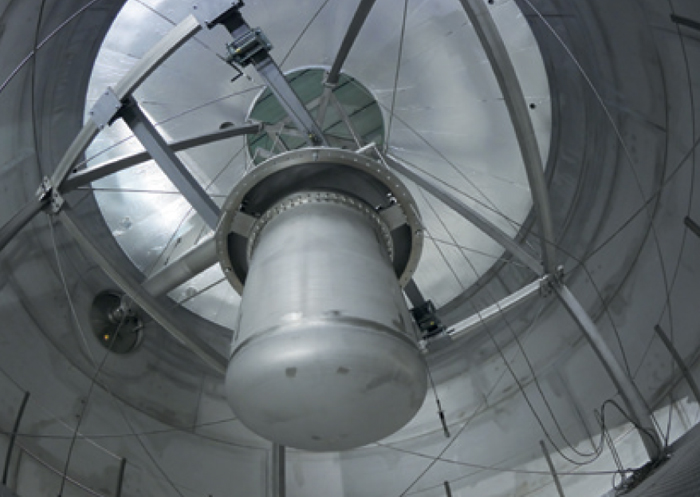
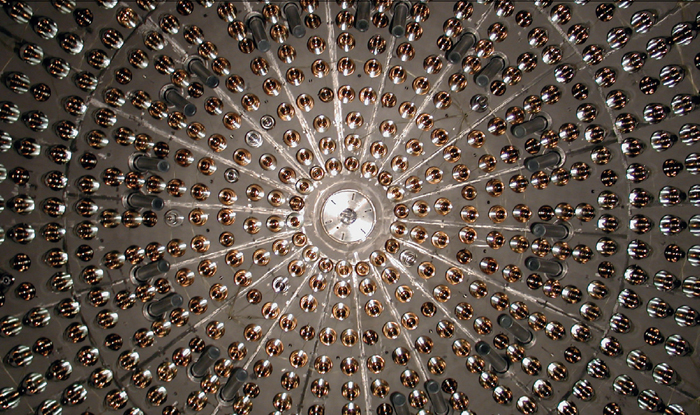
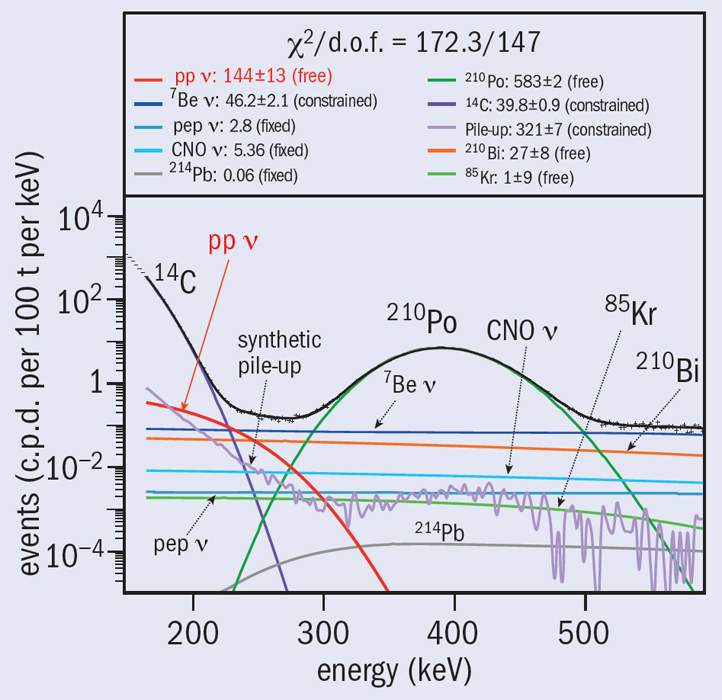
The Borexino experiment at the INFN Gran Sasso National Laboratories has measured the energy of the Sun in real time, showing for the first time that the energy released today at its centre is exactly the same as that produced 100,000 years ago. This has been possible through the experiment’s direct detection of the low-energy neutrinos produced in the initial nuclear reactions occurring in the solar core.

Previous measurements of solar energy have always been made on the radiation (photons) that currently illuminate and heat the Earth. The energy of this radiation originates in the Sun’s nuclear reactions, but, on average, has taken 100,000 years to travel through the dense solar matter and reach the surface. Neutrinos produced by the same nuclear reactions, on the other hand, take only a few seconds to escape from the Sun before making the eight-minute journey to Earth. The comparison between the neutrino measurement now published by the Borexino collaboration and the previous measurements on the emission of radiant energy from the Sun shows that solar activity has not changed during the past 100,000 years.

CCnew2_08_14

Borexino is an ultra-sensitive liquid-scintillator detector designed to detect low-energy neutrino events in real time at a high rate, in contrast to earlier radioachemical experiments such as Homestake, GALLEX and SAGE. The experiment previously has focussed on measurements of neutrinos from 7Be and 8B – nuclei formed in certain branches of the principal chain of reactions that converts hydrogen to helium at the heart of the Sun. The 7Be neutrinos constitute only 7% of the neutrino flux from the Sun and the 8B neutrinos even less, but they have been key to the discovery and study of the phenomenon of neutrino oscillations, most recently by Borexino. In contrast in this latest work, Borexino has focused on the neutrinos from the fusion of two hydrogen nuclei (protons) to form deuterium – the seed reaction of the nuclear-fusion cycle that produces about 99% of the solar power, some 3.84 × 1033 ergs/s.

The difficulty of the new measurement lies in the extremely low energy of these so-called pp neutrinos, which is smaller than that of the others emitted by the Sun. The capability to do this successfully makes the Borexino detector unique, and has also allowed the study of neutrinos produced by the Earth.

The Borexino experiment is the result of a collaboration between European countries (Italy, Germany, France, Poland), the US and Russia, and it will take data for at least another four years, improving the accuracy of measurements already made and addressing others of great importance, for both particle physics as well as astrophysics.

ATLAS closes and prepares for the restart

CCnew3_08_14

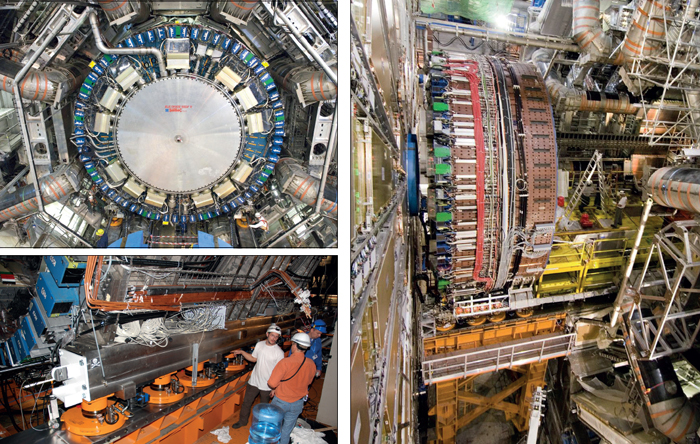
On 7 August, the technical teams in charge of closing activities in the ATLAS collaboration started to move the first pieces back into position around the LHC beam pipe. The subdetectors had been moved out in February 2013, at the beginning of the first LHC Long Shutdown (LS1) – a manoeuvre that was needed to allow access and work on the planned upgrades.

LS1 has seen a great deal of work on the ATLAS detector. In addition to the upgrades carried out on all of the subdetectors, when the next LHC run starts in 2015 the experiment will have a new beam pipe and a new inner barrel layer (IBL) for the pixel detector. For the work to be carried out in the cavern, one of the small wheels of the muon system had to be moved to the surface.

The various pieces are moved using an air-pad system on rails, with the exception of the 25-m-diameter big wheel (in the muon system), which moves on bogies. One of the most difficult objects to move is the endcap calorimeter: it weighs about 1000 tonnes and comes with many “satellites”, i.e. electric cables, cryogenic lines and optical fibres for the read-out. Thanks to the air pads, the 1000 tonnes of the calorimeter can be moved by applying a force of only 23 tonnes. During the movement, the calorimeter, with its cryostat filled with liquid argon, remains connected to the flexible lines whose motion is controlled by the motion of the calorimeter.

The inflation of the air pads must be controlled perfectly to avoid any damage to the delicate equipment. This is achieved using two automated control units –one built during LS1 – which perform hydraulic and pneumatic compensation. This year, the ATLAS positioning system has been improved thanks to the installation of a new sensor system on the various subdetectors. This will allow the experts to achieve an accuracy of 300 μm in placing the components in their final position. The position sensors were originally developed by Brandeis University within the ATLAS collaboration, but the positioning system itself was developed with the help of surveyors from CERN, who are now using this precision system in other experiments.

All of the equipment movements in the cavern happen under the strict control of the technical teams and the scientists in charge of the various subdetectors. It takes several hours to move each piece, not only owing to the weight involved, but also because several stops are necessary to perform tests and checks.

The closing activities are scheduled to run until the end of September. By then, the team will have moved a total of 12 pieces, that is, 3300 tonnes of material.

The SPS gets ready to restart

CCnew4_08_14

Work continues apace to ready the Super Proton Synchrotron (SPS) for its planned October restart, while beams are already being delivered to experiments at the Proton Synchrotron (PS) and PS Booster.

During July and August, SPS teams were kept busy with a range of start-up tests for the various equipment groups, including eight weeks of electrical power-converter tests. Since it began in February 2013, the Long Shutdown 1 (LS1) has seen the replacement and renovation of about 75% of the SPS powering, including major components such as 18 kV transformers, switches, cables and thyristor bridges that sit at the heart of the power converters. There have also been important upgrades to the control and high-precision measurement systems. The summer tests were to confirm that the renovated converters were operating correctly to power the SPS dipole and quadrupole magnets.

Slotted among this busy schedule of powering tests were the final checks of the accelerator’s magnets and beam dump. The SPS had one of each of the three main types of magnet fault: an electrical fault (short circuit) in a magnet circuit, a water leak (in the cooling system), and a vacuum-chamber leak. In addition, the main beam dump had to be replaced. Rather than stopping the tests for each move, the teams replaced all four elements in one go.

On 10–12 August, the three magnets and beam dump were removed and replaced with spares in the SPS tunnel. The logistics for this move were complex because of the weight of the magnets and beam dump, and also the 10-tonne chariot and lifting equipment. In addition, these large pieces of equipment fill the entire width of the tunnel, so co-ordinating which vehicles and teams were where and synchronizing their movements was vital.

Although the SPS teams are well-versed at replacing magnets – they can replace as many as four magnets during a two-day technical stop – replacing the beam dump proved to be a tougher challenge. Because the dump is radioactive, the length of transport had to be kept as short as possible and moving the dump from the tunnel to the radiation storage area could not take place if it rained. With this in mind, the operations team created detailed plans for the move, providing hourly updates and back-up solutions in case of rain.

Despite these extensive tests and replacements, the SPS remains on schedule to take beam from the PS in early September, with the accelerator operating again in October to provide beams to the North Area.

At the LHC, in late August the cooling of sector 1-2 was in progress, and the cooling of sector 5-6 beginning. Vacuum teams were checking for any final leaks and carrying out sealing tests in various sectors. At the same time, the copper-stabilizer continuity measurement tests were in progress in sector 8-1, before being carried out throughout the machine. The first power tests have begun in sector 6-7, which will be the first sector ready for beam. Elsewhere, electrical validation tests were in progress throughout the machine, together with instrumentation tests, particularly on the beam-loss sensors. All of the collimators, the kicker magnets and the beam instrumentation in the straight sections of the LHC were installed and under vacuum.

First beam in Linac4 DTL

CCnew5_08_14

Work progresses on Linac4, the linear accelerator foreseen to take over from the current Linac2 as injector to the PS Booster. On 5 August, the first drift-tube linac (DTL) tank saw beams at 12 MeV. After seven years of design, prototyping and manufacturing, the Linac4 DTL, which comprises three tanks, underwent countless workshop-based measurements of the geometry, vacuum and magnet polarization of the tanks, before the first was installed in the Linac4 tunnel on 5 June. Beam commissioning tests ran until 21 August, and found the DTL operating with nominal transmission.

Budker Institute’s booster gets going at Brookhaven

CCnew6_08_14

The National Synchrotron Light Source II (NSLS-II) is currently being commissioned at Brookhaven National Laboratory. When completed, it will be a state-of-the-art, medium-energy electron storage ring producing X-rays up to 10,000 times brighter than the original NSLS, which started operating at BNL in 1982 and will be shut down at the end of September.

The injector system includes a 200 MeV linac and booster with energy up to 3 GeV. The booster is a joint venture between the NSLS-II injector group and the Budker Institute of Nuclear Physics (BINP) in Novosibirsk, one of the NSLS-II partners. BINP has a solid relationship with the Brookhaven lab and has played a significant role in NSLS-II development, coming up with the final design of the booster. The institute has its own well-developed workshops and a variety of specialists, who are not only involved in many major international projects but also operate the VEPP-2000 and VEPP-4M colliders.

In May 2010, according to tender results, a contract was signed between Brookhaven and BINP on the manufacturing, installation and commissioning of the turnkey booster (except an RF system). One year later, Brookhaven staff visited BINP and accepted all first articles. Most of the components – including the magnets, power supplies, diagnostic systems, injection-extraction system – were made at BINP. However, BINP also engaged subcontractors, including European firms. For example, power supplies for the booster dipole magnets were produced by Danfysik A/S.

An 11-hour time difference between Novosibirsk and New York did not prevent good interaction between the laboratories. In the morning and evening, Brookhaven and BINP experts usually made contact to discuss the latest achievements and pose new questions. So the Sun never set over the booster project.

Booster parts arrived at Brookhaven from January through to August 2012. Most of the components came as girder assemblies with magnets aligned to tens of microns, and vacuum chambers installed. The journey of more than 10,000 km was made first by road from Novosibirsk to St Petersburg and then to New York by ship. Upon arrival at Brookhaven, all assemblies were thoroughly tested, but the long journey did not affect the alignment of magnets on the girders.

The testing and installation activities have spanned both organizations. The booster commissioning also involved staff from both NSLS-II and BINP. Following authorization, the commissioning of the booster started in December 2013 and was successfully completed in February 2014, ahead of schedule. The beam passing through booster was up to 95%, with all systems working according to design.

The commissioning of the main storage ring started in March and on 11 July, NSLS-II reached a current of 50 mA at 3 GeV, using a new superconducting radio-frequency cavity. The second cavity and other hardware are still to be installed before the accelerator reaches the full design current of 500 mA. The next step is commissioning insertion devices and front-ends.

ALFA in ATLAS measures pp cross-section with high precision

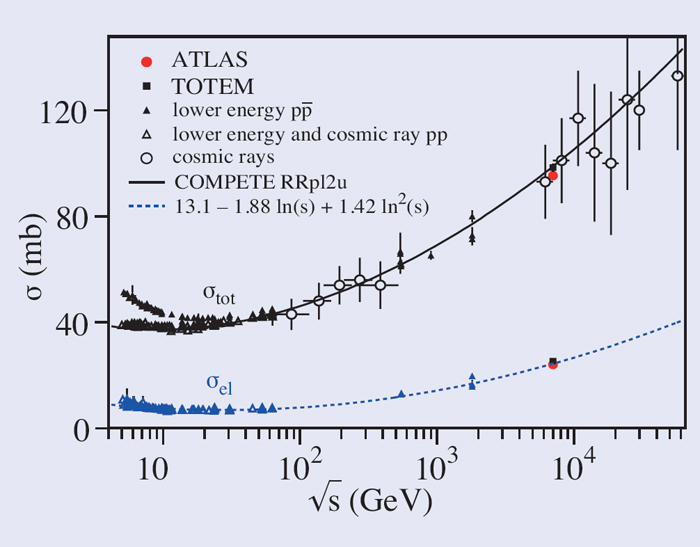
Data from a special run of the LHC using dedicated beam optics at 7 TeV have been analysed to measure the total cross-section of proton–proton collisions in ATLAS. Using the Absolute Luminosity For ATLAS (ALFA) Roman Pot sub-detector system located 240 m from the interaction point, ATLAS has determined the cross-section with unprecedented precision to be σtot (pp → X) = 95.4±1.4 mb.

CCnew8_08_14

The total cross-section is a fundamental parameter of the strong interactions, setting the scale of the size of the interaction region at a given energy. To measure the total cross-section, the optical theorem is used, which states that the total cross-section is proportional to the imaginary part of the forward elastic-scattering amplitude, extrapolated to momentum transfer, t = 0. From a measurement of the elastic-scattering cross-section differential in t, the value of the total cross-section is inferred, and is found to increase logarithmically with the centre-of-mass energy (see figure).

Measuring elastic scattering is a challenge because elastically scattered protons escape the interaction at very small angles of tens of micro-radians or less. To detect these protons, dedicated detectors are installed, such as ALFA. To achieve the required focusing properties, the LHC was operated with special beam optics of β* = 90 m. The detectors can then be moved as close as a few millimetres from the LHC beam, to access the smallest scattering angles.

ATLAS provides further insights into the Higgs boson

CCnew9_08_14

The discovery of a Higgs boson by the ATLAS and CMS collaborations in 2012 marked a new era in particle physics. Since then, the experimental determination of the properties of the new boson, such as its mass and production rate, as well as the study of its decays into as many final states as possible, have became crucial tasks for the LHC experiments.

The ATLAS collaboration has recently published a new set of measurements of the Higgs boson’s properties from the two high-resolution decay channels, to two photons (ATLAS Collaboration 2014a) and to four charged leptons (ATLAS Collaboration 2014b). The new measurements have been performed using the proton–proton collisions delivered by the LHC in 2011 and 2012. They exploit the most accurate knowledge of the detector performance achieved so far, which has also led to an updated measurement of the Higgs mass, m= 125.36±0.41 GeV (ATLAS Collaboration 2014c).

The Standard Model predicts precisely the couplings of the Higgs boson to all other known elementary particles, once its mass is measured. The simplest way to probe the new boson couplings is to measure the ratio μ (or signal strength) between the number of Higgs bosons measured in the collected data and the number predicted by the theory: a measured μ = 1 would mean that the observation is consistent with the Standard Model Higgs boson. In these latest analyses, the signal strength in the two-photon channel is found to be μ = 1.17±0.27, while it is μ = 1.44+0.40–0.33 in the four-lepton channel. So, within their uncertainties, both results agree with the Standard Model.

The Standard Model also predicts that a Higgs boson can be produced through different mechanisms in proton–proton collisions. The most frequent mechanism (87%) is the scattering (or “fusion”) of strongly interacting gluons to form a Higgs boson. Production through the fusion of W or Z bosons is predicted to occur in 7% of the cases, and has a characteristic event signature of two jets in the forward direction (along the proton beams) that accompany the Higgs boson. The figure shows a candidate event for this production mode. In the recent papers, ATLAS physicists have identified and measured Higgs bosons from various production mechanisms (ATLAS Collaboration 2014a and 2014b).

So far, no surprises have emerged when looking into the details, but the statistical uncertainties are still large. The new data-taking campaign starting in 2015 will be important to improve the precision of the measurements, and will lead to an improved understanding of the nature of the Higgs boson.

A bright future for dark-matter searches

CCnew10_08_14

The US Department of Energy Office of High Energy Physics and the National Science Foundation Physics Division have announced their joint programme for second-generation dark-matter experiments, aiming at direct detection of the elusive dark-matter particles in Earth-based detectors. It will include ADMX-Gen2 – a microwave cavity searching for axions – and the LUX-Zeplin (LZ) and SuperCDMS-SNOLAB experiments targeted at weakly interacting massive particles (WIMPs). These selections were partially in response to recommendations of the P5 subpanel of the US High-Energy Physics Advisory Panel for a broad second-generation dark-matter direct-detection programme at a funding level significantly above that originally planned.

While ADMX-Gen2 consists mainly of an upgrade of the existing apparatus to reach a lower operation temperature of around 100 mK, and is rather inexpensive, the two WIMP projects are significantly larger. SuperCDMS will initially operate around 50 kg of ultra-pure germanium and silicon crystals at the SNOLAB laboratory in Ontario, for a search focused on WIMPs with low masses, below 10 GeV/c2. The detectors will be optimized for low-energy thresholds and for very good particle discrimination. The experiment will be designed such that up to 400 kg of crystals can be installed at a later stage. The massive LZ experiment will employ about 7 tonnes of liquid xenon as a dark-matter target in a dual-phase time-projection chamber (TPC), installed at the Sanford Underground Research Facility in South Dakota. It is targeted mainly towards WIMPs with masses above 10 GeV/ c2. The timescale for these experiments foresees that the detector construction will start in 2016, with commissioning in 2018. All three experiments need to run for several years to reach their design sensitivities.

Meanwhile, other projects are operational and taking data, and several new second-generation experiments, with target masses beyond the tonne scale, are fully funded and currently being installed. The Canadian–UK project DEAP-3600, installed at SNOLAB, should take its first data with a 3.6-tonne single-phase liquid-argon detector by the end of this year. Its sensitivity goal is a factor 10–25 beyond the current best limit, depending on the WIMP mass. XENON1T, a joint effort by US, European, Swiss and Israeli groups, aims to surpass this goal using 3 tonnes of liquid xenon, of which 2 tonnes will be inside a dual-phase TPC. Construction is progressing fast at the Gran Sasso National Laboratory, and first data are expected by 2015. These experiments and their upgrades, the newly funded US projects, and other efforts around the globe, should open up a bright future for direct-dark-matter searches in the years to come.

INTEGRAL catches radioactivity of a supernova

ESA’s INTEGRAL satellite has detected gamma-ray lines from the radioactive decay of nickel and cobalt in a nearby supernova of type Ia. This unprecedented result confirms that the intense light of the supernova comes from the radioactive decay of these elements, which were formed by the thermonuclear explosion of a white-dwarf star.

There are basically two main classes of supernova explosions. Type II supernovae result from the collapse of the core of a massive star, whereas those of type Ia are thought to be the thermonuclear disruption of a white-dwarf star. According to the theory of such explosions, the carbon and oxygen found in a white dwarf should be fused into radioactive nickel (56Ni) during the explosion. The 56Ni should decay quickly into radioactive cobalt (56Co), which itself subsequently decays, on a somewhat longer timescale, into stable iron (56Fe). The ignition should arise when the white dwarf’s mass exceeds a critical mass of about 1.4 times the mass of the Sun. This can result from mass transfer from a companion star or by the merger of two white dwarfs.

It is this uniform process among all type-Ia supernovae that makes them “standard candles” for cosmology, which were used to measure the acceleration of the expansion of the universe (CERN Courier November 2011 p5). Type Ia supernovae are also less frequent than type IIs, and it is only by coincidence that two relatively nearby events appeared recently: SN 2011fe in the Pinwheel Galaxy (CERN Courier January/February 2012 p13) and now SN 2014J in Messier 82 (Picture of the month CERN Courier March 2014 p12). At a distance of 11.5-million light-years from Earth, SN 2014J is the closest of its type since 1972. Its appearance offered a unique opportunity to use the SPI gamma-ray spectrometer aboard INTEGRAL to try to detect the emission lines from the decays of 56Ni and 56Co. All other scheduled observations of INTEGRAL were delayed, but it paid off.

Eugene Churazov, from the Space Research Institute in Moscow and the Max Planck Institute for Astrophysics in Germany, and collaborators, report the detection of two emission lines at 847 and 1238 keV from the radioactive decay of 56Co between 50 and 100 days after the ignition. They also find a weak signal at 511 keV from the electron–positron annihilation following the decay 56Co → 56Fe + e+ and associated emission in the 200–400 keV band. By fitting a three-parameter model to the observations, they calculate that about 0.6 solar masses of 56Ni have been produced by the thermonuclear explosion. The observed broadening of the lines suggests a typical expansion velocity of about 10,000 km/s.

Another team, led by Roland Diehl from the Max Planck Institute for Extraterrestrial Physics, reports the detection of 56Ni already 15 to 20 days after the explosion. This came as a surprise, and suggests that about 10% of the nickel is not produced at the centre of the star – from where the radiation could not escape – but must have been produced outside it. The researchers propose that a belt of helium accreted from the companion star could have detonated first, forming the observed nickel and then triggering the internal explosion that became the supernova.

Regardless of the fine details, these results represent a new breakthrough for the 12-year-old INTEGRAL spacecraft, which has previously detected the radioactive signal of 44Ti from the bright type-II SN 1987A in the Large Magellanic Cloud (CERN Courier December 2012 p11). The new results provide direct evidence that type-Ia supernovae are indeed thermonuclear explosions of white-dwarf stars.

bright-rec iop pub iop-science physcis connect