Comsol -leaderboard other pages

Topics

Accelerator Physics at the Tevatron Collider

By Valery Lebedev and Vladimir Shiltsev (eds)
Springer
Hardback: £99 €116.04 $149
E-book: £79 €91.62 $119

CCboo1_09_14

This fascinating book, compiled and edited by two of the leaders of Tevatron’s Run II, describes the achievements and lessons from Fermilab’s famous machine, which shut down for the last time at the end of September 2011. The authors and editors take us on a mesmerizing tour through the components and history of this remarkable accelerator, and provide a lively account of how, across the years, numerous obstacles were overcome, and how novel technologies contributed to the astonishing success of “one of the most complex research instruments ever to reach the operation stage”. Not only was the Tevatron the highest-energy particle collider for about a quarter of a century, it was also a pioneering accelerator in almost every regard.

In the first of nine chapters, Steve Holmes, former Fermilab accelerator director, John Peoples, former Fermilab director, together with Ronald Moore and Vladimir Shiltsev, recall the history of Fermilab and the “Energy Saver/Doubler”, which was later to become known as the Tevatron. Across almost three decades, the peak luminosity of this collider was increased by four orders of magnitude. The second chapter, in which Alexander Valishev joins the two editors as author, surveys the Tevatron’s linear and nonlinear beam-optics control. I particularly enjoyed the review of the intricate and spectacular nonlinear dynamics experiments performed in the late 1980s and early 1990s, which had been conceived to unveil the origin of dynamic aperture (e.g., the famous “E778 experiment”) and the effect of tune modulation.

The third chapter, by Jerry Annala and co-workers, brings us to the heart of the accelerator. As the first superconducting hadron storage ring, the Tevatron designers and operators had many issues to tackle. These included the effects of large intrinsic nonlinear field errors; the dynamic chromaticity drifts owing to the decay of persistent-current field errors, whose successful automatic compensation depended on many details of the preceding magnet cycles, such as the length of the flat top, the ramp rate, etc; and, last but not least, the “snapback” – i.e. the sudden re-induction of the persistent currents in the superconducting cable at the start of the energy ramp. From my student days, I vividly remember how much the Tevatron experience guided the development of the later superconducting machines, such as HERA at DESY. This chapter also presents the Recycler, the first large-scale all-permanent-magnet storage ring, operating at 8 GeV.

In the following chapter, Chandra Bhat, Kiyomi Seiya and Shiltsev present two of the most fascinating techniques of longitudinal beam manipulation – slip stacking, which has doubled the proton intensity in the Main Injector, and radiofrequency barrier buckets, used for the accumulation and processing of antiprotons. Next, Alexey Burov, Lebedev and their colleagues discuss the Tevatron’s impedance and collective effects. There are noteworthy handy formulae for the transverse and longitudinal impedance of laminated vacuum chambers developed for the Tevatron, which I have used myself often.

Chapter six, by Richard Carrigan and several co-authors, treats mechanisms of emittance growth and beam loss, including important mitigation measures such as collimation, beam removal from the abort gap using the “Tevatron electron lens” as a pulsed exciter, tests of halo deflection with bent crystals, and the Tevatron luminosity model. Lebedev, Ralph Pasquinelli and others then delve into antiproton production, stochastic cooling and the first relativistic electron cooler, based on a 4.3 MV pelletron, which many of my colleagues had thought to be unfeasible. The antiproton source technology, which had begun at CERN, was brought to maturity at the Tevatron complex, where from 1994 to 2010 the antiproton intensity was raised by another factor of 10, making this the most powerful antiproton source constructed, by far. In chapter eight, Shiltsev and Valishev discuss beam–beam effects, including the famous “scallop”-shaped pattern of emittance growth along the antiproton bunch trains, which I witnessed myself fill after fill around the year 2002, while visiting the Tevatron control room. Finally, advanced beam instrumentation, including Schottky monitors and proton synchrotron-light diagnostics, are summarized in chapter nine.

At the end of the book I found a list of about 30 PhD theses, completed on accelerator-physics topics at the Tevatron across a span of about 25 years. I smiled when I realized that many of these earlier PhD students have become today’s leaders in the accelerator field. This illustrates the exceptional training experience from participating in a demanding and inspiring collider programme such as the Tevatron’s.

Undoubtedly, this book will serve as a wonderful and unique reference for many decades to come. The authors and editors are to be congratulated for their effort to compile and preserve the accelerator knowledge of the Tevatron, accumulated during 25 years of successful struggle and permanent innovation. The Tevatron’s lessons and achievements would be all too easily forgotten without such a written record. In conclusion, I recommend this book highly to accelerator professionals around the world. Reading it should be all but compulsory for anyone wishing to improve the performance of an existing frontier machine, or design the next generation of highest-energy colliders.

Reviews of Accelerator Science and Technology: Volume 6 – Accelerators for High Intensity Beams

By Alexander W Chao and Weiren Chou (eds)
World Scientific
Hardback: £98
E-book: £74
Also available at the CERN bookshop

9789814583244

As particle accelerators strive for ever-increasing performance, high-intensity particle beams are becoming one of the critical demands from a majority of users – whether for proton, electron or ion beams – and for most applications. The accelerator community has therefore put a great deal of effort into the pursuit of high-intensity accelerator performance, on a number of fronts. Recognizing the topic’s importance, the editors have dedicated this volume of Reviews of Accelerator Science and Technology to accelerators for high-intensity beams. As well as reviews of applications at the intensity frontier in particle and nuclear physics, this volume also looks at applications, for example, in radiography and the production of radiopharmaceuticals, as well as in accelerator-driven systems and the inertial production of fusion energy. Other chapters deal with different types of accelerator, such as superconducting hadron linacs and rapid-cycling synchrotrons, and accumulator rings for high-intensity hadron beams. Key accelerator subsystems that allow high-intensity operation are also covered, with chapters on ion injectors, ion charge-strippers, targets and secondary beams, neutron-beam lines and beam-material interactions. The final chapter follows the journal’s tradition of looking at people who have shaped the field. This time, Giorgio Brianti and David Plane contribute their personal recollections about John Adams, who made so many pioneering contributions to CERN’s unrivalled accelerator complex. In particular, it outlines Adams’s abilities as an international collaboration leader.

Path Integrals and Hamiltonians: Principles and Methods

By Belal E Baaquie
Cambridge University Press
Hardback: £75 $120
E-book: £96

51tDj3v9+cL

Providing a pedagogical introduction to the essential principles of path integrals and Hamiltonians, this book describes cutting-edge quantum-mathematical techniques applicable to a vast range of fields, from quantum mechanics, solid-state physics, statistical mechanics, quantum field theory and superstring theory to financial modelling, polymers, biology, chemistry and quantum finance. The powerful and flexible combination of Hamiltonian operators and path integrals is used to study a range of different quantum and classical random systems. With a practical emphasis on the methodological and mathematical aspects of each derivation, this introduction to these mathematical methods is suitable for researchers and graduate students in physics and engineering.

Nambu: A Foreteller of Modern Physics

By T Eguchi and M Y Han (eds)
World Scientific
Hardback: £45
E-book: £23

CCboo3_09_14

Seeds for many developments in contemporary particle physics were sown by Yoichiro Nambu in his lectures and papers in the 1960s and 1970s – in particular, his work on the mechanism of spontaneous broken symmetry, for which he was to receive the Nobel prize. Tackling first the problem of maintaining gauge invariance in a field theory of superconductivity, he went on to develop these ideas in field theories for elementary particles, in particular inspiring the important work that led to the Brout–Englert–Higgs (BEH) mechanism for generating mass through spontaneous symmetry breaking in the Standard Model. These developments culminated at CERN in July 2012 (not 2011, World Scientific please note) with the discovery of an appropriate scalar particle – a Higgs boson. This book collects together the important papers related to this story and much more, some never published before in book form. The text is not only of historical value, but also provides a window into the mind of a man that many refer to as “Nambu the seer”. It is a valuable resource for researchers in elementary particle theory, and for those who are interested in the history of modern physics.

Principles of Discrete Time Mechanics

By George Jaroszkiewicz
Cambridge University Press
Hardback: £85 $130
E-book: $104

9781107034297i

Could time be discrete on some unimaginably small scale? Exploring the idea in depth, this book systematically builds the theory up from scratch, beginning with the historical, physical and mathematical background to the chronon hypothesis. Covering classical and quantum discrete-time mechanics, the author presents all of the tools needed to formulate and develop applications of discrete-time mechanics in a number of areas, including classical and quantum mechanics and field theories.

Beam Dynamics in High Energy Particle Accelerators

By Andrzej Wolski
World Scientific
Hardback: £98
E-book: £74

CCboo2_09_14

This book by Andrzej Wolski is not a general textbook but, rather, a theoretical monograph on some of the basic physics of particle accelerators, with a strong emphasis on what can be treated analytically. It is decidedly not an introduction to accelerators. Indeed it contains no description, photo or diagram of what a particle accelerator looks like, no list of numerical parameters, nor any indication of what purposes such a device might serve. I could find no mention of the name, or energy, of any past or present accelerator. The unit of MeV first appears in relation to the spacing of spin resonances. I wonder whether the author consciously sought to imbue his work with a whiff of Whittaker’s treatise? No criticism intended – I rather admire his temerity – just make sure that you have some background before tackling this 590-page opus.

The first two words of the title are key to its coverage: beam dynamics is treated as an application of classical Hamiltonian mechanics and electrodynamics. These are the explicit prerequisites. Among existing books, those of S Y Lee (a little shorter and denser) and H Wiedemann (almost twice as long), are pitched at a similar level, but structured as textbooks with exercises and more applications.

I liked chapter one, a useful description of the electromagnetic fields in magnets and RF cavities that goes into more depth than most, and is careful to explain some key practical concepts that are sometimes taken for granted. On the other hand, there is no mention of how strong you can make those fields. Subsequent chapters cover thoroughly the well-trodden ground of linear single-particle dynamics and optics in the two transverse degrees of freedom, taking a Hamiltonian approach ab initio. I was a little disappointed in the perpetuation of an unfortunate choice of the canonical variables for longitudinal motion, first made in a well-known computer program in the 1980s. Perhaps it is as well to follow the crowd now, but subsequent Hamiltonians become messier than necessary, and there is some unnatural fudging around the dispersion function.

Unusually, but logically, longitudinal motion is treated in the context of a chapter on coupling, before the introduction of a formalism for full linear coupling. There is a standard discussion of synchrotron radiation (omitting the quantum lifetime) and low-emittance lattice modules for light sources. Nonlinear dynamics gets a great deal of attention, with discussions of the traditional topics of Lie transformations, canonical perturbation theory, symplectic integrators, nonlinear resonances, dynamic aperture and frequency map analysis. Practical results on linear perturbations are also worked in.

Like Lee and Wiedemann, Wolski says surprisingly little about colliders. There is no mention of low-beta collision optics, dispersion suppressors or separation schemes. A brief discussion of the head-on beam–beam effect and a passing mention of luminosity are appended to a more comprehensive discussion of single-beam space charge. Perhaps this reminds us that most accelerators are not colliders. There is a good derivation of the Touschek lifetime, but the standard results on intra-beam scattering (Piwinski, Bjorken–Mtingwa) are only quoted.

The final chapters cover wake-fields and impedances, and the collective instabilities they drive. The formal approach works well here, imposing order and clarity on what can be a confusing array of concepts and definitions. Several important beam- instability mechanisms are treated in detail.

The book seems relatively free of misprints (although there is a glaring one after equation 2.17). Overall, this is a recommendable addition to the literature, covering its topics clearly and thoroughly.

SESAME boosts electrons to 800 MeV

A key accelerator at the Synchrotron-light for Experimental Science and Applications in the Middle East (SESAME) facility in Allan, Jordan, has reached its top energy recently. After having successfully stored electrons in the Booster-Synchrotron in July, the SESAME team succeeded in accelerating electrons to their final energy of 800 MeV on 3 September.

The SESAME injector consists of a 20-MeV microtron and the 800-MeV booster synchrotron. Electrons are produced in the microtron and accelerated to 20 MeV before being transferred to the booster synchrotron. The microtron became operational in 2012 and installation of the booster was completed in 2013. Storage in the booster synchrotron of the electrons from the microtron in July saw them circulating several millions of turns at their initial energy of 20 MeV. Now, the electrons have been accelerated to 800 MeV, which is the top energy of the booster.

This success will lead towards the final goal, which is to make SESAME the first operational synchrotron light source in the Middle East.

Bringing SESAME’s booster synchhrotron successfully to full operation is of particular significance because this is the first high-energy accelerator in the Middle East. The achievement is thanks to a team of young scientists and technicians from the region, for whom accelerator technology is a new field. They were led in this work by Erhard Huttel, the technical director of SESAME.

This success will lead towards the final goal, which is to make SESAME the first operational synchrotron light source in the Middle East, and to confirm its position as a truly international research centre. When the facility starts operations – probably in early 2016 – scientists from the Middle East and neighbouring countries, in collaboration with the international synchrotron light community, will have the possibility to perform world-class scientific studies. They will be able, for example, to determine the structure of a virus to improve medical remedies, gain insight into the interior and the three-dimensional microstructure of objects such as materials that are of interest to cultural heritage and archaeology, and investigate magnetization processes that are highly relevant for magnetic data storage.

SESAME has had links with CERN from the start. Following a suggestion by Gus Voss (DESY) and Herman Winick (SLAC), Sergio Fubini (CERN and University of Turin, who chaired a Middle East Scientific Co-operation group) and Herwig Schopper (director-general of CERN in the years 1981–1987) persuaded the German government to donate the components of the then soon-to-be-dismantled Berlin synchrotron BESSY I for use at SESAME (CERN Courier September 2014 p46). At a meeting at UNESCO in 1999, an interim council was established with Schopper as president. SESAME is modelled closely on CERN, and shares CERN’s original aims and its governance structure. The current president of SESAME Council is Chris Llewellyn Smith, former director-general of CERN (1994–1998).

In July, a sextupole corrector magnet for the SESAME storage ring arrived at CERN for tests and magnetic measurements. It is the first unit out of 32 to be delivered by the CNE Technology Center, a Cypriot-based company under the EU-CERN CESSAMag project.

In November last year, a pre-series sextupole for SESAME was prepared at CERN, to check the design and to tune the manufacturing procedures before placing the order for the series production to industry. The contracts were then awarded to a Cypriot and a Pakistani company. The CERN team has been working closely with both companies to transfer the knowledge from CERN that is needed to build these magnets.

The first unit out of the 32 magnets from Cyprus has already arrived at CERN, where measurements carried out together with SESAME colleagues reveal a precise assembly, resulting in magnetic-field homogeneity of 0.2‰ within two thirds of the aperture. The unit is also mechanically, electrically and hydraulically sound, assuring good reliability during operation. This makes the magnet appropriate for the lattice of a synchrotron light source such as SESAME, and it is a major step in preparing the SESAME storage ring.

The Cypriot company has, in parallel, assembled more than 50% of the components needed for the rest of the contract. The first magnet from Pakistan is currently being assembled.

• CESSAMag is the FP7 project “CERN-EC Support for SESAME Magnets”, which aims at supporting the construction of the SESAME light source.

AMS finds evidence of new source of positrons in cosmic rays

CCnew2_09_14

The Alpha Magnetic Spectrometer (AMS) on the International Space Station (ISS) has new results on energetic cosmic-ray electrons and positrons, based on analysis of the first 41 billion events. These results provide a deeper understanding of the nature of high-energy cosmic rays and could shed more light on the existence of dark matter.

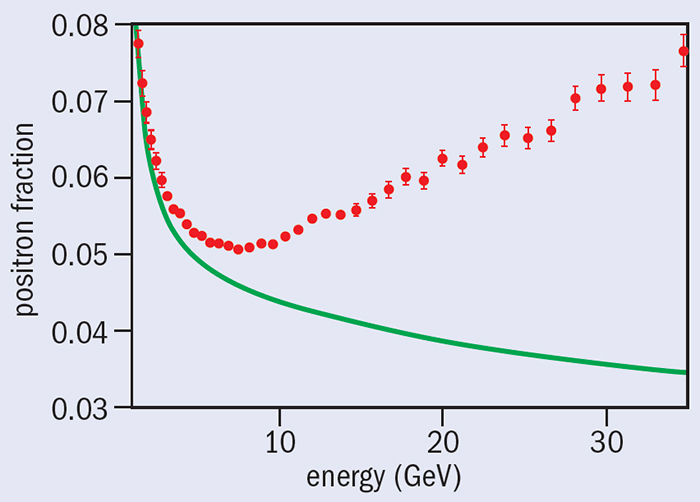
Of the 41 × 109 primary cosmic-ray events analysed so far, 10.9 × 106 have been identified as electrons and positrons. Using these, the AMS collaboration has measured the positron fraction – the ratio of the number of positrons to the combined number of positrons and electrons – in the energy range 0.5–500 GeV (Accardo et al. 2014). When compared with the expectation based on the production of positrons in standard cosmic-ray collisions, the results show that the fraction starts to increase rapidly at 8 GeV (figure 1). This indicates the existence of a new source of positrons.

CCnew3_09_14

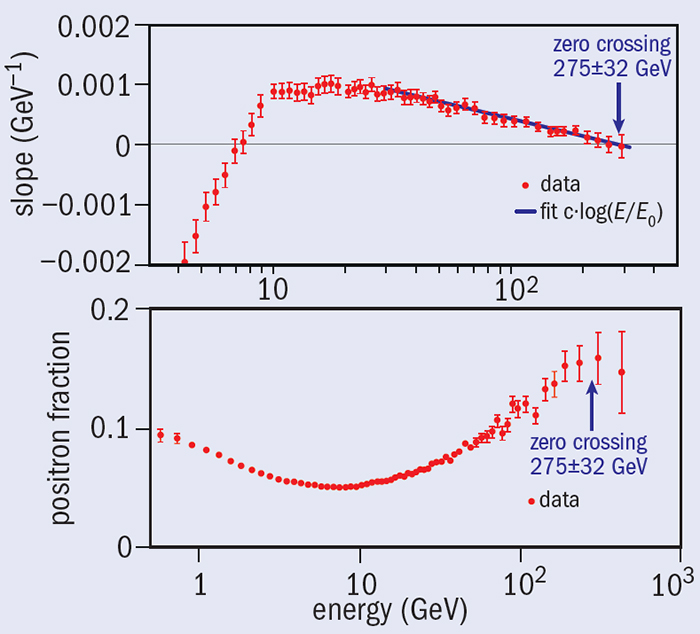
AMS has also accurately determined the exact rate at which the positron fraction increases with energy, and for the first time observed the fraction reach a maximum (figure 2). The data show that the rate of change of the positron fraction crosses zero at 275±32 GeV – indicating the energy at which the fraction reaches its maximum (Aguilar et al. 2014). The results also show that the excess of the positron fraction is isotropic within 3%, suggesting strongly that the energetic positrons might not be coming from a preferred direction in space. Moreover, the fraction shows no observable sharp structures.

CCnew4_09_14

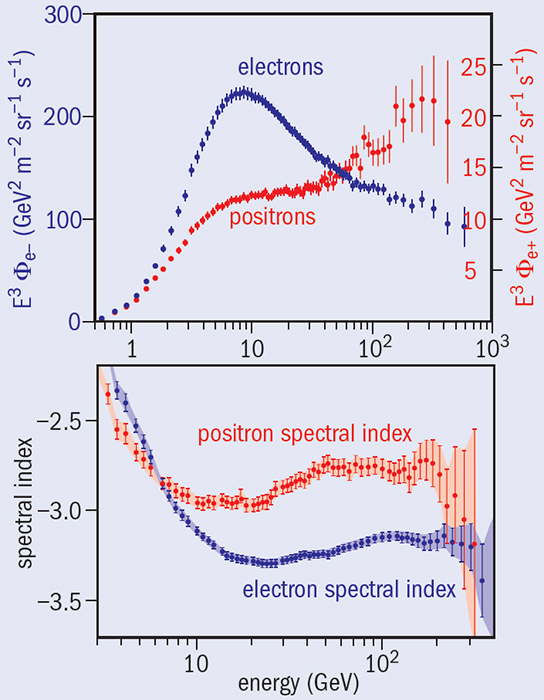
AMS has also precisely determined the flux of electrons (figure 3) as well as for positrons (figure 4). These measurements reveal that the fluxes differ significantly in both their magnitude and energy dependence. The positron flux first increases (0.5–10 GeV) and then levels out (10–30 GeV), before increasing again (30–200 GeV). Above 200 GeV, it has a tendency to decrease. This is totally different from the scaled electron flux. The results show that neither flux can be described with a constant spectral index (figure 4, bottom). In particular, between 20 and 200 GeV, the rate of change of the positron flux is surprisingly higher than the rate for electrons. This is important proof that the excess seen in the positron fraction is from a relative excess of high-energy positrons, and not the loss of high-energy electrons.

CCnew5_09_14

Different models for dark matter predict different behaviours for the positron-fraction excess. The new results from AMS put much tighter constraints on the validity of these models. The results are consistent with a dark-matter particle (neutralino) of mass of the order of 1 TeV. To determine if the observed new phenomenon is indeed from dark matter or from astrophysical sources such as pulsars, AMS is now making measurements to determine the rate at which the positron fraction decreases beyond the turning point, as well as to determine the antiproton fraction.

• Fifteen countries from Europe, Asia and America participated in the construction of AMS: Finland, France, Germany, the Netherlands, Italy, Portugal, Spain, Switzerland, Turkey, China, Korea, Taiwan, Russia, Mexico and the US. AMS was launched by NASA to the ISS on 16 May 2011. Data are transmitted to the AMS Payload Operations Control Center, located at CERN.

Beams back at the Antiproton Decelerator

CCnew6_09_14

Antiprotons returned to CERN’s Antiproton Decelerator (AD) on 5 August and experiments have been receiving beams since mid-September, following an intensive consolidation programme during the first long shutdown (LS1) of the accelerator complex. Work has involved some of the most vital parts of the decelerator, such as the target area, the ring magnets, the stochastic cooling system, vacuum system, control system and various aspects of the instrumentation.

The AD uses antiprotons produced by directing the 26 GeV/c proton beam extracted from the Proton Synchrotron (PS) onto an iridium target. In the AD target area, these antiprotons are produced, collimated and momentum-selected to prepare for their injection into the decelerator, where their energy is reduced to the level requested by the experiments.

Although the AD started operations for the antimatter programme in 2000, it reuses almost entirely the components and configuration of an older machine – the Antiproton Collector (AC) – built in 1986. When the AC was designed, the target area needed a high repetition rate of one proton pulse every 2.4 s. Now, the AD’s repetition rate is just 90 s, so components wear out more slowly. Nevertheless, at the beginning of LS1 a problem was found in the transmission line for the electric pulse that goes into the magnetic horn – the device invented by Nobel laureate Simon van der Meer that focusses the diverging antiproton beam. As well as this, after 20 years of operation, the magnetic horn itself had been severely damaged by electric arcs.

CCnew7_09_14

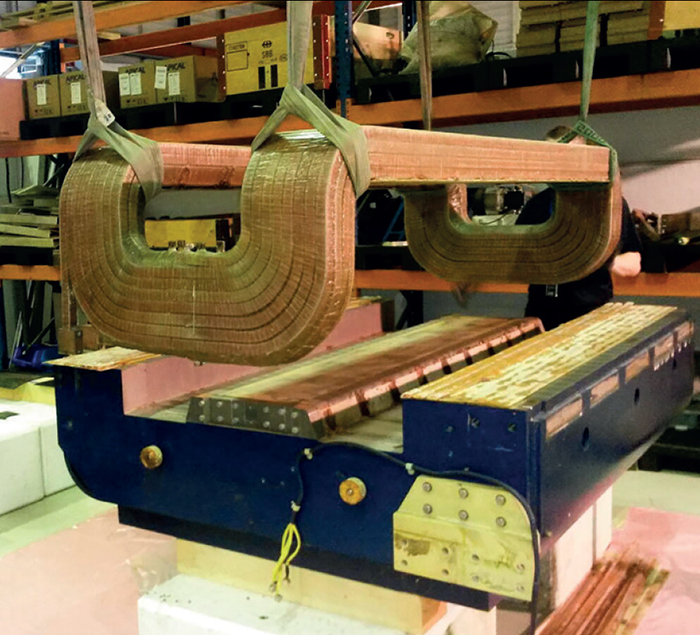
The LS1 programme, involving teams of specialists from CERN’s technology, engineering and beam departments, replaced the transmission line and magnetic horn. The horn assembly is composed of three main parts: the horn itself, which consists of two concentric aluminium conductors, a 6-m-long aluminium strip line that carries the current from the generators to the horn, and a movable clamping system that ensures the electrical continuity between the horn and the stripline. Given the critical situation, the teams decided to replace all three components. They had only six months to re-assemble and test spares more than 20 years old, and to construct additional pieces. The consolidated system was assembled and tested on the surface before being installed underground in the target area.

While repairing the damaged components, the teams also examined the 20-tonne dipole magnets. One magnet was removed from the ring and opened up for the first time in 30 years. The coils were in good condition, but the shimming that holds the coils had been completely transformed into dust and needed repair.

The consolidation work on the AD was completed at the end of July, and the first beam was sent to the target on 5 August. Debugging, adjustments and fine tuning were then carried out to deliver antiproton beams to the experiments in mid-September. The work also included the installation of a brand-new beam line for the new Baryon Antibaryon Symmetry Experiment (BASE) experiment, which aims to take ultra-high-precision measurements of the antiproton magnetic moment. The programme has been prompted by the start of the Extra Low ENergy Antiproton ring (ELENA) project. Planned to be operational in 2017, ELENA will allow further deceleration, together with beam cooling of the antiprotons, resulting in an increased number of particles trapped downstream in the experiments.

Elsewhere at CERN, 12 September saw the Super Proton Synchrotron accelerate its first proton beam after LS1. At the LHC, work continues towards the restart. Of the eight sectors, sector 6-7 is the first to have been cooled down to its nominal temperature of 1.9 K. The first powering tests began there on 15 September. Five other sectors were in the process of being cooled during September, with the seventh on track to begin its cool down in early October. All sectors are first cooled to 20 K for the copper-stabilizer continuity measurement tests, which allow the performance of the circuits to be checked when they are not superconducting. The finish line is in sight for the LHC’s restart in spring 2015.

The promise of boosted topologies

CCnew10_09_14

While analyses are progressing to ascertain the consistency of the new boson discovered at the LHC with the Standard Model Higgs boson (H), the LHC collaborations continue to develop tools in their search for new physics that could lead beyond the Standard Model, and cast light on the many fundamental open questions that remain.

CCnew9_09_14

The LHC can now reach energies far above those needed to produce Standard Model particles such as W/Z/H bosons and top quarks. The extra energy results in massive final-state particles with high Lorentz boosts (γ > 2), i.e. “boosted topologies”. Searches for new physics at the LHC often involve these boosted topologies, so it is necessary to extend the particle-physicists’ toolkit to handle these cases. This includes investigation of non-isolated leptons, overlapping jets that contain “substructure” from the decay of the Standard Model particles, and bottom-quark jets that merge with nearby jets. Classical techniques fail to capture these challenging topologies, so new techniques must be developed to ensure the broadest sensitivity to new physics.

CCnew10_09_14

To analyse these topologies, much theoretical and experimental understanding has been accomplished during the past few years. Now the CMS collaboration has published searches involving boosted W/Z/H bosons and top quarks, using a large suite of tools to improve sensitivity by factors of around 10 over classical techniques. This suite of tools includes identifying leptons within boosted top-quark decays, identifying W and top-mass peaks inside merged jets, and identifying bottom-quark jets embedded within merged jets.

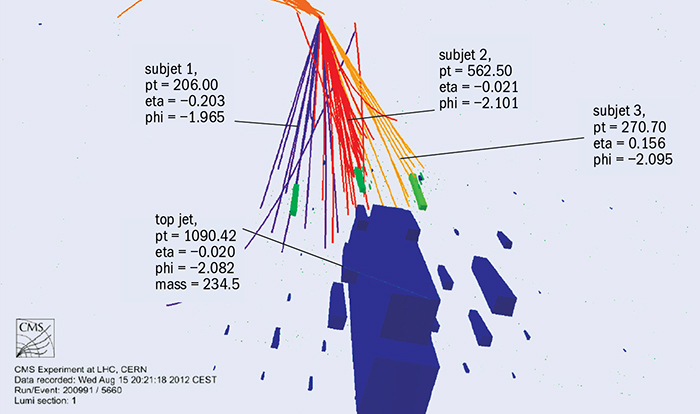
Figure 1 shows an event display of a boosted top-quark candidate recorded by CMS in 2012. The energy deposits in the calorimeters are shown as blue and green boxes, while the tracks are indicated with coloured lines. This jet has been found to exhibit a three-prong substructure that has been resolved with dedicated algorithms.

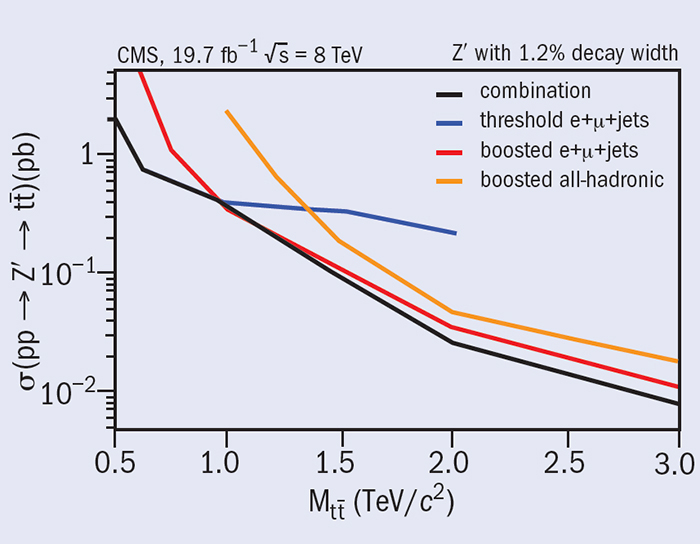
In the first analyses using these techniques, large improvements have been observed in high-mass sensitivity. Figure 2 shows the observed limits for a tt resonance search with and without using these boosted techniques. The blue line highlights the sensitivity of such a search using traditional, non-boosted techniques. The red and orange lines highlight the sensitivity using boosted techniques. At a mass, m, of 2 TeV, the sensitivity of the boosted techniques is 10 times better than traditional techniques.

This is just one of many analyses in which these new techniques have been deployed (see further reading below), and with a firm grasp on the relevant physics gained from experience in the LHC’s Run 1, CMS is now poised to apply the techniques broadly in Run 2.

bright-rec iop pub iop-science physcis connect