Bluefors – leaderboard other pages

Topics

From Physics to Daily Life: Applications in Informatics, Energy, and Environment and From Physics to Daily Life: Applications in Biology, Medicine and Healthcare

From Physics to Daily Life: Applications in Informatics, Energy, and Environment and From Physics to Daily Life: Applications in Biology, Medicine and Healthcare
By Beatrice Bressan (ed.)
Wiley-Blackwell
Hardback: £60 €75
E-book: £54.99 €66.99
(The prices are for each book separately)
Also available at the CERN bookshop

CCboo1_05_15

The old adage that “necessity is the mother of invention” explains, in a nutshell, why an institution like CERN is such a prolific source of new technologies. The extreme requirements of the LHC and its antecedents have driven researchers to make a host of inventions, many of which are detailed in these informative volumes that cover two broad areas of applications.

Eclectic is the word that comes to mind reading through the chapters of the two tomes that are all linked, in one way or another, to CERN. The editor, Beatrice Bressan, has done a valiant job of weaving together different styles and voices, from technical academic treatise to colourful first-hand account. For example, in one of his many insightful asides in a chapter entitled “WWW and More”, Robert Cailliau, a key contributor to the development of the World Wide Web, muses wryly that even after a 30-year career at CERN, it was not always clear to him what “CERN” meant.

Indeed, as the reader is reminded throughout these two books, CERN is the convenient shorthand for several closely connected organizations and networks, each with its own innovation potential. There’s the institution in Geneva whose staff consist primarily of engineers, technicians and administrators who run the facility. Then there’s the much more numerous global community of researchers that develop and manage giant experiments such as ATLAS. And underpinning all of this is the vast range of industrial suppliers, which provide most of the technology used at CERN, often through a joint R&D process with staff at CERN and its partner institutions.

From a purely utilitarian perspective, the justification for CERN surely lies in the contracts it provides to European industry. Without the billions of euros that have been cycled through European firms to build the LHC, there would be little political appetite for such a massive project. As explained in the introductory chapter by Bressan and Daan Boom – reproduced in both volumes, together with a chapter on Swiss spin-off – there has been a great deal of knowledge transfer thanks to these industrial contracts. Indeed, this more mundane part of CERN’s industrial impact may well dwarf many of the more visible examples of innovation illustrated in subsequent chapters.

CCboo2_05_15

Still, as several examples in these two volumes illustrate, there is no doubt that CERN can also generate the sort of “disruptive technologies” that shape our modern world. The web is the most stunning example, but major advances in particle accelerators and radiation sensors have had amazing knock-on effects on industry and society, too, as chapters by famous pioneers such as Ugo Amaldi and David Townsend illustrate clearly.

The question that journalists and other casual observers never cease to ask, though, is why has Europe not benefitted more directly from such breakthroughs? Why did touch screens, developed for the Super Proton Synchrotron control room, not lead to a slew of European high-tech companies? Why was it Silicon Valley and not some valley in Europe that reaped most of the direct commercial benefits of the web? Where are all of the digital start-ups that the hundreds of millions of euros invested in Grid technology were expected to generate?

Chapters on each of these technologies provide some clues to what the real challenge is. As Cailliau remarks wistfully, “WWW is an excellent example of a missed opportunity, but not by CERN.” In other words, to be successful, invention needs not only a scientific mother, it requires an entrepreneurial midwife, too. That is an area where Europe has been sorely lacking.

The only omission in these otherwise wide-ranging and well-researched books, in my opinion, is the lack of discussion on the central role of openness in CERN’s innovation strategy. Open science and open innovation are umbrella terms mentioned enthusiastically in the introductory chapter by Sergio Bertolucci, CERN’s director for research and computing. But there are no chapters dealing specifically with how open-access publication or open-source software and hardware – areas where CERN has for years been a global pioneer – have impacted knowledge transfer and innovation. Perhaps that is a topic broad enough for a third volume.

That said, there is, in these two volumes, already ample food for more thoughtful debate about successful knowledge management and technology transfer in and around European research organizations like CERN. If these books provoke such debate, and that debate leads to progress in Europe’s ability to transform innovations sparked by fundamental physics into applications that improve daily life, they will have made an important contribution

• For the colloquium held at CERN featuring talks by contributors to these two books, visit https://indico.cern.ch/event/331449/.

Proton beams are back in the LHC

After two years of intense maintenance and consolidation, and several months of preparation for the restart, the LHC is back in operation. At 10.41 a.m. on 5 April, for the first time in more than two years, proton Beam 1 completed an anti-clockwise circuit of the 27-km ring at the injection energy of 450 GeV. Injected at point 8 on the LHC, Beam 1 was allowed round the ring one step at a time, as collimators were opened at each point in turn, once the operators had checked that all was working well. On the way, the protons provided the first “beam-splash” events for the ATLAS and CMS experiments, at points 1 and 5, respectively. Beam 2 then followed a similar procedure. Injected at point 2, it completed its first orbit in the clockwise direction at 12.27 p.m.

The sight of first beam has set the LHC on course for Run 2 – but not without the kind of challenge to be expected when restarting such a complex system after the work undertaken during the long shutdown. The Herculean task to prepare the machine for operation at 6.5 TeV per beam – almost double the energy of Run 1 – involved the consolidation of some 10,000 electrical interconnections between the magnets, the addition of further magnet-protection systems, and the improvement and strengthening of cryogenic, vacuum and electronic systems.

Following the successful injection tests on 7–8 March, the final training of the superconducting magnets to the current levels required for a beam energy of 6.5 TeV continued in parallel with the many steps required for the machine check-out. During this final phase before beam, the various LHC systems are put through their operational paces from the CERN Control Centre. These include important tests of the beam-dump beam-interlock systems. All of the magnetic circuits are driven through the ramp, squeeze, ramp-down, and pre-cycle steps, together with the collimators and RF. Instrumentation, feedbacks, and the control system are also stress-tested.

By mid-March, the powering tests had left all but two of the 1700 or so magnetic circuits fully qualified for 6.5 TeV – the result of a six-month-long programme of rigorous tests involving the quench-protection system, power converters, energy extraction, uninterruptible power supplies, interlocks, electrical quality assurance and magnet behaviour. The dipoles of sector 4-5 proved a little stubborn but reached the target value of 11,080 A – the value for 6.5 TeV with a margin of an additional 100 A – after some 50 training quenches. Sector 3-4 was also nearly fully trained to the same value, when an earth fault occurred in the early morning of 21 March.

Investigations eventually pinned down the fault to a metal fragment lodged in a box housing a high-current bypass diode. After intensive discussions and simulations, the accelerator team decided to melt the fragment, and on 30 March injected a current of almost 400 A into the diode circuit for just a few milliseconds. Measurements made the following day confirmed that the short-circuit had indeed disappeared. Teams then had to re-qualify the sector, testing all of the circuits, particularly the dipole circuit that carries current up to 11 kA, before training could begin again. By 2 April, sector 3-4 had finally reached the target for operation at 6.5 TeV, and preparations to close the LHC for beam were fully under way again, for the successful restart three days later.

• To find out more, see the LHC reports in CERN Bulletin: bulletin.cern.ch.

SESAME passes an important milestone at CERN

The SESAME project – the Synchrotron-light for Experimental Science and Applications in the Middle East – passed an important milestone at the beginning of April, with the complete assembly and successful testing at CERN of the first of 16 magnetic cells for the electron storage ring.

Under construction in Jordan, SESAME is a unique joint venture that brings together scientists from its members: Bahrain, Cyprus, Egypt, Iran, Israel, Jordan, Pakistan, the Palestinian Authority and Turkey. The light source consists of an injector, comprised of a 20-MeV microtron and an 800-MeV booster synchrotron, which feeds a 2.5-GeV electron storage ring. CERN is responsible for the magnets of the storage ring and their powering scheme under CESSAMag – a project funded largely by the European Commission. Within the project, CERN has been collaborating with SESAME and the ALBA Synchrotron to design, test and characterize the components of the magnetic system.

The SESAME storage ring is built up from 16 magnetic cells, which make up the periodic structure of the machine, together with insertion regions where special synchrotron radiation can be produced. Each of the periodic cells consists of one bending magnet (a combined function dipole–quadrupole), two focusing and two defocusing magnets (quadrupoles) and four combined sextupole corrector magnets (including orbit and coupling correction). Orders were placed in the UK for the dipoles, in Spain and Turkey for the quadrupoles, and in France, Cyprus and Pakistan for the sextupoles. Italy, Israel and Switzerland are providing the power-supply components, and Iran, Pakistan and Turkey are providing additional in-kind support to CERN in the form of material and personnel.

The integration tests at CERN, which were carried out together with colleagues from SESAME, aimed at assembling a full periodic cell of the machine. Besides the magnets themselves, this involved the girder support structure as well as the vacuum chamber through which the electron beam will pass. The success of the tests demonstrates that these subsystems work together as foreseen.

Production of the magnets and their powering scheme is now in full swing. After acceptance tests and integration for the powering, the components will be shipped in batches to Jordan, where installation and commissioning of the storage ring is planned for 2016, followed by start-up the same year. The SESAME injector, which includes a booster synchrotron, is already operational.

Latest ATLAS results on the Higgs boson

CCnew6_04_15

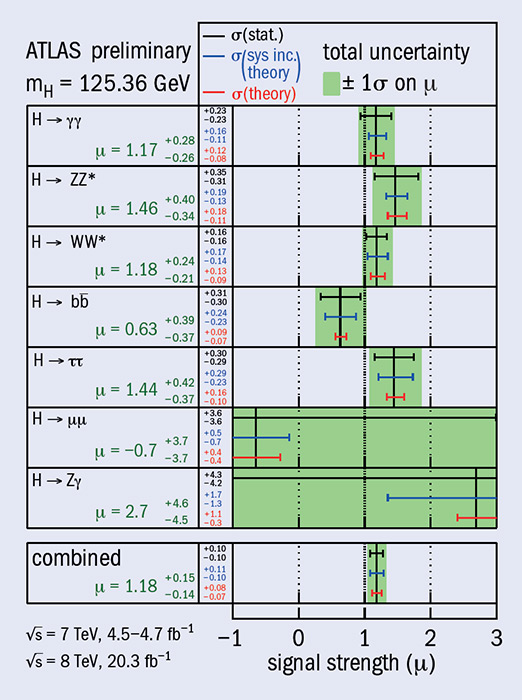
ATLAS physicists are making increasingly precise measurements of the properties of the observed Higgs boson, including production and decay rates, as well as the spin. Comparisons of the results with theoretical predictions could indicate whether new particles or phenomena beyond the Higgs field of the Standard Model are required for electroweak-symmetry breaking.

Recently published studies concern the decays of the Higgs boson into vector bosons (γγ, ZZ, WW, Zγ) and fermions (ττ, bb, μμ) in various production modes (ATLAS Collaboration 2015a). Measurements of the signal strength, μ = σ/σSM, allow the measured cross-sections, σ, of each decay channel to be compared to that predicted by the Standard Model, σSM. The figure shows that the results are compatible with the Standard Model’s prediction, that is, μ = 1. The new combination of all of the production and decay channels gives the most precise value from ATLAS to date: μ = 1.18 + 0.15 – 0.14.

Other new results include studies of the rare process of Higgs-boson production in association with two top quarks – a channel that allows physicists to probe directly the mysteriously large top–Higgs Yukawa coupling (ATLAS Collaboration 2015b). The analyses looked at a number of different decay modes of the Higgs boson, including decays into fermions (bb, ττ), and into bosons (WW, ZZ), the latter mode being measured for the first time by ATLAS in association with top quarks. Gathering all of the decay channels together, the data show a small excess of events over background with a strength μ(ttH) = 1.8±0.8. This gives a significance of 2.4σ with respect to a “no ttH” hypothesis. Observation of the Higgs boson in this production mode will require the new data expected in the LHC’s Run 2.

The LHC will soon restart running with a proton–proton collision energy of 13 TeV, more than 60% higher than that of Run 1

ATLAS has also improved its studies of the spin and parity of the Higgs boson (ATLAS Collaboration 2015c). The Standard Model hypothesis of a spin-0 particle with positive parity is favoured at more than 99% confidence level.

In addition, the ATLAS and CMS collaborations have joined forces to combine their precision measurements of the mass of the Higgs boson, and recently presented a new combined value of mH = 125.09±0.24 (0.21 stat.±0.11 syst.) GeV, with an uncertainty reduced to two parts in a thousand (0.2%).

The LHC will soon restart running with a proton–proton collision energy of 13 TeV, more than 60% higher than that of Run 1. The production rate of the Standard Model Higgs boson will increase by more than a factor of two, and that of the rare ttH process by almost a factor of four. ATLAS is ready to exploit the full potential of Run 2 to study the Higgs boson and to look beyond for new phenomena.

CMS digs deeply into lepton-pair production

Lepton pairs produced in proton–proton collisions at the LHC provide a clear signal that is easy to identify in the detector. The production is dominated by the Drell–Yan process, in which an intermediate Z/γ* boson is produced by the incoming partons. The measurements of the Drell–Yan production cross-section as a function of the mass of the intermediate boson, its rapidity (corresponding to the scattering angle) and its transverse momentum allow sensitive tests of QCD, the theory of the strong interaction. Recently, the CMS collaboration published two new measurements that provide a comprehensive view of the production of dimuons, a pair of oppositely charged muons, via the decay of Z bosons at a collision energy of 8 TeV at the LHC.

The parton structure of the proton and its evolution, governed by the dynamics of the strong interaction, can be scrutinized over a large range of phase space. By comparing the measurements to calculations that employ different parton distribution functions (PDFs) and different theoretical models for the dynamics, the PDFs and their uncertainty can be improved. These studies are also important for investigating other physics processes, for example searches for new resonances decaying into dileptons in models beyond the Standard Model.

In the CMS analysis, dimuon production in the vicinity of the Z-boson peak was parameterized doubly differentially as functions of the transverse momentum (qT) and the rapidity (y) of the Z boson. The analysis used the data sample of proton–proton collisions at a centre-of-mass energy of 8 TeV, amounting to an integrated luminosity of 19.7 fb–1. The measurement probes the production of Z bosons up to high transverse momenta of qT > 100 GeV, a kinematic regime in which the production is dominated by gluon–quark fusion. Therefore, the measurement is sensitive to the gluon PDF in a kinematic regime that is important for Higgs-boson production via gluon fusion. In the future, Z-boson production can also be used to constrain the gluon PDF and provide information complementary to other processes employed, such as direct photon production. The data are well reproduced within uncertainties by the next-to-next-to-leading-order predictions computed with the FEWZ simulation code. The MADGRAPH and POWHEG predictions deviate from data up to 20% at high-z transverse momentum.

CMS has measured the five major angular coefficients A0 to A4 as a function of qT and y

The angular distribution of the final-state leptons in Drell–Yan production is determined by the vector and axial-vector coupling structure of the Standard Model Lagrangian, and by the relative contributions of the quark–antiquark annihilation and quark–gluon Compton processes. In the presence of higher-order QCD corrections, the general structure of the lepton angular distribution in the boson rest-frame is given by a formula that contains a set of angular coefficients.

Using the 8 TeV data, CMS has measured the five major angular coefficients A0 to A4 as a function of qT and y. None of the theoretical models tested describe all of the coefficients satisfactorily. The coefficients A0 and A2 measured by CMS in proton–proton collisions at the LHC are larger than those measured in proton–antiproton collisions at Fermilab’s Tevatron at a lower centre-of-mass energy. This is expected, owing to the significant contribution of the quark–gluon process in proton–proton collisions at the LHC. In addition, as the figure shows, the analysis confirmed for the first time the anticipated deviation from the Lam–Tung relation, A0 = A2 (Lam and Tung 1979). This deviation is expected in QCD calculations beyond the leading order. The measurement by CMS shows that A0 > A2, especially for high qT. Nonzero values were also measured for A1 and A3.

The comprehensive study of the Z-boson production mechanism presented in these two recently published CMS papers lays the foundation for future high-precision measurements, such as the measurement of the mass of the W boson and the electroweak mixing angle.

LHCb’s new analysis confirms an old puzzle

At the recent Moriond Electroweak (EW) conference at La Thuile, the LHCb collaboration presented an updated angular analysis of the decay B → K*0 μ+μ using the experiment’s full data set from the LHC’s Run 1 (LHCb Collaboration 2015). This is an update of an earlier measurement based on the 2011 data alone, which showed a significant discrepancy in one angular observable (referred to as P´5) compared with predictions from the Standard Model. Because the discrepancy could be interpreted as a sign of physics beyond the Standard Model, it provoked considerable discussion within the particle-physics community, and the update with the full Run 1 sample has been eagerly awaited.

The decay of a B meson (containing a b quark and a d quark) into a K*0 meson (s and d) and a pair of muons is quite a rare process, occurring around once for every million B meson decays. At quark level, the decay involves a change of the quark flavour, b → s, without any change in charge. Such flavour-changing neutral processes are forbidden at the lowest perturbative order in the Standard Model, and come from higher-order loop processes involving virtual W bosons. In many extensions of the Standard Model, new particles can also contribute to the decay, leading to an enhancement or (through interference) a suppression in the rate of the decay. The contributions from new particles beyond the Standard Model can also change the angular distributions of the kaon and pion from the K*0 decay, and of the muons.

The analysis shown at Moriond, which is the first by any experiment to explore the full angular distribution of the decay, confirms the discrepancy seen in the 2011 data. At low dimuon masses, there is poor agreement between the current Standard Model predictions and the data for the P´5 observable. The two measurements in the range 4 < q2 < 8 GeV2/c4 are both 2.9σ from the Standard Model calculation (see figure).

Two invited theory talks followed LHCb’s presentation at Moriond. Both speakers were able to give an initial interpretation of the results, and found a consistent picture (see, for example, Straub and Altmannshofer 2015). A model-independent analysis favours a best-fit point that is about 4σ from the current Standard Model predictions.

It is, however, still too soon to claim evidence of new particles. The major challenge in interpreting the results lies in separating the interesting physics from poorly known QCD effects, which could be larger than first expected and hence responsible for the discrepancy. No matter the cause of the anomaly, there will need to be some rethinking of the current understanding of the B → K*0 μ+μ decay.

TOTEM finds evidence for non-exponential elastic pp scattering

Measurements of the differential cross-section in proton–proton (pp) or proton–antiproton (pp) scattering have generally proved consistent with a pure exponential dependence at low values of the square of the four-momentum transfer, ǀtǀ. However, slight deviations have been observed, notably in elastic pp and pp scattering at the Intersecting Storage Rings at CERN. Now, the TOTEM experiment has made a precision measurement of elastic pp scattering at the LHC, and finds that the data exclude a purely exponential behaviour of the cross-section at low ǀtǀ at a total energy of 8 TeV in the centre of mass.

The TOTEM experiment, which co-inhabits point 5 on the LHC with CMS, includes a system of Roman Pots, which allow detectors to be brought close to the beam so as to intercept particles scattered at very small angles to the beam. The Roman Pots are in two stations on opposite sides of interaction point 5, and each station is equipped with detectors at both 214 m and 220 m from the interaction point. The detectors consist of stacks of silicon-strip sensors, specially designed to have a narrow insensitive region, of a few tens of micrometres, along the edge that faces the beam (CERN Courier September 2009 p19).

TOTEM collected the data during a special run at the LHC in July 2012, in which the Roman Pots were brought in to a distance of only 9.5 times the transverse beam size of the beam. During 11 hours of data taking, the experiment amassed 7.2-million tagged elastic events at a collision energy of 8 TeV. The large data set has allowed a precise measurement of the elastic pp cross-section, with both statistical and systematic uncertainties below 1%, except for overall normalization. As a result of this precision, TOTEM is able to exclude a purely exponential differential cross-section in the range 0.027 < |t| < 0.2 GeV2, with a significance greater than 7σ. In contrast, parameterizations with either quadratic or cubic polynomials in the exponent are compatible with the data.

New possibilities for particle physics with IceCube

The IceCube Neutrino Observatory has measured neutrino oscillations via atmospheric muon-neutrino disappearance. This opens up new possibilities for particle physics with the experiment at the South Pole that was originally designed to detect neutrinos from distant cosmic sources.

IceCube records more than 100,000 atmospheric neutrinos a year, most of them muon neutrinos, and its sub-detector DeepCore allows the detection of neutrinos with energies from 100 GeV down to 10 GeV. These lower-energy neutrinos are key to IceCube’s oscillation studies. Based on current best-fit oscillation parameters, IceCube should see fewer muon neutrinos at energies around 25 GeV reaching the detector after passing through the Earth. Using data taken between May 2011 and April 2014, the analysis selected muon-neutrino candidates in DeepCore with energies in the region of 6–56 GeV. The detector surrounding DeepCore was used as a veto to suppress the atmospheric muon background. Nearly 5200 neutrino candidates were found, compared with the 6800 or so expected in the non-oscillation scenario. The reconstructed energy and arrival time for these events were used to obtain values for the neutrino-oscillation parameters, Δm322 = 2.72+0.19–0.20 × 10–3 ev2 and sin2 θ23 = 0.53+0.09–0.12. These results are compatible and comparable in precision to those of dedicated oscillation experiments.

The collaboration is currently planning the Precision IceCube Next Generation Upgrade (PINGU), in which a much higher density of optical modules in the whole central region will reduce the energy threshold to a few giga-electron-volts. By carefully measuring coherent neutrino interactions with electrons in the Earth (the Mikheyev–Smirnov–Wolfenstein effect), this should allow determination of the neutrino-mass hierarchy, and which neutrino flavour is heaviest.

The experiment now known as DUNE

The long-baseline neutrino experiment formerly known as LBNE has a new name: Deep Underground Neutrino Experiment (DUNE). Served by an intense neutrino beam from Fermilab’s Long Baseline Neutrino Facility, DUNE will have near detectors at Fermilab and four 10-kt far detectors at the Sanford Underground Research Facility in South Dakota. In March, the DUNE collaboration – now with more than 700 scientists from 148 institutions in 23 countries – elected two new spokespersons: André Rubbia from ETH Zurich, and Mark Thomson from the University of Cambridge. One will serve as spokesperson for two years, the other for three years, to provide continuity in leadership.

Collaboration meets for the first FCC week

CCnew13_04_15

As many as 340 physicists, engineers, science managers and journalists gathered in Washington DC for the first annual meeting of the global Future Circular Collider (FCC) study. The FCC week covered all aspects of the study – designs of 100-km hadron and lepton colliders, infrastructures, technology R&D, experiments and physics.

The meeting began with an exciting presentation by US congressman Bill Foster, who recalled the history of the LHC as well as the former design studies for a Very Large Hadron Collider. A special session on Thursday was devoted to the experience with the US LHC Accelerator Research Program (LARP), to the US particle-physics strategy, and US R&D activities in high-field magnets and superconducting RF. A well-attended industrial exhibition and a complementary “industry fast-track” session were focused on Nb3Sn and high-temperature superconductor development.

James Siegrist from the US Department of Energy (DOE) pointed the way for aligning the high-field magnet R&D efforts at the four leading US magnet laboratories (Brookhaven, Fermilab, Berkeley Lab and the National High Magnetic Field Laboratory) with the goals of the FCC study. An implementation plan for joint magnet R&D will be composed in the near future. Discussions with further US institutes and universities are ongoing, and within the coming months several other DOE laboratories should join the FCC collaboration. A first US demonstrator magnet could be ready as early as 2016.

A total of 51 institutes have joined the FCC collaboration since February 2014, and the FCC study has been recognized by the European Commission (EC). Through the EuroCirCol project within the HORIZON2020 programme, the EC will fund R&D by 16 beneficiaries – including KEK in Japan – on the core components of the hadron collider. The four key themes addressed by EuroCirCol are the FCC-hh arc design (led by CEA Saclay), the interaction-region design (John Adams Institute), the cryo-beam-vacuum system (CELLS consortium), and the high-field magnet design (CERN). On the last day of the FCC week, the first meeting of the FCC International Collaboration was held. Leonid Rivkin was confirmed as chair of the board, with a mandate consistent with the production of the Conceptual Design Report, that is, to the end of 2018.

The next FCC Week will be held in Rome on 11–15 April 2016.

• The FCC Week in Washington was jointly organized by CERN and the US DOE, with support from the IEEE Council of Superconductivity. More than a third of the participants (120) came from the US. CERN (93), Germany (20), China (16), UK (16), Italy (12), France (11), Russia (11), Japan (10), Switzerland (10) and Spain (6) were also strongly represented. For further information, visit cern.ch/fccw2015.

bright-rec iop pub iop-science physcis connect