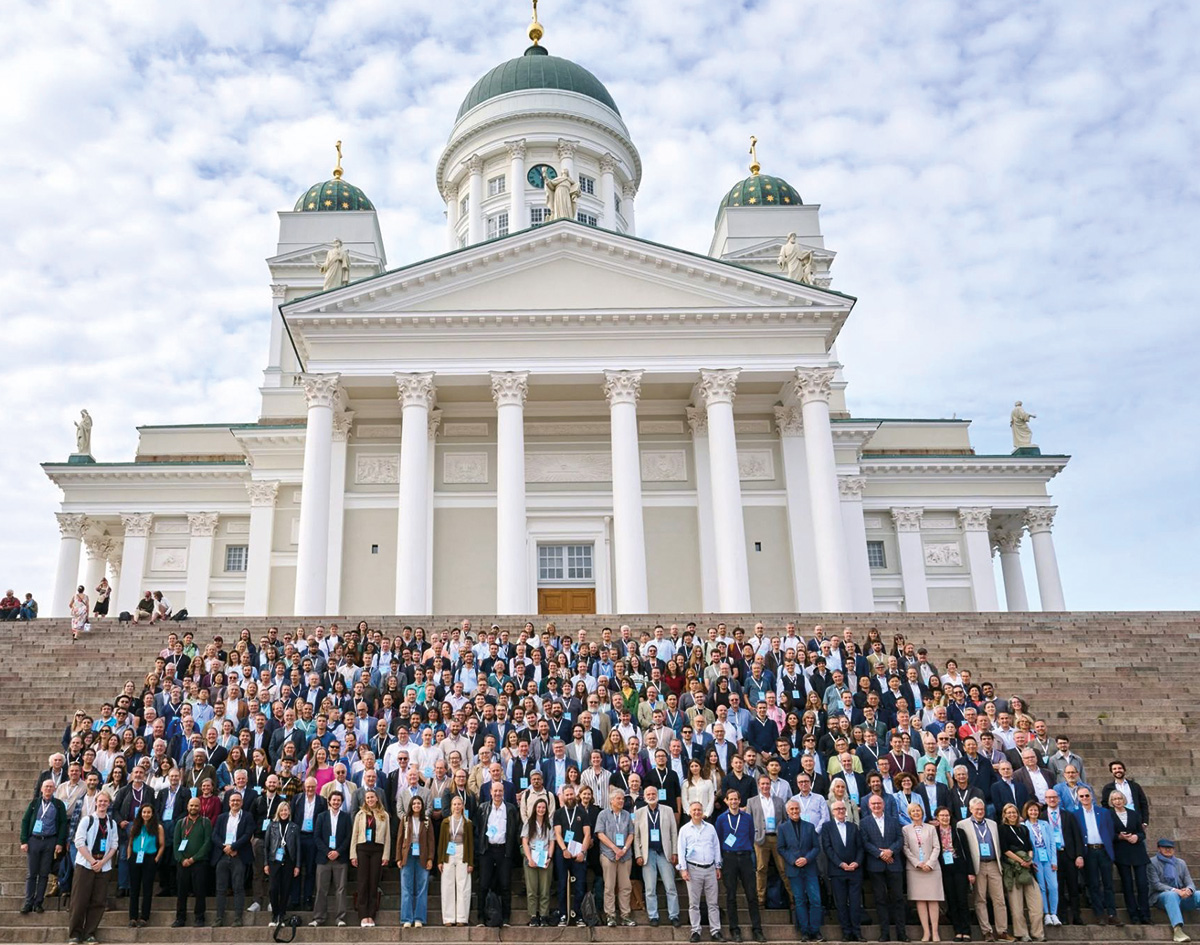
From 8 to 12 June, FCC Week brought 656 scientists, engineers, industry representatives and policymakers from 38 countries to the University of Helsinki. With its primary focus on FCC-ee, the meeting examined how the FCC study can progress from demonstrating feasibility to a coherent reference design, treating physics goals, accelerator parameters, detector concepts, theory, software and the machine–detector interface as parts of a single system.
Paula Eerola, president of the Research Council of Finland, opened the week by reflecting on CERN as a place where scientific responsibility is carried across borders and generations. CERN Director-General Mark Thomson described the coming years as a critical period, in which CERN must deliver the High-Luminosity LHC while advancing the FCC-ee as a possible next flagship project (CERN Courier July/August 2026 p7). Both efforts will rely on CERN’s close cooperation with its Member States, and Costas Fountas, president of the CERN Council, underlined their growing alignment with the laboratory and the particle-physics community. For European Commissioner Valdis Dombrovskis, the same model of international cooperation underpins Europe’s competitiveness, its technological capacity and its ability to invest over the long term.
Broad programme
The scientific case for the FCC-ee is often summarised in terms of the Higgs boson, but the programme discussed in Helsinki was considerably broader. Runs at the Z resonance, the W-pair threshold, the Higgs-production maximum and the top-quark threshold would yield around six trillion Z bosons and hundreds of millions of W pairs, improving statistical precision by three orders of magnitude and probing the Standard Model as an interconnected whole. The top-threshold run, for example, would determine the top mass, width, Yukawa coupling and strong coupling in a uniquely controlled environment, and a precise top mass is needed in turn to exploit the projected W-mass precision. The FCC-ee would also be a major flavour facility, with its clean initial state, vertex reconstruction and near-complete angular coverage, enabling studies of beauty, charm and tau decays, many of which are statistically limited today. As a precision-QCD machine, it could determine the strong coupling at the per-mille level (see How strong is the strong interaction?).
Discovery potential would not depend solely on producing new particles. Heavy states can alter measured quantities through quantum effects, leaving correlated deviations across electroweak, Higgs, flavour and top observables that global analyses could trace well beyond the machine’s direct reach. Direct searches would complement this programme, with the enormous Z and Higgs samples providing sensitivity to long-lived particles, heavy neutral leptons, axion-like particles and other hidden-sector states. The projected precision also creates a theoretical challenge. For the W-boson mass, a possible experimental uncertainty of about 0.24 MeV stands against a current theoretical uncertainty of several MeV, and closing such gaps will require higher-order calculations, better event generators and improved control of hadronisation, in a coordinated effort lasting many years.
On the accelerator side, the main news concerned the radiofrequency system. Studies indicate that it could be built entirely from 800 MHz superconducting cavities, instead of the planned mix of 400 and 800 MHz, and still reach the target collision rate with the new beam optics, although beam lifetime and the mutual disturbance of the colliding beams remain to be assessed. That collision rate calls for beams that are exceptionally flat, their vertical spread up to 2000 times smaller than the horizontal, demanding tight control of alignment, vibration and focusing. The rings would also need continuous refilling to hold the luminosity steady, a top-up injection that simulations now show can be performed with efficiencies above 90%.
Advancing hardware
Hardware is advancing too. Drawings for the 400 MHz superconducting cavities are nearly complete, and a first integrated cryomodule demonstrator is due by 2031. The cavities will only be as efficient as the klystrons that power them, and these are gaining ground, with a single-beam device in China reaching 78% and a CERN tristron targeting above 90%. Magnet studies now feed manufacturing imperfections into predictions of field quality, and alignment on the supporting girders aims at 10 to 20 micrometres. The synchrotron radiation emitted by the circulating electrons, an intense X-ray glare, would deposit its power along the vacuum chamber, with absorbers every 5 to 6 m to intercept it. At the Z pole, however, where the circulating current would be highest, the budget for the chamber’s electromagnetic response to the beam remains tight, and the effects of stray-electron clouds in the pipe are not yet fully resolved.
Six detector concepts are under study, providing redundancy and comparative optimisation
The interaction region is where accelerator and detector choices meet most directly. A longitudinal detector-opening scenario is now the baseline, and a full-scale mock-up of the cooled central beam pipe and vertex detector has validated assembly and cooling. Moving the first final-focus element to 2.4 m from the interaction point has reduced the radiation load on the superconducting coils. Synchrotron-radiation backgrounds, however, have emerged as one of the most serious potential problems. Current estimates indicate that unless the radiation can be reduced by orders of magnitude, it would leave unacceptably high hit rates in the trackers. Masks, revised beam-pipe geometry, shielding and optics changes all show promise, but a final solution is still to be defined, making the interaction region a defining test of the integrated design.
Detailed simulation
Six detector concepts are under study, providing redundancy and comparative optimisation. All concepts place silicon pixel sensors closest to the beam, in chips that combine sensor and readout. Ideas diverge further out. Calorimeter concepts range from silicon-tungsten and crystal systems to noble-liquid and dual-readout approaches, while trackers include full-silicon, drift-chamber and time-projection-chamber solutions. Comparing the concepts, and finding their weaknesses early, takes detailed simulation, and simulation in turn calls for common tools. The shared software platform Key4hep has matured, and a distributed computing model is already operating ahead of formal collaborations.
The Industry and Technology Day, opened by Finland’s minister of economic affairs Sakari Puisto, asked how companies can become involved early enough to shape the design, from superconducting RF and cryogenics to civil construction. Many technologies will need to be adapted, scaled up or made more efficient, while others will have to be co-developed.
The FCC-ee tunnel could later host a much higher-energy proton collider, the FCC-hh, which Helsinki discussed as a possible second stage rather than as the justification for the whole programme. The case for the FCC-ee rests on its own precision measurements, flavour physics and direct searches, while the FCC-hh would extend direct searches to masses of tens of TeV and improve the measurement of the Higgs self-coupling.
FCC Week 2026 showed substantial progress in all project domains, and equally how much remains to be done. Synchrotron-radiation backgrounds must fall dramatically, theory precision must catch up with experimental ambition, and industrial capacity and long-term expertise need sustained investment. The central outcome was the growing integration of the many strands of a credible international project.