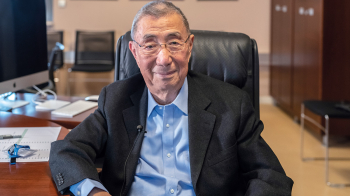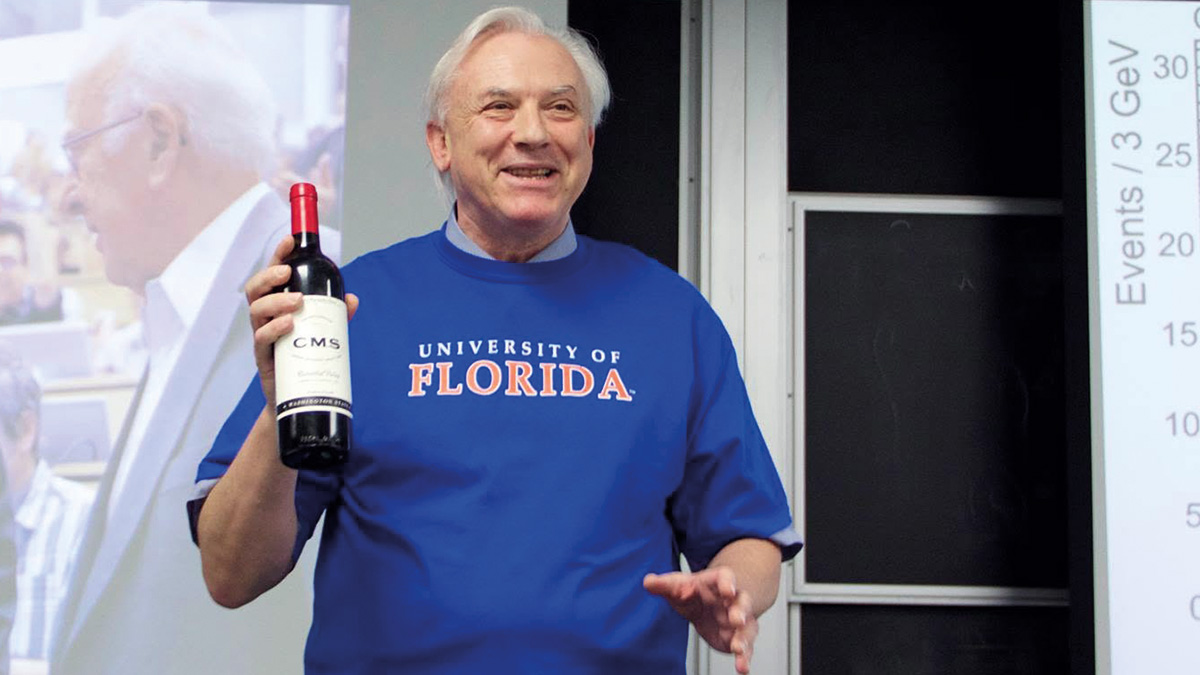
Guenakh Mitselmakher, an experimental high-energy physicist of international stature, passed away on 28 January at the age of 80. He was born on 5 December 1945 in Vilnius, Lithuania. After graduating from Moscow State University in 1968, Guenakh started his professional career at the Joint Institute for Nuclear Research (JINR) in Dubna, Russia. He often recalled that his mentor Bruno Pontecorvo made the largest impact on his scientific vision and “physics taste”.
For his PhD, he joined a collaboration of four that was designing an experiment to search for the charged-lepton flavour violating decay μ → 3e. The result, published in 1976, improved on the best previous limit by two orders of magnitude. Next, he took part in the first measurement of the charged-pion radius at the Serpukhov accelerator, published in 1974. He then proposed and co-led an experiment that yielded the first measurements of the pion’s polarisability and the γ → 3π coupling in 1983 and 1986, respectively. In the mid-1980s, he and his group joined the DELPHI experiment at LEP. Guenakh co-led the construction of the DELPHI hadron calorimeter and made critical contributions to the measurement of the number of light neutrinos coupling to the Z boson. To this end, he co-initiated the collaboration of theorists and experimentalists that developed the analysis framework later known as ZFITTER.
Guenakh moved to the US in 1991, to join the Superconducting Super Collider (SSC) laboratory in Texas. After the closure of the SSC, in 1993, and having worked briefly at Fermilab, he joined the University of Florida (UF) physics department in 1995. There, he spearheaded a vigorous experimental hadron-collider programme, building a group that at its peak counted seven faculty and more than 40 members, including students, postdocs and engineers. Together they made major contributions to the CDF experiment at Fermilab and to the CMS experiment at CERN, where Guenakh led the design and construction of the endcap muon system.
In both experiments, the UF group held leading roles in the physics programme, most notably in the Higgs-boson discovery in 2012, in precision measurements of the new particle’s properties, and in many searches for new physics. Among them, the recent search for the charged-lepton flavour violating decay τ → 3μ echoes Guenakh’s research from the early years of his career. He was also the driving force behind UF joining the Laser Interferometer Gravitational-Wave Observatory (LIGO) in 1996, where the group contributed prominently to the design and construction of the apparatus and to data analysis. Indeed, the first gravitational-wave event, in 2015, was initially identified by coherent WaveBurst, a real-time analysis algorithm conceived in a 2008 paper that Guenakh co-authored.
Guenakh Mitselmakher was a relentless advocate for the pursuit of physics of pivotal significance. His scientific legacy will persist through the many scientists he mentored during his career.